
the Creative Commons Attribution 4.0 License.
the Creative Commons Attribution 4.0 License.
 | 04 Feb 2026
Seasonal thermo-hydro-mechanical dynamics of permafrost rockwalls revealed by automated electrical resistivity monitoring
Abstract. Permafrost warming in rock slopes and the associated long-term increase in slope instability have been intensively studied in recent years, with most interpretations of electrical resistivity tomography (ERT) focusing on the thermal regime while assuming homogeneous rock conditions. Seasonal forcing by water and ice in fractures has often been neglected, even though hydrostatic and cryostatic processes are increasingly recognised as key mechanical drivers in the preparation and initiation of permafrost rock instabilities.
In contrast to previous studies, we applied automated ERT monitoring to decipher temporary phases of massive hydrostatic water injection into previously frozen joints and the development of cryostatic pressures related to ice formation processes. ERT monitoring was performed at the north face of the Kitzsteinhorn (Hohe Tauern range, Austria) year-round from April 2024 to April 2025. These measurements integrated reciprocal error estimation and a resistivity–temperature relation calibrated using in-situ borehole temperature data and laboratory experiments. The ERT data set was combined with observations of the rockwall's hydro-mechanical response derived from load cells of two 25 m-long anchors and from piezometric measurements at 16.85 m depth.
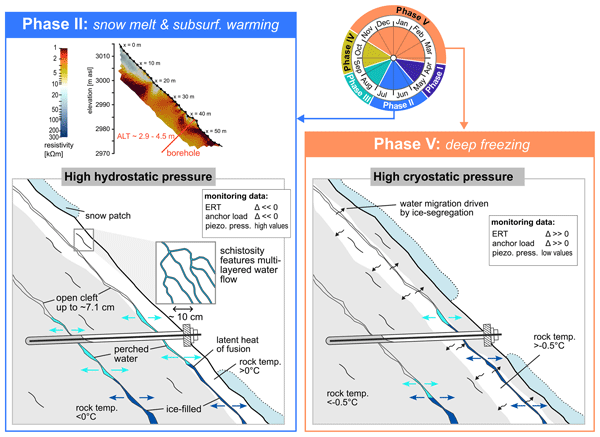
We identified five characteristic phases of seasonal forcing on permafrost rockwalls, driven by subsurface temperature, snow pack, and piezometric pressure: stable freezing from April–May (phase I), snow melt and subsurface warming from May–July (phase II), maximum active layer thickness from July–September (phase III), superficial cooling from September–November (phase IV), and deep freezing from November-April (phase V). Among these identified phases, two emerged as potentially preparing rock slope destabilisation and were temporally constrained using the ERT data. During peak meltwater infiltration from May to July (phase II), drastic decreases in resistivity from 140 to 9 kΩm and enhanced piezometric levels of up to 1.2 bar indicated high hydrostatic pressures, while simultaneous declines in anchor loads from 576 to 519 kN indicated stress redistribution within the jointed rock mass. A second critical phase was marked by increased resistivity in deeper layers and rising anchor loads during subsurface cooling from November to January (phase V), suggesting the onset of ice formation processes and high cryostatic pressures. Here, we show that temperature-calibrated automated ERT monitoring in high-alpine permafrost rockwalls can offer new insights into the coupled thermo-hydro-mechanical response of rock masses to seasonal forcing, potentially controlling stability.
Competing interests: Prof. Dr. Michael Krautblatter is a member of the editorial board of Earth Surface Dynamics.
Publisher's note: Copernicus Publications remains neutral with regard to jurisdictional claims made in the text, published maps, institutional affiliations, or any other geographical representation in this paper. While Copernicus Publications makes every effort to include appropriate place names, the final responsibility lies with the authors. Views expressed in the text are those of the authors and do not necessarily reflect the views of the publisher.-
Notice on discussion status
The requested preprint has a corresponding peer-reviewed final revised paper. You are encouraged to refer to the final revised version.
-
Preprint
(31284 KB)
-
The requested preprint has a corresponding peer-reviewed final revised paper. You are encouraged to refer to the final revised version.
- Preprint
(31284 KB) - Metadata XML
- BibTeX
- EndNote
- Final revised paper


Journal article(s) based on this preprint
Interactive discussion
Status: closed
-
RC1: 'Comment on egusphere-2025-6091', Lukas U. Arenson, 20 May 2026
- AC1: 'Reply on RC1', Maike Offer, 19 Jul 2026
- AC3: 'Reply on RC1', Maike Offer, 19 Jul 2026
-
RC2: 'Comment on egusphere-2025-6091', Anonymous Referee #2, 29 Jun 2026
This manuscript investigates the contributions of hydrostatic and cryostatic processes to the observed electrical resistivity signal in high-alpine permafrost rockwalls using a comprehensive monitoring dataset. It is well structured and clearly written, with well-defined objectives and a meaningful contribution to the understanding of seasonal processes in permafrost rock slopes. The dataset and its analysis are comprehensive, thoroughly explained, and well-illustrated. I found the figures particularly informative and well annotated.
Understanding the drivers of slope instability in permafrost rockwalls is an important research topic, and this study provides a novel and valuable contribution to the field. Overall, the manuscript is of high quality and suitable for publication. I have only a few minor comments and corrections for the authors to consider.
Specific comments
- Perhaps the word “preparing” in reference to permafrost rock instabilities could be replaced by “conditioning” or “priming”, as it sounds awkward in places (e.g lines 5, 32, 375)
- How was the active layer measured? If it was defined as the depth of the 0°-degree isotherm which seems to be the case, this should be explicitly stated in the methods section
- Section 3.1 Data pre-processing: It would be helpful to report the contact resistance values (e.g., as a range, seasonal averages, or similar statistics), as it provides a useful reference for other winter ERT studies
- I am a bit unclear about the choice of the b parameter in the error model. I find it a great strength of this study that reciprocal measurements were acquired, which is not always possible for permafrost ERT measurements. Considering that reciprocal analysis was performed, could the authors clarify why b = 0.08 was selected for all inversions? Based on Figure 2d, most values fall between 0 and 0.03, with only two outliers approaching 0.04-0.06. Would it be more appropriate to scale b based on measurement ID (perhaps binned into phases or seasons), as nicely illustrated in Figure 2d, rather than applying a single value to all measurements?
- Section 3.2 Inversion routines: This section could be expanded with a few more details on the inversion procedure. For example, it would be helpful to briefly describe the inversion method, the data and model norms used, and the choice of regularization.
- Lines 296-297: The authors write: “Almost the entire ERT model exhibited values below 10 kΩm, except for a localised zone near the surface (∼5 m depth) in the upper part of the profile (x = 0-18 m)”. I am curious about another localized zone of higher resistivities, around the borehole location. Since this phase corresponds to the deepest active layer, I would have expected the active layer to be more clearly resolved in the inverted tomogram, particularly around the borehole location. Do the authors have any thoughts on why this is not more apparent, and the shallow near-surface region shows higher resistivities instead?
- Figure 4 provides interesting historical anchor load data, and I understand that it is included to show how typical the observed seasonal pattern is. However, since the analysis and discussion focus mainly on the 2024–2025 observations, I wonder whether Figure 5b might be sufficient for the main text, and Figure 4 could be moved to the Appendix
- In the lower right corner of Figure 6, some of the colours used to depict the depth sections are repeated in the circular phase plot. This may be slightly confusing for the readers, as the same colours represent different information. Have the authors considered simplifying the colouring of the depth sections? In my view, a single colour or graduated shading would be sufficient, especially as the depths are already labelled next to the corresponding boxes.
Technical corrections
- Lines 10-12: The authors write: “The ERT data set was combined with observations of the rockwall’s hydro-mechanical response derived from load cells of two 25 m-long anchors and from piezometric measurements at 16.85 m depth”. To me, this wording gives the impression that the load cell and piezometric measurements are somehow directly integrated into the ERT inversion. Since these measurements are only used to help interpret the resistivity response, I would suggest rewording this statement to make that distinction clear.
- Lines 29-33: The authors write: “Despite the control exerted by the geological structure (Stead and Wolter, 2015), frost weathering- and erosion-driven fracture propagation (Matsuoka and Murton, 2008; Mayer et al., 2024), long-term seismic loading (Gischig et al., 2016), glacial changes (Hartmeyer et al., 2020a; Pfluger et al., 2025) and permafrost degradation (Gruber and Haeberli, 2007; Savi et al., 2021), hydrostatic and cryostatic pressure play a crucial role in preparing planes of weakness.” I am not sure that despite is the right word here. In my view, hydrostatic and cryostatic pressures are additional factors contributing to slope destabilization, rather than contrasting ones to the controls listed above. Perhaps the sentence could be reworded to reflect this more clearly?
- Line 69: in the sentence starting with “Therefore, we here conducted daily…” I suggest to either remove “here” altogether, or move it before the “we”
- Lines 101-103: The authors write: “Numerous open fractures, also observed along the ERT profil (Keuschnig et al., 2017), are filled with fine-grained material that promotes water infiltration and thus influences the hydrostatic and thermal dynamics of the rock mass”. A brief explanation of this influence would be helpful, rather than just stating that an influence exists.
- Line 102: typo in the word “profile”, missing “e” at the end
- Lines 116 - 119: Consider adding a reference for the statement of Wenner configuration being associated with the maximal signal strength
- Line 124: Consider adding an “and”: friction-locked and grouted
- Line 188: I would remove the word “technical” before “filtered data sets”
- Line 189: Suggests, instead of suggest
- Line 226: Is the statement that “fractures were predominantly ice-filled” based on the interpretation of the ground temperature data? Perhaps a brief clarification could be helpful here, as some readers may interpret this as a more direct measurement of unfrozen water content.
- Line 316: The authors write: “…During phase I (stable freezing), high resistivity values (> 19 kΩm, decisive for frozen conditions (Offer et al., 2025)) …”. I find the wording slightly awkward here. Perhaps indicative of frozen conditions (or characteristic of, associated with, etc.) would be more appropriate than decisive for frozen conditions.
- Line 375: Similarly, here, the phrase “decisive in preparing” reads slightly awkward to me. Perhaps consider rephrasing it using an alternative.
- Lines 386-387: The authors write: “the pattern of enhanced subsurface electrical conductivity during snowmelt is also reported in other automated monitoring studies (Hilbich et al., 2011; Kneisel et al., 2014)”. I would add “in similar settings” or an alternative, as “other monitoring studies” is rather broad
Citation: https://doi.org/10.5194/egusphere-2025-6091-RC2 -
EC1: 'Comment on egusphere-2025-6091', Tom Coulthard, 30 Jun 2026
Dear Maike and co-authors.
We now have two very constructive reviews for the paper. If you like you could start work on the changes already as the discussion will close soon
All the best
Tom
Citation: https://doi.org/10.5194/egusphere-2025-6091-EC1 -
AC4: 'Reply on EC1', Maike Offer, 19 Jul 2026
Dear Tom,
Thank you very much for the update.
We have already worked through all the comments, posted our point-by-point replies in the discussion, and prepared the revised manuscript.Best regards,
Maike (on behalf of all co-authors)Citation: https://doi.org/10.5194/egusphere-2025-6091-AC4
-
AC4: 'Reply on EC1', Maike Offer, 19 Jul 2026
- AC2: 'Reply on RC2', Maike Offer, 19 Jul 2026
Peer review completion


Interactive discussion
Status: closed
-
RC1: 'Comment on egusphere-2025-6091', Lukas U. Arenson, 20 May 2026
Maike Offer and colleagues present an innovative and well-executed study of seasonal thermo‑hydro‑mechanical dynamics in permafrost rockwalls using automated ERT monitoring integrated with temperature, piezometric, and mechanical data. The results convincingly demonstrate the importance of hydrostatic and cryostatic pressures in controlling rock slope stability, providing valuable new field-based evidence in an area where observations are typically scarce.
Overall, this is a novel, well-written, and scientifically robust contribution that clearly advances the understanding of coupled processes in permafrost rock slopes. The manuscript is well structured, figures are original, of high quality, and the interpretation is generally sound and well supported by the data. I particularly appreciated the integration of multiple datasets (ERT, anchor loads, piezometry, and temperature), which allows for a compelling process-based interpretation. I very much enjoyed reading the manuscript.
Minor comments are mostly editorial and stylistic and are provided in the annotated version attached.
- AC1: 'Reply on RC1', Maike Offer, 19 Jul 2026
- AC3: 'Reply on RC1', Maike Offer, 19 Jul 2026
-
RC2: 'Comment on egusphere-2025-6091', Anonymous Referee #2, 29 Jun 2026
This manuscript investigates the contributions of hydrostatic and cryostatic processes to the observed electrical resistivity signal in high-alpine permafrost rockwalls using a comprehensive monitoring dataset. It is well structured and clearly written, with well-defined objectives and a meaningful contribution to the understanding of seasonal processes in permafrost rock slopes. The dataset and its analysis are comprehensive, thoroughly explained, and well-illustrated. I found the figures particularly informative and well annotated.
Understanding the drivers of slope instability in permafrost rockwalls is an important research topic, and this study provides a novel and valuable contribution to the field. Overall, the manuscript is of high quality and suitable for publication. I have only a few minor comments and corrections for the authors to consider.
Specific comments
- Perhaps the word “preparing” in reference to permafrost rock instabilities could be replaced by “conditioning” or “priming”, as it sounds awkward in places (e.g lines 5, 32, 375)
- How was the active layer measured? If it was defined as the depth of the 0°-degree isotherm which seems to be the case, this should be explicitly stated in the methods section
- Section 3.1 Data pre-processing: It would be helpful to report the contact resistance values (e.g., as a range, seasonal averages, or similar statistics), as it provides a useful reference for other winter ERT studies
- I am a bit unclear about the choice of the b parameter in the error model. I find it a great strength of this study that reciprocal measurements were acquired, which is not always possible for permafrost ERT measurements. Considering that reciprocal analysis was performed, could the authors clarify why b = 0.08 was selected for all inversions? Based on Figure 2d, most values fall between 0 and 0.03, with only two outliers approaching 0.04-0.06. Would it be more appropriate to scale b based on measurement ID (perhaps binned into phases or seasons), as nicely illustrated in Figure 2d, rather than applying a single value to all measurements?
- Section 3.2 Inversion routines: This section could be expanded with a few more details on the inversion procedure. For example, it would be helpful to briefly describe the inversion method, the data and model norms used, and the choice of regularization.
- Lines 296-297: The authors write: “Almost the entire ERT model exhibited values below 10 kΩm, except for a localised zone near the surface (∼5 m depth) in the upper part of the profile (x = 0-18 m)”. I am curious about another localized zone of higher resistivities, around the borehole location. Since this phase corresponds to the deepest active layer, I would have expected the active layer to be more clearly resolved in the inverted tomogram, particularly around the borehole location. Do the authors have any thoughts on why this is not more apparent, and the shallow near-surface region shows higher resistivities instead?
- Figure 4 provides interesting historical anchor load data, and I understand that it is included to show how typical the observed seasonal pattern is. However, since the analysis and discussion focus mainly on the 2024–2025 observations, I wonder whether Figure 5b might be sufficient for the main text, and Figure 4 could be moved to the Appendix
- In the lower right corner of Figure 6, some of the colours used to depict the depth sections are repeated in the circular phase plot. This may be slightly confusing for the readers, as the same colours represent different information. Have the authors considered simplifying the colouring of the depth sections? In my view, a single colour or graduated shading would be sufficient, especially as the depths are already labelled next to the corresponding boxes.
Technical corrections
- Lines 10-12: The authors write: “The ERT data set was combined with observations of the rockwall’s hydro-mechanical response derived from load cells of two 25 m-long anchors and from piezometric measurements at 16.85 m depth”. To me, this wording gives the impression that the load cell and piezometric measurements are somehow directly integrated into the ERT inversion. Since these measurements are only used to help interpret the resistivity response, I would suggest rewording this statement to make that distinction clear.
- Lines 29-33: The authors write: “Despite the control exerted by the geological structure (Stead and Wolter, 2015), frost weathering- and erosion-driven fracture propagation (Matsuoka and Murton, 2008; Mayer et al., 2024), long-term seismic loading (Gischig et al., 2016), glacial changes (Hartmeyer et al., 2020a; Pfluger et al., 2025) and permafrost degradation (Gruber and Haeberli, 2007; Savi et al., 2021), hydrostatic and cryostatic pressure play a crucial role in preparing planes of weakness.” I am not sure that despite is the right word here. In my view, hydrostatic and cryostatic pressures are additional factors contributing to slope destabilization, rather than contrasting ones to the controls listed above. Perhaps the sentence could be reworded to reflect this more clearly?
- Line 69: in the sentence starting with “Therefore, we here conducted daily…” I suggest to either remove “here” altogether, or move it before the “we”
- Lines 101-103: The authors write: “Numerous open fractures, also observed along the ERT profil (Keuschnig et al., 2017), are filled with fine-grained material that promotes water infiltration and thus influences the hydrostatic and thermal dynamics of the rock mass”. A brief explanation of this influence would be helpful, rather than just stating that an influence exists.
- Line 102: typo in the word “profile”, missing “e” at the end
- Lines 116 - 119: Consider adding a reference for the statement of Wenner configuration being associated with the maximal signal strength
- Line 124: Consider adding an “and”: friction-locked and grouted
- Line 188: I would remove the word “technical” before “filtered data sets”
- Line 189: Suggests, instead of suggest
- Line 226: Is the statement that “fractures were predominantly ice-filled” based on the interpretation of the ground temperature data? Perhaps a brief clarification could be helpful here, as some readers may interpret this as a more direct measurement of unfrozen water content.
- Line 316: The authors write: “…During phase I (stable freezing), high resistivity values (> 19 kΩm, decisive for frozen conditions (Offer et al., 2025)) …”. I find the wording slightly awkward here. Perhaps indicative of frozen conditions (or characteristic of, associated with, etc.) would be more appropriate than decisive for frozen conditions.
- Line 375: Similarly, here, the phrase “decisive in preparing” reads slightly awkward to me. Perhaps consider rephrasing it using an alternative.
- Lines 386-387: The authors write: “the pattern of enhanced subsurface electrical conductivity during snowmelt is also reported in other automated monitoring studies (Hilbich et al., 2011; Kneisel et al., 2014)”. I would add “in similar settings” or an alternative, as “other monitoring studies” is rather broad
Citation: https://doi.org/10.5194/egusphere-2025-6091-RC2 -
EC1: 'Comment on egusphere-2025-6091', Tom Coulthard, 30 Jun 2026
Dear Maike and co-authors.
We now have two very constructive reviews for the paper. If you like you could start work on the changes already as the discussion will close soon
All the best
Tom
Citation: https://doi.org/10.5194/egusphere-2025-6091-EC1 -
AC4: 'Reply on EC1', Maike Offer, 19 Jul 2026
Dear Tom,
Thank you very much for the update.
We have already worked through all the comments, posted our point-by-point replies in the discussion, and prepared the revised manuscript.Best regards,
Maike (on behalf of all co-authors)Citation: https://doi.org/10.5194/egusphere-2025-6091-AC4
-
AC4: 'Reply on EC1', Maike Offer, 19 Jul 2026
- AC2: 'Reply on RC2', Maike Offer, 19 Jul 2026
Peer review completion
Journal article(s) based on this preprint
Viewed
| HTML | XML | Total | BibTeX | EndNote | |
|---|---|---|---|---|---|
| 1,176 | 551 | 94 | 1,821 | 314 | 354 |
- HTML: 1,176
- PDF: 551
- XML: 94
- Total: 1,821
- BibTeX: 314
- EndNote: 354
Viewed (geographical distribution)
| Country | # | Views | % |
|---|
| Total: | 0 |
| HTML: | 0 |
| PDF: | 0 |
| XML: | 0 |
- 1

Ingo Hartmeyer
Samuel Weber
Markus Keuschnig
Michael Krautblatter
The requested preprint has a corresponding peer-reviewed final revised paper. You are encouraged to refer to the final revised version.
- Preprint
(31284 KB) - Metadata XML
Maike Offer and colleagues present an innovative and well-executed study of seasonal thermo‑hydro‑mechanical dynamics in permafrost rockwalls using automated ERT monitoring integrated with temperature, piezometric, and mechanical data. The results convincingly demonstrate the importance of hydrostatic and cryostatic pressures in controlling rock slope stability, providing valuable new field-based evidence in an area where observations are typically scarce.
Overall, this is a novel, well-written, and scientifically robust contribution that clearly advances the understanding of coupled processes in permafrost rock slopes. The manuscript is well structured, figures are original, of high quality, and the interpretation is generally sound and well supported by the data. I particularly appreciated the integration of multiple datasets (ERT, anchor loads, piezometry, and temperature), which allows for a compelling process-based interpretation. I very much enjoyed reading the manuscript.
Minor comments are mostly editorial and stylistic and are provided in the annotated version attached.