
the Creative Commons Attribution 4.0 License.
the Creative Commons Attribution 4.0 License.
 | 07 Jan 2026
Northern high latitudes could become a net carbon source below 2 °C global warming
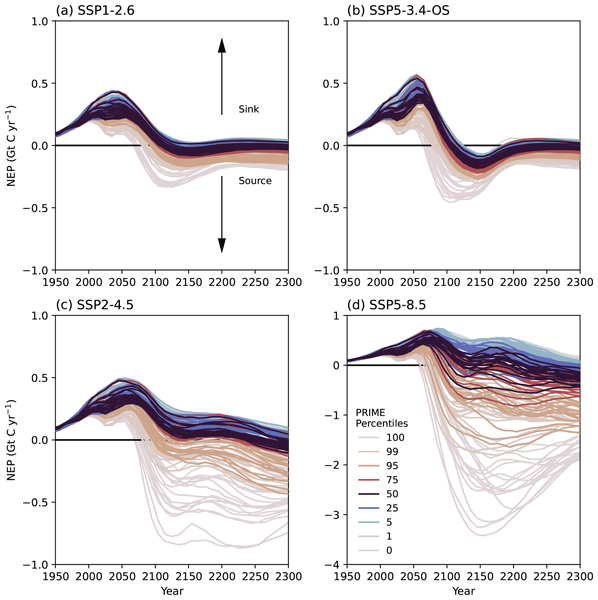
Abstract. Under historical warming, terrestrial ecosystems within the northern high latitudes have been a net carbon sink, providing vital mitigation against anthropogenic emissions of CO2. However, the long-term stability of this net sink is uncertain due to complex carbon cycle feedbacks in response to future climate change. Here, the PRIME framework is used to probabilistically quantify if and when this region will transition from a net carbon sink to a carbon source in a range of plausible future climate scenarios (SSP1-2.6, SSP2-4.5, SSP5-8.5), including overshoot (SSP5-3.4-OS). JULES - the land surface model component of PRIME, has the capability to explicitly simulate permafrost physics, dynamic vegetation and fire; key processes within high-latitude terrestrial ecosystems that are yet to be coupled together in Earth system models. In a low emission scenario, permafrost carbon emissions increase the risk of a net carbon source by more 50 % at 2 °C of warming, and at greater levels of warming in high emission scenarios. Conversely, in all emission scenarios dynamic vegetation is found to limit the sink-to-source transition at all warming levels by enhancing the carbon sink. Fire emissions can further weaken the sink by reducing its resilience to warming. A high temperature overshoot further limits the resilience of the carbon sink due to a reduction in temperatures after the peak, providing less optimal conditions for vegetation growth. These results highlight the importance of vegetation on the strength of the Arctic terrestrial carbon sink under warming and emphasise the need for representing comprehensive terrestrial climate feedbacks in Earth system models to improve projections of the land carbon response in future climate change trajectories.
-
Notice on discussion status
The requested preprint has a corresponding peer-reviewed final revised paper. You are encouraged to refer to the final revised version.
-
Preprint
(4085 KB)
-
Supplement
(726 KB)
-
The requested preprint has a corresponding peer-reviewed final revised paper. You are encouraged to refer to the final revised version.
- Preprint
(4085 KB) - Metadata XML
-
Supplement
(726 KB) - BibTeX
- EndNote
- Final revised paper


Journal article(s) based on this preprint
Interactive discussion
Status: closed
-
RC1: 'Comment on egusphere-2025-6075', Anonymous Referee #1, 06 Feb 2026
- AC1: 'Reply on RC1', Rebecca Varney, 25 Mar 2026
-
RC2: 'Comment on egusphere-2025-6075', Anonymous Referee #2, 13 Mar 2026
This study probabilistically quantifies the patterns of the sink-to-source carbon transition in the northern high latitudes under various emission scenarios (including the overshoot scenario) by means of the PRIME-JULES framework that explicitly couples permafrost physics, dynamic vegetation and fire processes. This study could fill the gap that key carbon cycle processes have not been jointly coupled in the current CMIP6 models.
As an ESM emulator, the PRIME framework can only simulate effects of climates on terrestrial carbon cycle, and fails to simulate the feedback of carbon cycle to climate system. That is, it fails to capture the two-way carbon-climate coupling effects. Furthermore, it does not couple the biophysical feedbacks of terrestrial ecosystems to climate (e.g., the impacts of vegetation albedo and evapotranspiration changes on regional temperatures), which may lead to biases in the simulation of long-term carbon cycle feedbacks.
The northward expansion of dynamic vegetation in the model is only driven by climate and CO₂, with no incorporation of factors such as soil nutrient limitations (excluding nitrogen), physical constraints of permafrost instability on plant growth, and human activities (e.g., forest management). In the real world, these factors can significantly inhibit the northward expansion of boreal forests, which may result in an overestimation of the enhancement effect of dynamic vegetation on the carbon sink.
Simulations in this study are solely based on the single land surface model JULES. The model results have not been validated with in-situ observational data (e.g., long-term carbon flux observation stations in tundra and boreal forest regions), leaving the generalizability of the results to be verified.
The 95% percentile range of CARDAMOM appears to be overly broad, and thus it is understandable that the results of JULES-pf fall within this range. However, this cannot prove that the results of JULES-pf are reliable or superior to those of other models. Please clarify what the 95% percentile range of CARDAMOM indicates.
Line 64: Mathison et al. (2025) should be cited in the correct reference format.
Citation: https://doi.org/10.5194/egusphere-2025-6075-RC2 - AC2: 'Reply on RC2', Rebecca Varney, 25 Mar 2026
-
EC1: 'Comment on egusphere-2025-6075', Sibyll Schaphoff, 13 Apr 2026
Please provide the revised manuscript with all changes incorporated, clearly indicating the modifications that were made.
Citation: https://doi.org/10.5194/egusphere-2025-6075-EC1
Peer review completion


Interactive discussion
Status: closed
-
RC1: 'Comment on egusphere-2025-6075', Anonymous Referee #1, 06 Feb 2026
General comments
The authors have conducted a study on the possibility of the northern high latitudes becoming a net carbon source under future climate conditions using the novel PRIME framework – an ESM emission-to-impacts emulator, which includes recent advancements in the representation of permafrost physics together with dynamic vegetation not yet available in ESMs. The study shows that the inclusion of permafrost physics and vegetation dynamics is essential in determining the temperature range at which the northern latitudes could transition from a carbon sink to a carbon source.
Specific comments
Line 89: Is it possible to provide the actual climate sensitivities to which the percentiles correspond?
Lines 172-174: It is not clear to me how the individual lines within each colour in Fig. 2 represent different spatial patterns. Do these correspond to individual grid cells? How is the spatial sensitivity of climate patterns calculated?
Lines 199-201: Based on Fig. S6, this statement is true only for high climate sensitivity scenarios. It would be interesting to elaborate on the reasons why simulations with low climate sensitivity sustain the carbon sink longer in a high emission/high warming scenario than in a low emission/low warming scenario, maybe also in continuation of the analysis provided in the next section (lines 232-238).
Line 231: Could you explain how you calculated the 62% likelihood? It seems that at 2 degrees 100% of the simulations in SSP2-4.5 are showing a carbon sink.
Lines 232-238: Consider including here an analysis on the impact of climate sensitivity on why in high emission scenarios the carbon sink is more resilient towards temperature changes (see previous comment). It seems that in low emissions/low warming scenarios the temperature changes are still low enough not to enable forest expansion, while in high emissions/high warming scenarios the low to moderate temperature increase (Fig. S3, lower percentiles) can already trigger the northward expansion. So, the trigger point (in terms of temperature) is not clearly defined and maybe varies with other factors (e.g., CO2 fertilization).
Lines 299-300: Do the other configurations of JULES implicitly account for the fire emissions from soil? Would it be possible to give an estimate of these emissions (or at least the order of magnitude compared to burning vegetation)?
Line 323: Is the temperature “exceeding” or rather “going under” the optimum for growth in overshoot scenarios?
Technical corrections
Line 8: Consider changing to “increase the risk of northern high latitudes becoming a net carbon source by more than 50%”
Line 20: Add “and” after “CO2 concentrations”.
Line 21: “climate change mitigation”.
Line 48: “differently”?
Line 49: Coupled Model Intercomparison Project Phase 6 (CMIP6)
Line 64: Probabilistic Regional Impact from Model patterns and Emissions (PRIME) framework by Mathison et al. (2025)
Lines 66-67: Consider changing to: “One advantage of PRIME is the possibility to use JULES configurations…”
Line 82: abbreviation inserted above
Line 103: consider giving the full name of the JULES abbreviation the first time it is mentioned in the text
Line 181: Do you mean “from higher climate sensitivity percentiles”?
Line 190: “than they take up”; Table 3: please, note that when printed the light grey is not visible.
Line 259: Consider changing to: “it is argued that… (Alfaro-Sanchez et al., 2024)”
Line 329: "create"
Lines 329-330: creates a balance between what and what?
Line 333: “This highlights…”?
Citation: https://doi.org/10.5194/egusphere-2025-6075-RC1 - AC1: 'Reply on RC1', Rebecca Varney, 25 Mar 2026
-
RC2: 'Comment on egusphere-2025-6075', Anonymous Referee #2, 13 Mar 2026
This study probabilistically quantifies the patterns of the sink-to-source carbon transition in the northern high latitudes under various emission scenarios (including the overshoot scenario) by means of the PRIME-JULES framework that explicitly couples permafrost physics, dynamic vegetation and fire processes. This study could fill the gap that key carbon cycle processes have not been jointly coupled in the current CMIP6 models.
As an ESM emulator, the PRIME framework can only simulate effects of climates on terrestrial carbon cycle, and fails to simulate the feedback of carbon cycle to climate system. That is, it fails to capture the two-way carbon-climate coupling effects. Furthermore, it does not couple the biophysical feedbacks of terrestrial ecosystems to climate (e.g., the impacts of vegetation albedo and evapotranspiration changes on regional temperatures), which may lead to biases in the simulation of long-term carbon cycle feedbacks.
The northward expansion of dynamic vegetation in the model is only driven by climate and CO₂, with no incorporation of factors such as soil nutrient limitations (excluding nitrogen), physical constraints of permafrost instability on plant growth, and human activities (e.g., forest management). In the real world, these factors can significantly inhibit the northward expansion of boreal forests, which may result in an overestimation of the enhancement effect of dynamic vegetation on the carbon sink.
Simulations in this study are solely based on the single land surface model JULES. The model results have not been validated with in-situ observational data (e.g., long-term carbon flux observation stations in tundra and boreal forest regions), leaving the generalizability of the results to be verified.
The 95% percentile range of CARDAMOM appears to be overly broad, and thus it is understandable that the results of JULES-pf fall within this range. However, this cannot prove that the results of JULES-pf are reliable or superior to those of other models. Please clarify what the 95% percentile range of CARDAMOM indicates.
Line 64: Mathison et al. (2025) should be cited in the correct reference format.
Citation: https://doi.org/10.5194/egusphere-2025-6075-RC2 - AC2: 'Reply on RC2', Rebecca Varney, 25 Mar 2026
-
EC1: 'Comment on egusphere-2025-6075', Sibyll Schaphoff, 13 Apr 2026
Please provide the revised manuscript with all changes incorporated, clearly indicating the modifications that were made.
Citation: https://doi.org/10.5194/egusphere-2025-6075-EC1
Peer review completion
Journal article(s) based on this preprint
Viewed
| HTML | XML | Total | Supplement | BibTeX | EndNote | |
|---|---|---|---|---|---|---|
| 2,294 | 1,497 | 166 | 3,957 | 368 | 126 | 126 |
- HTML: 2,294
- PDF: 1,497
- XML: 166
- Total: 3,957
- Supplement: 368
- BibTeX: 126
- EndNote: 126
Viewed (geographical distribution)
| Country | # | Views | % |
|---|
| Total: | 0 |
| HTML: | 0 |
| PDF: | 0 |
| XML: | 0 |
- 1
Rebecca M. Varney

Daniel Hooke
Norman J. Steinert
T. Luke Smallman
Camilla Mathison
Eleanor J. Burke
The requested preprint has a corresponding peer-reviewed final revised paper. You are encouraged to refer to the final revised version.
- Preprint
(4085 KB) - Metadata XML
-
Supplement
(726 KB) - BibTeX
- EndNote
- Final revised paper
General comments
The authors have conducted a study on the possibility of the northern high latitudes becoming a net carbon source under future climate conditions using the novel PRIME framework – an ESM emission-to-impacts emulator, which includes recent advancements in the representation of permafrost physics together with dynamic vegetation not yet available in ESMs. The study shows that the inclusion of permafrost physics and vegetation dynamics is essential in determining the temperature range at which the northern latitudes could transition from a carbon sink to a carbon source.
Specific comments
Line 89: Is it possible to provide the actual climate sensitivities to which the percentiles correspond?
Lines 172-174: It is not clear to me how the individual lines within each colour in Fig. 2 represent different spatial patterns. Do these correspond to individual grid cells? How is the spatial sensitivity of climate patterns calculated?
Lines 199-201: Based on Fig. S6, this statement is true only for high climate sensitivity scenarios. It would be interesting to elaborate on the reasons why simulations with low climate sensitivity sustain the carbon sink longer in a high emission/high warming scenario than in a low emission/low warming scenario, maybe also in continuation of the analysis provided in the next section (lines 232-238).
Line 231: Could you explain how you calculated the 62% likelihood? It seems that at 2 degrees 100% of the simulations in SSP2-4.5 are showing a carbon sink.
Lines 232-238: Consider including here an analysis on the impact of climate sensitivity on why in high emission scenarios the carbon sink is more resilient towards temperature changes (see previous comment). It seems that in low emissions/low warming scenarios the temperature changes are still low enough not to enable forest expansion, while in high emissions/high warming scenarios the low to moderate temperature increase (Fig. S3, lower percentiles) can already trigger the northward expansion. So, the trigger point (in terms of temperature) is not clearly defined and maybe varies with other factors (e.g., CO2 fertilization).
Lines 299-300: Do the other configurations of JULES implicitly account for the fire emissions from soil? Would it be possible to give an estimate of these emissions (or at least the order of magnitude compared to burning vegetation)?
Line 323: Is the temperature “exceeding” or rather “going under” the optimum for growth in overshoot scenarios?
Technical corrections
Line 8: Consider changing to “increase the risk of northern high latitudes becoming a net carbon source by more than 50%”
Line 20: Add “and” after “CO2 concentrations”.
Line 21: “climate change mitigation”.
Line 48: “differently”?
Line 49: Coupled Model Intercomparison Project Phase 6 (CMIP6)
Line 64: Probabilistic Regional Impact from Model patterns and Emissions (PRIME) framework by Mathison et al. (2025)
Lines 66-67: Consider changing to: “One advantage of PRIME is the possibility to use JULES configurations…”
Line 82: abbreviation inserted above
Line 103: consider giving the full name of the JULES abbreviation the first time it is mentioned in the text
Line 181: Do you mean “from higher climate sensitivity percentiles”?
Line 190: “than they take up”; Table 3: please, note that when printed the light grey is not visible.
Line 259: Consider changing to: “it is argued that… (Alfaro-Sanchez et al., 2024)”
Line 329: "create"
Lines 329-330: creates a balance between what and what?
Line 333: “This highlights…”?