
the Creative Commons Attribution 4.0 License.
the Creative Commons Attribution 4.0 License.
 | 14 Jan 2026
Temporal variability of NOx emissions from power plants: a comparison of satellite- and inventory-based estimates
Abstract. Satellite observations of nitrogen dioxide (NO2) are a valuable tool for estimating nitrogen oxides (NOx) emissions from point sources and can support carbon dioxide (CO2) monitoring through emission ratios. We assess the capability of TROPOMI NO2 measurements to quantify the temporal variability of NOx emissions from eighteen power plants in Europe and the United States. Using the cross-sectional flux (CSF) method implemented in the ddeq Python library (version 1.1), we derive top-down emissions and compare two NOx chemistry corrections approaches: a “local” method based on MicroHH and a “global” method based on GEOS-Chem simulations. Annual top-down estimates using the local approach agree well with bottom-up estimates from the CORSO point source database, with a mean bias of 9 ± 20 % when aggregating sources within 30 km. A regression analysis yields a slope of 1.05 ± 0.17 and a coefficient of determination of 0.68. The local correction yields emissions that are 58 ± 8 % higher than the global approach. Satellite-based estimates successfully captured seasonal and short-term variability in bottom-up emissions estimated from electricity generation in Europe and continuous emissions monitoring systems (CEMS) in the USA. However, limitations remain due to reduced winter coverage, emissions below the detection limit, overlapping plumes, and uncertainties in NOx chemistry corrections especially for non-isolated facilities. Overall, our findings demonstrate that satellite NO2 observations can effectively monitor the seasonality of NOx emissions from power plants. Addressing remaining uncertainties will be essential for future emission monitoring systems and upcoming satellite missions targeting both NO2 and CO2.
-
Notice on discussion status
The requested preprint has a corresponding peer-reviewed final revised paper. You are encouraged to refer to the final revised version.
-
Preprint
(3277 KB)
-
Supplement
(7508 KB)
-
The requested preprint has a corresponding peer-reviewed final revised paper. You are encouraged to refer to the final revised version.
- Preprint
(3277 KB) - Metadata XML
-
Supplement
(7508 KB) - BibTeX
- EndNote
- Final revised paper


Journal article(s) based on this preprint
Interactive discussion
Status: closed
-
RC1: 'Comment on egusphere-2025-6057', Anonymous Referee #1, 19 Feb 2026
-
AC1: 'Reply on RC1', Gerrit Kuhlmann, 10 Mar 2026
The comment was uploaded in the form of a supplement: https://egusphere.copernicus.org/preprints/2026/egusphere-2025-6057/egusphere-2025-6057-AC1-supplement.pdf
-
AC1: 'Reply on RC1', Gerrit Kuhlmann, 10 Mar 2026
-
RC2: 'Comment on egusphere-2025-6057', Anonymous Referee #2, 25 Feb 2026
Review of „Temporal variability of NOx emissions from power plants: a comparison of satellite- and inventory-based estimates “ by Gerrit Kuhlmann et al.
The study by Kuhlmann et al. evaluates the ability of TROPOMI NO2 observations to monitor short-term seasonal variability in power plant emissions in the US and Europe, comparing them with bottom-up emission inventories estimated from electricity generation in Europe and CEMS in the US. With a local and a global approach, two methods for the NO2 to NOx conversion are analyzed.
The paper provides more insights into the ability of satellite NO2 observations to investigate seasonal variations in power plant emissions, as well as their challenges and limitations. I recommend publication after addressing the minor comments below.
General comments:The introduction would benefit from a short overview of some main findings published by other studies closely related to the analyses presented here, see specific comment to P2 L38
The results section would benefit from including comparisons to results from previous studies, see specific comment below.
The study uses several results from other studies, e.g., the MicroHH simulations, power plant emission profiles, and a machine learning model for the global correction factor approach. These studies are briefly mentioned, but I think the reader of this study would have a better experience if some more details are provided for the results taken from these studies. See specific comments below.
Specific comments:
P1 L3: Specify that you are investigating seasonal and day-to-day temporal variabilityP1 L5: MicroHH is not well known, please add a short explanation to it.
P2 L38: spatially and temporally resolved emission
P2 L38: I think this section would benefit from a short overview of some main findings published by other studies, e.g., Lorente et al. (2019) and Lange et al. (2022). Especially since Lange et al. (2022) also compared seasonal TROPOMI emission estimates with EPA CEMS data. Maybe even earlier studies by Frost et al. 2006 and Kim et al. 2006, which compare OMI and SCIAMACHY data with EPA CEMS data, might be relevant.
P5 L105: To improve the readability and understanding of this study without further knowledge of Brunner et al., please provide a few more details about the power plant emission profiles, what they consider, and how it depends on the power plant, location, and meteorology.
P5 L115: I think it is more like an effective lifetime and not the chemical lifetime.
P5 L123: How do you decide the source location, is it based on the inventories?
P6 L131-137: Please provide more details. Is the correction based on the NO2 enhancements done on a daily basis? How transferable is the standard emission profile? How strongly does it deviate from the TM5 profiles?
P6 L153: Why are no ozone data used as input for the machine learning model? Where is the NOx concentration input coming from?
P7 L173/177: You mention that the MicroHH simulations showed variations in lifetime from 1 to 5 hours. What kind of variation, latitudinal, seasonal? How large is the influence of using a fixed lifetime of 2.5 hours?
P7 L175: Why have you decided for the parameters determined for the Jänschwalde power plant, how much do the parameters vary for the other 3 power plants?
P8 L200: How many individual emission estimates have to be available per month for calculating the monthly mean and having a representative estimate?
P9 L 246: For me, it wasn’t clear at first where one can see the Huntington plume. Maybe add a sentence that it is located north (point) of the Hunter power plant (triangle) within the source area.
P13 Fig. 4: The limits of the y-axis for the correction factor are ill-chosen to show the seasonal variation. Please adjust the y-axis of the correction factor subplot.
P14 L329: Can you see/understand the issue when looking at the outlier results? Is there a way to adjust the filter? This would be interesting when thinking about a more automatic analysis.
P14 L332: Do you have an idea why the US power plants show more variability compared to the European ones? Is it an issue with the bottom-up database and the assumption of an emission-power relationship? But I think also the top-down approach shows less variability for the European.
Results sections: In general, more comparisons to other studies, e.g.:
How does the correction factor compare to other studies like Beirle et al. (2021)
Have these power plants studied already in other studies, and how do they compare Beirle et al (2023)?
How do your TROPOMI-based vs CEMS correlations compare with Lange et al (2022)?Technical corrections:
P2 L41: of the satellite overpassP 3 L66: We therefore estimate hourly Nox emissions
P5 L124: Do you mean +/- 80km or +/- 40km
P12 L280: For example, for the Hunter power plant, which is …
P17 L379: our results instead of our result
References:
Beirle, S., Borger, C., Dörner, S., Eskes, H., Kumar, V., de Laat, A., and Wagner, T.: Catalog of NOx emissions from point sources as derived from the divergence of the NO2 flux for TROPOMI, Earth Syst. Sci. Data, 13, 2995–3012, https://doi.org/10.5194/essd-13-2995-2021, 2021.
Beirle, S., Borger, C., Jost, A., and Wagner, T.: Improved catalog of NOx point source emissions (version 2), Earth Syst. Sci. Data, 15, 3051–3073, https://doi.org/10.5194/essd-15-3051-2023, 2023.
Frost, G. J., et al. (2006), Effects of changing power plant NOx emissions on ozone in the eastern United States: Proof of concept, J. Geophys. Res., 111, D12306, doi:10.1029/2005JD006354.
Kim, S.-W., A. Heckel, S. A. McKeen, G. J. Frost, E.-Y. Hsie, M. K. Trainer, A. Richter, J. P. Burrows, S. E. Peckham, and G. A. Grell (2006), Satellite-observed U.S. power plant NOx emission reductions and their impact on air quality, Geophys. Res. Lett., 33, L22812, doi:10.1029/2006GL027749.
Lange, K., Richter, A., and Burrows, J. P.: Variability of nitrogen oxide emission fluxes and lifetimes estimated from Sentinel-5P TROPOMI observations, Atmos. Chem. Phys., 22, 2745–2767, https://doi.org/10.5194/acp-22-2745-2022, 2022.
Lorente, A., Boersma, K.F., Eskes, H.J. et al. Quantification of nitrogen oxides emissions from build-up of pollution over Paris with TROPOMI. Sci Rep 9, 20033 (2019). https://doi.org/10.1038/s41598-019-56428-5
Citation: https://doi.org/10.5194/egusphere-2025-6057-RC2 -
AC1: 'Reply on RC1', Gerrit Kuhlmann, 10 Mar 2026
The comment was uploaded in the form of a supplement: https://egusphere.copernicus.org/preprints/2026/egusphere-2025-6057/egusphere-2025-6057-AC1-supplement.pdf
-
AC1: 'Reply on RC1', Gerrit Kuhlmann, 10 Mar 2026


Interactive discussion
Status: closed
-
RC1: 'Comment on egusphere-2025-6057', Anonymous Referee #1, 19 Feb 2026
This is truly an excellent paper validating a NOx emission derivation approach on various global power plants. I was a bit surprised that the paper focused exclusively on power plants, but I understand the reason why. I hope this research team is able to do a follow-up paper focused on urban areas. All of my comments are minor. My most major of the minor comments is that the air mass factor correction section is a bit vague and could use a bit more description and ideally a schematic. All minor comments are below:
Line 123. I am curious why you are using a box that extends 30 km downwind as opposed to multiple 10 km boxes following the plume downwind. In this way you could derive the lifetime explicitly, is that correct? I’m not requesting you to re-do your analysis per se, but I am curious the pro’s and con’s of what I just proposed versus what you are doing. It could be helpful to acknowledge this in one or two additional sentences here.
Line 134. This is perhaps my most major comment. Can you be a bit more descriptive of how this is done? Are you assuming all NO2 is only at the stack height, or instead some type of vertically distributed Gaussian enhancement? A schematic of this directly in the paper or the supplement could be very helpful.
Line 175. This is very interesting, and personally, I agree with this approach of using something high-resolution is better than low-resolution. However, the background oxidative environment likely varies between power plant even if emission rates between power plants are similar. For example, a power plant in the presence of a VOC-laden forest may have different oxidative characteristics than a power plant in the desert. I am not sure how you can control for this, but it would be great for you to think about this, and perhaps incorporate this if you do not already, even if it is just a caveat in the text.
Line 222. Can you clarify what you mean by 10% systematic error? To me, systematic error implies that the direction of the bias is known (either positive or negative), but that the magnitude of that bias is unknown. It’d be best to modify this phrasing, because I think I am misinterpreting.
Lines 226 - 246 (and throughout). For clarity for the reader, please clarify in the text which countries, and US state if applicable, all power plants are located.
Figure 1. Ideally please enlarge the text size. My eyes can read it but some numbers are a bit small.
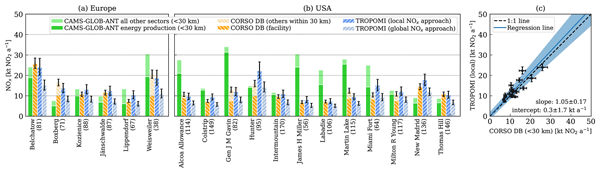
Figure 2. Why are you showing CAMS emissions on this plot? Personally I think it’d be clearer to exclude it from this image because it does not seem to be a validation dataset. It’s certainly worth mentioning that CAMS disagrees with CORSO, but intercomparing your top-down estimates with CAMS seems unnecessary. I can be convinced either way about this though, if you have a good reason for including CAMS emissions.
Figure 4. For Row 2, it seems the blue line and error bar is simply Equation 4. Is that a correction interpretation? If so, it may be convenient to list this in the white space on the figure. For Row 3, same comment between this and Equation 2. And Row 4 blue line is Equation 2 and 4, right?
Line 317. power plant —> power plants
Line 380. Can you more explicitly define “short-term”? In my opinion, monthly seems very possible. I think your results show that daily is possible only some of the time, and maybe what you are referring to here. And certainly hourly is not possible with once-per-day TROPOMI (which you should also mention).
Discussion. It’d be helpful to describe how you would alter this method if trying to derive NOx emissions from a pseudo-point source urban plume.
Line 7. Do you mean “when aggregating point sources”?
Citation: https://doi.org/10.5194/egusphere-2025-6057-RC1 -
AC1: 'Reply on RC1', Gerrit Kuhlmann, 10 Mar 2026
The comment was uploaded in the form of a supplement: https://egusphere.copernicus.org/preprints/2026/egusphere-2025-6057/egusphere-2025-6057-AC1-supplement.pdf
-
AC1: 'Reply on RC1', Gerrit Kuhlmann, 10 Mar 2026
-
RC2: 'Comment on egusphere-2025-6057', Anonymous Referee #2, 25 Feb 2026
Review of „Temporal variability of NOx emissions from power plants: a comparison of satellite- and inventory-based estimates “ by Gerrit Kuhlmann et al.
The study by Kuhlmann et al. evaluates the ability of TROPOMI NO2 observations to monitor short-term seasonal variability in power plant emissions in the US and Europe, comparing them with bottom-up emission inventories estimated from electricity generation in Europe and CEMS in the US. With a local and a global approach, two methods for the NO2 to NOx conversion are analyzed.
The paper provides more insights into the ability of satellite NO2 observations to investigate seasonal variations in power plant emissions, as well as their challenges and limitations. I recommend publication after addressing the minor comments below.
General comments:The introduction would benefit from a short overview of some main findings published by other studies closely related to the analyses presented here, see specific comment to P2 L38
The results section would benefit from including comparisons to results from previous studies, see specific comment below.
The study uses several results from other studies, e.g., the MicroHH simulations, power plant emission profiles, and a machine learning model for the global correction factor approach. These studies are briefly mentioned, but I think the reader of this study would have a better experience if some more details are provided for the results taken from these studies. See specific comments below.
Specific comments:
P1 L3: Specify that you are investigating seasonal and day-to-day temporal variabilityP1 L5: MicroHH is not well known, please add a short explanation to it.
P2 L38: spatially and temporally resolved emission
P2 L38: I think this section would benefit from a short overview of some main findings published by other studies, e.g., Lorente et al. (2019) and Lange et al. (2022). Especially since Lange et al. (2022) also compared seasonal TROPOMI emission estimates with EPA CEMS data. Maybe even earlier studies by Frost et al. 2006 and Kim et al. 2006, which compare OMI and SCIAMACHY data with EPA CEMS data, might be relevant.
P5 L105: To improve the readability and understanding of this study without further knowledge of Brunner et al., please provide a few more details about the power plant emission profiles, what they consider, and how it depends on the power plant, location, and meteorology.
P5 L115: I think it is more like an effective lifetime and not the chemical lifetime.
P5 L123: How do you decide the source location, is it based on the inventories?
P6 L131-137: Please provide more details. Is the correction based on the NO2 enhancements done on a daily basis? How transferable is the standard emission profile? How strongly does it deviate from the TM5 profiles?
P6 L153: Why are no ozone data used as input for the machine learning model? Where is the NOx concentration input coming from?
P7 L173/177: You mention that the MicroHH simulations showed variations in lifetime from 1 to 5 hours. What kind of variation, latitudinal, seasonal? How large is the influence of using a fixed lifetime of 2.5 hours?
P7 L175: Why have you decided for the parameters determined for the Jänschwalde power plant, how much do the parameters vary for the other 3 power plants?
P8 L200: How many individual emission estimates have to be available per month for calculating the monthly mean and having a representative estimate?
P9 L 246: For me, it wasn’t clear at first where one can see the Huntington plume. Maybe add a sentence that it is located north (point) of the Hunter power plant (triangle) within the source area.
P13 Fig. 4: The limits of the y-axis for the correction factor are ill-chosen to show the seasonal variation. Please adjust the y-axis of the correction factor subplot.
P14 L329: Can you see/understand the issue when looking at the outlier results? Is there a way to adjust the filter? This would be interesting when thinking about a more automatic analysis.
P14 L332: Do you have an idea why the US power plants show more variability compared to the European ones? Is it an issue with the bottom-up database and the assumption of an emission-power relationship? But I think also the top-down approach shows less variability for the European.
Results sections: In general, more comparisons to other studies, e.g.:
How does the correction factor compare to other studies like Beirle et al. (2021)
Have these power plants studied already in other studies, and how do they compare Beirle et al (2023)?
How do your TROPOMI-based vs CEMS correlations compare with Lange et al (2022)?Technical corrections:
P2 L41: of the satellite overpassP 3 L66: We therefore estimate hourly Nox emissions
P5 L124: Do you mean +/- 80km or +/- 40km
P12 L280: For example, for the Hunter power plant, which is …
P17 L379: our results instead of our result
References:
Beirle, S., Borger, C., Dörner, S., Eskes, H., Kumar, V., de Laat, A., and Wagner, T.: Catalog of NOx emissions from point sources as derived from the divergence of the NO2 flux for TROPOMI, Earth Syst. Sci. Data, 13, 2995–3012, https://doi.org/10.5194/essd-13-2995-2021, 2021.
Beirle, S., Borger, C., Jost, A., and Wagner, T.: Improved catalog of NOx point source emissions (version 2), Earth Syst. Sci. Data, 15, 3051–3073, https://doi.org/10.5194/essd-15-3051-2023, 2023.
Frost, G. J., et al. (2006), Effects of changing power plant NOx emissions on ozone in the eastern United States: Proof of concept, J. Geophys. Res., 111, D12306, doi:10.1029/2005JD006354.
Kim, S.-W., A. Heckel, S. A. McKeen, G. J. Frost, E.-Y. Hsie, M. K. Trainer, A. Richter, J. P. Burrows, S. E. Peckham, and G. A. Grell (2006), Satellite-observed U.S. power plant NOx emission reductions and their impact on air quality, Geophys. Res. Lett., 33, L22812, doi:10.1029/2006GL027749.
Lange, K., Richter, A., and Burrows, J. P.: Variability of nitrogen oxide emission fluxes and lifetimes estimated from Sentinel-5P TROPOMI observations, Atmos. Chem. Phys., 22, 2745–2767, https://doi.org/10.5194/acp-22-2745-2022, 2022.
Lorente, A., Boersma, K.F., Eskes, H.J. et al. Quantification of nitrogen oxides emissions from build-up of pollution over Paris with TROPOMI. Sci Rep 9, 20033 (2019). https://doi.org/10.1038/s41598-019-56428-5
Citation: https://doi.org/10.5194/egusphere-2025-6057-RC2 -
AC1: 'Reply on RC1', Gerrit Kuhlmann, 10 Mar 2026
The comment was uploaded in the form of a supplement: https://egusphere.copernicus.org/preprints/2026/egusphere-2025-6057/egusphere-2025-6057-AC1-supplement.pdf
-
AC1: 'Reply on RC1', Gerrit Kuhlmann, 10 Mar 2026
Peer review completion


Journal article(s) based on this preprint
Viewed
| HTML | XML | Total | Supplement | BibTeX | EndNote | |
|---|---|---|---|---|---|---|
| 273 | 177 | 28 | 478 | 35 | 21 | 27 |
- HTML: 273
- PDF: 177
- XML: 28
- Total: 478
- Supplement: 35
- BibTeX: 21
- EndNote: 27
Viewed (geographical distribution)
| Country | # | Views | % |
|---|
| Total: | 0 |
| HTML: | 0 |
| PDF: | 0 |
| XML: | 0 |
- 1
Erik Franciscus Maria Koene
Chloe Natasha Schooling
Paul Ian Palmer
Òscar Collado López
Marc Guevara
The requested preprint has a corresponding peer-reviewed final revised paper. You are encouraged to refer to the final revised version.
- Preprint
(3277 KB) - Metadata XML
-
Supplement
(7508 KB) - BibTeX
- EndNote
- Final revised paper
This is truly an excellent paper validating a NOx emission derivation approach on various global power plants. I was a bit surprised that the paper focused exclusively on power plants, but I understand the reason why. I hope this research team is able to do a follow-up paper focused on urban areas. All of my comments are minor. My most major of the minor comments is that the air mass factor correction section is a bit vague and could use a bit more description and ideally a schematic. All minor comments are below:
Line 123. I am curious why you are using a box that extends 30 km downwind as opposed to multiple 10 km boxes following the plume downwind. In this way you could derive the lifetime explicitly, is that correct? I’m not requesting you to re-do your analysis per se, but I am curious the pro’s and con’s of what I just proposed versus what you are doing. It could be helpful to acknowledge this in one or two additional sentences here.
Line 134. This is perhaps my most major comment. Can you be a bit more descriptive of how this is done? Are you assuming all NO2 is only at the stack height, or instead some type of vertically distributed Gaussian enhancement? A schematic of this directly in the paper or the supplement could be very helpful.
Line 175. This is very interesting, and personally, I agree with this approach of using something high-resolution is better than low-resolution. However, the background oxidative environment likely varies between power plant even if emission rates between power plants are similar. For example, a power plant in the presence of a VOC-laden forest may have different oxidative characteristics than a power plant in the desert. I am not sure how you can control for this, but it would be great for you to think about this, and perhaps incorporate this if you do not already, even if it is just a caveat in the text.
Line 222. Can you clarify what you mean by 10% systematic error? To me, systematic error implies that the direction of the bias is known (either positive or negative), but that the magnitude of that bias is unknown. It’d be best to modify this phrasing, because I think I am misinterpreting.
Lines 226 - 246 (and throughout). For clarity for the reader, please clarify in the text which countries, and US state if applicable, all power plants are located.
Figure 1. Ideally please enlarge the text size. My eyes can read it but some numbers are a bit small.
Figure 2. Why are you showing CAMS emissions on this plot? Personally I think it’d be clearer to exclude it from this image because it does not seem to be a validation dataset. It’s certainly worth mentioning that CAMS disagrees with CORSO, but intercomparing your top-down estimates with CAMS seems unnecessary. I can be convinced either way about this though, if you have a good reason for including CAMS emissions.
Figure 4. For Row 2, it seems the blue line and error bar is simply Equation 4. Is that a correction interpretation? If so, it may be convenient to list this in the white space on the figure. For Row 3, same comment between this and Equation 2. And Row 4 blue line is Equation 2 and 4, right?
Line 317. power plant —> power plants
Line 380. Can you more explicitly define “short-term”? In my opinion, monthly seems very possible. I think your results show that daily is possible only some of the time, and maybe what you are referring to here. And certainly hourly is not possible with once-per-day TROPOMI (which you should also mention).
Discussion. It’d be helpful to describe how you would alter this method if trying to derive NOx emissions from a pseudo-point source urban plume.
Line 7. Do you mean “when aggregating point sources”?