
the Creative Commons Attribution 4.0 License.
the Creative Commons Attribution 4.0 License.
 | 27 Jan 2026
Measurement report: Chemical characterization of cloud water at Monte Cimone (Italy). Impact of air mass origin and assessment of atmospheric processes
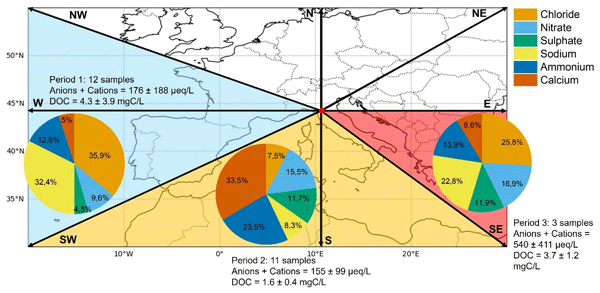
Abstract. In this article, we present the results of the chemical and microbiological characterization of clouds water collected at Monte Cimone (CMN) in Italy at 2165 m a.s.l. during the MC3 (Molecular Composition of Clouds at Mt. Cimone) campaign, which took place in October 2024. Twenty-six cloud samples are analyzed. Chemical analyses, including ions, oxidants, trace metals, and microbiological analyses with cell counting, are performed. The chemical characterization and back-trajectories analysis reveal that Mt. Cimone is a site under the influence of marine air masses, coming mainly from southern Europe and from the Mediterranean region. During the measurement campaign, 3 sampling periods are identified: period (1) October 07–10, with air masses mainly originating from Spain and Atlantic Ocean with a majority of Cl− and Na+ that are characteristics of marine origin; period (2) October 16–18 with air masses originating from North of Africa, impacted by a Saharan dust event with a high concentration in Ca2+; period (3) October 22–23 marked by air masses originated from southern Italy under polluted influence with a high concentration in NO3−. This study paves the way to further scientific campaigns intended to better comprehend cloud water composition at Mt. Cimone.
-
Notice on discussion status
The requested preprint has a corresponding peer-reviewed final revised paper. You are encouraged to refer to the final revised version.
-
Preprint
(1613 KB)
-
Supplement
(2612 KB)
-
The requested preprint has a corresponding peer-reviewed final revised paper. You are encouraged to refer to the final revised version.
- Preprint
(1613 KB) - Metadata XML
-
Supplement
(2612 KB) - BibTeX
- EndNote
- Final revised paper


Journal article(s) based on this preprint
Interactive discussion
Status: closed
-
RC1: 'Comment on egusphere-2025-5976', Anonymous Referee #3, 08 Feb 2026
-
AC1: 'Reply on RC1', Angelica Bianco, 17 Apr 2026
The comment was uploaded in the form of a supplement: https://egusphere.copernicus.org/preprints/2026/egusphere-2025-5976/egusphere-2025-5976-AC1-supplement.pdf
-
AC1: 'Reply on RC1', Angelica Bianco, 17 Apr 2026
-
RC2: 'Comment on egusphere-2025-5976', Anonymous Referee #4, 17 Feb 2026
This manuscript titled “Chemical characterization of cloud water at Monte Cimone (Italy): impact of air mass origin and assessment of atmospheric processes” examines the physico-chemical composition of cloud water at Monte Cimone, focusing on the role of air mass origin. The study presents valuable dataset covering a wide range of chemical components (e.g. major organic and inorganic ions, black carbon and dissolved organic carbon (DOC), trace gases, trace elements, and biological components) from 26 samples. The field work and the effort put into collecting and analyzing these samples are highly appreciated.
Overall, the manuscript provides useful and interesting results. However, some improvements in the abstract and the organization and clarity of explanations in the main paper would help make the paper easier to follow. My specific comments are listed below.
Specific comments:
- The abstract mainly focuses on the three mass origins and major ions, but it did not mention other important components studied, such as oxidants, DOC, metals, and microbiological components. Since these are also key parts of the paper, it would be helpful to briefly include their main findings in the abstract to better reflect the full scope of the study.
- In the abstract and conclusion, you mentioned that 26 cloud water samples were analyzed. But when I counted the cloud water samples in some figures (for example, in Fig. S3 upper panel, Fig. S5), I counted 27 samples. Could you clarify which one is accurate?
- Line 256: “The composition is well balanced between inorganic ions (Cl‒, NH4+, NO3‒, and SO42‒)”. Could you clarify what is meant by well balanced? Does this refer to having similar concentrations? And also, is this for aerosol phase or aqueous phase? I am assuming aerosol phase, but please clarify and use the appropriate notation (PM or CW).
- Line 257: Did you calculate Cl depletion? It would be nice to quantify Cl depletion for each sample. You may refer to Edwards et al. (2024) for guidance on the calculations.
- Line 261: “Cl‒ and NO3‒”. Please clarify whether this refers to the aerosol or aqueous phase.
- Line 302: I am curious how the chemical species correlate to each other. Did you perform a simple correlation analysis between all the measured components (other than correlation shown in Fig. 4b, Fig. S3, and Fig. S7)?
- Lines 439-441. You mentioned that “LWC is not measured during the campaign”, but then you proceeded with “the LWC for the last samples”. Please clarify this point.
- Line 980: For Figure 6a, did you correct the sample concentration for the blank concentration? The concentrations of Mn and Cu are a bit high, and some samples were even lower than the blank concentration.
Technical comments:
Line 126: should be ‘TOC-VCPH/CPN analyzer’ instead of “TOCVCPH/CPN TOC analyzer”
Lines 248-252: The sentence is a bit confusing, consider revising.
Line 253: should be ‘PMTOT’ instead of “total PMTOT”
Lines 273-279: These lines can be shortened into two sentences to improve flow.
Line 422: “..reported by (Laj et al., 2001) and (Vione et al., 2003)” should be ‘reported by Laj et al. (2001) and Vione et al. (2003)’. Please check similar issues throughout the paper since I’ve seen a few like this.
Lines 426-428. Be consistent with the use of “daytime and nighttime” versus “day-time and night-time”.
Line 504: should be ‘hypothesis’ instead of “hypothesys”
Line 969. It’s hard to read the coefficient of determination in Figure 4b. Consider minimizing the significant figures to 2-3 and improve the quality of the figure. Nitrate and sulfate can also share the same y-axis since the range of values is similar.
Line 974. For Figure 5 x-axis label, please be consistent with the samples naming convention. Use dd/mm instead of ddmmyy.
Line 981. I don’t think Figure 6c is mentioned in the main manuscript.
Figure S3 (lower panel). Y-axis label should be ‘Chloride’ instead of “Cloride”
In Tables S1-S3, you used the sample ID 23/10 Rain. Does this sample refer to 23/10A in Fig.S3 upper panel and Fig.S5? Please clarify.
Reference:
Edwards, E.-L., Choi, Y., Crosbie, E. C., DiGangi, J. P., Diskin, G. S., Robinson, C. E., Shook, M. A., Winstead, E. L., Ziemba, L. D., & Sorooshian, A. (2024). Sea salt reactivity over the northwest Atlantic: an in-depth look using the airborne ACTIVATE dataset. Atmospheric Chemistry and Physics, 24(5), 3349-3378. https://doi.org/10.5194/acp-24-3349-2024
Citation: https://doi.org/10.5194/egusphere-2025-5976-RC2 -
AC2: 'Reply on RC2', Angelica Bianco, 17 Apr 2026
The comment was uploaded in the form of a supplement: https://egusphere.copernicus.org/preprints/2026/egusphere-2025-5976/egusphere-2025-5976-AC2-supplement.pdf
Peer review completion


Interactive discussion
Status: closed
-
RC1: 'Comment on egusphere-2025-5976', Anonymous Referee #3, 08 Feb 2026
The manuscript titled “Chemical characterization of cloud water at Monte Cimone (Italy): impact of air mass origin and assessment of atmospheric processes” presents a detailed description on the cloud water chemistry in Italy mountaintop by emphasizing the significant impact of air mass sources. In general, this study shows a very comprehensive analysis of inorganic and organic ions, dissolved organic carbon (DOC), H2O2, trace metals and microbial cells in the collected 26 cloud water samples. I very appreciate the field work and valuable data provided by the authors. Although the authors show nearly all matters about individual samples, I have some concerns regarding the logical structure, figures/tables organization, and reasonable explanations. Substantial revision is still necessary for a better readability. My comments, either major or minor, are listed below in the order of main text.
- The abstract summarized the three types of origins of cloud chemistry with major ions, but didn’t mention the other important subsections studied, for example the oxidants, DOC, metals and microorganisms. That partial abstract will mislead my first view of this paper. Please revise the abstract with key findings of cloud components.
- Page 6, line 132, and Table S4, Figure 6: as the BOOGIE cloud impactor is made by aluminum (Vaitilingom et al., 2025), it may contain other metals besides Al. For example, the blank sample had a concentration of Cu, Mn, and Sb higher than that of cloud samples as shown in Table S4. Therefore, when the authors discuss the metals in cloud water in section 3.5, please make it clear that if the sample concentrations have deduced the blanks, and if the high blanks of some metals affect the conclusion. That is to say, could we believe the determined concentrations of specific metals with high blanks for cloud water sampler.
- Section 2.4.1: Here the authors provided the measurements of trace gases. I am also interested in SO2, the important precursor of sulfate, for comprehensive understanding. Is that possible to add the information of SO2?
- Section 3.1 is an important part of the paper, but it is too detailed and sometimes verbose for me to follow. I am afraid that most of the discussed figures are in the supporting information, rather than Figure 1 in the main text, which is the most inconvenient thing to be improved. I suggest to add a time-series figure of the full set of major chemical compositions (like Fig. S5 and Table S2) to the main text. The pies in Figure 1 should have different size indicating their relative concentrations. Also, why does Figure 1 only show 6 out of 8 measured ions and exclude DOC?
- Why the main text did not explain Figure 2 or should Figure 2 be replaced by other type of figures?
- Line 286: all ions concentrations of Period 2 are low, for which part? Cloud water, or PM1? Please show the concentrations of Ca2+ in Figure S5 for clarifying the dust effect on cloud and PM.
- Line 348: “Nevertheless, the absence of Cl‒PM and the depletion of NO3‒PM in particles, compared to cloud water, attest the marine input, similarly to samples of Period 1.” Why SO42‒ in particles are due to pollution but NO3- is depleted? And is it possible that the Cl- depletion in particles can be further discussed for atmospheric conversion?
- Line 395: “The concentration of Fe2+/Fe3+ is below…”, please reword this statement to avoid misleading of the measurement of total dissolved Fe rather than speciated Fe ions in this study.
- Lines 408-414: I did not find SO2 concentration in Figure S1. The high concentrations of H2O2 were attributed to direct industrial emission. Can you estimate how long time will the released H2O2 exist in the atmosphere and transport to the observation site at which concentration level?
- Line 426: “Figure 4a reports in yellow the concentration in daytime samples and in blue in night-time. The concentrations in night-time samples are generally higher than in day-time samples, except for sample 16/10 G, collected at sunset.” The sentences are redundant to the caption of Figure 4.
- Please revise the caption of Figure 3 to be more concise.
- What does the error bar mean in Figure 4a for individual sample? Set the same y-axis scale for nitrate and sulfate concentrations in Figure 4b using only left y-axis.
- Line 430 suggests the positive correlations between H2O2 and nitrate or sulfate. It is contrast to line 414 stating low SO2 concentration to explain high H2O2. Can we imagine that H2O2 had similar anthropogenic sources with other pollutants?
- Figure 5: As it shows much less information and is discussed in 3 sentences in the main text, I suggest move it to SI.
- Section 3.6: there are too much short paragraphs, which can be shortened into about four paragraphs.
- Line 540: it seems that air masses originating from continental areas contain one order of magnitude more microbial cells. Besides the altitude, can you find data or literatures comparing the abundant of atmospheric microbials in land and marine areas to support your findings?
- Lines 546-549: can you further explain the primary factors influencing culturable microbials?
Citation: https://doi.org/10.5194/egusphere-2025-5976-RC1 -
AC1: 'Reply on RC1', Angelica Bianco, 17 Apr 2026
The comment was uploaded in the form of a supplement: https://egusphere.copernicus.org/preprints/2026/egusphere-2025-5976/egusphere-2025-5976-AC1-supplement.pdf
-
RC2: 'Comment on egusphere-2025-5976', Anonymous Referee #4, 17 Feb 2026
This manuscript titled “Chemical characterization of cloud water at Monte Cimone (Italy): impact of air mass origin and assessment of atmospheric processes” examines the physico-chemical composition of cloud water at Monte Cimone, focusing on the role of air mass origin. The study presents valuable dataset covering a wide range of chemical components (e.g. major organic and inorganic ions, black carbon and dissolved organic carbon (DOC), trace gases, trace elements, and biological components) from 26 samples. The field work and the effort put into collecting and analyzing these samples are highly appreciated.
Overall, the manuscript provides useful and interesting results. However, some improvements in the abstract and the organization and clarity of explanations in the main paper would help make the paper easier to follow. My specific comments are listed below.
Specific comments:
- The abstract mainly focuses on the three mass origins and major ions, but it did not mention other important components studied, such as oxidants, DOC, metals, and microbiological components. Since these are also key parts of the paper, it would be helpful to briefly include their main findings in the abstract to better reflect the full scope of the study.
- In the abstract and conclusion, you mentioned that 26 cloud water samples were analyzed. But when I counted the cloud water samples in some figures (for example, in Fig. S3 upper panel, Fig. S5), I counted 27 samples. Could you clarify which one is accurate?
- Line 256: “The composition is well balanced between inorganic ions (Cl‒, NH4+, NO3‒, and SO42‒)”. Could you clarify what is meant by well balanced? Does this refer to having similar concentrations? And also, is this for aerosol phase or aqueous phase? I am assuming aerosol phase, but please clarify and use the appropriate notation (PM or CW).
- Line 257: Did you calculate Cl depletion? It would be nice to quantify Cl depletion for each sample. You may refer to Edwards et al. (2024) for guidance on the calculations.
- Line 261: “Cl‒ and NO3‒”. Please clarify whether this refers to the aerosol or aqueous phase.
- Line 302: I am curious how the chemical species correlate to each other. Did you perform a simple correlation analysis between all the measured components (other than correlation shown in Fig. 4b, Fig. S3, and Fig. S7)?
- Lines 439-441. You mentioned that “LWC is not measured during the campaign”, but then you proceeded with “the LWC for the last samples”. Please clarify this point.
- Line 980: For Figure 6a, did you correct the sample concentration for the blank concentration? The concentrations of Mn and Cu are a bit high, and some samples were even lower than the blank concentration.
Technical comments:
Line 126: should be ‘TOC-VCPH/CPN analyzer’ instead of “TOCVCPH/CPN TOC analyzer”
Lines 248-252: The sentence is a bit confusing, consider revising.
Line 253: should be ‘PMTOT’ instead of “total PMTOT”
Lines 273-279: These lines can be shortened into two sentences to improve flow.
Line 422: “..reported by (Laj et al., 2001) and (Vione et al., 2003)” should be ‘reported by Laj et al. (2001) and Vione et al. (2003)’. Please check similar issues throughout the paper since I’ve seen a few like this.
Lines 426-428. Be consistent with the use of “daytime and nighttime” versus “day-time and night-time”.
Line 504: should be ‘hypothesis’ instead of “hypothesys”
Line 969. It’s hard to read the coefficient of determination in Figure 4b. Consider minimizing the significant figures to 2-3 and improve the quality of the figure. Nitrate and sulfate can also share the same y-axis since the range of values is similar.
Line 974. For Figure 5 x-axis label, please be consistent with the samples naming convention. Use dd/mm instead of ddmmyy.
Line 981. I don’t think Figure 6c is mentioned in the main manuscript.
Figure S3 (lower panel). Y-axis label should be ‘Chloride’ instead of “Cloride”
In Tables S1-S3, you used the sample ID 23/10 Rain. Does this sample refer to 23/10A in Fig.S3 upper panel and Fig.S5? Please clarify.
Reference:
Edwards, E.-L., Choi, Y., Crosbie, E. C., DiGangi, J. P., Diskin, G. S., Robinson, C. E., Shook, M. A., Winstead, E. L., Ziemba, L. D., & Sorooshian, A. (2024). Sea salt reactivity over the northwest Atlantic: an in-depth look using the airborne ACTIVATE dataset. Atmospheric Chemistry and Physics, 24(5), 3349-3378. https://doi.org/10.5194/acp-24-3349-2024
Citation: https://doi.org/10.5194/egusphere-2025-5976-RC2 -
AC2: 'Reply on RC2', Angelica Bianco, 17 Apr 2026
The comment was uploaded in the form of a supplement: https://egusphere.copernicus.org/preprints/2026/egusphere-2025-5976/egusphere-2025-5976-AC2-supplement.pdf
Peer review completion
Journal article(s) based on this preprint
Data sets
Dust event identification product dataset collection over Monte Cimone, Italy 2003-2023, Version 1 F. Vogel et al. https://doi.org/10.71763/XDZA-FA77
Equivalent black carbon product dataset collection over Monte Cimone, Italy 2007-2024 (Version 1) M. Zanatta et al. https://doi.org/10.71763/itineris-hub/nfy7-yz86
Viewed
| HTML | XML | Total | Supplement | BibTeX | EndNote | |
|---|---|---|---|---|---|---|
| 1,554 | 679 | 159 | 2,392 | 321 | 129 | 199 |
- HTML: 1,554
- PDF: 679
- XML: 159
- Total: 2,392
- Supplement: 321
- BibTeX: 129
- EndNote: 199
Viewed (geographical distribution)
| Country | # | Views | % |
|---|
| Total: | 0 |
| HTML: | 0 |
| PDF: | 0 |
| XML: | 0 |
- 1
Pauline Nibert
Yi Wu
Muriel Joly
Pierre Amato
Paolo Cristofanelli
Francescopiero Calzolari
Jean-Luc Piro
Davide Putero
Simonetta Montaguti
Laura Renzi
Franziska Vogel
Marco Rapuano
Marcello Brigante
Christophe Verhaege
Jean-Luc Baray
Laurent Deguillaume
Angela Marinoni

The requested preprint has a corresponding peer-reviewed final revised paper. You are encouraged to refer to the final revised version.
- Preprint
(1613 KB) - Metadata XML
-
Supplement
(2612 KB) - BibTeX
- EndNote
- Final revised paper
The manuscript titled “Chemical characterization of cloud water at Monte Cimone (Italy): impact of air mass origin and assessment of atmospheric processes” presents a detailed description on the cloud water chemistry in Italy mountaintop by emphasizing the significant impact of air mass sources. In general, this study shows a very comprehensive analysis of inorganic and organic ions, dissolved organic carbon (DOC), H2O2, trace metals and microbial cells in the collected 26 cloud water samples. I very appreciate the field work and valuable data provided by the authors. Although the authors show nearly all matters about individual samples, I have some concerns regarding the logical structure, figures/tables organization, and reasonable explanations. Substantial revision is still necessary for a better readability. My comments, either major or minor, are listed below in the order of main text.