
the Creative Commons Attribution 4.0 License.
the Creative Commons Attribution 4.0 License.
 | 19 Jan 2026
Top-down estimate of regional carbon sinks over East Asia for 2010–2019 using satellite observations
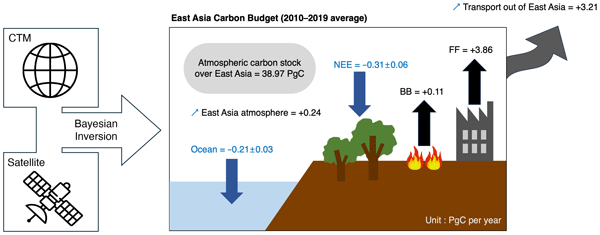
Abstract. Given East Asia's highest CO2 emissions, quantifying natural carbon sinks in this region is essential for improving climate projections and informing mitigation strategies. We estimated the Net Ecosystem Exchange (NEE) and ocean carbon fluxes over East Asia (18.5° N–54° N, 73° E–146° E) during 2010–2019 using a Bayesian inversion framework. The GEOS-Chem chemical transport model was combined with GOSAT ACOS v9.0 XCO2 retrievals, and region-specific prior uncertainties were assigned using standard deviations from land and ocean models. Posterior estimates show enhanced carbon uptake relative to the prior, with NEE increasing from −0.17 ± 0.08 to −0.31 ± 0.06 PgC yr⁻¹ and ocean uptake changing slightly from −0.20 ± 0.03 to −0.21 ± 0.03 PgC yr⁻¹. Simulated CO2 concentrations based on posterior fluxes agreed better with independent observations than those from prior fluxes. Most subregions in East Asia acted as net carbon sinks over the past decade. Enhanced Vegetation Index (EVI) trends also support strengthened carbon uptake. However, several regions showed temporary net carbon releases in 2015–2016, likely linked to the strong 2015/16 El Niño. East Asia released a net flux of +3.45 PgC yr⁻¹ to the atmosphere during 2010–2019. Natural sinks offset only ~13.6 % of fossil fuel emissions, leaving a substantial residual source. Despite strengthened posterior sinks, they remain insufficient to counter regional emissions, sustaining elevated CO2 levels and continued outflow from East Asia.
-
Notice on discussion status
The requested preprint has a corresponding peer-reviewed final revised paper. You are encouraged to refer to the final revised version.
-
Preprint
(2564 KB)
-
The requested preprint has a corresponding peer-reviewed final revised paper. You are encouraged to refer to the final revised version.
- Preprint
(2564 KB) - Metadata XML
- BibTeX
- EndNote
- Final revised paper


Journal article(s) based on this preprint
Interactive discussion
Status: closed
-
RC1: 'Comment on egusphere-2025-5971', Anonymous Referee #1, 12 Feb 2026
- AC1: 'Reply on RC1', Rokjin Park, 24 Mar 2026
-
RC2: 'Comment on egusphere-2025-5971', Anonymous Referee #2, 21 Feb 2026
The manuscript explores the East Asian flux estimation using an inverse modeling framework based on GEOS-Chem and GOSAT-ACOS product. The objectives are scientifically sound, and the manuscript is generally well-written in terms of motivation, objectives, language, numerical experiments, and explanations. However, still there remains considerable scope for major improvement before the manuscript can be considered for publication.
I therefore strongly recommend major revision of the manuscript in its current form. The detailed comments below, if carefully addressed, could substantially improve the quality and clarity of the work.
Major comments:
- In the abstract, author mentioned that most of the subregions of East Asia as net carbon sinks over the past decade—indicating East Asia as a net sink. However, shortly thereafter, they mentioned that natural sinks offset only ~13.6% of fossil fuel emission, leaving a substantial source. These two statements appear contradictory and may confuse readers. I request to revise the abstract carefully.
- The introduction would benefit from rearrangement. The flux estimation terminology, such as “inverse modeling” is referred before being formally introduced (which occurred in second paragraph).
- The calculation of apriori flux error is unclear. For error in terrestrial fluxes, author appear to use monthly NEE fluxes from eight land models and calculate ensemble standard deviation at each grid point and time step, which would result the 3D error field (time x latitude x longitude). How the table 1 values are calculated? Do these values represent ensemble standard deviation of regional annual total flux? In addition, final row of table 1 appears to be the average across years. Since standard deviation is a measure of dispersion, averaging standard deviation directly is not statistically well defined. I recommend to combine them as variance across, compute average and then convert to standard deviation again.
- Public TCCON data do not provide vertical weighting function, which is needed to calculate the XCO2. Please clarify how XCO2 was calculated for the TCCON evaluation?
- The manuscript doesn’t describe how posterior flux uncertainties is calculated. This information is essential to assess the robustness of the inversion flux. I strongly suggest adding a clear description about the posterior error estimation method. Additionally, a spatial map of uncertainty reduction would be highly informative and could be included in supplementary material.
- The manuscript reports enhanced uptake over major study regions except southwest China where strong uptake reduction is noticed. The underlying cause of this is not discussed. Please elaborate about the possible drivers.
- Details of the meteorological data used in this study (data source, resolution, temporal coverage etc.) should be explicitly mentioned.
Minor comments
- GOSAT should be introduced before it is first referred in the manuscript.
- Sub-sectional numbering in section 2 is incorrect: it begins with 2.1 skips section 2.2 and then proceed to section 2.3 directly.
- Page 4, line 103: The term “model parameters” is not explained. Please elaborate a bit.
- While discussing observational error covariance, the authors didn’t mention the instrumentation error. Please clarify whether and how instrumental uncertainty is accounted for.
- Page 6, line 155: The statement “The XCO2 uncertainty…..” is unclear. Please specify which term in the observational error equation corresponds to this “XCO2 uncertainty”.
- Page 7, line 161: The manuscript inconsistently refers to “…GOSAT/ACOS Version 9.0 Level 2…” and “…kernel of GOSAT/ACOS v9r…”. Please ensure that the version naming is consistent and unambiguous throughout.
- Table 3 is not referenced anywhere in the text; it should either be cited appropriately or removed.
- Page 10, Line 238: The statement “The 10-year mean ” needs clarification. Does “” indicate interannual standard deviation? Please specify.
- Page 12, line 285: The statement “Notably, both prior and posterior estimates indicated decreased carbon uptake during 2015–2016, coinciding with the Super El Niño.” is not consistently supported by the figure. For example, Korean peninsula and Japan show increased posterior uptake during both 2015, 2016 relative to other years. Although, the authors attempt to qualify this in the following sentence, the initial statement should be rephrased more carefully to avoid overgeneralization.
Citation: https://doi.org/10.5194/egusphere-2025-5971-RC2 - AC2: 'Reply on RC2', Rokjin Park, 24 Mar 2026
-
AC3: 'Comment on egusphere-2025-5971', Rokjin Park, 24 Mar 2026
The comment was uploaded in the form of a supplement: https://egusphere.copernicus.org/preprints/2026/egusphere-2025-5971/egusphere-2025-5971-AC3-supplement.zip
-
AC4: 'Reply on AC3', Rokjin Park, 31 Mar 2026
This is our responses to the reviewers' comments. The file size is relatively big, so it was compressed.
Citation: https://doi.org/10.5194/egusphere-2025-5971-AC4
-
AC4: 'Reply on AC3', Rokjin Park, 31 Mar 2026
Peer review completion


Interactive discussion
Status: closed
-
RC1: 'Comment on egusphere-2025-5971', Anonymous Referee #1, 12 Feb 2026
The authors estimate regional carbon sinks over East Asia using a GOSAT-based atmospheric inversion system. Overall, the manuscript is generally well written, and the study is clearly structured, particularly in terms of how the authors evaluate the inversion results and interpret the resulting flux estimates. I also appreciate that the analysis focuses on East Asia, where carbon budget estimates remain highly uncertain, and that the results are further broken down by country/region to discuss both regional carbon budgets and their responses to ENSO-related climate variability.
However, there are several aspects of the inversion configuration that are not sufficiently described or justified (e.g., boundary conditions and the treatment of the initial state). In addition, the manuscript would benefit from a more thorough discussion of previous efforts to quantify carbon budgets over East Asia. The evaluation of the inferred flux estimates relies on a limited set of comparison datasets, and more appropriate and comprehensive datasets should be considered to strengthen the credibility of the results.
I encourage the authors to carefully address the comments below, as I believe the study has strong potential to make a valuable contribution once these issues are resolved.
- The manuscript would benefit from a more comprehensive discussion of previous efforts to quantify the carbon budget over East Asia. In particular, the current literature review appears incomplete, as a substantial number of relevant studies and synthesis activities have been conducted beyond those cited in this paper.
Especially, the RECCAP (REgional Carbon Cycle Assessment and Processes) efforts are not discussed. Given that RECCAP provides coordinated regional carbon budget estimates in East Asia, these studies should be properly acknowledged. Where possible, the authors should also compare their inferred flux estimates against RECCAP-based budgets and related regional assessments to provide an independent benchmark for evaluating the reliability of their results.
Below I provide a key RECCAP-related reference that I recommend the authors consider. I also encourage the authors to review the references cited within this paper and incorporate additional relevant studies into the manuscript as appropriate.
Wang, X., Gao, Y., Jeong, S., Ito, A., Bastos, A., Poulter, B., ... & Piao, S. (2024). The greenhouse gas budget of terrestrial ecosystems in East Asia since 2000. Global Biogeochemical Cycles, 38(2), e2023GB007865. - The manuscript does not clearly highlight how the inversion performed in this study differs from previous inversion studies, or what merits it provides. I suggest that the authors revise the manuscript to better emphasize the unique aspects of their inversion framework.
For example, since this study applies a regional inversion system, one potential advantage could be the use of higher-resolution meteorological forcing compared to global inversions. - L42-45: The statement difficult to agree with and suggest revising it for clarity. In general, reported uncertainties for ocean XCO₂ retrievals are often smaller than those for land retrievals. The primary reason ocean retrievals have been excluded in many previous inversion studies is therefore not simply their random uncertainty, but rather the concern that ocean retrievals may exhibit larger systematic biases compared to land retrievals.
In this context, the authors’ statement that using the retrieval uncertainties provided in the GOSAT product represents a “new strategy” is not well supported. Many existing inversion systems already use the reported retrieval uncertainties from satellite products; the key issue has been whether to assimilate ocean observations given the potential for systematic biases. Thus, this aspect should not be framed as a clear methodological novelty relative to prior work. - As highlighted in Thompson et al. (2016), uncertainties in fossil fuel CO₂ emissions represent a major contributor to the overall uncertainty in estimating terrestrial carbon fluxes over East Asia. Given the large magnitude of anthropogenic emissions in this region, fossil fuel emission uncertainty can strongly influence inversion-based estimates of biospheric fluxes through potential attribution errors.
Even if the authors are not able to explicitly account for fossil fuel emission uncertainty within their inversion framework, this issue should be discussed in more detail, particularly in the context of East Asia. - L70–71: Boundary conditions are a very important component of a regional inversion system. However, the manuscript currently provides very limited information on how the boundary conditions were specified. For example, did the authors use a CO₂ concentration field obtained from a global inversion, or did they apply some correction based on observations?
If the boundary conditions were not constrained by observations, the estimated enhancement of terrestrial carbon uptake could potentially reflect biases in the boundary conditions rather than a true observational signal within the domain. Therefore, the reliability of the inversion results may depend strongly on how the boundary conditions were prescribed, and this aspect should be described more clearly. - Line 84: It is unclear how the initial conditions for the inversion were obtained. The authors mention that a 5-year spin-up was performed, but it is not explained what observational datasets were assimilated during this spin-up period.
Based on my understanding, a common approach is to conduct an inversion for several months using an independent observational dataset and then use the optimized CO₂ concentration fields as the initial state. Alternatively, some studies prescribe published optimized CO₂ fields as initial conditions. Which approach was adopted in this study? The authors should clarify how the initial atmospheric state was generated. - L226–227: It would be helpful to include a figure showing the spatial distribution of GOSAT observations used in this study. Since seasonally and regionally different observational coverage is one of the main factors explaining regional differences in flux adjustments, I encourage the authors to add a discussion on the relationship between the inferred flux adjustments and the spatial/temporal coverage of the observations.
In addition, the authors state that uncertainties are large over ocean regions. However, land XCO₂ retrievals generally have larger reported uncertainties than ocean retrievals. The main challenge in optimizing ocean fluxes using satellite-based inversions is not necessarily the retrieval uncertainty itself, but rather the fact that ocean fluxes are about an order of magnitude smaller than land fluxes at the grid scale. As a result, the contribution of ocean fluxes to XCO₂ variability is relatively small over the Northern Hemisphere, making it difficult for satellite observations to effectively constrain ocean fluxes. Therefore, the interpretation in this part should be reconsidered and clarified. - L256–278: This section appears to describe methodological details rather than results. I suggest moving this part to the Methods section to improve the overall structure and readability of the manuscript.
- L279–316: This section represents one of the key strengths of the manuscript compared to previous inversion studies. I appreciate that the authors attempt to interpret the inferred carbon flux variability in relation to ENSO.
However, the current discussion mainly provides an indirect interpretation and suggests possible mechanisms without clearly demonstrating them. To strengthen this part, I encourage the authors to include a more direct analysis, for example by examining precipitation and/or soil moisture anomalies and quantitatively evaluating their correlations with the inferred carbon flux anomalies. Such an analysis would provide stronger support for the proposed ENSO-related interpretation. - Section 5: The datasets used for comparison in this section do not appear to be fully appropriate or sufficient to robustly evaluate the inversion results. For example, FLUXCOM provides NEE estimates, and it is not a top-down product but rather closer to a bottom-up estimate. In addition, TRENDY NEE was used as the prior in this study, and it is therefore unclear why the TRENDY values shown in Figure 5 differ from the prior fluxes presented in this manuscript. This discrepancy should be clarified.
Furthermore, CMS-Flux provides estimates of NBE (NEE + fire) as well as ocean fluxes, which could provide a more consistent benchmark. The Global Carbon Project (GCP) also provides multiple pCO₂-based ocean flux estimates beyond those from GOBMs. In addition, the OCO-2 v10 MIP provides satellite-based NBE estimates for the 2015–2020 period, which would be highly relevant for comparison. Finally, RECCAP-2 provides country-level carbon budget estimates for East Asia based on both top-down and bottom-up approaches, and incorporating these results would substantially strengthen the evaluation.
Overall, I recommend that this section be substantially revised based on more widely used inversion products and published carbon budget estimates, in order to provide a more rigorous and credible comparison framework. - Lines 402–403: It would be helpful if the authors could provide a brief explanation of how the atmospheric carbon stock was calculated. Adding a short description of the calculation method would improve clarity and make this part easier to follow.
Minor comments
- L26: vegetation -> terrestrial ecosystems
- L101: vegetation -> terrestrial ecosystems
The author's inversion system does not directly provide information on vegetation carbon uptake alone, but rather constrains net carbon fluxes of the terrestrial systems. - Table 4 caption: vegetation CO2 uptake -> terrestrial ecosystems CO2 uptake
- Table 4 : When calculating the correlations between anomalies of vegetation indices and NEE, did the authors also use NEE anomalies with the seasonal cycle removed?
Citation: https://doi.org/10.5194/egusphere-2025-5971-RC1 - AC1: 'Reply on RC1', Rokjin Park, 24 Mar 2026
- The manuscript would benefit from a more comprehensive discussion of previous efforts to quantify the carbon budget over East Asia. In particular, the current literature review appears incomplete, as a substantial number of relevant studies and synthesis activities have been conducted beyond those cited in this paper.
-
RC2: 'Comment on egusphere-2025-5971', Anonymous Referee #2, 21 Feb 2026
The manuscript explores the East Asian flux estimation using an inverse modeling framework based on GEOS-Chem and GOSAT-ACOS product. The objectives are scientifically sound, and the manuscript is generally well-written in terms of motivation, objectives, language, numerical experiments, and explanations. However, still there remains considerable scope for major improvement before the manuscript can be considered for publication.
I therefore strongly recommend major revision of the manuscript in its current form. The detailed comments below, if carefully addressed, could substantially improve the quality and clarity of the work.
Major comments:
- In the abstract, author mentioned that most of the subregions of East Asia as net carbon sinks over the past decade—indicating East Asia as a net sink. However, shortly thereafter, they mentioned that natural sinks offset only ~13.6% of fossil fuel emission, leaving a substantial source. These two statements appear contradictory and may confuse readers. I request to revise the abstract carefully.
- The introduction would benefit from rearrangement. The flux estimation terminology, such as “inverse modeling” is referred before being formally introduced (which occurred in second paragraph).
- The calculation of apriori flux error is unclear. For error in terrestrial fluxes, author appear to use monthly NEE fluxes from eight land models and calculate ensemble standard deviation at each grid point and time step, which would result the 3D error field (time x latitude x longitude). How the table 1 values are calculated? Do these values represent ensemble standard deviation of regional annual total flux? In addition, final row of table 1 appears to be the average across years. Since standard deviation is a measure of dispersion, averaging standard deviation directly is not statistically well defined. I recommend to combine them as variance across, compute average and then convert to standard deviation again.
- Public TCCON data do not provide vertical weighting function, which is needed to calculate the XCO2. Please clarify how XCO2 was calculated for the TCCON evaluation?
- The manuscript doesn’t describe how posterior flux uncertainties is calculated. This information is essential to assess the robustness of the inversion flux. I strongly suggest adding a clear description about the posterior error estimation method. Additionally, a spatial map of uncertainty reduction would be highly informative and could be included in supplementary material.
- The manuscript reports enhanced uptake over major study regions except southwest China where strong uptake reduction is noticed. The underlying cause of this is not discussed. Please elaborate about the possible drivers.
- Details of the meteorological data used in this study (data source, resolution, temporal coverage etc.) should be explicitly mentioned.
Minor comments
- GOSAT should be introduced before it is first referred in the manuscript.
- Sub-sectional numbering in section 2 is incorrect: it begins with 2.1 skips section 2.2 and then proceed to section 2.3 directly.
- Page 4, line 103: The term “model parameters” is not explained. Please elaborate a bit.
- While discussing observational error covariance, the authors didn’t mention the instrumentation error. Please clarify whether and how instrumental uncertainty is accounted for.
- Page 6, line 155: The statement “The XCO2 uncertainty…..” is unclear. Please specify which term in the observational error equation corresponds to this “XCO2 uncertainty”.
- Page 7, line 161: The manuscript inconsistently refers to “…GOSAT/ACOS Version 9.0 Level 2…” and “…kernel of GOSAT/ACOS v9r…”. Please ensure that the version naming is consistent and unambiguous throughout.
- Table 3 is not referenced anywhere in the text; it should either be cited appropriately or removed.
- Page 10, Line 238: The statement “The 10-year mean ” needs clarification. Does “” indicate interannual standard deviation? Please specify.
- Page 12, line 285: The statement “Notably, both prior and posterior estimates indicated decreased carbon uptake during 2015–2016, coinciding with the Super El Niño.” is not consistently supported by the figure. For example, Korean peninsula and Japan show increased posterior uptake during both 2015, 2016 relative to other years. Although, the authors attempt to qualify this in the following sentence, the initial statement should be rephrased more carefully to avoid overgeneralization.
Citation: https://doi.org/10.5194/egusphere-2025-5971-RC2 - AC2: 'Reply on RC2', Rokjin Park, 24 Mar 2026
-
AC3: 'Comment on egusphere-2025-5971', Rokjin Park, 24 Mar 2026
The comment was uploaded in the form of a supplement: https://egusphere.copernicus.org/preprints/2026/egusphere-2025-5971/egusphere-2025-5971-AC3-supplement.zip
-
AC4: 'Reply on AC3', Rokjin Park, 31 Mar 2026
This is our responses to the reviewers' comments. The file size is relatively big, so it was compressed.
Citation: https://doi.org/10.5194/egusphere-2025-5971-AC4
-
AC4: 'Reply on AC3', Rokjin Park, 31 Mar 2026
Peer review completion
Journal article(s) based on this preprint
Viewed
| HTML | XML | Total | BibTeX | EndNote | |
|---|---|---|---|---|---|
| 1,627 | 897 | 163 | 2,687 | 123 | 142 |
- HTML: 1,627
- PDF: 897
- XML: 163
- Total: 2,687
- BibTeX: 123
- EndNote: 142
Viewed (geographical distribution)
| Country | # | Views | % |
|---|
| Total: | 0 |
| HTML: | 0 |
| PDF: | 0 |
| XML: | 0 |
- 1

Jingi Jung
Sang-Ik Oh
Eunjo S. Ha
Jaein I. Jeong
Sang-Wook Yeh
The requested preprint has a corresponding peer-reviewed final revised paper. You are encouraged to refer to the final revised version.
- Preprint
(2564 KB) - Metadata XML
The authors estimate regional carbon sinks over East Asia using a GOSAT-based atmospheric inversion system. Overall, the manuscript is generally well written, and the study is clearly structured, particularly in terms of how the authors evaluate the inversion results and interpret the resulting flux estimates. I also appreciate that the analysis focuses on East Asia, where carbon budget estimates remain highly uncertain, and that the results are further broken down by country/region to discuss both regional carbon budgets and their responses to ENSO-related climate variability.
However, there are several aspects of the inversion configuration that are not sufficiently described or justified (e.g., boundary conditions and the treatment of the initial state). In addition, the manuscript would benefit from a more thorough discussion of previous efforts to quantify carbon budgets over East Asia. The evaluation of the inferred flux estimates relies on a limited set of comparison datasets, and more appropriate and comprehensive datasets should be considered to strengthen the credibility of the results.
I encourage the authors to carefully address the comments below, as I believe the study has strong potential to make a valuable contribution once these issues are resolved.
Especially, the RECCAP (REgional Carbon Cycle Assessment and Processes) efforts are not discussed. Given that RECCAP provides coordinated regional carbon budget estimates in East Asia, these studies should be properly acknowledged. Where possible, the authors should also compare their inferred flux estimates against RECCAP-based budgets and related regional assessments to provide an independent benchmark for evaluating the reliability of their results.
Below I provide a key RECCAP-related reference that I recommend the authors consider. I also encourage the authors to review the references cited within this paper and incorporate additional relevant studies into the manuscript as appropriate.
Wang, X., Gao, Y., Jeong, S., Ito, A., Bastos, A., Poulter, B., ... & Piao, S. (2024). The greenhouse gas budget of terrestrial ecosystems in East Asia since 2000. Global Biogeochemical Cycles, 38(2), e2023GB007865.
For example, since this study applies a regional inversion system, one potential advantage could be the use of higher-resolution meteorological forcing compared to global inversions.
In this context, the authors’ statement that using the retrieval uncertainties provided in the GOSAT product represents a “new strategy” is not well supported. Many existing inversion systems already use the reported retrieval uncertainties from satellite products; the key issue has been whether to assimilate ocean observations given the potential for systematic biases. Thus, this aspect should not be framed as a clear methodological novelty relative to prior work.
Even if the authors are not able to explicitly account for fossil fuel emission uncertainty within their inversion framework, this issue should be discussed in more detail, particularly in the context of East Asia.
If the boundary conditions were not constrained by observations, the estimated enhancement of terrestrial carbon uptake could potentially reflect biases in the boundary conditions rather than a true observational signal within the domain. Therefore, the reliability of the inversion results may depend strongly on how the boundary conditions were prescribed, and this aspect should be described more clearly.
Based on my understanding, a common approach is to conduct an inversion for several months using an independent observational dataset and then use the optimized CO₂ concentration fields as the initial state. Alternatively, some studies prescribe published optimized CO₂ fields as initial conditions. Which approach was adopted in this study? The authors should clarify how the initial atmospheric state was generated.
In addition, the authors state that uncertainties are large over ocean regions. However, land XCO₂ retrievals generally have larger reported uncertainties than ocean retrievals. The main challenge in optimizing ocean fluxes using satellite-based inversions is not necessarily the retrieval uncertainty itself, but rather the fact that ocean fluxes are about an order of magnitude smaller than land fluxes at the grid scale. As a result, the contribution of ocean fluxes to XCO₂ variability is relatively small over the Northern Hemisphere, making it difficult for satellite observations to effectively constrain ocean fluxes. Therefore, the interpretation in this part should be reconsidered and clarified.
However, the current discussion mainly provides an indirect interpretation and suggests possible mechanisms without clearly demonstrating them. To strengthen this part, I encourage the authors to include a more direct analysis, for example by examining precipitation and/or soil moisture anomalies and quantitatively evaluating their correlations with the inferred carbon flux anomalies. Such an analysis would provide stronger support for the proposed ENSO-related interpretation.
Furthermore, CMS-Flux provides estimates of NBE (NEE + fire) as well as ocean fluxes, which could provide a more consistent benchmark. The Global Carbon Project (GCP) also provides multiple pCO₂-based ocean flux estimates beyond those from GOBMs. In addition, the OCO-2 v10 MIP provides satellite-based NBE estimates for the 2015–2020 period, which would be highly relevant for comparison. Finally, RECCAP-2 provides country-level carbon budget estimates for East Asia based on both top-down and bottom-up approaches, and incorporating these results would substantially strengthen the evaluation.
Overall, I recommend that this section be substantially revised based on more widely used inversion products and published carbon budget estimates, in order to provide a more rigorous and credible comparison framework.
Minor comments
The author's inversion system does not directly provide information on vegetation carbon uptake alone, but rather constrains net carbon fluxes of the terrestrial systems.