
the Creative Commons Attribution 4.0 License.
the Creative Commons Attribution 4.0 License.
 | 05 Jan 2026
Measuring cloud optical depth with a balloonborne microlidar operated from the stratosphere
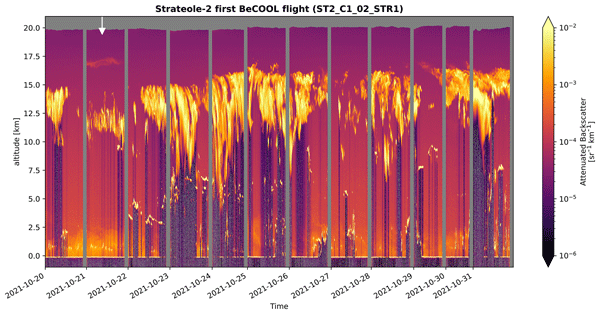
Abstract. The Balloonborne Cloud Observing micrOLidar (BeCOOL) has been developed to be operated onboard a stratospheric balloon in order to monitor the atmosphere below 20 km, more particularly thin ice clouds. This lidar system was designed to maintain a high level of performance while keeping its mass below 6 kg and limiting its power consumption to 4 W on average. Several balloons embarking BeCOOL instruments have been launched from the Tropics (Seychelles Islands, −4.68 S +55.45 E) during the STRATEOLE-2 campaign organized by the French Space Agency (Centre National d'Etudes Spatiales, CNES) in autumn and winter 2021−2022. The microlidar system, its operational performances, and the data processing to estimate optical properties are described. BeCOOL is able to measure optical depth of upper level thin ice clouds down to 2 × 10⁻⁵. It is possible to constrain the lidar ratio when the cloud optical depth is larger than 3 × 10⁻². In this case, the optical depth relative uncertainty is less than 10 %.
-
Notice on discussion status
The requested preprint has a corresponding peer-reviewed final revised paper. You are encouraged to refer to the final revised version.
-
Preprint
(8661 KB)
-
The requested preprint has a corresponding peer-reviewed final revised paper. You are encouraged to refer to the final revised version.
- Preprint
(8661 KB) - Metadata XML
- BibTeX
- EndNote
- Final revised paper


Journal article(s) based on this preprint
Interactive discussion
Status: closed
-
RC1: 'Comment on egusphere-2025-5905', Robin Wing, 06 Jan 2026
- AC1: 'Reply on RC1', François Ravetta, 09 Apr 2026
-
RC2: 'Comment on egusphere-2025-5905', Anonymous Referee #2, 17 Jan 2026
General comments
The paper describes the design of the Balloonborne Cloud Observing micrOLidar (BeCOOL) and introduces the applied signal processing and cloud property retrieval schemes. The microlidar can be flown on pressurized stratospheric balloons for several weeks. Impressive results from the first applications of the system during the STRATEOLE-2 campaign in 2021-2022 have already been published in an ACP highlight paper by Lesigne et al. (2024) and in Lesigne et al. (2025). With the present paper, the authors provide instrumental and methodological background that helps readers to better understand the data and assess their quality. Therefore, the paper is suitable for publication in AMT.
I recommend providing more scientific background and discussing aspects of the applied methodology in greater detail, as outlined below.
Specific comments
- The introduction should provide more scientific context. Research objectives, technical requirements, and atmospheric parameters to be measured with the new instrument should be discussed, considering also the state of the art and the anticipated advancements.
- In Sect. 2, information on the daytime/nighttime performance and operation should be given (in the caption of Fig. 6, it is mentioned that the instrument is not operated during daytime, but this is not discussed anywhere).
- The overlap function O and the lidar constant K are treated independently of each other in sections 3.2 and 3.3, respectively. However, as can be seen from Fig. 3 and 4, the normalization range used to determine K is exactly the range where the overlap function has its strongest sensitivity to misalignments (1-2 km distance from the platform). Please explain the combined effect of, e.g., temperature variations, on the retrieval of O and K.
- The terminology used in the context of the lidar signal normalization is confusing. For K, the terms “normalization constant” and “instrumental constant” are used. In Fig. 5, a “normalization coefficient” is shown without any further explanation. Please revise the wording and apply consistent terminology.
- When comparing BeCOOL and CALIOP observations of cirrus clouds, it is necessary to consider the pointing of the instruments. It is mentioned that BeCOOL is nadir-pointing. However, CALIOP pointed 3° off nadir most of the time to reduce the influence of specular reflections from horizontally oriented ice (HOI; e.g., Avery et al., 2020). The pointing is important for the determination of the apparent lidar ratio, because the strong backscatter from HOI drastically reduces the lidar ratio. This effect can contribute to the observed shift in the lidar ratio distributions from BeCOOL and CALIOP, i.e., multiple scattering might not be the only reason. Please discuss how the effect can be (or has been) minimized in your case and provide proper references.
- More explanation and discussion of the multiple-scattering effect and its correction is needed.
- The theoretical background is a bit hidden in sections 4 and 5. For non-experts, it might be difficult to follow the in-line equations and to put them into the context of Sect. 3 (equations on pages 5 and 6). It would be better to provide a complete set of variables, equations, and relationships at the beginning of the paper. Alternatively, at least the sought physical quantities should be clearly derived and indicated in sections 4 and 5. Numbering the equations will help with the referencing.
- The discussion in Sect. 4.1 implies that CALIOP measures “true” lidar ratios, but this is not the case. The multiple-scattering effect must be considered in CALIOP retrievals as well, and its influence is expected to be even larger for the spaceborne lidar. In general, η is not constant. It strongly depends on ice crystal size and is thus also a function of temperature and humidity. Consequences for the retrieval of lidar ratios and cirrus optical depth have been discussed in the literature (e.g., Garnier et al., 2015). Please provide more information and references on how multiple scattering is considered in the CALIOP retrievals, which assumptions are made, and how this influences the BeCOOL results that are based on comparisons with CALIOP data.
- The section on data availability is missing. Please provide information on the accessibility of both the balloonborne and the CALIOP data. For CALIOP, include information on data/algorithm version and provide respective references.
Technical corrections
Please make sure to explain all abbreviations. Check the use of BeCOOL vs BECOOL.
Fig. 1: In the right panel, inscribe the optical elements that are shown. Explain abbreviations in the figure caption.
Fig. 3: Please hint to the black line (overlap function) in the figure caption.
Fig. 7: The caption mentions “red brackets”. What does it mean? Are these the error bars on the red dots? Please clarify.
Table 1: Use the terms pulse length and pulse energy (not impulsion or impulse). Explain the abbreviations.
Equations: Variables should be indicated with a single letter. Abbreviation-like naming (RCS, BG) should be avoided. The equations should be numbered. Please refer to the AMT submission guidelines.
Line 17: …constraints…
Line 55: …spectrally narrow… (not thin)
Line 106: …two… (not tow)
Line 111/112: Please check the formulation of the sentence starting with “Actually, the raw signal…”.
Line 191, CALIOP lidar ratio database: Please provide reference and access information.
References
Avery, M. A., Ryan, R. A., Getzewich, B. J., Vaughan, M. A., Winker, D. M., Hu, Y., Garnier, A., Pelon, J., and Verhappen, C. A.: CALIOP V4 cloud thermodynamic phase assignment and the impact of near-nadir viewing angles, Atmos. Meas. Tech., 13, 4539–4563, https://doi.org/10.5194/amt-13-4539-2020, 2020.
Garnier, A., Pelon, J., Vaughan, M. A., Winker, D. M., Trepte, C. R., and Dubuisson, P.: Lidar multiple scattering factors inferred from CALIPSO lidar and IIR retrievals of semi-transparent cirrus cloud optical depths over oceans, Atmos. Meas. Tech., 8, 2759–2774, https://doi.org/10.5194/amt-8-2759-2015, 2015.
Citation: https://doi.org/10.5194/egusphere-2025-5905-RC2 - AC2: 'Reply on RC2', François Ravetta, 09 Apr 2026
Peer review completion


Interactive discussion
Status: closed
-
RC1: 'Comment on egusphere-2025-5905', Robin Wing, 06 Jan 2026
Review: Measuring cloud optical depth with a balloonborne microlidar operated from the stratosphere
The article describes the technical and data processing aspects of the balloon-borne lidar BeCOOL. A technique for deriving optical depth of upper tropospheric clouds is also shown. Overall the article is well written, the technique is well described and mature, the overlap calibration is reasonable, the transmission retrieval using forward and backwards integration is correct, the overlap correction and intentional misalignment is novel, the signal normalization using ECMWF is reasonable, and the two approaches for constrained vs. unconstrained optical depth retrievals make sense. I have no major comments or concerns for the article.
Minor points and comments:
The following points can be addressed or ignored by the authors as they choose. They are only suggestions, minor corrections or comments.
1) The Introduction could use a short paragraph about the importance of measuring clouds in the UTLS. Not critical, but it would provide some motivation for flying lidars on balloons.
2) Line 49: "BECOOL" --> "BeCOOL"
3) Figure 1. Please ensure all acronyms are explained in the caption.
4) Figure 2. We have started to 3D print our entire detector assemblies using carbon fibre. It is lighter, very rigid, and has nearly no thermal expansion. We have shown the technique to Gordien Strato and Jacques Porteneuve. It might be worth considering for future versions of BeCOOL
5) Line 129. Are you referring to the Junge Layer?
6) Adding a short paragraph to the conclusions addressing the significance of improved optical depth measurements would tie the article together nicely. Match with the points raised in Introduction paragraph.Citation: https://doi.org/10.5194/egusphere-2025-5905-RC1 - AC1: 'Reply on RC1', François Ravetta, 09 Apr 2026
-
RC2: 'Comment on egusphere-2025-5905', Anonymous Referee #2, 17 Jan 2026
General comments
The paper describes the design of the Balloonborne Cloud Observing micrOLidar (BeCOOL) and introduces the applied signal processing and cloud property retrieval schemes. The microlidar can be flown on pressurized stratospheric balloons for several weeks. Impressive results from the first applications of the system during the STRATEOLE-2 campaign in 2021-2022 have already been published in an ACP highlight paper by Lesigne et al. (2024) and in Lesigne et al. (2025). With the present paper, the authors provide instrumental and methodological background that helps readers to better understand the data and assess their quality. Therefore, the paper is suitable for publication in AMT.
I recommend providing more scientific background and discussing aspects of the applied methodology in greater detail, as outlined below.
Specific comments
- The introduction should provide more scientific context. Research objectives, technical requirements, and atmospheric parameters to be measured with the new instrument should be discussed, considering also the state of the art and the anticipated advancements.
- In Sect. 2, information on the daytime/nighttime performance and operation should be given (in the caption of Fig. 6, it is mentioned that the instrument is not operated during daytime, but this is not discussed anywhere).
- The overlap function O and the lidar constant K are treated independently of each other in sections 3.2 and 3.3, respectively. However, as can be seen from Fig. 3 and 4, the normalization range used to determine K is exactly the range where the overlap function has its strongest sensitivity to misalignments (1-2 km distance from the platform). Please explain the combined effect of, e.g., temperature variations, on the retrieval of O and K.
- The terminology used in the context of the lidar signal normalization is confusing. For K, the terms “normalization constant” and “instrumental constant” are used. In Fig. 5, a “normalization coefficient” is shown without any further explanation. Please revise the wording and apply consistent terminology.
- When comparing BeCOOL and CALIOP observations of cirrus clouds, it is necessary to consider the pointing of the instruments. It is mentioned that BeCOOL is nadir-pointing. However, CALIOP pointed 3° off nadir most of the time to reduce the influence of specular reflections from horizontally oriented ice (HOI; e.g., Avery et al., 2020). The pointing is important for the determination of the apparent lidar ratio, because the strong backscatter from HOI drastically reduces the lidar ratio. This effect can contribute to the observed shift in the lidar ratio distributions from BeCOOL and CALIOP, i.e., multiple scattering might not be the only reason. Please discuss how the effect can be (or has been) minimized in your case and provide proper references.
- More explanation and discussion of the multiple-scattering effect and its correction is needed.
- The theoretical background is a bit hidden in sections 4 and 5. For non-experts, it might be difficult to follow the in-line equations and to put them into the context of Sect. 3 (equations on pages 5 and 6). It would be better to provide a complete set of variables, equations, and relationships at the beginning of the paper. Alternatively, at least the sought physical quantities should be clearly derived and indicated in sections 4 and 5. Numbering the equations will help with the referencing.
- The discussion in Sect. 4.1 implies that CALIOP measures “true” lidar ratios, but this is not the case. The multiple-scattering effect must be considered in CALIOP retrievals as well, and its influence is expected to be even larger for the spaceborne lidar. In general, η is not constant. It strongly depends on ice crystal size and is thus also a function of temperature and humidity. Consequences for the retrieval of lidar ratios and cirrus optical depth have been discussed in the literature (e.g., Garnier et al., 2015). Please provide more information and references on how multiple scattering is considered in the CALIOP retrievals, which assumptions are made, and how this influences the BeCOOL results that are based on comparisons with CALIOP data.
- The section on data availability is missing. Please provide information on the accessibility of both the balloonborne and the CALIOP data. For CALIOP, include information on data/algorithm version and provide respective references.
Technical corrections
Please make sure to explain all abbreviations. Check the use of BeCOOL vs BECOOL.
Fig. 1: In the right panel, inscribe the optical elements that are shown. Explain abbreviations in the figure caption.
Fig. 3: Please hint to the black line (overlap function) in the figure caption.
Fig. 7: The caption mentions “red brackets”. What does it mean? Are these the error bars on the red dots? Please clarify.
Table 1: Use the terms pulse length and pulse energy (not impulsion or impulse). Explain the abbreviations.
Equations: Variables should be indicated with a single letter. Abbreviation-like naming (RCS, BG) should be avoided. The equations should be numbered. Please refer to the AMT submission guidelines.
Line 17: …constraints…
Line 55: …spectrally narrow… (not thin)
Line 106: …two… (not tow)
Line 111/112: Please check the formulation of the sentence starting with “Actually, the raw signal…”.
Line 191, CALIOP lidar ratio database: Please provide reference and access information.
References
Avery, M. A., Ryan, R. A., Getzewich, B. J., Vaughan, M. A., Winker, D. M., Hu, Y., Garnier, A., Pelon, J., and Verhappen, C. A.: CALIOP V4 cloud thermodynamic phase assignment and the impact of near-nadir viewing angles, Atmos. Meas. Tech., 13, 4539–4563, https://doi.org/10.5194/amt-13-4539-2020, 2020.
Garnier, A., Pelon, J., Vaughan, M. A., Winker, D. M., Trepte, C. R., and Dubuisson, P.: Lidar multiple scattering factors inferred from CALIPSO lidar and IIR retrievals of semi-transparent cirrus cloud optical depths over oceans, Atmos. Meas. Tech., 8, 2759–2774, https://doi.org/10.5194/amt-8-2759-2015, 2015.
Citation: https://doi.org/10.5194/egusphere-2025-5905-RC2 - AC2: 'Reply on RC2', François Ravetta, 09 Apr 2026
Peer review completion
Journal article(s) based on this preprint
Viewed
| HTML | XML | Total | BibTeX | EndNote | |
|---|---|---|---|---|---|
| 1,420 | 802 | 118 | 2,340 | 155 | 154 |
- HTML: 1,420
- PDF: 802
- XML: 118
- Total: 2,340
- BibTeX: 155
- EndNote: 154
Viewed (geographical distribution)
| Country | # | Views | % |
|---|
| Total: | 0 |
| HTML: | 0 |
| PDF: | 0 |
| XML: | 0 |
- 1
François Ravetta

Thomas Lesigne
Vincent Mariage
Jacques Pelon
The requested preprint has a corresponding peer-reviewed final revised paper. You are encouraged to refer to the final revised version.
- Preprint
(8661 KB) - Metadata XML
Review: Measuring cloud optical depth with a balloonborne microlidar operated from the stratosphere
The article describes the technical and data processing aspects of the balloon-borne lidar BeCOOL. A technique for deriving optical depth of upper tropospheric clouds is also shown. Overall the article is well written, the technique is well described and mature, the overlap calibration is reasonable, the transmission retrieval using forward and backwards integration is correct, the overlap correction and intentional misalignment is novel, the signal normalization using ECMWF is reasonable, and the two approaches for constrained vs. unconstrained optical depth retrievals make sense. I have no major comments or concerns for the article.
Minor points and comments:
The following points can be addressed or ignored by the authors as they choose. They are only suggestions, minor corrections or comments.
1) The Introduction could use a short paragraph about the importance of measuring clouds in the UTLS. Not critical, but it would provide some motivation for flying lidars on balloons.
2) Line 49: "BECOOL" --> "BeCOOL"
3) Figure 1. Please ensure all acronyms are explained in the caption.
4) Figure 2. We have started to 3D print our entire detector assemblies using carbon fibre. It is lighter, very rigid, and has nearly no thermal expansion. We have shown the technique to Gordien Strato and Jacques Porteneuve. It might be worth considering for future versions of BeCOOL
5) Line 129. Are you referring to the Junge Layer?
6) Adding a short paragraph to the conclusions addressing the significance of improved optical depth measurements would tie the article together nicely. Match with the points raised in Introduction paragraph.