
the Creative Commons Attribution 4.0 License.
the Creative Commons Attribution 4.0 License.
 | 19 Jan 2026
High-resolution inversion of methane emissions over Europe using the Community Inversion Framework and FLEXPART
Abstract. Constraining methane (CH4) emissions at high spatial and temporal resolution is critical for accurate European greenhouse gas budgets and mitigation policy. We use the Community Inversion Framework to estimate monthly CH4 fluxes across Europe (2017–2022) at 0.2° × 0.2°, coupling the FLEXPART and assimilating observations from 46 in situ stations, including ICOS and non-ICOS sites. Prior emissions combine GAINS and EDGARv8 anthropogenic inventories with GFED biomass burning, JSBACH-HIMMELI wetland fluxes, and climatological natural sources. The inversion markedly improves agreement with atmospheric observations (r2 = 0.87, RMSE = 24.35 ppb, mean bias = –2.14 ppb), performing best at northern European stations. Posterior EU27+3 CH4 totals 23.28 ± 0.36 Tg CH4 yr⁻¹, 6.6 % above the prior. Anthropogenic emissions average 17.6 ± 0.3 Tg CH4 yr⁻¹, exceeding GAINS by 11 %, EDGARv8 by 4 %, and UNFCCC NGHGI (2023) by 3 %, consistent with recent studies. Country-level differences are substantial: emissions are higher in BENELUX (+54 %), Germany (+37 %), and France (+10 %), and lower in the UK (–11 %), Romania (–25 %), Poland (–16 %), and Italy (–11 %) compared to UNFCCC NGHGI (2023). Sectoral changes primarily reflect agricultural increases in western and central Europe, with reductions in northern wetlands and southern geological sources. Sensitivity tests highlight the influence of horizontal correlation length and the value of dense observational networks for refining regional CH4 budgets.
-
Notice on discussion status
The requested preprint has a corresponding peer-reviewed final revised paper. You are encouraged to refer to the final revised version.
-
Preprint
(20171 KB)
-
The requested preprint has a corresponding peer-reviewed final revised paper. You are encouraged to refer to the final revised version.
- Preprint
(20171 KB) - Metadata XML
- BibTeX
- EndNote
- Final revised paper


Journal article(s) based on this preprint
Interactive discussion
Status: closed
- RC1: 'Comment on egusphere-2025-5877', Anonymous Referee #1, 09 Feb 2026
-
RC2: 'Comment on egusphere-2025-5877', Anonymous Referee #2, 20 Feb 2026
This study utilizes methane concentration observations from 46 ground-based stations across Europe to estimate European methane emissions from 2017 to 2022 using a constructed Community Inversion Framework. The manuscript reveals corrections to bottom-up emission fluxes across different sources and regions on a monthly scale and analyzes the sensitivity of the results to various inversion parameter assumptions. The study addresses significant scientific questions and is well-constructed. The inversion methodology is described in detail and appears robust, with a comprehensive analysis of the results. I recommend publication after the authors address the following (mostly technical) comments.
Specific Comments
Section 2.1: The ability of the inversion system to distinguish between different methane sources needs further justification. The manuscript claims to constrain different sources (Line 85). While technically feasible within the inversion framework, atmospheric methane emitted from different sectors is physically indistinguishable without isotopic data or co-emitted tracers. Consequently, the source attribution in the posterior results likely relies heavily on the spatial patterns provided by the prior inventory. I suggest the authors avoid overstating this capability. A more critical discussion is needed regarding the extent to which the observational data actually contains sufficient independent information to disentangle different methane sources.
Section 2.2: Please clarify how the OH sink is treated in the model. Is it accounted for within the last two terms of Equation 8? Providing a more explicit explanation of the OH representation would improve the clarity of the methodology.
Section 2.4: Inland water emissions (other than wetlands) appear to be excluded from the analysis. What is the rationale for this omission? Based on existing literature, what is the estimated magnitude of inland water emissions within the study domain? The authors should discuss how neglecting this source might bias or affect the inversion results.
Section 2.5: Lines 213–223 provide a sound justification for the selection of the observation time windows, which is reasonable. However, could the authors provide information regarding the temporal standard deviation of the measurements during these periods? This would be helpful to understand the variability of the data used.
Line 262: Could you elaborate on the background concentrations derived from the CAMSv22r2 and CTE-CH4 datasets? Are these derived from global inversions, and do they fully cover the 2017–2022 study period? Furthermore, there appears to be some confusion between the terms "initial concentration" and "background concentration." The text refers to "background concentration," while Table 2 lists "initial concentration." Do these terms refer to the same variable? My understanding is that "background concentration" refers to the methane concentration influenced by fluxes and sinks outside the regional domain (i.e., boundary conditions). Please clarify and ensure consistent terminology throughout the manuscript.
Minor Comments
Line 13: The phrase "the influence of horizontal correlation length" may be too technical (jargon) for the abstract. Please consider rephrasing it to be more accessible to a broader audience.
Structure: Some paragraphs are excessively long, such as the block from Line 280 to 326. I suggest breaking these into smaller paragraphs to improve readability.
Citation: https://doi.org/10.5194/egusphere-2025-5877-RC2 - AC1: 'Comment on egusphere-2025-5877', Anteneh Getachew Mengistu, 14 Apr 2026
Peer review completion


Interactive discussion
Status: closed
-
RC1: 'Comment on egusphere-2025-5877', Anonymous Referee #1, 09 Feb 2026
In “High-resolution inversion of methane emissions over Europe using the Community Inversion Framework and FLEXPART,” Mengistu and co-authors use the CIF system and Flexpart model to perform a 4D-Var data assimilation over Europe. The state vector includes CH4 concentrations and CH4 surface fluxes. Authors distinguish different sectors in the inversions and perform the inversions at 0.2x0.2 degrees. Results are compared to observations and compared to other inventories, including countries’ UNFCCC reporting. Overall I think this is a valuable study and has potential to be of strong interest to ACP readers. However, improvement is needed in the handling of uncertainty and description of the methods, particularly how prior error covariances are developed for the sectoral attribution.
General comments
Sectoral results heavily rely on sectoral correlations B, which contains correlation structure C. How is matrix C constructed? Are the same assumptions used for all sectors? There are many subjective choices for building this correlation matrix. It is not clear from the manuscript what these choices are.
How sensitive are the optimized fluxes to the observations? Can authors show the footprint map from the Flexpart simulations, are all areas of the map sensitive to the observations? I am particulary curious about Italy and the southern Europe region, where there are few observing stations but very large corrections.
Uncertainty on the results is not stated when results are given. The authors performed a sensitivity inversion, but only for 1 month due to computational cost. What are the implications for overall uncertainty on the year-to-year estimates? In addition to discussing the uncertainty in the 1-month estimates, can authors describing the implications for uncertainty levels on the overall results, and include that with the results? For example, on the bar chart in Figure 9 and time series in Figure 5. Or, can authors use posterior uncertainties described in lines 274-276 to present the results with their uncertainties?
In general, using 2 decimal places for CH4 concentrations in ppb implies that the model and measurements have precision down to the hundredth of a ppb. I doubt this is the case, and in my opinion using 0 or 1 decimal places would be much better. Similar for emissions, describing emissions down to 0.01 Tg precision implies a high degree of confidence in the results, but I am not convinced this level of precision is warranted. Including uncertainty ranges as mentioned above could help with this.
Specific comments
- Line 16 – there is a more recent citation for the Global Methane Budget (Saunois et al. 2025 https://doi.org/10.5194/essd-17-1873-2025)
- Line 112-113 – the sentence is confusing. Is the purpose of the sentence to state that analytical methods give a closed form expression for the posterior error covariance, while variational methods do not provide a posterior error covariance? If so, this should be stated. Does CIF-Flexpart give a posterior error covariance? Please clarify.
- Line 143 – The methods are a bit unclear. Are two separate inversions being performed, one for total flux and another for specific sectors? Or are all sectors included in the state vector and all optimized with concentrations in a single inversion?
- Line 161 – some more detail on the 3D OH fields are needed as these vary quite a bit (a citation to the study or model version is probably sufficient).
- Line 183 – please state the significance of there being ICOS and non-ICOS observations – what is the difference between these networks? Are the measurements of different quality?
- Lines 191-194 – Are the measurements at the sites in the same grid boxes comparable? Or, can authors provide some other justification for choosing arbitrarily? Are results sensitive to this choice?
- Line 208 – again the ICOS definitions are unclear. Please define “ICOS levelling,” and the significance that data are ICOS labeled after a certain time.
- Line 274-275 – How posterior error covariances are specific is unclear. Please give a brief description or equation.
- Lines 276-277 – what are the expected impact of only doing the sensitivity tests in the summer? Methane’s seasonality in both emissions and background concentrations in the northern midlatitudes is significant, affecting background and wetland sources, please comment on the significance of this. Even better would be to do winter senstivity tests but this is likely computationally prohibitive.
- Could authors please comment on the very large GEO decrease over Italy? The signal is a similar magnitude as wetland and anthropogenic emissions which is surprising.
- Lines 404-410 – authors may be interested in and should consider citing two recent papers regarding seasonal cycles of energy sector emissions Varon et al. 2025 ES&T (https://doi.org/10.1021/acs.est.5c08745) and Hu et al. 2025 ES&T (https://doi.org/10.1021/acs.est.4c14090)
- Lines 476 – Authors may also be interested in and should consider citing East et al. 2025 Nat Comm (https://doi.org/10.1038/s41467-025-67122-8) comparing inversion results to UNFCCC reports, and whether they see similar changes
- What is the temporal resolution of the optimizations?
- Lines 501-502 – could authors clarify what is meant by “fine-scale emissions patterns that are not accessible through conventional analytical inversion techniques”? I’m not sure this is a true statement.
Technical corrections
- Abstract contains many undefined acronyms
- Line 83 – parentheses around ICOS are missing
- Figure 2 – I appreciate authors showing all of the data, but it is difficult to parse apart Fig 2 and make sense of it. Markers are quite small and cover one another, and the colors are difficult to distinguish and keep track of. Please consider if there is any way to make the plot more clear to aid readability.
- Figure 9 – Y-axis is not labeled, what do the different bars with the same color represent?
- Fig 7 – This figure is unclear. Where are the ranges coming from for the boxplots, from the posterior uncertainty? Or temporal variability? What is the yellow shaded area that is referred to in the description, could there be a typo?
Citation: https://doi.org/10.5194/egusphere-2025-5877-RC1 -
RC2: 'Comment on egusphere-2025-5877', Anonymous Referee #2, 20 Feb 2026
This study utilizes methane concentration observations from 46 ground-based stations across Europe to estimate European methane emissions from 2017 to 2022 using a constructed Community Inversion Framework. The manuscript reveals corrections to bottom-up emission fluxes across different sources and regions on a monthly scale and analyzes the sensitivity of the results to various inversion parameter assumptions. The study addresses significant scientific questions and is well-constructed. The inversion methodology is described in detail and appears robust, with a comprehensive analysis of the results. I recommend publication after the authors address the following (mostly technical) comments.
Specific Comments
Section 2.1: The ability of the inversion system to distinguish between different methane sources needs further justification. The manuscript claims to constrain different sources (Line 85). While technically feasible within the inversion framework, atmospheric methane emitted from different sectors is physically indistinguishable without isotopic data or co-emitted tracers. Consequently, the source attribution in the posterior results likely relies heavily on the spatial patterns provided by the prior inventory. I suggest the authors avoid overstating this capability. A more critical discussion is needed regarding the extent to which the observational data actually contains sufficient independent information to disentangle different methane sources.
Section 2.2: Please clarify how the OH sink is treated in the model. Is it accounted for within the last two terms of Equation 8? Providing a more explicit explanation of the OH representation would improve the clarity of the methodology.
Section 2.4: Inland water emissions (other than wetlands) appear to be excluded from the analysis. What is the rationale for this omission? Based on existing literature, what is the estimated magnitude of inland water emissions within the study domain? The authors should discuss how neglecting this source might bias or affect the inversion results.
Section 2.5: Lines 213–223 provide a sound justification for the selection of the observation time windows, which is reasonable. However, could the authors provide information regarding the temporal standard deviation of the measurements during these periods? This would be helpful to understand the variability of the data used.
Line 262: Could you elaborate on the background concentrations derived from the CAMSv22r2 and CTE-CH4 datasets? Are these derived from global inversions, and do they fully cover the 2017–2022 study period? Furthermore, there appears to be some confusion between the terms "initial concentration" and "background concentration." The text refers to "background concentration," while Table 2 lists "initial concentration." Do these terms refer to the same variable? My understanding is that "background concentration" refers to the methane concentration influenced by fluxes and sinks outside the regional domain (i.e., boundary conditions). Please clarify and ensure consistent terminology throughout the manuscript.
Minor Comments
Line 13: The phrase "the influence of horizontal correlation length" may be too technical (jargon) for the abstract. Please consider rephrasing it to be more accessible to a broader audience.
Structure: Some paragraphs are excessively long, such as the block from Line 280 to 326. I suggest breaking these into smaller paragraphs to improve readability.
Citation: https://doi.org/10.5194/egusphere-2025-5877-RC2 - AC1: 'Comment on egusphere-2025-5877', Anteneh Getachew Mengistu, 14 Apr 2026
Peer review completion
Journal article(s) based on this preprint
Viewed
| HTML | XML | Total | BibTeX | EndNote | |
|---|---|---|---|---|---|
| 1,743 | 1,546 | 156 | 3,445 | 114 | 171 |
- HTML: 1,743
- PDF: 1,546
- XML: 156
- Total: 3,445
- BibTeX: 114
- EndNote: 171
Viewed (geographical distribution)
| Country | # | Views | % |
|---|
| Total: | 0 |
| HTML: | 0 |
| PDF: | 0 |
| XML: | 0 |
- 1
Anteneh Getachew Mengistu

Aki Tsuruta
Antoine Berchet
Rona Thompson
Maria Tenkanen
Hannakaisa Lindqvist
Tiina Markkanen
Antti Leppänen
Antti Laitinen
Adrien Martinez
Audrey Fortems-Cheiney
Lena Höglund-Isaksson
Tuula Aalto
The requested preprint has a corresponding peer-reviewed final revised paper. You are encouraged to refer to the final revised version.
- Preprint
(20171 KB) - Metadata XML
In “High-resolution inversion of methane emissions over Europe using the Community Inversion Framework and FLEXPART,” Mengistu and co-authors use the CIF system and Flexpart model to perform a 4D-Var data assimilation over Europe. The state vector includes CH4 concentrations and CH4 surface fluxes. Authors distinguish different sectors in the inversions and perform the inversions at 0.2x0.2 degrees. Results are compared to observations and compared to other inventories, including countries’ UNFCCC reporting. Overall I think this is a valuable study and has potential to be of strong interest to ACP readers. However, improvement is needed in the handling of uncertainty and description of the methods, particularly how prior error covariances are developed for the sectoral attribution.
General comments
Sectoral results heavily rely on sectoral correlations B, which contains correlation structure C. How is matrix C constructed? Are the same assumptions used for all sectors? There are many subjective choices for building this correlation matrix. It is not clear from the manuscript what these choices are.
How sensitive are the optimized fluxes to the observations? Can authors show the footprint map from the Flexpart simulations, are all areas of the map sensitive to the observations? I am particulary curious about Italy and the southern Europe region, where there are few observing stations but very large corrections.
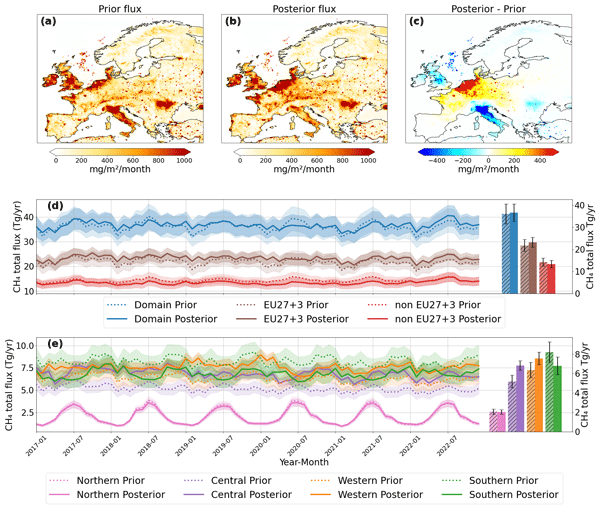
Uncertainty on the results is not stated when results are given. The authors performed a sensitivity inversion, but only for 1 month due to computational cost. What are the implications for overall uncertainty on the year-to-year estimates? In addition to discussing the uncertainty in the 1-month estimates, can authors describing the implications for uncertainty levels on the overall results, and include that with the results? For example, on the bar chart in Figure 9 and time series in Figure 5. Or, can authors use posterior uncertainties described in lines 274-276 to present the results with their uncertainties?
In general, using 2 decimal places for CH4 concentrations in ppb implies that the model and measurements have precision down to the hundredth of a ppb. I doubt this is the case, and in my opinion using 0 or 1 decimal places would be much better. Similar for emissions, describing emissions down to 0.01 Tg precision implies a high degree of confidence in the results, but I am not convinced this level of precision is warranted. Including uncertainty ranges as mentioned above could help with this.
Specific comments
Technical corrections