
the Creative Commons Attribution 4.0 License.
the Creative Commons Attribution 4.0 License.
 | 08 Jan 2026
Evaluating Different Roughness Approaches and Infiltration Parameters for Vegetation-Influenced Overland Flow in Hydrological Model
Abstract. Accurately simulating overland flow in vegetated landscapes remains a challenge in hydrological modeling due to the complex interactions between vegetation, surface roughness, and soil infiltration. This study evaluates multiple methods for estimating Manning's roughness coefficient and explores the influence of vegetation on infiltration processes using the OpenLISEM model. Based on 132 artificial rainfall experiments across 22 sites in southwest Germany, the model was calibrated and validated against observed runoff data, incorporating both depth-independent and depth-dependent roughness formulations. Incorporating water depth-dependent roughness into the model can improve its performance in simulating overland flow. Beyond roughness effects, vegetation was shown to significantly alter soil hydraulic properties, particularly saturated hydraulic conductivity (Ksat). Paired site comparisons revealed that increased vegetation cover corresponded with higher infiltration capacities, emphasizing vegetation's role not only in surface resistance but also in enhancing subsurface water fluxes. The findings demonstrate that models must account for both surface and subsurface impacts of vegetation to improve runoff predictions.
-
Notice on discussion status
The requested preprint has a corresponding peer-reviewed final revised paper. You are encouraged to refer to the final revised version.
-
Preprint
(2399 KB)
-
The requested preprint has a corresponding peer-reviewed final revised paper. You are encouraged to refer to the final revised version.
- Preprint
(2399 KB) - Metadata XML
- BibTeX
- EndNote
- Final revised paper


Journal article(s) based on this preprint
Interactive discussion
Status: closed
-
RC1: 'Comment on egusphere-2025-5855', P. Oberle, 09 Mar 2026
- AC1: 'Reply on RC1', Philipp Kraft, 21 May 2026
-
RC2: 'Comment on egusphere-2025-5855', Bob Zwartendijk, 17 Apr 2026
General:
This manuscript provides valuable insight into the importance and sensitivity of roughness parameterization and infiltration values commonly applied in hydrological modelling and engineering decision‑making. The authors employ appropriate methods to address their research objectives; however, there is room for improvement in the justification and explanation of certain methodological choices, as well as in the presentation of the results. The use of previously published data to implement the modelling framework is appropriate and well justified. I strongly recommend expanding the description of the modelling approach and the application of the referenced data in Section 2, as detailed in the specific comments. In addition, strengthening the introduction and better aligning the overall storyline with the discussion would further enhance the scientific contribution and overall impact of the study.
Specific comments
- Lines 21-32, it makes your case stronger if you link your statements to more or general (important) references (as applied after line 32). 1A: I.e. In line 25, you cite Zhang et al. 2018, I assume there are much more (important, or general) references underlining this statement. Please check/read and especially references therein or there to:
- Busari et al. 2016 https://doi.org/10.1016/j.jher.2016.02.003
- Crompton et al. 2020 https://doi.org/10.1029/2020WR027194
- Jackson and Klaus 2025 https://doi.org/10.1029/2025WR040753
- Bachmair et al. 2012 https://doi.org/10.1029/2011WR011196
- Crompton et al. 2025 https://doi.org/10.1029/2024WR037176
B: I.e. 2, Line 26. There are much more (important, or general) references underlining this statement, please check/read and especially references therein or there to (as you already do in the discussion!):
-
- Beven and Germann, 1982 https://doi.org/10.1029/WR018i005p01311
- Cerda, 1996. https://doi.org/10.1016/0016-7061(95)00062-3
- Liu et al. 2025 https://doi.org/10.1016/j.jhydrol.2024.132465
- Thompson et al. 2010 https://doi.org/10.1029/2009JG001134
- Zwartendijk et al. 2017 https://doi.org/10.1016/j.agee.2017.01.002
- Line 45 “… staple area of research within hydrology”, explain and/or add reference. This needs to be phrased stronger.
- Lines 53-56. The coherence between the sentences is not clear. What is examined in this study and what is the additional value after the previous mentioned studies? Which findings highlight the need for further evaluation?
- Lines 57-59. You’re totally right. You may consider re-structuring your introduction in line with previous comments on references. Try to synchronize your introduction and discussion such that your discussion finishes the line from introduction, to methods, and your results to the discussion. Try to embed the references from the discussion into the introduction.
- Lines 57-59. A pity that, again, limited references are shown. I think it is important to show that some cases/models are available incorporating infiltration and roughness (varying per land cover/vegetation type), although examples are limited. i.e.: VanderKwaak and Loague, 2001. https://doi.org/10.1029/2000WR900272, And their more recent studies, i.e. cited in Zwartendijk et al. 2026 https://doi.org/10.1016/j.jhydrol.2026.135259 and Schwemmle et al. https://doi.org/10.5194/gmd-17-5249-2024
- Your objectives suggest modelling, but you start section 2 (Materials and methods) with the study site and experimental set-up which is not part of your study. I strongly recommend that you start explaining your approach (to model) but the use of previously gathered data conform your objectives (perhaps mention this approach already in your introduction?).
- Line 111, “The elevation model is generated”. How? Lidar? Measured by…? Third-party data? Accuracy?
- Line 113, what is the definition of a homogeneous surface?
- Line 113-115, perhaps cite other research applying the same simplification? Or explain why.
- Lines 116-120. You mention that Ries et al. (2020) measured flow at three locations within the trench, but I found this part difficult to follow. The explanation does not clearly correspond to the photograph shown in Figure 1b, making it hard to place these measurement points spatially. I recommend indicating the measurement locations explicitly in Figures 1a and 1b (e.g., using markers or annotations) to improve clarity. The same applies to the description of the trench geometry and the “one‑third” section, which is not clearly identifiable from Figure 1b alone.
- Lines 127-135. “are not typically measured in the field”. Why not? If in general, add references. If our co-scientists of Ries et al. 2020 did not measured it (i.e. because it was not their scope), just mention that it’s not measured or available.
- Line 133 “calibrated to best match observed runoff data”, is this explained elsewhere? Perhaps insert link to sub-section.
- Line 133, “It should be considered that, …”, do you mean “It should be kept in mind that,…”?
- Lines 143-157, a part is repetitive (introduction?). Please elaborate on the two depth and five depth-independent roughness functions, it is not clear why you introduce 2 methods but show 7 options in the fallowing paragraphs. Make sure you introduce 2.2.1 – 2.2.7. In its current form it is not clear why you introduce these different concepts. Which did you applied?
- Lines 208-209, as a reader I had to check which 6 runs you’re aiming for. Please consider restructuring the methodology. Also, which of the runs did you selected and why? I don’t think line 218-221 is the right location to mention this.
- You created a very nice flow chart (of your methodology?), figure 2. Consider some minor editions conform previous comments and show this early in the methodology! I think it improves the readability of the methods section majorly! 😊
- Table 3. You may increase the readability to use ranges and just the > and < symbols, not mentioning NSE and pBias in the table as that is given in the header already. So: >0.75 for good, 0.36 – 0.75 for qualified, and <0.36 for not-qualified.
- Line 240-241 consider a reference or longer explanation.
- The figure is difficult to interpret in its current form. In the text, negative NSE values are discussed, but these are not visible in the figure. In addition, the red bars are described as indicating model failure, yet they appear to correspond to NSE = 1, which seems inconsistent with the definition and discussion of NSE. I recommend reconsidering the figure type or its visual encoding to clearly distinguish positive, zero, and negative NSE values and to ensure consistency between the figure and the accompanying text.
- Table 4 and related text, perhaps I missed it, but how realistic are the calibrated parameters? Does it match with field or literature values?
- Lines 284-286, did you used a statistical comparison method like Anova or? If yes, not mentioned in the methods?
- Lines 290-294, you may consider to move these lines to the Discussion section. You may consider to add references to support your claims.
- Effect of initial condition and pre-event soil moisture. Can this be explained as temporarily hydrophobicity of the soil for example? I think it’s recommended to elaborate on this in the discussion as initial condition of soil moisture has a large impact on your (and other research’s) outcomes.
- Lines 329-330, Please elaborate on this as its purpose and contribution to this paragraph is not clear to me as its not described in the methodology section. Are you comparing the individual sites or the separate model outcomes? I suggest to extend the methodology so its clear to the reader what kind of comparisons you made (and using with methods are used for these comparisons).
- Figure 8. Are you presenting calibrated or measured Ksat values? Did you determined the vegetation cover yourself or are the values determined by Ries et al. (2020)?
- Lines 385-387 add reference, idem for 387-389.
- Lines 419-423, add references.
- Lines 453-459. Please consider incorporating references from studies conducted in different climatic and geological settings to place the results in a broader context. Furthermore, I suggest replacing the phrase “validate previous research” with “are in line with studies elsewhere”, which is more appropriate and nuanced given the scope of the analysis.
- Lines, 471-473, in line with remark/comment #20, please elaborate on the estimation/range on the calibrated parameters (Ksat)? Does it match with field or literature values? Which model result not only in the most realistic outcome, but also in the most realistic values for psi and Ksat values? Consider keeping this paragraph descriptive and analytical, with final conclusions presented in the Conclusion.
Technical corrections and possible editions
- Line 15 (and elsewhere), you may consider changing Ksat into Ksat
- Line 44, add additional reference.
- Line 75, end with a .
- Line 231, MSE should be NSE?
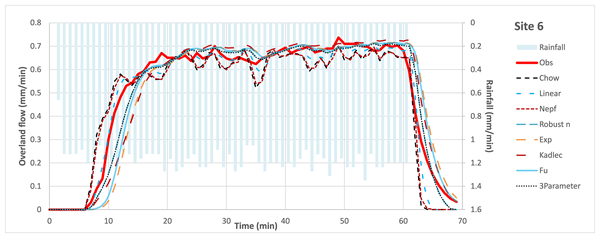
- Figure 3, in the current pdf version the figure is (too) small, make sure in the final version that it is readable!
- Figure 5. To increase the readability, you may consider to use the same lay-out as figure 4 (after editions).
- Line 370, multiple spaces between “lower” and “NSE values”.
- Line 475, I suggest to rephrase this to: “Our study evaluates seven roughness estimation methods and their impact to overland flow modelling using OpenLISEM”.
- Line 476, I suggest to replace this sentence by one summarizing your applied methodology.
- Line 491, be specific, what is “this” model, the OpenLISEM?
- AC2: 'Reply on RC2', Philipp Kraft, 21 May 2026
- Lines 21-32, it makes your case stronger if you link your statements to more or general (important) references (as applied after line 32). 1A: I.e. In line 25, you cite Zhang et al. 2018, I assume there are much more (important, or general) references underlining this statement. Please check/read and especially references therein or there to:
-
RC3: 'Comment on egusphere-2025-5855', Anonymous Referee #3, 18 Apr 2026
The study addresses an important topic—integrating depth-dependent roughness and vegetation-induced infiltration changes into overland flow modeling. However, several major and minor issues need to be addressed before publication.
Specific comments
- Methodological clarity and justification (Lines 85–100, 125–135)
The study uses 132 artificial rainfall experiments from 22 sites (excluding Site 10). However, the selection of calibration runs (Run 2 for most sites, except Sites 1 and 14) is insufficiently justified. Why is Run 2 considered “neither excessively dry nor fully saturated”? Provide quantitative criteria (e.g., measured soil moisture ranges). Additionally, the handling of zero-runoff events (Sites 12, 16, Run 1) by excluding them from NSE calculation is problematic. The authors should discuss how this affects the representativeness of model performance.
- Parameter calibration strategy (Lines 205–220, Table 4)
The calibration uses 5,000 simulations per model (880,000 total) with Latin hypercube sampling. However, the ranges for Ksat (5–100 mm/hr) and Psi (0–50 cm) are very broad. Why were these ranges chosen? Are they based on prior studies or site-specific measurements? Moreover, the conclusion that “differences between roughness methods are generally not significant for Ksat (p=0.94)” is misleading because the calibration may not be sensitive enough to distinguish them. A sensitivity analysis should be added.
- Handling of Fu’s method failure (Lines 255–265, 365–375)
The authors report that Fu’s method completely failed at Sites 5, 8, 15, 20, and 23 (negative NSE, pBias = -100). They attribute this to lack of vegetation cover at four of these sites. However, Site 20 (corn harvested, 0% cover) and Site 23 (corn harvested, 0% cover) are both unvegetated, but Fu’s method performed differently? Please clarify. Also, the explanation that Fu’s equation behaves differently when Cp < 0.74 is interesting but not quantitatively linked to the observed failures. Provide a figure or table showing Cp values for all sites.
- Vegetation effects on Ksat (Lines 335–350, Figure 8)
The paired-site comparison (e.g., Sites 15 vs. 16) shows higher Ksat with more vegetation cover. This is a key finding. However, the authors do not statistically test whether the differences in Ksat between paired sites are significant (e.g., t-test or ANOVA). Additionally, the role of soil type should be disentangled from vegetation effects—some paired sites have different soil textures (e.g., Sites 8 and 9: sandy loam vs. sandy loam? Actually Table 1 shows both as sandy loam, but Psi differs greatly). Please discuss.
- Initial soil moisture issues (Lines 315–330, 410–425)
The poor performance for Run 1 (dry) and Run 5 (saturated) is attributed to antecedent moisture conditions. The authors suggest that the Green-Ampt model assumes initially dry soil, leading to unrealistic estimates under wet conditions. This is a critical limitation. The authors should quantify the error (e.g., RMSE or bias) for these runs compared to others. Also, consider testing a modified Green-Ampt or a different infiltration model (e.g., Richards’ equation) in a follow-up sensitivity analysis.
- Statistical analysis (Lines 290–300, 305–310)
ANOVA results are reported (p = 0.94 for Ksat, p = 0.038 for Psi, p = 0.4 for NSE excluding Fu/Exp). However, the authors do not report post-hoc tests (e.g., Tukey HSD) to identify which specific roughness methods differ. Also, the statement “no significant differences are observed among the remaining roughness methods” (p=0.4) is weak because the sample size is small (only 22 sites). Please add effect sizes (e.g., Cohen’s d) or Bayesian statistics.
Minor Comments
- Line 45–50: The phrase “continues to be a staple area of research” is informal. Replace with “remains a fundamental topic in hydrology.”
- Line 85: Section heading “2.1 Model” should be “2.2 Model” (since 2.1 is study site).
- Line 125: “Isecond” → “1 second”.
- Line 165–170: Equation (1) uses Strickler coefficient k_str. How is k_str estimated from Chow (1959)? Provide a reference or formula.
- Line 190: Equation (4) (Kadlec’s method): The assumption that h0 = 5 × plant height is arbitrary. Justify this or test sensitivity to h0.
- Line 240: Section “4 Result” → “4 Results”.
- Line 255–260: The sentence “Overall, the NSE values … showed limited variation at each site” contradicts Figure 4, where some sites show NSE from 0.2 to 0.9. Please clarify.
- Figure 3: The hydrograph comparison is difficult to read because line colors are not distinguished in grayscale. Use different line styles or labels.
- Line 375–380: The authors state that “water depth remained below vegetation height” (emergent flow). How was this verified? Provide maximum water depth values for each site or run.
- Line 465–475: The conclusion that “the dataset is not sufficient to quantify the vegetation effect on Ksat” contradicts the paired-site analysis. Either provide a quantitative estimate (e.g., % increase per 10% vegetation cover) or tone down the claim.
- References: Several references are incomplete (e.g., van Meerveld et al., 2019, Line 550 has a truncated title). Please check all references against HESS formatting guidelines.
Citation: https://doi.org/10.5194/egusphere-2025-5855-RC3 - AC3: 'Reply on RC3', Philipp Kraft, 21 May 2026
Peer review completion


Interactive discussion
Status: closed
-
RC1: 'Comment on egusphere-2025-5855', P. Oberle, 09 Mar 2026
I would like to begin by thanking the authors for their research and for sharing their findings for discussion. Given the increasing frequency of intense rainfall events with significant damage potential, and the considerable efforts by federal states to produce high-resolution heavy rainfall hazard maps, advancing hydrological and hydraulic modeling remains crucial. In particular, there is an urgent need to better quantify and model how varying vegetation conditions affect runoff generation and overland flow dynamics. In this context, the authors’ work is highly valuable, offering insights that are both scientifically relevant and practically applicable.
At the same time, I see room for minor improvement in the presentation of the results, with the aim of making the findings clearer and more accessible to the professional community. Before providing our detailed comments and questions, I would like to share some general critical-constructive observations:
The model setup appears to differ from the study sites described by Ries et al., as the discharge in the model is measured at a different location compared to Ries, where, to my understanding, discharge was recorded 10–20 m downstream of the plot via drainage tubes. This discrepancy could lead to distortions in the subsequent evaluation and should at least be acknowledged as a source of uncertainty. It may also partly explain the differences observed between the model results, the Feldmann data (which presumably have comparable uncertainties), and the experimental measurements. Additionally, providing a rough overview of the ranges of discharge, flow velocities, and water depths across the plot would be highly useful for context and interpretation.
The study emphasizes the influence of vegetation cover, suggesting effects not only on the roughness coefficient but also on key infiltration parameters. However, this impact may be partly inherent to the modeling approach: because the model is calibrated using the original data, where these patterns are already present, the results could reflect a degree of circular reasoning, effectively producing a self-fulfilling confirmation of the initial observations. Also, some of the figures are partly difficult to read and could be improved.
L10 introduce also ksat and psi to complete the picture
L98 Original data resolution of 1min. Does this have a impact on the results? What are the uncertainties?
L105 To explore the impact of roughness on overland flow -> To explore the impact of different roughness functions on overland flow… would be more appropriate?
L113 Microrelief / Microtopography should better fit to roughness coefficients instead of depressions which are mainly connected to retention effects
L115-120 The differences between original setup and model needs to be addressed somehow. At least that this leads to uncertainties of the results. Could be also an explanation for the differences to the results of Feldmann?
L125 model data 1s. original data 1min. How does this influence the results?
L126 … kinematic wave is used together …
L128 Porosity and initial soil moisture was estimated or measurement data? Same for all model runs?
L131 What are the reasonable ranges?
L142 Surface roughness functions -> maybe “Flow resistance parameterisation” is better
L146 complicated sentence, maybe: In this study, two depth-independent and five depth-dependent roughness functions were implemented in OpenLISEM to assess the impact of the investigated approaches on vegetation modelling.
L150 Chow´s method could be changed to method with constant coefficients as it´s more like Manning´s method and chow provided reference tables / guidelines.
L153 … it does not consider the effect of water depth in presence of vegetation. -> … it does not consider the dynamic effect of water depth on the roughness coefficient in presence of vegetation.
L155 add that the same study site and experiments have been used by Feldmann
L157 They estimate surface roughness -> roughness coefficients maybe more suitable?
L169 in equation (1): 5 ∙ hveg
L185 1-2 sentences about this approach would help for understanding
L195 Only Hinsberger et al.; not in Oberle et al. 2021
L208 Please insert the unknown sensitive parameters
L211 It remains unclear on what basis the values from Chow were selected. Average? Max or Min?
L222 (NSE) instead of L224
L232 MSE -> NSE
L248 Calibration of different roughness methods -> Wouldn´t be something like “Calibration of ksat and psi for different roughness methods” be more suitable?
L265 Lag for falling hydrograph between observed data and model maybe due to differences between model and original setup?
L279 add (ksat) (psi)
L295 The font size appears to be inconsistent within the table.
L337 line break incorrect
L346 What is with loc 13, run 6. Differences look significant in contrast to statement in the text.
L351 Isn´t this already evident from the raw data?
L357-361 From my understanding, Run 5 was carried out on the same day as Runs 2, 3, and 4. Why do the initial soil moisture conditions differ, for example, from those of Run 4?
L384 emergent
L384 also this leads to constant manning values for some of the eq?
L405 Again also possible discrepancies between setup of your model, Feldmann model and original experiments could lead to differences.
Citation: https://doi.org/10.5194/egusphere-2025-5855-RC1 - AC1: 'Reply on RC1', Philipp Kraft, 21 May 2026
-
RC2: 'Comment on egusphere-2025-5855', Bob Zwartendijk, 17 Apr 2026
General:
This manuscript provides valuable insight into the importance and sensitivity of roughness parameterization and infiltration values commonly applied in hydrological modelling and engineering decision‑making. The authors employ appropriate methods to address their research objectives; however, there is room for improvement in the justification and explanation of certain methodological choices, as well as in the presentation of the results. The use of previously published data to implement the modelling framework is appropriate and well justified. I strongly recommend expanding the description of the modelling approach and the application of the referenced data in Section 2, as detailed in the specific comments. In addition, strengthening the introduction and better aligning the overall storyline with the discussion would further enhance the scientific contribution and overall impact of the study.
Specific comments
- Lines 21-32, it makes your case stronger if you link your statements to more or general (important) references (as applied after line 32). 1A: I.e. In line 25, you cite Zhang et al. 2018, I assume there are much more (important, or general) references underlining this statement. Please check/read and especially references therein or there to:
- Busari et al. 2016 https://doi.org/10.1016/j.jher.2016.02.003
- Crompton et al. 2020 https://doi.org/10.1029/2020WR027194
- Jackson and Klaus 2025 https://doi.org/10.1029/2025WR040753
- Bachmair et al. 2012 https://doi.org/10.1029/2011WR011196
- Crompton et al. 2025 https://doi.org/10.1029/2024WR037176
B: I.e. 2, Line 26. There are much more (important, or general) references underlining this statement, please check/read and especially references therein or there to (as you already do in the discussion!):
-
- Beven and Germann, 1982 https://doi.org/10.1029/WR018i005p01311
- Cerda, 1996. https://doi.org/10.1016/0016-7061(95)00062-3
- Liu et al. 2025 https://doi.org/10.1016/j.jhydrol.2024.132465
- Thompson et al. 2010 https://doi.org/10.1029/2009JG001134
- Zwartendijk et al. 2017 https://doi.org/10.1016/j.agee.2017.01.002
- Line 45 “… staple area of research within hydrology”, explain and/or add reference. This needs to be phrased stronger.
- Lines 53-56. The coherence between the sentences is not clear. What is examined in this study and what is the additional value after the previous mentioned studies? Which findings highlight the need for further evaluation?
- Lines 57-59. You’re totally right. You may consider re-structuring your introduction in line with previous comments on references. Try to synchronize your introduction and discussion such that your discussion finishes the line from introduction, to methods, and your results to the discussion. Try to embed the references from the discussion into the introduction.
- Lines 57-59. A pity that, again, limited references are shown. I think it is important to show that some cases/models are available incorporating infiltration and roughness (varying per land cover/vegetation type), although examples are limited. i.e.: VanderKwaak and Loague, 2001. https://doi.org/10.1029/2000WR900272, And their more recent studies, i.e. cited in Zwartendijk et al. 2026 https://doi.org/10.1016/j.jhydrol.2026.135259 and Schwemmle et al. https://doi.org/10.5194/gmd-17-5249-2024
- Your objectives suggest modelling, but you start section 2 (Materials and methods) with the study site and experimental set-up which is not part of your study. I strongly recommend that you start explaining your approach (to model) but the use of previously gathered data conform your objectives (perhaps mention this approach already in your introduction?).
- Line 111, “The elevation model is generated”. How? Lidar? Measured by…? Third-party data? Accuracy?
- Line 113, what is the definition of a homogeneous surface?
- Line 113-115, perhaps cite other research applying the same simplification? Or explain why.
- Lines 116-120. You mention that Ries et al. (2020) measured flow at three locations within the trench, but I found this part difficult to follow. The explanation does not clearly correspond to the photograph shown in Figure 1b, making it hard to place these measurement points spatially. I recommend indicating the measurement locations explicitly in Figures 1a and 1b (e.g., using markers or annotations) to improve clarity. The same applies to the description of the trench geometry and the “one‑third” section, which is not clearly identifiable from Figure 1b alone.
- Lines 127-135. “are not typically measured in the field”. Why not? If in general, add references. If our co-scientists of Ries et al. 2020 did not measured it (i.e. because it was not their scope), just mention that it’s not measured or available.
- Line 133 “calibrated to best match observed runoff data”, is this explained elsewhere? Perhaps insert link to sub-section.
- Line 133, “It should be considered that, …”, do you mean “It should be kept in mind that,…”?
- Lines 143-157, a part is repetitive (introduction?). Please elaborate on the two depth and five depth-independent roughness functions, it is not clear why you introduce 2 methods but show 7 options in the fallowing paragraphs. Make sure you introduce 2.2.1 – 2.2.7. In its current form it is not clear why you introduce these different concepts. Which did you applied?
- Lines 208-209, as a reader I had to check which 6 runs you’re aiming for. Please consider restructuring the methodology. Also, which of the runs did you selected and why? I don’t think line 218-221 is the right location to mention this.
- You created a very nice flow chart (of your methodology?), figure 2. Consider some minor editions conform previous comments and show this early in the methodology! I think it improves the readability of the methods section majorly! 😊
- Table 3. You may increase the readability to use ranges and just the > and < symbols, not mentioning NSE and pBias in the table as that is given in the header already. So: >0.75 for good, 0.36 – 0.75 for qualified, and <0.36 for not-qualified.
- Line 240-241 consider a reference or longer explanation.
- The figure is difficult to interpret in its current form. In the text, negative NSE values are discussed, but these are not visible in the figure. In addition, the red bars are described as indicating model failure, yet they appear to correspond to NSE = 1, which seems inconsistent with the definition and discussion of NSE. I recommend reconsidering the figure type or its visual encoding to clearly distinguish positive, zero, and negative NSE values and to ensure consistency between the figure and the accompanying text.
- Table 4 and related text, perhaps I missed it, but how realistic are the calibrated parameters? Does it match with field or literature values?
- Lines 284-286, did you used a statistical comparison method like Anova or? If yes, not mentioned in the methods?
- Lines 290-294, you may consider to move these lines to the Discussion section. You may consider to add references to support your claims.
- Effect of initial condition and pre-event soil moisture. Can this be explained as temporarily hydrophobicity of the soil for example? I think it’s recommended to elaborate on this in the discussion as initial condition of soil moisture has a large impact on your (and other research’s) outcomes.
- Lines 329-330, Please elaborate on this as its purpose and contribution to this paragraph is not clear to me as its not described in the methodology section. Are you comparing the individual sites or the separate model outcomes? I suggest to extend the methodology so its clear to the reader what kind of comparisons you made (and using with methods are used for these comparisons).
- Figure 8. Are you presenting calibrated or measured Ksat values? Did you determined the vegetation cover yourself or are the values determined by Ries et al. (2020)?
- Lines 385-387 add reference, idem for 387-389.
- Lines 419-423, add references.
- Lines 453-459. Please consider incorporating references from studies conducted in different climatic and geological settings to place the results in a broader context. Furthermore, I suggest replacing the phrase “validate previous research” with “are in line with studies elsewhere”, which is more appropriate and nuanced given the scope of the analysis.
- Lines, 471-473, in line with remark/comment #20, please elaborate on the estimation/range on the calibrated parameters (Ksat)? Does it match with field or literature values? Which model result not only in the most realistic outcome, but also in the most realistic values for psi and Ksat values? Consider keeping this paragraph descriptive and analytical, with final conclusions presented in the Conclusion.
Technical corrections and possible editions
- Line 15 (and elsewhere), you may consider changing Ksat into Ksat
- Line 44, add additional reference.
- Line 75, end with a .
- Line 231, MSE should be NSE?
- Figure 3, in the current pdf version the figure is (too) small, make sure in the final version that it is readable!
- Figure 5. To increase the readability, you may consider to use the same lay-out as figure 4 (after editions).
- Line 370, multiple spaces between “lower” and “NSE values”.
- Line 475, I suggest to rephrase this to: “Our study evaluates seven roughness estimation methods and their impact to overland flow modelling using OpenLISEM”.
- Line 476, I suggest to replace this sentence by one summarizing your applied methodology.
- Line 491, be specific, what is “this” model, the OpenLISEM?
- AC2: 'Reply on RC2', Philipp Kraft, 21 May 2026
- Lines 21-32, it makes your case stronger if you link your statements to more or general (important) references (as applied after line 32). 1A: I.e. In line 25, you cite Zhang et al. 2018, I assume there are much more (important, or general) references underlining this statement. Please check/read and especially references therein or there to:
-
RC3: 'Comment on egusphere-2025-5855', Anonymous Referee #3, 18 Apr 2026
The study addresses an important topic—integrating depth-dependent roughness and vegetation-induced infiltration changes into overland flow modeling. However, several major and minor issues need to be addressed before publication.
Specific comments
- Methodological clarity and justification (Lines 85–100, 125–135)
The study uses 132 artificial rainfall experiments from 22 sites (excluding Site 10). However, the selection of calibration runs (Run 2 for most sites, except Sites 1 and 14) is insufficiently justified. Why is Run 2 considered “neither excessively dry nor fully saturated”? Provide quantitative criteria (e.g., measured soil moisture ranges). Additionally, the handling of zero-runoff events (Sites 12, 16, Run 1) by excluding them from NSE calculation is problematic. The authors should discuss how this affects the representativeness of model performance.
- Parameter calibration strategy (Lines 205–220, Table 4)
The calibration uses 5,000 simulations per model (880,000 total) with Latin hypercube sampling. However, the ranges for Ksat (5–100 mm/hr) and Psi (0–50 cm) are very broad. Why were these ranges chosen? Are they based on prior studies or site-specific measurements? Moreover, the conclusion that “differences between roughness methods are generally not significant for Ksat (p=0.94)” is misleading because the calibration may not be sensitive enough to distinguish them. A sensitivity analysis should be added.
- Handling of Fu’s method failure (Lines 255–265, 365–375)
The authors report that Fu’s method completely failed at Sites 5, 8, 15, 20, and 23 (negative NSE, pBias = -100). They attribute this to lack of vegetation cover at four of these sites. However, Site 20 (corn harvested, 0% cover) and Site 23 (corn harvested, 0% cover) are both unvegetated, but Fu’s method performed differently? Please clarify. Also, the explanation that Fu’s equation behaves differently when Cp < 0.74 is interesting but not quantitatively linked to the observed failures. Provide a figure or table showing Cp values for all sites.
- Vegetation effects on Ksat (Lines 335–350, Figure 8)
The paired-site comparison (e.g., Sites 15 vs. 16) shows higher Ksat with more vegetation cover. This is a key finding. However, the authors do not statistically test whether the differences in Ksat between paired sites are significant (e.g., t-test or ANOVA). Additionally, the role of soil type should be disentangled from vegetation effects—some paired sites have different soil textures (e.g., Sites 8 and 9: sandy loam vs. sandy loam? Actually Table 1 shows both as sandy loam, but Psi differs greatly). Please discuss.
- Initial soil moisture issues (Lines 315–330, 410–425)
The poor performance for Run 1 (dry) and Run 5 (saturated) is attributed to antecedent moisture conditions. The authors suggest that the Green-Ampt model assumes initially dry soil, leading to unrealistic estimates under wet conditions. This is a critical limitation. The authors should quantify the error (e.g., RMSE or bias) for these runs compared to others. Also, consider testing a modified Green-Ampt or a different infiltration model (e.g., Richards’ equation) in a follow-up sensitivity analysis.
- Statistical analysis (Lines 290–300, 305–310)
ANOVA results are reported (p = 0.94 for Ksat, p = 0.038 for Psi, p = 0.4 for NSE excluding Fu/Exp). However, the authors do not report post-hoc tests (e.g., Tukey HSD) to identify which specific roughness methods differ. Also, the statement “no significant differences are observed among the remaining roughness methods” (p=0.4) is weak because the sample size is small (only 22 sites). Please add effect sizes (e.g., Cohen’s d) or Bayesian statistics.
Minor Comments
- Line 45–50: The phrase “continues to be a staple area of research” is informal. Replace with “remains a fundamental topic in hydrology.”
- Line 85: Section heading “2.1 Model” should be “2.2 Model” (since 2.1 is study site).
- Line 125: “Isecond” → “1 second”.
- Line 165–170: Equation (1) uses Strickler coefficient k_str. How is k_str estimated from Chow (1959)? Provide a reference or formula.
- Line 190: Equation (4) (Kadlec’s method): The assumption that h0 = 5 × plant height is arbitrary. Justify this or test sensitivity to h0.
- Line 240: Section “4 Result” → “4 Results”.
- Line 255–260: The sentence “Overall, the NSE values … showed limited variation at each site” contradicts Figure 4, where some sites show NSE from 0.2 to 0.9. Please clarify.
- Figure 3: The hydrograph comparison is difficult to read because line colors are not distinguished in grayscale. Use different line styles or labels.
- Line 375–380: The authors state that “water depth remained below vegetation height” (emergent flow). How was this verified? Provide maximum water depth values for each site or run.
- Line 465–475: The conclusion that “the dataset is not sufficient to quantify the vegetation effect on Ksat” contradicts the paired-site analysis. Either provide a quantitative estimate (e.g., % increase per 10% vegetation cover) or tone down the claim.
- References: Several references are incomplete (e.g., van Meerveld et al., 2019, Line 550 has a truncated title). Please check all references against HESS formatting guidelines.
Citation: https://doi.org/10.5194/egusphere-2025-5855-RC3 - AC3: 'Reply on RC3', Philipp Kraft, 21 May 2026
Peer review completion
Journal article(s) based on this preprint
Viewed
| HTML | XML | Total | BibTeX | EndNote | |
|---|---|---|---|---|---|
| 1,127 | 969 | 133 | 2,229 | 94 | 198 |
- HTML: 1,127
- PDF: 969
- XML: 133
- Total: 2,229
- BibTeX: 94
- EndNote: 198
Viewed (geographical distribution)
| Country | # | Views | % |
|---|
| Total: | 0 |
| HTML: | 0 |
| PDF: | 0 |
| XML: | 0 |
- 1
Azam Masoodi
Philipp Kraft

The requested preprint has a corresponding peer-reviewed final revised paper. You are encouraged to refer to the final revised version.
- Preprint
(2399 KB) - Metadata XML
I would like to begin by thanking the authors for their research and for sharing their findings for discussion. Given the increasing frequency of intense rainfall events with significant damage potential, and the considerable efforts by federal states to produce high-resolution heavy rainfall hazard maps, advancing hydrological and hydraulic modeling remains crucial. In particular, there is an urgent need to better quantify and model how varying vegetation conditions affect runoff generation and overland flow dynamics. In this context, the authors’ work is highly valuable, offering insights that are both scientifically relevant and practically applicable.
At the same time, I see room for minor improvement in the presentation of the results, with the aim of making the findings clearer and more accessible to the professional community. Before providing our detailed comments and questions, I would like to share some general critical-constructive observations:
The model setup appears to differ from the study sites described by Ries et al., as the discharge in the model is measured at a different location compared to Ries, where, to my understanding, discharge was recorded 10–20 m downstream of the plot via drainage tubes. This discrepancy could lead to distortions in the subsequent evaluation and should at least be acknowledged as a source of uncertainty. It may also partly explain the differences observed between the model results, the Feldmann data (which presumably have comparable uncertainties), and the experimental measurements. Additionally, providing a rough overview of the ranges of discharge, flow velocities, and water depths across the plot would be highly useful for context and interpretation.
The study emphasizes the influence of vegetation cover, suggesting effects not only on the roughness coefficient but also on key infiltration parameters. However, this impact may be partly inherent to the modeling approach: because the model is calibrated using the original data, where these patterns are already present, the results could reflect a degree of circular reasoning, effectively producing a self-fulfilling confirmation of the initial observations. Also, some of the figures are partly difficult to read and could be improved.
L10 introduce also ksat and psi to complete the picture
L98 Original data resolution of 1min. Does this have a impact on the results? What are the uncertainties?
L105 To explore the impact of roughness on overland flow -> To explore the impact of different roughness functions on overland flow… would be more appropriate?
L113 Microrelief / Microtopography should better fit to roughness coefficients instead of depressions which are mainly connected to retention effects
L115-120 The differences between original setup and model needs to be addressed somehow. At least that this leads to uncertainties of the results. Could be also an explanation for the differences to the results of Feldmann?
L125 model data 1s. original data 1min. How does this influence the results?
L126 … kinematic wave is used together …
L128 Porosity and initial soil moisture was estimated or measurement data? Same for all model runs?
L131 What are the reasonable ranges?
L142 Surface roughness functions -> maybe “Flow resistance parameterisation” is better
L146 complicated sentence, maybe: In this study, two depth-independent and five depth-dependent roughness functions were implemented in OpenLISEM to assess the impact of the investigated approaches on vegetation modelling.
L150 Chow´s method could be changed to method with constant coefficients as it´s more like Manning´s method and chow provided reference tables / guidelines.
L153 … it does not consider the effect of water depth in presence of vegetation. -> … it does not consider the dynamic effect of water depth on the roughness coefficient in presence of vegetation.
L155 add that the same study site and experiments have been used by Feldmann
L157 They estimate surface roughness -> roughness coefficients maybe more suitable?
L169 in equation (1): 5 ∙ hveg
L185 1-2 sentences about this approach would help for understanding
L195 Only Hinsberger et al.; not in Oberle et al. 2021
L208 Please insert the unknown sensitive parameters
L211 It remains unclear on what basis the values from Chow were selected. Average? Max or Min?
L222 (NSE) instead of L224
L232 MSE -> NSE
L248 Calibration of different roughness methods -> Wouldn´t be something like “Calibration of ksat and psi for different roughness methods” be more suitable?
L265 Lag for falling hydrograph between observed data and model maybe due to differences between model and original setup?
L279 add (ksat) (psi)
L295 The font size appears to be inconsistent within the table.
L337 line break incorrect
L346 What is with loc 13, run 6. Differences look significant in contrast to statement in the text.
L351 Isn´t this already evident from the raw data?
L357-361 From my understanding, Run 5 was carried out on the same day as Runs 2, 3, and 4. Why do the initial soil moisture conditions differ, for example, from those of Run 4?
L384 emergent
L384 also this leads to constant manning values for some of the eq?
L405 Again also possible discrepancies between setup of your model, Feldmann model and original experiments could lead to differences.