
the Creative Commons Attribution 4.0 License.
the Creative Commons Attribution 4.0 License.
 | 09 Jan 2026
A Systematic Atmospheric Parameter Optimization method to Improve ENSO Simulation in the ICON XPP Earth System Model
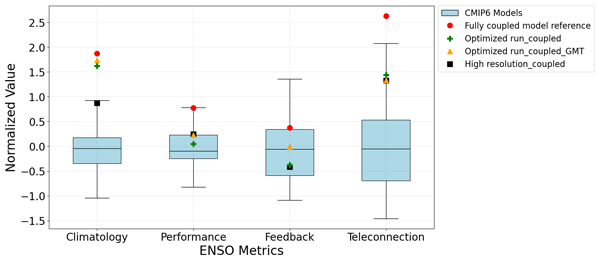
Abstract. The El Niño–Southern Oscillation (ENSO) is a dominant mode of interannual climate variability, yet accurately simulating ENSO in climate models remains a major challenge due to its complex coupled dynamics. In this study, we present a novel linear optimization methodology and systematically adjust atmospheric parameters to improve ENSO fidelity in the Icosahedral Nonhydrostatic eXtended Predictions and Projections (ICON XPP) Earth System Model of the Max-Planck-Institute for Meteorology. The optimization approach is based on the superposition of parameter sensitivities and a Nelder–Mead algorithm that reduces the ENSO cost function. The cost function account for ENSO-related tropical climatology, variability, and feedbacks, which are estimated with the ENSO metric package. We firstly assess the sensitivity of ENSO metrics to 21 atmospheric parameters in atmosphere-only simulations. The optimization approach reduces the ENSO cost function by 30 % in the optimized atmosphere-only runs. Key improvements include reduced precipitation bias and strengthened atmospheric feedbacks such as the Bjerknes and thermal damping feedbacks. These results demonstrate the effectiveness of our method in improving ENSO metrics within the atmosphere-only configuration. Six parameters identified as most impactful from atmosphere-only tuning experiments are subsequently tuned in fully coupled simulations. The optimized fully coupled run yields moderate improvements in ENSO amplitude, cold tongue SST bias, seasonal phase-locking, ocean-atmosphere coupling and teleconnection patterns. However, isolated ENSO tuning introduces unrealistic global warming, which is further corrected by adjusting turbulence-related parameters without degrading ENSO skill. These results demonstrate that systematic ENSO tuning can yield performance gains but must be balanced with broader climate stability constraints. Our method offers a scalable, physically grounded optimization strategy, with strong potential for tuning ENSO in climate model configurations.
-
Notice on discussion status
The requested preprint has a corresponding peer-reviewed final revised paper. You are encouraged to refer to the final revised version.
-
Preprint
(4449 KB)
-
The requested preprint has a corresponding peer-reviewed final revised paper. You are encouraged to refer to the final revised version.
- Preprint
(4449 KB) - Metadata XML
- BibTeX
- EndNote
- Final revised paper


Journal article(s) based on this preprint
Interactive discussion
Status: closed
-
CEC1: 'Comment on egusphere-2025-5736 - No compliance with the policy of the journal', Juan Antonio Añel, 11 Feb 2026
-
AC1: 'Reply on CEC1', Dakuan Yu, 12 Feb 2026
Dear Prof. Añel,
Thank you for your detailed assessment and for drawing our attention to the non-compliance of our previous submission with the journal’s Code and Data Policy. We fully agree on the importance of long-term accessibility and reproducibility.
We have now addressed all concerns and deposited the complete material in appropriate long-term repositories with persistent identifiers.
All scripts, processed data, raw ENSO metric outputs, observational datasets used in the study, and the exact version of the ENSO Metrics Package employed in our analysis are archived at:
Yu, D., Dommenget, D., Pohlmann, H., and Müller, W. (2026):
Source data and scripts for publication “A Systematic Atmospheric Parameter Optimization Method to Improve ENSO Simulation in the ICON XPP Earth System Model”, Zenodo, Version v2,
https://doi.org/10.5281/zenodo.18622333This Zenodo archive includes:
-
MATLAB optimisation scripts,
-
Parameter sensitivity diagnostics,
-
Raw ENSO metric outputs from atmosphere-only and coupled simulations,
-
The archived ENSO Metrics Package (version 1.1.3) used in this study,
-
Observational datasets (GPCP v2.3, TropFlux, and GODAS) required to reproduce the evaluation results,
The climate simulations were performed using ICON Release 2024.07, archived at the World Data Center for Climate, DOI: https://doi.org/10.35089/WDCC/IconRelease2024.07. No modifications to the ICON source code were made.
Accordingly, we have revised the “Code and Data Availability” section of the manuscript to cite these repositories and DOIs, and updated the bibliography where necessary.
We believe that these modifications fully resolve the issues raised and bring the manuscript into compliance with the journal’s Code and Data Policy. We kindly ask that the review process may now proceed.
Thank you again for your careful oversight.
With best regards,
Dakuan Yu
(on behalf of all co-authors)New Code and Data Availability
All scripts, processed data, and raw ENSO metric outputs required to reproduce the results of this study are archived at Zenodo, Version v2:
The archive includes:
-
MATLAB optimisation scripts,
-
Parameter sensitivity diagnostics,
-
Raw ENSO metric outputs from atmosphere-only and coupled simulations,
-
An archived copy of the ENSO Metrics Package (version 1.1.3),
-
Observational datasets used in this study.
Simulations were performed using ICON Release 2024.07 (ICON partnership, 2024), archived at the World Data Center for Climate, DOI: https://doi.org/10.35089/WDCC/IconRelease2024.07. No modifications to the ICON source code were made.
ENSO diagnostics were computed using version 1.1.3 of the ENSO Metrics Package (Planton et al., 2021). The exact version used is included in the Zenodo archive.
-
CEC2: 'Reply on AC1', Juan Antonio Añel, 12 Feb 2026
Dear authors,
Many thanks for your quick reply and for addressing the outstanding issues. We can consider now the current version of your manuscript in compliance with the Code and Data Policy of the journal.
Simply, I would like to know that you mention that you have used the proprietary interpreter for M language Matlab. It would be good that you indicate in your manuscript if the scripts are interpreter-depending, or if they run with FLOSS options, such as GNU Octave. Also, please, indicate in the manuscript the version number of the Matlab interpreter that you have used here, as, among others, the company owning such proprietary software does not ensure compatibility of the software developed under different versions, and bugs have been reported for Matlab in the past. If eventually in the future a new one appears that could affect computations, it is good to know if the ones presented in a given paper are affected by it.
Juan A. Añel
Geosci. Model Dev. Executive Editor
Citation: https://doi.org/10.5194/egusphere-2025-5736-CEC2 -
AC2: 'Reply on CEC2', Dakuan Yu, 12 Feb 2026
Dear Prof. Añel,
Thank you for your careful follow-up.
We appreciate your important remark regarding the use of MATLAB. The optimisation and diagnostic scripts were executed using MATLAB R2024b (MathWorks, Inc.). The scripts rely only on base MATLAB functionality and do not require proprietary toolboxes. We will explicitly state this version number in the revised manuscript.
Thank you again for your thorough editorial oversight.
With kind regards,
Dakuan Yu
(on behalf of all co-authors)
-
AC2: 'Reply on CEC2', Dakuan Yu, 12 Feb 2026
-
-
AC1: 'Reply on CEC1', Dakuan Yu, 12 Feb 2026
-
RC1: 'Comment on egusphere-2025-5736', Anonymous Referee #1, 26 Feb 2026
Review of “A Systematic Atmospheric Parameter Optimization method to Improve ENSO Simulation in the ICON XPP Earth System Model” by Yu et al.
General comments:
This study presented a linear optimization methodology to improve ENSO fidelity in the ICON XPP Earth System Model. The authors firstly assessed the sensitivity of ENSO metrics to 21 atmospheric parameters in atmosphere-only simulations. Then, six parameters were identified as most impactful and were subsequently tuned in fully coupled simulations, yielding moderate improvements in various ENSO metrics. Overall, the results demonstrated that the newly proposed method can effectively optimize key atmospheric parameters to improve representation of critical ENSO characteristics and feedback processes fidelity within a climate model. However, some aspects related to the optimization methodology should be improved before the paper is suitable for publication.
Major comments:
- As stated by the authors, one of the novelties of this work is that they provided a newly proposed optimization method. However, the motivation to develop such a new method is unclear to me. Many previous studies focusing on parametric sensitivity or parameter calibration have been conducted in the past two decades. The limitations of the methodologies in previous studies and the advantage of the new method provided here (e.g., linear vs nonlinear; direct tuning vs using surrogate model) should be discussed in more detail.
- For both atmosphere-only and fully coupled experiments, the cost functions are rescaled by the parameter setting in the control runs. This helps prevent the optimized parameter values from deviating excessively from their control-run settings, thereby ensuring physical plausibility (Line 408). However, the default settings are different in the atmosphere-only and in the fully coupled experiments. One may ask which setting has more physical plausibility?
- In section 3.4, the ENSO metric is estimated by using Eq. 11, which is based on the pre-calculated parameter sensitivities. However, the lefthand side of Eq. 11 (i.e., delta_m) is expressed as a quadratic function of a physical variable which measures the difference between simulation and observation (according to Line 386), while the righthand side of Eq. 11 is just a linear function with no observation information included (according to Line 323). So it is unclear to me what are the physical meaning and theoretical basis of Eq. 11?
Other comments:
- Line 267 (i.e., Eq. 3), phi_l or phi_i? Same question for Line 276.
- Line 352, “the correlation between the pair of sensitivities is shown in the heading of each panel”. It seems it is not given in the figure.
- Line 372, left X-axis, RMSE?
- Line 402 (i.e., Eq. 9), np_i or np_k?
- Line 409, the constraint term delta_limit ensures that parameters remain within physically meaningful bounds. Do the authors mean some values of parameters are out of the prescribed bounds? How does the sampling algorithm work when searching the parameter space?
- Line 695, the use of the word “although” is a bit strange.
Citation: https://doi.org/10.5194/egusphere-2025-5736-RC1 - AC4: 'Reply on RC1', Dakuan Yu, 07 Apr 2026
-
RC2: 'Comment on egusphere-2025-5736', Anonymous Referee #2, 17 Mar 2026
This manuscript presents a linear sensitivity–based optimization approach combined with the Nelder–Mead algorithm to improve ENSO simulation in the ICON XPP Earth System Model. The authors conduct a two-stage tuning: first in atmosphere-only mode (21 parameters) and then in fully coupled mode (6 selected parameters), using the CLIVAR ENSO Metrics Package for evaluation. The atmosphere-only optimization achieves roughly 30% reduction in the cost function; the coupled optimization yields improvements in ENSO amplitude, cold tongue bias, phase-locking, and some feedbacks, comparable in magnitude to gains from doubling resolution. The manuscript frankly discusses the unintended global mean warming induced by ENSO-only tuning and its correction via turbulence parameters, and recommends including global constraints (e.g. GMT, AMOC) in future multi-objective optimization.
The methodology is clearly structured, the two-stage design is well justified, and the comparison with CMIP6 and high-resolution ICON XPP is useful. Overall, I recommend MINOR revision: address the points below so that the manuscript is fully consistent and reproducible.
- The manuscript contains MANYbasic errors in equation/figure cross-references, spelling, grammar, and section numbering that collectively impair readability and raise concerns about the thoroughness of internal review. The authors are strongly urged to conduct a systematic, end-to-end proofread before resubmission. A non-exhaustive list is given below:
- Incorrect equation references: The cost function is defined in Section 3.3 as eq. [6], with Δmetric and Δpara given by eq. [7] and [8]. However, in Section 4.1 and 4.2 the text refers to “eq. 3”, and “eq. 4”.
- Missing section heading: Section 5 has subsections 5.1~4 but no parent heading (e.g. “5 Results for fully coupled experiments”) before 5.1.The authors should add a main Section 5 parent heading before 5.1 so that the section hierarchy is consistent and readers can locate the start of the coupled results.
- Incorrect figure references: The text (Line 309~310) “By design, the composite RMSE of the control simulation equals 1.0 (Fig. 2b)” refers to Fig. 3b.
- Incorrect maplabels: The “180°E” label in Figure 7 is incorrect, it should be labeled as “0°”. In addition, I recommend that the author use the longitude range label 0~360°E here to ensure consistency with the coordinates in other figures and the descriptions in the text.
- Spelling errors:
- "LIoyd" → "Lloyd" (Line 67 and 95). According to the reference list, the second letter should be a lowercase “l”, not an uppercase “I”.
- "fileds" → "fields" (Line 131).
- "regirded" → "regridded" (Line 134).
- "metrices" → "metrics" (Line 189, 190, 192. The correct plural of "metric" is "metrics").
- Inconsistent parameter names: Section 3.3 writes "tune_entrog"; Table 1 uses "tune_entrorg".
- For data grid resolution, Section 2.1 states that the model data and observational data are regridded to the same 1°x1° global grids, while Section 2.2 specifies that the model runs at 160 km atmosphere (~1.4°) and 40 km ocean (~0.36°). This creates confusion. (1) What are the native grid resolutions of each observational dataset and of the ICON model output, respectively? (2) What regridding/interpolation method was used to bring all data onto the 1°×1° grid. (3) Could interpolating the 160 km atmosphere (~1.4°) to a finer 1° grid introduce artificial smoothness in local metrics such as the meridional precipitation structure? (4) Could coarsening the 40 km ocean output to 1° obscure sub-degree small-scale ocean features (e.g. tropical instability waves, sharp SST fronts) that may be relevant to some ENSO feedbacks?
- For experiment period range, Section 2.1 states that the period for all observational reference data is 1980~2018, while Section 2.3 indicates that the AO experiments cover 1979~1997. The first year of the AO experiments (1979) has no corresponding observational reference. (1) When calculating ENSO metrics, is the AO model output compared with observations using only the 17 years from 1980~1997, or the full 19 years? If the latter, what is the source of observations for 1979? (2) The AO experiments do not cover the 1998~2018 period, which includes several strong ENSO events, does this affect the representativeness of the sensitivity estimates?
- In Table 1, multiple optimized values fall outside the stated ranges. Eq. [10] and the accompanying text imply that parameter combinations violating physical bounds are penalized and discarded, yet many parameters exceed the stated ranges.
- [11] approximates the metric bias δm by a linear combination of parameter sensitivities and is central to the computational efficiency of the scheme. However, ENSO is a complex air-sea coupled system with highly nonlinear characteristics. (1) Why is it reasonable to use a linear superposition approximation in such a complex nonlinear system? It seems to lack a physical or dynamical explanation for this basic assumption. (2) Over what range of parameter changes is this approximation expected to hold? (3) What is the impact of neglecting nonlinear and cross-parameter terms (interaction terms) on the optimization results?
- The “RMS threshold of 0.2” is used to select parameters with “significant” impact on ENSO metrics. The text states it corresponds to roughly 20% of the control-run bias amplitude. (1) Was this value chosen from a break in the sensitivity distribution or from a signal-to-noise criterion? (2) Has this empirical threshold been used in previous studies?
- The six parameters carried into the FC optimization were selected based on their AO sensitivity ranking. Giventhat AO and FC sensitivities differ substantially in both magnitude and sign, the AO ranking may not reliably reflect parameter importance in the coupled system. (1) Could parameters with weak AO sensitivities nonetheless have significant impacts in the coupled configuration? (2) What are the potential consequences of this selection strategy for the final coupled optimization?
- The Nelder-Mead method can converge to local minima. Was the optimization run from a single initial point or from multiple starting points?
Citation: https://doi.org/10.5194/egusphere-2025-5736-RC2 - AC3: 'Reply on RC2', Dakuan Yu, 07 Apr 2026
- The manuscript contains MANYbasic errors in equation/figure cross-references, spelling, grammar, and section numbering that collectively impair readability and raise concerns about the thoroughness of internal review. The authors are strongly urged to conduct a systematic, end-to-end proofread before resubmission. A non-exhaustive list is given below:
Peer review completion


Interactive discussion
Status: closed
-
CEC1: 'Comment on egusphere-2025-5736 - No compliance with the policy of the journal', Juan Antonio Añel, 11 Feb 2026
Dear authors,
Unfortunately, after checking your manuscript, it has come to our attention that it does not comply with our "Code and Data Policy".
https://www.geoscientific-model-development.net/policies/code_and_data_policy.html
You have archived all your code and data on sites that we can not accept. For example, in the case of GitHub, it is not a suitable repository for scientific publication. GitHub itself instructs authors to use other long-term archival and publishing alternatives, such as Zenodo. Also, you have archived part of code and the data used and produced in your work in Edmond; however, Edmond does not fulfil GMD’s requirements for a persistent data archive. Only in the cases where the administrators of Edmond confirm us that they have permanently removed the permissions for edition or deletion of the data by their authors, it can be acceptable. For the ICON model you have linked icon-model.org, which we can not accept. The sites linked for GPCPv2.3, TropFlux, and GODAS are neither acceptable.
Therefore, the current situation with your manuscript is irregular, and it should have never been accepted for peer-review or Discussions in the journal due to the above mentioned issues. The GMD review and publication process depends on reviewers and community commentators being able to access, during the discussion phase, the code and data on which a manuscript depends, and on ensuring the provenance of replicability of the published papers for years after their publication. Please, therefore, publish your code and data in one of the appropriate repositories and reply to this comment with the relevant information (link and a permanent identifier for it (e.g. DOI)) as soon as possible. We cannot have manuscripts under discussion that do not comply with our policy.
The 'Code and Data Availability’ section must also be modified to cite the new repository locations, and corresponding references added to the bibliography.
I must note that if you do not fix this problem, we cannot continue with the peer-review process or accept your manuscript for publication in GMD.
Juan A. Añel
Geosci. Model Dev. Executive EditorCitation: https://doi.org/10.5194/egusphere-2025-5736-CEC1 -
AC1: 'Reply on CEC1', Dakuan Yu, 12 Feb 2026
Dear Prof. Añel,
Thank you for your detailed assessment and for drawing our attention to the non-compliance of our previous submission with the journal’s Code and Data Policy. We fully agree on the importance of long-term accessibility and reproducibility.
We have now addressed all concerns and deposited the complete material in appropriate long-term repositories with persistent identifiers.
All scripts, processed data, raw ENSO metric outputs, observational datasets used in the study, and the exact version of the ENSO Metrics Package employed in our analysis are archived at:
Yu, D., Dommenget, D., Pohlmann, H., and Müller, W. (2026):
Source data and scripts for publication “A Systematic Atmospheric Parameter Optimization Method to Improve ENSO Simulation in the ICON XPP Earth System Model”, Zenodo, Version v2,
https://doi.org/10.5281/zenodo.18622333This Zenodo archive includes:
-
MATLAB optimisation scripts,
-
Parameter sensitivity diagnostics,
-
Raw ENSO metric outputs from atmosphere-only and coupled simulations,
-
The archived ENSO Metrics Package (version 1.1.3) used in this study,
-
Observational datasets (GPCP v2.3, TropFlux, and GODAS) required to reproduce the evaluation results,
The climate simulations were performed using ICON Release 2024.07, archived at the World Data Center for Climate, DOI: https://doi.org/10.35089/WDCC/IconRelease2024.07. No modifications to the ICON source code were made.
Accordingly, we have revised the “Code and Data Availability” section of the manuscript to cite these repositories and DOIs, and updated the bibliography where necessary.
We believe that these modifications fully resolve the issues raised and bring the manuscript into compliance with the journal’s Code and Data Policy. We kindly ask that the review process may now proceed.
Thank you again for your careful oversight.
With best regards,
Dakuan Yu
(on behalf of all co-authors)New Code and Data Availability
All scripts, processed data, and raw ENSO metric outputs required to reproduce the results of this study are archived at Zenodo, Version v2:
The archive includes:
-
MATLAB optimisation scripts,
-
Parameter sensitivity diagnostics,
-
Raw ENSO metric outputs from atmosphere-only and coupled simulations,
-
An archived copy of the ENSO Metrics Package (version 1.1.3),
-
Observational datasets used in this study.
Simulations were performed using ICON Release 2024.07 (ICON partnership, 2024), archived at the World Data Center for Climate, DOI: https://doi.org/10.35089/WDCC/IconRelease2024.07. No modifications to the ICON source code were made.
ENSO diagnostics were computed using version 1.1.3 of the ENSO Metrics Package (Planton et al., 2021). The exact version used is included in the Zenodo archive.
-
CEC2: 'Reply on AC1', Juan Antonio Añel, 12 Feb 2026
Dear authors,
Many thanks for your quick reply and for addressing the outstanding issues. We can consider now the current version of your manuscript in compliance with the Code and Data Policy of the journal.
Simply, I would like to know that you mention that you have used the proprietary interpreter for M language Matlab. It would be good that you indicate in your manuscript if the scripts are interpreter-depending, or if they run with FLOSS options, such as GNU Octave. Also, please, indicate in the manuscript the version number of the Matlab interpreter that you have used here, as, among others, the company owning such proprietary software does not ensure compatibility of the software developed under different versions, and bugs have been reported for Matlab in the past. If eventually in the future a new one appears that could affect computations, it is good to know if the ones presented in a given paper are affected by it.
Juan A. Añel
Geosci. Model Dev. Executive Editor
Citation: https://doi.org/10.5194/egusphere-2025-5736-CEC2 -
AC2: 'Reply on CEC2', Dakuan Yu, 12 Feb 2026
Dear Prof. Añel,
Thank you for your careful follow-up.
We appreciate your important remark regarding the use of MATLAB. The optimisation and diagnostic scripts were executed using MATLAB R2024b (MathWorks, Inc.). The scripts rely only on base MATLAB functionality and do not require proprietary toolboxes. We will explicitly state this version number in the revised manuscript.
Thank you again for your thorough editorial oversight.
With kind regards,
Dakuan Yu
(on behalf of all co-authors)
-
AC2: 'Reply on CEC2', Dakuan Yu, 12 Feb 2026
-
-
AC1: 'Reply on CEC1', Dakuan Yu, 12 Feb 2026
-
RC1: 'Comment on egusphere-2025-5736', Anonymous Referee #1, 26 Feb 2026
Review of “A Systematic Atmospheric Parameter Optimization method to Improve ENSO Simulation in the ICON XPP Earth System Model” by Yu et al.
General comments:
This study presented a linear optimization methodology to improve ENSO fidelity in the ICON XPP Earth System Model. The authors firstly assessed the sensitivity of ENSO metrics to 21 atmospheric parameters in atmosphere-only simulations. Then, six parameters were identified as most impactful and were subsequently tuned in fully coupled simulations, yielding moderate improvements in various ENSO metrics. Overall, the results demonstrated that the newly proposed method can effectively optimize key atmospheric parameters to improve representation of critical ENSO characteristics and feedback processes fidelity within a climate model. However, some aspects related to the optimization methodology should be improved before the paper is suitable for publication.
Major comments:
- As stated by the authors, one of the novelties of this work is that they provided a newly proposed optimization method. However, the motivation to develop such a new method is unclear to me. Many previous studies focusing on parametric sensitivity or parameter calibration have been conducted in the past two decades. The limitations of the methodologies in previous studies and the advantage of the new method provided here (e.g., linear vs nonlinear; direct tuning vs using surrogate model) should be discussed in more detail.
- For both atmosphere-only and fully coupled experiments, the cost functions are rescaled by the parameter setting in the control runs. This helps prevent the optimized parameter values from deviating excessively from their control-run settings, thereby ensuring physical plausibility (Line 408). However, the default settings are different in the atmosphere-only and in the fully coupled experiments. One may ask which setting has more physical plausibility?
- In section 3.4, the ENSO metric is estimated by using Eq. 11, which is based on the pre-calculated parameter sensitivities. However, the lefthand side of Eq. 11 (i.e., delta_m) is expressed as a quadratic function of a physical variable which measures the difference between simulation and observation (according to Line 386), while the righthand side of Eq. 11 is just a linear function with no observation information included (according to Line 323). So it is unclear to me what are the physical meaning and theoretical basis of Eq. 11?
Other comments:
- Line 267 (i.e., Eq. 3), phi_l or phi_i? Same question for Line 276.
- Line 352, “the correlation between the pair of sensitivities is shown in the heading of each panel”. It seems it is not given in the figure.
- Line 372, left X-axis, RMSE?
- Line 402 (i.e., Eq. 9), np_i or np_k?
- Line 409, the constraint term delta_limit ensures that parameters remain within physically meaningful bounds. Do the authors mean some values of parameters are out of the prescribed bounds? How does the sampling algorithm work when searching the parameter space?
- Line 695, the use of the word “although” is a bit strange.
Citation: https://doi.org/10.5194/egusphere-2025-5736-RC1 - AC4: 'Reply on RC1', Dakuan Yu, 07 Apr 2026
-
RC2: 'Comment on egusphere-2025-5736', Anonymous Referee #2, 17 Mar 2026
This manuscript presents a linear sensitivity–based optimization approach combined with the Nelder–Mead algorithm to improve ENSO simulation in the ICON XPP Earth System Model. The authors conduct a two-stage tuning: first in atmosphere-only mode (21 parameters) and then in fully coupled mode (6 selected parameters), using the CLIVAR ENSO Metrics Package for evaluation. The atmosphere-only optimization achieves roughly 30% reduction in the cost function; the coupled optimization yields improvements in ENSO amplitude, cold tongue bias, phase-locking, and some feedbacks, comparable in magnitude to gains from doubling resolution. The manuscript frankly discusses the unintended global mean warming induced by ENSO-only tuning and its correction via turbulence parameters, and recommends including global constraints (e.g. GMT, AMOC) in future multi-objective optimization.
The methodology is clearly structured, the two-stage design is well justified, and the comparison with CMIP6 and high-resolution ICON XPP is useful. Overall, I recommend MINOR revision: address the points below so that the manuscript is fully consistent and reproducible.
- The manuscript contains MANYbasic errors in equation/figure cross-references, spelling, grammar, and section numbering that collectively impair readability and raise concerns about the thoroughness of internal review. The authors are strongly urged to conduct a systematic, end-to-end proofread before resubmission. A non-exhaustive list is given below:
- Incorrect equation references: The cost function is defined in Section 3.3 as eq. [6], with Δmetric and Δpara given by eq. [7] and [8]. However, in Section 4.1 and 4.2 the text refers to “eq. 3”, and “eq. 4”.
- Missing section heading: Section 5 has subsections 5.1~4 but no parent heading (e.g. “5 Results for fully coupled experiments”) before 5.1.The authors should add a main Section 5 parent heading before 5.1 so that the section hierarchy is consistent and readers can locate the start of the coupled results.
- Incorrect figure references: The text (Line 309~310) “By design, the composite RMSE of the control simulation equals 1.0 (Fig. 2b)” refers to Fig. 3b.
- Incorrect maplabels: The “180°E” label in Figure 7 is incorrect, it should be labeled as “0°”. In addition, I recommend that the author use the longitude range label 0~360°E here to ensure consistency with the coordinates in other figures and the descriptions in the text.
- Spelling errors:
- "LIoyd" → "Lloyd" (Line 67 and 95). According to the reference list, the second letter should be a lowercase “l”, not an uppercase “I”.
- "fileds" → "fields" (Line 131).
- "regirded" → "regridded" (Line 134).
- "metrices" → "metrics" (Line 189, 190, 192. The correct plural of "metric" is "metrics").
- Inconsistent parameter names: Section 3.3 writes "tune_entrog"; Table 1 uses "tune_entrorg".
- For data grid resolution, Section 2.1 states that the model data and observational data are regridded to the same 1°x1° global grids, while Section 2.2 specifies that the model runs at 160 km atmosphere (~1.4°) and 40 km ocean (~0.36°). This creates confusion. (1) What are the native grid resolutions of each observational dataset and of the ICON model output, respectively? (2) What regridding/interpolation method was used to bring all data onto the 1°×1° grid. (3) Could interpolating the 160 km atmosphere (~1.4°) to a finer 1° grid introduce artificial smoothness in local metrics such as the meridional precipitation structure? (4) Could coarsening the 40 km ocean output to 1° obscure sub-degree small-scale ocean features (e.g. tropical instability waves, sharp SST fronts) that may be relevant to some ENSO feedbacks?
- For experiment period range, Section 2.1 states that the period for all observational reference data is 1980~2018, while Section 2.3 indicates that the AO experiments cover 1979~1997. The first year of the AO experiments (1979) has no corresponding observational reference. (1) When calculating ENSO metrics, is the AO model output compared with observations using only the 17 years from 1980~1997, or the full 19 years? If the latter, what is the source of observations for 1979? (2) The AO experiments do not cover the 1998~2018 period, which includes several strong ENSO events, does this affect the representativeness of the sensitivity estimates?
- In Table 1, multiple optimized values fall outside the stated ranges. Eq. [10] and the accompanying text imply that parameter combinations violating physical bounds are penalized and discarded, yet many parameters exceed the stated ranges.
- [11] approximates the metric bias δm by a linear combination of parameter sensitivities and is central to the computational efficiency of the scheme. However, ENSO is a complex air-sea coupled system with highly nonlinear characteristics. (1) Why is it reasonable to use a linear superposition approximation in such a complex nonlinear system? It seems to lack a physical or dynamical explanation for this basic assumption. (2) Over what range of parameter changes is this approximation expected to hold? (3) What is the impact of neglecting nonlinear and cross-parameter terms (interaction terms) on the optimization results?
- The “RMS threshold of 0.2” is used to select parameters with “significant” impact on ENSO metrics. The text states it corresponds to roughly 20% of the control-run bias amplitude. (1) Was this value chosen from a break in the sensitivity distribution or from a signal-to-noise criterion? (2) Has this empirical threshold been used in previous studies?
- The six parameters carried into the FC optimization were selected based on their AO sensitivity ranking. Giventhat AO and FC sensitivities differ substantially in both magnitude and sign, the AO ranking may not reliably reflect parameter importance in the coupled system. (1) Could parameters with weak AO sensitivities nonetheless have significant impacts in the coupled configuration? (2) What are the potential consequences of this selection strategy for the final coupled optimization?
- The Nelder-Mead method can converge to local minima. Was the optimization run from a single initial point or from multiple starting points?
Citation: https://doi.org/10.5194/egusphere-2025-5736-RC2 - AC3: 'Reply on RC2', Dakuan Yu, 07 Apr 2026
- The manuscript contains MANYbasic errors in equation/figure cross-references, spelling, grammar, and section numbering that collectively impair readability and raise concerns about the thoroughness of internal review. The authors are strongly urged to conduct a systematic, end-to-end proofread before resubmission. A non-exhaustive list is given below:
Peer review completion
Journal article(s) based on this preprint
Viewed
| HTML | XML | Total | BibTeX | EndNote | |
|---|---|---|---|---|---|
| 1,506 | 563 | 163 | 2,232 | 135 | 138 |
- HTML: 1,506
- PDF: 563
- XML: 163
- Total: 2,232
- BibTeX: 135
- EndNote: 138
Viewed (geographical distribution)
| Country | # | Views | % |
|---|
| Total: | 0 |
| HTML: | 0 |
| PDF: | 0 |
| XML: | 0 |
- 1

Dietmar Dommenget
Holger Pohlmann
Wolfgang A. Müller
The requested preprint has a corresponding peer-reviewed final revised paper. You are encouraged to refer to the final revised version.
- Preprint
(4449 KB) - Metadata XML
Dear authors,
Unfortunately, after checking your manuscript, it has come to our attention that it does not comply with our "Code and Data Policy".
https://www.geoscientific-model-development.net/policies/code_and_data_policy.html
You have archived all your code and data on sites that we can not accept. For example, in the case of GitHub, it is not a suitable repository for scientific publication. GitHub itself instructs authors to use other long-term archival and publishing alternatives, such as Zenodo. Also, you have archived part of code and the data used and produced in your work in Edmond; however, Edmond does not fulfil GMD’s requirements for a persistent data archive. Only in the cases where the administrators of Edmond confirm us that they have permanently removed the permissions for edition or deletion of the data by their authors, it can be acceptable. For the ICON model you have linked icon-model.org, which we can not accept. The sites linked for GPCPv2.3, TropFlux, and GODAS are neither acceptable.
Therefore, the current situation with your manuscript is irregular, and it should have never been accepted for peer-review or Discussions in the journal due to the above mentioned issues. The GMD review and publication process depends on reviewers and community commentators being able to access, during the discussion phase, the code and data on which a manuscript depends, and on ensuring the provenance of replicability of the published papers for years after their publication. Please, therefore, publish your code and data in one of the appropriate repositories and reply to this comment with the relevant information (link and a permanent identifier for it (e.g. DOI)) as soon as possible. We cannot have manuscripts under discussion that do not comply with our policy.
The 'Code and Data Availability’ section must also be modified to cite the new repository locations, and corresponding references added to the bibliography.
I must note that if you do not fix this problem, we cannot continue with the peer-review process or accept your manuscript for publication in GMD.
Juan A. Añel
Geosci. Model Dev. Executive Editor