
the Creative Commons Attribution 4.0 License.
the Creative Commons Attribution 4.0 License.
 | 30 Jan 2026
Decomposing pre-industrial to present-day land use change forcing in the UK Earth System Model
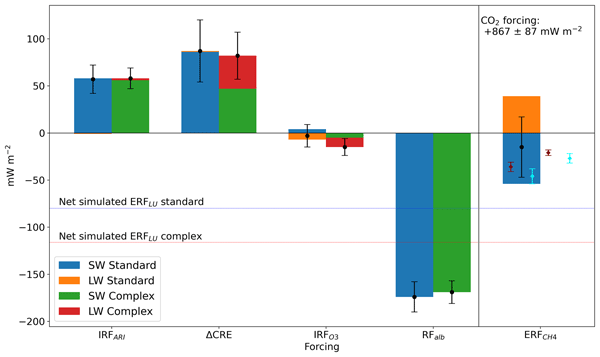
Abstract. Land use impacts climate through changes in carbon emissions, surface albedo and evapotranspiration, as well as biogenic volatile organic compound (BVOC) emissions, which influence atmospheric composition. The relative importance of changes in atmospheric composition driven by pre-industrial to present-day land use change has not been assessed for the UK Earth System Model (UKESM). Here, we decompose the pre-industrial to present-day land use change forcing in UKESM1.1 with additional process updates. We find a net simulated forcing of −0.08 ± 0.05 W m−2 when using the standard (Strat-Trop vn1.0) chemistry, and −0.12 ± 0.04 W m−2 for the complex (CRI-Strat 2) chemical mechanism. The simulated forcing includes the positive aerosol direct and indirect effects (around +0.06 W m−2 and +0.085 W m−2, respectively), alongside negative forcings from ozone (around −0.01 W m−2) and surface albedo change (around −0.17 W m−2). The forcing from the aerosol indirect effects calculated in this study is greater than in recent UKESM BVOC forcing experiments, which we attribute to using pre-industrial background conditions and increased organic matter hygroscopicity. Additional calculations show the radiative forcing from changes to methane lifetime is between −0.02 and −0.04 W m−2, while the land use carbon emissions drive a carbon dioxide forcing of +0.87 W m−2. Overall, the competing effects of changes in aerosols and short-lived greenhouse gases with surface albedo counter around 15 % of the carbon dioxide forcing. However, non-carbon dioxide effects have significant regional impacts.
-
Notice on discussion status
The requested preprint has a corresponding peer-reviewed final revised paper. You are encouraged to refer to the final revised version.
-
Preprint
(8829 KB)
-
The requested preprint has a corresponding peer-reviewed final revised paper. You are encouraged to refer to the final revised version.
- Preprint
(8829 KB) - Metadata XML
- BibTeX
- EndNote
- Final revised paper


Journal article(s) based on this preprint
Interactive discussion
Status: closed
-
RC1: 'Comment on egusphere-2025-5638', Anonymous Referee #1, 07 Feb 2026
The comment was uploaded in the form of a supplement: https://egusphere.copernicus.org/preprints/2026/egusphere-2025-5638/egusphere-2025-5638-RC1-supplement.pdfCitation: https://doi.org/
10.5194/egusphere-2025-5638-RC1 -
RC2: 'Comment on egusphere-2025-5638', Anonymous Referee #2, 24 Feb 2026
Summary
This paper quantifies the radiative forcing from pre-industrial to present-day land use change in UKESM1.1 with additional process updates, decomposing contributions from various factors and comparing two chemistry mechanisms. The topic is scientifically sound and interesting, particularly given the importance of non-CO2 land-use forcing in Earth System Models. However, I have several major concerns regarding the attribution analysis outlined below. Thus, a major revision is needed before it can be considered for publication.Major comments:
1) Since this study involves several model experiments with different setups, I suggest the authors add a detailed table for summarizing all simulations and their role in the forcing decomposition in Section 2.2.
2) The authors conclude that non-CO2 effects have “significant regional impacts,” yet no quantitative regional forcing metrics are presented in the abstract. For example, comparisons for high-latitude vs mid-latitude contributions and regional ERF values for East Asia, North America, etc., should be presented.
3) The mechanistic explanation linking land-use change to a positive ΔCRE_SW remains largely qualitative. While the manuscript presents changes in CDNC and effective radius, it does not provide a quantitative diagnosis of the underlying aerosol perturbations responsible for these microphysical changes. It is unclear which aerosol species (e.g., SOA, sulfate, primary organic aerosol) dominate the burden change, nor is there a decomposition of CCN responses or aerosol optical properties. Without explicit diagnostics of aerosol mass, number concentration, and CCN at relevant supersaturations, the causal chain from land-use change to cloud microphysical adjustment cannot be robustly established. A more detailed aerosol species and CCN budget analysis is needed to justify the proposed mechanism.
4) The reported positive aerosol indirect forcing (~+0.085 W m-2) is quite large at the global scale and warrants further scrutiny. While a reduction in BVOC emissions following deforestation could plausibly decrease SOA formation and weaken the Twomey effect, the magnitude of the resulting warming appears relatively large compared to existing CMIP6 and AR6 assessments of land-use forcing. Given the sensitivity of aerosol-cloud interactions to background conditions and model parameterizations, additional comparison against prior literature is needed to assess the robustness of this finding.
5) The explanation for the larger ΔCRE_LW under the complex chemistry mechanism remains insufficiently supported by diagnostics. The authors report that changes in high-altitude cloud amount, particularly cirrus-type clouds, drive the enhanced LW forcing; however, cloud vertical structure, cloud-top pressure, optical thickness, or cloud water content are not presented. Without explicit evidence demonstrating how the chemistry mechanism alters upper-tropospheric aerosol, microphysics, or dynamical conditions to influence high-level cloud formation, the proposed mechanism remains unclear.
6) The authors mention that the net forcing differs by ~0.04 W m-2 between chemistry schemes. However, the manuscript does not rigorously attribute this difference. It is unclear whether the difference arises from secondary organic aerosol yields, VOC oxidation pathways, or ozone production efficiency. Please clarify the major changes and differences between the chemical mechanisms that contribute to this difference.Minor comments:
1) Please correct minor typos throughout the manuscript. For example, Line 232: 'present-day PD' should be 'PD'.
2) Please improve the figure quality, especially the size of figures showing the global model outputs. It is very difficult for readers to identify the spatial changes and magnitude based on the current version of the figures.Citation: https://doi.org/10.5194/egusphere-2025-5638-RC2 -
AC1: 'Comment on egusphere-2025-5638', Emma Sands, 24 Apr 2026
The comment was uploaded in the form of a supplement: https://egusphere.copernicus.org/preprints/2026/egusphere-2025-5638/egusphere-2025-5638-AC1-supplement.pdf
Peer review completion


Interactive discussion
Status: closed
-
RC1: 'Comment on egusphere-2025-5638', Anonymous Referee #1, 07 Feb 2026
The comment was uploaded in the form of a supplement: https://egusphere.copernicus.org/preprints/2026/egusphere-2025-5638/egusphere-2025-5638-RC1-supplement.pdf
-
RC2: 'Comment on egusphere-2025-5638', Anonymous Referee #2, 24 Feb 2026
Summary
This paper quantifies the radiative forcing from pre-industrial to present-day land use change in UKESM1.1 with additional process updates, decomposing contributions from various factors and comparing two chemistry mechanisms. The topic is scientifically sound and interesting, particularly given the importance of non-CO2 land-use forcing in Earth System Models. However, I have several major concerns regarding the attribution analysis outlined below. Thus, a major revision is needed before it can be considered for publication.Major comments:
1) Since this study involves several model experiments with different setups, I suggest the authors add a detailed table for summarizing all simulations and their role in the forcing decomposition in Section 2.2.
2) The authors conclude that non-CO2 effects have “significant regional impacts,” yet no quantitative regional forcing metrics are presented in the abstract. For example, comparisons for high-latitude vs mid-latitude contributions and regional ERF values for East Asia, North America, etc., should be presented.
3) The mechanistic explanation linking land-use change to a positive ΔCRE_SW remains largely qualitative. While the manuscript presents changes in CDNC and effective radius, it does not provide a quantitative diagnosis of the underlying aerosol perturbations responsible for these microphysical changes. It is unclear which aerosol species (e.g., SOA, sulfate, primary organic aerosol) dominate the burden change, nor is there a decomposition of CCN responses or aerosol optical properties. Without explicit diagnostics of aerosol mass, number concentration, and CCN at relevant supersaturations, the causal chain from land-use change to cloud microphysical adjustment cannot be robustly established. A more detailed aerosol species and CCN budget analysis is needed to justify the proposed mechanism.
4) The reported positive aerosol indirect forcing (~+0.085 W m-2) is quite large at the global scale and warrants further scrutiny. While a reduction in BVOC emissions following deforestation could plausibly decrease SOA formation and weaken the Twomey effect, the magnitude of the resulting warming appears relatively large compared to existing CMIP6 and AR6 assessments of land-use forcing. Given the sensitivity of aerosol-cloud interactions to background conditions and model parameterizations, additional comparison against prior literature is needed to assess the robustness of this finding.
5) The explanation for the larger ΔCRE_LW under the complex chemistry mechanism remains insufficiently supported by diagnostics. The authors report that changes in high-altitude cloud amount, particularly cirrus-type clouds, drive the enhanced LW forcing; however, cloud vertical structure, cloud-top pressure, optical thickness, or cloud water content are not presented. Without explicit evidence demonstrating how the chemistry mechanism alters upper-tropospheric aerosol, microphysics, or dynamical conditions to influence high-level cloud formation, the proposed mechanism remains unclear.
6) The authors mention that the net forcing differs by ~0.04 W m-2 between chemistry schemes. However, the manuscript does not rigorously attribute this difference. It is unclear whether the difference arises from secondary organic aerosol yields, VOC oxidation pathways, or ozone production efficiency. Please clarify the major changes and differences between the chemical mechanisms that contribute to this difference.Minor comments:
1) Please correct minor typos throughout the manuscript. For example, Line 232: 'present-day PD' should be 'PD'.
2) Please improve the figure quality, especially the size of figures showing the global model outputs. It is very difficult for readers to identify the spatial changes and magnitude based on the current version of the figures.Citation: https://doi.org/10.5194/egusphere-2025-5638-RC2 -
AC1: 'Comment on egusphere-2025-5638', Emma Sands, 24 Apr 2026
The comment was uploaded in the form of a supplement: https://egusphere.copernicus.org/preprints/2026/egusphere-2025-5638/egusphere-2025-5638-AC1-supplement.pdf
Peer review completion
Journal article(s) based on this preprint
Viewed
| HTML | XML | Total | BibTeX | EndNote | |
|---|---|---|---|---|---|
| 1,234 | 576 | 135 | 1,945 | 105 | 123 |
- HTML: 1,234
- PDF: 576
- XML: 135
- Total: 1,945
- BibTeX: 105
- EndNote: 123
Viewed (geographical distribution)
| Country | # | Views | % |
|---|
| Total: | 0 |
| HTML: | 0 |
| PDF: | 0 |
| XML: | 0 |
- 1

Fiona M. O'Connor
James Weber
Ruth M. Doherty
Richard J. Pope
The requested preprint has a corresponding peer-reviewed final revised paper. You are encouraged to refer to the final revised version.
- Preprint
(8829 KB) - Metadata XML