
the Creative Commons Attribution 4.0 License.
the Creative Commons Attribution 4.0 License.
 | 16 Jan 2026
SNOWstorm (v1.0) – a deep-learning based model for near-surface winds and drifting snow in mountain environments
Abstract. Wind-driven redistribution of snow and resulting heterogeneous snow accumulation poses a major uncertainty in mountain hydrology and distributed glacier mass balance models as it is often neglected. High-quality information on the fine-scale wind structure is crucial to predict snow redistribution, but past approaches either relied on highly simplified assumptions or on computationally expensive numerical simulations, inhibiting the application for long-term studies.
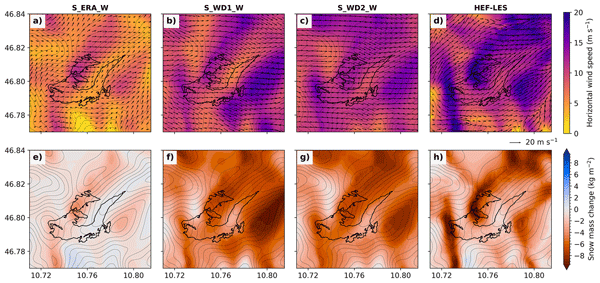
To bridge this gap, we introduce SNOWstorm – the snow drift sublimation and transport model. It is designed as a deep-learning based emulator model, that is trained on data from high-resolution (∆x = 50 m) numerical simulations in semi-idealized conditions, to be applicable over a wide range of atmospheric conditions and for a wide range of mountain regions. The model can be driven with input of standard atmospheric variables from coarse- to meso-scale numerical models and predicts near-surface wind fields, and rates of wind-driven snow mass change, drifting snow sublimation and snow transport. Validation experiments show that the model reproduces major terrain-induced flow features as well as patterns of snow redistribution. In a first real-world application study in the European Alps, SNOWstorm predicts wind fields and drifting snow patterns comparable to nested numerical large-eddy simulations, though at more than five orders of magnitude less computational expense. The model thus shows the potential to be used in future studies on multi-seasonal influence of snow redistribution on glacier mass balance in various climatic settings.
-
Notice on discussion status
The requested preprint has a corresponding peer-reviewed final revised paper. You are encouraged to refer to the final revised version.
-
Preprint
(16425 KB)
-
Supplement
(10292 KB)
-
The requested preprint has a corresponding peer-reviewed final revised paper. You are encouraged to refer to the final revised version.
- Preprint
(16425 KB) - Metadata XML
-
Supplement
(10292 KB) - BibTeX
- EndNote
- Final revised paper


Journal article(s) based on this preprint
Interactive discussion
Status: closed
-
CEC1: 'Comment on egusphere-2025-5608 - No compliance with the policy of the journal', Juan Antonio Añel, 11 Feb 2026
-
AC1: 'Reply on CEC1', Manuel Saigger, 17 Feb 2026
Dear Juan A. Añel,
thank you for raising these valid points.
WRFlux v1.3.2 published as Göbel (2021), https://doi.org/10.5281/zenodo.5643940, this contains also the other WRF code, except for the additional snow drift module, which is referenced as Saigger (2024), https://doi.org/10.5281/zenodo.10837359.
We added the observational data to the repository https://doi.org/10.5281/zenodo.18670232.
We will update the manuscript accordingly in the revision stage.
Kind regards,
Manuel Saigger on behalf of the co-authors
Citation: https://doi.org/10.5194/egusphere-2025-5608-AC1 -
CEC2: 'Reply on AC1', Juan Antonio Añel, 17 Feb 2026
Dear authors,
Thanks for addressing this issue so quickly. We can consider now your manuscript in compliance with the code and data policy of the journal.
Juan A. Añel
Geosci. Model Dev. Executive Editor
Citation: https://doi.org/10.5194/egusphere-2025-5608-CEC2
-
CEC2: 'Reply on AC1', Juan Antonio Añel, 17 Feb 2026
-
AC1: 'Reply on CEC1', Manuel Saigger, 17 Feb 2026
-
RC1: 'Comment on egusphere-2025-5608', Anonymous Referee #1, 15 Feb 2026
The comment was uploaded in the form of a supplement: https://egusphere.copernicus.org/preprints/2026/egusphere-2025-5608/egusphere-2025-5608-RC1-supplement.pdf
- AC2: 'Reply on RC1', Manuel Saigger, 20 Mar 2026
-
RC2: 'Comment on egusphere-2025-5608', Anonymous Referee #2, 17 Feb 2026
This is a review of SNOWstorm (v1.0). Overall, I really like the idea of going after blowing snow with deep learning. Blowing snow is critical to include, and it's very tricky. However, I think this manuscript needs more work and contextualization to be a strong contribution.
I found that the manuscript layout to be difficult to follow, with the mix of results and discussion together making for a difficult read to really figure out what was tested and where. For example, the conclusion notes that direction and speed were tested against observations, but I'm struggling to find this in the text. The heavy use of model variables, e.g., SUBL_VI, SNOW_VI, makes parsing the paragraphs difficult and makes it easy to get lost. I would encourage the authors to have clear numerical model methodology, the tests, and the case study results, with a synthesis discussion section to tie them together. And then use this to tighten the text as much as possible.
Broadly, I am left with an uncertainty as to how good this model really is. I find both the wind velocity and blowing snow analysis underwhelming. Specifically, I would really like to see figures showing model speed and direction, compared to both a model but also observations. I see figure 9, but I would prefer this as a wind rose and to see >24h of observation analysis. How are the ridges and lees /exactly/ compared ot the more complex model or obs? The lee is where the snow deposition will happen and if this is wrong, the deposition is wrong (which seems like the case). Can the model perturb the wind direction very much? It looks like it barely does, but this might just be a visualisation limitation. How large of a domain can this scale up to? How does this approach compare to other blowing snow approaches likes those of Snowmodel, ICAR, CHM, SnowPappus, and Alpine3D? For example, Figure 5 d-e shows a ~4x under estimation in transport rate. Figure 6 is completely missing deposition zones. This seems like a lot. I would also like to see side by side plots of the lidar snowdepth observations and the model outputs. Is the spatial variability we observe, that all models struggle to get 100% right, at least qualitatively present in the model outputs? Without these contextualizations, it is difficult to evaluate the manuscript.
I think having a core set of research questions that are answered throughout the manuscript would help tighten and refine the story. As is, this is a statement of what was done, and the clear common thread tying it all together, including the advancement versus existing approaches is lacking. Getting the wrong answer faster is not particularly useful unless the error in that approximation is well bounded, understood, and justified.
Specific comments:
L1 "and (the) resulting" missing the
L22 e.g., add the comma after e.g. throughout
L 91, Figure1 these need scale bars, north/south arrows, and lat/lon reticules. As is, it's not at all clear what we are looking at.
L95 The synthetic topographies are neat, but why go through the effort when global 30m DEM exist? I suspect it's for the periodic boundary conditions? If so, this needs to be stated up front and not as a buried lede
L 114 "to fit the requirements of the later model" where in the MS? what section?
L120 `a` term is what?
L145 "is used" -> "are used"
L155 Why are the particle sizes not a distribution as commonly noted in the literature?
L155 Is this domain masked for vegetation? how is that handled? I realize that the authors are interested in non-vegetated areas, but some description of how this is handled and impact on flow fields is needed
L 156 table 1, how are these sampled while maintaining physical coherence? Please cite ranges for these values
L174 "model run time" are these wall clocks or internal model hours?
L229 how is T changed but RH is not updated? this will dry/wet the atmosphere out and impact the sublimation estimates
L236 I would like to see clear wind direction eval here too
L308 has results in the overview
L320 how sensitive are the results to this light-ish density? Windslab layers are of course also missing here
L330-> would love to have S_WDI_W and other variables described or reiterated for the reader. By the time I got here, I had no idea what these were anymore. There is some description on L 325 but just they are inputs, of what?Citation: https://doi.org/10.5194/egusphere-2025-5608-RC2 - AC3: 'Reply on RC2', Manuel Saigger, 20 Mar 2026
Peer review completion


Post-review adjustments


Interactive discussion
Status: closed
-
CEC1: 'Comment on egusphere-2025-5608 - No compliance with the policy of the journal', Juan Antonio Añel, 11 Feb 2026
Dear authors,
Unfortunately, after checking your manuscript, it has come to our attention that it does not comply with our "Code and Data Policy".
https://www.geoscientific-model-development.net/policies/code_and_data_policy.html
First, for your study you have used the model WRF and WRFlux, version 1.3.2. However, you do not provide in the Code and Data Availability section of your manuscript a repository for them. Also, for part of the data necessary to replicate your work, you link a web page of the university of Innsbruck, which we can not accept. The data must be stored in a permanent repository which complies with the policy of the journal.
The GMD review and publication process depends on reviewers and community commentators being able to access, during the discussion phase, the code and data on which a manuscript depends, and on ensuring the provenance of replicability of the published papers for years after their publication. Please, therefore, publish your code and data in one of the appropriate repositories and reply to this comment with the relevant information (link and a permanent identifier for it (e.g. DOI)) as soon as possible. We cannot have manuscripts under discussion that do not comply with our policy.
The 'Code and Data Availability’ section must also be modified to cite the new repository locations, and corresponding references added to the bibliography.
I must note that if you do not fix this problem, we cannot continue with the peer-review process or accept your manuscript for publication in GMD.
Juan A. Añel
Geosci. Model Dev. Executive EditorCitation: https://doi.org/10.5194/egusphere-2025-5608-CEC1 -
AC1: 'Reply on CEC1', Manuel Saigger, 17 Feb 2026
Dear Juan A. Añel,
thank you for raising these valid points.
WRFlux v1.3.2 published as Göbel (2021), https://doi.org/10.5281/zenodo.5643940, this contains also the other WRF code, except for the additional snow drift module, which is referenced as Saigger (2024), https://doi.org/10.5281/zenodo.10837359.
We added the observational data to the repository https://doi.org/10.5281/zenodo.18670232.
We will update the manuscript accordingly in the revision stage.
Kind regards,
Manuel Saigger on behalf of the co-authors
Citation: https://doi.org/10.5194/egusphere-2025-5608-AC1 -
CEC2: 'Reply on AC1', Juan Antonio Añel, 17 Feb 2026
Dear authors,
Thanks for addressing this issue so quickly. We can consider now your manuscript in compliance with the code and data policy of the journal.
Juan A. Añel
Geosci. Model Dev. Executive Editor
Citation: https://doi.org/10.5194/egusphere-2025-5608-CEC2
-
CEC2: 'Reply on AC1', Juan Antonio Añel, 17 Feb 2026
-
AC1: 'Reply on CEC1', Manuel Saigger, 17 Feb 2026
-
RC1: 'Comment on egusphere-2025-5608', Anonymous Referee #1, 15 Feb 2026
The comment was uploaded in the form of a supplement: https://egusphere.copernicus.org/preprints/2026/egusphere-2025-5608/egusphere-2025-5608-RC1-supplement.pdf
- AC2: 'Reply on RC1', Manuel Saigger, 20 Mar 2026
-
RC2: 'Comment on egusphere-2025-5608', Anonymous Referee #2, 17 Feb 2026
This is a review of SNOWstorm (v1.0). Overall, I really like the idea of going after blowing snow with deep learning. Blowing snow is critical to include, and it's very tricky. However, I think this manuscript needs more work and contextualization to be a strong contribution.
I found that the manuscript layout to be difficult to follow, with the mix of results and discussion together making for a difficult read to really figure out what was tested and where. For example, the conclusion notes that direction and speed were tested against observations, but I'm struggling to find this in the text. The heavy use of model variables, e.g., SUBL_VI, SNOW_VI, makes parsing the paragraphs difficult and makes it easy to get lost. I would encourage the authors to have clear numerical model methodology, the tests, and the case study results, with a synthesis discussion section to tie them together. And then use this to tighten the text as much as possible.
Broadly, I am left with an uncertainty as to how good this model really is. I find both the wind velocity and blowing snow analysis underwhelming. Specifically, I would really like to see figures showing model speed and direction, compared to both a model but also observations. I see figure 9, but I would prefer this as a wind rose and to see >24h of observation analysis. How are the ridges and lees /exactly/ compared ot the more complex model or obs? The lee is where the snow deposition will happen and if this is wrong, the deposition is wrong (which seems like the case). Can the model perturb the wind direction very much? It looks like it barely does, but this might just be a visualisation limitation. How large of a domain can this scale up to? How does this approach compare to other blowing snow approaches likes those of Snowmodel, ICAR, CHM, SnowPappus, and Alpine3D? For example, Figure 5 d-e shows a ~4x under estimation in transport rate. Figure 6 is completely missing deposition zones. This seems like a lot. I would also like to see side by side plots of the lidar snowdepth observations and the model outputs. Is the spatial variability we observe, that all models struggle to get 100% right, at least qualitatively present in the model outputs? Without these contextualizations, it is difficult to evaluate the manuscript.
I think having a core set of research questions that are answered throughout the manuscript would help tighten and refine the story. As is, this is a statement of what was done, and the clear common thread tying it all together, including the advancement versus existing approaches is lacking. Getting the wrong answer faster is not particularly useful unless the error in that approximation is well bounded, understood, and justified.
Specific comments:
L1 "and (the) resulting" missing the
L22 e.g., add the comma after e.g. throughout
L 91, Figure1 these need scale bars, north/south arrows, and lat/lon reticules. As is, it's not at all clear what we are looking at.
L95 The synthetic topographies are neat, but why go through the effort when global 30m DEM exist? I suspect it's for the periodic boundary conditions? If so, this needs to be stated up front and not as a buried lede
L 114 "to fit the requirements of the later model" where in the MS? what section?
L120 `a` term is what?
L145 "is used" -> "are used"
L155 Why are the particle sizes not a distribution as commonly noted in the literature?
L155 Is this domain masked for vegetation? how is that handled? I realize that the authors are interested in non-vegetated areas, but some description of how this is handled and impact on flow fields is needed
L 156 table 1, how are these sampled while maintaining physical coherence? Please cite ranges for these values
L174 "model run time" are these wall clocks or internal model hours?
L229 how is T changed but RH is not updated? this will dry/wet the atmosphere out and impact the sublimation estimates
L236 I would like to see clear wind direction eval here too
L308 has results in the overview
L320 how sensitive are the results to this light-ish density? Windslab layers are of course also missing here
L330-> would love to have S_WDI_W and other variables described or reiterated for the reader. By the time I got here, I had no idea what these were anymore. There is some description on L 325 but just they are inputs, of what?Citation: https://doi.org/10.5194/egusphere-2025-5608-RC2 - AC3: 'Reply on RC2', Manuel Saigger, 20 Mar 2026
Peer review completion
Post-review adjustments
Journal article(s) based on this preprint
Viewed
| HTML | XML | Total | Supplement | BibTeX | EndNote | |
|---|---|---|---|---|---|---|
| 1,980 | 1,248 | 179 | 3,407 | 334 | 139 | 242 |
- HTML: 1,980
- PDF: 1,248
- XML: 179
- Total: 3,407
- Supplement: 334
- BibTeX: 139
- EndNote: 242
Viewed (geographical distribution)
| Country | # | Views | % |
|---|
| Total: | 0 |
| HTML: | 0 |
| PDF: | 0 |
| XML: | 0 |
- 1

Brigitta Goger
Thomas Mölg
The requested preprint has a corresponding peer-reviewed final revised paper. You are encouraged to refer to the final revised version.
- Preprint
(16425 KB) - Metadata XML
-
Supplement
(10292 KB) - BibTeX
- EndNote
- Final revised paper
Dear authors,
Unfortunately, after checking your manuscript, it has come to our attention that it does not comply with our "Code and Data Policy".
https://www.geoscientific-model-development.net/policies/code_and_data_policy.html
First, for your study you have used the model WRF and WRFlux, version 1.3.2. However, you do not provide in the Code and Data Availability section of your manuscript a repository for them. Also, for part of the data necessary to replicate your work, you link a web page of the university of Innsbruck, which we can not accept. The data must be stored in a permanent repository which complies with the policy of the journal.
The GMD review and publication process depends on reviewers and community commentators being able to access, during the discussion phase, the code and data on which a manuscript depends, and on ensuring the provenance of replicability of the published papers for years after their publication. Please, therefore, publish your code and data in one of the appropriate repositories and reply to this comment with the relevant information (link and a permanent identifier for it (e.g. DOI)) as soon as possible. We cannot have manuscripts under discussion that do not comply with our policy.
The 'Code and Data Availability’ section must also be modified to cite the new repository locations, and corresponding references added to the bibliography.
I must note that if you do not fix this problem, we cannot continue with the peer-review process or accept your manuscript for publication in GMD.
Juan A. Añel
Geosci. Model Dev. Executive Editor