
the Creative Commons Attribution 4.0 License.
the Creative Commons Attribution 4.0 License.
 | 19 Jan 2026
Rapid assessment of drivers and air quality effects of regional daily changes in air pollutant emissions based on near-real-time techniques: A case in Jiangsu Province, China
Abstract. Fast and timely estimation of changing air pollutant emissions is critical for understanding the complex sources of air pollution and supporting air quality improvement, while current regional emission inventory was commonly reported with time lag or coarse temporal resolution. Here we developed a near-real-time approach that calculates the daily emissions of anthropogenic air pollutants, and applied this approach for Jiangsu province, a typical developed region in eastern China. We estimated that the annual total anthropogenic emissions of SO2, NOX, primary fine particles (PM2.5), non-methane volatile organic compounds (NMVOCs), and NH3 were 246, 727, 298, 1186, and 377 Gg, respectively, for Jiangsu in 2022. Compared to the national emission inventory, application of the provincial-level daily emission estimates provided better model performance of PM2.5 and ozone (O3) simulation for all the involved months. The NOX, SO2, PM2.5, and NMVOCs emissions in Jiangsu during April–May 2022 (the period of COVID-19 lockdown in Shanghai) were respectively 8 %, 6 %, 6 %, and 10 % smaller than those in the same period of 2023. Transportation and Industry respectively contributed 89 % of NOX emission reduction and 93 % NMVOCs reduction. Combining with machine learning algorithms, moreover, we revealed that the changing agricultural NH3 emissions dominated the variability of daily PM2.5 concentration, and that off-road transportation contributed substantially to variabilities of both PM2.5 and O3 levels. The study proved advantages of incorporation of near-real-time data and machine learning techniques on tracking the fast-changing emissions and detecting the sources of varying air quality.
-
Notice on discussion status
The requested preprint has a corresponding peer-reviewed final revised paper. You are encouraged to refer to the final revised version.
-
Preprint
(2511 KB)
-
Supplement
(3590 KB)
-
The requested preprint has a corresponding peer-reviewed final revised paper. You are encouraged to refer to the final revised version.
- Preprint
(2511 KB) - Metadata XML
-
Supplement
(3590 KB) - BibTeX
- EndNote
- Final revised paper


Journal article(s) based on this preprint
Interactive discussion
Status: closed
-
RC1: 'Comment on egusphere-2025-5605', Anonymous Referee #2, 01 Mar 2026
-
AC1: 'Reply on RC1', Yu Zhao, 01 Jun 2026
Dear reviewer,
We would like to express our sincere gratitude to the editor and the reviewers for their highly valuable comments. We have carefully considered all the comments and revised the manuscript accordingly. We believe that these revisions have significantly improved the scientific depth, clarity, and practical applicability of our study. We provide a point-by-point response to the comments as below. Please note that the line/table/figure numbers mentioned following refer to the clean version of the revised manuscript, unless specifically noted.General Comments:
The fast-changing emissions are important factors driving the variability of air quality, and substantial challenges exist in tracking the emissions by sector and species, attributed to data access limitation and methodology. The manuscript develops a near-real-time emission accounting framework and combines it with machine learning to assess driving factors of air quality. They applied the methodology in Jiangsu Province, a hotspot of industrial and traffic activities, energy consumption, and anthropogenic emissions in Yangtze River Delta region, China. The efforts advanced the regional emission estimation and its application for the scientific community. Generally, the manuscript is well organized and easy to follow, and provides credible scientific evidence for regional air quality management. I recommend acceptance after addressing the following comments to further improve the manuscript.Response: We sincerely thank the reviewer for the positive evaluation of our work. The comments on our near-real-time emission accounting framework and its application in Jiangsu Province are highly encouraging. We have thoroughly addressed the reviewer’s specific comments to further improve the manuscript.
Specific Comments:
1.While Figures 6 and 7 effectively illustrate the time-series comparison between observed and simulated concentrations for PM2.5 and ozone, the accompanying discussion is currently too descriptive, focusing primarily on general statistical metrics (e.g., overall NMB and R values) without deeply analyzing the physical and chemical mechanisms driving these improvements during specific dynamic periods. To fully validate the “rapid assessment” capability of the proposed framework, I strongly recommend that the authors expand the discussion to specifically evaluate the model performance during key anomaly events in 2022. For instance, it would be valuable to quantify the improvement in PM2.5 simulations during the April COVID-19 lockdown, explaining how the near-real-time inventory captured these abrupt industrial and transport changes. Furthermore, regarding the ozone simulation, the authors should provide a more mechanistic explanation for the reduced biases in January and October; specifically, how the refined NOX and PM2.5 emission ratios influenced non-linear processes such as the NOX titration effect in winter and the aerosol-radiation feedback mechanism in autumn. A detailed analysis of these specific episodes will significantly strengthen the scientific depth of the manuscript.Response: We sincerely thank the reviewer for highlighting the necessity of a more careful discussion on physical and chemical mechanisms that resulted in the improvement of model performance. In the revised manuscript, we have expanded the discussion to better explain how the near-real-time emission inventory helped to evaluate the impacts of temporary disruptions of anthropogenic activities (e.g., the COVID-19 lockdown in April and industrial electricity rationing in July), which are typically challenging for static profiles to capture. For O3, we have further discussed how the refined precursor emission ratios likely modulated non-linear atmospheric processes, including (1) the potential enhancement of the NOX titration sink under weak winter solar radiation, (2) the easing of titration inhibition during the spring transition, and (3) the possible role of the aerosol-radiation feedback driven by emission controls in autumn and winter. We have added more descriptions in Lines 763-818 of the revised manuscript:
“Figure 6 compares the observed and simulated PM2.5 concentrations, and measurable improvement of model performance was achieved with the updated temporal profiles for emissions. Specifically, the NMEs for January, April, July, and October decreased from 37.5%, 55.3%, 62.5%, and 51.3% to 33.2%, 29.2%, 48.1%, and 42.6%, respectively. The greatly improved model performance for April 2022 demonstrated the capability of the near-real-time emission data to better capture the influence of temporarily disrupted anthropogenic activities on air quality. During this period, the COVID-19 lockdown in Shanghai severely restricted cross-regional freight transport and industrial operations in Jiangsu (Huang et al., 2021). Compared with previous emission inventories relying on historical temporal patterns, the refined daily emission inventory with near-real-time techniques provided a more realistic representation of the decline in primary aerosols and precursor emissions from heavy-duty vehicles and point sources. Consequently, the simulated PM2.5 concentrations showed better agreement with observations, with the NMB reduced to -6.6%. The refined emission inventory also yielded notable corrections for periods with targeted administrative interventions. During the late July period (July 20 to 31), for example, the NMB for PM2.5 decreased from 47.3% with MEIC to 16.1% with the near-real-time emission data, and the simulated mean concentrations dropped from 76.4 to 60.2 μg/m3, much closer to the observed 52.0 μg/m3. This improvement was likely attributable to the inventory’s dynamic response to official electricity rationing policy. Driven by extreme summer heat waves and power grid stress, local governments mandated load reduction measures for energy-intensive facilities (Wei et al., 2020), causing an irregular drop in industrial emissions that may not be tracked in previous inventories. Similarly, the clear overestimation with MEIC for October was effectively mitigated. The refined emission data appeared to better reflect the benefit of stringent control measures implemented for preventing the heavy haze pollution in autumn and winter (Jiang et al., 2023).
Figure 7 presents the observed and simulated O3 concentrations. Compared with MEIC, the NMEs with the near-real-time emission data for January, April, July, and October decreased from 51.4%, 54.0%, 44.3%, and 54.5% to 49.3%, 41.1%, 32.7%, and 34.6%, respectively. The updated emission data could have modulated the simulation of non-linear photochemical processes. In January when weak solar radiation generally limits photochemical O3 production, NOX titration often acts as a dominating mechanism. The simulation with MEIC underestimated NO2 by 37.4%, and it potentially contributed to a 36.0% overestimation of O3 due to insufficient chemical scavenging. With the NOX emissions 12% higher than MEIC during the January, the near-real-time emission inventory resulted in a more reasonable simulation of the titration effect. The enhanced chemical sink reduced the O3 NMB to -23.1% and improved the R2 from 0.30 to 0.66. For April, the NOX emissions were 15.9% lower in the real-near-time inventory than MEIC. Such a reduction in NOX could effectively weaken the titration inhibition, and it likely allowed the model to better track the accelerated accumulation of O3 driven by increasing spring solar radiation. Simulation with the refined emission data yielded a growth of 1.72 μg/m3 for the month, much closer to the observation (2.59 μg/m3) than that with MEIC (0.33 μg/m3). Furthermore, there existed substantial correction of O3 underestimation in October, with the NME reduced from 54.5% to 34.6%. Such improvement resulted potentially from the better simulated aerosol-radiation feedback. As mentioned earlier, specific measures were conducted during autumn and winter in Jiangsu to prevent heavy haze pollution. The emission abatement resulting from those measures were captured by the near-real-time techniques, facilitating a lower aerosol loading in CMAQ simulation compared to that with MEIC. This could theoretically elevate photochemistry process and accelerate O3 production, partially bridging the gap between simulation and observation. In contrast, MEIC did not fully include the local pollution control measures for specific seasons, and the relatively high aerosol loading from simlation might have overly suppressed photochemical O3 formation by scattering and absorbing actinic flux (Zhao et al., 2021).2.The study relies on various near-real-time activity data (e.g., traffic index, CEMS). In real-world applications, data loss or outliers are inevitable. Could the authors briefly mention in the Methodology section how they handled missing data or obvious outliers in the raw activity data? (e.g., did you use linear interpolation or average substitution?). This will make the method more robust and reproducible.
Response: We thank the reviewer’s suggestion and agree that data quality control is indeed an improtant step. We have added a paragraph in the methodology section to describe our data quality control and outlier correction strategies. We have clarified this information in Lines 164-171 of the revised manuscript:
“To ensure the robustness of the near-real-time activity data (e.g., traffic indices and CEMS records), a rigorous data quality control protocol was implemented to handle missing values and outliers. Obvious anomalies, defined as values exceeding three standard deviations from the 7-day moving average, were screened and removed. For short-term data gaps (1-2 days), linear interpolation was applied. For longer continuous missing periods (≥3 days), missing values were gap-filled using the historical average of the same day-of-week in the adjacent weeks, adjusted by the regional sector-specific variability.”3.One of the stated goals of this work is to support “rapid assessment” and policy-making. However, the current conclusion is somewhat generic. The authors are encouraged to expand the Implications section to discuss how this high-frequency inventory framework can be practically integrated into current air quality management systems in China. For example, how can this daily-resolved data support the specific “Heavy Pollution Weather Emergency Response” mechanisms? Can this framework distinguish between the effectiveness of long-term structural adjustments versus short-term emergency controls? A deeper discussion on the practical applicability of this system would greatly increase the impact of this paper for policymakers and the broader scientific community.
Response: We appreciate the insightful comment. We have expanded the Implications/Conclusion section to explicitly discuss how our framework can support policymaking, particularly distinguishing short-term emergency responses from long-term measures. We have added this explanation in Lines 935-947 of the revised manuscript:
“The near-real-time techniques and estimation of daily-level emissions offer substantial practical implications for current air quality management in China. Specifically, it can be directly integrated into the “Emergency Response for Reducing Heavy Pollution Weather” program. By providing the near-real-time feedback on emission variations, policy makers can reasonably determine the short-term emission reduction measures and timely evaluate their actual effectiveness (e.g., temporary suspension of specific industries or traffic restrictions). Furthermore, combined with machine learning techniques, this framework allows policy makers to decouple and distinguish the environmental benefits of long-term policies of air quality improvement from short-term emergency controls or unexpected socioeconomic shocks (like the COVID-19 lockdown). The obtained knowledges provide a scientific basis for formulating more cost-effective and precise coordinated control strategies for reducing PM2.5 and O3 pollution.”4.The manuscript presents robust data on the emissions during the COVID-19 lockdown. However, could the authors provide further analysis on the possible rebound of emissions as the region transitions back to normal economic activities? Moreover, could the current framework help in predicting future emissions under different scenarios?
Response: We sincerely thank the reviewer’s comment. We agree that an expanded analysis of emission rebound and a discussion on future emission prediction help improve the paper. To address this comment, we have kept our initial comparative analysis for 2022 and 2023, and revised the manuscript by adding discussions in two specific sections:
In Section 3.2, we have added an analysis on the post-lockdown emission rebound, highlighting the effects of compensatory industrial production and diverse recoveries of different sectors in Lines 694-705 of the revised manuscript:
“In addition, an examination was conducted for exploring the diverse rebounds of emissions for different sectors. Vehicle emissions exhibited a clear growth in May compared to the central lockdown period in April. This early rebound in transportation was likely driven by the gradual recovery of essential logistics and commuting. In contrast, the emissions from industrial sector remained at a greatly suppressed level throughout April and May, without an immediate rebound. This lag in industrial recovery aligned with the socioeconomic condition of YRD, where the regional industrial added value and GDP experienced a substantial decline in the second quarter of 2022, followed by a slow recovery in the subsequent months (JSBS, 2022). Such diversity between sectors indicated that mobile sources and energy supply could respond quickly to the lifting of restrictions, while the recovery of large-scale manufacturing could be more difficult due to complex supply chain realignment.”
In Section 4, we elaborated on how the near-real-time framework, coupled with the machine learning approach, could be potentially applied for predicting future emissions and evaluating different policy scenarios in Lines 948-959 of the revised manuscript:
“Furthermore, the framework could be potentially applied for predicting future emissions under various hypothetical scenarios. Because the framework establishes a dynamic linkage between sector-specific activity factors and emissions, it could theoretically serve as a tool for predicting the emission change from policy formulation. By adjusting these activity factors, such as the gradual penetration of electric heavy-duty vehicles, the implementation of various industrial production abatement during haze events, or targeted reductions in agricultural activities, policy-makers could project the emission levels of diverse future scenarios. Coupled with the rapid assessment approach with machine learning, the framework presents a promising pathway to quantify how the simulated emission changes might affect the daily variability of air quality, thereby better supporting the policy design and adjustment for regional complex pollution controls.”5.Given that meteorological conditions greatly influence air quality, could the authors explain how their near-real-time framework integrates real-time weather data to enhance emission predictions?
Response: We thank the reviewer for highlighting the importance of meteorological conditions. We would like to clarify that the emission estimations for most species (except NH3) in our near-real-time framework were fundamentally driven by socioeconomic activity proxies, rather than meteorological data. For NH3, We have clarified this information in Lines 315-326 of the revised manuscript:
“Regarding the baseline activity data for NH3 estimations, the information was systematically derived from official statistics. For livestock and poultry breeding, we utilized the year-end stock. For synthetic fertilizers, the application amount was calculated as the product of the city-level sown area of cropland and the provincial application rate per unit area obtained from national investigations. To convert these annual totals into dynamic near-real-time estimations, we integrated the temporal allocation of activity data with real-time meteorological conditions. Based on the regional farming database from the Ministry of Agriculture, we tracked the specific growing seasons of major crop types to determine the exact timing of basal dressing and top dressing. By combining the farming cycles with meteorological conditions and high-resolution soil pH databases, we generated the spatiotemporal pattern of NH3 emissions.”6.Please check the abbreviation style of journal names in the Reference list. For instance, in Line 1108, “Environ. Sci. Tech.” should likely be “Environ. Sci. Technol.” to match standard citations. Please ensure consistency across all references.
Response: Thank you for pointing out this formatting error. We have thoroughly checked all references and corrected “Environ. Sci. Tech.” to “Environ. Sci. Technol.”. (Yun et al., 2021 and Zhao et al., 2020a).7.Please ensure that “MEIC” is fully defined (Multi-resolution Emission Inventory for China) at its first appearance in the main text, as it is a key comparison dataset.
Response: We have defined MEIC at its first appearance in Lines 337-339 of the revised manuscript:
“The Multi-resolution emission inventory of China (MEIC, http:// http://meicmodel.org.cn/, last visited on October 2025) was applied for D1, D2, and the regions out of Jiangsu in D3 (Zheng et al., 2018), ...”
8. In Lines 1064-1066 (Wang et al., 2017), the journal name is “China Environmental Science”. Please check if the journal requires stating “(in Chinese)” at the end of the reference if the original article is in Chinese.
Response: We have added this information in Lines 1249-1252 of the revised manuscript:
“Wang, K., Gao, J., Tian, H., Dan, M., Yue, T., Xue, Y., Zou, P., and Wang, C.: An emission inventory spatial allocate method based on POI data, China Environ. Sci, 37, 2377-2382, https://doi.org/10.13198/j.issn.1001-6929.2019.02.13, 2017. (in Chinese).”9. In several instances, the manuscript uses varying units to express emissions (for example, Gg vs. metric tons). Can the authors standardize the units throughout the text to improve clarity and consistency?
Response: We thank the reviewer for the reminder. In response to the reviewer’s suggestion for better clarity, we have revised the units to ensure consistency. We now use Gg for annual emissions and have replaced "tons" with Mg for daily emissions (1 ton = 1 Mg) to prevent reader confusion.10.Some figure captions may lack sufficient descriptive detail. Can the authors provide clearer and more comprehensive explanations for Figures 6 and 7 to improve reader understanding?
Response: We thank the reviewer for this suggestion. We have revised the captions of Figures 6 and 7 to provide complete information. Note we have changed “MEIC” to “MEIC-revision” for clarification. Please also see our response to Question 10 of Reviewer #3.
Figure 6. Comparison between the observed daily PM2.5 concentrations (blue lines) and the simulated concentrations with different emission inventories in Jiangsu Province for January (a), April (b), July (c), and October (d) in 2022. The simulations were conducted using the near-real-time emission inventory developed in this work (red lines) and the revised national emission inventory MEIC (MEIC-revision, black lines).. See Section 2.3 for the rationale of MEIC revision.
Figure 7. Comparison between the observed daily maximum 8-hour average (MDA8) O3 concentrations and the simulated concentrations with different emission inventories in Jiangsu Province for January (a), April (b), July (c), and October (d) in 2022. The simulations were conducted using the near-real-time emission inventory developed in this work (red lines) and the revised national emission inventory MEIC (MEIC-revision, black lines). See Section 2.3 for the rationale of MEIC revision.Citation: https://doi.org/10.5194/egusphere-2025-5605-AC1
-
AC1: 'Reply on RC1', Yu Zhao, 01 Jun 2026
-
RC2: 'Comment on egusphere-2025-5605', Anonymous Referee #1, 04 Apr 2026
The manuscript presents a valuable and timely contribution to the field of atmospheric chemistry and environmental management. The authors developed a framework of making a near-real-time anthropogenic emission inventory for Jiangsu Province, by integrating multi-source dynamic activity data. Furthermore, the inclusion of machine learning techniques (XGBoost-SHAP) offered a rapid and efficient tool of decoupling the influences of meteorological conditions and anthropogenic emission changes on air quality Application of such tool in Jiangsu proved impressive and scientifically rigorous.
In general, the methodology of this current work is robust, and the results of emissions with high temporal resolution could potentially help the short-term air quality forecasting and policy design of emergent emission controls. The manuscript is logically structured and clearly written, and the conclusions were basically supported by the data presented. I recommend the manuscript to be accepted for publication after revisions.
- The methodology for updating the temporal profiles using high-frequency monitoring data (e.g., CEMS and traffic index) is prominent. However, the spatial allocation of these near-real-time emissions is somewhat ambiguous. Given that the manuscript aims to provide a “high-resolution spatial and temporal distribution”, does the framework utilize static spatial proxies (e.g., POI data or fixed road networks) for these dynamic emissions, or are the spatial distributions also updated with a relatively high frequency (e.g., daily for some sectors)? Please clarify this in Section 2.1.
- The near-real-time emission framework represents a valuable tool for Jiangsu Province in China. However, the system relies heavily on region-specific, high-quality data streams (e.g., extensive CEMS coverage and provincial traffic monitors). What are the limitations in transferring this methodology to less developed regions in China or other developing countries where such high-frequency ground data might be sparse? Adding a discussion on the general interest of this framework would broaden the paper’s impact for the scientific community.
- Besides the emission estimation, the application of XGBoost algorithm to explore the relationship between PM2.5/O3 concentrations and precursor emissions is an useful addition, highlighting the benefit of coupling machine learning with traditional modeling. However, tree-based models were often considered as “black boxes” without sufficient capability of interpreting the results. Could the authors briefly elaborate on how they interpreted the XGBoost outputs to draw meaningful conclusions?
- In the Methodology, the authors mention using the traffic congestion index for mobile sources. Please clarify if the same scaling factor was applied to all vehicle types (e.g., heavy-duty trucks, passenger cars, and others). If not, how was the difference in temporal patterns of the fleet emissions between those types recorded or reflected in the daily emission updates?
- The framework primarily scales “Activity Levels” using near-real-time data. However, Emission Factors (EF) for vehicles could be highly dependent on vehicle speed and engine load, and might vary greatly during heavy traffic or lockdowns. Did the authors consider these complicated factors for EFs in Equation 7, or were they treated as constants for the 2022 period?
- Section 3.2 provides a case study of COVID-19 lockdown for Shanghai in 2023. While the result proved reasonable for the whole province, could more anlaysis be conducted for cities so as to explore the different impacts of the lockdown for various regions?
- The section of evaluation of WRF-CMAQ modeling performance different emission inventories (Section 3.3) is quite descriptive. If possible, the manuscript would benefit from some more discussion or analysis, to interprate why the model performed better during specific periods with the near-real-time emission inventory developed in this work.
- Line 704. The NOx emission from certain sources? Lines 710-712: The description needs to be revised. Although VOCs emission indeed declined in winter, the NOX emissions were not “enhanced” in winter. As shown in Figure 4, instead, the NOX emissions in winter were relatively low.
- The format of References should be thoroughly checked and improved. For example, there is an inconsistency in the capitalization style of article titles (e.g, Lines 1086-1088: Multi-Scale Dynamics and Spatial Consistency...)
The formatting of Digital Object Identifiers (DOI) varies across the reference list. (e.g., Line 1094: doi: 10.1007/s11430-023-1230-3; Line 1097: https://doi.org/10.5194/acp-15-2105-2015).
Citation: https://doi.org/10.5194/egusphere-2025-5605-RC2 -
AC2: 'Reply on RC2', Yu Zhao, 01 Jun 2026
Dear reviewer,
We sincerely thank the reviewer for the highly positive evaluation of our manuscript and for recognizing the timeliness, rigor, and potential impact of our near-real-time emission framework and the XGBoost-SHAP application. We greatly appreciate the constructive comments, which have significantly helped us improve the clarity, depth, and formatting of our manuscript. We have carefully addressed each comment point-by-point as below, and all corresponding modifications have been highlighted in the revised manuscript. Please note that the line/table/figure numbers mentioned following refer to the clean version of the revised manuscript, unless specifically noted.General Comments:
The manuscript presents a valuable and timely contribution to the field of atmospheric chemistry and environmental management. The authors developed a framework of making a near-real-time anthropogenic emission inventory for Jiangsu Province, by integrating multi-source dynamic activity data. Furthermore, the inclusion of machine learning techniques (XGBoost-SHAP) offered a rapid and efficient tool of decoupling the influences of meteorological conditions and anthropogenic emission changes on air quality Application of such tool in Jiangsu proved impressive and scientifically rigorous.
In general, the methodology of this current work is robust, and the results of emissions with high temporal resolution could potentially help the short-term air quality forecasting and policy design of emergent emission controls. The manuscript is logically structured and clearly written, and the conclusions were basically supported by the data presented. I recommend the manuscript to be accepted for publication after revisions.
Response: We sincerely thank the reviewer for the positive evaluation of our work. The comments on our near-real-time emission accounting framework and its application is highly encouraging. We have thoroughly addressed your specific comments to further enhance the quality of the manuscript.Specific Comments:
1.The methodology for updating the temporal profiles using high-frequency monitoring data (e.g., CEMS and traffic index) is prominent. However, the spatial allocation of these near-real-time emissions is somewhat ambiguous. Given that the manuscript aims to provide a “high-resolution spatial and temporal distribution”, does the framework utilize static spatial proxies (e.g., POI data or fixed road networks) for these dynamic emissions, or are the spatial distributions also updated with a relatively high frequency (e.g., daily for some sectors)? Please clarify this in Section 2.1. Please note that the line/table/figure numbers mentioned following refer to the clean version of the revised manuscript, unless specifically noted.
Response: We thank the reviewer for raising this important question regarding spatial allocation. While our temporal profiles were updated at a very high frequency using dynamic activity data, the spatial distribution of emission sources could not be updated at the daily level. It did not only rely on static proxies that were commonly applied in previous studies, either. Instead, we applied a strategy with moderate data updating frequency, according to data availability.
Specifically, point sources (power and industrial enterprises) were allocated based on their precise latitudes and longitudes. For other sectors, we utilized Point of Interest (POI) data from Gaode Map to capture real-time changes in road and waterway networks, land use, and building footprints. The spatial information is commonly updated every 2-3 months. While it was not updated at the daily level due to computational and data limits, this updating frequency of 2-3 month greatly reduced the spatial allocation errors associated with traditional delayed or static proxies. We have clarified this information in Lines 172-179 of the revised manuscript:
“Furthermore, we improved the spatial distribution of air pollutant emissions. Point sources of power and industrial enterprises were allocated based on their latitudes and longitudes. We further utilized Point of Interest (POI) data from Gaode Map (https://lbs.amap.com/, last visited on October 2025) to obtain changes on road/waterway networks, land use, and building footprints. The spatial information is commonly updated every 2-3 months. The use of updated POI data greatly reduced the error of spatial allocation of emissions that may result from the delayed information from the constant spatial proxies (Wang et al., 2017).”2.The near-real-time emission framework represents a valuable tool for Jiangsu Province in China. However, the system relies heavily on region-specific, high-quality data streams (e.g., extensive CEMS coverage and provincial traffic monitors). What are the limitations in transferring this methodology to less developed regions in China or other developing countries where such high-frequency ground data might be sparse? Adding a discussion on the general interest of this framework would broaden the paper’s impact for the scientific community.
Response: We completely agree that the reliance on region-specific high-quality data streams litmits the transferability of the research framework to less developed regions. To address this and broaden the paper’s general interest, we have added a paragraph in the Discussion section (Lines 967-977 in the revised manuscript) exploring how this framework can be adapted for less developed regions by utilizing alternative remote sensing or widely accessible proxy data:
“While our research framework demonstrates robust performance in data-rich regions like Jiangsu Province, its heavy reliance on extensive CEMS coverage and provincial traffic monitors poses a limitation for its transferability to less developed regions or other developing countries without sufficient data support. To adapt this methodology for those regions, future applications could be expanded to other datasets with global accessibility. For instance, satellite-derived tropospheric NO2 columns, daily nighttime light fluctuations, and generalized mobile phone signaling data could serve as alternative proxies to estimate the activity levels and their temporal profiles. Expanding this framework to incorporate such multi-source remote sensing data will be more crucial for establishing near-real-time emission inventories in regions with less data support.”3.Besides the emission estimation, the application of XGBoost algorithm to explore the relationship between PM2.5/O3 concentrations and precursor emissions is an useful addition, highlighting the benefit of coupling machine learning with traditional modeling. However, tree-based models were often considered as “black boxes” without sufficient capability of interpreting the results. Could the authors briefly elaborate on how they interpreted the XGBoost outputs to draw meaningful conclusions?
Response: We appreciate the reviewer’s concern regarding the “black box” nature of tree-based models. In our study, we explicitly addressed this issue by integrating the SHAP (SHapley Additive exPlanations) algorithm with the XGBoost model. As described in our methodology, the SHAP tree explainer algorithm calculates the marginal contribution of each emission feature, allowing us to quantify how much each pollutant-sector combination contributed to the variability of daily concentrations. This opens the black box and partly translates machine learning outputs into physically meaningful atmospheric insights. We have clarified this information in Lines 406-411 of the revised manuscript:
“To overcome the traditional “black box” limitation of tree-based machine learning models, we utilized the SHAP algorithm to interpret the XGBoost outputs. Based on the algorithm, we were able to explicitly attribute the day-to-day variations in ambient pollutant concentrations to precursor emission changes from specific sectors, thereby drawing physically meaningful and conclusions.”4.In the Methodology, the authors mention using the traffic congestion index for mobile sources. Please clarify if the same scaling factor was applied to all vehicle types (e.g., heavy-duty trucks, passenger cars, and others). If not, how was the difference in temporal patterns of the fleet emissions between those types recorded or reflected in the daily emission updates?
Response: We thank the reviewer for this insightful question. To clarify, in the current framework, the same scaling factor based on the overall traffic congestion index was applied uniformly to all vehicle types.
The traffic congestion index reflects the comprehensive traffic volume and operational speed of the overall road network, thereby encompassing the mixed fleet on the road. We acknowledged that various vehicle types (especially heavy-duty trucks versus passenger cars) exhibit different temporal operational patterns (e.g., larger volume for trucks during nighttime or on specific freight corridors). However, obtaining near-real-time data that explicitly differentiate between vehicle types across an entire province remains highly challenging due to current data availability limitations. Therefore, we utilized the comprehensive traffic congestion index as a generalized proxy for all vehicle types. We have explicitly clarified this and acknowledged the limitation in Lines 256-271 of the revised manuscript:
“In Equation (7), EF represents the emission factor calculated by the IVE model. The input parameters of IVE, such as vehicle population by type, registration dates, fuel types, and emission standards, can be obtained from the transportation management departments of individual cities. These historical data can be extrapolated to the present date utilizing the vehicle survival curve, thereby bridging any gaps in the current information (Sun et al., 2020). Because official high-frequency traffic activity data are unavailable in near-real-time, we introduced I, the Gaode traffic congestion index, as a dynamic activity scaling factor. This index reflects the comprehensive traffic volume and operational status of the overall road network, allowing us to dynamically scale the baseline emissions into daily-scale trajectories. The index serves as a generalized proxy for total road network activity, and the same scaling factor was applied uniformly for all vehicle types. Although different temporal operational patterns might exist for various vehicle types (e.g., larger volume for trucks during nighttime or on specific freight corridors), obtaining the near-real-time activity information by vehicle type remains a challenge at the provincial level in China.”5.The framework primarily scales “Activity Levels” using near-real-time data. However, Emission Factors (EF) for vehicles could be highly dependent on vehicle speed and engine load, and might vary greatly during heavy traffic or lockdowns. Did the authors consider these complicated factors for EFs in Equation 7, or were they treated as constants for the 2022 period?
Response: We highly appreciate the reviewer’s professional insight regarding the complexity of vehicle emission factors (EFs). We would like to clarify that the baseline EFs utilized in our study were calculated using the IVE (International Vehicle Emissions) model. The IVE model inherently incorporates the intricate impacts of diverse driving conditions, such as vehicle speed, acceleration, and engine load, into the baseline EF calculations.
However, in our near-real-time research framework, we primarily focused on the adjustment of activity levels as the predominant driving factor for day-to-day emission fluctuations. Consequently, while the base EFs scientifically reflect typical driving conditions derived from the IVE model, they were treated as baseline constants for the calculation of daily emissions for 2022. Continuous recalculation of real-time, speed-dependent EFs on a daily, province-wide scale is computationally intensive and remains as a direction for future improvement of our model. We have added this explanation in Lines 271-278 of the revised manuscript:
“The baseline EFs for vehicles in Equation 7 were derived using the IVE model, which comprehensively accounts for the influences of complex driving conditions, including vehicle speed and engine load. However, continuous recalculation of real-time and speed-dependent EFs on a daily, province-wide scale is computationally intensive and remains as a challenge. For the near-real-time estimation of traffic emissions, therefore, the EFs were treated as baseline constants for 2022, and we predominantly focused on the dynamic adjustment of activity levels and treated them as the primary driving factor for the daily emission fluctuations.”6.Section 3.2 provides a case study of COVID-19 lockdown for Shanghai in 2023. While the result proved reasonable for the whole province, could more analysis be conducted for cities so as to explore the different impacts of the lockdown for various regions?
Response: We thank the reviewer for this insightful suggestion and fully agree that analysis and comparison for cities were insufficienty conducted in the original submission. In this work, utilization of local dynamic proxies (e.g., city-level traffic congestion indices for on-road transportation, port throughput for marine, and CEMS for industrial sources) allows us to capture the differentiated impacts of the lockdown on emissions for different cities. Following your advice, we have expanded Section 3.2 to include a city-level analysis and comparison. We selected three representative cities across Jiangsu Province (Figure S1): Suzhou (in southern Jiangsu, close to Shanghai), Nantong (in central Jiangsu, heavily relying on marine logistics), and Xuzhou (in northern Jiangsu, geographically further from Shanghai and dominated by heavy industry).
Driven by our real-time proxies, the model successfully captured distinct responses of air pollutant emissions to Shanghai lockdown. For instance, Suzhou experienced a massive drop in traffic NOX, leading to a sharp emission reduction for the whole city. Indicated by CEMS data, meanwhile, the industrial NOX reductions for all the three cities were moderate.
We have added more descriptions in Lines 706-713 of the revised manuscript and a supplementary table (Table S2) to highlight this spatial heterogeneity:
“To further explore the spatial heterogeneity of the lockdown impacts, we conducted a city-level comparative analysis by selecting three representative cities: Suzhou in southern Jiangsu, Nantong in central Jiangsu, and Xuzhou in northern Jiangsu (see locations of the cities in Figure S1). Suzhou is adjacent to Shanghai, with dense petrochemical and manufacturing industries deeply embedded in regional supply chains. Nantong is located in coastal area and relies heavily on marine logistics and ports. Xuzhou is a city dominated by heavy industries and is farther from Shanghai with less direct lockdown exposure compared to other cities in Jiaingsu.
As a core economic hub deeply integrated with Shanghai’s supply chain, Suzhou was greatly influenced by Shanghai lockdown (Table S2). The NMVOCs and NOX emissions in April-May 2022 dropped 17.9% (6,812 tons) and 15.2% (2,917 tons), respectively, compared to the normal level (April-May 2023). This acute decline was co-driven by the near-total freeze of cross-city highway freight, massive operational bottlenecks at major ports, and widespread suspensions of petrochemical and electronics manufacturing. Meanhwile, there existed notable drops in PM2.5 (-13.0%) and SO2 emissions (-9.0%) from halted construction and industrial fuel use. In Nantong, the moderate declines in NOX (-9.2%,), NMVOCs (-8.6%), PM2.5 (-6.8%) and SO2 (-4.9%) primarily reflected disruptions in regional waterway logistics and slowdowns in general manufacturing. In contrast, the emission reductions in Xuzhou were much smaller around 3%, attributed to the continous operations of heavy industry to maintain the essential supply chains of industrial economy. These diversities between cities demonstrated the capability of the research framework to track the emission variation due to temporal and/or unexpected events at relatively high spatiotemproal resolution.”7.The section of evaluation of WRF-CMAQ modeling performance different emission inventories (Section 3.3) is quite descriptive. If possible, the manuscript would benefit from some more discussion or analysis, to interpret why the model performed better during specific periods with the near-real-time emission inventory developed in this work.
Response: We agree that Section 3.3 required more careful interpretation. We have expand this section to explicitly explain why the model performance with the near-real-time inventory was better than that with traditional emission inventory. Modifications in Lines 763-818 of the revised manuscript:
“Figure 6 compares the observed and simulated PM2.5 concentrations, and measurable improvement of model performance was achieved with the updated temporal profiles for emissions. Specifically, the NMEs for January, April, July, and October decreased from 37.5%, 55.3%, 62.5%, and 51.3% to 33.2%, 29.2%, 48.1%, and 42.6%, respectively. The greatly improved model performance for April 2022 demonstrated the capability of the near-real-time emission data to better capture the influence of temporarily disrupted anthropogenic activities on air quality. During this period, the COVID-19 lockdown in Shanghai severely restricted cross-regional freight transport and industrial operations in Jiangsu (Huang et al., 2021). Compared with previous emission inventories relying on historical temporal patterns, the refined daily emission inventory with near-real-time techniques provided a more realistic representation of the decline in primary aerosols and precursor emissions from heavy-duty vehicles and point sources. Consequently, the simulated PM2.5 concentrations showed better agreement with observations, with the NMB reduced to -6.6%. The refined emission inventory also yielded notable corrections for periods with targeted administrative interventions. During the late July period (July 20 to 31), for example, the NMB for PM2.5 decreased from 47.3% with MEIC to 16.1% with the near-real-time emission data, and the simulated mean concentrations dropped from 76.4 to 60.2 μg/m3, much closer to the observed 52.0 μg/m3. This improvement was likely attributable to the inventory’s dynamic response to official electricity rationing policy. Driven by extreme summer heat waves and power grid stress, local governments mandated load reduction measures for energy-intensive facilities (Wei et al., 2020), causing an irregular drop in industrial emissions that may not be tracked in previous inventories. Similarly, the clear overestimation with MEIC for October was effectively mitigated. The refined emission data appeared to better reflect the benefit of stringent control measures implemented for preventing the heavy haze pollution in autumn and winter (Jiang et al., 2023).
Figure 7 presents the observed and simulated O3 concentrations. Compared with MEIC, the NMEs with the near-real-time emission data for January, April, July, and October decreased from 51.4%, 54.0%, 44.3%, and 54.5% to 49.3%, 41.1%, 32.7%, and 34.6%, respectively. The updated emission data could have modulated the simulation of non-linear photochemical processes. In January when weak solar radiation generally limits photochemical O3 production, NOX titration often acts as a dominating mechanism. The simulation with MEIC underestimated NO2 by 37.4%, and it potentially contributed to a 36.0% overestimation of O3 due to insufficient chemical scavenging. With the NOX emissions 12% higher than MEIC during the January, the near-real-time emission inventory resulted in a more reasonable simulation of the titration effect. The enhanced chemical sink reduced the O3 NMB to -23.1% and improved the R2 from 0.30 to 0.66. For April, the NOX emissions were 15.9% lower in the real-near-time inventory than MEIC. Such a reduction in NOX could effectively weaken the titration inhibition, and it likely allowed the model to better track the accelerated accumulation of O3 driven by increasing spring solar radiation. Simulation with the refined emission data yielded a growth of 1.72 μg/m3 for the month, much closer to the observation (2.59 μg/m3) than that with MEIC (0.33 μg/m3). Furthermore, there existed substantial correction of O3 underestimation in October, with the NME reduced from 54.5% to 34.6%. Such improvement resulted potentially from the better simulated aerosol-radiation feedback. As mentioned earlier, specific measures were conducted during autumn and winter in Jiangsu to prevent heavy haze pollution. The emission abatement resulting from those measures were captured by the near-real-time techniques, facilitating a lower aerosol loading in CMAQ simulation compared to that with MEIC. This could theoretically elevate photochemistry process and accelerate O3 production, partially bridging the gap between simulation and observation. In contrast, MEIC did not fully include the local pollution control measures for specific seasons, and the relatively high aerosol loading from simlation might have overly suppressed photochemical O3 formation by scattering and absorbing actinic flux (Zhao et al., 2021).
8.Line 704. The NOx emission from certain sources? Lines 710-712: The description needs to be revised. Although VOCs emission indeed declined in winter, the NOX emissions were not “enhanced” in winter. As shown in Figure 4, instead, the NOX emissions in winter were relatively low.
Response: We sincerely thank the reviewer for pointing out the missing word and the imprecise description. We have made the corresponding corrections.
For Line 704, the word “sources” was missing and we have corrected the sentence.
For Lines 710-712, we apologize for the confusion by using the phrase “elevated NOx level.” The reviewer is correct that NOx emissions in winter were relatively low, as shown in Figure 4. The net negative contribution to surface O3 in winter did not resulting from the growing NOx emissions, but was rather because the low temperature and weak solar radiation in winter inhibited the photochemical production of O3. Even without significant enhancement of NOx emissions, the O3-depleting titration became dominating. We have revised the text to reflect this mechanism and maintain consistency with Figure 4.
(1) The text at Lines 848-850: “In addition, the NOX emissions from certain sources were elevated in warm seasons, e.g., those from off-road machinery in the summer harvest season (Figure 2a).”
(2) The text at Lines 852-858: “However, the anthropogenic emissions during winter demonstrated a net negative contribution to surface O3 concentrations (e.g., -6.2 and -2.4 μg/m³ for November and December, respectively), indicating a shift in the chemical regime of O3 formation. Although the NOX emissions were not enhanced in winter (Figure 4), the weak photochemical production under low temperature and solar radiation made the NOX titration more dominating in O3 chemistry, primarily resulting in this net negative contribution.”9.The format of References should be thoroughly checked and improved. For example, there is an inconsistency in the capitalization style of article titles (e.g, Lines 1086-1088: Multi-Scale Dynamics and Spatial Consistency...) The formatting of Digital Object Identifiers (DOI) varies across the reference list. (e.g., Line 1094: doi: 10.1007/s11430-023-1230-3; Line 1097: https://doi.org/10.5194/acp-15-2105-2015).
Response: We appreciate the reviewer’s reminder. We have thoroughly checked and corrected the entire reference list for consistency in capitalization and DOI formatting.Citation: https://doi.org/10.5194/egusphere-2025-5605-AC2
-
RC3: 'Comment on egusphere-2025-5605', Anonymous Referee #3, 16 Apr 2026
This study develops a “near-real-time” emission inventory for Jiangsu Province, China. Its performance and advantages are evaluated using air quality simulations and machine learning techniques. The topic is interesting, and the manuscript is generally well written. I was particularly impressed that recent social data enable the development of such a near-real-time emission inventory. However, please address the following comments.
1. First, it is necessary to define what is meant by “near-real-time” emissions. I assume that this concept has two aspects. One refers to the most recent emission estimates available before official statistical data are released; however, a delay of at least one month is required. The other refers to daily emissions, which are generally not available in conventional emission inventories.
2. I did not understand the rationale for estimating vehicle emissions using Equation (7). Is the emission factor (EF) defined on a daily basis? What is the traffic congestion index? Please explain the basis and justification of Equation (7).
3. NH3 emission factors are affected by various factors, including meteorological conditions, as stated in Lines 279–285. Could you also clarify the activity data used in the estimation? How were these data obtained?
4. Emissions estimated for 2022 were compared with those for 2015 and 2019 in the beginning of Section 3.1.1. Were these emissions estimated using consistent methodologies? If not, differences in estimation methodologies may influence the differences in emission estimates across years.
5. The influences of activity changes on NH3 emissions are discussed in Lines 464–465, whereas their treatment is not described in Lines 279–285. How about influences of changes in emission factors?
6. What types of restrictions were imposed on coal-fired boilers and industrial plants in September, as described in Lines 466–477? Please clarify the nature and scope of these restrictions.
7. (Lines 517–534) It is difficult for me to judge that SO2 and PM2.5 emissions demonstrate a close agreement between the monthly variations in emissions and those in observed concentrations in Figure 4. In addition, although possible reasons for the poor agreement in NO2 variations are discussed, some of these reasons including meteorological conditions also apply to SO2 and PM2.5. A fraction of NO2 and PM2.5 is secondarily formed in the atmosphere. Therefore, I believe it is inherently difficult to achieve close agreement between emission variations and observed concentration variations.
8. (Line 532-534) It is not possible to assess the importance of controlling NOx emissions for reducing PM2.5 pollution solely on the basis of a similar correlation between PM2.5 and NO2 in their monthly trends.
9. Does “12,877 metric tons” represent an annual total? (Line 550) Please clarify this point in other similar instances in the manuscript as well.
10. The model performance using the emissions obtained in this study was compared with that using MEIC emissions in Section 3.3. Although the results indicate that the emissions from this study perform better than those from MEIC, this does not necessarily imply that “near-real-time” emissions are superior to conventional emission inventories. Other modeling experiments are required to show their advantages.
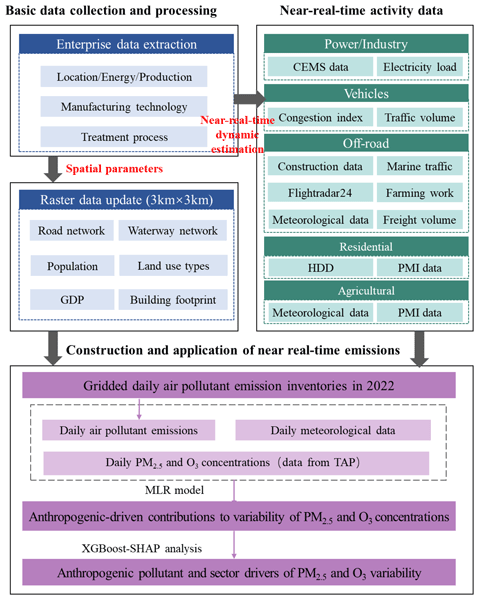
11. Please clearly indicate the connections among the three boxes in Figure 1.
Citation: https://doi.org/10.5194/egusphere-2025-5605-RC3 -
AC3: 'Reply on RC3', Yu Zhao, 01 Jun 2026
Dear Reviewer,
We sincerely thank you for taking the time to review our manuscript. We are greatly encouraged by your positive comments regarding the novelty of our near-real-time emission inventory and the integration of multiple data sources. Your insightful comments are invaluable for methodology clarification and scientific enhancement of this work, particularly regarding the concentration-emission relationships and the definitions of key parameters. We have carefully addressed all your concerns, and detailed point-by-point responses are provided as below. Please note that the line/table/figure numbers mentioned following refer to the clean version of the revised manuscript, unless specifically noted.General Comments:
This study develops a “near-real-time” emission inventory for Jiangsu Province, China. Its performance and advantages are evaluated using air quality simulations and machine learning techniques. The topic is interesting, and the manuscript is generally well written. I was particularly impressed that recent social data enable the development of such a near-real-time emission inventory. However, please address the following comments.
Response: We sincerely thank the reviewer for the positive evaluation of our work. Your comments on our near-real-time emission inventory framework and its application in Jiangsu Province is highly encouraging. We have thoroughly addressed your specific comments to further improve the manuscript.
Specific Comments:
1.First, it is necessary to define what is meant by “near-real-time” emissions. I assume that this concept has two aspects. One refers to the most recent emission estimates available before official statistical data are released; however, a delay of at least one month is required. The other refers to daily emissions, which are generally not available in conventional emission inventories.
Response: We completely agree with this insightful perspective. The reviewer has perfectly summarized the essence of our approach. We have described these two core aspects in the definition of near-real-time emission inventory in Lines 139-146 in the Introduction Section of the revised manuscript:
“In this study, “near-real-time” refers to two fundamental aspects. First, the emissions were rapidly estimated based on dynamic activity data, with a minimal delay. It greatly bridged the substantial temporal gap between the occurrence of emissions and the release of official statistical data. Second, it refers to high temporal resolution of the emission data. Unlike previous emission inventories that commonly provided monthly or annual average estimates, the near-real-time approach provided daily emission data and thereby captured the short and temporary perturbations of emissions from anthropogenic activities.”2.I did not understand the rationale for estimating vehicle emissions using Equation (7). Is the emission factor (EF) defined on a daily basis? What is the traffic congestion index? Please explain the basis and justification of Equation (7).
Response: We sincerely apologize for the lack of clarity regarding Equation (7). The emission factor (EF) in our methodology was not dynamically updated on a daily basis. Instead, it served as a fleet-average baseline EF calculated using the International Vehicle Emissions (IVE) model. The inputs required for the IVE model, including vehicle population by type, registration dates, fuel types, and emission standards, were obtained from the transportation management departments of individual cities. These historical data were then extrapolated to the present date utilizing vehicle survival curves.
The parameter I in the equation represents the Gaode Traffic Congestion Index, a metric derived from mobile navigation big data that reflects the comprehensive traffic volume and operational speed of the overall road network. As obtaining official traffic activity data with high temporoal resolution was difficult,we utilized the congestion index I as a near-real-time scaling factor for vehicle activity levels. By applying this daily index to the baseline emissions, Equation (7) enables the reasonable temporal allocation of annual emissions into daily emissions, effectively capturing traffic fluctuations such as severe drops during pandemic lockdown.
Furthermore, we have clarified that this overall congestion index was uniformly applied for all vehicle types. While we fully recognized the varying temporal patterns for different vehicle types, obtaining the near-real-time indices for them remains highly challenging due to limited data availability. Thus, the comprehensive traffic congestion index served as a proxy for total road network activity.
We have explicitly clarified this and acknowledged the limitation in Lines 256-271 of the revised manuscript:
“In Equation (7), EF represents the emission factor calculated by the IVE model. The input parameters of IVE, such as vehicle population by type, registration dates, fuel types, and emission standards, can be obtained from the transportation management departments of individual cities. These historical data can be extrapolated to the present date utilizing the vehicle survival curve, thereby bridging any gaps in the current information (Sun et al., 2020). Because official high-frequency traffic activity data are unavailable in near-real-time, we introduced I, the Gaode traffic congestion index, as a dynamic activity scaling factor. This index reflects the comprehensive traffic volume and operational status of the overall road network, allowing us to dynamically scale the baseline emissions into daily-scale trajectories. The index serves as a generalized proxy for total road network activity, and the same scaling factor was applied uniformly for all vehicle types. Although different temporal operational patterns might exist for various vehicle types (e.g., larger volume for trucks during nighttime or on specific freight corridors), obtaining the near-real-time activity information by vehicle type remains a challenge at the provincial level in China.”
3.NH3 emission factors are affected by various factors, including meteorological conditions, as stated in Lines 279–285. Could you also clarify the activity data used in the estimation? How were these data obtained?
Response: We sincerely thank the reviewer for the comment. As the reviewer noted, meteorological conditions—particularly ambient temperature—play a critical role in NH3 emissions. Our methodology fundamentally relied on the varying meteorological conditions and agricultural activity data, and we have added the information in in Lines 315-326 of the revised manuscript:
“Regarding the baseline activity data for NH3 estimations, the information was systematically derived from official statistics. For livestock and poultry breeding, we utilized the year-end stock. For synthetic fertilizers, the application amount was calculated as the product of the city-level sown area of cropland and the provincial application rate per unit area obtained from national investigations. To convert these annual totals into dynamic near-real-time estimations, we integrated the temporal allocation of activity data with real-time meteorological conditions. Based on the regional farming database from the Ministry of Agriculture, we tracked the specific growing seasons of major crop types to determine the exact timing of basal dressing and top dressing. By combining the farming cycles with meteorological conditions and high-resolution soil pH databases, we generated the spatiotemporal pattern of NH3 emissions.”4.Emissions estimated for 2022 were compared with those for 2015 and 2019 in the beginning of Section 3.1.1. Were these emissions estimated using consistent methodologies? If not, differences in estimation methodologies may influence the differences in emission estimates across years.
Response: We appreciate the reviewer’s comment. We confirm that a strictly consistent bottom-up methodological framework was applied across all the years. We have added the information in Lines 450-452 of the revised manuscript:
“Note the emissions for multiple years (2015, 2019, and 2022) were estimated with a consistent methodological framework to make reasonbal interannual comparison.”5.The influences of activity changes on NH3 emissions are discussed in Lines 464–465, whereas their treatment is not described in Lines 279–285. How about influences of changes in emission factors?
Response: We highly appreciate the reviewer's insightful comments. For the treatment of activity changes, we have added the information in Section 2.2, as described in our response to Comment 3:
“Regarding the baseline activity data for NH3 estimations, the information was systematically derived from official statistics. For livestock and poultry breeding, we utilized the year-end stock. For synthetic fertilizers, the application amount was calculated as the product of the city-level sown area of cropland and the provincial application rate per unit area obtained from national investigations. To convert these annual totals into dynamic near-real-time estimations, we integrated the temporal allocation of activity data with real-time meteorological conditions. Based on the regional farming database from the Ministry of Agriculture, we tracked the specific growing seasons of major crop types to determine the exact timing of basal dressing and top dressing. By combining the farming cycles with meteorological conditions and high-resolution soil pH databases, we generated the spatiotemporal pattern of NH3 emissions.”
Moreover, we have added analysis on the influence of changing emission factors on the seasonal emissions of NH3 in Lines 517-523 of the revised manuscript:
“For NH3, the highest emissions in March and September were predominantly driven by the intensive spring sowing and autumn farming seasons. In contrast, although the total fertilizer amount decreased in summer (mainly limited to top dressing for specific crops like paddy rice), the high temperature in summer together with top dressing greatly elevated the NH3 volatilization rates, resulting in peak emission factors that kept the emissions at a high level.”6.What types of restrictions were imposed on coal-fired boilers and industrial plants in September, as described in Lines 466–477? Please clarify the nature and scope of these restrictions.
Response: We appreciate the reviewer’s suggestion, and we have clarified the restriction measures in Lines 525-530 of the revised manuscript:
“The restriction measures included alternating operations of energy-intensive industrial plants, such as cement, steel, and glass production, in order to reduce the total production level and energy consumption during the period. Furthermore, industrial parks were required to temporarily shut down or to reduce the load of coal-fired boilers to mitigate regional precursor emissions under the unfavorable meteorological conditions.”7.(Lines 517–534) It is difficult for me to judge that SO2 and PM2.5 emissions demonstrate a close agreement between the monthly variations in emissions and those in observed concentrations in Figure 4. In addition, although possible reasons for the poor agreement in NO2 variations are discussed, some of these reasons including meteorological conditions also apply to SO2 and PM2.5. A fraction of NO2 and PM2.5 is secondarily formed in the atmosphere. Therefore, I believe it is inherently difficult to achieve close agreement between emission variations and observed concentration variations.
Response: We appreciate the reviewer’s insightful and rigorous comment. We agree with the reviewer that ambient concentrations were jointly affected by the primary emissions, meteorological conditions, and secondary atmospheric chemistry. Thus, using the phrase “close agreement” to describe the relationship between primary emissions and concentrations for SO2 and PM2.5 was indeed an overstatement in our original manuscript. Furthermore, it is also true that meteorological factors and secondary formation mechanisms affect all pollutants, (SO2 and PM2.5, and NOX). However, we would respectfully clarify that the different atmospheric lifetimes and chemical reactivities of these pollutants fundamentally explained why SO2 and PM2.5 concentrations could better reflect the signature of primary emission fluctuation compared to NOX. The chemical lifetime of NOX is highly sensitive to seasonal variations. In summer, intense solar radiation and high temperature reduce the lifetime of NOX to merely a few hours due to rapid photochemical reactions of O3 and nitrate formation. This overwhelming chemical sink effectively decouples ambient concentrations from primary emissions, resulting in the diverse seasonal patterns (high emissions and low concentration in summer). In winter, reduced photochemical activity extends NOX lifetime, allowing for greater accumulation. SO2 and PM2.5 have longer atmospheric lifetimes (typically on the order of several days). Although they are undoubtedly modulated by boundary layer dynamics and secondary formation, their longer lifetimes and less extreme seasonal variations in chemical loss rates allow them to accumulate and transport regionally, thus reflecting the impact of considerable short-term disruptions in anthropogenic activities. For example, the sharp reduction in primary emissions during the COVID-19 lockdown in April, and the impact of temporary emission control measures in autumn, were expected to reduce the ambient concentrations. Following your constructive advice, we have revised this paragraph in Lines 581-602 of the revised manuscript:
“For SO2 (Figure 4a) and PM2.5 (Figure 4e), similar monthly variation patterns were found between emissions and observed concentrations in Jiangsu. The near-real-time emission estimates effectively captured the short-term fluctuations in anthropogenic activities, including the abrupt reduction in April associated with the COVID-19 lockdown and the seasonal change from the temporary pollution control measures in autumn. While ambient concentrations were influenced by meteorology and secondary formation as well, the relatively long atmospheric lifetimes of SO2 and PM2.5 (typically several days) allow them to reflect the impact of primary emission variations. These results partly justified the capability of the approach to track the effect of changing anthropogenic activities on air pollutant emissions. In contrast, the highly reactive nature and shorter atmospheric lifetime of NOX resulted in a decoupling between its emissions and ambient concentrations. We found contrary monthly distributions between NOX emissions and the observed NO2 concentrations (Figure 4c). The largest emissions were estimated in summer months but the lowest concentrations were observed for the same months across the year. This inconsistency likely resulted from the following factors. Increased transportation activity in summer, particularly mobility rebound after lockdown, elevated NOX emissions. Meanwhile, NO2 was substantially consumed for O3 formation through rapid photochemical reactions under the intense solar radiation and high temperatures, and its atmospheric lifetime was reduced to merely a few hours. In winter, there was more NOX accumulation in the atmosphere with weaker photochemical reactions and reduced boundary layer heights (Ding et al., 2015; Wang et al., 2012). ”8.(Line 532-534) It is not possible to assess the importance of controlling NOX emissions for reducing PM2.5 pollution solely on the basis of a similar correlation between PM2.5 and NO2 in their monthly trends.
Response: We agree with the reviewer’s comment. We realized that this statement was confusing and less rigorous. To avoid any misunderstanding, we have directly deleted this sentence in the revised manuscript. We thank the reviewer for pointing this out.9.Does “12,877 metric tons” represent an annual total? (Line 550) Please clarify this point in other similar instances in the manuscript as well.
Response: Yes, it represents an annual total. We apologize for the ambiguity and have standardized the units throughout the manuscript. We have systematically checked and corrected all mass values in the manuscript.10.The model performance using the emissions obtained in this study was compared with that using MEIC emissions in Section 3.3. Although the results indicate that the emissions from this study perform better than those from MEIC, this does not necessarily imply that “near-real-time” emissions are superior to conventional emission inventories. Other modeling experiments are required to show their advantages.
Response: We appreciate the reviewer’s comment and understand the reviewer’s concern on the advantage of our near-real-time emission inventory against previous ones. Challenge indeed existed in the comparison between our emission estimates and other emission inventories, as there were few emission data available for Jiangsu for the target year 2022. For example, MEIC, the most commonly applied emission inventory for China, were updated for 2020 as the most recent year. Therefore, it is unfair to directly compare MEIC and our estimates for through through air quality modeling for 2022. The discrepancy in total emission levels for different years would bring bias for the model evaluation. Therefore, to conduct a more reasonable comparison that addressed the impact of spatiotemporal pattern of emissions, we had already adjusted the annual total emissions of MEIC (for Jiangsu 2020) to perfectly match those of our estimates (for Jiangsu 2022), while the spatiotemproal distribution of emissions were kept unchanged as MEIC. In the revised manuscript, we named this updated emission data as “MEIC-revision”. We had conducted model simulation with MEIC-revision and our near-real-time emission inventory and justified the advantage of the latter. We mean this is the effort we could currently make for model evaluation, and more comparsions can be expected once more recent emission inventories get available for the region.
We have modified the description in Lines 360-369 of the revised manuscript:.
“We further compared the modeling performance using the provincial-level near-real-time emission estimates in D3 with that based on MEIC. Since MEIC was currently available till 2020, direct application of MEIC introduce bias from the discrepancy in annual total emissions for different years. To avoid this, we adjusted the annual total emissions of various species in MEIC (for Jiangsu 2020) to perfectly match those of our near-real-time estimates (for Jiangsu 2022), and kept the spatiotemproal distribution of emissions unchanged (referred as “MEIC-revision”). The treatment ensured that any improvement in modeling performance with the near-real-time emission estimate resulted from its optimized spatiotemporal pattern of emissions rather than the total levels.”11.Please clearly indicate the connections among the three boxes in Figure 1.
Response: Thanks for the reviewer’s reminder. We have redrawn Figure 1 and clearly indicate the connections among the three main methodological components.Citation: https://doi.org/10.5194/egusphere-2025-5605-AC3
-
AC3: 'Reply on RC3', Yu Zhao, 01 Jun 2026
Peer review completion


Interactive discussion
Status: closed
-
RC1: 'Comment on egusphere-2025-5605', Anonymous Referee #2, 01 Mar 2026
General Comments: The fast-changing emissions are important factors driving the variability of air quality, and substantial challenges exist in tracking the emissions by sector and species, attributed to data access limitation and methodology. The manuscript develops a near-real-time emission accounting framework and combines it with machine learning to assess driving factors of air quality. They applied the methodology in Jiangsu Province, a hotspot of industrial and traffic activities, energy consumption, and anthropogenic emissions in Yangtze River Delta region, China. The efforts advanced the regional emission estimation and its application for the scientific community. Generally, the manuscript is well organized and easy to follow, and provides credible scientific evidence for regional air quality management. I recommend acceptance after addressing the following comments to further improve the manuscript.
Specific comments:
- While Figures 6 and 7 effectively illustrate the time-series comparison between observed and simulated concentrations for PM5 and ozone, the accompanying discussion is currently too descriptive, focusing primarily on general statistical metrics (e.g., overall NMB and R values) without deeply analyzing the physical and chemical mechanisms driving these improvements during specific dynamic periods. To fully validate the “rapid assessment” capability of the proposed framework, I strongly recommend that the authors expand the discussion to specifically evaluate the model performance during key anomaly events in 2022. For instance, it would be valuable to quantify the improvement in PM2.5 simulations during the April COVID-19 lockdown, explaining how the near-real-time inventory captured these abrupt industrial and transport changes. Furthermore, regarding the ozone simulation, the authors should provide a more mechanistic explanation for the reduced biases in January and October; specifically, how the refined NOX and PM2.5 emission ratios influenced non-linear processes such as the NOX titration effect in winter and the aerosol-radiation feedback mechanism in autumn. A detailed analysis of these specific episodes will significantly strengthen the scientific depth of the manuscript.
- The study relies on various near-real-time activity data (e.g., traffic index, CEMS). In real-world applications, data loss or outliers are inevitable. Could the authors briefly mention in the Methodology section how they handled missing data or obvious outliers in the raw activity data? (e.g., did you use linear interpolation or average substitution?). This will make the method more robust and reproducible.
- One of the stated goals of this work is to support “rapid assessment” and policy-making. However, the current conclusion is somewhat generic. The authors are encouraged to expand the Implications section to discuss how this high-frequency inventory framework can be practically integrated into current air quality management systems in China. For example, how can this daily-resolved data support the specific “Heavy Pollution Weather Emergency Response” mechanisms? Can this framework distinguish between the effectiveness of long-term structural adjustments versus short-term emergency controls? A deeper discussion on the practical applicability of this system would greatly increase the impact of this paper for policymakers and the broader scientific community.
- The manuscript presents robust data on the emissions during the COVID-19 lockdown. However, could the authors provide further analysis on the possible rebound of emissions as the region transitions back to normal economic activities? Moreover, could the current framework help in predicting future emissions under different scenarios?
- Given that meteorological conditions greatly influence air quality, could the authors explain how their near-real-time framework integrates real-time weather data to enhance emission predictions?
- Please check the abbreviation style of journal names in the Reference list. For instance, in Line 1108, “Environ. Sci. Tech.” should likely be “Environ. Sci. Technol.” to match standard citations. Please ensure consistency across all references.
- Please ensure that “MEIC” is fully defined (Multi-resolution Emission Inventory for China) at its first appearance in the main text, as it is a key comparison dataset.
- In Lines 1064-1066 (Wang et al., 2017), the journal name is “China Environmental Science”. Please check if the journal requires stating “(in Chinese)” at the end of the reference if the original article is in Chinese.
- In several instances, the manuscript uses varying units to express emissions (for example, Gg vs. metric tons). Can the authors standardize the units throughout the text to improve clarity and consistency?
- Some figure captions may lack sufficient descriptive detail. Can the authors provide clearer and more comprehensive explanations for Figures 6 and 7 to improve reader understanding?
Citation: https://doi.org/10.5194/egusphere-2025-5605-RC1 -
AC1: 'Reply on RC1', Yu Zhao, 01 Jun 2026
Dear reviewer,
We would like to express our sincere gratitude to the editor and the reviewers for their highly valuable comments. We have carefully considered all the comments and revised the manuscript accordingly. We believe that these revisions have significantly improved the scientific depth, clarity, and practical applicability of our study. We provide a point-by-point response to the comments as below. Please note that the line/table/figure numbers mentioned following refer to the clean version of the revised manuscript, unless specifically noted.General Comments:
The fast-changing emissions are important factors driving the variability of air quality, and substantial challenges exist in tracking the emissions by sector and species, attributed to data access limitation and methodology. The manuscript develops a near-real-time emission accounting framework and combines it with machine learning to assess driving factors of air quality. They applied the methodology in Jiangsu Province, a hotspot of industrial and traffic activities, energy consumption, and anthropogenic emissions in Yangtze River Delta region, China. The efforts advanced the regional emission estimation and its application for the scientific community. Generally, the manuscript is well organized and easy to follow, and provides credible scientific evidence for regional air quality management. I recommend acceptance after addressing the following comments to further improve the manuscript.Response: We sincerely thank the reviewer for the positive evaluation of our work. The comments on our near-real-time emission accounting framework and its application in Jiangsu Province are highly encouraging. We have thoroughly addressed the reviewer’s specific comments to further improve the manuscript.
Specific Comments:
1.While Figures 6 and 7 effectively illustrate the time-series comparison between observed and simulated concentrations for PM2.5 and ozone, the accompanying discussion is currently too descriptive, focusing primarily on general statistical metrics (e.g., overall NMB and R values) without deeply analyzing the physical and chemical mechanisms driving these improvements during specific dynamic periods. To fully validate the “rapid assessment” capability of the proposed framework, I strongly recommend that the authors expand the discussion to specifically evaluate the model performance during key anomaly events in 2022. For instance, it would be valuable to quantify the improvement in PM2.5 simulations during the April COVID-19 lockdown, explaining how the near-real-time inventory captured these abrupt industrial and transport changes. Furthermore, regarding the ozone simulation, the authors should provide a more mechanistic explanation for the reduced biases in January and October; specifically, how the refined NOX and PM2.5 emission ratios influenced non-linear processes such as the NOX titration effect in winter and the aerosol-radiation feedback mechanism in autumn. A detailed analysis of these specific episodes will significantly strengthen the scientific depth of the manuscript.Response: We sincerely thank the reviewer for highlighting the necessity of a more careful discussion on physical and chemical mechanisms that resulted in the improvement of model performance. In the revised manuscript, we have expanded the discussion to better explain how the near-real-time emission inventory helped to evaluate the impacts of temporary disruptions of anthropogenic activities (e.g., the COVID-19 lockdown in April and industrial electricity rationing in July), which are typically challenging for static profiles to capture. For O3, we have further discussed how the refined precursor emission ratios likely modulated non-linear atmospheric processes, including (1) the potential enhancement of the NOX titration sink under weak winter solar radiation, (2) the easing of titration inhibition during the spring transition, and (3) the possible role of the aerosol-radiation feedback driven by emission controls in autumn and winter. We have added more descriptions in Lines 763-818 of the revised manuscript:
“Figure 6 compares the observed and simulated PM2.5 concentrations, and measurable improvement of model performance was achieved with the updated temporal profiles for emissions. Specifically, the NMEs for January, April, July, and October decreased from 37.5%, 55.3%, 62.5%, and 51.3% to 33.2%, 29.2%, 48.1%, and 42.6%, respectively. The greatly improved model performance for April 2022 demonstrated the capability of the near-real-time emission data to better capture the influence of temporarily disrupted anthropogenic activities on air quality. During this period, the COVID-19 lockdown in Shanghai severely restricted cross-regional freight transport and industrial operations in Jiangsu (Huang et al., 2021). Compared with previous emission inventories relying on historical temporal patterns, the refined daily emission inventory with near-real-time techniques provided a more realistic representation of the decline in primary aerosols and precursor emissions from heavy-duty vehicles and point sources. Consequently, the simulated PM2.5 concentrations showed better agreement with observations, with the NMB reduced to -6.6%. The refined emission inventory also yielded notable corrections for periods with targeted administrative interventions. During the late July period (July 20 to 31), for example, the NMB for PM2.5 decreased from 47.3% with MEIC to 16.1% with the near-real-time emission data, and the simulated mean concentrations dropped from 76.4 to 60.2 μg/m3, much closer to the observed 52.0 μg/m3. This improvement was likely attributable to the inventory’s dynamic response to official electricity rationing policy. Driven by extreme summer heat waves and power grid stress, local governments mandated load reduction measures for energy-intensive facilities (Wei et al., 2020), causing an irregular drop in industrial emissions that may not be tracked in previous inventories. Similarly, the clear overestimation with MEIC for October was effectively mitigated. The refined emission data appeared to better reflect the benefit of stringent control measures implemented for preventing the heavy haze pollution in autumn and winter (Jiang et al., 2023).
Figure 7 presents the observed and simulated O3 concentrations. Compared with MEIC, the NMEs with the near-real-time emission data for January, April, July, and October decreased from 51.4%, 54.0%, 44.3%, and 54.5% to 49.3%, 41.1%, 32.7%, and 34.6%, respectively. The updated emission data could have modulated the simulation of non-linear photochemical processes. In January when weak solar radiation generally limits photochemical O3 production, NOX titration often acts as a dominating mechanism. The simulation with MEIC underestimated NO2 by 37.4%, and it potentially contributed to a 36.0% overestimation of O3 due to insufficient chemical scavenging. With the NOX emissions 12% higher than MEIC during the January, the near-real-time emission inventory resulted in a more reasonable simulation of the titration effect. The enhanced chemical sink reduced the O3 NMB to -23.1% and improved the R2 from 0.30 to 0.66. For April, the NOX emissions were 15.9% lower in the real-near-time inventory than MEIC. Such a reduction in NOX could effectively weaken the titration inhibition, and it likely allowed the model to better track the accelerated accumulation of O3 driven by increasing spring solar radiation. Simulation with the refined emission data yielded a growth of 1.72 μg/m3 for the month, much closer to the observation (2.59 μg/m3) than that with MEIC (0.33 μg/m3). Furthermore, there existed substantial correction of O3 underestimation in October, with the NME reduced from 54.5% to 34.6%. Such improvement resulted potentially from the better simulated aerosol-radiation feedback. As mentioned earlier, specific measures were conducted during autumn and winter in Jiangsu to prevent heavy haze pollution. The emission abatement resulting from those measures were captured by the near-real-time techniques, facilitating a lower aerosol loading in CMAQ simulation compared to that with MEIC. This could theoretically elevate photochemistry process and accelerate O3 production, partially bridging the gap between simulation and observation. In contrast, MEIC did not fully include the local pollution control measures for specific seasons, and the relatively high aerosol loading from simlation might have overly suppressed photochemical O3 formation by scattering and absorbing actinic flux (Zhao et al., 2021).2.The study relies on various near-real-time activity data (e.g., traffic index, CEMS). In real-world applications, data loss or outliers are inevitable. Could the authors briefly mention in the Methodology section how they handled missing data or obvious outliers in the raw activity data? (e.g., did you use linear interpolation or average substitution?). This will make the method more robust and reproducible.
Response: We thank the reviewer’s suggestion and agree that data quality control is indeed an improtant step. We have added a paragraph in the methodology section to describe our data quality control and outlier correction strategies. We have clarified this information in Lines 164-171 of the revised manuscript:
“To ensure the robustness of the near-real-time activity data (e.g., traffic indices and CEMS records), a rigorous data quality control protocol was implemented to handle missing values and outliers. Obvious anomalies, defined as values exceeding three standard deviations from the 7-day moving average, were screened and removed. For short-term data gaps (1-2 days), linear interpolation was applied. For longer continuous missing periods (≥3 days), missing values were gap-filled using the historical average of the same day-of-week in the adjacent weeks, adjusted by the regional sector-specific variability.”3.One of the stated goals of this work is to support “rapid assessment” and policy-making. However, the current conclusion is somewhat generic. The authors are encouraged to expand the Implications section to discuss how this high-frequency inventory framework can be practically integrated into current air quality management systems in China. For example, how can this daily-resolved data support the specific “Heavy Pollution Weather Emergency Response” mechanisms? Can this framework distinguish between the effectiveness of long-term structural adjustments versus short-term emergency controls? A deeper discussion on the practical applicability of this system would greatly increase the impact of this paper for policymakers and the broader scientific community.
Response: We appreciate the insightful comment. We have expanded the Implications/Conclusion section to explicitly discuss how our framework can support policymaking, particularly distinguishing short-term emergency responses from long-term measures. We have added this explanation in Lines 935-947 of the revised manuscript:
“The near-real-time techniques and estimation of daily-level emissions offer substantial practical implications for current air quality management in China. Specifically, it can be directly integrated into the “Emergency Response for Reducing Heavy Pollution Weather” program. By providing the near-real-time feedback on emission variations, policy makers can reasonably determine the short-term emission reduction measures and timely evaluate their actual effectiveness (e.g., temporary suspension of specific industries or traffic restrictions). Furthermore, combined with machine learning techniques, this framework allows policy makers to decouple and distinguish the environmental benefits of long-term policies of air quality improvement from short-term emergency controls or unexpected socioeconomic shocks (like the COVID-19 lockdown). The obtained knowledges provide a scientific basis for formulating more cost-effective and precise coordinated control strategies for reducing PM2.5 and O3 pollution.”4.The manuscript presents robust data on the emissions during the COVID-19 lockdown. However, could the authors provide further analysis on the possible rebound of emissions as the region transitions back to normal economic activities? Moreover, could the current framework help in predicting future emissions under different scenarios?
Response: We sincerely thank the reviewer’s comment. We agree that an expanded analysis of emission rebound and a discussion on future emission prediction help improve the paper. To address this comment, we have kept our initial comparative analysis for 2022 and 2023, and revised the manuscript by adding discussions in two specific sections:
In Section 3.2, we have added an analysis on the post-lockdown emission rebound, highlighting the effects of compensatory industrial production and diverse recoveries of different sectors in Lines 694-705 of the revised manuscript:
“In addition, an examination was conducted for exploring the diverse rebounds of emissions for different sectors. Vehicle emissions exhibited a clear growth in May compared to the central lockdown period in April. This early rebound in transportation was likely driven by the gradual recovery of essential logistics and commuting. In contrast, the emissions from industrial sector remained at a greatly suppressed level throughout April and May, without an immediate rebound. This lag in industrial recovery aligned with the socioeconomic condition of YRD, where the regional industrial added value and GDP experienced a substantial decline in the second quarter of 2022, followed by a slow recovery in the subsequent months (JSBS, 2022). Such diversity between sectors indicated that mobile sources and energy supply could respond quickly to the lifting of restrictions, while the recovery of large-scale manufacturing could be more difficult due to complex supply chain realignment.”
In Section 4, we elaborated on how the near-real-time framework, coupled with the machine learning approach, could be potentially applied for predicting future emissions and evaluating different policy scenarios in Lines 948-959 of the revised manuscript:
“Furthermore, the framework could be potentially applied for predicting future emissions under various hypothetical scenarios. Because the framework establishes a dynamic linkage between sector-specific activity factors and emissions, it could theoretically serve as a tool for predicting the emission change from policy formulation. By adjusting these activity factors, such as the gradual penetration of electric heavy-duty vehicles, the implementation of various industrial production abatement during haze events, or targeted reductions in agricultural activities, policy-makers could project the emission levels of diverse future scenarios. Coupled with the rapid assessment approach with machine learning, the framework presents a promising pathway to quantify how the simulated emission changes might affect the daily variability of air quality, thereby better supporting the policy design and adjustment for regional complex pollution controls.”5.Given that meteorological conditions greatly influence air quality, could the authors explain how their near-real-time framework integrates real-time weather data to enhance emission predictions?
Response: We thank the reviewer for highlighting the importance of meteorological conditions. We would like to clarify that the emission estimations for most species (except NH3) in our near-real-time framework were fundamentally driven by socioeconomic activity proxies, rather than meteorological data. For NH3, We have clarified this information in Lines 315-326 of the revised manuscript:
“Regarding the baseline activity data for NH3 estimations, the information was systematically derived from official statistics. For livestock and poultry breeding, we utilized the year-end stock. For synthetic fertilizers, the application amount was calculated as the product of the city-level sown area of cropland and the provincial application rate per unit area obtained from national investigations. To convert these annual totals into dynamic near-real-time estimations, we integrated the temporal allocation of activity data with real-time meteorological conditions. Based on the regional farming database from the Ministry of Agriculture, we tracked the specific growing seasons of major crop types to determine the exact timing of basal dressing and top dressing. By combining the farming cycles with meteorological conditions and high-resolution soil pH databases, we generated the spatiotemporal pattern of NH3 emissions.”6.Please check the abbreviation style of journal names in the Reference list. For instance, in Line 1108, “Environ. Sci. Tech.” should likely be “Environ. Sci. Technol.” to match standard citations. Please ensure consistency across all references.
Response: Thank you for pointing out this formatting error. We have thoroughly checked all references and corrected “Environ. Sci. Tech.” to “Environ. Sci. Technol.”. (Yun et al., 2021 and Zhao et al., 2020a).7.Please ensure that “MEIC” is fully defined (Multi-resolution Emission Inventory for China) at its first appearance in the main text, as it is a key comparison dataset.
Response: We have defined MEIC at its first appearance in Lines 337-339 of the revised manuscript:
“The Multi-resolution emission inventory of China (MEIC, http:// http://meicmodel.org.cn/, last visited on October 2025) was applied for D1, D2, and the regions out of Jiangsu in D3 (Zheng et al., 2018), ...”
8. In Lines 1064-1066 (Wang et al., 2017), the journal name is “China Environmental Science”. Please check if the journal requires stating “(in Chinese)” at the end of the reference if the original article is in Chinese.
Response: We have added this information in Lines 1249-1252 of the revised manuscript:
“Wang, K., Gao, J., Tian, H., Dan, M., Yue, T., Xue, Y., Zou, P., and Wang, C.: An emission inventory spatial allocate method based on POI data, China Environ. Sci, 37, 2377-2382, https://doi.org/10.13198/j.issn.1001-6929.2019.02.13, 2017. (in Chinese).”9. In several instances, the manuscript uses varying units to express emissions (for example, Gg vs. metric tons). Can the authors standardize the units throughout the text to improve clarity and consistency?
Response: We thank the reviewer for the reminder. In response to the reviewer’s suggestion for better clarity, we have revised the units to ensure consistency. We now use Gg for annual emissions and have replaced "tons" with Mg for daily emissions (1 ton = 1 Mg) to prevent reader confusion.10.Some figure captions may lack sufficient descriptive detail. Can the authors provide clearer and more comprehensive explanations for Figures 6 and 7 to improve reader understanding?
Response: We thank the reviewer for this suggestion. We have revised the captions of Figures 6 and 7 to provide complete information. Note we have changed “MEIC” to “MEIC-revision” for clarification. Please also see our response to Question 10 of Reviewer #3.
Figure 6. Comparison between the observed daily PM2.5 concentrations (blue lines) and the simulated concentrations with different emission inventories in Jiangsu Province for January (a), April (b), July (c), and October (d) in 2022. The simulations were conducted using the near-real-time emission inventory developed in this work (red lines) and the revised national emission inventory MEIC (MEIC-revision, black lines).. See Section 2.3 for the rationale of MEIC revision.
Figure 7. Comparison between the observed daily maximum 8-hour average (MDA8) O3 concentrations and the simulated concentrations with different emission inventories in Jiangsu Province for January (a), April (b), July (c), and October (d) in 2022. The simulations were conducted using the near-real-time emission inventory developed in this work (red lines) and the revised national emission inventory MEIC (MEIC-revision, black lines). See Section 2.3 for the rationale of MEIC revision.Citation: https://doi.org/10.5194/egusphere-2025-5605-AC1
-
RC2: 'Comment on egusphere-2025-5605', Anonymous Referee #1, 04 Apr 2026
The manuscript presents a valuable and timely contribution to the field of atmospheric chemistry and environmental management. The authors developed a framework of making a near-real-time anthropogenic emission inventory for Jiangsu Province, by integrating multi-source dynamic activity data. Furthermore, the inclusion of machine learning techniques (XGBoost-SHAP) offered a rapid and efficient tool of decoupling the influences of meteorological conditions and anthropogenic emission changes on air quality Application of such tool in Jiangsu proved impressive and scientifically rigorous.
In general, the methodology of this current work is robust, and the results of emissions with high temporal resolution could potentially help the short-term air quality forecasting and policy design of emergent emission controls. The manuscript is logically structured and clearly written, and the conclusions were basically supported by the data presented. I recommend the manuscript to be accepted for publication after revisions.
- The methodology for updating the temporal profiles using high-frequency monitoring data (e.g., CEMS and traffic index) is prominent. However, the spatial allocation of these near-real-time emissions is somewhat ambiguous. Given that the manuscript aims to provide a “high-resolution spatial and temporal distribution”, does the framework utilize static spatial proxies (e.g., POI data or fixed road networks) for these dynamic emissions, or are the spatial distributions also updated with a relatively high frequency (e.g., daily for some sectors)? Please clarify this in Section 2.1.
- The near-real-time emission framework represents a valuable tool for Jiangsu Province in China. However, the system relies heavily on region-specific, high-quality data streams (e.g., extensive CEMS coverage and provincial traffic monitors). What are the limitations in transferring this methodology to less developed regions in China or other developing countries where such high-frequency ground data might be sparse? Adding a discussion on the general interest of this framework would broaden the paper’s impact for the scientific community.
- Besides the emission estimation, the application of XGBoost algorithm to explore the relationship between PM2.5/O3 concentrations and precursor emissions is an useful addition, highlighting the benefit of coupling machine learning with traditional modeling. However, tree-based models were often considered as “black boxes” without sufficient capability of interpreting the results. Could the authors briefly elaborate on how they interpreted the XGBoost outputs to draw meaningful conclusions?
- In the Methodology, the authors mention using the traffic congestion index for mobile sources. Please clarify if the same scaling factor was applied to all vehicle types (e.g., heavy-duty trucks, passenger cars, and others). If not, how was the difference in temporal patterns of the fleet emissions between those types recorded or reflected in the daily emission updates?
- The framework primarily scales “Activity Levels” using near-real-time data. However, Emission Factors (EF) for vehicles could be highly dependent on vehicle speed and engine load, and might vary greatly during heavy traffic or lockdowns. Did the authors consider these complicated factors for EFs in Equation 7, or were they treated as constants for the 2022 period?
- Section 3.2 provides a case study of COVID-19 lockdown for Shanghai in 2023. While the result proved reasonable for the whole province, could more anlaysis be conducted for cities so as to explore the different impacts of the lockdown for various regions?
- The section of evaluation of WRF-CMAQ modeling performance different emission inventories (Section 3.3) is quite descriptive. If possible, the manuscript would benefit from some more discussion or analysis, to interprate why the model performed better during specific periods with the near-real-time emission inventory developed in this work.
- Line 704. The NOx emission from certain sources? Lines 710-712: The description needs to be revised. Although VOCs emission indeed declined in winter, the NOX emissions were not “enhanced” in winter. As shown in Figure 4, instead, the NOX emissions in winter were relatively low.
- The format of References should be thoroughly checked and improved. For example, there is an inconsistency in the capitalization style of article titles (e.g, Lines 1086-1088: Multi-Scale Dynamics and Spatial Consistency...)
The formatting of Digital Object Identifiers (DOI) varies across the reference list. (e.g., Line 1094: doi: 10.1007/s11430-023-1230-3; Line 1097: https://doi.org/10.5194/acp-15-2105-2015).
Citation: https://doi.org/10.5194/egusphere-2025-5605-RC2 -
AC2: 'Reply on RC2', Yu Zhao, 01 Jun 2026
Dear reviewer,
We sincerely thank the reviewer for the highly positive evaluation of our manuscript and for recognizing the timeliness, rigor, and potential impact of our near-real-time emission framework and the XGBoost-SHAP application. We greatly appreciate the constructive comments, which have significantly helped us improve the clarity, depth, and formatting of our manuscript. We have carefully addressed each comment point-by-point as below, and all corresponding modifications have been highlighted in the revised manuscript. Please note that the line/table/figure numbers mentioned following refer to the clean version of the revised manuscript, unless specifically noted.General Comments:
The manuscript presents a valuable and timely contribution to the field of atmospheric chemistry and environmental management. The authors developed a framework of making a near-real-time anthropogenic emission inventory for Jiangsu Province, by integrating multi-source dynamic activity data. Furthermore, the inclusion of machine learning techniques (XGBoost-SHAP) offered a rapid and efficient tool of decoupling the influences of meteorological conditions and anthropogenic emission changes on air quality Application of such tool in Jiangsu proved impressive and scientifically rigorous.
In general, the methodology of this current work is robust, and the results of emissions with high temporal resolution could potentially help the short-term air quality forecasting and policy design of emergent emission controls. The manuscript is logically structured and clearly written, and the conclusions were basically supported by the data presented. I recommend the manuscript to be accepted for publication after revisions.
Response: We sincerely thank the reviewer for the positive evaluation of our work. The comments on our near-real-time emission accounting framework and its application is highly encouraging. We have thoroughly addressed your specific comments to further enhance the quality of the manuscript.Specific Comments:
1.The methodology for updating the temporal profiles using high-frequency monitoring data (e.g., CEMS and traffic index) is prominent. However, the spatial allocation of these near-real-time emissions is somewhat ambiguous. Given that the manuscript aims to provide a “high-resolution spatial and temporal distribution”, does the framework utilize static spatial proxies (e.g., POI data or fixed road networks) for these dynamic emissions, or are the spatial distributions also updated with a relatively high frequency (e.g., daily for some sectors)? Please clarify this in Section 2.1. Please note that the line/table/figure numbers mentioned following refer to the clean version of the revised manuscript, unless specifically noted.
Response: We thank the reviewer for raising this important question regarding spatial allocation. While our temporal profiles were updated at a very high frequency using dynamic activity data, the spatial distribution of emission sources could not be updated at the daily level. It did not only rely on static proxies that were commonly applied in previous studies, either. Instead, we applied a strategy with moderate data updating frequency, according to data availability.
Specifically, point sources (power and industrial enterprises) were allocated based on their precise latitudes and longitudes. For other sectors, we utilized Point of Interest (POI) data from Gaode Map to capture real-time changes in road and waterway networks, land use, and building footprints. The spatial information is commonly updated every 2-3 months. While it was not updated at the daily level due to computational and data limits, this updating frequency of 2-3 month greatly reduced the spatial allocation errors associated with traditional delayed or static proxies. We have clarified this information in Lines 172-179 of the revised manuscript:
“Furthermore, we improved the spatial distribution of air pollutant emissions. Point sources of power and industrial enterprises were allocated based on their latitudes and longitudes. We further utilized Point of Interest (POI) data from Gaode Map (https://lbs.amap.com/, last visited on October 2025) to obtain changes on road/waterway networks, land use, and building footprints. The spatial information is commonly updated every 2-3 months. The use of updated POI data greatly reduced the error of spatial allocation of emissions that may result from the delayed information from the constant spatial proxies (Wang et al., 2017).”2.The near-real-time emission framework represents a valuable tool for Jiangsu Province in China. However, the system relies heavily on region-specific, high-quality data streams (e.g., extensive CEMS coverage and provincial traffic monitors). What are the limitations in transferring this methodology to less developed regions in China or other developing countries where such high-frequency ground data might be sparse? Adding a discussion on the general interest of this framework would broaden the paper’s impact for the scientific community.
Response: We completely agree that the reliance on region-specific high-quality data streams litmits the transferability of the research framework to less developed regions. To address this and broaden the paper’s general interest, we have added a paragraph in the Discussion section (Lines 967-977 in the revised manuscript) exploring how this framework can be adapted for less developed regions by utilizing alternative remote sensing or widely accessible proxy data:
“While our research framework demonstrates robust performance in data-rich regions like Jiangsu Province, its heavy reliance on extensive CEMS coverage and provincial traffic monitors poses a limitation for its transferability to less developed regions or other developing countries without sufficient data support. To adapt this methodology for those regions, future applications could be expanded to other datasets with global accessibility. For instance, satellite-derived tropospheric NO2 columns, daily nighttime light fluctuations, and generalized mobile phone signaling data could serve as alternative proxies to estimate the activity levels and their temporal profiles. Expanding this framework to incorporate such multi-source remote sensing data will be more crucial for establishing near-real-time emission inventories in regions with less data support.”3.Besides the emission estimation, the application of XGBoost algorithm to explore the relationship between PM2.5/O3 concentrations and precursor emissions is an useful addition, highlighting the benefit of coupling machine learning with traditional modeling. However, tree-based models were often considered as “black boxes” without sufficient capability of interpreting the results. Could the authors briefly elaborate on how they interpreted the XGBoost outputs to draw meaningful conclusions?
Response: We appreciate the reviewer’s concern regarding the “black box” nature of tree-based models. In our study, we explicitly addressed this issue by integrating the SHAP (SHapley Additive exPlanations) algorithm with the XGBoost model. As described in our methodology, the SHAP tree explainer algorithm calculates the marginal contribution of each emission feature, allowing us to quantify how much each pollutant-sector combination contributed to the variability of daily concentrations. This opens the black box and partly translates machine learning outputs into physically meaningful atmospheric insights. We have clarified this information in Lines 406-411 of the revised manuscript:
“To overcome the traditional “black box” limitation of tree-based machine learning models, we utilized the SHAP algorithm to interpret the XGBoost outputs. Based on the algorithm, we were able to explicitly attribute the day-to-day variations in ambient pollutant concentrations to precursor emission changes from specific sectors, thereby drawing physically meaningful and conclusions.”4.In the Methodology, the authors mention using the traffic congestion index for mobile sources. Please clarify if the same scaling factor was applied to all vehicle types (e.g., heavy-duty trucks, passenger cars, and others). If not, how was the difference in temporal patterns of the fleet emissions between those types recorded or reflected in the daily emission updates?
Response: We thank the reviewer for this insightful question. To clarify, in the current framework, the same scaling factor based on the overall traffic congestion index was applied uniformly to all vehicle types.
The traffic congestion index reflects the comprehensive traffic volume and operational speed of the overall road network, thereby encompassing the mixed fleet on the road. We acknowledged that various vehicle types (especially heavy-duty trucks versus passenger cars) exhibit different temporal operational patterns (e.g., larger volume for trucks during nighttime or on specific freight corridors). However, obtaining near-real-time data that explicitly differentiate between vehicle types across an entire province remains highly challenging due to current data availability limitations. Therefore, we utilized the comprehensive traffic congestion index as a generalized proxy for all vehicle types. We have explicitly clarified this and acknowledged the limitation in Lines 256-271 of the revised manuscript:
“In Equation (7), EF represents the emission factor calculated by the IVE model. The input parameters of IVE, such as vehicle population by type, registration dates, fuel types, and emission standards, can be obtained from the transportation management departments of individual cities. These historical data can be extrapolated to the present date utilizing the vehicle survival curve, thereby bridging any gaps in the current information (Sun et al., 2020). Because official high-frequency traffic activity data are unavailable in near-real-time, we introduced I, the Gaode traffic congestion index, as a dynamic activity scaling factor. This index reflects the comprehensive traffic volume and operational status of the overall road network, allowing us to dynamically scale the baseline emissions into daily-scale trajectories. The index serves as a generalized proxy for total road network activity, and the same scaling factor was applied uniformly for all vehicle types. Although different temporal operational patterns might exist for various vehicle types (e.g., larger volume for trucks during nighttime or on specific freight corridors), obtaining the near-real-time activity information by vehicle type remains a challenge at the provincial level in China.”5.The framework primarily scales “Activity Levels” using near-real-time data. However, Emission Factors (EF) for vehicles could be highly dependent on vehicle speed and engine load, and might vary greatly during heavy traffic or lockdowns. Did the authors consider these complicated factors for EFs in Equation 7, or were they treated as constants for the 2022 period?
Response: We highly appreciate the reviewer’s professional insight regarding the complexity of vehicle emission factors (EFs). We would like to clarify that the baseline EFs utilized in our study were calculated using the IVE (International Vehicle Emissions) model. The IVE model inherently incorporates the intricate impacts of diverse driving conditions, such as vehicle speed, acceleration, and engine load, into the baseline EF calculations.
However, in our near-real-time research framework, we primarily focused on the adjustment of activity levels as the predominant driving factor for day-to-day emission fluctuations. Consequently, while the base EFs scientifically reflect typical driving conditions derived from the IVE model, they were treated as baseline constants for the calculation of daily emissions for 2022. Continuous recalculation of real-time, speed-dependent EFs on a daily, province-wide scale is computationally intensive and remains as a direction for future improvement of our model. We have added this explanation in Lines 271-278 of the revised manuscript:
“The baseline EFs for vehicles in Equation 7 were derived using the IVE model, which comprehensively accounts for the influences of complex driving conditions, including vehicle speed and engine load. However, continuous recalculation of real-time and speed-dependent EFs on a daily, province-wide scale is computationally intensive and remains as a challenge. For the near-real-time estimation of traffic emissions, therefore, the EFs were treated as baseline constants for 2022, and we predominantly focused on the dynamic adjustment of activity levels and treated them as the primary driving factor for the daily emission fluctuations.”6.Section 3.2 provides a case study of COVID-19 lockdown for Shanghai in 2023. While the result proved reasonable for the whole province, could more analysis be conducted for cities so as to explore the different impacts of the lockdown for various regions?
Response: We thank the reviewer for this insightful suggestion and fully agree that analysis and comparison for cities were insufficienty conducted in the original submission. In this work, utilization of local dynamic proxies (e.g., city-level traffic congestion indices for on-road transportation, port throughput for marine, and CEMS for industrial sources) allows us to capture the differentiated impacts of the lockdown on emissions for different cities. Following your advice, we have expanded Section 3.2 to include a city-level analysis and comparison. We selected three representative cities across Jiangsu Province (Figure S1): Suzhou (in southern Jiangsu, close to Shanghai), Nantong (in central Jiangsu, heavily relying on marine logistics), and Xuzhou (in northern Jiangsu, geographically further from Shanghai and dominated by heavy industry).
Driven by our real-time proxies, the model successfully captured distinct responses of air pollutant emissions to Shanghai lockdown. For instance, Suzhou experienced a massive drop in traffic NOX, leading to a sharp emission reduction for the whole city. Indicated by CEMS data, meanwhile, the industrial NOX reductions for all the three cities were moderate.
We have added more descriptions in Lines 706-713 of the revised manuscript and a supplementary table (Table S2) to highlight this spatial heterogeneity:
“To further explore the spatial heterogeneity of the lockdown impacts, we conducted a city-level comparative analysis by selecting three representative cities: Suzhou in southern Jiangsu, Nantong in central Jiangsu, and Xuzhou in northern Jiangsu (see locations of the cities in Figure S1). Suzhou is adjacent to Shanghai, with dense petrochemical and manufacturing industries deeply embedded in regional supply chains. Nantong is located in coastal area and relies heavily on marine logistics and ports. Xuzhou is a city dominated by heavy industries and is farther from Shanghai with less direct lockdown exposure compared to other cities in Jiaingsu.
As a core economic hub deeply integrated with Shanghai’s supply chain, Suzhou was greatly influenced by Shanghai lockdown (Table S2). The NMVOCs and NOX emissions in April-May 2022 dropped 17.9% (6,812 tons) and 15.2% (2,917 tons), respectively, compared to the normal level (April-May 2023). This acute decline was co-driven by the near-total freeze of cross-city highway freight, massive operational bottlenecks at major ports, and widespread suspensions of petrochemical and electronics manufacturing. Meanhwile, there existed notable drops in PM2.5 (-13.0%) and SO2 emissions (-9.0%) from halted construction and industrial fuel use. In Nantong, the moderate declines in NOX (-9.2%,), NMVOCs (-8.6%), PM2.5 (-6.8%) and SO2 (-4.9%) primarily reflected disruptions in regional waterway logistics and slowdowns in general manufacturing. In contrast, the emission reductions in Xuzhou were much smaller around 3%, attributed to the continous operations of heavy industry to maintain the essential supply chains of industrial economy. These diversities between cities demonstrated the capability of the research framework to track the emission variation due to temporal and/or unexpected events at relatively high spatiotemproal resolution.”7.The section of evaluation of WRF-CMAQ modeling performance different emission inventories (Section 3.3) is quite descriptive. If possible, the manuscript would benefit from some more discussion or analysis, to interpret why the model performed better during specific periods with the near-real-time emission inventory developed in this work.
Response: We agree that Section 3.3 required more careful interpretation. We have expand this section to explicitly explain why the model performance with the near-real-time inventory was better than that with traditional emission inventory. Modifications in Lines 763-818 of the revised manuscript:
“Figure 6 compares the observed and simulated PM2.5 concentrations, and measurable improvement of model performance was achieved with the updated temporal profiles for emissions. Specifically, the NMEs for January, April, July, and October decreased from 37.5%, 55.3%, 62.5%, and 51.3% to 33.2%, 29.2%, 48.1%, and 42.6%, respectively. The greatly improved model performance for April 2022 demonstrated the capability of the near-real-time emission data to better capture the influence of temporarily disrupted anthropogenic activities on air quality. During this period, the COVID-19 lockdown in Shanghai severely restricted cross-regional freight transport and industrial operations in Jiangsu (Huang et al., 2021). Compared with previous emission inventories relying on historical temporal patterns, the refined daily emission inventory with near-real-time techniques provided a more realistic representation of the decline in primary aerosols and precursor emissions from heavy-duty vehicles and point sources. Consequently, the simulated PM2.5 concentrations showed better agreement with observations, with the NMB reduced to -6.6%. The refined emission inventory also yielded notable corrections for periods with targeted administrative interventions. During the late July period (July 20 to 31), for example, the NMB for PM2.5 decreased from 47.3% with MEIC to 16.1% with the near-real-time emission data, and the simulated mean concentrations dropped from 76.4 to 60.2 μg/m3, much closer to the observed 52.0 μg/m3. This improvement was likely attributable to the inventory’s dynamic response to official electricity rationing policy. Driven by extreme summer heat waves and power grid stress, local governments mandated load reduction measures for energy-intensive facilities (Wei et al., 2020), causing an irregular drop in industrial emissions that may not be tracked in previous inventories. Similarly, the clear overestimation with MEIC for October was effectively mitigated. The refined emission data appeared to better reflect the benefit of stringent control measures implemented for preventing the heavy haze pollution in autumn and winter (Jiang et al., 2023).
Figure 7 presents the observed and simulated O3 concentrations. Compared with MEIC, the NMEs with the near-real-time emission data for January, April, July, and October decreased from 51.4%, 54.0%, 44.3%, and 54.5% to 49.3%, 41.1%, 32.7%, and 34.6%, respectively. The updated emission data could have modulated the simulation of non-linear photochemical processes. In January when weak solar radiation generally limits photochemical O3 production, NOX titration often acts as a dominating mechanism. The simulation with MEIC underestimated NO2 by 37.4%, and it potentially contributed to a 36.0% overestimation of O3 due to insufficient chemical scavenging. With the NOX emissions 12% higher than MEIC during the January, the near-real-time emission inventory resulted in a more reasonable simulation of the titration effect. The enhanced chemical sink reduced the O3 NMB to -23.1% and improved the R2 from 0.30 to 0.66. For April, the NOX emissions were 15.9% lower in the real-near-time inventory than MEIC. Such a reduction in NOX could effectively weaken the titration inhibition, and it likely allowed the model to better track the accelerated accumulation of O3 driven by increasing spring solar radiation. Simulation with the refined emission data yielded a growth of 1.72 μg/m3 for the month, much closer to the observation (2.59 μg/m3) than that with MEIC (0.33 μg/m3). Furthermore, there existed substantial correction of O3 underestimation in October, with the NME reduced from 54.5% to 34.6%. Such improvement resulted potentially from the better simulated aerosol-radiation feedback. As mentioned earlier, specific measures were conducted during autumn and winter in Jiangsu to prevent heavy haze pollution. The emission abatement resulting from those measures were captured by the near-real-time techniques, facilitating a lower aerosol loading in CMAQ simulation compared to that with MEIC. This could theoretically elevate photochemistry process and accelerate O3 production, partially bridging the gap between simulation and observation. In contrast, MEIC did not fully include the local pollution control measures for specific seasons, and the relatively high aerosol loading from simlation might have overly suppressed photochemical O3 formation by scattering and absorbing actinic flux (Zhao et al., 2021).
8.Line 704. The NOx emission from certain sources? Lines 710-712: The description needs to be revised. Although VOCs emission indeed declined in winter, the NOX emissions were not “enhanced” in winter. As shown in Figure 4, instead, the NOX emissions in winter were relatively low.
Response: We sincerely thank the reviewer for pointing out the missing word and the imprecise description. We have made the corresponding corrections.
For Line 704, the word “sources” was missing and we have corrected the sentence.
For Lines 710-712, we apologize for the confusion by using the phrase “elevated NOx level.” The reviewer is correct that NOx emissions in winter were relatively low, as shown in Figure 4. The net negative contribution to surface O3 in winter did not resulting from the growing NOx emissions, but was rather because the low temperature and weak solar radiation in winter inhibited the photochemical production of O3. Even without significant enhancement of NOx emissions, the O3-depleting titration became dominating. We have revised the text to reflect this mechanism and maintain consistency with Figure 4.
(1) The text at Lines 848-850: “In addition, the NOX emissions from certain sources were elevated in warm seasons, e.g., those from off-road machinery in the summer harvest season (Figure 2a).”
(2) The text at Lines 852-858: “However, the anthropogenic emissions during winter demonstrated a net negative contribution to surface O3 concentrations (e.g., -6.2 and -2.4 μg/m³ for November and December, respectively), indicating a shift in the chemical regime of O3 formation. Although the NOX emissions were not enhanced in winter (Figure 4), the weak photochemical production under low temperature and solar radiation made the NOX titration more dominating in O3 chemistry, primarily resulting in this net negative contribution.”9.The format of References should be thoroughly checked and improved. For example, there is an inconsistency in the capitalization style of article titles (e.g, Lines 1086-1088: Multi-Scale Dynamics and Spatial Consistency...) The formatting of Digital Object Identifiers (DOI) varies across the reference list. (e.g., Line 1094: doi: 10.1007/s11430-023-1230-3; Line 1097: https://doi.org/10.5194/acp-15-2105-2015).
Response: We appreciate the reviewer’s reminder. We have thoroughly checked and corrected the entire reference list for consistency in capitalization and DOI formatting.Citation: https://doi.org/10.5194/egusphere-2025-5605-AC2
-
RC3: 'Comment on egusphere-2025-5605', Anonymous Referee #3, 16 Apr 2026
This study develops a “near-real-time” emission inventory for Jiangsu Province, China. Its performance and advantages are evaluated using air quality simulations and machine learning techniques. The topic is interesting, and the manuscript is generally well written. I was particularly impressed that recent social data enable the development of such a near-real-time emission inventory. However, please address the following comments.
1. First, it is necessary to define what is meant by “near-real-time” emissions. I assume that this concept has two aspects. One refers to the most recent emission estimates available before official statistical data are released; however, a delay of at least one month is required. The other refers to daily emissions, which are generally not available in conventional emission inventories.
2. I did not understand the rationale for estimating vehicle emissions using Equation (7). Is the emission factor (EF) defined on a daily basis? What is the traffic congestion index? Please explain the basis and justification of Equation (7).
3. NH3 emission factors are affected by various factors, including meteorological conditions, as stated in Lines 279–285. Could you also clarify the activity data used in the estimation? How were these data obtained?
4. Emissions estimated for 2022 were compared with those for 2015 and 2019 in the beginning of Section 3.1.1. Were these emissions estimated using consistent methodologies? If not, differences in estimation methodologies may influence the differences in emission estimates across years.
5. The influences of activity changes on NH3 emissions are discussed in Lines 464–465, whereas their treatment is not described in Lines 279–285. How about influences of changes in emission factors?
6. What types of restrictions were imposed on coal-fired boilers and industrial plants in September, as described in Lines 466–477? Please clarify the nature and scope of these restrictions.
7. (Lines 517–534) It is difficult for me to judge that SO2 and PM2.5 emissions demonstrate a close agreement between the monthly variations in emissions and those in observed concentrations in Figure 4. In addition, although possible reasons for the poor agreement in NO2 variations are discussed, some of these reasons including meteorological conditions also apply to SO2 and PM2.5. A fraction of NO2 and PM2.5 is secondarily formed in the atmosphere. Therefore, I believe it is inherently difficult to achieve close agreement between emission variations and observed concentration variations.
8. (Line 532-534) It is not possible to assess the importance of controlling NOx emissions for reducing PM2.5 pollution solely on the basis of a similar correlation between PM2.5 and NO2 in their monthly trends.
9. Does “12,877 metric tons” represent an annual total? (Line 550) Please clarify this point in other similar instances in the manuscript as well.
10. The model performance using the emissions obtained in this study was compared with that using MEIC emissions in Section 3.3. Although the results indicate that the emissions from this study perform better than those from MEIC, this does not necessarily imply that “near-real-time” emissions are superior to conventional emission inventories. Other modeling experiments are required to show their advantages.
11. Please clearly indicate the connections among the three boxes in Figure 1.
Citation: https://doi.org/10.5194/egusphere-2025-5605-RC3 -
AC3: 'Reply on RC3', Yu Zhao, 01 Jun 2026
Dear Reviewer,
We sincerely thank you for taking the time to review our manuscript. We are greatly encouraged by your positive comments regarding the novelty of our near-real-time emission inventory and the integration of multiple data sources. Your insightful comments are invaluable for methodology clarification and scientific enhancement of this work, particularly regarding the concentration-emission relationships and the definitions of key parameters. We have carefully addressed all your concerns, and detailed point-by-point responses are provided as below. Please note that the line/table/figure numbers mentioned following refer to the clean version of the revised manuscript, unless specifically noted.General Comments:
This study develops a “near-real-time” emission inventory for Jiangsu Province, China. Its performance and advantages are evaluated using air quality simulations and machine learning techniques. The topic is interesting, and the manuscript is generally well written. I was particularly impressed that recent social data enable the development of such a near-real-time emission inventory. However, please address the following comments.
Response: We sincerely thank the reviewer for the positive evaluation of our work. Your comments on our near-real-time emission inventory framework and its application in Jiangsu Province is highly encouraging. We have thoroughly addressed your specific comments to further improve the manuscript.
Specific Comments:
1.First, it is necessary to define what is meant by “near-real-time” emissions. I assume that this concept has two aspects. One refers to the most recent emission estimates available before official statistical data are released; however, a delay of at least one month is required. The other refers to daily emissions, which are generally not available in conventional emission inventories.
Response: We completely agree with this insightful perspective. The reviewer has perfectly summarized the essence of our approach. We have described these two core aspects in the definition of near-real-time emission inventory in Lines 139-146 in the Introduction Section of the revised manuscript:
“In this study, “near-real-time” refers to two fundamental aspects. First, the emissions were rapidly estimated based on dynamic activity data, with a minimal delay. It greatly bridged the substantial temporal gap between the occurrence of emissions and the release of official statistical data. Second, it refers to high temporal resolution of the emission data. Unlike previous emission inventories that commonly provided monthly or annual average estimates, the near-real-time approach provided daily emission data and thereby captured the short and temporary perturbations of emissions from anthropogenic activities.”2.I did not understand the rationale for estimating vehicle emissions using Equation (7). Is the emission factor (EF) defined on a daily basis? What is the traffic congestion index? Please explain the basis and justification of Equation (7).
Response: We sincerely apologize for the lack of clarity regarding Equation (7). The emission factor (EF) in our methodology was not dynamically updated on a daily basis. Instead, it served as a fleet-average baseline EF calculated using the International Vehicle Emissions (IVE) model. The inputs required for the IVE model, including vehicle population by type, registration dates, fuel types, and emission standards, were obtained from the transportation management departments of individual cities. These historical data were then extrapolated to the present date utilizing vehicle survival curves.
The parameter I in the equation represents the Gaode Traffic Congestion Index, a metric derived from mobile navigation big data that reflects the comprehensive traffic volume and operational speed of the overall road network. As obtaining official traffic activity data with high temporoal resolution was difficult,we utilized the congestion index I as a near-real-time scaling factor for vehicle activity levels. By applying this daily index to the baseline emissions, Equation (7) enables the reasonable temporal allocation of annual emissions into daily emissions, effectively capturing traffic fluctuations such as severe drops during pandemic lockdown.
Furthermore, we have clarified that this overall congestion index was uniformly applied for all vehicle types. While we fully recognized the varying temporal patterns for different vehicle types, obtaining the near-real-time indices for them remains highly challenging due to limited data availability. Thus, the comprehensive traffic congestion index served as a proxy for total road network activity.
We have explicitly clarified this and acknowledged the limitation in Lines 256-271 of the revised manuscript:
“In Equation (7), EF represents the emission factor calculated by the IVE model. The input parameters of IVE, such as vehicle population by type, registration dates, fuel types, and emission standards, can be obtained from the transportation management departments of individual cities. These historical data can be extrapolated to the present date utilizing the vehicle survival curve, thereby bridging any gaps in the current information (Sun et al., 2020). Because official high-frequency traffic activity data are unavailable in near-real-time, we introduced I, the Gaode traffic congestion index, as a dynamic activity scaling factor. This index reflects the comprehensive traffic volume and operational status of the overall road network, allowing us to dynamically scale the baseline emissions into daily-scale trajectories. The index serves as a generalized proxy for total road network activity, and the same scaling factor was applied uniformly for all vehicle types. Although different temporal operational patterns might exist for various vehicle types (e.g., larger volume for trucks during nighttime or on specific freight corridors), obtaining the near-real-time activity information by vehicle type remains a challenge at the provincial level in China.”
3.NH3 emission factors are affected by various factors, including meteorological conditions, as stated in Lines 279–285. Could you also clarify the activity data used in the estimation? How were these data obtained?
Response: We sincerely thank the reviewer for the comment. As the reviewer noted, meteorological conditions—particularly ambient temperature—play a critical role in NH3 emissions. Our methodology fundamentally relied on the varying meteorological conditions and agricultural activity data, and we have added the information in in Lines 315-326 of the revised manuscript:
“Regarding the baseline activity data for NH3 estimations, the information was systematically derived from official statistics. For livestock and poultry breeding, we utilized the year-end stock. For synthetic fertilizers, the application amount was calculated as the product of the city-level sown area of cropland and the provincial application rate per unit area obtained from national investigations. To convert these annual totals into dynamic near-real-time estimations, we integrated the temporal allocation of activity data with real-time meteorological conditions. Based on the regional farming database from the Ministry of Agriculture, we tracked the specific growing seasons of major crop types to determine the exact timing of basal dressing and top dressing. By combining the farming cycles with meteorological conditions and high-resolution soil pH databases, we generated the spatiotemporal pattern of NH3 emissions.”4.Emissions estimated for 2022 were compared with those for 2015 and 2019 in the beginning of Section 3.1.1. Were these emissions estimated using consistent methodologies? If not, differences in estimation methodologies may influence the differences in emission estimates across years.
Response: We appreciate the reviewer’s comment. We confirm that a strictly consistent bottom-up methodological framework was applied across all the years. We have added the information in Lines 450-452 of the revised manuscript:
“Note the emissions for multiple years (2015, 2019, and 2022) were estimated with a consistent methodological framework to make reasonbal interannual comparison.”5.The influences of activity changes on NH3 emissions are discussed in Lines 464–465, whereas their treatment is not described in Lines 279–285. How about influences of changes in emission factors?
Response: We highly appreciate the reviewer's insightful comments. For the treatment of activity changes, we have added the information in Section 2.2, as described in our response to Comment 3:
“Regarding the baseline activity data for NH3 estimations, the information was systematically derived from official statistics. For livestock and poultry breeding, we utilized the year-end stock. For synthetic fertilizers, the application amount was calculated as the product of the city-level sown area of cropland and the provincial application rate per unit area obtained from national investigations. To convert these annual totals into dynamic near-real-time estimations, we integrated the temporal allocation of activity data with real-time meteorological conditions. Based on the regional farming database from the Ministry of Agriculture, we tracked the specific growing seasons of major crop types to determine the exact timing of basal dressing and top dressing. By combining the farming cycles with meteorological conditions and high-resolution soil pH databases, we generated the spatiotemporal pattern of NH3 emissions.”
Moreover, we have added analysis on the influence of changing emission factors on the seasonal emissions of NH3 in Lines 517-523 of the revised manuscript:
“For NH3, the highest emissions in March and September were predominantly driven by the intensive spring sowing and autumn farming seasons. In contrast, although the total fertilizer amount decreased in summer (mainly limited to top dressing for specific crops like paddy rice), the high temperature in summer together with top dressing greatly elevated the NH3 volatilization rates, resulting in peak emission factors that kept the emissions at a high level.”6.What types of restrictions were imposed on coal-fired boilers and industrial plants in September, as described in Lines 466–477? Please clarify the nature and scope of these restrictions.
Response: We appreciate the reviewer’s suggestion, and we have clarified the restriction measures in Lines 525-530 of the revised manuscript:
“The restriction measures included alternating operations of energy-intensive industrial plants, such as cement, steel, and glass production, in order to reduce the total production level and energy consumption during the period. Furthermore, industrial parks were required to temporarily shut down or to reduce the load of coal-fired boilers to mitigate regional precursor emissions under the unfavorable meteorological conditions.”7.(Lines 517–534) It is difficult for me to judge that SO2 and PM2.5 emissions demonstrate a close agreement between the monthly variations in emissions and those in observed concentrations in Figure 4. In addition, although possible reasons for the poor agreement in NO2 variations are discussed, some of these reasons including meteorological conditions also apply to SO2 and PM2.5. A fraction of NO2 and PM2.5 is secondarily formed in the atmosphere. Therefore, I believe it is inherently difficult to achieve close agreement between emission variations and observed concentration variations.
Response: We appreciate the reviewer’s insightful and rigorous comment. We agree with the reviewer that ambient concentrations were jointly affected by the primary emissions, meteorological conditions, and secondary atmospheric chemistry. Thus, using the phrase “close agreement” to describe the relationship between primary emissions and concentrations for SO2 and PM2.5 was indeed an overstatement in our original manuscript. Furthermore, it is also true that meteorological factors and secondary formation mechanisms affect all pollutants, (SO2 and PM2.5, and NOX). However, we would respectfully clarify that the different atmospheric lifetimes and chemical reactivities of these pollutants fundamentally explained why SO2 and PM2.5 concentrations could better reflect the signature of primary emission fluctuation compared to NOX. The chemical lifetime of NOX is highly sensitive to seasonal variations. In summer, intense solar radiation and high temperature reduce the lifetime of NOX to merely a few hours due to rapid photochemical reactions of O3 and nitrate formation. This overwhelming chemical sink effectively decouples ambient concentrations from primary emissions, resulting in the diverse seasonal patterns (high emissions and low concentration in summer). In winter, reduced photochemical activity extends NOX lifetime, allowing for greater accumulation. SO2 and PM2.5 have longer atmospheric lifetimes (typically on the order of several days). Although they are undoubtedly modulated by boundary layer dynamics and secondary formation, their longer lifetimes and less extreme seasonal variations in chemical loss rates allow them to accumulate and transport regionally, thus reflecting the impact of considerable short-term disruptions in anthropogenic activities. For example, the sharp reduction in primary emissions during the COVID-19 lockdown in April, and the impact of temporary emission control measures in autumn, were expected to reduce the ambient concentrations. Following your constructive advice, we have revised this paragraph in Lines 581-602 of the revised manuscript:
“For SO2 (Figure 4a) and PM2.5 (Figure 4e), similar monthly variation patterns were found between emissions and observed concentrations in Jiangsu. The near-real-time emission estimates effectively captured the short-term fluctuations in anthropogenic activities, including the abrupt reduction in April associated with the COVID-19 lockdown and the seasonal change from the temporary pollution control measures in autumn. While ambient concentrations were influenced by meteorology and secondary formation as well, the relatively long atmospheric lifetimes of SO2 and PM2.5 (typically several days) allow them to reflect the impact of primary emission variations. These results partly justified the capability of the approach to track the effect of changing anthropogenic activities on air pollutant emissions. In contrast, the highly reactive nature and shorter atmospheric lifetime of NOX resulted in a decoupling between its emissions and ambient concentrations. We found contrary monthly distributions between NOX emissions and the observed NO2 concentrations (Figure 4c). The largest emissions were estimated in summer months but the lowest concentrations were observed for the same months across the year. This inconsistency likely resulted from the following factors. Increased transportation activity in summer, particularly mobility rebound after lockdown, elevated NOX emissions. Meanwhile, NO2 was substantially consumed for O3 formation through rapid photochemical reactions under the intense solar radiation and high temperatures, and its atmospheric lifetime was reduced to merely a few hours. In winter, there was more NOX accumulation in the atmosphere with weaker photochemical reactions and reduced boundary layer heights (Ding et al., 2015; Wang et al., 2012). ”8.(Line 532-534) It is not possible to assess the importance of controlling NOX emissions for reducing PM2.5 pollution solely on the basis of a similar correlation between PM2.5 and NO2 in their monthly trends.
Response: We agree with the reviewer’s comment. We realized that this statement was confusing and less rigorous. To avoid any misunderstanding, we have directly deleted this sentence in the revised manuscript. We thank the reviewer for pointing this out.9.Does “12,877 metric tons” represent an annual total? (Line 550) Please clarify this point in other similar instances in the manuscript as well.
Response: Yes, it represents an annual total. We apologize for the ambiguity and have standardized the units throughout the manuscript. We have systematically checked and corrected all mass values in the manuscript.10.The model performance using the emissions obtained in this study was compared with that using MEIC emissions in Section 3.3. Although the results indicate that the emissions from this study perform better than those from MEIC, this does not necessarily imply that “near-real-time” emissions are superior to conventional emission inventories. Other modeling experiments are required to show their advantages.
Response: We appreciate the reviewer’s comment and understand the reviewer’s concern on the advantage of our near-real-time emission inventory against previous ones. Challenge indeed existed in the comparison between our emission estimates and other emission inventories, as there were few emission data available for Jiangsu for the target year 2022. For example, MEIC, the most commonly applied emission inventory for China, were updated for 2020 as the most recent year. Therefore, it is unfair to directly compare MEIC and our estimates for through through air quality modeling for 2022. The discrepancy in total emission levels for different years would bring bias for the model evaluation. Therefore, to conduct a more reasonable comparison that addressed the impact of spatiotemporal pattern of emissions, we had already adjusted the annual total emissions of MEIC (for Jiangsu 2020) to perfectly match those of our estimates (for Jiangsu 2022), while the spatiotemproal distribution of emissions were kept unchanged as MEIC. In the revised manuscript, we named this updated emission data as “MEIC-revision”. We had conducted model simulation with MEIC-revision and our near-real-time emission inventory and justified the advantage of the latter. We mean this is the effort we could currently make for model evaluation, and more comparsions can be expected once more recent emission inventories get available for the region.
We have modified the description in Lines 360-369 of the revised manuscript:.
“We further compared the modeling performance using the provincial-level near-real-time emission estimates in D3 with that based on MEIC. Since MEIC was currently available till 2020, direct application of MEIC introduce bias from the discrepancy in annual total emissions for different years. To avoid this, we adjusted the annual total emissions of various species in MEIC (for Jiangsu 2020) to perfectly match those of our near-real-time estimates (for Jiangsu 2022), and kept the spatiotemproal distribution of emissions unchanged (referred as “MEIC-revision”). The treatment ensured that any improvement in modeling performance with the near-real-time emission estimate resulted from its optimized spatiotemporal pattern of emissions rather than the total levels.”11.Please clearly indicate the connections among the three boxes in Figure 1.
Response: Thanks for the reviewer’s reminder. We have redrawn Figure 1 and clearly indicate the connections among the three main methodological components.Citation: https://doi.org/10.5194/egusphere-2025-5605-AC3
-
AC3: 'Reply on RC3', Yu Zhao, 01 Jun 2026
Peer review completion
Journal article(s) based on this preprint
Viewed
| HTML | XML | Total | Supplement | BibTeX | EndNote | |
|---|---|---|---|---|---|---|
| 1,318 | 1,126 | 136 | 2,580 | 362 | 143 | 142 |
- HTML: 1,318
- PDF: 1,126
- XML: 136
- Total: 2,580
- Supplement: 362
- BibTeX: 143
- EndNote: 142
Viewed (geographical distribution)
| Country | # | Views | % |
|---|
| Total: | 0 |
| HTML: | 0 |
| PDF: | 0 |
| XML: | 0 |
- 1
Chen Gu
Yutong Wang
Yuan Ji
Lei Zhang
Shuanzhu Sun
Yuandong Bian
Zimeng Zhang
Jiewen Zhu
Wenxin Zhao
Sheng Zhong
Yu Zhao

The requested preprint has a corresponding peer-reviewed final revised paper. You are encouraged to refer to the final revised version.
- Preprint
(2511 KB) - Metadata XML
-
Supplement
(3590 KB) - BibTeX
- EndNote
- Final revised paper
General Comments: The fast-changing emissions are important factors driving the variability of air quality, and substantial challenges exist in tracking the emissions by sector and species, attributed to data access limitation and methodology. The manuscript develops a near-real-time emission accounting framework and combines it with machine learning to assess driving factors of air quality. They applied the methodology in Jiangsu Province, a hotspot of industrial and traffic activities, energy consumption, and anthropogenic emissions in Yangtze River Delta region, China. The efforts advanced the regional emission estimation and its application for the scientific community. Generally, the manuscript is well organized and easy to follow, and provides credible scientific evidence for regional air quality management. I recommend acceptance after addressing the following comments to further improve the manuscript.
Specific comments: