
the Creative Commons Attribution 4.0 License.
the Creative Commons Attribution 4.0 License.
 | 29 Jan 2026
Machine-learning-based analysis of influencing factors and synoptic patterns of foehn on the eastern foothills of the Taihang Mountains, China
Abstract. Foehn generates over alpine terrain and is exerting increasingly pronounced impacts on air pollution, heatwaves, wildfires, and human health under global warming. Due to the complexity of influencing factors of foehn, it is difficult for traditional techniques to identify them, thereby limiting foehn’s comprehensive assessments and accurate forecasting. Based on 64 years (1959–2022) of surface-station observations and reanalysis data, this study employs interpretable machine-learning techniques and synoptic analysis, to systematically reveal the key controlling factors, dynamic thresholds, and synoptic patterns of foehn on the eastern foothills of the Taihang Mountains, China. Our results show that foehn formation is predominantly controlled by surface conditions and the influence of foehn factors varies seasonally: the leeward wind speed > 3 m/s from 203°–324° annually, the windward temperature below -17 °C in winter or 9 °C in summer, and the windward specific humidity > 0.07 g/kg in winter or 0.75 g/kg in summer. Synoptic analyses further validate the results obtained from the machine learning model, revealing that foehns preferentially occur in a stably stratified atmospheric environment with a surface pressure pattern characterized by a high- and low-pressure system on the windward and leeward, respectively, accompanied by an upper-level cold trough at 500 hPa and pronounced subsidence at 850 hPa on the leeward. The results provide a scientific basis for improving foehn forecasting capabilities, offering valuable guidance for forecasting compound disaster events associated with foehns.
-
Notice on discussion status
The requested preprint has a corresponding peer-reviewed final revised paper. You are encouraged to refer to the final revised version.
-
Preprint
(2457 KB)
-
Supplement
(2047 KB)
-
The requested preprint has a corresponding peer-reviewed final revised paper. You are encouraged to refer to the final revised version.
- Preprint
(2457 KB) - Metadata XML
-
Supplement
(2047 KB) - BibTeX
- EndNote
- Final revised paper


Journal article(s) based on this preprint
Interactive discussion
Status: closed
-
RC1: 'Comment on egusphere-2025-5439', Anonymous Referee #1, 19 Feb 2026
- AC1: 'Reply on RC1', Xinpeng Xu, 06 Apr 2026
-
RC2: 'Comment on egusphere-2025-5439', Anonymous Referee #3, 22 Feb 2026
This is an interesting paper that employs interpretable machine-learning techniques to investigate the key controlling factors, dynamic thresholds, and synoptic patterns of foehn winds on the eastern foothills of the Taihang Mountains in China. The authors have conducted a lot of analysis and synoptic analysis, which are good for elaborating the main arguments. Overall, the paper employs novel methods, presents solid analysis, and draws clear conclusions.
Some minor questions and comments are listed as the following:
- Line 139: This study explicitly used the potential temperature difference (Δθ > 2K) as one of the defining criteria for foehn events in Table 1. However, in the subsequent machine learning modeling (Table 2), the 28 predictor variables used for training and interpreting the model did not include any variables related to potential temperature (such as θWind, θLee, or Δθ). This needs clarification.
- Line192-194: There remains a gap between the statistical association and the physical causation. To bridge this, it is recommended to: (a) Whether the Fr (Froude) number is directly calculated from observational data and indeed falls within this specific range during foehn wind events. (b) Why the Fr between 0.8 and 1.2 is conducive the foehn development? There seems still some physical process gap between your proofs and current conclusions.
- Line 290: Please add a brief explanation in the discussion (or other appropriate place) to more explicitly link the stable stratification with the physical mechanism of foehn occurrence.
- Line 315: It is suggested that the outlook section propose the future development of a regression model to predict specific foehn intensity metrics (such as wind speed or warming magnitude), and to again utilize the SHAP method to reveal its influencing factors. This would represent a natural and valuable deepening of the current classification-based research.
Citation: https://doi.org/10.5194/egusphere-2025-5439-RC2 - AC2: 'Reply on RC2', Xinpeng Xu, 06 Apr 2026
Peer review completion


Interactive discussion
Status: closed
-
RC1: 'Comment on egusphere-2025-5439', Anonymous Referee #1, 19 Feb 2026
General Comments:
This study investigates the controlling factors and synoptic patterns of foehn events on the eastern foothills of the Taihang Mountains using long-term observations and interpretable machine-learning techniques. The application of machine learning to foehn analysis is innovative and highly commendable. In particular, the use of SHAP to quantify dominant factors and dynamic thresholds represents a valuable methodological contribution.
However, the scientific necessity of applying machine learning is not sufficiently clarified. The manuscript does not clearly demonstrate what additional physical insights are gained beyond those obtainable from conventional statistical or dynamical analyses. A more explicit justification of the added value of the machine-learning approach is needed.
In addition, the review of previous studies on foehn mechanisms is insufficient. Established dynamical explanations and controlling processes are not systematically synthesized, resulting in a discussion that lacks physical depth. Consequently, the interpretation of the results remains somewhat descriptive and would benefit from a stronger linkage to existing theoretical frameworks.
If these issues are adequately addressed, particularly by clarifying the role of machine learning and strengthening the mechanistic discussion, I would recommend publication of this study in ACP.
Specific Comments:- L55: The manuscript should explicitly describe the limitations of conventional approaches and clearly articulate the rationale for adopting machine learning.
- L61–63: Since the study focuses on influencing factors, seasonal variations, and synoptic patterns, a more systematic review of previous foehn studies addressing these aspects is necessary.
- L68–72: Elevation differences are a fundamental factor in foehn dynamics. The manuscript should provide clearer information on the topographic characteristics and elevation of the study area.
- L108–111: A brief explanation of the principles of each machine-learning model is needed. At minimum, the manuscript should describe the basic mechanism of the random forest model.
- L138: Windward precipitation is generally important in foehn processes. The authors should clarify why precipitation was not included as a predictor in this study.
- L193–194: The explanation is difficult to understand. The mountain Froude number is typically defined by wind speed, static stability, and mountain height, rather than wind direction. This statement should be reconsidered and clarified.
- Discussion and Conclusion: Since similar conclusions might potentially be obtained using conventional statistical analyses, the authors should explicitly discuss the advantages of the machine-learning approach and clearly state the added scientific value of this study.
Technical Comments:
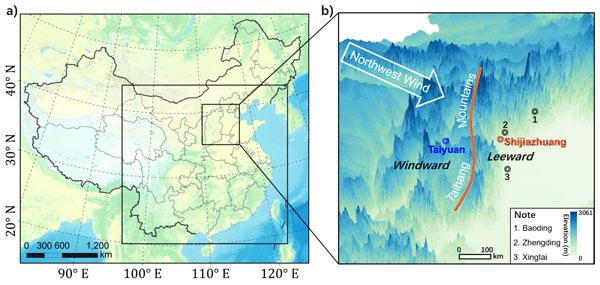
- Figure 1b: An elevation color bar and a horizontal distance scale should be added.
- Figure 1b: The red labels in the figure are difficult to read. Please improve their visibility.
- Figure 5h: The legend label “Yes” is unclear. It would be more appropriate to replace it with “Foehn” or another clearer term.
Citation: https://doi.org/10.5194/egusphere-2025-5439-RC1 - AC1: 'Reply on RC1', Xinpeng Xu, 06 Apr 2026
-
RC2: 'Comment on egusphere-2025-5439', Anonymous Referee #3, 22 Feb 2026
This is an interesting paper that employs interpretable machine-learning techniques to investigate the key controlling factors, dynamic thresholds, and synoptic patterns of foehn winds on the eastern foothills of the Taihang Mountains in China. The authors have conducted a lot of analysis and synoptic analysis, which are good for elaborating the main arguments. Overall, the paper employs novel methods, presents solid analysis, and draws clear conclusions.
Some minor questions and comments are listed as the following:
- Line 139: This study explicitly used the potential temperature difference (Δθ > 2K) as one of the defining criteria for foehn events in Table 1. However, in the subsequent machine learning modeling (Table 2), the 28 predictor variables used for training and interpreting the model did not include any variables related to potential temperature (such as θWind, θLee, or Δθ). This needs clarification.
- Line192-194: There remains a gap between the statistical association and the physical causation. To bridge this, it is recommended to: (a) Whether the Fr (Froude) number is directly calculated from observational data and indeed falls within this specific range during foehn wind events. (b) Why the Fr between 0.8 and 1.2 is conducive the foehn development? There seems still some physical process gap between your proofs and current conclusions.
- Line 290: Please add a brief explanation in the discussion (or other appropriate place) to more explicitly link the stable stratification with the physical mechanism of foehn occurrence.
- Line 315: It is suggested that the outlook section propose the future development of a regression model to predict specific foehn intensity metrics (such as wind speed or warming magnitude), and to again utilize the SHAP method to reveal its influencing factors. This would represent a natural and valuable deepening of the current classification-based research.
Citation: https://doi.org/10.5194/egusphere-2025-5439-RC2 - AC2: 'Reply on RC2', Xinpeng Xu, 06 Apr 2026
Peer review completion
Journal article(s) based on this preprint
Data sets
Hourly/Sub-Hourly Observational Data NOAA https://www.ncei.noaa.gov/maps/hourly/
ECMWF Reanalysis v5 | ECMWF ECMWF https://www.ecmwf.int/en/forecasts/dataset/ecmwf-reanalysis-v5
Viewed
| HTML | XML | Total | Supplement | BibTeX | EndNote | |
|---|---|---|---|---|---|---|
| 1,088 | 435 | 140 | 1,663 | 269 | 85 | 125 |
- HTML: 1,088
- PDF: 435
- XML: 140
- Total: 1,663
- Supplement: 269
- BibTeX: 85
- EndNote: 125
Viewed (geographical distribution)
| Country | # | Views | % |
|---|
| Total: | 0 |
| HTML: | 0 |
| PDF: | 0 |
| XML: | 0 |
- 1
Xinpeng Xu
Shoujuan Shu

Guochen Wang
Weijun Li
The requested preprint has a corresponding peer-reviewed final revised paper. You are encouraged to refer to the final revised version.
- Preprint
(2457 KB) - Metadata XML
-
Supplement
(2047 KB) - BibTeX
- EndNote
- Final revised paper
General Comments:
This study investigates the controlling factors and synoptic patterns of foehn events on the eastern foothills of the Taihang Mountains using long-term observations and interpretable machine-learning techniques. The application of machine learning to foehn analysis is innovative and highly commendable. In particular, the use of SHAP to quantify dominant factors and dynamic thresholds represents a valuable methodological contribution.
However, the scientific necessity of applying machine learning is not sufficiently clarified. The manuscript does not clearly demonstrate what additional physical insights are gained beyond those obtainable from conventional statistical or dynamical analyses. A more explicit justification of the added value of the machine-learning approach is needed.
In addition, the review of previous studies on foehn mechanisms is insufficient. Established dynamical explanations and controlling processes are not systematically synthesized, resulting in a discussion that lacks physical depth. Consequently, the interpretation of the results remains somewhat descriptive and would benefit from a stronger linkage to existing theoretical frameworks.
If these issues are adequately addressed, particularly by clarifying the role of machine learning and strengthening the mechanistic discussion, I would recommend publication of this study in ACP.
Specific Comments:
Technical Comments: