
the Creative Commons Attribution 4.0 License.
the Creative Commons Attribution 4.0 License.
 | 13 Jan 2026
Detection of embedded contrails in airborne lidar measurements
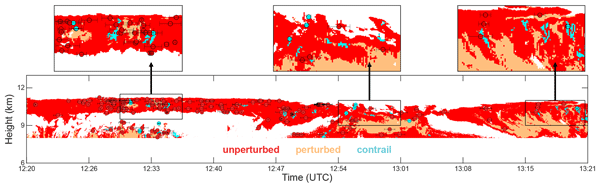
Abstract. Aviation affects the Earth's energy balance through the emission CO2 and non-CO2 effects. Contrails mark one of the latter and can occur inside the cirrus clouds where they might affect the clouds' optical and microphysical characteristics as well as their climate impact. In this study, airborne lidar observations with the German research aircraft HALO during the ML-CIRRUS and CIRRUS-HL campaigns are used together with aircraft-location data to detect the occurrence of contrails that have formed within already existing cirrus clouds. Based on manual analysis, we developed (based on ML-CIRRUS) and verified (based on CIRRUS-HL) an automated two-step method for detecting embedded contrails in lidar measurements. In the first, threshold-based step, potential embedded contrail regions are identified by particle backscatter coefficients (β(λ)) larger than 4 Mm−1sr−1 and particle linear depolarization ratios (δ(λ)) smaller than 30 % or 43 % depending on the impact of pollution on the background cloud. The second step assesses the area of the identified objects in a lidar curtain for finding cases that could realistically be associated with an aircraft-related perturbation. Specifically, areas smaller than 10 pixels are dismissed as noisy data, while areas larger than 50 pixels are too homogeneous to be in line with the assumptions of the manual analysis that cloud regions that are perturbed by the passage of an aircraft occur in close vicinity to unperturbed cloud areas. The resulting contrail mask enables the detection and quantification of the occurrence rate of embedded contrails in airborne lidar measurements without the need for auxiliary air-traffic information.
-
Notice on discussion status
The requested preprint has a corresponding peer-reviewed final revised paper. You are encouraged to refer to the final revised version.
-
Preprint
(4307 KB)
-
The requested preprint has a corresponding peer-reviewed final revised paper. You are encouraged to refer to the final revised version.
- Preprint
(4307 KB) - Metadata XML
- BibTeX
- EndNote
- Final revised paper


Journal article(s) based on this preprint
Interactive discussion
Status: closed
-
RC1: 'Comment on egusphere-2025-5344', Anonymous Referee #3, 16 Feb 2026
-
AC1: 'Reply on RC1', Matthias Tesche, 14 Apr 2026
The comment was uploaded in the form of a supplement: https://egusphere.copernicus.org/preprints/2026/egusphere-2025-5344/egusphere-2025-5344-AC1-supplement.pdf
-
AC1: 'Reply on RC1', Matthias Tesche, 14 Apr 2026
-
RC2: 'Comment on egusphere-2025-5344', Anonymous Referee #2, 27 Feb 2026
GENERAL COMMENTS
The manuscript presents a novel automatable method for identifying contrails embedded in cirrus clouds from airborne lidar observations. The detection of embedded contrails inside cirrus clouds is at present high up on the agenda, and therefore this method makes a very timely contribution to an active research field.
The described method uses the particle backscatter coefficient b and the particle linear depolarization ratio d from the lidar system to define a contrail mask which can be used to identify embedded contrails in lidar observations. Suggested boundary values for separating embedded contrails from natural cirrus are ß > 4 Mm-1 sr-1, and δ < 30% to 43%, depending in the conditions of the background cloud. The threshold values were deduced from the observations of the airborne WALES system onboard of the German research aircraft HALO during the field experiment ML-CIRRUS on mid-latitude cirrus clouds in 2014. The developed mask was then applied to the observations during the subsequent HALO field experiment CIRRUS-HL on cirrus clouds at high latitudes.
The method description in Chapter 2 is clear but the presentation of results and of the method validation in Chapter 3 requires clearer presentation and a better structured discussion. Details of requested changes will be discussed in the SPECIFIC COMMENTS.
Overall, the manuscript is well structured and fits very well into the scope of AMT. However, before being acceptable for publication it requires modifications of the presentation in general and of the explanation and discussion of results in particular. Suggested revisions are discussed in the following paragraphs.
SPECIFIC COMMENTS
1| Throughout the manuscript there is a bit of confusion about the used terminology:
Contrail formation requires fulfillment of the Schmidt-Appleman criterion, according to Schumann (1996), independent of the environmental conditions or preexisting cloudiness. Persistent contrail existence requires ice-supersaturation of the embedding air mass. Following e.g. Kärcher (2018), climate-impactful contrail-cirrus develop from persistent contrails only, when they spread out into contrail-cirrus by wind shear perpendicular to the line shape of the persistent contrail, so that they cover a large area. That means, persistent contrails can exist for a long period but may have no climate impact as long as they keep their line shape. In contradiction to this concept, Figure 11 suggests that all persistent contrails develop into contrail-cirrus.
Since this is not always the case, this differentiation needs to be reflected in the manuscript. Particularly on line 30, the statement “that the conditions for contrail formation are most often fulfilled in regions already covered with cirrus clouds (Petzold et al., 2025)” is not correct. The referenced study says that long-lived contrails exist most often in regions already covered with cirrus clouds. This is a significant difference and needs to be corrected. That can be achieved easily by rephrasing “that the conditions for existence of climate-impactful long-lived contrails are most often fulfilled for regions already covered with cirrus clouds (Petzold et al., 2025)".
In the same context, the statement on line 305 saying that “While one might therefore expect that an aircraft that passes through a cirrus cloud automatically forms an embedded contrail, we rather find that most cases don’t” needs to be corrected. The formation of a contrail, also inside a preexisting cirrus cloud, still requires the fulfillment of the Schmidt-Appleman criterion which, however, must not always be the case inside a dissolving cirrus cloud which exists at ice-subsaturation. In such a case, no contrail will form since the conditions are not fulfilled. Only if the aircraft passes through an air mass close or above ice-saturation (PCCR and ISSR, following the terminology used by Petzold et al. (2025)) the conditions for contrail formation are fulfilled and a contrail will form which may develop into an embedded contrail-cirrus. The authors may of course find many cases of aircraft passing through an existing but dissolving cirrus cloud and no contrail will form because the air mass is not humid enough. Therefore, Section 3.6 requires substantial revision.
2| Section 3.3 on the validation of the contrail mask is very difficult to understand. It is presented as a long but a bit unstructured text section. Adding sub-headings may help to give a structure to this section.
What is meant by the term “unrelated” in line 191? If it means “independent of” then it may be rephrased to make the message clearer.
Same for line 202 where the term “resort” is not clear. It is suggested to rephrase this sentence for the sake of clarity.
3| The presentation of important results of this study in Figures 2 and 8 suffer from a “diffuse” presentation. In Figure 2, the “clean” and “polluted” cases are hardly identifiable given the chosen color scheme. Adding contour lines or selecting another color scheme may improve these figures and may make the contained information more visible. In Figure 8, extracting the relevant information is even more difficult. In Figure 8a, there is no difference identifiable between perturbed and unperturbed cases. The inserted lines simply represent the threshold values but the consequences for the distribution of the observed cases are difficult to identify. It is recommended to re-work the presentation of the figures.
MINOR ISSUES AND TYPOS:
- Abstract, 1st line: Please correct “through the emission of …”
- Abstract line 6: remove space character in the word “identifier”.
- Line 63: correct presentation of references to Author et al. (Year).
- Line 81: Shouldn’t that refer to Figure 2 instead of Figure 3?
- Caption of Figure 2: The properties b and d should be named explicitly so that the figure caption can be understood without having read the abstract where b and d are defined.
- Line 87: Suggested clarification if ERA5 information is meant: “in addition, ERA5 information on temperature, …”
- Line 97: A link to Flightradar24 may be added.
- Line 133: In the sentence “An example of this assessment is presented below” it should be specified where this information is given, e.g., which section, paragraph etc.
- Caption of Figure 6: Please explain the meaning of the yellow dots. They likely point to embedded contrails but that should be explained in the caption. I assume the last sentence of the figure caption refers to lidar profiles. If so, it should be made clear.
- Line 169: the term “Cases” should be written in lower case letters.
- Line 344: remove “)” after 50°C.
- Update reference list, namely Seelig et al. (2025) and Petzold et al. (2025).
REFERENCES
Kärcher, B.: Formation and radiative forcing of contrail cirrus, Nature Communications, 9, 17, 10.1038/s41467-018-04068-0, 2018.
Petzold, A., Khan, N. F., Li, Y., Spichtinger, P., Rohs, S., Crewell, S., Wahner, A., and Krämer, M.: Most long-lived contrails form within cirrus clouds with uncertain climate impact, Nature Communications, 16, 9695, https://doi.org/10.1038/s41467-025-65532-2, 2025.
Schumann, U.: On conditions for contrail formation from aircraft exhausts, Meteorologische Zeitschrift, N.F.5, 4-23, https://doi.org/10.1127/metz/5/1996/4, 1996.
Seelig, T., Wolf, K., Bellouin, N., and Tesche, M.: Quantification of the radiative forcing of contrails embedded in cirrus clouds, Nature Communications, 16, 10703, doi: https://doi.org/10.1038/s41467-025-66231-8, 2025.
Citation: https://doi.org/10.5194/egusphere-2025-5344-RC2 -
AC1: 'Reply on RC1', Matthias Tesche, 14 Apr 2026
The comment was uploaded in the form of a supplement: https://egusphere.copernicus.org/preprints/2026/egusphere-2025-5344/egusphere-2025-5344-AC1-supplement.pdf
Peer review completion


Interactive discussion
Status: closed
-
RC1: 'Comment on egusphere-2025-5344', Anonymous Referee #3, 16 Feb 2026
Review of “Detection of embedded contrails in airborne lidar measurements” by Mahshad Soleimanpour et al.
General comments
The study presents an analysis of airborne lidar observations from the HALO research aircraft during the ML-CIRRUS (2014) and CIRRUS-HL (2021) campaigns to develop and validate an automated method for detecting contrails embedded within existing cirrus clouds. Using measurements of particle backscatter and depolarization ratios from the WALES lidar, combined with aircraft position data and ERA5 wind fields, the authors first identify and manually verify cases of embedded contrails and then derive a two-step detection algorithm based on physical thresholds and object-size criteria. The method is trained on ML-CIRRUS data and validated with CIRRUS-HL observations, showing good performance in identifying unperturbed cloud regions and reasonable skill in detecting embedded contrails, although with systematic overestimation, particularly under polluted (high-PLDR) conditions. The study further examines sources of misclassification, the influence of contrail age, and statistical occurrence rates, concluding that embedded contrails represent only a small fraction of cirrus observations but can be systematically detected using lidar data alone, providing a basis for future large-scale and synergistic studies of aviation-induced cloud perturbations.
While the methodological approach is well motivated and carefully implemented, there are several overarching issues that limit how confidently the results can be interpreted. Most importantly, the automated detection relies on thresholds derived from manual, intercept-based analysis, so the validation is only partly independent and the ground truth remains limited. Moreover, the detected “embedded contrails” are not clearly distinguishable from other small-scale cirrus perturbations (e.g., fall streaks), leading to substantial and acknowledged overestimation, especially under high-PLDR conditions, and raising questions about the robustness of the occurrence statistics. The method’s performance also depends strongly on fixed β, δ, and object-size thresholds, whose sensitivity is not systematically assessed, and on assumptions about depolarization signatures that may not hold across different contrail ages and temperature regimes. Finally, uncertainties in the advection-based matching and PLDR regime classification may further affect detection accuracy. Together, these points suggest that the product is best interpreted as a proxy for contrail-like perturbations rather than unambiguous embedded contrail identification, warranting more detailed discussion and quantitative assessment, as outlined in the specific comments.
Nevertheless, this study presents a timely and technically well-executed contribution toward the automated detection of aviation-induced perturbations in cirrus clouds using airborne lidar observations. The approach is clearly motivated and carefully documented. However, several methodological and interpretational aspects require further clarification and strengthening. Addressing these points through additional analysis and clearer discussion of the method’s scope and limitations would improve the robustness and impact of the study. I therefore recommend that the paper undergo revisions before publication.
Specific comments
Line 85: In Sect. 2.3, the description of the ERA5 data is rather brief. The authors should provide more detailed information on the temporal and spatial resolution of the reanalysis used and clarify more explicitly which ERA5 variables were applied in this study. In addition, the proper reference for ERA5 (Hersbach et al., 2020) should be used.
Hersbach, H., Bell, B., Berrisford, P., et al. (2020): The ERA5 global reanalysis. Q. J. R. Meteorol. Soc., 146, 1999–2049.
Line 92: In Sect. 2.4, where the advection correction and intercept matching based on ERA5 winds are introduced, and in Sect. 3.2–3.3, where spatial offsets between masked regions and confirmed intercepts are discussed, the uncertainty associated with the advection correction deserves more quantitative treatment. Since the validation relies on predicted intercept locations, errors in wind fields, headings, and timing may contribute to both false negatives and apparent false positives. The authors might consider estimating and reporting an uncertainty range for the advected intercept positions and discussing how this uncertainty affects the interpretation of the detection performance.
Line 115: In Sect. 2.5, where the manual detection procedure is described, the authors may consider explicitly acknowledging that the thresholds used in the automated mask are derived from this by-eye, intercept-guided analysis and that the subsequent validation relies on a similar approach. While this is reasonable for method development, it implies that the evaluation is not fully independent. A brief discussion of this potential circularity and its implications for detection uncertainty and overestimation would improve the transparency of the methodology.
Figure 5: The authors may consider adding the tracks of the relevant commercial aircraft (if feasible) and possibly the ERA5 background winds to better place the observations in context. In addition, it would be helpful to more clearly indicate the locations of the selected profiles discussed later in Fig. 6 and in the main text, as these are currently difficult to see.
Line 178: Regarding the choice of the β and δ thresholds (e.g., β > 4 Mm⁻¹ sr⁻¹ and δ < 30%/43%), the authors should consider providing a quantitative sensitivity analysis to demonstrate the robustness of these values. Although the thresholds are physically motivated and derived from the ML-CIRRUS dataset, it remains unclear how variations in these parameters would affect detection performance, overestimation rates, and regime dependence. Exploring alternative threshold ranges and documenting their impact on the results would strengthen the methodological credibility and transferability of the proposed approach.
Line 203: Where the object-size filter of 10–50 pixels is introduced, the authors should consider including a sensitivity analysis to assess the robustness of this choice. While the selected range is physically motivated and supported by empirical examples, it remains unclear how strongly the detection rates and overestimation factor depend on this specific threshold. Testing alternative ranges and quantifying their impact on true and false detections would strengthen confidence in the method.
Line 242: In Sect. 3.3, where the authors discuss detections during CIRRUS-HL that cannot be linked to aircraft and may be related to fall streaks or other in-cloud features, the ambiguity between embedded contrails and non-aviation-induced structures should be addressed more explicitly. Given that the stated goal is to enable detection without air-traffic data, the current method appears to identify “perturbation-like objects” rather than unambiguous embedded contrails. The authors may wish to clarify this limitation and discuss how it might be further mitigated.
Line 335: In the Conclusions, where the systematic overestimation by approximately a factor of four is mentioned, the authors should consider providing a more thorough discussion of the origin, robustness, and implications of this uncertainty. In particular, it would be helpful to clarify to what extent this factor depends on the chosen thresholds, PLDR regime classification, and campaign-specific conditions, and how it propagates into the reported occurrence statistics and potential future applications of the method.
Technical corrections
Please ensure that abbreviations (e.g., Figure/Fig., Section/Sect.) follow the Copernicus manuscript guidelines and are used consistently.
Please avoid contractions (e.g., “don’t,” “doesn’t,” “haven’t”) to maintain a formal writing style.
The title of Subsection 3.6 should be rephrased in a more formal and descriptive manner.
Line 1: Rephrase as “emission of CO₂”?
Line 7: There appear to be superfluous spaces within individual words.
Line 81: Reference to “Figure 3” should be replaced by “Figure 2”.
Line 81: Abbreviation PLDR was not introduced.
Line 169: “Therefore, _c_ases…”
Line 302: Start sentence with “Figures 9 and 10 show…”
Line 344: Remove “)” after −50 °C.
Citation: https://doi.org/10.5194/egusphere-2025-5344-RC1 -
AC1: 'Reply on RC1', Matthias Tesche, 14 Apr 2026
The comment was uploaded in the form of a supplement: https://egusphere.copernicus.org/preprints/2026/egusphere-2025-5344/egusphere-2025-5344-AC1-supplement.pdf
-
AC1: 'Reply on RC1', Matthias Tesche, 14 Apr 2026
-
RC2: 'Comment on egusphere-2025-5344', Anonymous Referee #2, 27 Feb 2026
GENERAL COMMENTS
The manuscript presents a novel automatable method for identifying contrails embedded in cirrus clouds from airborne lidar observations. The detection of embedded contrails inside cirrus clouds is at present high up on the agenda, and therefore this method makes a very timely contribution to an active research field.
The described method uses the particle backscatter coefficient b and the particle linear depolarization ratio d from the lidar system to define a contrail mask which can be used to identify embedded contrails in lidar observations. Suggested boundary values for separating embedded contrails from natural cirrus are ß > 4 Mm-1 sr-1, and δ < 30% to 43%, depending in the conditions of the background cloud. The threshold values were deduced from the observations of the airborne WALES system onboard of the German research aircraft HALO during the field experiment ML-CIRRUS on mid-latitude cirrus clouds in 2014. The developed mask was then applied to the observations during the subsequent HALO field experiment CIRRUS-HL on cirrus clouds at high latitudes.
The method description in Chapter 2 is clear but the presentation of results and of the method validation in Chapter 3 requires clearer presentation and a better structured discussion. Details of requested changes will be discussed in the SPECIFIC COMMENTS.
Overall, the manuscript is well structured and fits very well into the scope of AMT. However, before being acceptable for publication it requires modifications of the presentation in general and of the explanation and discussion of results in particular. Suggested revisions are discussed in the following paragraphs.
SPECIFIC COMMENTS
1| Throughout the manuscript there is a bit of confusion about the used terminology:
Contrail formation requires fulfillment of the Schmidt-Appleman criterion, according to Schumann (1996), independent of the environmental conditions or preexisting cloudiness. Persistent contrail existence requires ice-supersaturation of the embedding air mass. Following e.g. Kärcher (2018), climate-impactful contrail-cirrus develop from persistent contrails only, when they spread out into contrail-cirrus by wind shear perpendicular to the line shape of the persistent contrail, so that they cover a large area. That means, persistent contrails can exist for a long period but may have no climate impact as long as they keep their line shape. In contradiction to this concept, Figure 11 suggests that all persistent contrails develop into contrail-cirrus.
Since this is not always the case, this differentiation needs to be reflected in the manuscript. Particularly on line 30, the statement “that the conditions for contrail formation are most often fulfilled in regions already covered with cirrus clouds (Petzold et al., 2025)” is not correct. The referenced study says that long-lived contrails exist most often in regions already covered with cirrus clouds. This is a significant difference and needs to be corrected. That can be achieved easily by rephrasing “that the conditions for existence of climate-impactful long-lived contrails are most often fulfilled for regions already covered with cirrus clouds (Petzold et al., 2025)".
In the same context, the statement on line 305 saying that “While one might therefore expect that an aircraft that passes through a cirrus cloud automatically forms an embedded contrail, we rather find that most cases don’t” needs to be corrected. The formation of a contrail, also inside a preexisting cirrus cloud, still requires the fulfillment of the Schmidt-Appleman criterion which, however, must not always be the case inside a dissolving cirrus cloud which exists at ice-subsaturation. In such a case, no contrail will form since the conditions are not fulfilled. Only if the aircraft passes through an air mass close or above ice-saturation (PCCR and ISSR, following the terminology used by Petzold et al. (2025)) the conditions for contrail formation are fulfilled and a contrail will form which may develop into an embedded contrail-cirrus. The authors may of course find many cases of aircraft passing through an existing but dissolving cirrus cloud and no contrail will form because the air mass is not humid enough. Therefore, Section 3.6 requires substantial revision.
2| Section 3.3 on the validation of the contrail mask is very difficult to understand. It is presented as a long but a bit unstructured text section. Adding sub-headings may help to give a structure to this section.
What is meant by the term “unrelated” in line 191? If it means “independent of” then it may be rephrased to make the message clearer.
Same for line 202 where the term “resort” is not clear. It is suggested to rephrase this sentence for the sake of clarity.
3| The presentation of important results of this study in Figures 2 and 8 suffer from a “diffuse” presentation. In Figure 2, the “clean” and “polluted” cases are hardly identifiable given the chosen color scheme. Adding contour lines or selecting another color scheme may improve these figures and may make the contained information more visible. In Figure 8, extracting the relevant information is even more difficult. In Figure 8a, there is no difference identifiable between perturbed and unperturbed cases. The inserted lines simply represent the threshold values but the consequences for the distribution of the observed cases are difficult to identify. It is recommended to re-work the presentation of the figures.
MINOR ISSUES AND TYPOS:
- Abstract, 1st line: Please correct “through the emission of …”
- Abstract line 6: remove space character in the word “identifier”.
- Line 63: correct presentation of references to Author et al. (Year).
- Line 81: Shouldn’t that refer to Figure 2 instead of Figure 3?
- Caption of Figure 2: The properties b and d should be named explicitly so that the figure caption can be understood without having read the abstract where b and d are defined.
- Line 87: Suggested clarification if ERA5 information is meant: “in addition, ERA5 information on temperature, …”
- Line 97: A link to Flightradar24 may be added.
- Line 133: In the sentence “An example of this assessment is presented below” it should be specified where this information is given, e.g., which section, paragraph etc.
- Caption of Figure 6: Please explain the meaning of the yellow dots. They likely point to embedded contrails but that should be explained in the caption. I assume the last sentence of the figure caption refers to lidar profiles. If so, it should be made clear.
- Line 169: the term “Cases” should be written in lower case letters.
- Line 344: remove “)” after 50°C.
- Update reference list, namely Seelig et al. (2025) and Petzold et al. (2025).
REFERENCES
Kärcher, B.: Formation and radiative forcing of contrail cirrus, Nature Communications, 9, 17, 10.1038/s41467-018-04068-0, 2018.
Petzold, A., Khan, N. F., Li, Y., Spichtinger, P., Rohs, S., Crewell, S., Wahner, A., and Krämer, M.: Most long-lived contrails form within cirrus clouds with uncertain climate impact, Nature Communications, 16, 9695, https://doi.org/10.1038/s41467-025-65532-2, 2025.
Schumann, U.: On conditions for contrail formation from aircraft exhausts, Meteorologische Zeitschrift, N.F.5, 4-23, https://doi.org/10.1127/metz/5/1996/4, 1996.
Seelig, T., Wolf, K., Bellouin, N., and Tesche, M.: Quantification of the radiative forcing of contrails embedded in cirrus clouds, Nature Communications, 16, 10703, doi: https://doi.org/10.1038/s41467-025-66231-8, 2025.
Citation: https://doi.org/10.5194/egusphere-2025-5344-RC2 -
AC1: 'Reply on RC1', Matthias Tesche, 14 Apr 2026
The comment was uploaded in the form of a supplement: https://egusphere.copernicus.org/preprints/2026/egusphere-2025-5344/egusphere-2025-5344-AC1-supplement.pdf
Peer review completion
Journal article(s) based on this preprint
Viewed
| HTML | XML | Total | BibTeX | EndNote | |
|---|---|---|---|---|---|
| 1,195 | 1,267 | 166 | 2,628 | 111 | 158 |
- HTML: 1,195
- PDF: 1,267
- XML: 166
- Total: 2,628
- BibTeX: 111
- EndNote: 158
Viewed (geographical distribution)
| Country | # | Views | % |
|---|
| Total: | 0 |
| HTML: | 0 |
| PDF: | 0 |
| XML: | 0 |
- 1
Mahshad Soleimanpour

Torsten Seelig
Silke Groß
Matthias Tesche
The requested preprint has a corresponding peer-reviewed final revised paper. You are encouraged to refer to the final revised version.
- Preprint
(4307 KB) - Metadata XML
Review of “Detection of embedded contrails in airborne lidar measurements” by Mahshad Soleimanpour et al.
General comments
The study presents an analysis of airborne lidar observations from the HALO research aircraft during the ML-CIRRUS (2014) and CIRRUS-HL (2021) campaigns to develop and validate an automated method for detecting contrails embedded within existing cirrus clouds. Using measurements of particle backscatter and depolarization ratios from the WALES lidar, combined with aircraft position data and ERA5 wind fields, the authors first identify and manually verify cases of embedded contrails and then derive a two-step detection algorithm based on physical thresholds and object-size criteria. The method is trained on ML-CIRRUS data and validated with CIRRUS-HL observations, showing good performance in identifying unperturbed cloud regions and reasonable skill in detecting embedded contrails, although with systematic overestimation, particularly under polluted (high-PLDR) conditions. The study further examines sources of misclassification, the influence of contrail age, and statistical occurrence rates, concluding that embedded contrails represent only a small fraction of cirrus observations but can be systematically detected using lidar data alone, providing a basis for future large-scale and synergistic studies of aviation-induced cloud perturbations.
While the methodological approach is well motivated and carefully implemented, there are several overarching issues that limit how confidently the results can be interpreted. Most importantly, the automated detection relies on thresholds derived from manual, intercept-based analysis, so the validation is only partly independent and the ground truth remains limited. Moreover, the detected “embedded contrails” are not clearly distinguishable from other small-scale cirrus perturbations (e.g., fall streaks), leading to substantial and acknowledged overestimation, especially under high-PLDR conditions, and raising questions about the robustness of the occurrence statistics. The method’s performance also depends strongly on fixed β, δ, and object-size thresholds, whose sensitivity is not systematically assessed, and on assumptions about depolarization signatures that may not hold across different contrail ages and temperature regimes. Finally, uncertainties in the advection-based matching and PLDR regime classification may further affect detection accuracy. Together, these points suggest that the product is best interpreted as a proxy for contrail-like perturbations rather than unambiguous embedded contrail identification, warranting more detailed discussion and quantitative assessment, as outlined in the specific comments.
Nevertheless, this study presents a timely and technically well-executed contribution toward the automated detection of aviation-induced perturbations in cirrus clouds using airborne lidar observations. The approach is clearly motivated and carefully documented. However, several methodological and interpretational aspects require further clarification and strengthening. Addressing these points through additional analysis and clearer discussion of the method’s scope and limitations would improve the robustness and impact of the study. I therefore recommend that the paper undergo revisions before publication.
Specific comments
Line 85: In Sect. 2.3, the description of the ERA5 data is rather brief. The authors should provide more detailed information on the temporal and spatial resolution of the reanalysis used and clarify more explicitly which ERA5 variables were applied in this study. In addition, the proper reference for ERA5 (Hersbach et al., 2020) should be used.
Hersbach, H., Bell, B., Berrisford, P., et al. (2020): The ERA5 global reanalysis. Q. J. R. Meteorol. Soc., 146, 1999–2049.
Line 92: In Sect. 2.4, where the advection correction and intercept matching based on ERA5 winds are introduced, and in Sect. 3.2–3.3, where spatial offsets between masked regions and confirmed intercepts are discussed, the uncertainty associated with the advection correction deserves more quantitative treatment. Since the validation relies on predicted intercept locations, errors in wind fields, headings, and timing may contribute to both false negatives and apparent false positives. The authors might consider estimating and reporting an uncertainty range for the advected intercept positions and discussing how this uncertainty affects the interpretation of the detection performance.
Line 115: In Sect. 2.5, where the manual detection procedure is described, the authors may consider explicitly acknowledging that the thresholds used in the automated mask are derived from this by-eye, intercept-guided analysis and that the subsequent validation relies on a similar approach. While this is reasonable for method development, it implies that the evaluation is not fully independent. A brief discussion of this potential circularity and its implications for detection uncertainty and overestimation would improve the transparency of the methodology.
Figure 5: The authors may consider adding the tracks of the relevant commercial aircraft (if feasible) and possibly the ERA5 background winds to better place the observations in context. In addition, it would be helpful to more clearly indicate the locations of the selected profiles discussed later in Fig. 6 and in the main text, as these are currently difficult to see.
Line 178: Regarding the choice of the β and δ thresholds (e.g., β > 4 Mm⁻¹ sr⁻¹ and δ < 30%/43%), the authors should consider providing a quantitative sensitivity analysis to demonstrate the robustness of these values. Although the thresholds are physically motivated and derived from the ML-CIRRUS dataset, it remains unclear how variations in these parameters would affect detection performance, overestimation rates, and regime dependence. Exploring alternative threshold ranges and documenting their impact on the results would strengthen the methodological credibility and transferability of the proposed approach.
Line 203: Where the object-size filter of 10–50 pixels is introduced, the authors should consider including a sensitivity analysis to assess the robustness of this choice. While the selected range is physically motivated and supported by empirical examples, it remains unclear how strongly the detection rates and overestimation factor depend on this specific threshold. Testing alternative ranges and quantifying their impact on true and false detections would strengthen confidence in the method.
Line 242: In Sect. 3.3, where the authors discuss detections during CIRRUS-HL that cannot be linked to aircraft and may be related to fall streaks or other in-cloud features, the ambiguity between embedded contrails and non-aviation-induced structures should be addressed more explicitly. Given that the stated goal is to enable detection without air-traffic data, the current method appears to identify “perturbation-like objects” rather than unambiguous embedded contrails. The authors may wish to clarify this limitation and discuss how it might be further mitigated.
Line 335: In the Conclusions, where the systematic overestimation by approximately a factor of four is mentioned, the authors should consider providing a more thorough discussion of the origin, robustness, and implications of this uncertainty. In particular, it would be helpful to clarify to what extent this factor depends on the chosen thresholds, PLDR regime classification, and campaign-specific conditions, and how it propagates into the reported occurrence statistics and potential future applications of the method.
Technical corrections
Please ensure that abbreviations (e.g., Figure/Fig., Section/Sect.) follow the Copernicus manuscript guidelines and are used consistently.
Please avoid contractions (e.g., “don’t,” “doesn’t,” “haven’t”) to maintain a formal writing style.
The title of Subsection 3.6 should be rephrased in a more formal and descriptive manner.
Line 1: Rephrase as “emission of CO₂”?
Line 7: There appear to be superfluous spaces within individual words.
Line 81: Reference to “Figure 3” should be replaced by “Figure 2”.
Line 81: Abbreviation PLDR was not introduced.
Line 169: “Therefore, _c_ases…”
Line 302: Start sentence with “Figures 9 and 10 show…”
Line 344: Remove “)” after −50 °C.