
the Creative Commons Attribution 4.0 License.
the Creative Commons Attribution 4.0 License.
 | 16 Mar 2026
Advancing Isotope-Enabled Model for Comprehensive Understanding of Atmospheric Sulfur Isotope Effects: Revealing the Overlooked Isotopic Fractionation During Combustion and Gas Desulfurization
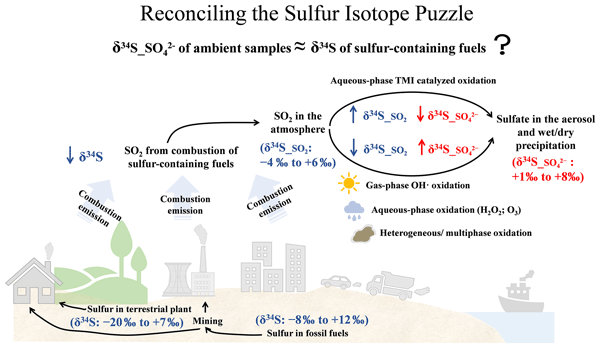
Abstract. The isotopic composition of atmospheric species provides fundamental insights into their sources, sinks, and chemical processes. However, conventional end-member mixing box models fail to accurately represent the progressive isotopic evolution within complex systems, where mixing and reactions occur simultaneously. This limitation hinders a comprehensive understanding of the isotope effect and its atmospheric applications. To address this, we have designed an isotopic chemistry module and incorporated it into the three-dimensional chemical transport model, utilizing an iterative time-splitting method to mitigate the bias introduced by the Rayleigh equation. The model incorporates four isotopologues (32SO2, 34SO2, 32SO42−, 34SO42−) as prognostic tracers for SO2 and sulfate aerosol, simulating isotope effects during various gas-phase, heterogeneous/multiphase and aqueous-phase reactions. Validation against compiled observation data demonstrates the model's ability to reproduce the sulfur isotope effect (Δδ34S_SO42−/SO2= 3.43±1.11 ‰) and spatiotemporal variations of δ34SO42− across Eastern China. Further, our study underscores the importance of considering isotopic fractionation during combustion and chemical processes for accurate source apportionment using the isotope mixing model. The isotope-enabled model presents an innovative approach for effectively constraining the sulfur budget.
-
Notice on discussion status
The requested preprint has a corresponding peer-reviewed final revised paper. You are encouraged to refer to the final revised version.
-
Preprint
(2160 KB)
-
Supplement
(779 KB)
-
The requested preprint has a corresponding peer-reviewed final revised paper. You are encouraged to refer to the final revised version.
- Preprint
(2160 KB) - Metadata XML
-
Supplement
(779 KB) - BibTeX
- EndNote
- Final revised paper


Journal article(s) based on this preprint
Interactive discussion
Status: closed
-
RC1: 'Comment on egusphere-2025-3649', Anonymous Referee #3, 09 Apr 2026
-
AC1: 'Reply on RC1', Lianfang Wei, 23 Jun 2026
The comment was uploaded in the form of a supplement: https://egusphere.copernicus.org/preprints/2026/egusphere-2025-3649/egusphere-2025-3649-AC1-supplement.pdf
-
AC1: 'Reply on RC1', Lianfang Wei, 23 Jun 2026
-
RC2: 'Comment on egusphere-2025-3649', Anonymous Referee #2, 12 May 2026
This paper presents a new isotope-enabled atmospheric chemistry model that simulates sulfur isotope fractionation during SO₂ oxidation and sulfate formation. The model tracks sulfur isotopologues through emissions, transport, chemistry, and deposition, while reducing biases associated with classical Rayleigh isotope calculations. It successfully reproduces observed sulfur isotope patterns over Eastern China and shows that both atmospheric oxidation and combustion/desulfurization processes strongly influence sulfur isotopic signatures and source apportionment.
The scope of the paper is interesting and the proposed model is globally coherent with experimental data. The notations and mathematical derivations ought to be clarified, as detailed below, and the influence of the numerical scheme investigated further. Also, formulating the time-dependent evolution law for the fractionation dynamics would give a clear vue of the production/reservoir evolution, associated with the proposed in-depth discussion.
p6. check notation between alpha as defined by eq 2 and the first alpha in eq. 6
precise how the average isotope ratio of accumulated product is calculated to obtain Eq. 7different notations are then used in Eq. 9-10
we should have and \bar{Rp} in Eq 9
detail Eq. 10 and the simplifying approximation. what would be its magnitude?Fig.2 new variables are introduced in the "solver" section that should be consistent with thoses introduced in the text . The notations should be consistent too. The text in this section is too small and should be of reable size
p10
l. 285 "it assumes that a system that only" -> it assumes a system that only
"When the Rayleigh equation is employed in the isotopic chemistry module": it is unclear how this equation can be optional? shouldn't it be used to provide the fractionation information based on the mass conservation of species provided by the model? How "fresh mixture" is included?
"the residual fraction of reactants frem, which is influenced by the time discretization" the model output should be robust to variations on the numerical scheme
"iterative time-splitting method" please provide a referencep11
the relationship "α>1/α<1" is not mathematically correct. Do you mean α>1?
accumulated produce -> accumulated product
p12
(see Text S3). Figure S1 -> (see Text S3), Figure S1
"To mitigate the significant bias in simulated isotopic composition introduced by the Rayleigh equation in the isotopic chemistry module, we implement an iterative time-splitting method." If the Rayleigh equation is the source of a bias, it means that it's not adequate or it is misused; this shouldn't be solved by adjusting the numerical scheme.
p16
Fig. 6 shows that the model doesn't always provide a reliable framework, e.g. discrepencies between simulation and observation in figure (c).p20
The references Wei et al. (2024) and Wei, et al. (2025) are not included in the references.------- Supplement ------------------
(S1) N and N* are not defined
(S6): this α is the same as in Eq (3)? Rr is undefined
(S9) the derivation of the left hand side is not clearCitation: https://doi.org/10.5194/egusphere-2025-3649-RC2 -
AC2: 'Reply on RC2', Lianfang Wei, 23 Jun 2026
The comment was uploaded in the form of a supplement: https://egusphere.copernicus.org/preprints/2026/egusphere-2025-3649/egusphere-2025-3649-AC2-supplement.pdf
-
AC2: 'Reply on RC2', Lianfang Wei, 23 Jun 2026
Peer review completion


Interactive discussion
Status: closed
-
RC1: 'Comment on egusphere-2025-3649', Anonymous Referee #3, 09 Apr 2026
"Advancing Isotope-Enabled Model for Comprehensive Understanding of Atmospheric Sulfur Isotope Effects: Revealing the Overlooked Isotopic Fractionation During Combustion and Gas Desulfurization"
This manuscript addresses an important limitation of conventional end-member mixing models in representing progressive isotopic evolution in complex atmospheric systems where mixing and reactions occur simultaneously. The development of an isotope-enabled chemical transport model and the iterative time-splitting strategy are potentially valuable methodological contributions. The discussion of isotopic fractionation during combustion and flue gas desulfurization (FGD) is also interesting and relevant to sulfur isotope source apportionment. However, the manuscript still has important weaknesses in internal consistency, model evaluation, manuscript organization, and figure presentation. In its current form, the paper does not yet clearly separate what is directly demonstrated by the isotope-enabled model from what is inferred from literature synthesis or conceptual interpretation. In addition, repeated problems in the figures, captions, and formatting suggest that the manuscript would benefit from a more careful and systematic revision before further consideration.
Major Comments
- The authors assign a uniform δ³⁴S value of 0‰ to all anthropogenic SO₂ emissions (Lines 178–179), while acknowledging that the actual isotopic composition of anthropogenic sources spans a range of −30‰ to +30‰ (Hoefs and Harmon, 2022). More importantly, one of the manuscript's central interpretive claims is that combustion processes cause a depletion of approximately −10‰ to −5‰ in emitted SO₂ relative to sulfur-containing fuels, yet this effect is not actually represented in the model framework. This creates an important internal inconsistency between model setup and interpretation. The authors should therefore distinguish much more clearly between conclusions supported directly by the isotope-enabled simulation and broader implications inferred from literature synthesis or conceptual discussion.
- The model shows substantial site- and season-dependent bias in Δδ³⁴S_SO₄²⁻/SO₂, including strong overestimation in Nanjing winter and Tianjin summer, but also underestimation in other cases such as Beijing winter. Under these circumstances, the Abstract statement that the model can "reproduce the sulfur isotope effect" is too strong. The authors should revise the Abstract and Conclusions to reflect the actual level of model skill more accurately, and they should discuss the likely causes of these mismatches in more mechanistic detail rather than attributing them mainly to emission inventory uncertainty.
Minor Comments
- (Lines 30–31 and 547): The manuscript states that the model reproduces "the observed mean sulfur isotope effect (Δδ³⁴S_SO₄²⁻/SO₂ = 3.43 ± 1.11‰)". However, 3.43‰ is the observed mean value, not the simulated one. The current phrasing is therefore misleading and should be corrected.
- (Lines 64–66): The authors identify reliance on the Rayleigh distillation equation as one reason for discrepancies in prior studies. However, the present model also relies on a Rayleigh-type framework, albeit with iterative time-splitting to reduce part of the associated bias. The authors should discuss this limitation more explicitly and clarify that the numerical treatment likely alleviates, rather than fully resolves, the mismatch between Rayleigh-type assumptions and continuous atmospheric mixing.
- (Lines 121–122): Tense inconsistency. "The simulation began in March 2014. The initial 3 months serve as a spin-up time." The second sentence should read "served" to match the past tense of the preceding sentence.
- (Line 172): The URL for the MEIC emission inventory is incorrectly formatted as "http:// http://meicmodel.org.cn/...", with the protocol prefix duplicated. Please correct.
- (Lines 309–310): If the overall net sulfur isotope fractionation factor α³⁴S_S(IV) = 1.0063 at 0°C is parameterized using pathway contributions derived from GEOS-Chem (Shao et al., 2019) rather than diagnosed directly from NAQPMS, this should be stated much more explicitly. In that case, the authors should also assess how sensitive the subsequent discussion is to the use of pathway contributions from another model.
- (Lines 383–384): Subject–verb agreement error. "Figure 4 and 5 shows the simulated spatial-temporal distribution..." should read "Figures 4 and 5 show the simulated spatial-temporal distribution..."
- (Lines 508–511): The discussion linking the post-1999 decline in δ³⁴S_SO₄²⁻ observed at Tsuruoka, Japan to the widespread adoption of FGD technology is suggestive, but the temporal correlation alone does not establish causation. This should be presented more cautiously as circumstantial evidence rather than as a direct causal attribution.
- (Throughout): The notation for δ³⁴S_SO₄²⁻ is inconsistent across the manuscript (e.g., "δ³⁴SO₄²⁻" at Lines 31–32 and 460 vs. "δ³⁴S_SO₄²⁻" elsewhere). Similarly, "Δδ³⁴S" and "Δ³⁴S" are used interchangeably (e.g., Lines 181 vs. 317). A consistent notation must be adopted throughout.
- (Throughout): Equation reference formats are inconsistent. The manuscript uses both "Equation (4)" and "eq. 9-10" (Line 303). All equation references should follow a single format, e.g., "Equations (9)–(10)".
- (Throughout): Capitalization of "Eastern China" is inconsistent: "eastern China" appears at Line 108, while "Eastern China" appears at Lines 389 and 548, among others. Please standardize throughout.
- (Reference list): Wei et al. (2018a) (Lines 762–764) and Wei et al. (2018b) (Lines 765–768) appear to refer to the same published article (same title, journal, volume, and page numbers: Sci. Total Environ., 633, 1156–1164). The only differences are a minor variation in the author list and the inclusion of a DOI in the second entry. This duplication should be corrected; the two entries should be merged into one with a complete and accurate author list.
- The manuscript currently interweaves three different layers of contribution: method development, model evaluation, and broader interpretive implications for sulfur isotope source apportionment. These three layers should be more clearly separated, especially at the end of the Introduction and at the start of the Results and Discussion.
- The Results section sometimes moves too quickly from describing model behavior to offering broader mechanistic interpretation. The authors should make a clearer distinction between what the model directly shows and what is proposed as a plausible explanation or implication.
- The title, abstract, and conclusions appear stronger than the actual level of evidence provided in the main text. In particular, the phrase "revealing the overlooked isotopic fractionation during combustion and gas desulfurization" reads as though this process were directly resolved by the model, whereas much of this discussion is based on synthesis and interpretation rather than explicit simulation.
- The Supporting Information requires substantial formatting correction. Several equations in the derivation section are not properly rendered, which makes it difficult to verify the mathematical basis of the method.
- Some of the most important method-validation content is currently relegated to the Supporting Information. At minimum, the main text should more clearly summarize why the iterative time-splitting method is needed, how the 1% sub-time-step choice was selected, and how much numerical bias it reduces.
- Figure 1 contains several problems in map presentation and domain consistency. The map domain and basemap in Figure 1 raise several concerns. A short line-like symbol appears near the Mongolia region, but its meaning is not explained in the figure or caption. The legend uses “wet precipitation” whereas the figure caption uses “precipitation”, and the spatial extent and basemap style are not consistent with those used in the subsequent result figures. These inconsistencies may confuse readers regarding the actual simulation domain and the relationship between Figure 1 and the later results.
- Figures 3–5 are not clearly labeled, and the captions do not match the figure structure well enough. The captions of Figures 3–5 explicitly refer to panels (a), (b), and (c), but the corresponding sub-panel labels within the figures are not sufficiently clear or intuitive. This makes it unnecessarily difficult for readers to match the caption descriptions to the correct panels. In addition, the caption of Figure 3 contains obvious textual and editorial errors, which further weakens the clarity and professionalism of the figure presentation.
- Figure 6 is difficult to interpret because of unexplained graphic elements and insufficient visual differentiation. Figure 6 contains unexplained boundary or box-like elements, and the visual distinction between summer and winter as well as between simulated and observed data is not sufficiently clear in panels (b) and (c).
- Several figure captions are too compressed and depend too heavily on the main text. The captions should be revised so that each figure is largely self-explanatory, including the experimental setup, comparison target, and definition of symbols where needed.
- Across the main figures, the visual language should be standardized more carefully, including color-bar direction, enrichment/depletion color logic, seasonal labels, and simulated-versus-observed symbol conventions.
Citation: https://doi.org/10.5194/egusphere-2025-3649-RC1 -
AC1: 'Reply on RC1', Lianfang Wei, 23 Jun 2026
The comment was uploaded in the form of a supplement: https://egusphere.copernicus.org/preprints/2026/egusphere-2025-3649/egusphere-2025-3649-AC1-supplement.pdf
-
RC2: 'Comment on egusphere-2025-3649', Anonymous Referee #2, 12 May 2026
This paper presents a new isotope-enabled atmospheric chemistry model that simulates sulfur isotope fractionation during SO₂ oxidation and sulfate formation. The model tracks sulfur isotopologues through emissions, transport, chemistry, and deposition, while reducing biases associated with classical Rayleigh isotope calculations. It successfully reproduces observed sulfur isotope patterns over Eastern China and shows that both atmospheric oxidation and combustion/desulfurization processes strongly influence sulfur isotopic signatures and source apportionment.
The scope of the paper is interesting and the proposed model is globally coherent with experimental data. The notations and mathematical derivations ought to be clarified, as detailed below, and the influence of the numerical scheme investigated further. Also, formulating the time-dependent evolution law for the fractionation dynamics would give a clear vue of the production/reservoir evolution, associated with the proposed in-depth discussion.
p6. check notation between alpha as defined by eq 2 and the first alpha in eq. 6
precise how the average isotope ratio of accumulated product is calculated to obtain Eq. 7different notations are then used in Eq. 9-10
we should have and \bar{Rp} in Eq 9
detail Eq. 10 and the simplifying approximation. what would be its magnitude?Fig.2 new variables are introduced in the "solver" section that should be consistent with thoses introduced in the text . The notations should be consistent too. The text in this section is too small and should be of reable size
p10
l. 285 "it assumes that a system that only" -> it assumes a system that only
"When the Rayleigh equation is employed in the isotopic chemistry module": it is unclear how this equation can be optional? shouldn't it be used to provide the fractionation information based on the mass conservation of species provided by the model? How "fresh mixture" is included?
"the residual fraction of reactants frem, which is influenced by the time discretization" the model output should be robust to variations on the numerical scheme
"iterative time-splitting method" please provide a referencep11
the relationship "α>1/α<1" is not mathematically correct. Do you mean α>1?
accumulated produce -> accumulated product
p12
(see Text S3). Figure S1 -> (see Text S3), Figure S1
"To mitigate the significant bias in simulated isotopic composition introduced by the Rayleigh equation in the isotopic chemistry module, we implement an iterative time-splitting method." If the Rayleigh equation is the source of a bias, it means that it's not adequate or it is misused; this shouldn't be solved by adjusting the numerical scheme.
p16
Fig. 6 shows that the model doesn't always provide a reliable framework, e.g. discrepencies between simulation and observation in figure (c).p20
The references Wei et al. (2024) and Wei, et al. (2025) are not included in the references.------- Supplement ------------------
(S1) N and N* are not defined
(S6): this α is the same as in Eq (3)? Rr is undefined
(S9) the derivation of the left hand side is not clearCitation: https://doi.org/10.5194/egusphere-2025-3649-RC2 -
AC2: 'Reply on RC2', Lianfang Wei, 23 Jun 2026
The comment was uploaded in the form of a supplement: https://egusphere.copernicus.org/preprints/2026/egusphere-2025-3649/egusphere-2025-3649-AC2-supplement.pdf
-
AC2: 'Reply on RC2', Lianfang Wei, 23 Jun 2026
Peer review completion
Journal article(s) based on this preprint
Viewed
| HTML | XML | Total | Supplement | BibTeX | EndNote | |
|---|---|---|---|---|---|---|
| 864 | 315 | 102 | 1,281 | 175 | 87 | 105 |
- HTML: 864
- PDF: 315
- XML: 102
- Total: 1,281
- Supplement: 175
- BibTeX: 87
- EndNote: 105
Viewed (geographical distribution)
| Country | # | Views | % |
|---|
| Total: | 0 |
| HTML: | 0 |
| PDF: | 0 |
| XML: | 0 |
- 1
Lianfang Wei
Xueshun Chen
Wenyi Yang
Jie Li
Huiyun Du
Xiaole Pan
Yafang Cheng

Zifa Wang
The requested preprint has a corresponding peer-reviewed final revised paper. You are encouraged to refer to the final revised version.
- Preprint
(2160 KB) - Metadata XML
-
Supplement
(779 KB) - BibTeX
- EndNote
- Final revised paper
"Advancing Isotope-Enabled Model for Comprehensive Understanding of Atmospheric Sulfur Isotope Effects: Revealing the Overlooked Isotopic Fractionation During Combustion and Gas Desulfurization"
This manuscript addresses an important limitation of conventional end-member mixing models in representing progressive isotopic evolution in complex atmospheric systems where mixing and reactions occur simultaneously. The development of an isotope-enabled chemical transport model and the iterative time-splitting strategy are potentially valuable methodological contributions. The discussion of isotopic fractionation during combustion and flue gas desulfurization (FGD) is also interesting and relevant to sulfur isotope source apportionment. However, the manuscript still has important weaknesses in internal consistency, model evaluation, manuscript organization, and figure presentation. In its current form, the paper does not yet clearly separate what is directly demonstrated by the isotope-enabled model from what is inferred from literature synthesis or conceptual interpretation. In addition, repeated problems in the figures, captions, and formatting suggest that the manuscript would benefit from a more careful and systematic revision before further consideration.
Major Comments
Minor Comments