
the Creative Commons Attribution 4.0 License.
the Creative Commons Attribution 4.0 License.
 | 14 Mar 2025
Reconstruction of reservoir water level-storage relationship based on capacity loss induced by sediment accumulation and its impact on flood control operation
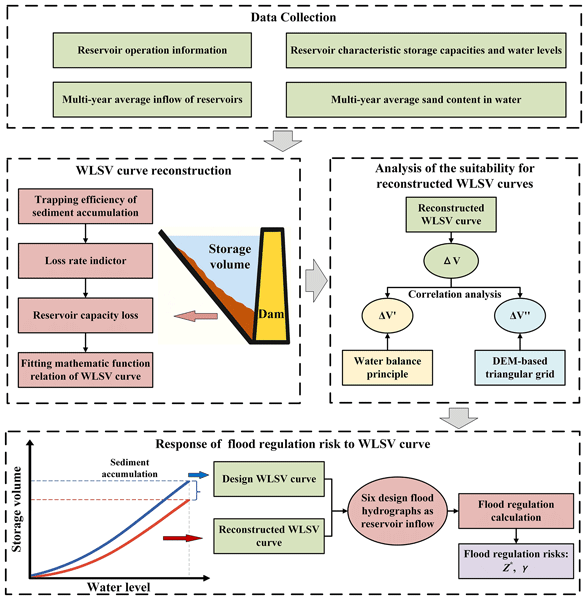
Abstract. Sediment accumulation in reservoirs can change the predefined water level-storage (WLS) relationship by significantly reducing the storage capacity, further threatening the flood control safety of reservoirs in long-term scheduling and operation. However, reconstructing the WLS relationship has long been challenging, especially on a large scale, due to the difficulties of traditional field bathymetric measurement. To fill this knowledge gap, a method to estimate the reservoir WLS curve based on the capacity loss induced by sediment accumulation is proposed in this study. To assess the potential negative impact caused by inaccurate WLS curve, flood regulation calculations for reservoirs are performed individually using six design flood hydrographs with return intervals ranging from 200–10,000 years as reservoir inflow. The flood regulation risk is quantified using the maximum flood regulation water level (Z*) and the ratio of periods exceeding the design flood level (γ). Based on hydrological and sediment data and operational information over ten years, a cascade of nine reservoirs in the Wujiang River in China is selected to conduct the established method. The results show that sediment accumulation is more severe in reservoirs located in the middle and upper reaches of the Wujiang River, leading to the most significant reduction in capacity loss volume for Hongjiadu (180.3 million m³) and the largest loss rate for Suofengying (25.02 %) reservoirs. Using the current design WLS curve for flood regulation calculations, Z* is underestimated by 7.11 m and 1.84 m, and γ by 2 % and 3 % for Suofengying and Dongfeng reservoirs, respectively, compared with the reconstructed one. This underestimation increases with the length of the return interval. This indicates that when storage capacity is considerably reduced, continued use of the existing design WLS curve may significantly underestimate flood regulation risks, thus posing potential safety hazards to the reservoir itself and downstream flood protection objects.
-
Notice on discussion status
The requested preprint has a corresponding peer-reviewed final revised paper. You are encouraged to refer to the final revised version.
-
Preprint
(1916 KB)
-
The requested preprint has a corresponding peer-reviewed final revised paper. You are encouraged to refer to the final revised version.
- Preprint
(1916 KB) - Metadata XML
- BibTeX
- EndNote
- Final revised paper


Journal article(s) based on this preprint
Interactive discussion
Status: closed
-
RC1: 'Comment on egusphere-2025-679', Anonymous Referee #1, 18 Apr 2025
-
AC1: 'Reply on RC1', Qiumei Ma, 04 Jun 2025
Thanks for your time and invaluable comments, which have substantially
improved the study. Based on your comments, we have carefully revised the paper. Please find the detailed point-by-point response to the reviewers’ comments in the attachment. The comments have been replied one by one in this document.
The line numbers in the responses below refer to the revised manuscript, while the line numbers in the comments refer to the original manuscript. We hope the revised manuscript can meet the publication standard of the Hydrology and Earth System Sciences at this time.
-
AC1: 'Reply on RC1', Qiumei Ma, 04 Jun 2025
-
RC2: 'Comment on egusphere-2025-679', Anonymous Referee #2, 28 Apr 2025
The comment was uploaded in the form of a supplement: https://egusphere.copernicus.org/preprints/2025/egusphere-2025-679/egusphere-2025-679-RC2-supplement.pdf
-
AC2: 'Reply on RC2', Qiumei Ma, 04 Jun 2025
Thank you for your efforts and constructive comments, which have significantly improved the quality of the manuscript. We have provided detailed point-by-point responses to the reviewers' comments and meticulously revised the manuscript. The response document is provided as an attachment, where the line numbers in replies refer to the revised manuscript, while those in the comments refer to the original manuscript. We hope the revised manuscript now meets the publication standard of the Hydrology and Earth System Sciences.
-
AC2: 'Reply on RC2', Qiumei Ma, 04 Jun 2025


Interactive discussion
Status: closed
-
RC1: 'Comment on egusphere-2025-679', Anonymous Referee #1, 18 Apr 2025
The study proposes a capacity loss rate (LR) index to reconstruct the water level-storage (WLS) relationship of reservoirs, utilizing measured water/sediment data and operational records. The suitability of the proposed method is evaluated through water balance principles and comparison with traditional approaches. Subsequently, the impact of reconstructed WLS curves on reservoir flood control and operation is quantified using a flood regulation algorithm with varying design inflow scenarios. The experimental design from WLS curve reconstruction to flood operation impact assessment is systematic. While the proposed methods offer practical values for reservoir management, issues remain in language expression and method application. Therefore, I recommend Major Revision for this manuscript. The detailed comments are as follows:
- The terms “Fig.” and “Figure” are used interchangeably in the manuscript. Please standardize to one format for consistency. Additionally, proofreading by a native English speaker should be conducted to improve overall language quality.
- This study uses the sediment deposition rate (Te) to calculate LR. It is recommended to introduce the concept and development history of Te in Introduction Section and reduce the examples of traditional methods to better highlight the study’s core methodology.
- For 2.1 Section of the study area, in Line 151, a period is missing after “Fig. 1”. Please revise throughout the manuscript. In Line 152, the phrase “the Wujiang River Basin has aggravated the interception of sediment” should be reworded to “sediment interception in the basin has increased”.
- In Methods Section, since the Brune model is an empirical model based on U.S. reservoir siltation survey data, its applicability to reservoir siltation calculation in China may be limited. It is suggested to add a discussion on the model’s applicability, supported by relevant literature.
- In 3.1, according to Eq. 1, as ni in the denominator increases, the reservoir capacity loss rate LRi also increases. This implies that LR grows over time, suggesting an unrealistic scenario where reservoirs would silt up indefinitely. Please clarify the constraints of this equation to reflect real-world limitations.
- The study establishes Brune model to calculate Te, but multiple approaches exist for this purpose. It is recommended to compare the results with those from other models in the Methods section to strengthen methodological robustness.
- The reservoir exhibits complicated morphometry, with significant variations in water depth and width. In the current study, several reservoirs (e.g., Hongjiadu and Goupitan) also cover extensive surface areas. On the other hand, the authors employ mathematical functions with exponential, polynomial and power function forms in Eqs. (3-5) to estimate reservoir water storage changes. Please address potential errors induced by the simplified estimation formula. Could the accuracy of the WLS curve be improved by subdividing the reservoir into smaller sections based on morphometry and summing their contributions?
- In Eqs. (3-5), the water level (Z) is treated as the response variable, while the reservoir water storage is the explanatory variable, Yet, the reservoir WLS curve reconstruction is evaluated based on the water storage variable. This inconsistency needs clarification.
- In Figure 1, the abbreviation for the “GLT” reservoir should be corrected to “GLQ” (Geliqiao).
- The Discussion Section should include a comparison of your WLS curve construction method with other existing approaches. Additionally, please elaborate on how the accuracy of WLS curve impacts the reliability of the water storage estimation.
- The abbreviations in the text and figures should be independent of each other. It is recommended that the corresponding vocabulary of the reservoir name abbreviations should also be clearly stated in the data methods in the manuscript text.
Citation: https://doi.org/10.5194/egusphere-2025-679-RC1 -
AC1: 'Reply on RC1', Qiumei Ma, 04 Jun 2025
Thanks for your time and invaluable comments, which have substantially
improved the study. Based on your comments, we have carefully revised the paper. Please find the detailed point-by-point response to the reviewers’ comments in the attachment. The comments have been replied one by one in this document.
The line numbers in the responses below refer to the revised manuscript, while the line numbers in the comments refer to the original manuscript. We hope the revised manuscript can meet the publication standard of the Hydrology and Earth System Sciences at this time.
-
RC2: 'Comment on egusphere-2025-679', Anonymous Referee #2, 28 Apr 2025
The comment was uploaded in the form of a supplement: https://egusphere.copernicus.org/preprints/2025/egusphere-2025-679/egusphere-2025-679-RC2-supplement.pdf
-
AC2: 'Reply on RC2', Qiumei Ma, 04 Jun 2025
Thank you for your efforts and constructive comments, which have significantly improved the quality of the manuscript. We have provided detailed point-by-point responses to the reviewers' comments and meticulously revised the manuscript. The response document is provided as an attachment, where the line numbers in replies refer to the revised manuscript, while those in the comments refer to the original manuscript. We hope the revised manuscript now meets the publication standard of the Hydrology and Earth System Sciences.
-
AC2: 'Reply on RC2', Qiumei Ma, 04 Jun 2025
Peer review completion


Journal article(s) based on this preprint
Viewed
| HTML | XML | Total | BibTeX | EndNote | |
|---|---|---|---|---|---|
| 784 | 94 | 28 | 906 | 28 | 46 |
- HTML: 784
- PDF: 94
- XML: 28
- Total: 906
- BibTeX: 28
- EndNote: 46
Viewed (geographical distribution)
| Country | # | Views | % |
|---|
| Total: | 0 |
| HTML: | 0 |
| PDF: | 0 |
| XML: | 0 |
- 1
Qiumei Ma
Chengyu Xie
Zheng Duan
Yanke Zhang
Lihua Xiong
Chong-Yu Xu
The requested preprint has a corresponding peer-reviewed final revised paper. You are encouraged to refer to the final revised version.
- Preprint
(1916 KB) - Metadata XML
The study proposes a capacity loss rate (LR) index to reconstruct the water level-storage (WLS) relationship of reservoirs, utilizing measured water/sediment data and operational records. The suitability of the proposed method is evaluated through water balance principles and comparison with traditional approaches. Subsequently, the impact of reconstructed WLS curves on reservoir flood control and operation is quantified using a flood regulation algorithm with varying design inflow scenarios. The experimental design from WLS curve reconstruction to flood operation impact assessment is systematic. While the proposed methods offer practical values for reservoir management, issues remain in language expression and method application. Therefore, I recommend Major Revision for this manuscript. The detailed comments are as follows: