
the Creative Commons Attribution 4.0 License.
the Creative Commons Attribution 4.0 License.
 | 30 Dec 2025
Vertical Mode and Cyclonic Eddy Encounters Govern Internal Tide Propagation and Intermodal Cascades: High-resolution Eddy Permitting Simulations
Abstract. The interaction between internal tides (ITs) and mesoscale features plays a key role in ocean energy dissipation. Understanding how IT energy is transformed in energetic western boundary regions remains a central challenge, particularly in regions of vigorous mesoscale activity.
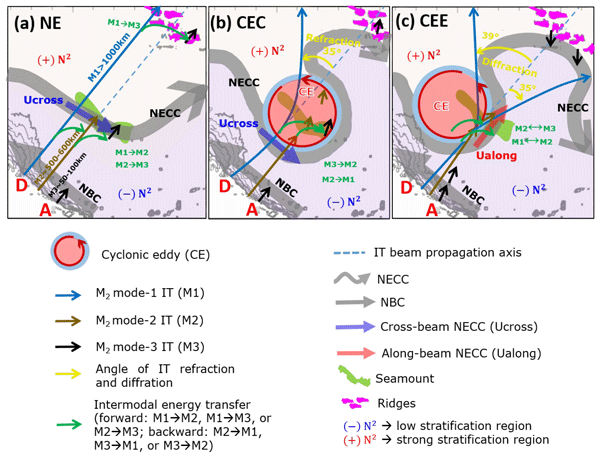
To this aim, we apply vertical mode decompositions to the flow from high-resolution (3 km) NEMO-AMAZON36 simulations during September-December 2015. This study shows that the IT vertical mode and the precise point of IT-eddy encounter determine whether the IT energy propagates freely, deviates, or is trapped, and how topography and coherent eddies synergistically scatter energy between baroclinic modes off the Amazon shelf.
Three representative interaction cases, each captured in a separate 25 hour snapshot, were examined: undisturbed propagation until crossing the Ceará Rise seamount, interaction with a cyclonic eddy (CE) core, and interaction with a CE eastern periphery. The principal findings establish two points.
First, an IT response (propagation, deviation or scattering) is dually controlled by its vertical mode and the mesoscale encounter properties. In the absence of a strong eddy, the Mode-1 IT propagates as a coherent beam with a long propagation range (O (1100 km)). In the presence of a strong CE, however, the IT beams are disrupted, preventing sustained long-range transmission. Within the eddy core, the Mode-1 IT is coherently refracted northward (~35° relative to its northeastward incident direction) while maintaining high energy fluxes exceeding 200 W m⁻¹. At the CE periphery, Mode-1 is diffracted into two distinct branches, with one propagating northward (∼39°) and the other eastward (∼35°). In contrast, the IT higher modes are highly susceptible to blocking and trapping: Mode-2 energy, despite initial amplitudes comparable to Mode-1, is completely arrested at the CE-seamount interface, while Mode-3 remains weak (below 200 W m⁻¹) and less propagative.
Second, intermodal energy transfer is governed by a hierarchical synergy between the seamount and CE's background flow. The seamount drives a forward energy cascade (O (10⁻⁸ W m kg⁻¹)) from the Mode-1 IT to higher modes. In contrast, the CE's strong horizontal shear triggers a competing inverse energy cascade (O (10⁻⁸ W m kg⁻¹)) from the background flow to the IT modes. This interaction is critical for the extreme damping of Mode-2 and explains the observed redistribution of energy fluxes.
These results provide mechanistic insight into the fate of IT energy in complex oceanic environments and advance understanding of multi-scale ocean dynamics.
-
Notice on discussion status
The requested preprint has a corresponding peer-reviewed final revised paper. You are encouraged to refer to the final revised version.
-
Preprint
(3406 KB)
-
The requested preprint has a corresponding peer-reviewed final revised paper. You are encouraged to refer to the final revised version.
- Preprint
(3406 KB) - Metadata XML
- BibTeX
- EndNote
- Final revised paper


Journal article(s) based on this preprint
Interactive discussion
Status: closed
-
RC1: 'Comment on egusphere-2025-6390', Anonymous Referee #1, 04 Mar 2026
This is a good paper with solid analysis. It builds on a good framework of previous studies, and presents interesting new results.
Some of the discussion is a bit over-simplified. The pattern of energy transfer terms (Fig 5.6,) are complex and it is hard to know what to focus on. Features and 'results' highlighted not always as clear as the text suggests (e.g., most of what is emphasized in the discussion of Fig 6 can also be seen in Fig 5 - see comments on L473-475).
In addition to the changing mesoscale field, it is worth noting that the IT also changes quite a bit between the 2nd and 3rd cases - the forcing is about 50% larger! I don't think one can really ignore this and state that the IT fields are the same (L332). What are the impacts of a stronger IT (if the eddy field stayed the same)? I presume that this is part of the signal seen in Fig 7 (vs Fig 6).
The analysis is well done, and the results very interesting, although arguably pretty complicated. It could be good to build composites (for all cases when a CE is on top of the seamount, for example, or to the north of it, or...), or try to quantify the dominant terms in a control region over multiple realizations, or ... Overall, the manuscript leaves many questions open but still is a solid piece of work that might inspire other studies. As such, I recommend publication, with authors reading and thinking about my comments.
--------
Figure 1 - Cyan contour should not be used for Ceará Rise seamount. In the rest of the paper, cyan is used to mark eddies. It would be better to mark the seamount by a different color (thick black?), and repeat it in later figures (Fig 2,4) where the seamount is hard to locate.
L332 and Figure 3 - Magnitude of the internal tide for the 3rd case is much larger.
Figure 4 - it might be worth stating that while the conditions for the 3rd case seem very similar to the second case, the energetics (discussed later) are very different. Looking at Fig 4, I was wondering why there was a 3rd case.
L338-343: Information about the seamount is scattered in the first two items. Combine in a new sentence before listing the 3 cases (L335).
L473: "In the CEC case, the net effect of Hmn (Figs. 6g-i) is primarily governed by its symmetric part (Figs. 6m-o)." This is a bit of an overstatement. Like in the previous case (Fig. 5), I would argue that it is 'clear' that H^A_{1-3} dominates H_{1-3} and H^S_{2-3} dominates H_{2-3}, but it's hard to immediately decide if A or S dominates for H_{1-2}. In this case, its's really a combination of both. The symmetric component plays a bigger role than it did in the previous case.
L475. "Specifically, between the shelf break and the southern edge of the CE, Mode-
2 IT loses energy to the Mode-3 background flow (Fig. 6o, blue patches)." That statement is also true for the previous case (Fig 5o). Maybe it is stronger here, but it's really hard to see with this (saturated) colorbar.L5530-538: One of the most striking feature of Fig 7 is the alternating bands in H_{12}, and H{23}, to a lesser extent. This is noted in L532, but left without explanation. This is due to the symmetric part (background and IT interactions). Is this due to an interference pattern (stronger IT)? You see it both before and after the seamount...
L602: The impact of anticyclonic eddies is not shown in this paper.
Citation: https://doi.org/10.5194/egusphere-2025-6390-RC1 - AC1: 'Reply on RC1', Fabius Kouogang, 05 Apr 2026
-
RC2: 'Comment on egusphere-2025-6390', Anonymous Referee #2, 10 Mar 2026
My detailed review is provided in the attached file.
- AC2: 'Reply on RC2', Fabius Kouogang, 05 Apr 2026
- AC3: 'Reply on RC2', Fabius Kouogang, 05 Apr 2026
Peer review completion


Interactive discussion
Status: closed
-
RC1: 'Comment on egusphere-2025-6390', Anonymous Referee #1, 04 Mar 2026
This is a good paper with solid analysis. It builds on a good framework of previous studies, and presents interesting new results.
Some of the discussion is a bit over-simplified. The pattern of energy transfer terms (Fig 5.6,) are complex and it is hard to know what to focus on. Features and 'results' highlighted not always as clear as the text suggests (e.g., most of what is emphasized in the discussion of Fig 6 can also be seen in Fig 5 - see comments on L473-475).
In addition to the changing mesoscale field, it is worth noting that the IT also changes quite a bit between the 2nd and 3rd cases - the forcing is about 50% larger! I don't think one can really ignore this and state that the IT fields are the same (L332). What are the impacts of a stronger IT (if the eddy field stayed the same)? I presume that this is part of the signal seen in Fig 7 (vs Fig 6).
The analysis is well done, and the results very interesting, although arguably pretty complicated. It could be good to build composites (for all cases when a CE is on top of the seamount, for example, or to the north of it, or...), or try to quantify the dominant terms in a control region over multiple realizations, or ... Overall, the manuscript leaves many questions open but still is a solid piece of work that might inspire other studies. As such, I recommend publication, with authors reading and thinking about my comments.
--------
Figure 1 - Cyan contour should not be used for Ceará Rise seamount. In the rest of the paper, cyan is used to mark eddies. It would be better to mark the seamount by a different color (thick black?), and repeat it in later figures (Fig 2,4) where the seamount is hard to locate.
L332 and Figure 3 - Magnitude of the internal tide for the 3rd case is much larger.
Figure 4 - it might be worth stating that while the conditions for the 3rd case seem very similar to the second case, the energetics (discussed later) are very different. Looking at Fig 4, I was wondering why there was a 3rd case.
L338-343: Information about the seamount is scattered in the first two items. Combine in a new sentence before listing the 3 cases (L335).
L473: "In the CEC case, the net effect of Hmn (Figs. 6g-i) is primarily governed by its symmetric part (Figs. 6m-o)." This is a bit of an overstatement. Like in the previous case (Fig. 5), I would argue that it is 'clear' that H^A_{1-3} dominates H_{1-3} and H^S_{2-3} dominates H_{2-3}, but it's hard to immediately decide if A or S dominates for H_{1-2}. In this case, its's really a combination of both. The symmetric component plays a bigger role than it did in the previous case.
L475. "Specifically, between the shelf break and the southern edge of the CE, Mode-
2 IT loses energy to the Mode-3 background flow (Fig. 6o, blue patches)." That statement is also true for the previous case (Fig 5o). Maybe it is stronger here, but it's really hard to see with this (saturated) colorbar.L5530-538: One of the most striking feature of Fig 7 is the alternating bands in H_{12}, and H{23}, to a lesser extent. This is noted in L532, but left without explanation. This is due to the symmetric part (background and IT interactions). Is this due to an interference pattern (stronger IT)? You see it both before and after the seamount...
L602: The impact of anticyclonic eddies is not shown in this paper.
Citation: https://doi.org/10.5194/egusphere-2025-6390-RC1 - AC1: 'Reply on RC1', Fabius Kouogang, 05 Apr 2026
-
RC2: 'Comment on egusphere-2025-6390', Anonymous Referee #2, 10 Mar 2026
My detailed review is provided in the attached file.
- AC2: 'Reply on RC2', Fabius Kouogang, 05 Apr 2026
- AC3: 'Reply on RC2', Fabius Kouogang, 05 Apr 2026
Peer review completion
Journal article(s) based on this preprint
Viewed
| HTML | XML | Total | BibTeX | EndNote | |
|---|---|---|---|---|---|
| 1,368 | 549 | 199 | 2,116 | 378 | 393 |
- HTML: 1,368
- PDF: 549
- XML: 199
- Total: 2,116
- BibTeX: 378
- EndNote: 393
Viewed (geographical distribution)
| Country | # | Views | % |
|---|
| Total: | 0 |
| HTML: | 0 |
| PDF: | 0 |
| XML: | 0 |
- 1
Fabius Kouogang

Ariane Koch-Larrouy
Xavier Carton
Moacyr Araujo
The requested preprint has a corresponding peer-reviewed final revised paper. You are encouraged to refer to the final revised version.
- Preprint
(3406 KB) - Metadata XML