
the Creative Commons Attribution 4.0 License.
the Creative Commons Attribution 4.0 License.
 | 28 Dec 2025
A quasi-Lagrangian perspective on the role of dry and moist processes in the formation of blocked North Atlantic-European weather regimes
Abstract. Atmospheric blocking often triggers extreme events and remains difficult for weather and climate models to represent due to the complex multi-scale processes in its lifecycle. While recent studies highlight the importance of latent heat release in building and maintaining the upper-level anticyclonic anomaly, different perspectives assign varying roles to dry and moist dynamics, and it is still unclear whether their relative roles differ across regions where blocking occurs. This study uses a quasi-Lagrangian potential vorticity (PV) framework applied to ERA5 (1979–2021) to investigate blocking in the North Atlantic-European sector from the perspective of four large-scale blocked weather regimes. We track negative upper-tropospheric PV anomalies (PVAs-) around blocked regime onset and quantify the processes governing their amplitude changes to assess the roles of dry and moist dynamics. Most PVAs- linked to blocked regime onset are not formed in situ but follow two main pathways, arriving either from upstream or from downstream. PVAs- intensify in the days before onset, with moist, divergence-related PV tendencies associated with warm conveyor belt activity and baroclinic PV tendencies contributing strongly to their amplification, independent of blocked regime type or pathway. The position of PVAs- relative to storm tracks determines the strength of the moist contribution, with moist processes exerting a greater influence within the midlatitude storm track over the North Atlantic. Consequently, the magnitude of PVA- amplification depends more on whether a PVA- arrives from upstream or downstream, since the pathway controls the timing, location, and strength of the moist-dynamical processes acting on it, than on the blocked regime type it eventually contributes to. This study highlights the synoptic-scale moist-dynamical evolution of PVAs- associated with different types of blocked regimes from a quasi-Lagrangian perspective. Complementing the quasi-Lagrangian analysis with previous insights from a Eulerian perspective provides a coherent view of blocked regime evolution, linking the remote moist amplification of PVAs- with the local formation of the regime pattern by anomaly re-arrangement, which is dominated by dry, quasi-barotropic dynamics. Given the key role of moist processes in PVA- amplification and the systematic biases of blocking in weather and climate models, our results emphasize the need for better representation of moist baroclinic eddies and scale interactions, from cloud microphysics to the synoptic scale.
Competing interests: At least one of the (co-)authors is a member of the editorial board of Weather and Climate Dynamics.
Publisher's note: Copernicus Publications remains neutral with regard to jurisdictional claims made in the text, published maps, institutional affiliations, or any other geographical representation in this paper. While Copernicus Publications makes every effort to include appropriate place names, the final responsibility lies with the authors. Views expressed in the text are those of the authors and do not necessarily reflect the views of the publisher.-
Notice on discussion status
The requested preprint has a corresponding peer-reviewed final revised paper. You are encouraged to refer to the final revised version.
-
Preprint
(9514 KB)
-
The requested preprint has a corresponding peer-reviewed final revised paper. You are encouraged to refer to the final revised version.
- Preprint
(9514 KB) - Metadata XML
- BibTeX
- EndNote
- Final revised paper


Journal article(s) based on this preprint
Interactive discussion
Status: closed
-
RC1: 'Comment on egusphere-2025-6306', Anonymous Referee #1, 01 Feb 2026
The comment was uploaded in the form of a supplement: https://egusphere.copernicus.org/preprints/2025/egusphere-2025-6306/egusphere-2025-6306-RC1-supplement.pdfCitation: https://doi.org/
10.5194/egusphere-2025-6306-RC1 -
RC2: 'Comment on egusphere-2025-6306', Anonymous Referee #2, 09 Mar 2026
Review of “A quasi-Lagrangian perspective on the role of dry and moist processes in the formation of blocked North Atlantic-European weather regimes” by Hauser et al. (2025)
This study looks at blocking in the North Atlantic-European sector from two different perspectives: an eulerian one, based on a well established weather regimes approach, and a lagrangian one, by tracking anticyclonic potential vorticity anomalies. The work highlights that several paths exist to create blocked regimes and a PV budget approach highlights the contributions of a range of different processes. I enjoyed reading the manuscript and learned a lot from it - I think it would be of interest to Weather andClimate Dynamics readers and the community at large. The manuscript is well reasoned and well written. I only have a few minor suggestions for the authors to consider.
General comment
The manuscript is well written and well reasoned. However, I found some of the diabatic process links somewhat tenuous at times. Figures 6 and 7 perhaps make this case nicely. However, it is then argued that diabatics are important for retrogressive regimes, when most figures show the reverse. For example, consider the critical role that moist processes play in retrogression pathways. However, the relevant figures do not always necessarily support that in my view (see 8 and Figure 11 for example). In addition, Figure 9 shows a different perspective from say Figures 6 and 7 on which diabatic processes are perhaps equally as important as boundary and baroclinicity (UP). Perhaps discussing this in some more detail will help to clarify for the reader.
Specific comment for consideration
- Line 57-58: Confusing sentence, consider rewording.
- Lines 127: PVAs already defined above?
- Line 263-265: I know what you mean here but it reads fairly clunkily. Consider rewording this paragraph.
- Lines 318-320: Where do I see the onset PVAs amplifying to day t+1? I am not sure which result you are referring to here? All amplifications in Figure 6 occur before the onset day.
- Lines 321-323: DIVdiv is certainly the most positive contribution. But is it positive the entire pre-onset period? How long back do you need to go before it (and DIAG) become neutral? Additionally, DIAG amplifies in the days leading to onset (when the composite comes more into focus) without much movement in DIVdiv? Do diabatic processes explain this accelerated amplification? What are the major contributions to the increases? Can this be quantified?
- Lines 339-340: Does the amplification of EuBL and AR over the high latitude regimes not also a reflection of their latitude? They would have easy access to low-PV tropospheric air as they are situated close to or the mean jet axis. Is this also related to their size?
- Figure 7: I found the grey DIAG bar hard to see. Perhaps consider a grey line across the other bars to mark the height of the grey bar.
- Figure 8: I was perhaps surprised that the PV tendencies did not change on each dipole between the upstream and retrogression cases, given that they are both moving opposite directions.
- Lines 365 - 367: How can two objects merge without increasing the overall size of the merged object? I was confused by this statement.
- Lines 436 - 447: Would it be valuable to show how the positive and negative contributions of DIVdiv change with time in Figs 7/9?
- Linked to Figure 11 in Lines 436 - 454, the discussion surrounds the importance of WCB and diabatic heating in retrogression of blocking, linking these statements to current and previous results. It was not clear to me from these results how this was the case. However, several results including Figure 7, 8 and 11 show that diabatic and WCB anticyclonic amplification are much more prominent in progressive regimes.
Citation: https://doi.org/10.5194/egusphere-2025-6306-RC2 - EC1: 'Comment on egusphere-2025-6306', Juliane Schwendike, 16 Mar 2026
- AC1: 'Comment on egusphere-2025-6306', Seraphine Hauser, 24 Apr 2026
Peer review completion


Interactive discussion
Status: closed
-
RC1: 'Comment on egusphere-2025-6306', Anonymous Referee #1, 01 Feb 2026
The comment was uploaded in the form of a supplement: https://egusphere.copernicus.org/preprints/2025/egusphere-2025-6306/egusphere-2025-6306-RC1-supplement.pdf
-
RC2: 'Comment on egusphere-2025-6306', Anonymous Referee #2, 09 Mar 2026
Review of “A quasi-Lagrangian perspective on the role of dry and moist processes in the formation of blocked North Atlantic-European weather regimes” by Hauser et al. (2025)
This study looks at blocking in the North Atlantic-European sector from two different perspectives: an eulerian one, based on a well established weather regimes approach, and a lagrangian one, by tracking anticyclonic potential vorticity anomalies. The work highlights that several paths exist to create blocked regimes and a PV budget approach highlights the contributions of a range of different processes. I enjoyed reading the manuscript and learned a lot from it - I think it would be of interest to Weather andClimate Dynamics readers and the community at large. The manuscript is well reasoned and well written. I only have a few minor suggestions for the authors to consider.
General comment
The manuscript is well written and well reasoned. However, I found some of the diabatic process links somewhat tenuous at times. Figures 6 and 7 perhaps make this case nicely. However, it is then argued that diabatics are important for retrogressive regimes, when most figures show the reverse. For example, consider the critical role that moist processes play in retrogression pathways. However, the relevant figures do not always necessarily support that in my view (see 8 and Figure 11 for example). In addition, Figure 9 shows a different perspective from say Figures 6 and 7 on which diabatic processes are perhaps equally as important as boundary and baroclinicity (UP). Perhaps discussing this in some more detail will help to clarify for the reader.
Specific comment for consideration
- Line 57-58: Confusing sentence, consider rewording.
- Lines 127: PVAs already defined above?
- Line 263-265: I know what you mean here but it reads fairly clunkily. Consider rewording this paragraph.
- Lines 318-320: Where do I see the onset PVAs amplifying to day t+1? I am not sure which result you are referring to here? All amplifications in Figure 6 occur before the onset day.
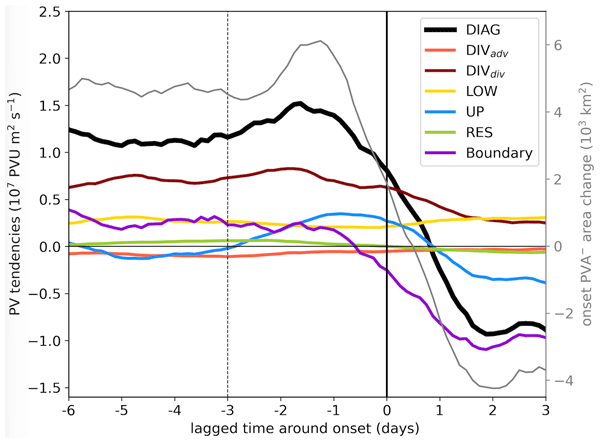
- Lines 321-323: DIVdiv is certainly the most positive contribution. But is it positive the entire pre-onset period? How long back do you need to go before it (and DIAG) become neutral? Additionally, DIAG amplifies in the days leading to onset (when the composite comes more into focus) without much movement in DIVdiv? Do diabatic processes explain this accelerated amplification? What are the major contributions to the increases? Can this be quantified?
- Lines 339-340: Does the amplification of EuBL and AR over the high latitude regimes not also a reflection of their latitude? They would have easy access to low-PV tropospheric air as they are situated close to or the mean jet axis. Is this also related to their size?
- Figure 7: I found the grey DIAG bar hard to see. Perhaps consider a grey line across the other bars to mark the height of the grey bar.
- Figure 8: I was perhaps surprised that the PV tendencies did not change on each dipole between the upstream and retrogression cases, given that they are both moving opposite directions.
- Lines 365 - 367: How can two objects merge without increasing the overall size of the merged object? I was confused by this statement.
- Lines 436 - 447: Would it be valuable to show how the positive and negative contributions of DIVdiv change with time in Figs 7/9?
- Linked to Figure 11 in Lines 436 - 454, the discussion surrounds the importance of WCB and diabatic heating in retrogression of blocking, linking these statements to current and previous results. It was not clear to me from these results how this was the case. However, several results including Figure 7, 8 and 11 show that diabatic and WCB anticyclonic amplification are much more prominent in progressive regimes.
Citation: https://doi.org/10.5194/egusphere-2025-6306-RC2 - EC1: 'Comment on egusphere-2025-6306', Juliane Schwendike, 16 Mar 2026
- AC1: 'Comment on egusphere-2025-6306', Seraphine Hauser, 24 Apr 2026
Peer review completion
Journal article(s) based on this preprint
Viewed
| HTML | XML | Total | BibTeX | EndNote | |
|---|---|---|---|---|---|
| 1,704 | 1,043 | 201 | 2,948 | 272 | 322 |
- HTML: 1,704
- PDF: 1,043
- XML: 201
- Total: 2,948
- BibTeX: 272
- EndNote: 322
Viewed (geographical distribution)
| Country | # | Views | % |
|---|
| Total: | 0 |
| HTML: | 0 |
| PDF: | 0 |
| XML: | 0 |
- 1
Seraphine Hauser

Franziska Teubler
Michael Riemer
Christian M. Grams
The requested preprint has a corresponding peer-reviewed final revised paper. You are encouraged to refer to the final revised version.
- Preprint
(9514 KB) - Metadata XML