
the Creative Commons Attribution 4.0 License.
the Creative Commons Attribution 4.0 License.
 | 19 Dec 2025
Natural disturbances increasingly affect Europe’s most mature and carbon-rich forests
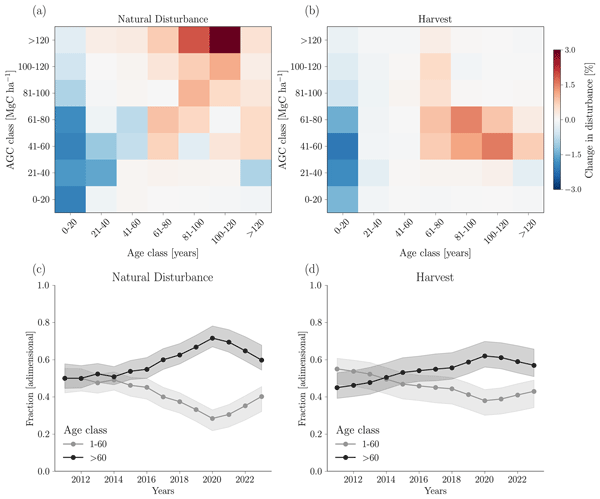
Abstract. Europe's forests store nearly 40 PgC and provide a critical carbon sink of ~0.2 PgC yr-1, yet climate-driven disturbances increasingly threaten this capacity. Although disturbance rates from windthrow and bark beetle outbreaks have risen in recent decades, it remains unclear whether these events increasingly affect the oldest and largest trees, which store a disproportionate share of carbon. Here, we combine three decades of satellite-derived disturbance maps with spatially explicit data on forest age, biomass, and species composition to reveal patterns of structural selectivity across Europe. We show that natural disturbances have shifted toward older, carbon-rich stands, with disturbed forest area > 60 years old nearly tripling since 2010 (from 0.38 to 1.06 Mha). This structural shift is most pronounced in spruce-dominated regions of Central Europe (effect size = 1), where compound heat and drought events have amplified susceptibility to bark beetles. Biomass losses from natural disturbances in spruce forests increased eightfold between the early (2011–2016) and recent (2017–2023) periods. Trend-based projections indicate that, if current patterns of structural selectivity persist, natural disturbances could expose biomass carbon stocks equivalent to approximately 20 % of Europe’s contemporary forest carbon sink by 2040 (~0.05 PgC yr -1 or ~0.7 PgC cumulative). Our findings reveal a previously unquantified vulnerability: climate-driven disturbances increasingly affect forest structures with high per-hectare carbon stocks, amplifying disturbance-related carbon exposure and weakening the long-term effectiveness of Europe’s forest carbon sink. Adaptive management strategies that promote structural and compositional diversification in high-risk regions will be critical to stabilise forest carbon storage under continued climate change.
-
Notice on discussion status
The requested preprint has a corresponding peer-reviewed final revised paper. You are encouraged to refer to the final revised version.
-
Preprint
(1673 KB)
-
Supplement
(1580 KB)
-
The requested preprint has a corresponding peer-reviewed final revised paper. You are encouraged to refer to the final revised version.
- Preprint
(1673 KB) - Metadata XML
-
Supplement
(1580 KB) - BibTeX
- EndNote
- Final revised paper


Journal article(s) based on this preprint
Europe’s forests store vast amounts of carbon, but climate-driven disturbances are becoming more frequent. By combining satellite records with information on forest age and structure, we show that recent disturbances increasingly affect the oldest and most carbon-rich forests, particularly spruce forests in Central Europe. This emerging pattern puts long-accumulated carbon at risk and may reduce the long-term climate benefits provided by Europe’s forests.
Interactive discussion
Status: closed
-
RC1: 'Comment on egusphere-2025-6288', Bogdan Brzeziecki, 18 Feb 2026
General assessment
The subject of this work is the impact of natural disturbances (such as insect outbreaks and windstorms) and planned harvesting operations on the current condition and future development of European forests, in the context of their vital role in climate mitigation. The authors focused on basic tree stand’s features such as age, dominant tree species, aboveground biomass and spatial structure. In order to achieve the main paper’s goal, they first compiled and standardized relevant data from various sources and streams (in form of various thematic maps covering the entire area of Europe) and then processed them using advanced statistical methods and tools. They compared two periods: 2011-2016 (serving as a reference) and 2017-2023. Based on the obtained results, they concluded that, compared to the reference period, recently, not only the rate of disturbances and the damage they cause increased, but also the ecological profile of the affected stands changed significantly, i.e. current disturbances increasingly affect mature forest stands and forest areas distinguished by high carbon stocks (with particular emphasis on spruce-dominated forests). As pointed out by authors, structural shifts toward older, higher-biomass, and more homogeneous stands substantially amplify future carbon exposure and negatively affect the mitigation role of forests in relation to climate change. Their discussion highlights, among other things, the fact that reducing the future susceptibility of forests to increasingly frequent and intense disturbances "will likely require coordinated management of species composition, structural complexity, and spatial heterogeneity."
In general, the results obtained in this work are not surprising and confirm what has been known for a long time, such as the fact that older (and denser) and structurally less diverse stands are more susceptible to disturbances, like hurricane winds or harmful insects. Similarly, the idea of creating forest stands distinguished by diverse species composition and age structure is certainly not new and has been formulated many times before.
The above comments do not in any way lower my high assessment of this work, which, in my opinion, presents a very high scientific level. It is based on extensive empirical material. It employs a significant number of modern and advanced methodological approaches. The obtained results are presented in a clear manner, including aesthetically pleasing and easily readable figures. Thanks to the analyses conducted, the authors were able to quantitatively characterize the phenomena they studied, including estimating the magnitude of the reduction in the rate of carbon uptake by European forests by 2040, depending on the adopted scenario for future disturbance regimes.
Thus, in my opinion, the potential for significant improvement of this interesting, important and necessary work is not big. Possibly, a certain dissatisfaction may arise from the lack of an attempt to explain in more detail the reasons for the change in the characteristics of the stands affected by studied disturbance types that took place between the reference period and the present one. Was it the result of a change in the disturbance regimes and their vital parameters? Or the result of a change in approach from the forest management side, often forced by external circumstances? It would also have been possible to discuss in more detail the consequences of the obtained results from the point of view of what the optimal strategy for using forests should be for the purpose of mitigating climate change. I am thinking here, for example, of the recently strongly promoted concept of proforestation, i.e. withdrawing managed stands - including young and very young stands - from utilisation, placing them under strict protection and allowing them to “age” naturally. Does such a strategy make much sense, taking into account the results of this work and its forecasts for further developments?
Minor concerns
From a formal point of view, I wouldn't have too many critical comments about this paper, either. Perhaps in a few cases certain issues could be made a little clearer, especially from the point of view of a reader who is less familiar with the methods used in the work. Some examples from this field, including few editorial propositions, are given below:
Line 22. Add space after „area”.
Line 27. “expose” or maybe simply “release into the atmosphere”?
Line 38. “climate-sensitive” or maybe “climate-induced” or “climate-driven”?
Line 53-54. Maybe: “These trends are likely to persist as climate change continues” (to avoid repetition of “continue”).
Lines 55-56. Maybe: “such as windstorms Vivian and Wiebke (in 1990), Lothar and Martin (in 1999), and Klaus (in 2009).”?
Line 64. “are driven primarily by expanding spatial footprints”. Not very clear.
Line 72. What about: “with spatially explicit data on forest age…”?
Lines 85-87. It is not quite obvious for me how “the 30 m binary disturbance maps were aggregated to 100 m resolution”. Did you use information from nine 30 m x 30 m pixels (81,000 m2) per one 100 m x 100 m pixel (10,000 m2)?
Line 95. I am just not very sure if the term “disturbance” is appropriate in the case of (planned) harvesting activities. Maybe from the pure ecological point of view…
Line 95. “the forest age and biomass products” or just “the forest age and biomass data”?
Line 114. Is “20 members” clear enough?
Line 116. “forest fraction at 100 m pixel”?
Line 124. “Forest age was obtained from the 20-member GAMIv3.0 ensemble”. Repetition, see Line 114.
Line 128. indicated?
Line 134. “X ′ and Y′ are independent copies of X and Y”. Not very clear what is meant here by “independent copies”.
Line 143. “we summarised uncertainty across the 20-member ensembles”. I am not sure what is meant by “member ensembles”. Could you be more specific here?
Line 156. “ 20 biomass members”. Not very clear what does it mean.
Lines 164-167. Repetition. See lines 122-126.
Line 168. “each member of the 20-realisation biomass ensemble”. Not very clear, see comment to Line 156.
Lines 179-181. Repetition. See lines 122-126.
Lines 232-234. Partly repetition. Besides, this fragments fits better the Methods chapter. What does it actually mean: “higher values”? higher than what?
Line 348. Maybe “…the recent biomass loss scenario…”?
Fig. 5. “Biomass Loss: Natural Disturbance/Harvest (Late – Early)” or “Biomass Loss: Natural Disturbance/Harvest (Recent – Early)”?
Lines 428-430. This is certainly true, broadly speaking. However, there are studies, such as the long-term (started in 1936 and continued until today) study on permanent research plots in Białowieża National Park, NE Poland, that show that spruce is strongly declining also in stands characterized by significant age and species diversity. See Fig. 8 in Brzeziecki et al. 2020. Over 80 years without major disturbance .... J. Ecol. 108: 1138-1154. https://doi.org/10.1111/1365-2745.13367.
Line 443-444. “Together with the homogenising effects of salvage logging…”. Not very clear for me what do you mean by “homogenising effects of salvage logging”. For example, if salvage logging takes place in the initial period of insect outbreaks, then its effect is the creation of smaller or larger gaps in forest canopies, which lead to an increase in the structural diversity of the tree stands. These types of gaps make also possible introduction of more resistant tree species, either by natural regeneration or by planting.
Line 449. Tendency towards “accumulating high biomass over decades of growth” occurs also in the case of many natural forest types, for example in beech-dominated forest in Europe (see Schütz J.-Ph. 2002. Silvicultural tools to develop irregular…Forestry 75,4: 329-337.)
Line 500-501. “reducing susceptibility in high-risk stands”. It is not very clear what exactly is meant by that. Could you be more specific? What do you actually propose to do in the case of “high-risk stands”?
Citation: https://doi.org/10.5194/egusphere-2025-6288-RC1 -
AC1: 'Reply on RC1', Simon Besnard, 20 Apr 2026
Response to Referee #1
We thank Referee #1 for their constructive review. Their positive assessment and suggestions have helped us strengthen the manuscript. Below, we address the referee's feedback. Line numbers refer to the revised manuscript.
General Comments
Comment 1: A certain dissatisfaction may arise from the lack of an attempt to explain in more detail the reasons for the change in the characteristics of the stands affected… Was it the result of a change in the disturbance regimes and their vital parameters? Or the result of a change in approach from the forest management side?
Response: We thank the reviewer for raising this point. We agree that attributing the observed structural shift requires discussion of both changes in disturbance regimes and management responses. We have expanded the relevant section of the Discussion (Section 4) to address this more explicitly.
Our results suggest that the shift is primarily driven by climate-amplified bark beetle dynamics rather than a systematic change in forest management. Several lines of evidence support this: (1) the structural shift is concentrated geographically in Central European spruce forests, coinciding temporally with the 2018-2022 compound drought events; (2) harvest patterns show structural stability between periods (median ED: 0.9 years; stable biomass distributions; <2% change in projected exposure across scenarios), in contrast to the pronounced shift in natural disturbances; and (3) the near-identical temporal CV trajectories of harvested and naturally disturbed spruce stands (Pearson's r = 0.75) are most consistent with salvage logging operations following beetle outbreaks, rather than independent management shifts driving the pattern.
That said, we acknowledge that management choices, including decades of homogeneous spruce planting and, more recently, salvage logging, have helped maintain the structural conditions that amplify susceptibility. We have added the following clarifying passage to Section 4 [L 531-541]:
"The observed structural shift appears to be primarily driven by climate-amplified bark beetle outbreaks, rather than a systematic change in forest management. Harvest patterns remained structurally similar across periods, with only minor shifts in age and biomass distributions (median ED: 0.9 years). The strong spatial and temporal correspondence between the structural shift in natural disturbances and compound drought events since 2018 points to climate forcing as the primary driver. Nevertheless, longstanding management legacies, particularly decades of favouring monospecific spruce planting and increasing growing stocks, have maintained structural conditions that predispose these landscapes to continued outbreak amplification. It is worth noting that the majority of bark beetle-affected stands are subsequently salvage-logged, which explains the tight coupling between natural disturbance and harvest trajectories observed in our data (Pearson's r = 0.75). This coupling reflects a management response to disturbance rather than a driver of structural vulnerability, and is consistent with the structural stability we observe in harvest-related biomass distributions across periods."
Comment 2: It would also have been possible to discuss in more detail the consequences from the point of view of the optimal strategy for using forests for climate mitigation. For example, the recently promoted concept of proforestation. Does such a strategy make much sense, given the results of this work?
Response: We thank the reviewer for this suggestion. The proforestation concept, i.e., withdrawing managed stands from utilisation and allowing them to age under strict protection, raises a question in light of our findings: if older, high-biomass stands are disproportionately vulnerable to climate-driven disturbances, does protecting and ageing stands increase their exposure?
We have added a paragraph in the Discussion to address this directly [L 594-606]:
"These findings have direct implications for proposed strategies to enhance forest carbon storage. For instance, our results raise an important caveat regarding proforestation, the strategy of withdrawing managed stands from harvest and allowing them to age naturally to accumulate carbon. While proforestation can substantially increase carbon stocks in the medium term (Moomaw et al., 2019), our findings reveal a structural vulnerability that can partially counteract its expected carbon benefits: the structural characteristics that proforestation promotes, namely advanced age and greater biomass in early successional phases, are precisely those now associated with disproportionate disturbance susceptibility in Central Europe's spruce-dominated forests. This does not invalidate proforestation as a strategy for increasing forest carbon storage, though. In broadleaf and structurally diverse ecosystems, for instance, the susceptibility we document is substantially lower. However, our findings underscore that the effectiveness of proforestation strategies is strongly species- and region-dependent. In spruce-dominated landscapes, proforestation without concurrent efforts to increase structural and compositional diversity may not fully realise its expected carbon benefits, given the elevated disturbance susceptibility of ageing, high-biomass stands documented here. Conversely, in broadleaf-dominated or structurally complex systems with lower susceptibility to disturbance, proforestation remains a promising complement to active management strategies."
Minor Comments
L. 22: Add a space after "area": Corrected.L. 27: "expose" or "release into the atmosphere"?: We thank the reviewer for this suggestion. After consideration, we have retained "expose" rather than replacing it with "release into the atmosphere." Disturbances transfer carbon from live biomass pools to dead organic matter, from which only a fraction may ultimately reach the atmosphere. Using "release into the atmosphere" would “blur” the distinction between disturbance-related carbon exposure and actual atmospheric emissions, overstating the directness of the flux. The term "expose" is used deliberately and consistently throughout the manuscript to describe carbon stocks rendered vulnerable to longer-term loss.
L. 38: "climate-sensitive" to "climate-induced" or "climate-driven?": We thank the reviewer for this suggestion. After consideration, we have retained "climate-sensitive" throughout the manuscript. The term is well-established in the disturbance ecology literature and accurately conveys that the frequency and severity of these disturbances are modulated by climate variability, without implying a single-factor direct cause.
L. 53-54: rephrase to avoid repetition of "continue": Revised to: "These trends are likely to persist as climate change progresses."
L. 55-56: rephrase storm names with dates: Revised to: "such as windstorms Vivian and Wiebke (in 1990), Lothar and Martin (in 1999), and Klaus (in 2009)."
L. 64: "driven primarily by expanding spatial footprints", not clear: Revised to: "…whether rising disturbance rates reflect a simple increase in the total area affected or a systematic shift toward structurally vulnerable forest cohorts."
L. 72: "with spatially explicit data on forest age…": Revised as suggested.
L. 85-87: How were 30 m pixels aggregated to 100 m?: We have clarified: "The reprojected 30 m binary disturbance maps were aggregated to 100 m resolution using average resampling. Within each 100 m pixel (~10,000 m²), we computed the fraction of overlapping 30 m sub-pixels (~9 m² each) classified as disturbed, yielding a continuous disturbance fraction rather than a binary indicator."
L. 95 (1st): Is "disturbance" appropriate for planned harvesting?: We appreciate this terminological concern. We use "disturbance" in its ecological sense (i.e., loss of the top tree canopy/gap creation), which, in managed systems, encompasses both natural tree death and human tree removal. We explicitly distinguish "natural disturbances" from "harvest" throughout the manuscript and have added a clarifying sentence at first use:
"Fire and mixed disturbances were excluded from this study because our research question specifically concerns the structural consequences of the documented shift from wind-dominated to bark beetle-dominated disturbance regimes. Such a shift unfolds through biotic and abiotic mechanisms distinct from fire dynamics and is geographically concentrated in temperate and boreal forest systems. We focus on two disturbance categories: harvest, representing planned timber removal for wood production or silvicultural reasons, and wind and bark beetle disturbances, representing unplanned canopy loss driven by natural agents but often followed by human management (i.e. salvage logging). We use the term disturbance broadly throughout to encompass both categories, as both human timber removal and natural canopy loss are disturbances with ecological consequences, while maintaining a consistent distinction between natural disturbances and harvest in all analyses and figures." [L 94-102]
L. 95 (2nd): "products" vs. "data": Changed to "forest age and biomass data".
L. 114: Is "20 members" clear enough?: Revised to: "a 20-member ensemble of forest age maps (GAMIv3.0)" to clarify what "members" refers to.
L. 116: "forest fraction at 100 m pixel": Revised to: "forest fraction within each 100 m pixel".
L. 124: Repetition of L. 114: Sentence removed; reference to the ensemble is now made by cross-reference only.
L. 128: "indicated"?: Revised to "indicated" as suggested.
L. 134: "independent copies" not clear: Revised to: "where X′ and Y′ are additional independent random samples drawn from the same distributions as X and Y, respectively, used to normalise the expected distance."
L. 143: "member ensembles" unclear: Revised to: "we summarised uncertainty across all 20 realisations of the forest age ensemble."
L. 156: "20 biomass members" unclear: Revised to: "the 20 independent realisations of the ESA CCI biomass ensemble."
L. 164-167: Repetition: Sentence removed; readers are directed to Section 2.3 for methodological details.
L. 168: "each member of the 20-realisation biomass ensemble" unclear: Revised consistently with our clarification at L. 156.
L. 179-181: Repetition: Removed; cross-reference added to Section 2.3.
L. 232-234: Repetition + belongs in Methods + "higher values"?: The sentence has been moved to the Methods section. "Higher values" have been clarified as: "higher energy distance values indicate that the age distributions of disturbed forests in the two periods are more dissimilar."
L. 348: "recent biomass loss scenario": Revised to: "the recent biomass loss scenario".
Fig. 5: "Recent - Early" instead of "Late - Early"?: Corrected to "Recent - Early" for consistency with the terminology used throughout the text.
L. 428-430: Spruce decline even in diverse stands (Brzeziecki et al. 2020): We thank the reviewer for pointing to this study. We have added the following sentence: "While structural and compositional diversity generally reduces susceptibility, long-term studies demonstrate that spruce decline can also occur in age- and species-diverse stands, suggesting that diversity increases but does not ensure resistance, and that site-level climate stress may outweigh the protective influence of structural diversity under prolonged drought conditions (Brzeziecki et al. (2020))." [L 547-550]The reference has been added to the bibliography.
L. 443-444: "homogenising effects of salvage logging" unclear: We have clarified: "Salvage logging following natural disturbances often leads to the establishment of new, even-aged monospecific stands on cleared sites (Sommerfeld et al., 2021), thereby preserving the structural homogeneity associated with high bark beetle susceptibility, even when individual gap creation temporarily increases local heterogeneity." [L 563-566]
L. 449: High biomass also accumulates in natural beech forests (Schütz 2002): We agree that this is an important nuance. We have revised the sentence to: "Biomass accumulation occurs across multiple forest types, including naturally developing beech-dominated forests in Europe (Schütz, 2002). In the context of our study, however, biomass accumulation most strongly amplifies disturbance susceptibility in even-aged spruce monocultures, where it combines with structural homogeneity and elevated drought sensitivity." [L 572-575]The reference has been added.
L. 500-501: "reducing susceptibility in high-risk stands", what does this mean specifically?: We have expanded this to: "Several measures like increasing species and structural diversity have been proposed to reduce susceptibility in high-risk stands. Targeted interventions promote mixed-species composition, structural thinning reduces stem density and host connectivity, while adopting uneven-aged management in climatically marginal spruce-dominated landscapes and refining harvest and post-disturbance management practices in disturbance-prone regions will further reduce susceptibility (Migliavacca et al., 2025)" [L 656-659]
Citation: https://doi.org/10.5194/egusphere-2025-6288-AC1
-
AC1: 'Reply on RC1', Simon Besnard, 20 Apr 2026
-
RC2: 'Comment on egusphere-2025-6288', Marina Rodes & Veronica Cruz-Alonso (co-review team), 17 Mar 2026
General comments
This manuscript presents a comprehensive large-scale analysis of forest disturbances across Europe, with a particular focus on how disturbance regimes interact with forest structural attributes such as age and biomass. By integrating multiple spatial datasets, including disturbance maps and forest structure information, the study provides a valuable and timely contribution to our understanding of how natural disturbances are affecting European forests in the context of ongoing environmental change. The continental-scale perspective, combined with the explicit focus on structurally mature and carbon-rich forests, makes this work particularly relevant for both the scientific community and forest management. Overall, the manuscript is clearly written and addresses an important and timely research question. However, several methodological and conceptual concerns arise regarding both the analytical approach and the actual scope of the study.
Firstly, although a wide range of natural disturbances affect European forests (e.g., fires, pests and diseases, windthrow, droughts), the authors focus exclusively on bark beetle outbreaks and windthrow. While it is understandable that some disturbances are difficult to detect reliably with satellite remote sensing and may therefore be excluded, such as droughts, the omission of forest fires is not justified in the manuscript. Fire and droughts are major disturbances in many parts of Europe, particularly in Mediterranean forests, and excluding it effectively removes Mediterranean forests from the analysis, as is evident in Figure 2a. Given that Mediterranean forests represent a significant proportion of Europe’s forest area, limiting the study to bark beetle infestations and windthrow narrows the geographical and ecological scope of the work. Under this view, the main messages of the manuscript appear somewhat overstated. Because the study excludes important disturbance types such as wildfires and drought-related mortality, and therefore omits large parts of Mediterranean forest systems, the conclusions may not be representative of European forests and natural disturbances as a whole. We encourage the authors to moderate the wording of the title, abstract, and discussion to better reflect the actual scope of the analysis and better justify why they decided to exclude some disturbance types.
Moreover, the manuscript clearly places a strong emphasis on bark beetle disturbances and on spruce dominated stands. For example, authors use a threshold to differentiate between age classes according to an ecological threshold based on bark beetles’ preference (L 141-142 “Given known ecological thresholds (e.g., bark beetles preferentially affecting spruce > ~60 years) […], we further grouped stands into broad age classes (1-60 years, > 60 years)”). Another example is how genus data are aggregated. In the manuscript genus data originally divided into eight classes are grouped in 3 groups: spruce, other needleleaf and broadleaf species. This grouping lacks ecological justification and effectively isolates spruce as the focal taxon while grouping all other genera into broad categories. As a result, the analysis appears to emphasize spruce‑specific patterns rather than providing a balanced comparison across taxa. For the reasons outlined above, we suggest either broadening the analysis so that it aligns with the current title of the manuscript or, alternatively, adjusting the wording to reflect the actual scope of the study. This could involve specifying that the work focuses primarily on Central Europe, explicitly referring to bark beetle and windthrow disturbances rather than using the broader term “natural disturbances”, and/or indicating that the analysis is particularly centered on spruce-dominated forests.
Secondly, to assess whether the age structure of disturbed forests changed over time, authors calculated the median 2010 age of disturbed pixels for the early (2011-2016) and recent (2017-2023) periods interpreting differences between periods as evidence that disturbances increasingly affect older (>60 years) or younger stands (1-60 years). While using a fixed point in time to calculate stand age is understandable, because forest age is fixed at its 2010 value, the discrepancy between the assigned age and the true age at the time of disturbance increases over time. This means that disturbances occurring in the 2017–2023 period are associated with systematically larger age errors than those occurring in 2011–2016. As a result, the two periods are not strictly comparable with respect to forest age, and disturbances affecting older forests in the later period may be systematically assigned to younger age classes. This temporal bias could be corrected by using a relative stand age to the beginning of each period but if not, it would need to be acknowledged and discussed. Also, the manuscript does not clarify how pixels that experience disturbances in both periods are treated. For example, if a stand older than 60 years is disturbed in 2011 and again in 2020, is it classified as >60 years in both cases, even if the 2011 event was a stand replacing disturbance that would reset its age? Additionally, it is unclear whether disturbance intensity is considered to distinguish stand replacing events from partial disturbances, which would have important implications for interpreting age-related patterns.
Similarly, the interpretation that disturbances increasingly affect high-biomass, carbon-rich forests may partly reflect changes in the underlying forest structure rather than changes in disturbance selectivity. Forest biomass across large parts of Europe has increased over recent decades, meaning that the availability of high-biomass stands in the landscape has also increased. If disturbances occur randomly with respect to biomass, an increasing fraction of disturbances would be expected to occur in high-biomass forests simply because such forests have become more widespread. The manuscript should clarify how this potential availability effect is accounted for when interpreting disturbance selectivity.
The manuscript refers to the ~100 km hexagonal units as “forest stands”. However, in forest ecology and silviculture the term “stand” typically refers to a relatively homogeneous forest unit at the scale of hectares to tens of hectares. The hexagonal units used here represent landscape-scale areas containing many different forest stands. Using the term “stand” for these units may therefore be misleading. We recommend using a term such as “landscape unit” to not create confusion. Also, we recommend reconducting messages like “natural disturbances increasingly occur in structurally homogeneous forests/stands” to “natural disturbances occur more frequently in landscapes where biomass distribution is more homogeneous”. Related to the forest landscape homogeneity, other methodological details should be clarified. For example, the analysis excludes hexagonal units with fewer than “50 valid disturbed pixels” (L168) to ensure stable estimates of disturbance selectivity. While this is understandable from a statistical perspective, it may also bias the analysis towards regions with relatively high disturbance activity. If the number of hexagons meeting this threshold differs between the two study periods, this could influence the comparability of the results for the two periods. Clarifying how many hexagons are retained in each period would help assess the robustness of the comparison. Second, the manuscript states that annual median CV values were calculated to assess continuous shifts in structural heterogeneity (L173). However, it is not entirely clear how the yearly calculation is done (see also related minor comments).
Finally, more detailed discussion of the study’s limitations, both in terms of data inputs and methodological choices, will be needed. For example, regarding disturbance data, the Forest Disturbance Atlas can miss gradual non–stand‑replacing disturbances, as acknowledged by its authors. These processes also shape forest dynamics, and their omission may affect the interpretation of disturbance–related patterns. For the stand age product, the original publication reports high uncertainty values, which could propagate into the analysis and should be addressed when discussing the robustness of the findings. Overall, the datasets selected are appropriate and represent the best options available for conducting this type of analysis, and the methodological framework is generally sound. Nonetheless, a more explicit discussion of the limitations associated with remote sensing products and analytical choices would help readers better assess the robustness and generality of the conclusions.
Specific comments
L 21, 147, 148, 397, 399:
The manuscript repeatedly uses terms such as “species‑specific” even though the analysis is based on maps where tree taxa are aggregated at the genus level that are grouped into broader functional groups. Because the study does not employ taxonomic information at the species level, this terminology is misleading and should be revised. The authors should adjust the wording to reflect the actual taxonomic resolution used (e.g., “genus‑level” or “taxon‑group–specific”).
L 59-60:
The statement that older, high-biomass stands may be particularly vulnerable to natural disturbances is currently supported by Jactel et al. (2017). However, that study primarily focuses on the role of tree species diversity in resistance to disturbances rather than on stand age or biomass per se.
L 70-71: “We examine whether disturbance impacts have shifted toward older, carbon-rich stands and how these patterns vary across dominant genera”
Consider removing this sentence since it is similar to what is expressed in L 74: “We quantify shifts in the age and biomass structure of disturbed stands, test”. In addition, the patterns analyzed are not across dominant genera but among Picea, rest of conifers and broadleaves.
L 102-104:
Disturbance information is aggregated to the 100 m grid using the fraction of disturbed pixels, while forest composition is represented by the most common genus within the cell. These two aggregation approaches differ substantially in how much within-cell information is retained. Using only the dominant genus may obscure compositional heterogeneity, particularly in mixed forests. The authors may wish to clarify the rationale for this choice or discuss its potential implications.
L 113-117:
Consider adding further description to the data sets not described above such as forest age, above ground biomass and forest fraction products. Including information about resolution, year(s) of the information provided, members and reference (in the case of forest fraction) is highly recommended.
L 119:
Disturbances previous to 2011 are not used, right?
L 122-123: “we selected all 100 m pixels with ≥30% forest fraction.”
Please, justify this threshold. Why ≥30% and not ≥50%?
L 122-123: “we retained only those where ≥50% of the forested area was disturbed...”
Please, justify this threshold and discuss possible implications.
L 148-150: “To investigate species-specific susceptibility to disturbance, we assessed the structural and cumulative biomass loss across three genus groups: Spruce, Other needleleaf (including Larix, Pinus, and other conifers), and Broadleaf (including Fagus, Quercus, and other broadleaf species).”
In L101-103 states that the original genus map (at 10 m resolution) was aggregated to 100 m using “a mode-based majority filter, assigning each 100 m cell the genus class that occurred most”. According to the original genus map there are eight genus classes. Later (L 148–150), the authors introduce a second reclassification step in which these eight classes are grouped into three broader categories (spruce, other needleleaf and broadleaf). It is unclear why this grouping was not applied prior to aggregation. Aggregating first using the eight-class scheme and only afterwards collapsing the classes can lead to inconsistencies. For example, a 100 m pixel composed of 30 % Quercus spp., 30 % Fagus spp., and 40 % Pinus spp. would be assigned to Pinus spp. under the majority filter. In the subsequent reclassification, this pixel would be labeled as “other needleleaf,” even though 60 % of the area corresponds to broadleaf genera. Please, justify or clarify the aggregation methodology.
L 151: “For each disturbed pixel, we used ensemble median aboveground biomass estimates”
Specify what “ensemble median above ground estimates” refers to. Besides, aboveground biomass from the ESA CCI biomass v6.0 provides biomass information for the years 2007, 2010, 2015, 2016, 2017, 2018, 2019, 2020, 2021 and 2022. Specify which years were used for each period, 2010,2015 and 2016 for 2011-2016 and 2017, 2018, 2019, 2020, 2021, 2022 for 2017-2023?
L 173: “To assess continuous shifts, we calculated the annual median CV for each ensemble member and aggregated these across the 20 biomass realisations”
Explain in more detail, please.
L249-251: “The contrast between stable harvest selectivity and shifting natural disturbance patterns suggests that climate-amplified biotic agents, rather than management changes, drive the observed structural selectivity.”
The comparison between harvesting and natural disturbances may be somewhat misleading because the two disturbance categories are not represented with the same completeness. While harvesting is quantified across all European forests, natural disturbances exclude important agents such as fire and drought-induced mortality. As a result, natural disturbances are likely underestimated in regions where these processes dominate, particularly in Mediterranean forests.
Technical corrections
L 36: “A large share of Europe’s forests originated from post-war planting campaigns and are entering maturity, during which carbon accumulation slows as stands approach saturation”
In this sentence, the use of “and” appears to be an error.
L49: “Living with bark beetles,” 2019; Weynants et al., 2024).”
Revise this citation, please.
L 51-53: “(“Korhonen K. T., Ahola A. et al. (2021) Forests of Finland 2014-2018 and their development 1921-2018,” n.d.; “Pulgarin Diaz J. A., Melin M. et al. (2024) Relationship between stand and landscape attributes and Ips typographus salvage loggings in Finland,”n.d.).”
Please, revise citation.
L 72: “(Besnad et al, n.d)”
Include year in this citation as it appears in references section.
L 72, 83, 516: refers to the citation Santoro and Cartus (2023) which is the v4 of the data set. However, according to lines 115 and 517 v6 is used.
L 82: “European Forest Disturbance Atlas v2.1.1 dataset”
Include acronym EFDA
L 100: “The map distinguishes eight classes: Larix, Picea, Pinus, Fagus, Quercus, other needleleaf,”
Please follow standard taxonomic nomenclature by using genus‑level notation (in italics) with “spp.” (e.g. Larix spp., Picea spp., Pinus spp., etc.)
L 113: “The annual disturbance fraction for each agent (harvest, natural disturbance)”
Specify that it is not natural disturbance but bark beetle or windthrow disturbance (there are other natural disturbances not included in the study)
L 114: (Besnard et al., 2021, n.d.)
Remove “, n.d.”
L 120: “2.4 Integration of the different Earth Observation data streams”
This section repeats the title used in section 2.3
L 134: “Where X and Y represent the 2010 age distributions of disturbed pixels in the early and recent periods, X ´ and Y´ are”
Correct the blank in “X ´”
L 149: “… three genus groups: Spruce, Other needleleaf (including Larix, Pinus, and other conifers), and Broadleaf (including …”
Revise capital letters in “other needleaf” and “broadleaf”
L 164-167: “We used harmonized disturbance and biomass datasets at 100 m resolution across Europe from 2011 to 2023, covering both natural disturbances (windthrow and bark beetle) and harvests. All data were aggregated to a 100 km hexagonal grid (EPSG:3035) to ensure consistency in regional comparisons. Pixels were included if forest cover exceeded 30%, and disturbance affected more than 50% of the forested area in a given year.”
This information is repeated. The same information is provided previously in lines 121-124 and later in lines 178-182.
L 614: Living with bark beetles: impacts, outlook and management options | European Forest Institute [WWW Document],2019. URL https://efi.int/publications-bank/living-bark-beetles-impacts-outlook-and-management-options (accessed 7.8.25).
Revise citation, please. Authors?
L 678: “Santoro, M., Cartus, O., 2023. ESA Biomass Climate Change Initiative (Biomass_cci): Global datasets of forest above-ground biomass for the years 2010, 2017, 2018, 2019 and 2020, v4. https://doi.org/10.5285/AF60720C1E404A9E9D2C145D2B2EAD4E”
Reference and link to version 4 while in the text authors refer to version 6. Please, correct according to the version used.
Marina Rodes-Blanco and Verónica Cruz-Alonso
Citation: https://doi.org/10.5194/egusphere-2025-6288-RC2 -
AC2: 'Reply on RC2', Simon Besnard, 20 Apr 2026
Response to Referee #2
We thank Referee #2 for their detailed and constructive review. Their comments have helped us strengthen both the clarity and the framing of the manuscript. We address each point below. Reviewer comments are shown in italics, followed by our responses. Line numbers refer to the revised manuscript.
General Comments
Comment 1: The omission of forest fires is not justified in the manuscript. Fire and droughts are major disturbances in many parts of Europe, particularly in Mediterranean forests, and excluding them effectively removes Mediterranean forests from the analysis… the main messages of the manuscript appear somewhat overstated.
Response: We appreciate the reviewer’s criticism and agree that the study's scope needs more explicit framing. The exclusion of fire is an intended scientific choice driven by our research question/hypothesis, rather than a data limitation. The European Forest Disturbance Atlas v2.1.1 (Viana-Soto and Senf, 2025) provides reliable disturbance mapping across the full range of European forest systems. We excluded fire because our central research question concerns the structural consequences of the documented shift from wind-dominated to bark beetle-dominated disturbance regimes. Including fire would mix ecologically distinct disturbance processes and hide the specific demographic and carbon dynamics we aim to characterise. As such, this decision, which we agree should be stated more explicitly, does not reflect a limitation of the underlying data.
Our spatial coverage is thus not arbitrarily restricted but is determined by where bark beetle and windthrow disturbances actually occur, primarily in Central, Northern, and Eastern Europe. Mediterranean forests are underrepresented not because of a design flaw but because the disturbance agents we study are naturally concentrated outside that region.
That said, we fully agree that the title, abstract, and discussion should more precisely reflect this scope. We have made the following revisions:
1. The title has been revised to: "Natural disturbances from bark beetle outbreaks and windthrow increasingly affect Europe's most mature and carbon-rich forests."
2. The abstract now explicitly states: "Focusing on bark beetle outbreaks and windthrow, the dominant natural disturbance agents in temperate and boreal European forests, we combine three decades of satellite-derived disturbance maps…"
3. The following sentence has been added to the Methods [L. 94-102]: "Fire and mixed disturbances were excluded from this study because our research question specifically concerns the structural consequences of the documented shift from wind-dominated to bark beetle-dominated disturbance regimes. Such a shift unfolds through biotic and abiotic mechanisms distinct from fire dynamics and is geographically concentrated in temperate and boreal forest systems. We focus on two disturbance categories: harvest, representing planned timber removal for wood production or silvicultural reasons, and wind and bark beetle disturbances, representing unplanned canopy loss driven by natural agents but often followed by human management (i.e. salvage logging). We use the term disturbance broadly throughout to encompass both categories, as both human timber removal and natural canopy loss are disturbances with ecological consequences, while maintaining a consistent distinction between natural disturbances and harvest in all analyses and figures."
Comment 2: The analysis appears to emphasise spruce-specific patterns rather than providing a balanced comparison across taxa. We suggest either broadening the analysis or adjusting the wording to reflect the actual scope.
Response: We agree that the prominence of spruce in our results requires explicit justification. The emphasis on spruce is not an a priori analytical choice but emerges directly from the data: spruce-dominated forests exhibit by far the strongest and most statistically robust structural shifts between periods (Cohen's d = 1.0 for biomass, d = 1.25 for structural homogeneity), and they account for a disproportionate share of disturbance-related carbon losses relative to their disturbed area (approximately 40% of losses from 30% of area). The genus grouping into spruce, other needleleaf, and broadleaf is justified because the research question specifically concerns whether disturbance selectivity differs between a known high-susceptibility group (spruce) and other forest types, and because finer genus-level comparisons are not statistically supported at the continental scale, given the available sample sizes.
We have revised the manuscript to make this framing more explicit throughout. We have added the following justification at the first introduction of the genus grouping [L. 110-119]: "Prior to spatial aggregation, these eight classes were reclassified at the native 10 m resolution into three functional groups based on known differences in disturbance susceptibility: spruce (Picea spp.), other needleleaf (Larix spp., Pinus spp., and other conifers), and broadleaf (Fagus spp., Quercus spp., and other broadleaf species). Non-tree pixels were assigned to nodata at this stage and excluded from the subsequent majority filter. Spruce was retained as a distinct group given its documented preferential susceptibility to bark beetle outbreaks and its dominant role in Central European disturbance dynamics. This grouping is analytical and is not intended to provide a balanced comparison across taxa. The reclassified 10 m map was then reprojected to EPSG:4326 and aggregated to 100 m resolution using a mode-based majority filter, assigning each 100 m cell the functional group that occurred most frequently among its underlying 10 m pixels. Reclassifying to three functional groups prior to spatial aggregation reduces class fragmentation during the majority filter, producing more robust and stable genus assignments under the projection transformation from EPSG:3035 to EPSG:4326."
Comment 3: Because forest age is fixed at its 2010 value, the discrepancy between the assigned age and the true age at the time of disturbance increases over time. Disturbances in 2017-2023 are associated with systematically larger age errors than those in 2011-2016, meaning the two periods are not strictly comparable.
Response: We respectfully disagree with this interpretation and believe it reflects a misunderstanding of the methodological design, which we may not have sufficiently explained in the manuscript. The use of a fixed 2010 baseline age is not a limitation but an analytical choice designed precisely to ensure comparability between the two periods.
By fixing all pixels to their 2010 age, we hold the landscape composition constant. This means that any difference in the age distribution of disturbed stands between the early (2011-2016) and recent (2017-2023) periods cannot be attributed to natural forest ageing during the study period. It can only reflect an actual change in which age cohorts are affected. This is explicitly stated in Figure 2c of the manuscript: "Because all ages are fixed to 2010 values, the differences reflect selection, not regrowth or mortality."
If we had instead used contemporary age estimates (i.e., allowing age to increase each year), any apparent shift toward older disturbed stands could simply reflect that all forests have aged by 6-12 years over the study period, thereby confounding disturbance selectivity with natural ageing. The 2010 fixed baseline eliminates this confounded effect entirely.
We have expanded the methodological explanation in Section 2.4 [L 153-158] to make this reasoning more explicit: "All analyses were fixed to the 2010 age estimate regardless of the year of disturbance. This design choice is intentional: by holding the landscape age structure constant, we ensure that differences in the age of disturbed stands between the early (2011-2016) and recent (2017-2023) periods reflect actual changes in disturbance selectivity rather than the confounding effect of natural forest ageing. Any shift toward older disturbed cohorts, therefore, represents an actual change of forest age classes preferentially affected by disturbances, independent of natural stand development."
Comment 4: The manuscript should clarify how pixels disturbed in both periods are treated. If a stand is disturbed in 2011 and again in 2020, is it classified as >60 years in both cases, even if the 2011 event was stand-replacing?
Response: This is a valid clarification point. In our dataset, each disturbed pixel is assigned its 2010 baseline age regardless of when the disturbance occurred within the study period. Pixels disturbed in both periods are treated independently in each period's analysis, each time retaining their 2010 age. We acknowledge that for pixels experiencing a stand-replacing disturbance in the early period, the assigned age in the recent period would no longer reflect the true post-disturbance age. However, the proportion of pixels experiencing two stand-replacing disturbances within a 12-year window was expected to be very small for two reasons. First, natural disturbance return intervals in European forests are typically in the range of decades to centuries (Schelhaas et al., 2003; Seidl et al., 2014), making repeated stand-replacing events within 12 years rare. Second, even in the unlikely case of two successive disturbances, stands regenerating after a stand-replacing event in 2011 would not reach the structural maturity, stem density, or canopy height required to become susceptible to bark beetle attack or windthrow by 2020, given known minimum rotation lengths and stand development trajectories in European forests (Lindegaard et al., 2016; Suvanto et al., 2025). To confirm this empirically, we quantified the fraction of pixels experiencing two or more stand-replacing natural disturbances within the 2011-2023 period. As anticipated, these represent a negligible fraction (<3%) of the total disturbed area (Table S3), confirming that recurrent disturbance events do not substantially affect our continental-scale results. We have added a clarifying sentence to Section 2.4 [L. 159-166] acknowledging this assumption.
"We acknowledge that pixels experiencing a stand-replacing disturbance in the early period would, if disturbed again in the recent period, be assigned an age that no longer reflects their true post-disturbance condition. However, recurrent stand-replacing natural disturbance events were found in less than 3% of all forested pixels across the study domain (Table S3), consistent with the long return intervals documented for European forest disturbances (Schelhaas et al., 2003; Seidl et al., 2014). Furthermore, stands regenerating after a stand-replacing event in the early period would not reach the structural maturity required to become susceptible to bark beetle attack or windthrow within a 12-year window, given known minimum canopy development trajectories in European forests (Lindegaard et al., 2016; Suvanto et al., 2025). Together, these considerations confirm that repeat disturbance events do not substantially affect our continental-scale conclusions."
Comment 5: The interpretation that disturbances increasingly affect high-biomass forests may partly reflect changes in the underlying forest structure. If disturbances occur randomly, an increasing fraction would be expected in high-biomass forests simply because such forests have become more widespread.
Response: This is an important conceptual point that deserves explicit discussion. We note that our use of the fixed 2010 biomass baseline directly addresses the availability concern as described by the reviewers: by fixing all biomass values to 2010, we hold the landscape biomass distribution constant across both periods, ensuring that any observed shift in the biomass of disturbed stands reflects a change in selectivity rather than background biomass accumulation.
To further address the related possibility that preferential disturbance of lower-biomass stands in the early period may have decreased their availability as hosts in the recent period, thereby driving subsequent disturbances toward higher-biomass cohorts by host pool decrease rather than selectivity, we conducted an additional analysis using the fixed 2010 biomass baseline. For each 100 km hexagon, we compared the biomass distribution of all forested pixels against the residual landscape obtained by removing pixels disturbed by any agent during 2011-2016. If the early disturbance wave had substantially removed the pool of lower-biomass stands, the residual landscape would show a systematic shift toward higher biomass relative to the full landscape.
The results rule out a decrease in the host pool as an alternative explanation. Even in hexagons where up to 25% of the forested landscape was disturbed during 2011-2016, the biomass distribution of the residual landscape remained identical to that of the full landscape (r = 1.000; maximum energy distance = 0.125 MgC ha-1, representing less than 0.1% of the study domain biomass range; Fig. S7). The regression line between full- and residual-landscape median biomass is indistinguishable from the 1:1 line across the full biomass range (50-250 MgC ha-1), confirming that disturbances between 2011-2016 did not meaningfully alter the biomass composition of the available host pool.
We have added the following statement to the Discussion [L. 627-630]: "The persistence of the background landscape biomass distribution across periods (Fig. S7) confirms that the observed shift toward higher-biomass disturbed stands reflects an actual change in disturbance selectivity rather than a consequence of either biomass accumulation or the progressive loss of lower-biomass stands through the 2011-2016 disturbance activity"
Comment 6: The manuscript refers to ~100 km hexagonal units as "forest stands", which is misleading. We recommend using "landscape unit" instead.
Response: We thank the reviewers for catching this terminological inconsistency. We agree that "stand" has a specific meaning in forestry/forest ecology, typically a relatively homogeneous unit on the order of hectares, and that applying this term to 100 km hexagonal aggregation units is misleading. We have systematically replaced "stand" with "landscape unit" or "forest patch" (at pixel scale where appropriate) throughout the manuscript, and have revised the section heading 3.3 accordingly: "Natural disturbances increasingly occur in structurally homogeneous landscapes."
Comment 7: It may bias the analysis towards regions with high disturbance activity. Clarifying how many hexagons are retained in each period would help assess robustness.
Response: This is a valid point. We have added Table S4, which reports the number of hexagons retained for each disturbance type and period. For natural disturbances, 683 hexagons met the minimum pixel threshold in the early period (2011-2016) and 753 in the recent period (2017-2023). For harvest, 1,093 and 1,102 hexagons were retained, respectively. The modest increase in retained hexagons between periods for natural disturbances reflects the documented expansion of bark beetle outbreaks across Central and Northern Europe since 2017, which brought more landscape units. We also note that any bias introduced by the 50-pixel threshold would be consistent across periods, as the threshold is applied identically to both early and recent windows, and is therefore unlikely to systematically inflate differences between them.Comment 8: A more explicit discussion of the study's limitations, both in terms of data inputs and methodological choices, will be needed.
Response: We agree. In addition to the limitations paragraph added in response to Comment 1, we have expanded the Limitations section to include the following:
"The analysis is also subject to several empirical and methodological limitations. The European Forest Disturbance Atlas primarily detects stand-replacing canopy loss events and may miss gradual or partial disturbances, such as progressive drought-induced dieback or low-severity insect damage. Our analysis, therefore, captures the most severe end of the disturbance spectrum, and patterns in lower-severity events may differ. The GAMIv3.0 age product carries inherent uncertainty, particularly in forests with complex management histories, which could propagate into the energy distance calculations and age-class comparisons. We address this by propagating uncertainty across the full 20-member age ensemble and reporting 5th-95th percentile ranges throughout. ESA CCI biomass data carry inherent limitations in calibrating aboveground carbon estimates from remote sensing observations, as the sensitivity of satellite-derived retrievals decreases with increasing biomass, contributing to uncertainty that is disproportionately large in high-biomass forests (Santoro et al., 2024). Biomass uncertainty is explicitly propagated through 20 independent realisations of the ESA CCI v6.0 product by introducing controlled perturbations to the mean estimates, scaled by the per-pixel standard deviation, ensuring that uncertainty is largest where retrieval uncertainty is greatest. All biomass-dependent results are reported as ensemble medians with 5th-95th percentile ranges." [L. 614-626]
Specific CommentsL 21, 147, 148, 397, 399: "species-specific" should be revised to reflect genus-level resolution: Agreed. We have revised all instances of "species-specific" throughout the manuscript to reflect the actual taxonomic and analytical resolution used. Where the text refers to patterns across the three functional groups (spruce, other needleleaf, broadleaf), we use "functional-group-specific." Where the text refers to the genus-level classification underlying those groups, we use "genus-level." This terminology more accurately reflects both the input data resolution and the analytical grouping applied in our study.
L 59-60: Jactel et al. (2017) focus on species diversity, not stand age or biomass: Agreed. We removed the reference.
L 70-71: Redundant with L 74; patterns are not "across dominant genera" but among three groups: The sentence at L 70-71 has been removed. The description at L.74 has been lightly revised to accurately reflect the three-group structure.
L 102-104: Using dominant genus may obscure compositional heterogeneity in mixed forests: We thank the reviewers for this comment. We agree that assigning a single dominant functional group to each 100 m pixel may underrepresent compositional heterogeneity, particularly in mixed forests. To address the related aggregation concern raised in comments L 148-150, we have rerun the analysis using the corrected aggregation order, reclassifying the eight original genus classes into three functional groups at the native 10 m resolution before applying the majority filter to aggregate to 100 m. This procedure is more robust than the original approach for two reasons. First, aggregating functional groups rather than individual genera reduces vote fragmentation in mixed pixels, producing more stable majority assignments under the projection transformation from EPSG:3035 to EPSG:4326. Second, it ensures that no-tree pixels are correctly treated as nodata before the majority filter operates, preventing them from distorting genus assignments in partially forested pixels.
We acknowledge that assigning a single dominant functional group to each 100 m pixel remains an inherent simplification and does not fully capture compositional heterogeneity within mixed forests. We have added the following caveat to Section 2.2 [L 122-124]: "Assigning a single dominant functional group to each 100 m pixel may underrepresent compositional heterogeneity, particularly in structurally complex mixed forests. Results should therefore be interpreted as reflecting the dominant compositional signal of each pixel rather than its full taxonomic complexity." The revised results, while differing from the original manuscript in absolute values for broadleaf categories, do not alter the main conclusions of the study, as discussed in our response to comments L 148-150.L 113-117: Add further description of forest age, biomass, and forest fraction products: Additional metadata (resolution, reference years, member counts) have been added for all three products in Section 2.3.
L 119: Disturbances prior to 2011 are not used, correct?: Correct. Disturbances prior to 2011 are not used in the structural selectivity analyses but in the trend-based forecasting analysis. We have added a clarifying sentence: "The resulting dataset is stored in tabular format, with each row corresponding to a single forested pixel that was disturbed at least once between 1985 and 2023. Disturbance records prior to 2011 are retained in the dataset for trend-based forecasting (Section 2.7) but are not used in the structural selectivity analyses, which are restricted to the 2011-2023 period."
L 122-123: Justify the ≥30% forest fraction threshold: Revised to include justification: "A minimum forest fraction of 30% was applied to exclude pixels dominated by non-forest land cover while retaining partially forested cells representative of Europe's fragmented forest landscapes."
L 122-123: Justify the ≥50% disturbance threshold: Revised to include justification: "A minimum disturbance fraction of 50% was applied to focus the analysis on high-severity, largely stand-replacing events where structural attributes of the disturbed stand are most meaningfully characterised. This conservative threshold minimises the influence of partial disturbances."
L 148-150: Aggregation inconsistency, collapsing eight classes to three after majority filtering may misclassify mixed pixels: We thank the reviewers for identifying this inconsistency. We agree that the correct aggregation order is to first reclassify the 10 m genus map into three functional groups and then apply the majority filter to aggregate to 100 m. We have rerun the full analysis following this corrected procedure. The revised results show meaningful differences from the original manuscript, particularly in broadleaf totals, which we attribute to two compounding issues in the original approach. First, collapsing eight classes to three after the majority filter allowed vote fragmentation among fine-grained classes to determine outcomes in mixed pixels, where no single genus reached plurality but a functional group would have done so clearly. Second, a nodata-handling inconsistency in the original resampling pipeline caused no-tree pixels to participate in the majority filter as a valid class rather than being excluded, thereby systematically distorting genus assignments in partially forested pixels. Reclassifying to three functional groups prior to spatial aggregation resolves both issues simultaneously: it reduces class fragmentation and ensures that no-tree pixels are correctly excluded before the majority filter operates. Importantly, the core findings of the manuscript are robust to this correction. The structural shift toward higher-biomass disturbed stands in spruce-dominated Central European landscapes remains the dominant signal (Cohen's d = 1.0), and the contrast between natural disturbance selectivity and harvest stability is preserved. All figures and tables have been updated to reflect the reanalysis, and the Methods section has been revised accordingly. All figures and tables have been updated to reflect the reanalysis. We have updated the methodology: "Prior to spatial aggregation, these eight classes were reclassified at the native 10 m resolution into three functional groups based on known differences in disturbance susceptibility: spruce (Picea spp.), other needleleaf (Larix spp., Pinus spp., and other conifers), and broadleaf (Fagus spp., Quercus spp., and other broadleaf species). No-tree pixels were assigned to nodata at this stage and excluded from the subsequent majority filter. Spruce is retained as a distinct group given its documented preferential vulnerability to bark beetle outbreaks and its central role in Central European disturbance dynamics. This grouping is analytical rather than exhaustive and is not intended to provide equal taxonomic resolution across all genera. The reclassified 10 m map was then reprojected to EPSG:4326 and aggregated to 100 m resolution using a mode-based majority filter, assigning each 100 m cell the functional group that occurred most frequently among its underlying 10 m pixels. Reclassifying to three functional groups prior to spatial aggregation reduces class fragmentation during the majority filter, producing more robust and stable genus assignments under the projection transformation from EPSG:3035 to EPSG:4326." [L. 110-119]
L 151: Specify which ESA CCI biomass years were used for each period: We thank the reviewers for this comment. We clarify that, consistent with our use of a fixed 2010 forest age baseline, all biomass analyses use the 2010 ESA CCI v6.0 biomass estimates exclusively. This design choice is intentional: by anchoring biomass values to a single reference year, we ensure that any observed shift in the biomass of disturbed stands between the early and recent periods reflects an actual change in disturbance selectivity rather than changes in forest biomass accumulation over time. We have clarified this in Section 2.5 [L. 197-200]: "For all analyses, aboveground biomass was fixed to the 2010 ESA CCI v6.0 estimate, consistent with the fixed 2010 forest age baseline. This approach ensures that differences in the biomass of disturbed stands between the early and recent periods reflect changes in disturbance selectivity rather than background biomass accumulation across the landscape."
L 173: Explain annual median CV calculation in more detail: Revised to: "To assess continuous shifts, we computed the annual median CV of pre-disturbance biomass across all retained hexagons separately for each of the 20 biomass ensemble members, then derived the annual ensemble median and 5th-95th percentile range across members, yielding a temporal trajectory of structural heterogeneity with associated uncertainty bounds. For each disturbance type and genus, we fitted ordinary least-squares regressions of CV against year; slopes and significance levels summarised long-term changes in structural heterogeneity. Temporal coherence between harvest- and disturbance-related CV trajectories was evaluated using Pearson's r." [L. 218-224]
L 249-251: Comparison between harvest and natural disturbances may be misleading, given the incomplete representation of natural disturbances: Agreed. We have revised this sentence to: "The contrast between stable harvest selectivity and shifting bark beetle and windthrow patterns suggests that climate-amplified biotic agents, rather than management changes, drive the observed structural selectivity within the disturbance types and geographic regions captured by our analysis." [L. 294-296]
Citation: https://doi.org/10.5194/egusphere-2025-6288-AC2
-
AC2: 'Reply on RC2', Simon Besnard, 20 Apr 2026
Peer review completion


Interactive discussion
Status: closed
-
RC1: 'Comment on egusphere-2025-6288', Bogdan Brzeziecki, 18 Feb 2026
General assessment
The subject of this work is the impact of natural disturbances (such as insect outbreaks and windstorms) and planned harvesting operations on the current condition and future development of European forests, in the context of their vital role in climate mitigation. The authors focused on basic tree stand’s features such as age, dominant tree species, aboveground biomass and spatial structure. In order to achieve the main paper’s goal, they first compiled and standardized relevant data from various sources and streams (in form of various thematic maps covering the entire area of Europe) and then processed them using advanced statistical methods and tools. They compared two periods: 2011-2016 (serving as a reference) and 2017-2023. Based on the obtained results, they concluded that, compared to the reference period, recently, not only the rate of disturbances and the damage they cause increased, but also the ecological profile of the affected stands changed significantly, i.e. current disturbances increasingly affect mature forest stands and forest areas distinguished by high carbon stocks (with particular emphasis on spruce-dominated forests). As pointed out by authors, structural shifts toward older, higher-biomass, and more homogeneous stands substantially amplify future carbon exposure and negatively affect the mitigation role of forests in relation to climate change. Their discussion highlights, among other things, the fact that reducing the future susceptibility of forests to increasingly frequent and intense disturbances "will likely require coordinated management of species composition, structural complexity, and spatial heterogeneity."
In general, the results obtained in this work are not surprising and confirm what has been known for a long time, such as the fact that older (and denser) and structurally less diverse stands are more susceptible to disturbances, like hurricane winds or harmful insects. Similarly, the idea of creating forest stands distinguished by diverse species composition and age structure is certainly not new and has been formulated many times before.
The above comments do not in any way lower my high assessment of this work, which, in my opinion, presents a very high scientific level. It is based on extensive empirical material. It employs a significant number of modern and advanced methodological approaches. The obtained results are presented in a clear manner, including aesthetically pleasing and easily readable figures. Thanks to the analyses conducted, the authors were able to quantitatively characterize the phenomena they studied, including estimating the magnitude of the reduction in the rate of carbon uptake by European forests by 2040, depending on the adopted scenario for future disturbance regimes.
Thus, in my opinion, the potential for significant improvement of this interesting, important and necessary work is not big. Possibly, a certain dissatisfaction may arise from the lack of an attempt to explain in more detail the reasons for the change in the characteristics of the stands affected by studied disturbance types that took place between the reference period and the present one. Was it the result of a change in the disturbance regimes and their vital parameters? Or the result of a change in approach from the forest management side, often forced by external circumstances? It would also have been possible to discuss in more detail the consequences of the obtained results from the point of view of what the optimal strategy for using forests should be for the purpose of mitigating climate change. I am thinking here, for example, of the recently strongly promoted concept of proforestation, i.e. withdrawing managed stands - including young and very young stands - from utilisation, placing them under strict protection and allowing them to “age” naturally. Does such a strategy make much sense, taking into account the results of this work and its forecasts for further developments?
Minor concerns
From a formal point of view, I wouldn't have too many critical comments about this paper, either. Perhaps in a few cases certain issues could be made a little clearer, especially from the point of view of a reader who is less familiar with the methods used in the work. Some examples from this field, including few editorial propositions, are given below:
Line 22. Add space after „area”.
Line 27. “expose” or maybe simply “release into the atmosphere”?
Line 38. “climate-sensitive” or maybe “climate-induced” or “climate-driven”?
Line 53-54. Maybe: “These trends are likely to persist as climate change continues” (to avoid repetition of “continue”).
Lines 55-56. Maybe: “such as windstorms Vivian and Wiebke (in 1990), Lothar and Martin (in 1999), and Klaus (in 2009).”?
Line 64. “are driven primarily by expanding spatial footprints”. Not very clear.
Line 72. What about: “with spatially explicit data on forest age…”?
Lines 85-87. It is not quite obvious for me how “the 30 m binary disturbance maps were aggregated to 100 m resolution”. Did you use information from nine 30 m x 30 m pixels (81,000 m2) per one 100 m x 100 m pixel (10,000 m2)?
Line 95. I am just not very sure if the term “disturbance” is appropriate in the case of (planned) harvesting activities. Maybe from the pure ecological point of view…
Line 95. “the forest age and biomass products” or just “the forest age and biomass data”?
Line 114. Is “20 members” clear enough?
Line 116. “forest fraction at 100 m pixel”?
Line 124. “Forest age was obtained from the 20-member GAMIv3.0 ensemble”. Repetition, see Line 114.
Line 128. indicated?
Line 134. “X ′ and Y′ are independent copies of X and Y”. Not very clear what is meant here by “independent copies”.
Line 143. “we summarised uncertainty across the 20-member ensembles”. I am not sure what is meant by “member ensembles”. Could you be more specific here?
Line 156. “ 20 biomass members”. Not very clear what does it mean.
Lines 164-167. Repetition. See lines 122-126.
Line 168. “each member of the 20-realisation biomass ensemble”. Not very clear, see comment to Line 156.
Lines 179-181. Repetition. See lines 122-126.
Lines 232-234. Partly repetition. Besides, this fragments fits better the Methods chapter. What does it actually mean: “higher values”? higher than what?
Line 348. Maybe “…the recent biomass loss scenario…”?
Fig. 5. “Biomass Loss: Natural Disturbance/Harvest (Late – Early)” or “Biomass Loss: Natural Disturbance/Harvest (Recent – Early)”?
Lines 428-430. This is certainly true, broadly speaking. However, there are studies, such as the long-term (started in 1936 and continued until today) study on permanent research plots in Białowieża National Park, NE Poland, that show that spruce is strongly declining also in stands characterized by significant age and species diversity. See Fig. 8 in Brzeziecki et al. 2020. Over 80 years without major disturbance .... J. Ecol. 108: 1138-1154. https://doi.org/10.1111/1365-2745.13367.
Line 443-444. “Together with the homogenising effects of salvage logging…”. Not very clear for me what do you mean by “homogenising effects of salvage logging”. For example, if salvage logging takes place in the initial period of insect outbreaks, then its effect is the creation of smaller or larger gaps in forest canopies, which lead to an increase in the structural diversity of the tree stands. These types of gaps make also possible introduction of more resistant tree species, either by natural regeneration or by planting.
Line 449. Tendency towards “accumulating high biomass over decades of growth” occurs also in the case of many natural forest types, for example in beech-dominated forest in Europe (see Schütz J.-Ph. 2002. Silvicultural tools to develop irregular…Forestry 75,4: 329-337.)
Line 500-501. “reducing susceptibility in high-risk stands”. It is not very clear what exactly is meant by that. Could you be more specific? What do you actually propose to do in the case of “high-risk stands”?
Citation: https://doi.org/10.5194/egusphere-2025-6288-RC1 -
AC1: 'Reply on RC1', Simon Besnard, 20 Apr 2026
Response to Referee #1
We thank Referee #1 for their constructive review. Their positive assessment and suggestions have helped us strengthen the manuscript. Below, we address the referee's feedback. Line numbers refer to the revised manuscript.
General Comments
Comment 1: A certain dissatisfaction may arise from the lack of an attempt to explain in more detail the reasons for the change in the characteristics of the stands affected… Was it the result of a change in the disturbance regimes and their vital parameters? Or the result of a change in approach from the forest management side?
Response: We thank the reviewer for raising this point. We agree that attributing the observed structural shift requires discussion of both changes in disturbance regimes and management responses. We have expanded the relevant section of the Discussion (Section 4) to address this more explicitly.
Our results suggest that the shift is primarily driven by climate-amplified bark beetle dynamics rather than a systematic change in forest management. Several lines of evidence support this: (1) the structural shift is concentrated geographically in Central European spruce forests, coinciding temporally with the 2018-2022 compound drought events; (2) harvest patterns show structural stability between periods (median ED: 0.9 years; stable biomass distributions; <2% change in projected exposure across scenarios), in contrast to the pronounced shift in natural disturbances; and (3) the near-identical temporal CV trajectories of harvested and naturally disturbed spruce stands (Pearson's r = 0.75) are most consistent with salvage logging operations following beetle outbreaks, rather than independent management shifts driving the pattern.
That said, we acknowledge that management choices, including decades of homogeneous spruce planting and, more recently, salvage logging, have helped maintain the structural conditions that amplify susceptibility. We have added the following clarifying passage to Section 4 [L 531-541]:
"The observed structural shift appears to be primarily driven by climate-amplified bark beetle outbreaks, rather than a systematic change in forest management. Harvest patterns remained structurally similar across periods, with only minor shifts in age and biomass distributions (median ED: 0.9 years). The strong spatial and temporal correspondence between the structural shift in natural disturbances and compound drought events since 2018 points to climate forcing as the primary driver. Nevertheless, longstanding management legacies, particularly decades of favouring monospecific spruce planting and increasing growing stocks, have maintained structural conditions that predispose these landscapes to continued outbreak amplification. It is worth noting that the majority of bark beetle-affected stands are subsequently salvage-logged, which explains the tight coupling between natural disturbance and harvest trajectories observed in our data (Pearson's r = 0.75). This coupling reflects a management response to disturbance rather than a driver of structural vulnerability, and is consistent with the structural stability we observe in harvest-related biomass distributions across periods."
Comment 2: It would also have been possible to discuss in more detail the consequences from the point of view of the optimal strategy for using forests for climate mitigation. For example, the recently promoted concept of proforestation. Does such a strategy make much sense, given the results of this work?
Response: We thank the reviewer for this suggestion. The proforestation concept, i.e., withdrawing managed stands from utilisation and allowing them to age under strict protection, raises a question in light of our findings: if older, high-biomass stands are disproportionately vulnerable to climate-driven disturbances, does protecting and ageing stands increase their exposure?
We have added a paragraph in the Discussion to address this directly [L 594-606]:
"These findings have direct implications for proposed strategies to enhance forest carbon storage. For instance, our results raise an important caveat regarding proforestation, the strategy of withdrawing managed stands from harvest and allowing them to age naturally to accumulate carbon. While proforestation can substantially increase carbon stocks in the medium term (Moomaw et al., 2019), our findings reveal a structural vulnerability that can partially counteract its expected carbon benefits: the structural characteristics that proforestation promotes, namely advanced age and greater biomass in early successional phases, are precisely those now associated with disproportionate disturbance susceptibility in Central Europe's spruce-dominated forests. This does not invalidate proforestation as a strategy for increasing forest carbon storage, though. In broadleaf and structurally diverse ecosystems, for instance, the susceptibility we document is substantially lower. However, our findings underscore that the effectiveness of proforestation strategies is strongly species- and region-dependent. In spruce-dominated landscapes, proforestation without concurrent efforts to increase structural and compositional diversity may not fully realise its expected carbon benefits, given the elevated disturbance susceptibility of ageing, high-biomass stands documented here. Conversely, in broadleaf-dominated or structurally complex systems with lower susceptibility to disturbance, proforestation remains a promising complement to active management strategies."
Minor Comments
L. 22: Add a space after "area": Corrected.L. 27: "expose" or "release into the atmosphere"?: We thank the reviewer for this suggestion. After consideration, we have retained "expose" rather than replacing it with "release into the atmosphere." Disturbances transfer carbon from live biomass pools to dead organic matter, from which only a fraction may ultimately reach the atmosphere. Using "release into the atmosphere" would “blur” the distinction between disturbance-related carbon exposure and actual atmospheric emissions, overstating the directness of the flux. The term "expose" is used deliberately and consistently throughout the manuscript to describe carbon stocks rendered vulnerable to longer-term loss.
L. 38: "climate-sensitive" to "climate-induced" or "climate-driven?": We thank the reviewer for this suggestion. After consideration, we have retained "climate-sensitive" throughout the manuscript. The term is well-established in the disturbance ecology literature and accurately conveys that the frequency and severity of these disturbances are modulated by climate variability, without implying a single-factor direct cause.
L. 53-54: rephrase to avoid repetition of "continue": Revised to: "These trends are likely to persist as climate change progresses."
L. 55-56: rephrase storm names with dates: Revised to: "such as windstorms Vivian and Wiebke (in 1990), Lothar and Martin (in 1999), and Klaus (in 2009)."
L. 64: "driven primarily by expanding spatial footprints", not clear: Revised to: "…whether rising disturbance rates reflect a simple increase in the total area affected or a systematic shift toward structurally vulnerable forest cohorts."
L. 72: "with spatially explicit data on forest age…": Revised as suggested.
L. 85-87: How were 30 m pixels aggregated to 100 m?: We have clarified: "The reprojected 30 m binary disturbance maps were aggregated to 100 m resolution using average resampling. Within each 100 m pixel (~10,000 m²), we computed the fraction of overlapping 30 m sub-pixels (~9 m² each) classified as disturbed, yielding a continuous disturbance fraction rather than a binary indicator."
L. 95 (1st): Is "disturbance" appropriate for planned harvesting?: We appreciate this terminological concern. We use "disturbance" in its ecological sense (i.e., loss of the top tree canopy/gap creation), which, in managed systems, encompasses both natural tree death and human tree removal. We explicitly distinguish "natural disturbances" from "harvest" throughout the manuscript and have added a clarifying sentence at first use:
"Fire and mixed disturbances were excluded from this study because our research question specifically concerns the structural consequences of the documented shift from wind-dominated to bark beetle-dominated disturbance regimes. Such a shift unfolds through biotic and abiotic mechanisms distinct from fire dynamics and is geographically concentrated in temperate and boreal forest systems. We focus on two disturbance categories: harvest, representing planned timber removal for wood production or silvicultural reasons, and wind and bark beetle disturbances, representing unplanned canopy loss driven by natural agents but often followed by human management (i.e. salvage logging). We use the term disturbance broadly throughout to encompass both categories, as both human timber removal and natural canopy loss are disturbances with ecological consequences, while maintaining a consistent distinction between natural disturbances and harvest in all analyses and figures." [L 94-102]
L. 95 (2nd): "products" vs. "data": Changed to "forest age and biomass data".
L. 114: Is "20 members" clear enough?: Revised to: "a 20-member ensemble of forest age maps (GAMIv3.0)" to clarify what "members" refers to.
L. 116: "forest fraction at 100 m pixel": Revised to: "forest fraction within each 100 m pixel".
L. 124: Repetition of L. 114: Sentence removed; reference to the ensemble is now made by cross-reference only.
L. 128: "indicated"?: Revised to "indicated" as suggested.
L. 134: "independent copies" not clear: Revised to: "where X′ and Y′ are additional independent random samples drawn from the same distributions as X and Y, respectively, used to normalise the expected distance."
L. 143: "member ensembles" unclear: Revised to: "we summarised uncertainty across all 20 realisations of the forest age ensemble."
L. 156: "20 biomass members" unclear: Revised to: "the 20 independent realisations of the ESA CCI biomass ensemble."
L. 164-167: Repetition: Sentence removed; readers are directed to Section 2.3 for methodological details.
L. 168: "each member of the 20-realisation biomass ensemble" unclear: Revised consistently with our clarification at L. 156.
L. 179-181: Repetition: Removed; cross-reference added to Section 2.3.
L. 232-234: Repetition + belongs in Methods + "higher values"?: The sentence has been moved to the Methods section. "Higher values" have been clarified as: "higher energy distance values indicate that the age distributions of disturbed forests in the two periods are more dissimilar."
L. 348: "recent biomass loss scenario": Revised to: "the recent biomass loss scenario".
Fig. 5: "Recent - Early" instead of "Late - Early"?: Corrected to "Recent - Early" for consistency with the terminology used throughout the text.
L. 428-430: Spruce decline even in diverse stands (Brzeziecki et al. 2020): We thank the reviewer for pointing to this study. We have added the following sentence: "While structural and compositional diversity generally reduces susceptibility, long-term studies demonstrate that spruce decline can also occur in age- and species-diverse stands, suggesting that diversity increases but does not ensure resistance, and that site-level climate stress may outweigh the protective influence of structural diversity under prolonged drought conditions (Brzeziecki et al. (2020))." [L 547-550]The reference has been added to the bibliography.
L. 443-444: "homogenising effects of salvage logging" unclear: We have clarified: "Salvage logging following natural disturbances often leads to the establishment of new, even-aged monospecific stands on cleared sites (Sommerfeld et al., 2021), thereby preserving the structural homogeneity associated with high bark beetle susceptibility, even when individual gap creation temporarily increases local heterogeneity." [L 563-566]
L. 449: High biomass also accumulates in natural beech forests (Schütz 2002): We agree that this is an important nuance. We have revised the sentence to: "Biomass accumulation occurs across multiple forest types, including naturally developing beech-dominated forests in Europe (Schütz, 2002). In the context of our study, however, biomass accumulation most strongly amplifies disturbance susceptibility in even-aged spruce monocultures, where it combines with structural homogeneity and elevated drought sensitivity." [L 572-575]The reference has been added.
L. 500-501: "reducing susceptibility in high-risk stands", what does this mean specifically?: We have expanded this to: "Several measures like increasing species and structural diversity have been proposed to reduce susceptibility in high-risk stands. Targeted interventions promote mixed-species composition, structural thinning reduces stem density and host connectivity, while adopting uneven-aged management in climatically marginal spruce-dominated landscapes and refining harvest and post-disturbance management practices in disturbance-prone regions will further reduce susceptibility (Migliavacca et al., 2025)" [L 656-659]
Citation: https://doi.org/10.5194/egusphere-2025-6288-AC1
-
AC1: 'Reply on RC1', Simon Besnard, 20 Apr 2026
-
RC2: 'Comment on egusphere-2025-6288', Marina Rodes & Veronica Cruz-Alonso (co-review team), 17 Mar 2026
General comments
This manuscript presents a comprehensive large-scale analysis of forest disturbances across Europe, with a particular focus on how disturbance regimes interact with forest structural attributes such as age and biomass. By integrating multiple spatial datasets, including disturbance maps and forest structure information, the study provides a valuable and timely contribution to our understanding of how natural disturbances are affecting European forests in the context of ongoing environmental change. The continental-scale perspective, combined with the explicit focus on structurally mature and carbon-rich forests, makes this work particularly relevant for both the scientific community and forest management. Overall, the manuscript is clearly written and addresses an important and timely research question. However, several methodological and conceptual concerns arise regarding both the analytical approach and the actual scope of the study.
Firstly, although a wide range of natural disturbances affect European forests (e.g., fires, pests and diseases, windthrow, droughts), the authors focus exclusively on bark beetle outbreaks and windthrow. While it is understandable that some disturbances are difficult to detect reliably with satellite remote sensing and may therefore be excluded, such as droughts, the omission of forest fires is not justified in the manuscript. Fire and droughts are major disturbances in many parts of Europe, particularly in Mediterranean forests, and excluding it effectively removes Mediterranean forests from the analysis, as is evident in Figure 2a. Given that Mediterranean forests represent a significant proportion of Europe’s forest area, limiting the study to bark beetle infestations and windthrow narrows the geographical and ecological scope of the work. Under this view, the main messages of the manuscript appear somewhat overstated. Because the study excludes important disturbance types such as wildfires and drought-related mortality, and therefore omits large parts of Mediterranean forest systems, the conclusions may not be representative of European forests and natural disturbances as a whole. We encourage the authors to moderate the wording of the title, abstract, and discussion to better reflect the actual scope of the analysis and better justify why they decided to exclude some disturbance types.
Moreover, the manuscript clearly places a strong emphasis on bark beetle disturbances and on spruce dominated stands. For example, authors use a threshold to differentiate between age classes according to an ecological threshold based on bark beetles’ preference (L 141-142 “Given known ecological thresholds (e.g., bark beetles preferentially affecting spruce > ~60 years) […], we further grouped stands into broad age classes (1-60 years, > 60 years)”). Another example is how genus data are aggregated. In the manuscript genus data originally divided into eight classes are grouped in 3 groups: spruce, other needleleaf and broadleaf species. This grouping lacks ecological justification and effectively isolates spruce as the focal taxon while grouping all other genera into broad categories. As a result, the analysis appears to emphasize spruce‑specific patterns rather than providing a balanced comparison across taxa. For the reasons outlined above, we suggest either broadening the analysis so that it aligns with the current title of the manuscript or, alternatively, adjusting the wording to reflect the actual scope of the study. This could involve specifying that the work focuses primarily on Central Europe, explicitly referring to bark beetle and windthrow disturbances rather than using the broader term “natural disturbances”, and/or indicating that the analysis is particularly centered on spruce-dominated forests.
Secondly, to assess whether the age structure of disturbed forests changed over time, authors calculated the median 2010 age of disturbed pixels for the early (2011-2016) and recent (2017-2023) periods interpreting differences between periods as evidence that disturbances increasingly affect older (>60 years) or younger stands (1-60 years). While using a fixed point in time to calculate stand age is understandable, because forest age is fixed at its 2010 value, the discrepancy between the assigned age and the true age at the time of disturbance increases over time. This means that disturbances occurring in the 2017–2023 period are associated with systematically larger age errors than those occurring in 2011–2016. As a result, the two periods are not strictly comparable with respect to forest age, and disturbances affecting older forests in the later period may be systematically assigned to younger age classes. This temporal bias could be corrected by using a relative stand age to the beginning of each period but if not, it would need to be acknowledged and discussed. Also, the manuscript does not clarify how pixels that experience disturbances in both periods are treated. For example, if a stand older than 60 years is disturbed in 2011 and again in 2020, is it classified as >60 years in both cases, even if the 2011 event was a stand replacing disturbance that would reset its age? Additionally, it is unclear whether disturbance intensity is considered to distinguish stand replacing events from partial disturbances, which would have important implications for interpreting age-related patterns.
Similarly, the interpretation that disturbances increasingly affect high-biomass, carbon-rich forests may partly reflect changes in the underlying forest structure rather than changes in disturbance selectivity. Forest biomass across large parts of Europe has increased over recent decades, meaning that the availability of high-biomass stands in the landscape has also increased. If disturbances occur randomly with respect to biomass, an increasing fraction of disturbances would be expected to occur in high-biomass forests simply because such forests have become more widespread. The manuscript should clarify how this potential availability effect is accounted for when interpreting disturbance selectivity.
The manuscript refers to the ~100 km hexagonal units as “forest stands”. However, in forest ecology and silviculture the term “stand” typically refers to a relatively homogeneous forest unit at the scale of hectares to tens of hectares. The hexagonal units used here represent landscape-scale areas containing many different forest stands. Using the term “stand” for these units may therefore be misleading. We recommend using a term such as “landscape unit” to not create confusion. Also, we recommend reconducting messages like “natural disturbances increasingly occur in structurally homogeneous forests/stands” to “natural disturbances occur more frequently in landscapes where biomass distribution is more homogeneous”. Related to the forest landscape homogeneity, other methodological details should be clarified. For example, the analysis excludes hexagonal units with fewer than “50 valid disturbed pixels” (L168) to ensure stable estimates of disturbance selectivity. While this is understandable from a statistical perspective, it may also bias the analysis towards regions with relatively high disturbance activity. If the number of hexagons meeting this threshold differs between the two study periods, this could influence the comparability of the results for the two periods. Clarifying how many hexagons are retained in each period would help assess the robustness of the comparison. Second, the manuscript states that annual median CV values were calculated to assess continuous shifts in structural heterogeneity (L173). However, it is not entirely clear how the yearly calculation is done (see also related minor comments).
Finally, more detailed discussion of the study’s limitations, both in terms of data inputs and methodological choices, will be needed. For example, regarding disturbance data, the Forest Disturbance Atlas can miss gradual non–stand‑replacing disturbances, as acknowledged by its authors. These processes also shape forest dynamics, and their omission may affect the interpretation of disturbance–related patterns. For the stand age product, the original publication reports high uncertainty values, which could propagate into the analysis and should be addressed when discussing the robustness of the findings. Overall, the datasets selected are appropriate and represent the best options available for conducting this type of analysis, and the methodological framework is generally sound. Nonetheless, a more explicit discussion of the limitations associated with remote sensing products and analytical choices would help readers better assess the robustness and generality of the conclusions.
Specific comments
L 21, 147, 148, 397, 399:
The manuscript repeatedly uses terms such as “species‑specific” even though the analysis is based on maps where tree taxa are aggregated at the genus level that are grouped into broader functional groups. Because the study does not employ taxonomic information at the species level, this terminology is misleading and should be revised. The authors should adjust the wording to reflect the actual taxonomic resolution used (e.g., “genus‑level” or “taxon‑group–specific”).
L 59-60:
The statement that older, high-biomass stands may be particularly vulnerable to natural disturbances is currently supported by Jactel et al. (2017). However, that study primarily focuses on the role of tree species diversity in resistance to disturbances rather than on stand age or biomass per se.
L 70-71: “We examine whether disturbance impacts have shifted toward older, carbon-rich stands and how these patterns vary across dominant genera”
Consider removing this sentence since it is similar to what is expressed in L 74: “We quantify shifts in the age and biomass structure of disturbed stands, test”. In addition, the patterns analyzed are not across dominant genera but among Picea, rest of conifers and broadleaves.
L 102-104:
Disturbance information is aggregated to the 100 m grid using the fraction of disturbed pixels, while forest composition is represented by the most common genus within the cell. These two aggregation approaches differ substantially in how much within-cell information is retained. Using only the dominant genus may obscure compositional heterogeneity, particularly in mixed forests. The authors may wish to clarify the rationale for this choice or discuss its potential implications.
L 113-117:
Consider adding further description to the data sets not described above such as forest age, above ground biomass and forest fraction products. Including information about resolution, year(s) of the information provided, members and reference (in the case of forest fraction) is highly recommended.
L 119:
Disturbances previous to 2011 are not used, right?
L 122-123: “we selected all 100 m pixels with ≥30% forest fraction.”
Please, justify this threshold. Why ≥30% and not ≥50%?
L 122-123: “we retained only those where ≥50% of the forested area was disturbed...”
Please, justify this threshold and discuss possible implications.
L 148-150: “To investigate species-specific susceptibility to disturbance, we assessed the structural and cumulative biomass loss across three genus groups: Spruce, Other needleleaf (including Larix, Pinus, and other conifers), and Broadleaf (including Fagus, Quercus, and other broadleaf species).”
In L101-103 states that the original genus map (at 10 m resolution) was aggregated to 100 m using “a mode-based majority filter, assigning each 100 m cell the genus class that occurred most”. According to the original genus map there are eight genus classes. Later (L 148–150), the authors introduce a second reclassification step in which these eight classes are grouped into three broader categories (spruce, other needleleaf and broadleaf). It is unclear why this grouping was not applied prior to aggregation. Aggregating first using the eight-class scheme and only afterwards collapsing the classes can lead to inconsistencies. For example, a 100 m pixel composed of 30 % Quercus spp., 30 % Fagus spp., and 40 % Pinus spp. would be assigned to Pinus spp. under the majority filter. In the subsequent reclassification, this pixel would be labeled as “other needleleaf,” even though 60 % of the area corresponds to broadleaf genera. Please, justify or clarify the aggregation methodology.
L 151: “For each disturbed pixel, we used ensemble median aboveground biomass estimates”
Specify what “ensemble median above ground estimates” refers to. Besides, aboveground biomass from the ESA CCI biomass v6.0 provides biomass information for the years 2007, 2010, 2015, 2016, 2017, 2018, 2019, 2020, 2021 and 2022. Specify which years were used for each period, 2010,2015 and 2016 for 2011-2016 and 2017, 2018, 2019, 2020, 2021, 2022 for 2017-2023?
L 173: “To assess continuous shifts, we calculated the annual median CV for each ensemble member and aggregated these across the 20 biomass realisations”
Explain in more detail, please.
L249-251: “The contrast between stable harvest selectivity and shifting natural disturbance patterns suggests that climate-amplified biotic agents, rather than management changes, drive the observed structural selectivity.”
The comparison between harvesting and natural disturbances may be somewhat misleading because the two disturbance categories are not represented with the same completeness. While harvesting is quantified across all European forests, natural disturbances exclude important agents such as fire and drought-induced mortality. As a result, natural disturbances are likely underestimated in regions where these processes dominate, particularly in Mediterranean forests.
Technical corrections
L 36: “A large share of Europe’s forests originated from post-war planting campaigns and are entering maturity, during which carbon accumulation slows as stands approach saturation”
In this sentence, the use of “and” appears to be an error.
L49: “Living with bark beetles,” 2019; Weynants et al., 2024).”
Revise this citation, please.
L 51-53: “(“Korhonen K. T., Ahola A. et al. (2021) Forests of Finland 2014-2018 and their development 1921-2018,” n.d.; “Pulgarin Diaz J. A., Melin M. et al. (2024) Relationship between stand and landscape attributes and Ips typographus salvage loggings in Finland,”n.d.).”
Please, revise citation.
L 72: “(Besnad et al, n.d)”
Include year in this citation as it appears in references section.
L 72, 83, 516: refers to the citation Santoro and Cartus (2023) which is the v4 of the data set. However, according to lines 115 and 517 v6 is used.
L 82: “European Forest Disturbance Atlas v2.1.1 dataset”
Include acronym EFDA
L 100: “The map distinguishes eight classes: Larix, Picea, Pinus, Fagus, Quercus, other needleleaf,”
Please follow standard taxonomic nomenclature by using genus‑level notation (in italics) with “spp.” (e.g. Larix spp., Picea spp., Pinus spp., etc.)
L 113: “The annual disturbance fraction for each agent (harvest, natural disturbance)”
Specify that it is not natural disturbance but bark beetle or windthrow disturbance (there are other natural disturbances not included in the study)
L 114: (Besnard et al., 2021, n.d.)
Remove “, n.d.”
L 120: “2.4 Integration of the different Earth Observation data streams”
This section repeats the title used in section 2.3
L 134: “Where X and Y represent the 2010 age distributions of disturbed pixels in the early and recent periods, X ´ and Y´ are”
Correct the blank in “X ´”
L 149: “… three genus groups: Spruce, Other needleleaf (including Larix, Pinus, and other conifers), and Broadleaf (including …”
Revise capital letters in “other needleaf” and “broadleaf”
L 164-167: “We used harmonized disturbance and biomass datasets at 100 m resolution across Europe from 2011 to 2023, covering both natural disturbances (windthrow and bark beetle) and harvests. All data were aggregated to a 100 km hexagonal grid (EPSG:3035) to ensure consistency in regional comparisons. Pixels were included if forest cover exceeded 30%, and disturbance affected more than 50% of the forested area in a given year.”
This information is repeated. The same information is provided previously in lines 121-124 and later in lines 178-182.
L 614: Living with bark beetles: impacts, outlook and management options | European Forest Institute [WWW Document],2019. URL https://efi.int/publications-bank/living-bark-beetles-impacts-outlook-and-management-options (accessed 7.8.25).
Revise citation, please. Authors?
L 678: “Santoro, M., Cartus, O., 2023. ESA Biomass Climate Change Initiative (Biomass_cci): Global datasets of forest above-ground biomass for the years 2010, 2017, 2018, 2019 and 2020, v4. https://doi.org/10.5285/AF60720C1E404A9E9D2C145D2B2EAD4E”
Reference and link to version 4 while in the text authors refer to version 6. Please, correct according to the version used.
Marina Rodes-Blanco and Verónica Cruz-Alonso
Citation: https://doi.org/10.5194/egusphere-2025-6288-RC2 -
AC2: 'Reply on RC2', Simon Besnard, 20 Apr 2026
Response to Referee #2
We thank Referee #2 for their detailed and constructive review. Their comments have helped us strengthen both the clarity and the framing of the manuscript. We address each point below. Reviewer comments are shown in italics, followed by our responses. Line numbers refer to the revised manuscript.
General Comments
Comment 1: The omission of forest fires is not justified in the manuscript. Fire and droughts are major disturbances in many parts of Europe, particularly in Mediterranean forests, and excluding them effectively removes Mediterranean forests from the analysis… the main messages of the manuscript appear somewhat overstated.
Response: We appreciate the reviewer’s criticism and agree that the study's scope needs more explicit framing. The exclusion of fire is an intended scientific choice driven by our research question/hypothesis, rather than a data limitation. The European Forest Disturbance Atlas v2.1.1 (Viana-Soto and Senf, 2025) provides reliable disturbance mapping across the full range of European forest systems. We excluded fire because our central research question concerns the structural consequences of the documented shift from wind-dominated to bark beetle-dominated disturbance regimes. Including fire would mix ecologically distinct disturbance processes and hide the specific demographic and carbon dynamics we aim to characterise. As such, this decision, which we agree should be stated more explicitly, does not reflect a limitation of the underlying data.
Our spatial coverage is thus not arbitrarily restricted but is determined by where bark beetle and windthrow disturbances actually occur, primarily in Central, Northern, and Eastern Europe. Mediterranean forests are underrepresented not because of a design flaw but because the disturbance agents we study are naturally concentrated outside that region.
That said, we fully agree that the title, abstract, and discussion should more precisely reflect this scope. We have made the following revisions:
1. The title has been revised to: "Natural disturbances from bark beetle outbreaks and windthrow increasingly affect Europe's most mature and carbon-rich forests."
2. The abstract now explicitly states: "Focusing on bark beetle outbreaks and windthrow, the dominant natural disturbance agents in temperate and boreal European forests, we combine three decades of satellite-derived disturbance maps…"
3. The following sentence has been added to the Methods [L. 94-102]: "Fire and mixed disturbances were excluded from this study because our research question specifically concerns the structural consequences of the documented shift from wind-dominated to bark beetle-dominated disturbance regimes. Such a shift unfolds through biotic and abiotic mechanisms distinct from fire dynamics and is geographically concentrated in temperate and boreal forest systems. We focus on two disturbance categories: harvest, representing planned timber removal for wood production or silvicultural reasons, and wind and bark beetle disturbances, representing unplanned canopy loss driven by natural agents but often followed by human management (i.e. salvage logging). We use the term disturbance broadly throughout to encompass both categories, as both human timber removal and natural canopy loss are disturbances with ecological consequences, while maintaining a consistent distinction between natural disturbances and harvest in all analyses and figures."
Comment 2: The analysis appears to emphasise spruce-specific patterns rather than providing a balanced comparison across taxa. We suggest either broadening the analysis or adjusting the wording to reflect the actual scope.
Response: We agree that the prominence of spruce in our results requires explicit justification. The emphasis on spruce is not an a priori analytical choice but emerges directly from the data: spruce-dominated forests exhibit by far the strongest and most statistically robust structural shifts between periods (Cohen's d = 1.0 for biomass, d = 1.25 for structural homogeneity), and they account for a disproportionate share of disturbance-related carbon losses relative to their disturbed area (approximately 40% of losses from 30% of area). The genus grouping into spruce, other needleleaf, and broadleaf is justified because the research question specifically concerns whether disturbance selectivity differs between a known high-susceptibility group (spruce) and other forest types, and because finer genus-level comparisons are not statistically supported at the continental scale, given the available sample sizes.
We have revised the manuscript to make this framing more explicit throughout. We have added the following justification at the first introduction of the genus grouping [L. 110-119]: "Prior to spatial aggregation, these eight classes were reclassified at the native 10 m resolution into three functional groups based on known differences in disturbance susceptibility: spruce (Picea spp.), other needleleaf (Larix spp., Pinus spp., and other conifers), and broadleaf (Fagus spp., Quercus spp., and other broadleaf species). Non-tree pixels were assigned to nodata at this stage and excluded from the subsequent majority filter. Spruce was retained as a distinct group given its documented preferential susceptibility to bark beetle outbreaks and its dominant role in Central European disturbance dynamics. This grouping is analytical and is not intended to provide a balanced comparison across taxa. The reclassified 10 m map was then reprojected to EPSG:4326 and aggregated to 100 m resolution using a mode-based majority filter, assigning each 100 m cell the functional group that occurred most frequently among its underlying 10 m pixels. Reclassifying to three functional groups prior to spatial aggregation reduces class fragmentation during the majority filter, producing more robust and stable genus assignments under the projection transformation from EPSG:3035 to EPSG:4326."
Comment 3: Because forest age is fixed at its 2010 value, the discrepancy between the assigned age and the true age at the time of disturbance increases over time. Disturbances in 2017-2023 are associated with systematically larger age errors than those in 2011-2016, meaning the two periods are not strictly comparable.
Response: We respectfully disagree with this interpretation and believe it reflects a misunderstanding of the methodological design, which we may not have sufficiently explained in the manuscript. The use of a fixed 2010 baseline age is not a limitation but an analytical choice designed precisely to ensure comparability between the two periods.
By fixing all pixels to their 2010 age, we hold the landscape composition constant. This means that any difference in the age distribution of disturbed stands between the early (2011-2016) and recent (2017-2023) periods cannot be attributed to natural forest ageing during the study period. It can only reflect an actual change in which age cohorts are affected. This is explicitly stated in Figure 2c of the manuscript: "Because all ages are fixed to 2010 values, the differences reflect selection, not regrowth or mortality."
If we had instead used contemporary age estimates (i.e., allowing age to increase each year), any apparent shift toward older disturbed stands could simply reflect that all forests have aged by 6-12 years over the study period, thereby confounding disturbance selectivity with natural ageing. The 2010 fixed baseline eliminates this confounded effect entirely.
We have expanded the methodological explanation in Section 2.4 [L 153-158] to make this reasoning more explicit: "All analyses were fixed to the 2010 age estimate regardless of the year of disturbance. This design choice is intentional: by holding the landscape age structure constant, we ensure that differences in the age of disturbed stands between the early (2011-2016) and recent (2017-2023) periods reflect actual changes in disturbance selectivity rather than the confounding effect of natural forest ageing. Any shift toward older disturbed cohorts, therefore, represents an actual change of forest age classes preferentially affected by disturbances, independent of natural stand development."
Comment 4: The manuscript should clarify how pixels disturbed in both periods are treated. If a stand is disturbed in 2011 and again in 2020, is it classified as >60 years in both cases, even if the 2011 event was stand-replacing?
Response: This is a valid clarification point. In our dataset, each disturbed pixel is assigned its 2010 baseline age regardless of when the disturbance occurred within the study period. Pixels disturbed in both periods are treated independently in each period's analysis, each time retaining their 2010 age. We acknowledge that for pixels experiencing a stand-replacing disturbance in the early period, the assigned age in the recent period would no longer reflect the true post-disturbance age. However, the proportion of pixels experiencing two stand-replacing disturbances within a 12-year window was expected to be very small for two reasons. First, natural disturbance return intervals in European forests are typically in the range of decades to centuries (Schelhaas et al., 2003; Seidl et al., 2014), making repeated stand-replacing events within 12 years rare. Second, even in the unlikely case of two successive disturbances, stands regenerating after a stand-replacing event in 2011 would not reach the structural maturity, stem density, or canopy height required to become susceptible to bark beetle attack or windthrow by 2020, given known minimum rotation lengths and stand development trajectories in European forests (Lindegaard et al., 2016; Suvanto et al., 2025). To confirm this empirically, we quantified the fraction of pixels experiencing two or more stand-replacing natural disturbances within the 2011-2023 period. As anticipated, these represent a negligible fraction (<3%) of the total disturbed area (Table S3), confirming that recurrent disturbance events do not substantially affect our continental-scale results. We have added a clarifying sentence to Section 2.4 [L. 159-166] acknowledging this assumption.
"We acknowledge that pixels experiencing a stand-replacing disturbance in the early period would, if disturbed again in the recent period, be assigned an age that no longer reflects their true post-disturbance condition. However, recurrent stand-replacing natural disturbance events were found in less than 3% of all forested pixels across the study domain (Table S3), consistent with the long return intervals documented for European forest disturbances (Schelhaas et al., 2003; Seidl et al., 2014). Furthermore, stands regenerating after a stand-replacing event in the early period would not reach the structural maturity required to become susceptible to bark beetle attack or windthrow within a 12-year window, given known minimum canopy development trajectories in European forests (Lindegaard et al., 2016; Suvanto et al., 2025). Together, these considerations confirm that repeat disturbance events do not substantially affect our continental-scale conclusions."
Comment 5: The interpretation that disturbances increasingly affect high-biomass forests may partly reflect changes in the underlying forest structure. If disturbances occur randomly, an increasing fraction would be expected in high-biomass forests simply because such forests have become more widespread.
Response: This is an important conceptual point that deserves explicit discussion. We note that our use of the fixed 2010 biomass baseline directly addresses the availability concern as described by the reviewers: by fixing all biomass values to 2010, we hold the landscape biomass distribution constant across both periods, ensuring that any observed shift in the biomass of disturbed stands reflects a change in selectivity rather than background biomass accumulation.
To further address the related possibility that preferential disturbance of lower-biomass stands in the early period may have decreased their availability as hosts in the recent period, thereby driving subsequent disturbances toward higher-biomass cohorts by host pool decrease rather than selectivity, we conducted an additional analysis using the fixed 2010 biomass baseline. For each 100 km hexagon, we compared the biomass distribution of all forested pixels against the residual landscape obtained by removing pixels disturbed by any agent during 2011-2016. If the early disturbance wave had substantially removed the pool of lower-biomass stands, the residual landscape would show a systematic shift toward higher biomass relative to the full landscape.
The results rule out a decrease in the host pool as an alternative explanation. Even in hexagons where up to 25% of the forested landscape was disturbed during 2011-2016, the biomass distribution of the residual landscape remained identical to that of the full landscape (r = 1.000; maximum energy distance = 0.125 MgC ha-1, representing less than 0.1% of the study domain biomass range; Fig. S7). The regression line between full- and residual-landscape median biomass is indistinguishable from the 1:1 line across the full biomass range (50-250 MgC ha-1), confirming that disturbances between 2011-2016 did not meaningfully alter the biomass composition of the available host pool.
We have added the following statement to the Discussion [L. 627-630]: "The persistence of the background landscape biomass distribution across periods (Fig. S7) confirms that the observed shift toward higher-biomass disturbed stands reflects an actual change in disturbance selectivity rather than a consequence of either biomass accumulation or the progressive loss of lower-biomass stands through the 2011-2016 disturbance activity"
Comment 6: The manuscript refers to ~100 km hexagonal units as "forest stands", which is misleading. We recommend using "landscape unit" instead.
Response: We thank the reviewers for catching this terminological inconsistency. We agree that "stand" has a specific meaning in forestry/forest ecology, typically a relatively homogeneous unit on the order of hectares, and that applying this term to 100 km hexagonal aggregation units is misleading. We have systematically replaced "stand" with "landscape unit" or "forest patch" (at pixel scale where appropriate) throughout the manuscript, and have revised the section heading 3.3 accordingly: "Natural disturbances increasingly occur in structurally homogeneous landscapes."
Comment 7: It may bias the analysis towards regions with high disturbance activity. Clarifying how many hexagons are retained in each period would help assess robustness.
Response: This is a valid point. We have added Table S4, which reports the number of hexagons retained for each disturbance type and period. For natural disturbances, 683 hexagons met the minimum pixel threshold in the early period (2011-2016) and 753 in the recent period (2017-2023). For harvest, 1,093 and 1,102 hexagons were retained, respectively. The modest increase in retained hexagons between periods for natural disturbances reflects the documented expansion of bark beetle outbreaks across Central and Northern Europe since 2017, which brought more landscape units. We also note that any bias introduced by the 50-pixel threshold would be consistent across periods, as the threshold is applied identically to both early and recent windows, and is therefore unlikely to systematically inflate differences between them.Comment 8: A more explicit discussion of the study's limitations, both in terms of data inputs and methodological choices, will be needed.
Response: We agree. In addition to the limitations paragraph added in response to Comment 1, we have expanded the Limitations section to include the following:
"The analysis is also subject to several empirical and methodological limitations. The European Forest Disturbance Atlas primarily detects stand-replacing canopy loss events and may miss gradual or partial disturbances, such as progressive drought-induced dieback or low-severity insect damage. Our analysis, therefore, captures the most severe end of the disturbance spectrum, and patterns in lower-severity events may differ. The GAMIv3.0 age product carries inherent uncertainty, particularly in forests with complex management histories, which could propagate into the energy distance calculations and age-class comparisons. We address this by propagating uncertainty across the full 20-member age ensemble and reporting 5th-95th percentile ranges throughout. ESA CCI biomass data carry inherent limitations in calibrating aboveground carbon estimates from remote sensing observations, as the sensitivity of satellite-derived retrievals decreases with increasing biomass, contributing to uncertainty that is disproportionately large in high-biomass forests (Santoro et al., 2024). Biomass uncertainty is explicitly propagated through 20 independent realisations of the ESA CCI v6.0 product by introducing controlled perturbations to the mean estimates, scaled by the per-pixel standard deviation, ensuring that uncertainty is largest where retrieval uncertainty is greatest. All biomass-dependent results are reported as ensemble medians with 5th-95th percentile ranges." [L. 614-626]
Specific CommentsL 21, 147, 148, 397, 399: "species-specific" should be revised to reflect genus-level resolution: Agreed. We have revised all instances of "species-specific" throughout the manuscript to reflect the actual taxonomic and analytical resolution used. Where the text refers to patterns across the three functional groups (spruce, other needleleaf, broadleaf), we use "functional-group-specific." Where the text refers to the genus-level classification underlying those groups, we use "genus-level." This terminology more accurately reflects both the input data resolution and the analytical grouping applied in our study.
L 59-60: Jactel et al. (2017) focus on species diversity, not stand age or biomass: Agreed. We removed the reference.
L 70-71: Redundant with L 74; patterns are not "across dominant genera" but among three groups: The sentence at L 70-71 has been removed. The description at L.74 has been lightly revised to accurately reflect the three-group structure.
L 102-104: Using dominant genus may obscure compositional heterogeneity in mixed forests: We thank the reviewers for this comment. We agree that assigning a single dominant functional group to each 100 m pixel may underrepresent compositional heterogeneity, particularly in mixed forests. To address the related aggregation concern raised in comments L 148-150, we have rerun the analysis using the corrected aggregation order, reclassifying the eight original genus classes into three functional groups at the native 10 m resolution before applying the majority filter to aggregate to 100 m. This procedure is more robust than the original approach for two reasons. First, aggregating functional groups rather than individual genera reduces vote fragmentation in mixed pixels, producing more stable majority assignments under the projection transformation from EPSG:3035 to EPSG:4326. Second, it ensures that no-tree pixels are correctly treated as nodata before the majority filter operates, preventing them from distorting genus assignments in partially forested pixels.
We acknowledge that assigning a single dominant functional group to each 100 m pixel remains an inherent simplification and does not fully capture compositional heterogeneity within mixed forests. We have added the following caveat to Section 2.2 [L 122-124]: "Assigning a single dominant functional group to each 100 m pixel may underrepresent compositional heterogeneity, particularly in structurally complex mixed forests. Results should therefore be interpreted as reflecting the dominant compositional signal of each pixel rather than its full taxonomic complexity." The revised results, while differing from the original manuscript in absolute values for broadleaf categories, do not alter the main conclusions of the study, as discussed in our response to comments L 148-150.L 113-117: Add further description of forest age, biomass, and forest fraction products: Additional metadata (resolution, reference years, member counts) have been added for all three products in Section 2.3.
L 119: Disturbances prior to 2011 are not used, correct?: Correct. Disturbances prior to 2011 are not used in the structural selectivity analyses but in the trend-based forecasting analysis. We have added a clarifying sentence: "The resulting dataset is stored in tabular format, with each row corresponding to a single forested pixel that was disturbed at least once between 1985 and 2023. Disturbance records prior to 2011 are retained in the dataset for trend-based forecasting (Section 2.7) but are not used in the structural selectivity analyses, which are restricted to the 2011-2023 period."
L 122-123: Justify the ≥30% forest fraction threshold: Revised to include justification: "A minimum forest fraction of 30% was applied to exclude pixels dominated by non-forest land cover while retaining partially forested cells representative of Europe's fragmented forest landscapes."
L 122-123: Justify the ≥50% disturbance threshold: Revised to include justification: "A minimum disturbance fraction of 50% was applied to focus the analysis on high-severity, largely stand-replacing events where structural attributes of the disturbed stand are most meaningfully characterised. This conservative threshold minimises the influence of partial disturbances."
L 148-150: Aggregation inconsistency, collapsing eight classes to three after majority filtering may misclassify mixed pixels: We thank the reviewers for identifying this inconsistency. We agree that the correct aggregation order is to first reclassify the 10 m genus map into three functional groups and then apply the majority filter to aggregate to 100 m. We have rerun the full analysis following this corrected procedure. The revised results show meaningful differences from the original manuscript, particularly in broadleaf totals, which we attribute to two compounding issues in the original approach. First, collapsing eight classes to three after the majority filter allowed vote fragmentation among fine-grained classes to determine outcomes in mixed pixels, where no single genus reached plurality but a functional group would have done so clearly. Second, a nodata-handling inconsistency in the original resampling pipeline caused no-tree pixels to participate in the majority filter as a valid class rather than being excluded, thereby systematically distorting genus assignments in partially forested pixels. Reclassifying to three functional groups prior to spatial aggregation resolves both issues simultaneously: it reduces class fragmentation and ensures that no-tree pixels are correctly excluded before the majority filter operates. Importantly, the core findings of the manuscript are robust to this correction. The structural shift toward higher-biomass disturbed stands in spruce-dominated Central European landscapes remains the dominant signal (Cohen's d = 1.0), and the contrast between natural disturbance selectivity and harvest stability is preserved. All figures and tables have been updated to reflect the reanalysis, and the Methods section has been revised accordingly. All figures and tables have been updated to reflect the reanalysis. We have updated the methodology: "Prior to spatial aggregation, these eight classes were reclassified at the native 10 m resolution into three functional groups based on known differences in disturbance susceptibility: spruce (Picea spp.), other needleleaf (Larix spp., Pinus spp., and other conifers), and broadleaf (Fagus spp., Quercus spp., and other broadleaf species). No-tree pixels were assigned to nodata at this stage and excluded from the subsequent majority filter. Spruce is retained as a distinct group given its documented preferential vulnerability to bark beetle outbreaks and its central role in Central European disturbance dynamics. This grouping is analytical rather than exhaustive and is not intended to provide equal taxonomic resolution across all genera. The reclassified 10 m map was then reprojected to EPSG:4326 and aggregated to 100 m resolution using a mode-based majority filter, assigning each 100 m cell the functional group that occurred most frequently among its underlying 10 m pixels. Reclassifying to three functional groups prior to spatial aggregation reduces class fragmentation during the majority filter, producing more robust and stable genus assignments under the projection transformation from EPSG:3035 to EPSG:4326." [L. 110-119]
L 151: Specify which ESA CCI biomass years were used for each period: We thank the reviewers for this comment. We clarify that, consistent with our use of a fixed 2010 forest age baseline, all biomass analyses use the 2010 ESA CCI v6.0 biomass estimates exclusively. This design choice is intentional: by anchoring biomass values to a single reference year, we ensure that any observed shift in the biomass of disturbed stands between the early and recent periods reflects an actual change in disturbance selectivity rather than changes in forest biomass accumulation over time. We have clarified this in Section 2.5 [L. 197-200]: "For all analyses, aboveground biomass was fixed to the 2010 ESA CCI v6.0 estimate, consistent with the fixed 2010 forest age baseline. This approach ensures that differences in the biomass of disturbed stands between the early and recent periods reflect changes in disturbance selectivity rather than background biomass accumulation across the landscape."
L 173: Explain annual median CV calculation in more detail: Revised to: "To assess continuous shifts, we computed the annual median CV of pre-disturbance biomass across all retained hexagons separately for each of the 20 biomass ensemble members, then derived the annual ensemble median and 5th-95th percentile range across members, yielding a temporal trajectory of structural heterogeneity with associated uncertainty bounds. For each disturbance type and genus, we fitted ordinary least-squares regressions of CV against year; slopes and significance levels summarised long-term changes in structural heterogeneity. Temporal coherence between harvest- and disturbance-related CV trajectories was evaluated using Pearson's r." [L. 218-224]
L 249-251: Comparison between harvest and natural disturbances may be misleading, given the incomplete representation of natural disturbances: Agreed. We have revised this sentence to: "The contrast between stable harvest selectivity and shifting bark beetle and windthrow patterns suggests that climate-amplified biotic agents, rather than management changes, drive the observed structural selectivity within the disturbance types and geographic regions captured by our analysis." [L. 294-296]
Citation: https://doi.org/10.5194/egusphere-2025-6288-AC2
-
AC2: 'Reply on RC2', Simon Besnard, 20 Apr 2026
Peer review completion
Journal article(s) based on this preprint
Europe’s forests store vast amounts of carbon, but climate-driven disturbances are becoming more frequent. By combining satellite records with information on forest age and structure, we show that recent disturbances increasingly affect the oldest and most carbon-rich forests, particularly spruce forests in Central Europe. This emerging pattern puts long-accumulated carbon at risk and may reduce the long-term climate benefits provided by Europe’s forests.
Viewed
| HTML | XML | Total | Supplement | BibTeX | EndNote | |
|---|---|---|---|---|---|---|
| 3,110 | 1,348 | 198 | 4,656 | 331 | 276 | 300 |
- HTML: 3,110
- PDF: 1,348
- XML: 198
- Total: 4,656
- Supplement: 331
- BibTeX: 276
- EndNote: 300
Viewed (geographical distribution)
| Country | # | Views | % |
|---|
| Total: | 0 |
| HTML: | 0 |
| PDF: | 0 |
| XML: | 0 |
- 1

Alba Viana-Soto
Henrik Hartmann
Marco Patacca
Viola H. A. Heinrich
Katja Kowalski
Maurizio Santoro
Wanda De Keersmaecker
Ruben Van De Kerchove
Martin Herold
Cornelius Senf
The requested preprint has a corresponding peer-reviewed final revised paper. You are encouraged to refer to the final revised version.
- Preprint
(1673 KB) - Metadata XML
-
Supplement
(1580 KB) - BibTeX
- EndNote
- Final revised paper
Europe’s forests store vast amounts of carbon, but climate-driven disturbances are becoming more frequent. By combining satellite records with information on forest age and structure, we show that recent disturbances increasingly affect the oldest and most carbon-rich forests, particularly spruce forests in Central Europe. This emerging pattern puts long-accumulated carbon at risk and may reduce the long-term climate benefits provided by Europe’s forests.
Europe’s forests store vast amounts of carbon, but climate-driven disturbances are becoming more...