
the Creative Commons Attribution 4.0 License.
the Creative Commons Attribution 4.0 License.
 | 28 Dec 2025
A real time reference system for wavelength locking in laser induced fluorescence with gas expansion (LIF-FAGE) measurement of atmospheric hydroxyl (OH) radicals
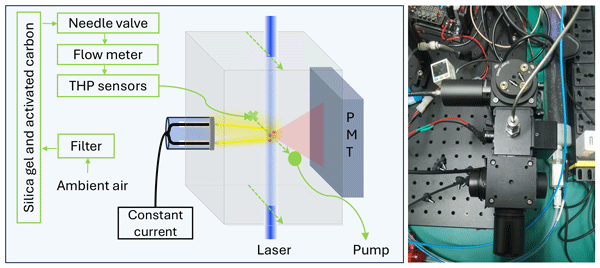
Abstract. The hydroxyl radical (OH) plays a central role in atmospheric chemistry, however, its accurate measurement by laser induced fluorescence with gas expansion (LIF-FAGE) is unavoidably compromised by wavelength drift of the excitation laser. To overcome this limitation, a real time reference system for active wavelength locking has been developed and systematically characterized in this work. Stable, and high concentration OH radicals were generated through thermocatalytic decomposition of ambient air on a heated filament within a low pressure cell. The excitation source was a 308 nm laser produced by frequency doubling the output of a DCM-ethanol dye laser pumped by an Nd:YAG laser. The induced fluorescence was monitored in real time using a non-gated photomultiplier tube (PMT). The wavelength locking program, implemented with a closed loop feedback mechanism, dynamically adjusted the laser wavelength to the optimal OH excitation line. Through comprehensive characterization of the key parameters, including laser power, filament operating conditions (current, voltage), and cell environment (pressure/inlet flow rate, inlet gas relative humidity), an optimal operational window of the reference system has been identified. A 12-hour continuous measurement demonstrated high system stability in OH generation and detection, the observed fluorescence intensity showed a low drift rate of 0.2% per hour during the first nine hours. The good robustness of the reference system, and its integrated wavelength locking program, enable long term and accurate ambient OH radical quantification in LIF-FAGE measurements.
Competing interests: At least one of the (co-)authors is a member of the editorial board of Atmospheric Measurement Techniques.
Publisher's note: Copernicus Publications remains neutral with regard to jurisdictional claims made in the text, published maps, institutional affiliations, or any other geographical representation in this paper. While Copernicus Publications makes every effort to include appropriate place names, the final responsibility lies with the authors. Views expressed in the text are those of the authors and do not necessarily reflect the views of the publisher.-
Notice on discussion status
The requested preprint has a corresponding peer-reviewed final revised paper. You are encouraged to refer to the final revised version.
-
Preprint
(1106 KB)
-
The requested preprint has a corresponding peer-reviewed final revised paper. You are encouraged to refer to the final revised version.
- Preprint
(1106 KB) - Metadata XML
- BibTeX
- EndNote
- Final revised paper


Journal article(s) based on this preprint
Interactive discussion
Status: closed
-
RC1: 'Comment on egusphere-2025-6252', Anonymous Referee #1, 20 Jan 2026
-
AC1: 'Reply on RC1', Keding Lu, 05 Mar 2026
The comment was uploaded in the form of a supplement: https://egusphere.copernicus.org/preprints/2025/egusphere-2025-6252/egusphere-2025-6252-AC1-supplement.pdf
-
AC1: 'Reply on RC1', Keding Lu, 05 Mar 2026
-
RC2: 'Comment on egusphere-2025-6252', Anonymous Referee #2, 04 Feb 2026
The manuscript by Chen et al. describes a systematically developed and characterized reference system designed for active wavelength locking in LIF-FAGE instrument. Given that laser wavelength stability is a critical prerequisite for accurate OH radical quantification, this work addresses a significant technical challenge in atmospheric spectroscopy. The authors provide a comprehensive characterization of the thermolysis OH source and demonstrate an impressive stability of 0.2% drift per hour over an extended period. The technical approach is sound, and the results are presented with high clarity. The identification of an "optimal operational window" provides a valuable framework for the community. I recommend publication after the following technical and linguistic points are addressed.
General comments:
1. The authors implement a wavelength locking program that triggers a re-scan once the net signal falls below 95% of the peak intensity. However, the 12-hour stability assessment reveals a systematic decay (1.1% per hour) in the final 3 hours that did not trigger the threshold. This implies that a 5% threshold may be too coarse for high-precision atmospheric measurements. The authors should discuss whether a dual-track strategy—combining amplitude-based triggers with periodic timed re-scans—would further enhance the system’s reliability.
2. In Section 1, only a brief comparison with the AIOFM reference system (282 nm excitation) is provided. It is suggested to add comparative data on key performance indicators (e.g., wavelength locking speed, signal stability, detection limit) with other similar reference systems using 308 nm excitation (if any), to more comprehensively highlight the advantages of the proposed system.
3. In Section 2.1.2, it is stated that dissociation into oxygen atoms is a non-negligible pathway for OH production. While the Harvard group’s findings are cited, the manuscript would benefit from a more precise discussion of the filament temperature regime. Specifically, is the Fe/Cr/Al/Ni alloy surface temperature sufficient to drive molecular dissociation via thermolysis, or is the catalytic effect of iron the dominant driver?
4. In Figure 6(a), the linear relationship of inlet flow rate and pressure is presented on a logarithmic scale, which is counterintuitive. It is suggested to supplement a flow rate-pressure relationship graph on the original scale to facilitate readers' intuitive understanding of pressure changes in different flow rate ranges.
5. Increasing the filament power will accelerate filament aging, but the manuscript does not provide data on the service life of the filament (e.g., continuous operation time under the optimal operating current, number of uses when the signal attenuates to the threshold, etc.). It is suggested to supplement filament lifespan test experiments to provide reference for the long-term maintenance and practical application of the system.
6. The results in Figure 8 indicate an optimal OH signal at ~74% RH. Yet, for operational stability, the authors chose 30%–40% RH to prevent electronic aging. This is a pragmatic engineering decision but the authors should clarify if further hardware isolation (e.g., improved sealing of the reference cell channels) could allow for higher RH and thus a better Signal-to-Noise Ratio. Is the red line a polynomial fit of the measurement results? What does it mean?
7. The reasons for the fluctuations in the signal data in Figure 9 are not detailed. It is recommended to add possible factors for short-term fluctuations (e.g., laser pulse stability, minor environmental disturbances) in the figure caption.
Minor comments:
1.The term "air-conditioned box" is somewhat colloquial. I suggest replacing it with a more technical term such as "thermostated enclosure" or "temperature-controlled housing".
2. Throughout the text, the word "Therefore" is used with high frequency (e.g., Line 175-176). Utilizing alternatives such as "Accordingly" or "Hence" would improve the flow of the manuscript.
3. Please ensure consistent use of units for laser power normalization. Both "kcounts s⁻¹ mW⁻¹" and "counts s⁻¹ mW⁻¹" are present.
Citation: https://doi.org/10.5194/egusphere-2025-6252-RC2 -
AC2: 'Reply on RC2', Keding Lu, 05 Mar 2026
The comment was uploaded in the form of a supplement: https://egusphere.copernicus.org/preprints/2025/egusphere-2025-6252/egusphere-2025-6252-AC2-supplement.pdf
-
AC2: 'Reply on RC2', Keding Lu, 05 Mar 2026
Peer review completion


Interactive discussion
Status: closed
-
RC1: 'Comment on egusphere-2025-6252', Anonymous Referee #1, 20 Jan 2026
The hydroxyl (OH) radical is the pivotal oxidant in the atmosphere, its accurate measurement is essential for understanding atmospheric oxidation capacity, and thus air quality, and climate change. However, the accuracy of OH measurements using the laser-induced fluorescence (LIF) technique is unavoidably compromised by wavelength drift of the excitation laser. Therefore, a reference system capable of monitoring the laser output wavelength and actively locking it to the optimal OH excitation line is crucial for long-term, reliable measurements. In this manuscript, Chen et al. develop a compact real-time reference system for wavelength locking in LIF-FAGE measurements. Through comprehensive characterization of key parameters, an optimal operational window for stable and high-concentration OH generation and detection is identified. The system's high stability is convincingly demonstrated by continuous measurements over 12 hours, with exceptionally low drift (0.2% per hour) during the first 9 hours. The detailed description of this system will be valuable for other researchers aiming to implement wavelength-locking techniques to improve the stability of their measurement systems. Overall, I recommend its publication after considering the following minor comments:
- In lines 74-75, it mentioned that the AIOFM group used a 282 nm laser as excitation laser, I know that they have updated the excitation laser to 308 nm, please see this paper (Wang et al., "Development of a field system for measurement of tropospheric OH radical using laser-induced fluorescence technique".) for detail information, and add the corresponding updated description to the main text.
- In lines 292-293, it says that, during the 12-hour test, the signal attenuation never exceeded the threshold to trigger the wavelength re-locking program. For a complete performance evaluation, it would be informative to know if and how the system performs when a drift event does trigger the full corrective sequence (wavelength scan and re-lock). Could the authors comment on this? Have they tested the system's response to induced, larger wavelength drifts?
- In lines 296-298, the suggestion to normalize ambient OH data against the concurrent reference cell signal during wavelength drift should be treated with caution. The physical conditions (e.g., temperature, pressure) inside the reference cell and the ambient sampling cell are different. These differences can lead to slight variations in the OH excitation spectrum. Consequently, the rate of signal attenuation due to laser wavelength drift may not be identical in both cells. Using the reference signal for direct normalization without carefully characterizing and correcting for this potential discrepancy could introduce additional error. Therefore, I recommend either removing this statement or significantly qualifying it with a discussion of the necessary corrections and associated uncertainties.
- In Figure 4, there is a typographical error in the labeling of the OH excitation spectrum. The last characteristic peak within the red frame should be P1(1), not P1(3).
- In Figure 4, an offset appears between the two OH excitation spectral lines, causing them to fail to correspond precisely. What might account for this phenomenon?
- In Section 3.2, the author did not specify the exact installation location of the THP sensor. Additionally, the filament's position and temperature were not considered in the author's experimental conditions. Would the filament's temperature rise during heating interfere with the humidity measurement results shown in Figure 8?
Citation: https://doi.org/10.5194/egusphere-2025-6252-RC1 -
AC1: 'Reply on RC1', Keding Lu, 05 Mar 2026
The comment was uploaded in the form of a supplement: https://egusphere.copernicus.org/preprints/2025/egusphere-2025-6252/egusphere-2025-6252-AC1-supplement.pdf
-
RC2: 'Comment on egusphere-2025-6252', Anonymous Referee #2, 04 Feb 2026
The manuscript by Chen et al. describes a systematically developed and characterized reference system designed for active wavelength locking in LIF-FAGE instrument. Given that laser wavelength stability is a critical prerequisite for accurate OH radical quantification, this work addresses a significant technical challenge in atmospheric spectroscopy. The authors provide a comprehensive characterization of the thermolysis OH source and demonstrate an impressive stability of 0.2% drift per hour over an extended period. The technical approach is sound, and the results are presented with high clarity. The identification of an "optimal operational window" provides a valuable framework for the community. I recommend publication after the following technical and linguistic points are addressed.
General comments:
1. The authors implement a wavelength locking program that triggers a re-scan once the net signal falls below 95% of the peak intensity. However, the 12-hour stability assessment reveals a systematic decay (1.1% per hour) in the final 3 hours that did not trigger the threshold. This implies that a 5% threshold may be too coarse for high-precision atmospheric measurements. The authors should discuss whether a dual-track strategy—combining amplitude-based triggers with periodic timed re-scans—would further enhance the system’s reliability.
2. In Section 1, only a brief comparison with the AIOFM reference system (282 nm excitation) is provided. It is suggested to add comparative data on key performance indicators (e.g., wavelength locking speed, signal stability, detection limit) with other similar reference systems using 308 nm excitation (if any), to more comprehensively highlight the advantages of the proposed system.
3. In Section 2.1.2, it is stated that dissociation into oxygen atoms is a non-negligible pathway for OH production. While the Harvard group’s findings are cited, the manuscript would benefit from a more precise discussion of the filament temperature regime. Specifically, is the Fe/Cr/Al/Ni alloy surface temperature sufficient to drive molecular dissociation via thermolysis, or is the catalytic effect of iron the dominant driver?
4. In Figure 6(a), the linear relationship of inlet flow rate and pressure is presented on a logarithmic scale, which is counterintuitive. It is suggested to supplement a flow rate-pressure relationship graph on the original scale to facilitate readers' intuitive understanding of pressure changes in different flow rate ranges.
5. Increasing the filament power will accelerate filament aging, but the manuscript does not provide data on the service life of the filament (e.g., continuous operation time under the optimal operating current, number of uses when the signal attenuates to the threshold, etc.). It is suggested to supplement filament lifespan test experiments to provide reference for the long-term maintenance and practical application of the system.
6. The results in Figure 8 indicate an optimal OH signal at ~74% RH. Yet, for operational stability, the authors chose 30%–40% RH to prevent electronic aging. This is a pragmatic engineering decision but the authors should clarify if further hardware isolation (e.g., improved sealing of the reference cell channels) could allow for higher RH and thus a better Signal-to-Noise Ratio. Is the red line a polynomial fit of the measurement results? What does it mean?
7. The reasons for the fluctuations in the signal data in Figure 9 are not detailed. It is recommended to add possible factors for short-term fluctuations (e.g., laser pulse stability, minor environmental disturbances) in the figure caption.
Minor comments:
1.The term "air-conditioned box" is somewhat colloquial. I suggest replacing it with a more technical term such as "thermostated enclosure" or "temperature-controlled housing".
2. Throughout the text, the word "Therefore" is used with high frequency (e.g., Line 175-176). Utilizing alternatives such as "Accordingly" or "Hence" would improve the flow of the manuscript.
3. Please ensure consistent use of units for laser power normalization. Both "kcounts s⁻¹ mW⁻¹" and "counts s⁻¹ mW⁻¹" are present.
Citation: https://doi.org/10.5194/egusphere-2025-6252-RC2 -
AC2: 'Reply on RC2', Keding Lu, 05 Mar 2026
The comment was uploaded in the form of a supplement: https://egusphere.copernicus.org/preprints/2025/egusphere-2025-6252/egusphere-2025-6252-AC2-supplement.pdf
-
AC2: 'Reply on RC2', Keding Lu, 05 Mar 2026
Peer review completion
Journal article(s) based on this preprint
Viewed
| HTML | XML | Total | BibTeX | EndNote | |
|---|---|---|---|---|---|
| 1,607 | 647 | 186 | 2,440 | 290 | 289 |
- HTML: 1,607
- PDF: 647
- XML: 186
- Total: 2,440
- BibTeX: 290
- EndNote: 289
Viewed (geographical distribution)
| Country | # | Views | % |
|---|
| Total: | 0 |
| HTML: | 0 |
| PDF: | 0 |
| XML: | 0 |
- 1
Shiyi Chen
Cuihong Zhang

Yihui Wang
Xuefei Ma
Zhaofeng Tan
Limin Zeng
Yuanhang Zhang
The requested preprint has a corresponding peer-reviewed final revised paper. You are encouraged to refer to the final revised version.
- Preprint
(1106 KB) - Metadata XML
The hydroxyl (OH) radical is the pivotal oxidant in the atmosphere, its accurate measurement is essential for understanding atmospheric oxidation capacity, and thus air quality, and climate change. However, the accuracy of OH measurements using the laser-induced fluorescence (LIF) technique is unavoidably compromised by wavelength drift of the excitation laser. Therefore, a reference system capable of monitoring the laser output wavelength and actively locking it to the optimal OH excitation line is crucial for long-term, reliable measurements. In this manuscript, Chen et al. develop a compact real-time reference system for wavelength locking in LIF-FAGE measurements. Through comprehensive characterization of key parameters, an optimal operational window for stable and high-concentration OH generation and detection is identified. The system's high stability is convincingly demonstrated by continuous measurements over 12 hours, with exceptionally low drift (0.2% per hour) during the first 9 hours. The detailed description of this system will be valuable for other researchers aiming to implement wavelength-locking techniques to improve the stability of their measurement systems. Overall, I recommend its publication after considering the following minor comments: