
the Creative Commons Attribution 4.0 License.
the Creative Commons Attribution 4.0 License.
 | 28 Dec 2025
Projected elevation-dependent warming in the Alps depicted with surface energy balance trends
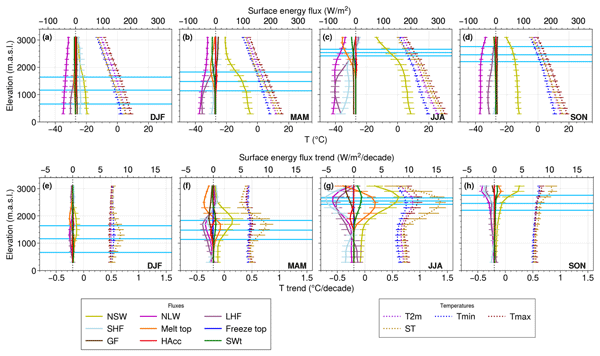
Abstract. Because of topography, climate change exhibits complex regional imprints in the Alps. This study aims at understanding the processes that link elevation-dependent warming (EDW) at seasonal scale in the Alps to the surface energy balance. We investigate projected EDW patterns in the Alps using 7-km resolution simulations spanning the period 1961–2100 made with the Modèle Atmosphérique Régional (MAR), exploring scenarios SSP2-4.5 and SSP5-8.5 and driven by two general circulation models, EC-Earth3 and MPI-ESM1-2-HR. We find a larger yearly warming signal at high elevations (1.2 to 1.5 °C/°C of global warming) than at low elevations (1.1 to 1.3 °C/°C of global warming), with contrasted seasonal patterns and intensities (up to 2 °C/°C of global warming at high elevations in summer). EDW signals are found to be different near the surface than in the free atmosphere, with a maximum signal in the former that is migrating to higher elevations through the seasons, linked to the snowline migration. Investigating surface energy balance trends reveals a link between the profiles of EDW and those of net shortwave radiation and energy used to melt snow. The snow-albedo feedback linked to the net shortwave radiation trend is found to be responsible for two thirds of the impact of the snowline on warming, while snow melt accounts for the last third. Melting limits the warming at high elevation when snow is persisting. We suggest that snow melting is an important driver of EDW that should be considered in any EDW-snow investigations.
-
Notice on discussion status
The requested preprint has a corresponding peer-reviewed final revised paper. You are encouraged to refer to the final revised version.
-
Preprint
(4585 KB)
-
The requested preprint has a corresponding peer-reviewed final revised paper. You are encouraged to refer to the final revised version.
- Preprint
(4585 KB) - Metadata XML
- BibTeX
- EndNote
- Final revised paper


Journal article(s) based on this preprint
Interactive discussion
Status: closed
-
RC1: 'Comment on egusphere-2025-6211', Anonymous Referee #1, 04 Feb 2026
- AC1: 'Reply on RC1', Ian Castellanos, 21 Mar 2026
-
RC2: 'Comment on egusphere-2025-6211', Anonymous Referee #2, 15 Feb 2026
General comments
The paper by Castellanos et al. is very interesting both because it presents a study on EDW and its drivers using a high-resolution Regional Climate Model and because it compares surface warming rates with warming rates in the free atmosphere. The paper deserves publication after some - mainly minor - points, listed below, are addressed.
Major comments:
One drawback of the study is the small model ensemble which is employed, in particular the limit of using only two GCMs to drive the (two versions of the) RCM. Though the GCM selection has been explained by the authors (and though the explanation provided at lines 590-596) the limit of using a small ensemble persists. Moreover, the analysis of the drivers (through the energy balance) is performed using only one MAR simulation (MARv3.14).
Another question that came to my mind is whether there is quantifiable added value of the 7-km MAR simulations compared to the Euro-CORDEX ones, considering only their resolution. These are, of course, very different experiments, but the difference of resolution is not that huge.
Minor comments:
- Line 17: The word topograhy here is used to indicate the overall shape and physical features of the land surface, including slope, aspect, roughness, together with elevation, correct?
- Line 39: Placing this sentence “Mountain regions are hotspots of biodiversity thanks to their often unique ecosystems which are vulnerable to rapid climate change (Rahbek et al., 2019)” at the very beginning of the paper seems to suggest that biodiversity will be a focus, whereas the focus is on something else. Of course, the sentence is correct; it just seems a bit unusual to begin this paper by emphasizing biodiversity, at least to me.
- Line 49: “Elevation-dependent warming” “Elevation-Dependent Warming”
- Line 60: EDW has been investigated in more mountainous areas than those reported in the list, such as in the Andes and in the Rockies. I suggest including studies on those key mountains too.
- Line 71: Change “points” with “point”
- Line 76: Some thoughts on the sentence “and model grid resolutions that are coarse with respect to the orography on the other hand.” I think that the model resolution can be coarse also with respect to the extent of the GAR, besides the complex orography.
- Line 85: “ensuring a better representation of the topography and the mountain climate.” Not only RCMs allow a greater detail of local forcings, such as topography, but also an explicit representation of a larger number of processes, given the higher resolution.
- Line 96: what does “comprehensive” mean in this sentence?
- Line 104: “associated with scenarios SSP2-4.5 and SSP5-8.5 from 1961 to 2100”: of course, the scenarios apply only to the period 2015-2100.
- Lines 195-201: There is a comment on a previous paper (Beaumet et al. 2021) which used MAR simulations and found biases in temperature and snow cover in the Alps when comparing to gridded observational datasets, reanalyses and in-situ observations. Are those MAR simulations similar to those employed in the present study? What is the magnitude of the cited biases?
- Lines 214-217: “The biases provided here are an estimation, since observational datasets over the Alps also have large uncertainties, due in particular to the inherent missing values in such products (Prein and Gobiet, 2017 ; Kotlarski et al., 2019 ; Matiu et al., 2024) that are not discussed in this article.” this is an issue shared by most (maybe all) mountain areas
- Line 223: please replace “topography” with “orography” in the caption of Fig. 1
- Line 254: Can you explain the choice of 360 m as the lower elevation limit for the Alps selection?
- Line 256-257: are the selected 200-m bins composed of a coherent/similar number of pixels? Can you provide any indications about that?
- Line 285: “The first criteria gives … ” change with “The first criterion gives …”; the same at line 286
- Line 300 (and caption of Fig. 2): are the yearly and seasonal warmings shown in the Figure an average of the three v3.10 MAR simulations?
- Line 318: Change “its” with “the”
- Lines 340-343: Are there any hypotheses on the different behaviour between historical profiles and projected profiles seen in in summer and autumn for the MAR-MPI SSP2 simulation (Figs. 3g and 3h) compared to all other cases?
- Line 554: in the sentence “both a historical and projection periods” remove the “a”
- Line 555: the authors use the word “topography” here. Do they mean topography or orography? Because the paper does not discuss all topographic elements, but just elevation.
- Line 641: please replace “elevated” with “high-elevation”
- Line 662: please remove “present” from the sentence
In addition:
- There are many extra spaces before the sign “:”
- The figures presented in the Appendix are not mentioned in the main text and probably they should be (Fig. A1 in particular)
Citation: https://doi.org/10.5194/egusphere-2025-6211-RC2 - AC2: 'Reply on RC2', Ian Castellanos, 21 Mar 2026
Peer review completion


Interactive discussion
Status: closed
-
RC1: 'Comment on egusphere-2025-6211', Anonymous Referee #1, 04 Feb 2026
General comment:
The paper by Castellanos et al., entitled “Projected elevation-dependent warming in the Alps depicted with surface energy balance trends”, is a well-executed study that addresses a research topic of growing interest using robust and appropriate methodological approaches. The study investigates projected EDW in the European Alps using the MAR model, highlighting different warming patterns as a function of elevation at the surface and altitude in the free atmosphere. The results show an enhanced warming signal that progressively shifts toward higher elevations throughout the seasons, in connection with the seasonal migration of the snowline. The authors further investigate the physical processes underlying this EDW pattern, showing that changes in net shortwave radiation and in the energy available for snowmelt play a key role. One notable novelty of this work is the inclusion of an analysis of the free atmosphere in addition to surface processes. I therefore suggest that the authors consider explicitly reflecting this aspect in the title of the manuscript.
Overall, the paper is sound and suitable for publication; however, some major points need to be reconsidered. In particular, some sections would benefit from a more technical and specific treatment in order to strengthen the interpretation of the results and the robustness of the conclusions.
Major comments:
- The abstract is not fully clear to me. In particular, sentences from 25 to 28: when reading the abstract on its own, it is not clear what is meant by maximum. Moreover, the definition of the EDW signal is not explicitly stated. Clarifying these aspects in the abstract would substantially improve its clarity and allow readers to better grasp the main results at first glance.
- Lines 165–169: it would be interesting to better explain why only these three variables were selected to evaluate GCM skill. Did you analyse both means and trends? Additional information would be valuable. I do not think this analysis needs to be included in the main manuscript, but it could be very interesting in the supplementary material or Appendix, with a brief mention in the main text.
- Lines 175–182: Why was this specific ensemble selected instead of considering all possible combinations of GCMs, model versions, and realizations? Including a larger number of members could provide additional insight into model variability. Or perhaps I missed some important information?
- Lines 202–217: in addition to analysing spatial biases, it would be very useful to examine the annual cycle of the three analysed variables. As stated by the authors, biases arise not only from models but also from observational limitations at high elevations. Since the main goal is to assess whether models capture the dominant climate features, including the annual cycle would strengthen the analysis.
- Lines 252–255: did the autors perform a sensitivity analysis before selecting these threshold values? Why did you adopt such a strict rule for pixel selection? I suggest including in the Appendix or in the Supplementary:
1) a map showing all selected pixels;
2) a table with the number of pixels per elevation band.
In my opinion, these elements would be very helpful for understanding the results.
- Lines 301–304 and Figure 2: I suggest using elevation isolines instead of national borders. Since the analysis focuses on elevation, the current representation may be difficult to interpret without detailed regional knowledge.
- Figure 3: it is not clear which brown line corresponds to the dashed and which to the solid representation. I suggest considering an alternative visualization (e.g., shaded bands instead of error bars?), which could improve readability. In addition, it may be worth evaluating whether to include daily surface temperature in this figure to provide a more complete picture, even though it is already shown in Figure 4.
- Lines 478-491: This paragraph, in my opinion, needs to be reconsidered and clarified for several reasons. First, the description of the results related to the “spatially averaged” trends is unclear to me. The manuscript refers to spatially averaged trends of the snowmelt energy flux and net shortwave radiation, but then reports maximum and minimum values without clearly specifying the dimension over which these extrema are computed. This ambiguity makes it difficult to properly interpret the magnitude and meaning of the reported trends, as well as the subsequent comparison between net shortwave radiation and snowmelt energy flux. The second comment mainly concerns the method used to infer the causes of the EDW pattern. The approach adopted to isolate the effect of the snowline by subtracting low-elevation trends from the elevation-dependent signals is conceptually reasonable and provides useful insight into the role of snow-related processes. However, this method relies on the assumption that trends at low elevations represent a warming signal that is independent of elevation and unaffected by snow-related feedbacks. As a consequence, subtracting low-elevation trends may not fully isolate the snowline effect, but rather provide a first-order proxy of snow-related contributions. The authors are therefore encouraged to clarify the assumptions underlying this approach and to explicitly discuss its limitations. Moreover, I would be very cautious in stating that these variables are the causes of the observed changes, as many other factors are not considered (as the authors describe in the discussion). Throughout the manuscript, it would be more appropriate to describe these variables as one of the possible contributors to the observed changes.
- Lines 598-606: In my opinion, these aspects should not be considered true limitations of the study, as the authors intentionally adopt a sort of idealized experimental framework that does not account for several additional environmental changes. These simulations appear to adequately represent the climate of the domain while deliberately focusing on a limited set of processes and changes. Such changes do have an impact; however, as the authors themselves note, further work would be required to explicitly include these processes and assess their influence. I recommend that the authors reconsider and reformulate this paragraph.
- Figure B1: I suggest using white for the sea instead of the current color, as it may otherwise be confused with the colorbar.
Minor comments:
- From the beginning of the manuscript, whenever referring to topography, it would be preferable to use “elevation” rather than “altitude”, which is more commonly used in atmospheric contexts (e.g., lines 409–410).
- Line 42: climate changes → climate change
- Line 49: Elevation-dependent warming → Elevation-Dependent Warming
- Line 98: please define the acronym ERA-20C and cite the reference https://doi.org/10.1175/JCLI-D-15-0556.1
- Line 103: instead of stronger, I would suggest strong, unless a direct comparison is being made.
- Lines 142: I would avoid breaking the sentence into a new line.
- Lines 272–276: if I understand correctly, the lowest 10% and the highest 0.3% of elevations are excluded in order to focus on maximum warming at intermediate elevations, consistent with the definition of EDW. However, this choice excludes possible monotonic elevation trends. To be precise, it should be clearly stated that this study only considers elevation-dependent trends that exhibit intermediate-elevation maxima.
- Line 282: remove the extra space before “:”.
- Line 318: remove the extra space before “:”.
- Line 335: the temperature trend 2 meters → the temperature trend at 2 meters
- Line 579: remove the extra space before “:”.
- Line 616: remove the extra space before “:”.
- Figure A1: this figure needs to be cited in the manuscript.
- Figure B2: please specify clearly in the caption that one panel shows the relative change, while the other shows the absolute change.
Citation: https://doi.org/10.5194/egusphere-2025-6211-RC1 - AC1: 'Reply on RC1', Ian Castellanos, 21 Mar 2026
-
RC2: 'Comment on egusphere-2025-6211', Anonymous Referee #2, 15 Feb 2026
General comments
The paper by Castellanos et al. is very interesting both because it presents a study on EDW and its drivers using a high-resolution Regional Climate Model and because it compares surface warming rates with warming rates in the free atmosphere. The paper deserves publication after some - mainly minor - points, listed below, are addressed.
Major comments:
One drawback of the study is the small model ensemble which is employed, in particular the limit of using only two GCMs to drive the (two versions of the) RCM. Though the GCM selection has been explained by the authors (and though the explanation provided at lines 590-596) the limit of using a small ensemble persists. Moreover, the analysis of the drivers (through the energy balance) is performed using only one MAR simulation (MARv3.14).
Another question that came to my mind is whether there is quantifiable added value of the 7-km MAR simulations compared to the Euro-CORDEX ones, considering only their resolution. These are, of course, very different experiments, but the difference of resolution is not that huge.
Minor comments:
- Line 17: The word topograhy here is used to indicate the overall shape and physical features of the land surface, including slope, aspect, roughness, together with elevation, correct?
- Line 39: Placing this sentence “Mountain regions are hotspots of biodiversity thanks to their often unique ecosystems which are vulnerable to rapid climate change (Rahbek et al., 2019)” at the very beginning of the paper seems to suggest that biodiversity will be a focus, whereas the focus is on something else. Of course, the sentence is correct; it just seems a bit unusual to begin this paper by emphasizing biodiversity, at least to me.
- Line 49: “Elevation-dependent warming” “Elevation-Dependent Warming”
- Line 60: EDW has been investigated in more mountainous areas than those reported in the list, such as in the Andes and in the Rockies. I suggest including studies on those key mountains too.
- Line 71: Change “points” with “point”
- Line 76: Some thoughts on the sentence “and model grid resolutions that are coarse with respect to the orography on the other hand.” I think that the model resolution can be coarse also with respect to the extent of the GAR, besides the complex orography.
- Line 85: “ensuring a better representation of the topography and the mountain climate.” Not only RCMs allow a greater detail of local forcings, such as topography, but also an explicit representation of a larger number of processes, given the higher resolution.
- Line 96: what does “comprehensive” mean in this sentence?
- Line 104: “associated with scenarios SSP2-4.5 and SSP5-8.5 from 1961 to 2100”: of course, the scenarios apply only to the period 2015-2100.
- Lines 195-201: There is a comment on a previous paper (Beaumet et al. 2021) which used MAR simulations and found biases in temperature and snow cover in the Alps when comparing to gridded observational datasets, reanalyses and in-situ observations. Are those MAR simulations similar to those employed in the present study? What is the magnitude of the cited biases?
- Lines 214-217: “The biases provided here are an estimation, since observational datasets over the Alps also have large uncertainties, due in particular to the inherent missing values in such products (Prein and Gobiet, 2017 ; Kotlarski et al., 2019 ; Matiu et al., 2024) that are not discussed in this article.” this is an issue shared by most (maybe all) mountain areas
- Line 223: please replace “topography” with “orography” in the caption of Fig. 1
- Line 254: Can you explain the choice of 360 m as the lower elevation limit for the Alps selection?
- Line 256-257: are the selected 200-m bins composed of a coherent/similar number of pixels? Can you provide any indications about that?
- Line 285: “The first criteria gives … ” change with “The first criterion gives …”; the same at line 286
- Line 300 (and caption of Fig. 2): are the yearly and seasonal warmings shown in the Figure an average of the three v3.10 MAR simulations?
- Line 318: Change “its” with “the”
- Lines 340-343: Are there any hypotheses on the different behaviour between historical profiles and projected profiles seen in in summer and autumn for the MAR-MPI SSP2 simulation (Figs. 3g and 3h) compared to all other cases?
- Line 554: in the sentence “both a historical and projection periods” remove the “a”
- Line 555: the authors use the word “topography” here. Do they mean topography or orography? Because the paper does not discuss all topographic elements, but just elevation.
- Line 641: please replace “elevated” with “high-elevation”
- Line 662: please remove “present” from the sentence
In addition:
- There are many extra spaces before the sign “:”
- The figures presented in the Appendix are not mentioned in the main text and probably they should be (Fig. A1 in particular)
Citation: https://doi.org/10.5194/egusphere-2025-6211-RC2 - AC2: 'Reply on RC2', Ian Castellanos, 21 Mar 2026
Peer review completion
Journal article(s) based on this preprint
Viewed
| HTML | XML | Total | BibTeX | EndNote | |
|---|---|---|---|---|---|
| 1,795 | 1,275 | 225 | 3,295 | 268 | 292 |
- HTML: 1,795
- PDF: 1,275
- XML: 225
- Total: 3,295
- BibTeX: 268
- EndNote: 292
Viewed (geographical distribution)
| Country | # | Views | % |
|---|
| Total: | 0 |
| HTML: | 0 |
| PDF: | 0 |
| XML: | 0 |
- 1
Ian Castellanos

Martin Ménégoz
Juliette Blanchet
Julien Beaumet
Hubert Gallée
Eduardo Moreno-Chamarro
Chantal Staquet
Xavier Fettweis
The requested preprint has a corresponding peer-reviewed final revised paper. You are encouraged to refer to the final revised version.
- Preprint
(4585 KB) - Metadata XML
General comment:
The paper by Castellanos et al., entitled “Projected elevation-dependent warming in the Alps depicted with surface energy balance trends”, is a well-executed study that addresses a research topic of growing interest using robust and appropriate methodological approaches. The study investigates projected EDW in the European Alps using the MAR model, highlighting different warming patterns as a function of elevation at the surface and altitude in the free atmosphere. The results show an enhanced warming signal that progressively shifts toward higher elevations throughout the seasons, in connection with the seasonal migration of the snowline. The authors further investigate the physical processes underlying this EDW pattern, showing that changes in net shortwave radiation and in the energy available for snowmelt play a key role. One notable novelty of this work is the inclusion of an analysis of the free atmosphere in addition to surface processes. I therefore suggest that the authors consider explicitly reflecting this aspect in the title of the manuscript.
Overall, the paper is sound and suitable for publication; however, some major points need to be reconsidered. In particular, some sections would benefit from a more technical and specific treatment in order to strengthen the interpretation of the results and the robustness of the conclusions.
Major comments:
- The abstract is not fully clear to me. In particular, sentences from 25 to 28: when reading the abstract on its own, it is not clear what is meant by maximum. Moreover, the definition of the EDW signal is not explicitly stated. Clarifying these aspects in the abstract would substantially improve its clarity and allow readers to better grasp the main results at first glance.
- Lines 165–169: it would be interesting to better explain why only these three variables were selected to evaluate GCM skill. Did you analyse both means and trends? Additional information would be valuable. I do not think this analysis needs to be included in the main manuscript, but it could be very interesting in the supplementary material or Appendix, with a brief mention in the main text.
- Lines 175–182: Why was this specific ensemble selected instead of considering all possible combinations of GCMs, model versions, and realizations? Including a larger number of members could provide additional insight into model variability. Or perhaps I missed some important information?
- Lines 202–217: in addition to analysing spatial biases, it would be very useful to examine the annual cycle of the three analysed variables. As stated by the authors, biases arise not only from models but also from observational limitations at high elevations. Since the main goal is to assess whether models capture the dominant climate features, including the annual cycle would strengthen the analysis.
- Lines 252–255: did the autors perform a sensitivity analysis before selecting these threshold values? Why did you adopt such a strict rule for pixel selection? I suggest including in the Appendix or in the Supplementary:
1) a map showing all selected pixels;
2) a table with the number of pixels per elevation band.
In my opinion, these elements would be very helpful for understanding the results.
- Lines 301–304 and Figure 2: I suggest using elevation isolines instead of national borders. Since the analysis focuses on elevation, the current representation may be difficult to interpret without detailed regional knowledge.
- Figure 3: it is not clear which brown line corresponds to the dashed and which to the solid representation. I suggest considering an alternative visualization (e.g., shaded bands instead of error bars?), which could improve readability. In addition, it may be worth evaluating whether to include daily surface temperature in this figure to provide a more complete picture, even though it is already shown in Figure 4.
- Lines 478-491: This paragraph, in my opinion, needs to be reconsidered and clarified for several reasons. First, the description of the results related to the “spatially averaged” trends is unclear to me. The manuscript refers to spatially averaged trends of the snowmelt energy flux and net shortwave radiation, but then reports maximum and minimum values without clearly specifying the dimension over which these extrema are computed. This ambiguity makes it difficult to properly interpret the magnitude and meaning of the reported trends, as well as the subsequent comparison between net shortwave radiation and snowmelt energy flux. The second comment mainly concerns the method used to infer the causes of the EDW pattern. The approach adopted to isolate the effect of the snowline by subtracting low-elevation trends from the elevation-dependent signals is conceptually reasonable and provides useful insight into the role of snow-related processes. However, this method relies on the assumption that trends at low elevations represent a warming signal that is independent of elevation and unaffected by snow-related feedbacks. As a consequence, subtracting low-elevation trends may not fully isolate the snowline effect, but rather provide a first-order proxy of snow-related contributions. The authors are therefore encouraged to clarify the assumptions underlying this approach and to explicitly discuss its limitations. Moreover, I would be very cautious in stating that these variables are the causes of the observed changes, as many other factors are not considered (as the authors describe in the discussion). Throughout the manuscript, it would be more appropriate to describe these variables as one of the possible contributors to the observed changes.
- Lines 598-606: In my opinion, these aspects should not be considered true limitations of the study, as the authors intentionally adopt a sort of idealized experimental framework that does not account for several additional environmental changes. These simulations appear to adequately represent the climate of the domain while deliberately focusing on a limited set of processes and changes. Such changes do have an impact; however, as the authors themselves note, further work would be required to explicitly include these processes and assess their influence. I recommend that the authors reconsider and reformulate this paragraph.
- Figure B1: I suggest using white for the sea instead of the current color, as it may otherwise be confused with the colorbar.
Minor comments:
- From the beginning of the manuscript, whenever referring to topography, it would be preferable to use “elevation” rather than “altitude”, which is more commonly used in atmospheric contexts (e.g., lines 409–410).
- Line 42: climate changes → climate change
- Line 49: Elevation-dependent warming → Elevation-Dependent Warming
- Line 98: please define the acronym ERA-20C and cite the reference https://doi.org/10.1175/JCLI-D-15-0556.1
- Line 103: instead of stronger, I would suggest strong, unless a direct comparison is being made.
- Lines 142: I would avoid breaking the sentence into a new line.
- Lines 272–276: if I understand correctly, the lowest 10% and the highest 0.3% of elevations are excluded in order to focus on maximum warming at intermediate elevations, consistent with the definition of EDW. However, this choice excludes possible monotonic elevation trends. To be precise, it should be clearly stated that this study only considers elevation-dependent trends that exhibit intermediate-elevation maxima.
- Line 282: remove the extra space before “:”.
- Line 318: remove the extra space before “:”.
- Line 335: the temperature trend 2 meters → the temperature trend at 2 meters
- Line 579: remove the extra space before “:”.
- Line 616: remove the extra space before “:”.
- Figure A1: this figure needs to be cited in the manuscript.
- Figure B2: please specify clearly in the caption that one panel shows the relative change, while the other shows the absolute change.