
the Creative Commons Attribution 4.0 License.
the Creative Commons Attribution 4.0 License.
 | 31 Dec 2025
Linking grassland dynamics to snowmelt timing in the Western Pyrenees
Abstract. It is now well established that climate change modifies the snow cover regime in European mountains. However, the impact of snow cover changes on alpine ecosystems is not well understood. In this study, we assess how snowmelt timing affects alpine grassland growth (onset and evolution) in the western Spanish Pyrenees using eight years (2018–2025) of Sentinel-2 imagery at 10 m resolution. We combined satellite-derived snow melt-out dates (SMOD) with NDVI time series, meteorological data, and fractional snow-covered area (fSCA) to evaluate the temporal and spatial relationships between snowmelt timing and vegetation greening. Our results confirm that snowmelt consistently influences the onset of greening and regulates the timing of peak NDVI (annual maximum). However, short-term variations in melt-out timing had limited influence on the intensity of peak NDVI, which was more strongly linked to post-melt meteorological conditions. The spatial pattern of peak NDVI remained stable across years despite variable melt timing. Our observations suggest that site-specific characteristics – such as soil properties, microclimate, and vegetation composition – that can be linked to the long-term legacy of snow presence can exert a stronger influence on productivity than year-to-year snowmelt dynamics.
-
Notice on discussion status
The requested preprint has a corresponding peer-reviewed final revised paper. You are encouraged to refer to the final revised version.
-
Preprint
(1360 KB)
-
The requested preprint has a corresponding peer-reviewed final revised paper. You are encouraged to refer to the final revised version.
- Preprint
(1360 KB) - Metadata XML
- BibTeX
- EndNote
- Final revised paper


Journal article(s) based on this preprint
Interactive discussion
Status: closed
-
RC1: 'Comment on egusphere-2025-6131', Anonymous Referee #1, 09 Feb 2026
-
AC1: 'Reply on RC1', Pablo Domínguez Aguilar, 30 Mar 2026
Dear Reviewer #1,
Thank you for your constructive comments. We appreciate your positive assessment of the methodological framework and have revised the manuscript to address your concerns. Below, we provide a point-by-point response.
General Comments
Excerpt 1:
“One aspect that could be further addressed concerns the use of the Sentinel 2 L2A surface reflectance product in a topographically complex environment. While L2A products are atmospherically corrected and include a topographic correction component through the Sen2Cor algorithm, several studies have shown that residual topographic effects may persist in mountainous terrain, particularly when the DEM resolution used for correction does not match the sensor spatial resolution. In this context, I do not question the suitability of L2A data itself, which is widely used in alpine studies, but I suggest that the potential influence of residual topographic effects on spectral indices such as NDVI and NDSI should be explicitly discussed. These effects could locally influence snow detection and phenological metrics in steep terrain. A brief discussion of this limitation and its potential impact on the results would strengthen the methodological and discussion sections.Related to this point, cloud shadow and terrain-induced illumination effects may also represent an additional source of uncertainty in the analysis and are not sufficiently addressed in the current discussion. Given the complex orography of the study area, acknowledging these effects and their potential influence on the derived time series would improve the robustness of the interpretation.”
Response:
We thank the reviewer for this insightful comment. We agree that terrain-induced illumination effects can increase uncertainty in topographically complex areas. To assess their influence, we computed shadow presence for three representative dates (February 1, June 20, and September 30) and calculated the percentage of affected vegetation pixels, excluding bare soil and water surfaces. Most shadows occurred in these masked-out areas, and the proportion of shadow-affected vegetation ranged from 12.5% in February to 0.3% in June and 2.8% in September. This analysis has been added to the revised manuscript to provide additional context for interpreting spectral indices in our study area.Excerpt 2:
“Another potential limitation is the relatively short temporal period considered in this study… The lack of cloud-free images is another relevant limitation, particularly given the extended temporal gaps without valid spectral information. Other satellite-derived products could potentially improve the temporal resolution, even if this requires a reduction in spatial resolution.”Response:
We acknowledge the potential limitations related to the short study period and cloud gaps. While other satellite datasets could have improved temporal coverage, they would require sacrificing the high spatial resolution that is central to our study objectives. Therefore, we focused on Sentinel-2 L2A data, which provide the highest spatial resolution for accurately identifying snow melt-out dates. These limitations are now discussed in the revised manuscript, and further details are provided in the specific comments below.Excerpt 3:
“Finally, I suggest considering the inclusion of an additional figure, such as a methodological flowchart, illustrating the main data-processing steps. A visual summary of the SMOD calculation, cloud filtering procedures, and spatial masking would improve clarity and help readers better understand the overall workflow.”Response:
We appreciate this helpful suggestion. A new Figure 2 has been included in the Methods section to provide a clear visual summary of the data-processing workflow, including SMOD calculation, cloud filtering, and spatial masking, improving the overall clarity of the methodology.Specific Comments
Comment 1 (Line 50):
“I think that SAR-based approaches should be mentioned in the background as an alternative for detecting snow-covered areas. Was Sentinel-1 considered in this study? Cross-polarization channels can be useful for snow detection and could help mitigate the cloud-cover limitation.”Response:
We thank the reviewer for this suggestion. While SAR-based approaches, including Sentinel-1, can provide cloud-independent snow observations, they were not used for several reasons. Snow backscatter in alpine terrain can vary extensively depending on snow properties and melting status, and phase-based approaches can be unreliable in areas affected by extreme incidence angles, shadows, layovers, and tree cover. Improving SAR signal quality through multilooking or filtering would increase the pixel size to >40 m, reducing spatial detail. In contrast, our framework exploits Sentinel-2 L2A optical data to directly compute spectral snow indices (e.g., NDSI) at high spatial resolution, optimized for detecting snow melt-out dates. For completeness, a brief mention of SAR-based alternatives has been added to the Introduction.Comment 2 (Line 90):
“The period 2018–2025 is selected for the Sentinel-2 analysis. I assume this choice is related to the availability of a complete annual coverage of the Sentinel-2 GEE product since 2018. This could be stated more explicitly.”Response:
We selected the period 2018–2025 to ensure complete annual coverage of Sentinel-2 data, providing consistent temporal resolution for the analysis. The text has been revised to make this selection explicit.Comment 3 (Line 101-102):
“Cloud shadows are mentioned as being considered in the calculation of spectral indices, but the filtering process is not described in detail. This is particularly important in mountainous regions with complex topography and frequent cloud occurrence.”Response:
Images with more than 10% cloud coverage were excluded from the NDVI analysis. No additional alteration of the images was performed, as the remaining cloud cover was unlikely to substantially impact zonal NDVI statistics.Comment 4 (Line 112):
“this criterion may introduce a bias related to altitude, since high-elevation areas likely have fewer valid acquisitions than lower areas at the pixel level. This potential bias is not mentioned in the text. Are any strategies applied to mitigate this effect?”Response:
We acknowledge this potential source of uncertainty. High-elevation areas contain relatively few vegetation pixels due to topography, with most vegetated areas between 1600 and 2200 m asl. Therefore, the impact on our results is likely limited. This limitation is now mentioned in the revised manuscript.Comment 5 (Lines 114–115):
“obtaining valid satellite observations in mountain regions is challenging. I find the second SMOD rule/threshold to be a reasonable criterion. It could be informative to report, in the results, the number or percentage of pixels classified using each criterion, to better assess the variability of this parameter. This could be included in Table 2 or, in the Supplementary Information.”Response:
We carried out this analysis and included the results in Table 2. In 6 of 8 years, more than 50% of pixels were classified using the main algorithm. Only 2022 and 2023 were slightly lower (~50%). No significant relationship was found between the percentage of classified pixels and the number of valid images (r = 0.11, p = 0.79) in our 8-year collection.Comment 6 (Line 126):
“in my experience, surface reflectance products (L2A) may still be affected by topography, particularly in complex mountainous areas such as the one studied here, even when processed with Sen2Cor. This statement would benefit from additional nuance and supporting references. You may consider citing studies that evaluate the direct use of L2A products versus additional topographic correction using high-resolution DEMs (see more details in general comments)”Response:
As noted in response to General Comment 1, shadow maps were computed for representative dates. Early-season shadows were higher than 10%, but during the main growing season, shadows affected less than 3% of vegetated pixels. We consider this acceptable for zonal statistics, and the text now reflects this discussion.Comment 7 (Line 182):
“more detailed information about the outlier observed in 2019 would be helpful. It would also be useful to indicate whether this effect is visible in any of the figures.”Response:
The early 2019 observations coincided with a period of unusually frequent clear-sky images while snow was still widespread (February). This did not materially influence NDVI or SMOD results, and no further analysis was necessary. This clarification has been added to the manuscript.Comment 8 (Line 193):
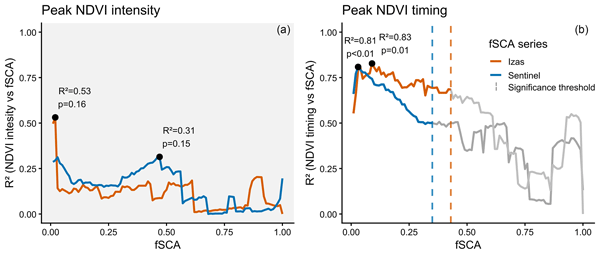
“I find Figure 3 very informative. In Fig. 3b, I suggest adding vertical dashed lines (or a similar visual indicator) to mark the fSCA ranges where p-values are below 0.05 for each dataset (Izas and Sentinel-2). This would improve the visualization of statistical significance.”Response:
This suggestion has been implemented in Figure 3b to improve visualization of statistical significance.Comment 9 (Line 196):
“Figure 4 seems to suggest an analysis of contrasting cases in melt-out timing and vegetation development. In its current form, this interpretation is implicit. A clearer explanation in the text would help guide the reader.”Response:
The text accompanying Figure 4 has been revised to make interpretations of contrasting melt-out timing explicit.Comment 10 (Line 212):
“Does the spatial extent considered in the analysis depend solely on the applied masks, or are there additional spatial constraints? Clarification would be useful.”Response:
The analysis is constrained only by masks for bare soil and water surfaces. Variation in SMOD extent is primarily driven by annual snowpack evolution. The manuscript text has been updated for clarity.Comment 11 (Line 244):
“Long-term satellite products such as Landsat provide continuous data over several decades. Applying the proposed framework to such datasets could help extend the temporal scope of the analysis. Was the Landsat series considered in this study?”Response:
Thanks for the suggestion. Yes, these datasets were considered but quickly discarded, as the longer revisit time of this mission combined with the already observed cloud-presence issue would render this kind of analysis not viable. The discussion in the revised manuscript has been updated to mention the trade-offs with long-term satellite missions, either in reduced temporal or spatial resolution.Comment 12 (Line 259):
“When referring to an “ecological filter,” is it implied that vegetation types and plant performance reflect long-term adaptation to mountain environmental conditions? Clarifying this interpretation would be helpful.”Response:
We clarify that the ecological filter reflects long-term adaptation of vegetation types to mountain environmental conditions. The revised text now explicitly states this.Comment 13 (Line 269):
“Have you considered using the HLS product to improve temporal resolution, acknowledging that this would require reducing spatial resolution from 10 to 30 m?”Response:
As discussed in Specific Comment 11, products like HLS were considered but would reduce spatial resolution from 10 m to 30 m. Our main goal was to exploit the highest spatial resolution available, prioritizing fine-scale snow melt-out detection over temporal coverage. This rationale is now explained in the manuscript.Technical corrections
We thank the reviewer for noting these issues. The suggested citation corrections in lines 37 and 39 have been implemented in the revised manuscript.
Citation: https://doi.org/10.5194/egusphere-2025-6131-AC1
-
AC1: 'Reply on RC1', Pablo Domínguez Aguilar, 30 Mar 2026
-
RC2: 'Comment on egusphere-2025-6131', Anonymous Referee #2, 27 Feb 2026
Using eight years (2018–2025) of 10 m Sentinel-2 imagery over ~77 km² of alpine grasslands in the western Spanish Pyrenees, the paper derives pixel-wise snow melt-out dates (from NDSI-based snow maps) and NDVI phenology metrics, and tests how snowmelt timing (also evaluated via fractional snow-covered area thresholds, including a time-lapse camera catchment) controls green-up and peak-season vegetation dynamics. One of the main results of the paper is to show that while snowmelt necessarily exert a strong phenological constraint on growing season, the maximum productivity is dominated by after-melt climate and persistent site controls. Snowmelt controls over growing season start and duration is well established and has been demonstrated repeatedly using satellite remote sensing. What’s interesting here is to decipher the effect of snowmelt and after-melt conditions on maximum productivity. The authors should put more emphasis on this in the paper title. Currently, the title is very general while it should clearly state the novelty. I think this paper is very well written and that the analysis are well structured and described and should be published as it is.
Citation: https://doi.org/10.5194/egusphere-2025-6131-RC2 -
AC2: 'Reply on RC2', Pablo Domínguez Aguilar, 30 Mar 2026
Dear Reviewer,
We thank you for the positive assessment of our work and for highlighting the main contribution of the study. We have considered your suggestion to revise the title in order to better emphasize the novelty of disentangling the effects of snowmelt timing and post-melt conditions on peak productivity.
Following your recommendation, we have modified the title accordingly. The new title reads:
“Snowmelt timing constrains green-up but not peak productivity in alpine grasslands of the western Pyrenees.”Citation: https://doi.org/10.5194/egusphere-2025-6131-AC2
-
AC2: 'Reply on RC2', Pablo Domínguez Aguilar, 30 Mar 2026
Peer review completion


Interactive discussion
Status: closed
-
RC1: 'Comment on egusphere-2025-6131', Anonymous Referee #1, 09 Feb 2026
General comments:
This work presents interesting results on how alpine grasslands are affected by snow cover dynamics and melt-out timing. The proposed framework is well considered, with a detailed methodological description and, in my opinion, an appropriate algorithm to identify SMOD events. However, the manuscript presents several issues that, from my point of view, are not sufficiently addressed.
One aspect that could be further addressed concerns the use of the Sentinel 2 L2A surface reflectance product in a topographically complex environment. While L2A products are atmospherically corrected and include a topographic correction component through the Sen2Cor algorithm, several studies have shown that residual topographic effects may persist in mountainous terrain, particularly when the DEM resolution used for correction does not match the sensor spatial resolution. In this context, I do not question the suitability of L2A data itself, which is widely used in alpine studies, but I suggest that the potential influence of residual topographic effects on spectral indices such as NDVI and NDSI should be explicitly discussed. These effects could locally influence snow detection and phenological metrics in steep terrain. A brief discussion of this limitation and its potential impact on the results would strengthen the methodological and discussion sections.
Related to this point, cloud shadow and terrain-induced illumination effects may also represent an additional source of uncertainty in the analysis and are not sufficiently addressed in the current discussion. Given the complex orography of the study area, acknowledging these effects and their potential influence on the derived time series would improve the robustness of the interpretation.
Another potential limitation is the relatively short temporal period considered in this study. While the results are interesting and the proposed approach is coherent, this limited time span may be influenced by specific climatic patterns during the study period, potentially biasing the conclusions. The use of additional remote sensing datasets could help to further support the results and some of the interpretations proposed in the manuscript.
The lack of cloud-free images is another relevant limitation of the framework, particularly given the extended temporal gaps without valid spectral information. Other satellite-derived products could potentially improve the temporal resolution, even if this requires a reduction in spatial resolution.
Finally, I suggest considering the inclusion of an additional figure, such as a methodological flowchart, illustrating the main data-processing steps. A visual summary of the SMOD calculation, cloud filtering procedures, and spatial masking would improve clarity and help readers better understand the overall workflow.
Specific comments:
Line 50: I think that SAR-based approaches should be mentioned in the background as an alternative for detecting snow-covered areas. Was Sentinel-1 considered in this study? Cross-polarization channels can be useful for snow detection and could help mitigate the cloud-cover limitation.
Line 90: the period 2018–2025 is selected for the Sentinel-2 analysis. I assume this choice is related to the availability of a complete annual coverage of the Sentinel-2 GEE product since 2018. This could be stated more explicitly.
Line 101-102: cloud shadows are mentioned as being considered in the calculation of spectral indices, but the filtering process is not described in detail. This is particularly important in mountainous regions with complex topography and frequent cloud occurrence.
Line 112: this criterion may introduce a bias related to altitude, since high-elevation areas likely have fewer valid acquisitions than lower areas at the pixel level. This potential bias is not mentioned in the text. Are any strategies applied to mitigate this effect?
Lines 114-115: obtaining valid satellite observations in mountain regions is challenging. I find the second SMOD rule/threshold to be a reasonable criterion. It could be informative to report, in the results, the number or percentage of pixels classified using each criterion, to better assess the variability of this parameter. This could be included in Table 2 or, in the Supplementary Information.
Line 126: in my experience, surface reflectance products (L2A) may still be affected by topography, particularly in complex mountainous areas such as the one studied here, even when processed with Sen2Cor. This statement would benefit from additional nuance and supporting references. You may consider citing studies that evaluate the direct use of L2A products versus additional topographic correction using high-resolution DEMs (see more details in general comments).
Line 182: more detailed information about the outlier observed in 2019 would be helpful. It would also be useful to indicate whether this effect is visible in any of the figures.
Line 193: I find Figure 3 very informative. In Fig. 3b, I suggest adding vertical dashed lines (or a similar visual indicator) to mark the fSCA ranges where p-values are below 0.05 for each dataset (Izas and Sentinel-2). This would improve the visualization of statistical significance.
Line 196: Figure 4 seems to suggest an analysis of contrasting cases in melt-out timing and vegetation development. In its current form, this interpretation is implicit. A clearer explanation in the text would help guide the reader.
Line 212: Does the spatial extent considered in the analysis depend solely on the applied masks, or are there additional spatial constraints? Clarification would be useful.
Line 244: Long-term satellite products such as Landsat provide continuous data over several decades. Applying the proposed framework to such datasets could help extend the temporal scope of the analysis. Was the Landsat series considered in this study?
Line 259: When referring to an “ecological filter,” is it implied that vegetation types and plant performance reflect long-term adaptation to mountain environmental conditions? Clarifying this interpretation would be helpful.
Line 269: Have you considered using the HLS product to improve temporal resolution, acknowledging that this would require reducing spatial resolution from 10 to 30 m?
Technical corrections:
Line 37: correct citation to “Barrou Dumont et al. (2025)”
Line 39: correct citation to “Bayle et al. (2025)”
Citation: https://doi.org/10.5194/egusphere-2025-6131-RC1 -
AC1: 'Reply on RC1', Pablo Domínguez Aguilar, 30 Mar 2026
Dear Reviewer #1,
Thank you for your constructive comments. We appreciate your positive assessment of the methodological framework and have revised the manuscript to address your concerns. Below, we provide a point-by-point response.
General Comments
Excerpt 1:
“One aspect that could be further addressed concerns the use of the Sentinel 2 L2A surface reflectance product in a topographically complex environment. While L2A products are atmospherically corrected and include a topographic correction component through the Sen2Cor algorithm, several studies have shown that residual topographic effects may persist in mountainous terrain, particularly when the DEM resolution used for correction does not match the sensor spatial resolution. In this context, I do not question the suitability of L2A data itself, which is widely used in alpine studies, but I suggest that the potential influence of residual topographic effects on spectral indices such as NDVI and NDSI should be explicitly discussed. These effects could locally influence snow detection and phenological metrics in steep terrain. A brief discussion of this limitation and its potential impact on the results would strengthen the methodological and discussion sections.Related to this point, cloud shadow and terrain-induced illumination effects may also represent an additional source of uncertainty in the analysis and are not sufficiently addressed in the current discussion. Given the complex orography of the study area, acknowledging these effects and their potential influence on the derived time series would improve the robustness of the interpretation.”
Response:
We thank the reviewer for this insightful comment. We agree that terrain-induced illumination effects can increase uncertainty in topographically complex areas. To assess their influence, we computed shadow presence for three representative dates (February 1, June 20, and September 30) and calculated the percentage of affected vegetation pixels, excluding bare soil and water surfaces. Most shadows occurred in these masked-out areas, and the proportion of shadow-affected vegetation ranged from 12.5% in February to 0.3% in June and 2.8% in September. This analysis has been added to the revised manuscript to provide additional context for interpreting spectral indices in our study area.Excerpt 2:
“Another potential limitation is the relatively short temporal period considered in this study… The lack of cloud-free images is another relevant limitation, particularly given the extended temporal gaps without valid spectral information. Other satellite-derived products could potentially improve the temporal resolution, even if this requires a reduction in spatial resolution.”Response:
We acknowledge the potential limitations related to the short study period and cloud gaps. While other satellite datasets could have improved temporal coverage, they would require sacrificing the high spatial resolution that is central to our study objectives. Therefore, we focused on Sentinel-2 L2A data, which provide the highest spatial resolution for accurately identifying snow melt-out dates. These limitations are now discussed in the revised manuscript, and further details are provided in the specific comments below.Excerpt 3:
“Finally, I suggest considering the inclusion of an additional figure, such as a methodological flowchart, illustrating the main data-processing steps. A visual summary of the SMOD calculation, cloud filtering procedures, and spatial masking would improve clarity and help readers better understand the overall workflow.”Response:
We appreciate this helpful suggestion. A new Figure 2 has been included in the Methods section to provide a clear visual summary of the data-processing workflow, including SMOD calculation, cloud filtering, and spatial masking, improving the overall clarity of the methodology.Specific Comments
Comment 1 (Line 50):
“I think that SAR-based approaches should be mentioned in the background as an alternative for detecting snow-covered areas. Was Sentinel-1 considered in this study? Cross-polarization channels can be useful for snow detection and could help mitigate the cloud-cover limitation.”Response:
We thank the reviewer for this suggestion. While SAR-based approaches, including Sentinel-1, can provide cloud-independent snow observations, they were not used for several reasons. Snow backscatter in alpine terrain can vary extensively depending on snow properties and melting status, and phase-based approaches can be unreliable in areas affected by extreme incidence angles, shadows, layovers, and tree cover. Improving SAR signal quality through multilooking or filtering would increase the pixel size to >40 m, reducing spatial detail. In contrast, our framework exploits Sentinel-2 L2A optical data to directly compute spectral snow indices (e.g., NDSI) at high spatial resolution, optimized for detecting snow melt-out dates. For completeness, a brief mention of SAR-based alternatives has been added to the Introduction.Comment 2 (Line 90):
“The period 2018–2025 is selected for the Sentinel-2 analysis. I assume this choice is related to the availability of a complete annual coverage of the Sentinel-2 GEE product since 2018. This could be stated more explicitly.”Response:
We selected the period 2018–2025 to ensure complete annual coverage of Sentinel-2 data, providing consistent temporal resolution for the analysis. The text has been revised to make this selection explicit.Comment 3 (Line 101-102):
“Cloud shadows are mentioned as being considered in the calculation of spectral indices, but the filtering process is not described in detail. This is particularly important in mountainous regions with complex topography and frequent cloud occurrence.”Response:
Images with more than 10% cloud coverage were excluded from the NDVI analysis. No additional alteration of the images was performed, as the remaining cloud cover was unlikely to substantially impact zonal NDVI statistics.Comment 4 (Line 112):
“this criterion may introduce a bias related to altitude, since high-elevation areas likely have fewer valid acquisitions than lower areas at the pixel level. This potential bias is not mentioned in the text. Are any strategies applied to mitigate this effect?”Response:
We acknowledge this potential source of uncertainty. High-elevation areas contain relatively few vegetation pixels due to topography, with most vegetated areas between 1600 and 2200 m asl. Therefore, the impact on our results is likely limited. This limitation is now mentioned in the revised manuscript.Comment 5 (Lines 114–115):
“obtaining valid satellite observations in mountain regions is challenging. I find the second SMOD rule/threshold to be a reasonable criterion. It could be informative to report, in the results, the number or percentage of pixels classified using each criterion, to better assess the variability of this parameter. This could be included in Table 2 or, in the Supplementary Information.”Response:
We carried out this analysis and included the results in Table 2. In 6 of 8 years, more than 50% of pixels were classified using the main algorithm. Only 2022 and 2023 were slightly lower (~50%). No significant relationship was found between the percentage of classified pixels and the number of valid images (r = 0.11, p = 0.79) in our 8-year collection.Comment 6 (Line 126):
“in my experience, surface reflectance products (L2A) may still be affected by topography, particularly in complex mountainous areas such as the one studied here, even when processed with Sen2Cor. This statement would benefit from additional nuance and supporting references. You may consider citing studies that evaluate the direct use of L2A products versus additional topographic correction using high-resolution DEMs (see more details in general comments)”Response:
As noted in response to General Comment 1, shadow maps were computed for representative dates. Early-season shadows were higher than 10%, but during the main growing season, shadows affected less than 3% of vegetated pixels. We consider this acceptable for zonal statistics, and the text now reflects this discussion.Comment 7 (Line 182):
“more detailed information about the outlier observed in 2019 would be helpful. It would also be useful to indicate whether this effect is visible in any of the figures.”Response:
The early 2019 observations coincided with a period of unusually frequent clear-sky images while snow was still widespread (February). This did not materially influence NDVI or SMOD results, and no further analysis was necessary. This clarification has been added to the manuscript.Comment 8 (Line 193):
“I find Figure 3 very informative. In Fig. 3b, I suggest adding vertical dashed lines (or a similar visual indicator) to mark the fSCA ranges where p-values are below 0.05 for each dataset (Izas and Sentinel-2). This would improve the visualization of statistical significance.”Response:
This suggestion has been implemented in Figure 3b to improve visualization of statistical significance.Comment 9 (Line 196):
“Figure 4 seems to suggest an analysis of contrasting cases in melt-out timing and vegetation development. In its current form, this interpretation is implicit. A clearer explanation in the text would help guide the reader.”Response:
The text accompanying Figure 4 has been revised to make interpretations of contrasting melt-out timing explicit.Comment 10 (Line 212):
“Does the spatial extent considered in the analysis depend solely on the applied masks, or are there additional spatial constraints? Clarification would be useful.”Response:
The analysis is constrained only by masks for bare soil and water surfaces. Variation in SMOD extent is primarily driven by annual snowpack evolution. The manuscript text has been updated for clarity.Comment 11 (Line 244):
“Long-term satellite products such as Landsat provide continuous data over several decades. Applying the proposed framework to such datasets could help extend the temporal scope of the analysis. Was the Landsat series considered in this study?”Response:
Thanks for the suggestion. Yes, these datasets were considered but quickly discarded, as the longer revisit time of this mission combined with the already observed cloud-presence issue would render this kind of analysis not viable. The discussion in the revised manuscript has been updated to mention the trade-offs with long-term satellite missions, either in reduced temporal or spatial resolution.Comment 12 (Line 259):
“When referring to an “ecological filter,” is it implied that vegetation types and plant performance reflect long-term adaptation to mountain environmental conditions? Clarifying this interpretation would be helpful.”Response:
We clarify that the ecological filter reflects long-term adaptation of vegetation types to mountain environmental conditions. The revised text now explicitly states this.Comment 13 (Line 269):
“Have you considered using the HLS product to improve temporal resolution, acknowledging that this would require reducing spatial resolution from 10 to 30 m?”Response:
As discussed in Specific Comment 11, products like HLS were considered but would reduce spatial resolution from 10 m to 30 m. Our main goal was to exploit the highest spatial resolution available, prioritizing fine-scale snow melt-out detection over temporal coverage. This rationale is now explained in the manuscript.Technical corrections
We thank the reviewer for noting these issues. The suggested citation corrections in lines 37 and 39 have been implemented in the revised manuscript.
Citation: https://doi.org/10.5194/egusphere-2025-6131-AC1
-
AC1: 'Reply on RC1', Pablo Domínguez Aguilar, 30 Mar 2026
-
RC2: 'Comment on egusphere-2025-6131', Anonymous Referee #2, 27 Feb 2026
Using eight years (2018–2025) of 10 m Sentinel-2 imagery over ~77 km² of alpine grasslands in the western Spanish Pyrenees, the paper derives pixel-wise snow melt-out dates (from NDSI-based snow maps) and NDVI phenology metrics, and tests how snowmelt timing (also evaluated via fractional snow-covered area thresholds, including a time-lapse camera catchment) controls green-up and peak-season vegetation dynamics. One of the main results of the paper is to show that while snowmelt necessarily exert a strong phenological constraint on growing season, the maximum productivity is dominated by after-melt climate and persistent site controls. Snowmelt controls over growing season start and duration is well established and has been demonstrated repeatedly using satellite remote sensing. What’s interesting here is to decipher the effect of snowmelt and after-melt conditions on maximum productivity. The authors should put more emphasis on this in the paper title. Currently, the title is very general while it should clearly state the novelty. I think this paper is very well written and that the analysis are well structured and described and should be published as it is.
Citation: https://doi.org/10.5194/egusphere-2025-6131-RC2 -
AC2: 'Reply on RC2', Pablo Domínguez Aguilar, 30 Mar 2026
Dear Reviewer,
We thank you for the positive assessment of our work and for highlighting the main contribution of the study. We have considered your suggestion to revise the title in order to better emphasize the novelty of disentangling the effects of snowmelt timing and post-melt conditions on peak productivity.
Following your recommendation, we have modified the title accordingly. The new title reads:
“Snowmelt timing constrains green-up but not peak productivity in alpine grasslands of the western Pyrenees.”Citation: https://doi.org/10.5194/egusphere-2025-6131-AC2
-
AC2: 'Reply on RC2', Pablo Domínguez Aguilar, 30 Mar 2026
Peer review completion
Journal article(s) based on this preprint
Viewed
| HTML | XML | Total | BibTeX | EndNote | |
|---|---|---|---|---|---|
| 1,581 | 750 | 199 | 2,530 | 755 | 1,410 |
- HTML: 1,581
- PDF: 750
- XML: 199
- Total: 2,530
- BibTeX: 755
- EndNote: 1,410
Viewed (geographical distribution)
| Country | # | Views | % |
|---|
| Total: | 0 |
| HTML: | 0 |
| PDF: | 0 |
| XML: | 0 |
- 1
Pablo Domínguez-Aguilar

Jesús Revuelto
Simon Gascoin
Juan I. López-Moreno
The requested preprint has a corresponding peer-reviewed final revised paper. You are encouraged to refer to the final revised version.
- Preprint
(1360 KB) - Metadata XML
General comments:
This work presents interesting results on how alpine grasslands are affected by snow cover dynamics and melt-out timing. The proposed framework is well considered, with a detailed methodological description and, in my opinion, an appropriate algorithm to identify SMOD events. However, the manuscript presents several issues that, from my point of view, are not sufficiently addressed.
One aspect that could be further addressed concerns the use of the Sentinel 2 L2A surface reflectance product in a topographically complex environment. While L2A products are atmospherically corrected and include a topographic correction component through the Sen2Cor algorithm, several studies have shown that residual topographic effects may persist in mountainous terrain, particularly when the DEM resolution used for correction does not match the sensor spatial resolution. In this context, I do not question the suitability of L2A data itself, which is widely used in alpine studies, but I suggest that the potential influence of residual topographic effects on spectral indices such as NDVI and NDSI should be explicitly discussed. These effects could locally influence snow detection and phenological metrics in steep terrain. A brief discussion of this limitation and its potential impact on the results would strengthen the methodological and discussion sections.
Related to this point, cloud shadow and terrain-induced illumination effects may also represent an additional source of uncertainty in the analysis and are not sufficiently addressed in the current discussion. Given the complex orography of the study area, acknowledging these effects and their potential influence on the derived time series would improve the robustness of the interpretation.
Another potential limitation is the relatively short temporal period considered in this study. While the results are interesting and the proposed approach is coherent, this limited time span may be influenced by specific climatic patterns during the study period, potentially biasing the conclusions. The use of additional remote sensing datasets could help to further support the results and some of the interpretations proposed in the manuscript.
The lack of cloud-free images is another relevant limitation of the framework, particularly given the extended temporal gaps without valid spectral information. Other satellite-derived products could potentially improve the temporal resolution, even if this requires a reduction in spatial resolution.
Finally, I suggest considering the inclusion of an additional figure, such as a methodological flowchart, illustrating the main data-processing steps. A visual summary of the SMOD calculation, cloud filtering procedures, and spatial masking would improve clarity and help readers better understand the overall workflow.
Specific comments:
Line 50: I think that SAR-based approaches should be mentioned in the background as an alternative for detecting snow-covered areas. Was Sentinel-1 considered in this study? Cross-polarization channels can be useful for snow detection and could help mitigate the cloud-cover limitation.
Line 90: the period 2018–2025 is selected for the Sentinel-2 analysis. I assume this choice is related to the availability of a complete annual coverage of the Sentinel-2 GEE product since 2018. This could be stated more explicitly.
Line 101-102: cloud shadows are mentioned as being considered in the calculation of spectral indices, but the filtering process is not described in detail. This is particularly important in mountainous regions with complex topography and frequent cloud occurrence.
Line 112: this criterion may introduce a bias related to altitude, since high-elevation areas likely have fewer valid acquisitions than lower areas at the pixel level. This potential bias is not mentioned in the text. Are any strategies applied to mitigate this effect?
Lines 114-115: obtaining valid satellite observations in mountain regions is challenging. I find the second SMOD rule/threshold to be a reasonable criterion. It could be informative to report, in the results, the number or percentage of pixels classified using each criterion, to better assess the variability of this parameter. This could be included in Table 2 or, in the Supplementary Information.
Line 126: in my experience, surface reflectance products (L2A) may still be affected by topography, particularly in complex mountainous areas such as the one studied here, even when processed with Sen2Cor. This statement would benefit from additional nuance and supporting references. You may consider citing studies that evaluate the direct use of L2A products versus additional topographic correction using high-resolution DEMs (see more details in general comments).
Line 182: more detailed information about the outlier observed in 2019 would be helpful. It would also be useful to indicate whether this effect is visible in any of the figures.
Line 193: I find Figure 3 very informative. In Fig. 3b, I suggest adding vertical dashed lines (or a similar visual indicator) to mark the fSCA ranges where p-values are below 0.05 for each dataset (Izas and Sentinel-2). This would improve the visualization of statistical significance.
Line 196: Figure 4 seems to suggest an analysis of contrasting cases in melt-out timing and vegetation development. In its current form, this interpretation is implicit. A clearer explanation in the text would help guide the reader.
Line 212: Does the spatial extent considered in the analysis depend solely on the applied masks, or are there additional spatial constraints? Clarification would be useful.
Line 244: Long-term satellite products such as Landsat provide continuous data over several decades. Applying the proposed framework to such datasets could help extend the temporal scope of the analysis. Was the Landsat series considered in this study?
Line 259: When referring to an “ecological filter,” is it implied that vegetation types and plant performance reflect long-term adaptation to mountain environmental conditions? Clarifying this interpretation would be helpful.
Line 269: Have you considered using the HLS product to improve temporal resolution, acknowledging that this would require reducing spatial resolution from 10 to 30 m?
Technical corrections:
Line 37: correct citation to “Barrou Dumont et al. (2025)”
Line 39: correct citation to “Bayle et al. (2025)”