
the Creative Commons Attribution 4.0 License.
the Creative Commons Attribution 4.0 License.
 | 23 Dec 2025
Elucidating loessal landslide initiation in wood- and shrub-land by hydro-mechanical heterogeneity
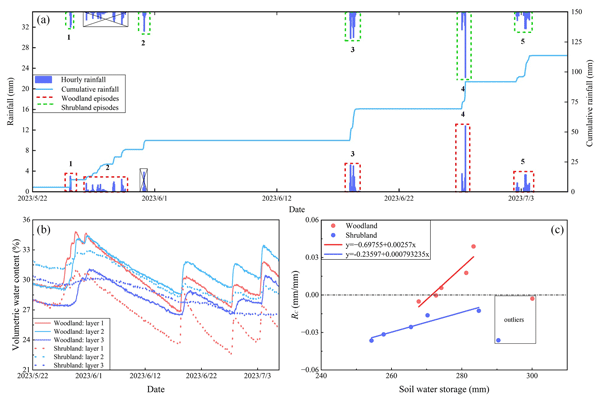
Abstract. Vegetation recovery on the Chinese Loess Plateau has markedly changed the hydrological and mechanical controls on hillslope erosion, shifting sediment production from runoff-driven erosion to gravity-driven processes such as rainfall-induced landslides. However, few studies have clearly documented differences in landslide erosion and initiation between two common vegetation types, shrubland and woodland. We conducted field investigations, rainfall soil-moisture observations, dye-tracer experiments, and soil-root tests in two steep stands. These data were used to examine differences in landslide characteristics in terms of geometry and volume, excess soil-water ratio, preferential-flow pathways, and failure potential. Rainfall-induced loessal landslides in the shrubland stand have shallower failure depths and smaller volumes but are wider than those in the woodland stand, and they are triggered under lower contributing area-slope conditions. Moreover, vertical infiltration in the woodland stand tends to be more stable and efficient, characterized by greater water penetration depth and enhanced pore connectivity. The relationship between the excess soil-water ratio and soil-water storage demonstrates that subsurface flow in woodland stand is triggered at relatively lower degrees of saturation. This behavior is attributed to well-developed preferential-flow pathways and reduced matric suction. The landscape dissection-rainfall index indicates that steep woodland slopes have lower landslide susceptibility than steep slopes in shrubland, consistent with the lower susceptibility is consistent with the lower landslide density in woodland than in shrubland. Overall, these hydrological and mechanical contrasts indicate that woodland slopes, by combining deep root systems, stable preferential-flow pathways, and strong mechanical reinforcement, support an effective subsurface flow system that enhances infiltration and delays shallow saturation, thus improving slope stability. These results highlight the need to reassess sediment production on the Loess Plateau by explicitly accounting for landslides rather than attributing it solely to runoff-driven erosion.
-
Notice on discussion status
The requested preprint has a corresponding peer-reviewed final revised paper. You are encouraged to refer to the final revised version.
-
Preprint
(3830 KB)
-
The requested preprint has a corresponding peer-reviewed final revised paper. You are encouraged to refer to the final revised version.
- Preprint
(3830 KB) - Metadata XML
- BibTeX
- EndNote
- Final revised paper


Journal article(s) based on this preprint
We carried out a series of field studies on woodland and shrubland slopes on China’s Loess Plateau. We found that woodland slopes allow water to move deeper into the ground, which helps them remain more stable, whereas shrubland slopes tend to hold more water near the surface and are more likely to fail. This means that landslides may play a bigger role in moving soil than previously thought, so soil loss on the Loess Plateau should be re-evaluated rather than linked only to surface runoff.
Interactive discussion
Status: closed
-
RC1: 'Comment on egusphere-2025-6098', Anonymous Referee #1, 18 Jan 2026
-
AC1: 'Reply on RC1', Ruijie Yang, 28 Jan 2026
To Reviewer:
Thank you for your valuable comments on this work. Your feedback has helped us improve the clarity and accuracy of the manuscript. As an initial change, we updated Fig. 4 by replacing the panel with the final version and removing the capital letters to reduce distractions and improve readability. We provide point-by-point responses to all comments in the attached document.Sincerely,
Ruijie Yang
(on behalf of all co-authors) - AC3: 'Reply on RC1', Ruijie Yang, 09 Feb 2026
-
AC1: 'Reply on RC1', Ruijie Yang, 28 Jan 2026
-
RC2: 'Comment on egusphere-2025-6098', Anonymous Referee #2, 26 Jan 2026
Publisher’s note: the supplement to this comment was edited on 29 January 2026. The adjustments were minor without effect on the scientific meaning.
Dear authors,
your manuscript is valid and well written, in my opinion it only needs some minor revisions and then it can be published.
See the attached file with some comments.
Regards
-
CC1: 'Reply on RC2', Ma Chao, 03 Feb 2026
The comment was uploaded in the form of a supplement: https://egusphere.copernicus.org/preprints/2025/egusphere-2025-6098/egusphere-2025-6098-CC1-supplement.pdf
- AC2: 'Reply on RC2', Ruijie Yang, 09 Feb 2026
-
CC1: 'Reply on RC2', Ma Chao, 03 Feb 2026
Peer review completion


Interactive discussion
Status: closed
-
RC1: 'Comment on egusphere-2025-6098', Anonymous Referee #1, 18 Jan 2026
This is a fascinating manuscript, I have no hesitation in recommending it for publication following some tidy-up. I will evaluate this manuscript as demonstrating the difference on hillslope stability between woodland and shrubland.
- Line 158: What are the capital letters in the figure 4(b)?
- Lines 135-136: Indicate the slope gradients for which dye tracer experiments were conducted for woodland and shrubland, respectively.
- Line 208: Provide evidence supporting the claim that the landslide point density in woodland is about 50% lower than in shrubland under similar conditions.
- Line 283: Replace S-50 with S-85 in Figure 9(b).
- Lines 323-324: I suspect that the tensile strength varies significantly depending on tree species. Could it be due to differences in the tensile strength possessed by constituent species, rather than differences between woodland and shrubland?
- Lines 387-388: These descriptions appear to differ from the results in Figure 11(a) and Figure11(b).
Citation: https://doi.org/10.5194/egusphere-2025-6098-RC1 -
AC1: 'Reply on RC1', Ruijie Yang, 28 Jan 2026
To Reviewer:
Thank you for your valuable comments on this work. Your feedback has helped us improve the clarity and accuracy of the manuscript. As an initial change, we updated Fig. 4 by replacing the panel with the final version and removing the capital letters to reduce distractions and improve readability. We provide point-by-point responses to all comments in the attached document.Sincerely,
Ruijie Yang
(on behalf of all co-authors) - AC3: 'Reply on RC1', Ruijie Yang, 09 Feb 2026
-
RC2: 'Comment on egusphere-2025-6098', Anonymous Referee #2, 26 Jan 2026
Publisher’s note: the supplement to this comment was edited on 29 January 2026. The adjustments were minor without effect on the scientific meaning.
Dear authors,
your manuscript is valid and well written, in my opinion it only needs some minor revisions and then it can be published.
See the attached file with some comments.
Regards
-
CC1: 'Reply on RC2', Ma Chao, 03 Feb 2026
The comment was uploaded in the form of a supplement: https://egusphere.copernicus.org/preprints/2025/egusphere-2025-6098/egusphere-2025-6098-CC1-supplement.pdf
- AC2: 'Reply on RC2', Ruijie Yang, 09 Feb 2026
-
CC1: 'Reply on RC2', Ma Chao, 03 Feb 2026
Peer review completion
Journal article(s) based on this preprint
We carried out a series of field studies on woodland and shrubland slopes on China’s Loess Plateau. We found that woodland slopes allow water to move deeper into the ground, which helps them remain more stable, whereas shrubland slopes tend to hold more water near the surface and are more likely to fail. This means that landslides may play a bigger role in moving soil than previously thought, so soil loss on the Loess Plateau should be re-evaluated rather than linked only to surface runoff.
Viewed
| HTML | XML | Total | BibTeX | EndNote | |
|---|---|---|---|---|---|
| 905 | 248 | 127 | 1,280 | 83 | 80 |
- HTML: 905
- PDF: 248
- XML: 127
- Total: 1,280
- BibTeX: 83
- EndNote: 80
Viewed (geographical distribution)
| Country | # | Views | % |
|---|
| Total: | 0 |
| HTML: | 0 |
| PDF: | 0 |
| XML: | 0 |
- 1
Ruijie Yang

Xi Yang
Yan Zhang
Liqun Lyu
Xinying Wang
The requested preprint has a corresponding peer-reviewed final revised paper. You are encouraged to refer to the final revised version.
- Preprint
(3830 KB) - Metadata XML
This is a fascinating manuscript, I have no hesitation in recommending it for publication following some tidy-up. I will evaluate this manuscript as demonstrating the difference on hillslope stability between woodland and shrubland.