
the Creative Commons Attribution 4.0 License.
the Creative Commons Attribution 4.0 License.
 | 18 Dec 2025
Bomb-radiocarbon signal suggests that soil carbon contributes to chlorophyll a in archival oak leaves
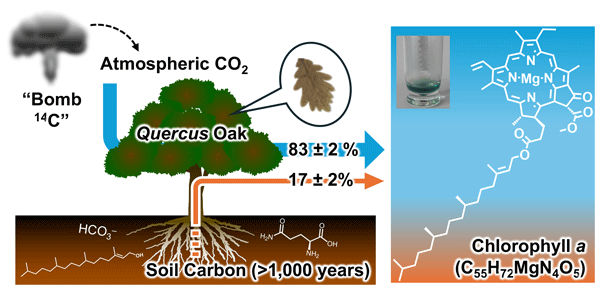
Abstract. Carbon exchange between biosphere and rhizosphere is an important component of the global carbon cycle. Photosynthetic products being sequestered into soils have been intensively studied, yet the reverse pathway from rhizosphere to biosphere is poorly known. In the present study, we determined the radiocarbon content (Δ14C) of the bulk leaves of the deciduous Quercus oak and of chlorophyll a extracted from the same leaves collected in Switzerland during the 1950s and 2000s. Our results demonstrate that old soil-derived carbon significantly contributes to the synthesis of chlorophyll a, an essential molecule for photoautotrophs. The Δ14C values of chlorophyll a were consistently lower than those of bulk leaves which closely tracked bomb-derived Δ14C signals in the atmosphere. The results cannot be explained without invoking an additional carbon source with a turnover time exceeding 100 years. A two-pool mixing model assuming atmosphere and rhizosphere as two endmembers indicates that contributions of the soil carbon to chlorophyll a are 19 ± 5 % (n = 4), and turnover time of such soil carbon is no shorter than 1,300 years. We suggest that hydrophilic compounds such as amino acids or phytol are transferred into plant roots from soils through mycorrhizal symbionts, and chlorophyll a is one of the destinations of such 14C-depleted carbon in vascular plants.
-
Notice on discussion status
The requested preprint has a corresponding peer-reviewed final revised paper. You are encouraged to refer to the final revised version.
-
Preprint
(4240 KB)
-
Supplement
(10839 KB)
-
The requested preprint has a corresponding peer-reviewed final revised paper. You are encouraged to refer to the final revised version.
- Preprint
(4240 KB) - Metadata XML
-
Supplement
(10839 KB) - BibTeX
- EndNote
- Final revised paper


Journal article(s) based on this preprint
Interactive discussion
Status: closed
-
RC1: 'Comment on egusphere-2025-6072', Anonymous Referee #1, 31 Jan 2026
-
AC1: 'Reply on RC1', Naoto F. Ishikawa, 27 Mar 2026
We thank Referee 1 very much for the thoughtful review and constructive suggestions. We are revising the manuscript in accordance with the comments and suggestions.
The major criticisms raised by Referee 1 and our corresponding responses are summarized as follows. Please note that both referees commented on almost the same points, so our responses to the comments of each referee are overlapping.
- Quality assessment: the impact of uncertain blank carbon on the results of Chl a Δ14C and the subsequent mixing model (Comments 1 and 4)
- We conducted a rigorous blank assessment for the entire procedure (see Workflow.pdf attached) and found that the procedural blank has 0.32 ± 0.11 µgC. Even in the most extreme case where the wet chemistry blank Δ14C was –1,000‰, the effect of the procedural blank on Chl a Δ14C correction is smaller than the AMS analytical error (± 8‰, 1σ).
- Methodological limitation: the unclear effect of compound degradation during the storage and the experiment on the results (Comment 2)
- We acknowledge that Chl a degradation occurs, however, there is no effect on Δ14C values because isotopic fractionations associated with degradation are corrected by δ13C, following reporting conventions.
- Insufficient discussion on plant physiology including the phytol salvage pathway (Comment 3)
- We will elaborate on the discussion regarding this topic in the revised manuscript. We have also carried out a sensitivity analysis by exploring variations in the leaf turnover time, and these did not change our conclusions.
- Overdiscussion regarding the implications for global carbon cycle (Comment 5)
- We agree that, in the absence of additional studies that reinforce our findings and support its broader relevance, we will remove the discussions concerning the global-scale perspective and focus more on the interaction between the biosphere and the rhizosphere in the revised manuscript.
Please see our responses to the specific comments in the attached PDF. One new table and ten new figures will be added to the revised manuscript and Supplemental Information (as Figures 2, S1, S2, S8, S9, S21, S22, S23, S24, and S25; the numbers reordered, and Table S1).
- Quality assessment: the impact of uncertain blank carbon on the results of Chl a Δ14C and the subsequent mixing model (Comments 1 and 4)
-
AC1: 'Reply on RC1', Naoto F. Ishikawa, 27 Mar 2026
-
RC2: 'Comment on egusphere-2025-6072', Anonymous Referee #2, 03 Feb 2026
The potential transfer pathways of carbon from the rhizophere into plants is a relevant subject of which the mechanisms and extent are not fully understood and which is of interest to readers of Biogeosciences. The approach to analyse archival herbarium leaves to compare the radiocarbon content of bulk leaves with Chl a (through pheophytin a) from the same leaves is original. Moreover, the finding that Δ14C values of chlorophyll a were found to be consistently lower than those of bulk leaves shows potential for a relevant contribution to the discussion on carbon transfer pathways.
However, due to methodogological uncertainties and the neglection of known alternative physiological mechansims, the manuscripts – in its current form – draws strong conclusions that go beyond what can be derived from the data analysis. Therefore I recommend major revision.
My major concerns are:
- Δ14C values of chlorophyll a were found to be consistently lower than those of bulk leaves. However, four out of eight samples did not fall within the permissible impurity range set by the authors themselves. Eventhough the authors speculate about explanations and the respective samples were not used for the model estimations, carbon contamination during the lab analysis and its effect on the results was not assesed. This reduces confidence in the results and opens up the possibility for other explanatory mechanisms, which were not considered.
- The implictations of measuring pheophytin a as proxy for Chl a are not discussed. How could pigment degradation due to long-term storage impact the results? How were the herbarium leaves stored and what could be the effect on the result?
- A two pool mixing model was used to estimate the contribution and turnover time of the soil pool. The model assumes that Chl a only originates from current year photosynthates, which ignores known chlorophyll recycling pathways, while the less known pathway through soil carbon was much less constrained in the model. A would have at least expected a sensitivity analyses showing the implications of these assumptons.
- Eventhough a direct transfer of C from the rhizosphere to trees through fungal uptake of organic N has been observed in other studies, the mechanism remains speculative in the current study. The statement that the findings of this study would call for a considerable revison of the carbon budget and cycle is not supported by its results given its limited scale (4 samples, one species) and methodological uncertainties.
Citation: https://doi.org/10.5194/egusphere-2025-6072-RC2 -
AC2: 'Reply on RC2', Naoto F. Ishikawa, 27 Mar 2026
We thank Referee 2 very much for the thoughtful review and constructive suggestions. We are revising the manuscript in accordance with the comments and suggestions.
The major criticisms raised by Referee 2 and our corresponding responses are summarized as follows. Please note that both referees commented on almost the same points, so our responses to the comments of each referee are overlapping.
- Quality assessment: the impact of uncertain blank carbon on the results of Chl a Δ14C and the subsequent mixing model (First comment)
- We conducted a rigorous blank assessment for the entire procedure (see Workflow.pdf attached) and found that the procedural blank has 0.32 ± 0.11 µgC. Even in the most extreme case where the wet chemistry blank Δ14C was –1,000‰, the effect of the procedural blank on Chl a Δ14C correction is smaller than the AMS analytical error (± 8‰, 1σ).
- Methodological limitation: the unclear effect of compound degradation during the storage and the experiment on the results (Second comment)
- We acknowledge that Chl a degradation occurs, however, there is no effect on Δ14C values because isotopic fractionations associated with degradation are corrected by δ13C, following reporting conventions.
- Insufficient discussion on plant physiology including the phytol salvage pathway (Third comment)
- We will elaborate on the discussion regarding this topic in the revised manuscript. We have also carried out a sensitivity analysis by exploring variations in the leaf turnover time, and these did not change our conclusions.
- Overdiscussion regarding the implications for global carbon cycle (Fourth comment)
- We agree that, in the absence of additional studies that reinforce our findings and support its broader relevance, we will remove the discussions concerning the global-scale perspective and focus more on the interaction between the biosphere and the rhizosphere in the revised manuscript.
Please see our responses to the specific comments in the attached PDF. One new table and ten new figures will be added to the revised manuscript and Supplemental Information (as Figures 2, S1, S2, S8, S9, S21, S22, S23, S24, and S25; the numbers reordered, and Table S1).
- Quality assessment: the impact of uncertain blank carbon on the results of Chl a Δ14C and the subsequent mixing model (First comment)
-
AC3: 'Reply on RC2', Naoto F. Ishikawa, 27 Mar 2026
We thank Referee 2 very much for the thoughtful review and constructive suggestions. We are revising the manuscript in accordance with the comments and suggestions.
The major criticisms raised by Referee 2 and our corresponding responses are summarized as follows. Please note that both referees commented on almost the same points, so our responses to the comments of each referee are overlapping.
- Quality assessment: the impact of uncertain blank carbon on the results of Chl a Δ14C and the subsequent mixing model (First comment)
- We conducted a rigorous blank assessment for the entire procedure (see Workflow.pdf attached) and found that the procedural blank has 0.32 ± 0.11 µgC. Even in the most extreme case where the wet chemistry blank Δ14C was –1,000‰, the effect of the procedural blank on Chl a Δ14C correction is smaller than the AMS analytical error (± 8‰, 1σ).
- Methodological limitation: the unclear effect of compound degradation during the storage and the experiment on the results (Second comment)
- We acknowledge that Chl a degradation occurs, however, there is no effect on Δ14C values because isotopic fractionations associated with degradation are corrected by δ13C, following reporting conventions.
- Insufficient discussion on plant physiology including the phytol salvage pathway (Third comment)
- We will elaborate on the discussion regarding this topic in the revised manuscript. We have also carried out a sensitivity analysis by exploring variations in the leaf turnover time, and these did not change our conclusions.
- Overdiscussion regarding the implications for global carbon cycle (Fourth comment)
- We agree that, in the absence of additional studies that reinforce our findings and support its broader relevance, we will remove the discussions concerning the global-scale perspective and focus more on the interaction between the biosphere and the rhizosphere in the revised manuscript.
Please see our responses to the specific comments in the attached PDF. One new table and ten new figures will be added to the revised manuscript and Supplemental Information (as Figures 2, S1, S2, S8, S9, S21, S22, S23, S24, and S25; the numbers reordered, and Table S1).
- Quality assessment: the impact of uncertain blank carbon on the results of Chl a Δ14C and the subsequent mixing model (First comment)
-
AC4: 'Reply on RC2', Naoto F. Ishikawa, 27 Mar 2026
We thank Referee 2 very much for the thoughtful review and constructive suggestions. We are revising the manuscript in accordance with the comments and suggestions.
The major criticisms raised by Referee 2 and our corresponding responses are summarized as follows. Please note that both referees commented on almost the same points, so our responses to the comments of each referee are overlapping.
- Quality assessment: the impact of uncertain blank carbon on the results of Chl a Δ14C and the subsequent mixing model (First comment)
- We conducted a rigorous blank assessment for the entire procedure (see Workflow.pdf attached) and found that the procedural blank has 0.32 ± 0.11 µgC. Even in the most extreme case where the wet chemistry blank Δ14C was –1,000‰, the effect of the procedural blank on Chl a Δ14C correction is smaller than the AMS analytical error (± 8‰, 1σ).
- Methodological limitation: the unclear effect of compound degradation during the storage and the experiment on the results (Second comment)
- We acknowledge that Chl a degradation occurs, however, there is no effect on Δ14C values because isotopic fractionations associated with degradation are corrected by δ13C, following reporting conventions.
- Insufficient discussion on plant physiology including the phytol salvage pathway (Third comment)
- We will elaborate on the discussion regarding this topic in the revised manuscript. We have also carried out a sensitivity analysis by exploring variations in the leaf turnover time, and these did not change our conclusions.
- Overdiscussion regarding the implications for global carbon cycle (Fourth comment)
- We agree that, in the absence of additional studies that reinforce our findings and support its broader relevance, we will remove the discussions concerning the global-scale perspective and focus more on the interaction between the biosphere and the rhizosphere in the revised manuscript.
Please see our responses to the specific comments in the attached PDF. One new table and ten new figures will be added to the revised manuscript and Supplemental Information (as Figures 2, S1, S2, S8, S9, S21, S22, S23, S24, and S25; the numbers reordered, and Table S1).
- Quality assessment: the impact of uncertain blank carbon on the results of Chl a Δ14C and the subsequent mixing model (First comment)
-
AC5: 'Comment on egusphere-2025-6072', Naoto F. Ishikawa, 27 Mar 2026
I failed to upload the attachment ZIP file in AC2 and AC3 comments. Please ignore AC2 and AC3. Instead, please see AC4 'Reply on RC2' where the attachment ZIP file can be found.
Citation: https://doi.org/10.5194/egusphere-2025-6072-AC5
Peer review completion


Interactive discussion
Status: closed
-
RC1: 'Comment on egusphere-2025-6072', Anonymous Referee #1, 31 Jan 2026
Review of “Bomb-radiocarbon signal suggests that soil carbon contributes to chlorophyll a in archival oak leaves” by Ishikawa et al. submitted to EGUsphere
Summary
This manuscript addresses an original and stimulating question: whether carbon originating from belowground pools may contribute directly to the synthesis of a core photosynthetic biomolecule, chlorophyll a, in vascular plants. The use of the bomb-¹⁴C transient combined with compound-specific radiocarbon analysis of pigments extracted from archival herbarium leaves is technically ambitious and conceptually clever.
The key observation, that Δ¹⁴C of chlorophyll a (measured as pheophytin a) is consistently lower than Δ¹⁴C of bulk leaf tissue across several decades, is intriguing and deserves attention. The study has the potential to open an important discussion about overlooked carbon pathways in plants.
However, in its current form, the manuscript over-interprets what the dataset can uniquely demonstrate.
However, in its current form, the manuscript over-interprets what the dataset can uniquely demonstrate. Several alternative mechanisms, well documented in plant physiology and carbon allocation studies, can produce ¹⁴C depletion in specific compounds without requiring direct incorporation of very old soil carbon. In addition, important methodological limitations significantly weaken the strength of the inference. Half of the dataset does not meet the authors’ own purity criteria for pigment isolation, and the manuscript does not quantify the actual mass and radiocarbon signature (F¹⁴C) of the carbon contamination introduced by the full analytical protocol. Without this information, it is difficult to assess how much of the observed ¹⁴C depletion could arise from methodological contamination versus a true biological signal.
I therefore recommend major revision.
General comments
1) Pigment purity and contamination: a critical issue
Four of the eight pigment isolates (1952, 1965, 1966, 1968) fall outside the authors’ own C/N-based purity threshold, with impurity carbon fractions estimated between 13% and 27%. These samples coincide with the period of maximum Δ¹⁴C separation between chlorophyll and bulk leaf — precisely where the interpretation is most sensitive.
The manuscript argues that remaining impurities are mainly triterpenoids and do not significantly affect conclusions. This is asserted rather than demonstrated quantitatively. A contaminant fraction of 15–25% is easily large enough to bias compound-specific Δ¹⁴C values at the scale discussed here. The mass and radiocarbon signature (F¹⁴C) of the contamination introduced along the analytical chain should be evaluated explicitly for each series of sample treatments. The procedure involves multiple solvent extractions, two HPLC separations, and an elemental analyzer prior to AMS measurement. Each of these steps can introduce carbon contamination or cross-contamination, whose magnitude may vary with solvent purity, column history, and instrument condition. For this reason, the effective procedural blank and its F¹⁴C value should be determined for each measurement batch rather than inferred from previous studies. This point is particularly critical here given the potentially far-reaching implications of the reported results.
Without this, the main inference rests heavily on data that are analytically fragile.
2) Use of pheophytin a as a proxy for chlorophyll a
Although the carbon skeleton of pheophytin a is identical to that of chlorophyll a, the issue is whether the fraction recovered after decades of degradation and multiple purification steps is chemically representative of the original chlorophyll pool present in the living leaf. Chlorophyll is known to undergo extensive degradation pathways, leading to numerous derivatives with different stability and solubility properties. The fraction ultimately isolated by HPLC may therefore represent a subset of molecules selected by their resistance to degradation and by the analytical procedure itself. This potential selection effect should be discussed, as the measured Δ¹⁴C may reflect the properties of the surviving fraction rather than those of intact chlorophyll at the time of leaf formation.
3) Alternative explanations: stored carbon and internal recycling
The manuscript concludes that the additional carbon source must have a turnover time greater than 100 years and is therefore “most likely in the rhizosphere”. This conclusion relies critically on the magnitude of the observed Δ¹⁴C offset between chlorophyll and bulk leaf. However, this offset is evaluated assuming a procedural contamination of only 0.1-0.2 µgC. If the effective contamination introduced along the analytical chain were larger than assumed, the true Δ¹⁴C difference would be substantially reduced, potentially to values fully compatible with the mobilization of non-structural carbon that is few years old, especially in early season processes, rather than requiring an external millennial source. This possibility is not explored, yet it is central to the interpretation because the argument for an old rhizospheric source rests on the amplitude of the Δ¹⁴C separation.
In addition, chlorophyll metabolism includes known recycling pathways (notably involving phytol), which further complicates the assumption that chlorophyll carbon must derive only from current-year assimilates plus an external source.
4) Mixing model and soil carbon endmember: underdetermined inference
The two-pool mixing model assumes atmosphere and rhizosphere as endmembers, but the rhizosphere carbon signature is not directly constrained. The inferred soil turnover time (≥ 1,300 years) is therefore strongly model-dependent. The heatmaps suggest that solutions are not uniquely constrained, and parameters appear sensitive to assumed leaf turnover times and endmember definitions.
In fact, the necessity to invoke such extremely old carbon pools is closely tied to the magnitude of the observed Δ¹⁴C offset and would become far less compelling if the effective procedural contamination were higher than assumed. A contribution from even modest amounts of ¹⁴C-depleted carbon introduced during the analytical procedure would naturally push the model toward unrealistically old endmembers.
Moreover, it is highly unlikely, from a soil biogeochemistry perspective, that vascular plants would access pedological carbon of such age. In temperate soils, carbon with turnover times on the order of a millennium typically corresponds to fractions that are strongly stabilized, often tightly associated with mineral surfaces and poorly accessible to microbial processing. Such pools are not readily involved in the dynamic exchanges that characterize mycorrhizal symbiosis and are therefore improbable candidates for contributing directly to metabolically active plant compounds.
5) Overstated implications for global carbon budgets
The suggestion that this mechanism would “considerably revise” the terrestrial primary production carbon budget is not supported by the limited dataset and current level of uncertainty. While the observation is interesting, it does not yet justify global-scale implications.
Details
- Reporting 14C data
I would also like to commend the authors for their careful respect of conventions in reporting physical quantities. The consistent use of significant figures, the correct spacing between numbers and units, and the proper notation for % and ‰ without unnecessary spacing are exemplary and, unfortunately, increasingly rare in the literature.
In the same spirit, it would be desirable to extend this rigor to the formulation of the Stuiver and Polach (1977) equation. The current presentation retains explicit “×100” or “×1000” factors in the expression of Δ¹⁴C, which is not fully consistent with IUPAC conventions for the use of % and ‰ notation. Although this equation predates formal IUPAC recommendations, adopting the modern notation here would improve clarity and consistency with the otherwise very careful treatment of units throughout the manuscript. It would also be judicious to express Δ¹⁴C explicitly from F¹⁴C, following the format now widely recommended in the radiocarbon community (e.g., Reimer et al., 2004).
∆14C = d14C – 2·(d13C + 0.025) (1 + d14C) with ∆14C, d13C and d14C expressed in ‰
∆14C = F14C – 1 with ∆14C expressed in ‰
Reimer, P.J., Brown, T.A. and Reimer, R.W. (2004) Discussion; reporting and calibration of post-bomb 14C data. Radiocarbon 46, 1299-1304.
- Appendix
I may have overlooked a supplementary file, but I did not find an appendix providing the complete dataset underlying the measurements. For transparency and reproducibility, it will be necessary to include a table reporting all individual measurements, following standard reporting practices for radiocarbon analyses. This should include, for each sample, the laboratory identification, the carbon mass submitted to AMS, the measured F¹⁴C values, and—consistent with the presentation in the manuscript—the corresponding Δ¹⁴C values.
Citation: https://doi.org/10.5194/egusphere-2025-6072-RC1 -
AC1: 'Reply on RC1', Naoto F. Ishikawa, 27 Mar 2026
We thank Referee 1 very much for the thoughtful review and constructive suggestions. We are revising the manuscript in accordance with the comments and suggestions.
The major criticisms raised by Referee 1 and our corresponding responses are summarized as follows. Please note that both referees commented on almost the same points, so our responses to the comments of each referee are overlapping.
- Quality assessment: the impact of uncertain blank carbon on the results of Chl a Δ14C and the subsequent mixing model (Comments 1 and 4)
- We conducted a rigorous blank assessment for the entire procedure (see Workflow.pdf attached) and found that the procedural blank has 0.32 ± 0.11 µgC. Even in the most extreme case where the wet chemistry blank Δ14C was –1,000‰, the effect of the procedural blank on Chl a Δ14C correction is smaller than the AMS analytical error (± 8‰, 1σ).
- Methodological limitation: the unclear effect of compound degradation during the storage and the experiment on the results (Comment 2)
- We acknowledge that Chl a degradation occurs, however, there is no effect on Δ14C values because isotopic fractionations associated with degradation are corrected by δ13C, following reporting conventions.
- Insufficient discussion on plant physiology including the phytol salvage pathway (Comment 3)
- We will elaborate on the discussion regarding this topic in the revised manuscript. We have also carried out a sensitivity analysis by exploring variations in the leaf turnover time, and these did not change our conclusions.
- Overdiscussion regarding the implications for global carbon cycle (Comment 5)
- We agree that, in the absence of additional studies that reinforce our findings and support its broader relevance, we will remove the discussions concerning the global-scale perspective and focus more on the interaction between the biosphere and the rhizosphere in the revised manuscript.
Please see our responses to the specific comments in the attached PDF. One new table and ten new figures will be added to the revised manuscript and Supplemental Information (as Figures 2, S1, S2, S8, S9, S21, S22, S23, S24, and S25; the numbers reordered, and Table S1).
- Quality assessment: the impact of uncertain blank carbon on the results of Chl a Δ14C and the subsequent mixing model (Comments 1 and 4)
-
RC2: 'Comment on egusphere-2025-6072', Anonymous Referee #2, 03 Feb 2026
The potential transfer pathways of carbon from the rhizophere into plants is a relevant subject of which the mechanisms and extent are not fully understood and which is of interest to readers of Biogeosciences. The approach to analyse archival herbarium leaves to compare the radiocarbon content of bulk leaves with Chl a (through pheophytin a) from the same leaves is original. Moreover, the finding that Δ14C values of chlorophyll a were found to be consistently lower than those of bulk leaves shows potential for a relevant contribution to the discussion on carbon transfer pathways.
However, due to methodogological uncertainties and the neglection of known alternative physiological mechansims, the manuscripts – in its current form – draws strong conclusions that go beyond what can be derived from the data analysis. Therefore I recommend major revision.
My major concerns are:
- Δ14C values of chlorophyll a were found to be consistently lower than those of bulk leaves. However, four out of eight samples did not fall within the permissible impurity range set by the authors themselves. Eventhough the authors speculate about explanations and the respective samples were not used for the model estimations, carbon contamination during the lab analysis and its effect on the results was not assesed. This reduces confidence in the results and opens up the possibility for other explanatory mechanisms, which were not considered.
- The implictations of measuring pheophytin a as proxy for Chl a are not discussed. How could pigment degradation due to long-term storage impact the results? How were the herbarium leaves stored and what could be the effect on the result?
- A two pool mixing model was used to estimate the contribution and turnover time of the soil pool. The model assumes that Chl a only originates from current year photosynthates, which ignores known chlorophyll recycling pathways, while the less known pathway through soil carbon was much less constrained in the model. A would have at least expected a sensitivity analyses showing the implications of these assumptons.
- Eventhough a direct transfer of C from the rhizosphere to trees through fungal uptake of organic N has been observed in other studies, the mechanism remains speculative in the current study. The statement that the findings of this study would call for a considerable revison of the carbon budget and cycle is not supported by its results given its limited scale (4 samples, one species) and methodological uncertainties.
Citation: https://doi.org/10.5194/egusphere-2025-6072-RC2 -
AC2: 'Reply on RC2', Naoto F. Ishikawa, 27 Mar 2026
We thank Referee 2 very much for the thoughtful review and constructive suggestions. We are revising the manuscript in accordance with the comments and suggestions.
The major criticisms raised by Referee 2 and our corresponding responses are summarized as follows. Please note that both referees commented on almost the same points, so our responses to the comments of each referee are overlapping.
- Quality assessment: the impact of uncertain blank carbon on the results of Chl a Δ14C and the subsequent mixing model (First comment)
- We conducted a rigorous blank assessment for the entire procedure (see Workflow.pdf attached) and found that the procedural blank has 0.32 ± 0.11 µgC. Even in the most extreme case where the wet chemistry blank Δ14C was –1,000‰, the effect of the procedural blank on Chl a Δ14C correction is smaller than the AMS analytical error (± 8‰, 1σ).
- Methodological limitation: the unclear effect of compound degradation during the storage and the experiment on the results (Second comment)
- We acknowledge that Chl a degradation occurs, however, there is no effect on Δ14C values because isotopic fractionations associated with degradation are corrected by δ13C, following reporting conventions.
- Insufficient discussion on plant physiology including the phytol salvage pathway (Third comment)
- We will elaborate on the discussion regarding this topic in the revised manuscript. We have also carried out a sensitivity analysis by exploring variations in the leaf turnover time, and these did not change our conclusions.
- Overdiscussion regarding the implications for global carbon cycle (Fourth comment)
- We agree that, in the absence of additional studies that reinforce our findings and support its broader relevance, we will remove the discussions concerning the global-scale perspective and focus more on the interaction between the biosphere and the rhizosphere in the revised manuscript.
Please see our responses to the specific comments in the attached PDF. One new table and ten new figures will be added to the revised manuscript and Supplemental Information (as Figures 2, S1, S2, S8, S9, S21, S22, S23, S24, and S25; the numbers reordered, and Table S1).
- Quality assessment: the impact of uncertain blank carbon on the results of Chl a Δ14C and the subsequent mixing model (First comment)
-
AC3: 'Reply on RC2', Naoto F. Ishikawa, 27 Mar 2026
We thank Referee 2 very much for the thoughtful review and constructive suggestions. We are revising the manuscript in accordance with the comments and suggestions.
The major criticisms raised by Referee 2 and our corresponding responses are summarized as follows. Please note that both referees commented on almost the same points, so our responses to the comments of each referee are overlapping.
- Quality assessment: the impact of uncertain blank carbon on the results of Chl a Δ14C and the subsequent mixing model (First comment)
- We conducted a rigorous blank assessment for the entire procedure (see Workflow.pdf attached) and found that the procedural blank has 0.32 ± 0.11 µgC. Even in the most extreme case where the wet chemistry blank Δ14C was –1,000‰, the effect of the procedural blank on Chl a Δ14C correction is smaller than the AMS analytical error (± 8‰, 1σ).
- Methodological limitation: the unclear effect of compound degradation during the storage and the experiment on the results (Second comment)
- We acknowledge that Chl a degradation occurs, however, there is no effect on Δ14C values because isotopic fractionations associated with degradation are corrected by δ13C, following reporting conventions.
- Insufficient discussion on plant physiology including the phytol salvage pathway (Third comment)
- We will elaborate on the discussion regarding this topic in the revised manuscript. We have also carried out a sensitivity analysis by exploring variations in the leaf turnover time, and these did not change our conclusions.
- Overdiscussion regarding the implications for global carbon cycle (Fourth comment)
- We agree that, in the absence of additional studies that reinforce our findings and support its broader relevance, we will remove the discussions concerning the global-scale perspective and focus more on the interaction between the biosphere and the rhizosphere in the revised manuscript.
Please see our responses to the specific comments in the attached PDF. One new table and ten new figures will be added to the revised manuscript and Supplemental Information (as Figures 2, S1, S2, S8, S9, S21, S22, S23, S24, and S25; the numbers reordered, and Table S1).
- Quality assessment: the impact of uncertain blank carbon on the results of Chl a Δ14C and the subsequent mixing model (First comment)
-
AC4: 'Reply on RC2', Naoto F. Ishikawa, 27 Mar 2026
We thank Referee 2 very much for the thoughtful review and constructive suggestions. We are revising the manuscript in accordance with the comments and suggestions.
The major criticisms raised by Referee 2 and our corresponding responses are summarized as follows. Please note that both referees commented on almost the same points, so our responses to the comments of each referee are overlapping.
- Quality assessment: the impact of uncertain blank carbon on the results of Chl a Δ14C and the subsequent mixing model (First comment)
- We conducted a rigorous blank assessment for the entire procedure (see Workflow.pdf attached) and found that the procedural blank has 0.32 ± 0.11 µgC. Even in the most extreme case where the wet chemistry blank Δ14C was –1,000‰, the effect of the procedural blank on Chl a Δ14C correction is smaller than the AMS analytical error (± 8‰, 1σ).
- Methodological limitation: the unclear effect of compound degradation during the storage and the experiment on the results (Second comment)
- We acknowledge that Chl a degradation occurs, however, there is no effect on Δ14C values because isotopic fractionations associated with degradation are corrected by δ13C, following reporting conventions.
- Insufficient discussion on plant physiology including the phytol salvage pathway (Third comment)
- We will elaborate on the discussion regarding this topic in the revised manuscript. We have also carried out a sensitivity analysis by exploring variations in the leaf turnover time, and these did not change our conclusions.
- Overdiscussion regarding the implications for global carbon cycle (Fourth comment)
- We agree that, in the absence of additional studies that reinforce our findings and support its broader relevance, we will remove the discussions concerning the global-scale perspective and focus more on the interaction between the biosphere and the rhizosphere in the revised manuscript.
Please see our responses to the specific comments in the attached PDF. One new table and ten new figures will be added to the revised manuscript and Supplemental Information (as Figures 2, S1, S2, S8, S9, S21, S22, S23, S24, and S25; the numbers reordered, and Table S1).
- Quality assessment: the impact of uncertain blank carbon on the results of Chl a Δ14C and the subsequent mixing model (First comment)
-
AC5: 'Comment on egusphere-2025-6072', Naoto F. Ishikawa, 27 Mar 2026
I failed to upload the attachment ZIP file in AC2 and AC3 comments. Please ignore AC2 and AC3. Instead, please see AC4 'Reply on RC2' where the attachment ZIP file can be found.
Citation: https://doi.org/10.5194/egusphere-2025-6072-AC5
Peer review completion
Journal article(s) based on this preprint
Viewed
| HTML | XML | Total | Supplement | BibTeX | EndNote | |
|---|---|---|---|---|---|---|
| 1,852 | 565 | 196 | 2,613 | 703 | 292 | 305 |
- HTML: 1,852
- PDF: 565
- XML: 196
- Total: 2,613
- Supplement: 703
- BibTeX: 292
- EndNote: 305
Viewed (geographical distribution)
| Country | # | Views | % |
|---|
| Total: | 0 |
| HTML: | 0 |
| PDF: | 0 |
| XML: | 0 |
- 1
Naoto F. Ishikawa

Hisami Suga
Tessa S. van der Voort
Reto Nyffeler
Nanako O. Ogawa
Negar Haghipour
Lukas Wacker
Timothy I. Eglinton
Naohiko Ohkouchi
The requested preprint has a corresponding peer-reviewed final revised paper. You are encouraged to refer to the final revised version.
- Preprint
(4240 KB) - Metadata XML
-
Supplement
(10839 KB) - BibTeX
- EndNote
- Final revised paper
Review of “Bomb-radiocarbon signal suggests that soil carbon contributes to chlorophyll a in archival oak leaves” by Ishikawa et al. submitted to EGUsphere
Summary
This manuscript addresses an original and stimulating question: whether carbon originating from belowground pools may contribute directly to the synthesis of a core photosynthetic biomolecule, chlorophyll a, in vascular plants. The use of the bomb-¹⁴C transient combined with compound-specific radiocarbon analysis of pigments extracted from archival herbarium leaves is technically ambitious and conceptually clever.
The key observation, that Δ¹⁴C of chlorophyll a (measured as pheophytin a) is consistently lower than Δ¹⁴C of bulk leaf tissue across several decades, is intriguing and deserves attention. The study has the potential to open an important discussion about overlooked carbon pathways in plants.
However, in its current form, the manuscript over-interprets what the dataset can uniquely demonstrate.
However, in its current form, the manuscript over-interprets what the dataset can uniquely demonstrate. Several alternative mechanisms, well documented in plant physiology and carbon allocation studies, can produce ¹⁴C depletion in specific compounds without requiring direct incorporation of very old soil carbon. In addition, important methodological limitations significantly weaken the strength of the inference. Half of the dataset does not meet the authors’ own purity criteria for pigment isolation, and the manuscript does not quantify the actual mass and radiocarbon signature (F¹⁴C) of the carbon contamination introduced by the full analytical protocol. Without this information, it is difficult to assess how much of the observed ¹⁴C depletion could arise from methodological contamination versus a true biological signal.
I therefore recommend major revision.
General comments
1) Pigment purity and contamination: a critical issue
Four of the eight pigment isolates (1952, 1965, 1966, 1968) fall outside the authors’ own C/N-based purity threshold, with impurity carbon fractions estimated between 13% and 27%. These samples coincide with the period of maximum Δ¹⁴C separation between chlorophyll and bulk leaf — precisely where the interpretation is most sensitive.
The manuscript argues that remaining impurities are mainly triterpenoids and do not significantly affect conclusions. This is asserted rather than demonstrated quantitatively. A contaminant fraction of 15–25% is easily large enough to bias compound-specific Δ¹⁴C values at the scale discussed here. The mass and radiocarbon signature (F¹⁴C) of the contamination introduced along the analytical chain should be evaluated explicitly for each series of sample treatments. The procedure involves multiple solvent extractions, two HPLC separations, and an elemental analyzer prior to AMS measurement. Each of these steps can introduce carbon contamination or cross-contamination, whose magnitude may vary with solvent purity, column history, and instrument condition. For this reason, the effective procedural blank and its F¹⁴C value should be determined for each measurement batch rather than inferred from previous studies. This point is particularly critical here given the potentially far-reaching implications of the reported results.
Without this, the main inference rests heavily on data that are analytically fragile.
2) Use of pheophytin a as a proxy for chlorophyll a
Although the carbon skeleton of pheophytin a is identical to that of chlorophyll a, the issue is whether the fraction recovered after decades of degradation and multiple purification steps is chemically representative of the original chlorophyll pool present in the living leaf. Chlorophyll is known to undergo extensive degradation pathways, leading to numerous derivatives with different stability and solubility properties. The fraction ultimately isolated by HPLC may therefore represent a subset of molecules selected by their resistance to degradation and by the analytical procedure itself. This potential selection effect should be discussed, as the measured Δ¹⁴C may reflect the properties of the surviving fraction rather than those of intact chlorophyll at the time of leaf formation.
3) Alternative explanations: stored carbon and internal recycling
The manuscript concludes that the additional carbon source must have a turnover time greater than 100 years and is therefore “most likely in the rhizosphere”. This conclusion relies critically on the magnitude of the observed Δ¹⁴C offset between chlorophyll and bulk leaf. However, this offset is evaluated assuming a procedural contamination of only 0.1-0.2 µgC. If the effective contamination introduced along the analytical chain were larger than assumed, the true Δ¹⁴C difference would be substantially reduced, potentially to values fully compatible with the mobilization of non-structural carbon that is few years old, especially in early season processes, rather than requiring an external millennial source. This possibility is not explored, yet it is central to the interpretation because the argument for an old rhizospheric source rests on the amplitude of the Δ¹⁴C separation.
In addition, chlorophyll metabolism includes known recycling pathways (notably involving phytol), which further complicates the assumption that chlorophyll carbon must derive only from current-year assimilates plus an external source.
4) Mixing model and soil carbon endmember: underdetermined inference
The two-pool mixing model assumes atmosphere and rhizosphere as endmembers, but the rhizosphere carbon signature is not directly constrained. The inferred soil turnover time (≥ 1,300 years) is therefore strongly model-dependent. The heatmaps suggest that solutions are not uniquely constrained, and parameters appear sensitive to assumed leaf turnover times and endmember definitions.
In fact, the necessity to invoke such extremely old carbon pools is closely tied to the magnitude of the observed Δ¹⁴C offset and would become far less compelling if the effective procedural contamination were higher than assumed. A contribution from even modest amounts of ¹⁴C-depleted carbon introduced during the analytical procedure would naturally push the model toward unrealistically old endmembers.
Moreover, it is highly unlikely, from a soil biogeochemistry perspective, that vascular plants would access pedological carbon of such age. In temperate soils, carbon with turnover times on the order of a millennium typically corresponds to fractions that are strongly stabilized, often tightly associated with mineral surfaces and poorly accessible to microbial processing. Such pools are not readily involved in the dynamic exchanges that characterize mycorrhizal symbiosis and are therefore improbable candidates for contributing directly to metabolically active plant compounds.
5) Overstated implications for global carbon budgets
The suggestion that this mechanism would “considerably revise” the terrestrial primary production carbon budget is not supported by the limited dataset and current level of uncertainty. While the observation is interesting, it does not yet justify global-scale implications.
Details
I would also like to commend the authors for their careful respect of conventions in reporting physical quantities. The consistent use of significant figures, the correct spacing between numbers and units, and the proper notation for % and ‰ without unnecessary spacing are exemplary and, unfortunately, increasingly rare in the literature.
In the same spirit, it would be desirable to extend this rigor to the formulation of the Stuiver and Polach (1977) equation. The current presentation retains explicit “×100” or “×1000” factors in the expression of Δ¹⁴C, which is not fully consistent with IUPAC conventions for the use of % and ‰ notation. Although this equation predates formal IUPAC recommendations, adopting the modern notation here would improve clarity and consistency with the otherwise very careful treatment of units throughout the manuscript. It would also be judicious to express Δ¹⁴C explicitly from F¹⁴C, following the format now widely recommended in the radiocarbon community (e.g., Reimer et al., 2004).
∆14C = d14C – 2·(d13C + 0.025) (1 + d14C) with ∆14C, d13C and d14C expressed in ‰
∆14C = F14C – 1 with ∆14C expressed in ‰
Reimer, P.J., Brown, T.A. and Reimer, R.W. (2004) Discussion; reporting and calibration of post-bomb 14C data. Radiocarbon 46, 1299-1304.
I may have overlooked a supplementary file, but I did not find an appendix providing the complete dataset underlying the measurements. For transparency and reproducibility, it will be necessary to include a table reporting all individual measurements, following standard reporting practices for radiocarbon analyses. This should include, for each sample, the laboratory identification, the carbon mass submitted to AMS, the measured F¹⁴C values, and—consistent with the presentation in the manuscript—the corresponding Δ¹⁴C values.