
the Creative Commons Attribution 4.0 License.
the Creative Commons Attribution 4.0 License.
 | 08 Dec 2025
Strong intensification of extreme fire weather in Europe under 3 °C compared to 2 °C global warming
Abstract. The climate in Europe is warming faster than the global average, raising concerns about how climate change will affect extreme fire events. In this study, we use ERA5-Land reanalysis data and an ensemble of 34 high-resolution regional climate models (RCMs) from the EURO-CORDEX framework to compute the Canadian Forest Fire Weather Index (FWI) and investigate both recent and projected changes in atmospheric conditions favorable for wildfires across Europe. Historical trends (1950–2023) based on ERA5-Land data reveal statistically significant increases in the frequency and intensity of extreme fire weather in regions such as the Iberian Peninsula, Central Europe, and parts of Eastern Europe. All RCM input fields were bias-adjusted prior to FWI calculation using Quantile Delta Mapping, resulting in improved FWI representation relative to raw simulations. Projections based on the bias-adjusted EURO-CORDEX ensemble indicate that future extreme fire weather will become more frequent, more intense, and more widespread across Europe as global warming progresses. The strongest signals are projected for southern Europe, with a northward expansion of fire-prone conditions under higher global warming levels (GWLs). At 3 °C GWL, the spatial extent of robust changes in extreme fire weather metrics nearly doubles compared to 2 °C, with one metric increasing almost fivefold. Relative increases in frequency generally exceed those in magnitude. These changes coincide with rising vapor pressure deficit, suggesting that thermodynamic processes play a key role through atmospheric drying. The projected intensification of extreme fire weather in Europe highlights the growing need for coordinated climate action along with proactive mitigation strategies.
-
Notice on discussion status
The requested preprint has a corresponding peer-reviewed final revised paper. You are encouraged to refer to the final revised version.
-
Preprint
(17875 KB)
-
The requested preprint has a corresponding peer-reviewed final revised paper. You are encouraged to refer to the final revised version.
- Preprint
(17875 KB) - Metadata XML
- BibTeX
- EndNote
- Final revised paper


Journal article(s) based on this preprint
Europe is warming faster than the global average, raising concerns about future wildfire risks. Using regional climate models, we find that extreme fire weather is projected to become more severe, more frequent, and more widespread across the continent, especially if global warming reaches 3 °C. The projected increase is mainly linked to a drier atmosphere. Our findings highlight the need to limit warming and strengthen adaptation practices to protect vulnerable ecosystems and communities.
Interactive discussion
Status: closed
-
RC1: 'Comment on egusphere-2025-6004', Anonymous Referee #1, 16 Feb 2026
- AC1: 'Reply on RC1', A. Serkan Bayar, 27 Mar 2026
-
RC2: 'Comment on egusphere-2025-6004', Anonymous Referee #2, 19 Feb 2026
This study projects changes in extreme fire weather across Europe under global warming levels of 2°C and 3°C using bias-adjusted RCMs. The manuscript is well-structured and methodologically thorough, making a meaningful contribution to understanding regional fire risk. However, despite the overall high quality of the manuscript, a major revision is required to address the specific points detailed below before publication in ESD.
Major Comments:
- This study utilizes the QDM method to bias-adjust the regional EURO-CORDEX model outputs. However, the rationale for not directly adjusting the FWI data remains unclear. Furthermore, the bias correction evaluation for FWI appears to be performed solely based on the 95th percentile. The authors should provide a clearer justification for this choice and discuss the potential implications of this specific threshold-based approach on the overall results.
- I understand the authors' explanation regarding the unavailability of minimum relative humidity for most models. Nevertheless, it is necessary to explicitly discuss this limitation in the Discussion section. Specifically, the authors should describe how the choice of this humidity metric might influence the robustness of the conclusions.
- The use of (outdated?) CMIP5-based RCP8.5 scenarios warrants further justification, given that CMIP6 (and increasingly CMIP7) scenarios are already available and are widely used for future projections. Notably, since the "future" projections in RCP scenarios begin in 2005, there is now a 20-year overlap with historical observations (up to 2026). The authors should clarify whether the observed warming pathways over the past two decades align with the RCP8.5 trajectory used here. This comparison is particularly important for assessing the lower warming level of 2°C.
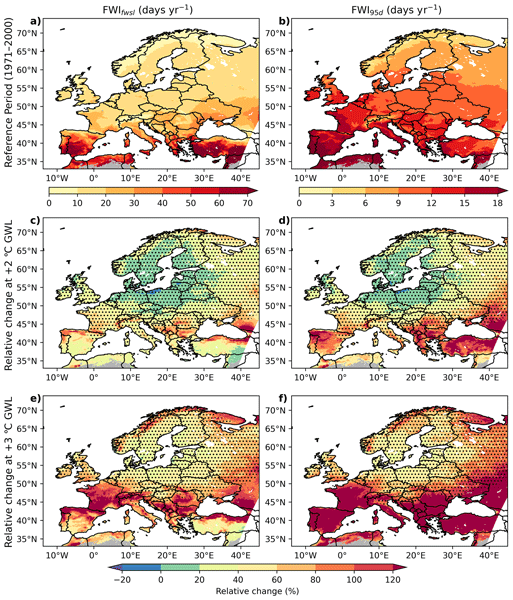
- The colormaps in Figure 5 (and similarly in Figure 4) require revision. The current use of blue for FWI values ranging from 0 to 20 can be misleading to readers. Additionally, both the colormap selection and the numerical ranges in Figures 4c and 4d should be optimized to better represent the data distribution (+/-) and enhance clarity.
- While Figures 6 and 7 present relative changes, I recommend including the absolute changes for key results, at least in the Supplementary Materials. In high-latitude regions (e.g., Northern Europe), where baseline values are inherently low, a large relative increase does not necessarily translate into a significant rise in actual wildfire risk.
Minor Comments:
- Caption of Figure 3 : "Com-4" should be "Comb-4".
Citation: https://doi.org/10.5194/egusphere-2025-6004-RC2 - AC2: 'Reply on RC2', A. Serkan Bayar, 27 Mar 2026
Peer review completion


Interactive discussion
Status: closed
-
RC1: 'Comment on egusphere-2025-6004', Anonymous Referee #1, 16 Feb 2026
This study evaluates historical and projected changes in extreme fire weather across Europe, assesses the performance of EURO-CORDEX simulations in fire weather calculations, and demonstrates the added value of bias adjustment in improving FWI-based projections under different global warming levels. Overall, it shows that extreme fire weather is already intensifying and is projected to become more widespread, more frequent, and more severe with increasing warming.
The manuscript is very well written, methodologically thorough, and clearly structured. I particularly appreciate bias-adjustment exercise, which substantially improves confidence in the projections. The study is comprehensive and makes a meaningful contribution to the fire–climate literature.
I have noted a few minor points and some methodological clarifications that, in my view, would further strengthen the paper. Addressing these would enhance the scientific rigor and improve clarity, but they do not alter the overall conclusions. Based on this, I would recommend acceptance subject to minor revisions.
Comments:
- The study mentions earlier Europe-wide assessments based on smaller ensembles. We also have multiple global studies with similar results over Europe. I think it is important to explicitly articulate the added value or knowledge gap addressed by the larger ensemble and bias-adjustment based approach. A short paragraph clarifying the added value is necessary to help round off the storyline.
- While the manuscript provides a thorough assessment of fire weather, it does not look into how closely the calculated FWI signals translate into actual fire occurrences across the study region. Although the role of factors other than FWI is discussed later, a plot showing the actual fire-occurrence pattern across the study region (perhaps next to Figure 1) would help clarify the linkage between FWI and real-world fire regimes. In other words, are the regions identified as experiencing strong fire-weather signals also those where fires are climatically constrained and responsive to FWI, or are these areas where other limiting factors (fuel availability, land use, ignition sources, suppression capacity) dominate? Without this context, there is a risk of interpreting increases in fire weather in regions where fire occurrence may remain structurally limited.
- I am concerned about the choice of using mean daily relative humidity in the FWI calculations. The proxy-selection framework is appreciated, and it is helpful that daily combinations are benchmarked against the original noon-time FWI using ERA5-Land. That said, I still wonder about the physical consistency of using mean daily relative humidity in the FWI formulation. The system is fundamentally designed around 12:00 local time, when fuel moisture is typically close to its daily minimum and atmospheric demand is highest. Given the strong diurnal cycle and nonlinear influence of RH on the fuel moisture codes, using mean RH (even if it minimizes percentile bias) could potentially dampen extremes especially under climate change where diurnal characteristics may shift. A brief discussion of the following points would help separate statistical performance from process-level robustness and increase confidence in the methodological choice. Was daily minimum RH explicitly tested in the proxy evaluation, and how did it perform spatially and seasonally relative to mean RH? When identifying the optimal combination, was the sensitivity to RH assessed independently, or could the reduced 95th percentile bias partly be because of compensating effects from the other variables? More generally, is optimizing only against the 95th percentile sufficient to ensure that the overall distribution and physical behavior of FWI are preserved, particularly in the upper tail?]
- Is there any particular reason for northward expansion of fire-prone conditions. The authors should clarify more on this at this point.
- Were any particular criteria (such as performance of projections over Europe) used to identify the models?
- Line 13: Relative increases in frequency generally exceed those in magnitude; do the authors mean that the frequency is projected to increase more than frequency? It is not clear.
- Lines 22-25: Is it appropriate to compare fire emissions averaged over 1997–2016 with fossil fuel emissions from a single year (2024)? Perhaps the time periods could be aligned, or a brief justification added?
- Line 85 onwards: Could the authors clarify at this point which hourly values were actually used from ERA5-Land (e.g., noon values for CFFDRS calculations and daily mean/max/min for bias correction)? It appears, however, that at this point it would help to avoid confusion, as different applications require different temporal aggregations.
- Line 101: Given the current emphasis on multi-scenario assessments, is there a particular reason for focusing solely on the RCP8.5 scenario?
- Line 200: Could the authors comment on the degree of correlation or redundancy among these indices? A brief assessment (e.g., spatial correlation or variance partitioning) would help clarify whether each metric adds distinct process-relevant information (frequency, duration, intensity, seasonality) or whether some are effectively reflecting the same underlying signal in different forms.
- Section 3.4 As rightly pointed out by the authors in a previous section, climatologically low FWI values may result in large relative percentage changes in FWIfwsl or FWI95d. This could be a bit misleading. In the region-wise analysis, we do see some presentation in absolute terms. The authors may consider normalizing the metrics in this section to better contextualize and refine the percentages.
Citation: https://doi.org/10.5194/egusphere-2025-6004-RC1 - AC1: 'Reply on RC1', A. Serkan Bayar, 27 Mar 2026
-
RC2: 'Comment on egusphere-2025-6004', Anonymous Referee #2, 19 Feb 2026
This study projects changes in extreme fire weather across Europe under global warming levels of 2°C and 3°C using bias-adjusted RCMs. The manuscript is well-structured and methodologically thorough, making a meaningful contribution to understanding regional fire risk. However, despite the overall high quality of the manuscript, a major revision is required to address the specific points detailed below before publication in ESD.
Major Comments:
- This study utilizes the QDM method to bias-adjust the regional EURO-CORDEX model outputs. However, the rationale for not directly adjusting the FWI data remains unclear. Furthermore, the bias correction evaluation for FWI appears to be performed solely based on the 95th percentile. The authors should provide a clearer justification for this choice and discuss the potential implications of this specific threshold-based approach on the overall results.
- I understand the authors' explanation regarding the unavailability of minimum relative humidity for most models. Nevertheless, it is necessary to explicitly discuss this limitation in the Discussion section. Specifically, the authors should describe how the choice of this humidity metric might influence the robustness of the conclusions.
- The use of (outdated?) CMIP5-based RCP8.5 scenarios warrants further justification, given that CMIP6 (and increasingly CMIP7) scenarios are already available and are widely used for future projections. Notably, since the "future" projections in RCP scenarios begin in 2005, there is now a 20-year overlap with historical observations (up to 2026). The authors should clarify whether the observed warming pathways over the past two decades align with the RCP8.5 trajectory used here. This comparison is particularly important for assessing the lower warming level of 2°C.
- The colormaps in Figure 5 (and similarly in Figure 4) require revision. The current use of blue for FWI values ranging from 0 to 20 can be misleading to readers. Additionally, both the colormap selection and the numerical ranges in Figures 4c and 4d should be optimized to better represent the data distribution (+/-) and enhance clarity.
- While Figures 6 and 7 present relative changes, I recommend including the absolute changes for key results, at least in the Supplementary Materials. In high-latitude regions (e.g., Northern Europe), where baseline values are inherently low, a large relative increase does not necessarily translate into a significant rise in actual wildfire risk.
Minor Comments:
- Caption of Figure 3 : "Com-4" should be "Comb-4".
Citation: https://doi.org/10.5194/egusphere-2025-6004-RC2 - AC2: 'Reply on RC2', A. Serkan Bayar, 27 Mar 2026
Peer review completion
Journal article(s) based on this preprint
Europe is warming faster than the global average, raising concerns about future wildfire risks. Using regional climate models, we find that extreme fire weather is projected to become more severe, more frequent, and more widespread across the continent, especially if global warming reaches 3 °C. The projected increase is mainly linked to a drier atmosphere. Our findings highlight the need to limit warming and strengthen adaptation practices to protect vulnerable ecosystems and communities.
Viewed
| HTML | XML | Total | BibTeX | EndNote | |
|---|---|---|---|---|---|
| 1,725 | 1,584 | 195 | 3,504 | 255 | 218 |
- HTML: 1,725
- PDF: 1,584
- XML: 195
- Total: 3,504
- BibTeX: 255
- EndNote: 218
Viewed (geographical distribution)
| Country | # | Views | % |
|---|
| Total: | 0 |
| HTML: | 0 |
| PDF: | 0 |
| XML: | 0 |
- 1
A. Serkan Bayar

Joaquim G. Pinto
Célia M. Gouveia
Alexandre M. Ramos
The requested preprint has a corresponding peer-reviewed final revised paper. You are encouraged to refer to the final revised version.
- Preprint
(17875 KB) - Metadata XML
Europe is warming faster than the global average, raising concerns about future wildfire risks. Using regional climate models, we find that extreme fire weather is projected to become more severe, more frequent, and more widespread across the continent, especially if global warming reaches 3 °C. The projected increase is mainly linked to a drier atmosphere. Our findings underscore the urgent need to adopt proactive forest management practices to protect vulnerable ecosystems and communities.
Europe is warming faster than the global average, raising concerns about future wildfire risks....
This study evaluates historical and projected changes in extreme fire weather across Europe, assesses the performance of EURO-CORDEX simulations in fire weather calculations, and demonstrates the added value of bias adjustment in improving FWI-based projections under different global warming levels. Overall, it shows that extreme fire weather is already intensifying and is projected to become more widespread, more frequent, and more severe with increasing warming.
The manuscript is very well written, methodologically thorough, and clearly structured. I particularly appreciate bias-adjustment exercise, which substantially improves confidence in the projections. The study is comprehensive and makes a meaningful contribution to the fire–climate literature.
I have noted a few minor points and some methodological clarifications that, in my view, would further strengthen the paper. Addressing these would enhance the scientific rigor and improve clarity, but they do not alter the overall conclusions. Based on this, I would recommend acceptance subject to minor revisions.
Comments: