
the Creative Commons Attribution 4.0 License.
the Creative Commons Attribution 4.0 License.
 | 05 Dec 2025
Prediction of basin-scale river channel migration based on landscape evolution numerical simulation
Abstract. The basin-scale river channel migration, driven by multiple factors such as hydrometeorological conditions, tectonic movements, and human activities, exerts a profound influence on regional morphological features, water resource, and ecosystem over long-term evolution. Conventional river dynamics approaches struggle to quantitatively characterize basin-scale channel migration due to difficulties in incorporating factors like basin hydrological processes and tectonic activities. This study proposed a novel technique for the numerical simulation of river channel migration, integrating a fully coupled multi-processes landscape evolution model (e.g., hydrological, geomorphic and tectonic processes) with channel extraction. Furthermore, to address model parameter uncertainty, a Markov chain Monte Carlo (MCMC) method with a modified likelihood function is used for parameter uncertainty quantification. Simultaneously, a computationally efficient Long Short-Term Memory (LSTM)-based surrogate model for channel migration is developed to overcome the computational bottleneck in uncertainty analysis. Applied to the Kumalake River Basin within China's Tarim Basin, the study employs the Landscape Evolution-Penn State Integrated Hydrologic Model (LE-PIHM) to construct the landscape evolution model. Combined with channel extraction, it simulates historical (2000–2021) and future (2021–2100) landscape evolution and channel migration processes. Results demonstrated that the developed river channel migration model, aided by parameter uncertainty analysis, reliably captures the dynamics of channel migration in the study area during 2000–2021. Additionally, the LSTM-based surrogate model achieves high accuracy, effectively resolving computational challenges in parameter uncertainty analysis. Predictions under different climate scenarios reveal significant variations in future channel evolution, indicating that climate change will profoundly reshape basin geomorphic features and river patterns.
-
Notice on discussion status
The requested preprint has a corresponding peer-reviewed final revised paper. You are encouraged to refer to the final revised version.
-
Preprint
(6249 KB)
-
The requested preprint has a corresponding peer-reviewed final revised paper. You are encouraged to refer to the final revised version.
- Preprint
(6249 KB) - Metadata XML
- BibTeX
- EndNote
- Final revised paper


Journal article(s) based on this preprint
Interactive discussion
Status: closed
-
RC1: 'Comment on egusphere-2025-6000', Anonymous Referee #1, 17 Dec 2025
-
AC1: 'Reply on RC1', Xiankui Zeng, 06 Jan 2026
The comment was uploaded in the form of a supplement: https://egusphere.copernicus.org/preprints/2025/egusphere-2025-6000/egusphere-2025-6000-AC1-supplement.pdf
-
AC1: 'Reply on RC1', Xiankui Zeng, 06 Jan 2026
-
RC2: 'Comment on egusphere-2025-6000', Anonymous Referee #2, 17 Dec 2025
The manuscript presents an integrated, basin-scale framework for reconstructing and projecting river channel migration by coupling the LE-PIHM landscape evolution model with automated channel extraction from simulated DEMs, and it further advances the state of practice by embedding Bayesian MCMC uncertainty quantification using a modified average Hausdorff-distance likelihood and accelerating calibration via an LSTM surrogate that maps key parameters to channel planform coordinates; the approach is novel in its end-to-end linkage of process-based landscape evolution, spatial planform misfit calibration, and computationally efficient uncertainty analysis, and the case-study results are promising, so the paper is clearly valuable, but it requires some clarifications to improve statistical transparency, reproducibility, and interpretability before it is ready for publication.
1. The manuscript should explicitly clarify the statistical/error-model assumptions behind using the average Hausdorff distance H as the calibration target and then use the same metric to provide a reach-wise (regional) difficulty diagnosis for the channel prediction/surrogate. Currently, the likelihood formulation based on H (with 𝐻𝑜𝑏𝑠 = 0) is presented, but the assumed distribution for H and the selection/estimation of the scale (variance) term are not sufficiently specified, which directly affects posterior tightness and the credibility of uncertainty bounds. Also, the paper should quantify the known spatial heterogeneity in performance by splitting the main channel into two or three reaches (e.g., upstream canyon vs downstream plain) and reporting H (and optionally mean pointwise distance) per reach for both reconstruction/validation and surrogate evaluation, since the text indicates downstream deviations are larger. This will make the Bayesian calibration statistically transparent while also giving readers a practical, spatially explicit statement of where the workflow is reliable.
2. The LSTM surrogate section should be expanded with minimal but essential implementation details to ensure reproducibility, beyond the already provided training design (LHS sample size, train/validation split, optimizer and hyperparameters). Specifically, please add a compact description (ideally a short table plus a few sentences) of the LSTM architecture (number of layers, hidden units, dropout/regularization if any), the preprocessing applied to the 11 parameters (e.g., min–max scaling or z-score normalization), the exact output formatting of the 2,000-point planform, and the loss definition used to train the network (e.g., coordinate-wise MSE, any weighting along the channel). These additions are documentation-level and do not require new experiments, but they materially improve the scientific value of the surrogate contribution by allowing other groups to replicate and benchmark the approach.
3. The future-scenario projection component should include a clear, concise description of how CMIP6 EC-Earth3-Veg forcings under the SSP scenarios are prepared and mapped into LE-PIHM, because scenario-to-scenario differences in projected migration—particularly the large response reported for SSP2-4.5—are sensitive to bias correction, downscaling, and temporal aggregation choices. Please state explicitly whether precipitation/temperature are used raw or bias-corrected (and name the method at a high level if applied), how spatial downscaling/interpolation to the basin model grid is performed, and what temporal resolution is used to drive the model during 2021–2100 (including whether any aggregation is performed before the landscape-evolution time step). A brief paragraph should then connect the interpretation of “threshold-like” migration behavior to these forcing-preprocessing uncertainties; this strengthens the credibility of the scenario comparison.
Citation: https://doi.org/10.5194/egusphere-2025-6000-RC2 -
AC2: 'Reply on RC2', Xiankui Zeng, 06 Jan 2026
The comment was uploaded in the form of a supplement: https://egusphere.copernicus.org/preprints/2025/egusphere-2025-6000/egusphere-2025-6000-AC2-supplement.pdf
-
AC2: 'Reply on RC2', Xiankui Zeng, 06 Jan 2026
-
RC3: 'Comment on egusphere-2025-6000', Anonymous Referee #3, 19 Dec 2025
General Comments
River channel migration in basin scale shapes water distribution and ecosystems. Accurately measuring this process is vital for effective basin management and climate change adaptation. This study presents a coupled modelling framework that integrates landscape evolution model, channel-extraction method and Bayesian uncertainty analysis to reconstruct the river channel migration in the Kumalake River Basin. The paper validates the predictions of river channel migration, confirming the reliability of the proposed methodology. The proposed method exhibits good generalizability, it holds significant potential for application in other basins.
However, there are several points where the manuscript could be improved or clarified. I recommend a minor revision before considering it for publication. With the suggested revisions, the manuscript has the potential to make a significant impact on practical landscape evolution simulation.
Specific Comments
Comment 1. This study uses the average Hausdorff distance as an indicator to assess the difference between the simulated and the observed river channel, thereby evaluating the simulation accuracy. What is the justification for this indicator?
Comment 2. The results of the parameter uncertainty analysis in Figure 10 show the posterior distribution histograms of model parameters, which are very useful. The significance of these posterior distributions could be further explained. I recommend to provide additional discussion on the posterior ranges.
Comment 3. River channel migration at the basin scale is the result of landscape evolution processes. The manuscript proposes that LE-PIHM includes processes such as tectonics and hydrology. Could the authors provide more detailed explanations of the full-coupled multi-processes involved?
Comment 4: For the parameter calibration of river channel migration model, the reliability of the validation data is crucial. How were the river channel location data acquired? The authors should specify if they originate from field surveys or remote sensing techniques.
Comment 5: Figure 11 illustrates that the distribution of channel sections is narrow in the upstream areas of the basin, whereas it widens in the downstream areas. An explanation for this spatial pattern is required.
Minor Comments
To enhance the readability of the manuscript, it is advisable to add brief explanations for the technical terms, such as "Markov chain Monte Carlo" and "surrogate model".
2. The use of "Equation" and "Eq." in the manuscript should follow a consistent format. In line 264, Equation (10) is missing a closing parenthesis.
The “H” in the first column of Table 6.
Citation: https://doi.org/10.5194/egusphere-2025-6000-RC3 -
AC3: 'Reply on RC3', Xiankui Zeng, 06 Jan 2026
The comment was uploaded in the form of a supplement: https://egusphere.copernicus.org/preprints/2025/egusphere-2025-6000/egusphere-2025-6000-AC3-supplement.pdf
-
AC3: 'Reply on RC3', Xiankui Zeng, 06 Jan 2026


Interactive discussion
Status: closed
-
RC1: 'Comment on egusphere-2025-6000', Anonymous Referee #1, 17 Dec 2025
General Comments
The research on “Prediction of basin-scale river channel migration based on landscape evolution numerical simulation” provides a new basin-scale river channel migration simulation framework. To address the limitations of traditional approaches for application in large-scale river basins, this study coupled landscape evolution model and river channel extraction. Meanwhile, it is commendable that the use of the surrogate model and Bayesian parameter uncertainty analysis enhances the generalizability of the proposed method.
The paper is well organized and the topic is suitable for HESS. I recommend a moderate revision before considering it for publication. However, I have some suggestions before publication.
Specific comments
(1) The parameter uncertainty is performed by using Markov Chain Monte Carlo method, and a modified Gaussian likelihood function is used. It is interesting in Bayesian uncertainty analysis. However, the statistical assumptions behind Equation (10) are still somewhat unclear, and further explanation is recommended. What is the physical meaning of Σ in Equation (10)? Could non-Gaussian likelihood functions or different error model specifications further improve results?
(2) The manuscript mentioned that since 2012, there has been significant agricultural development in the downstream river reaches, and human activities may have altered land cover, soil properties, and river channel constraints. However, in the model, the settings for land cover and soil parameters do not seem to be influenced by time. This is an important limitation and should be more clearly emphasized. Currently, it is briefly mentioned only as a qualitative explanation for local mismatches.
(3) In section 3.2, the datasets from NASA (Leaf Area Index, Surface Roughness, Air Temperature) are referenced. The resolution of these input raster datasets is relatively coarse. Could this impact the accuracy of the simulations?
(4) The simulation technique for basin-scale river channels proposed in the manuscript has been successfully applied to the Kumalake River Basin. A broader discussion of the generalizability of this method would help improve its applicability.
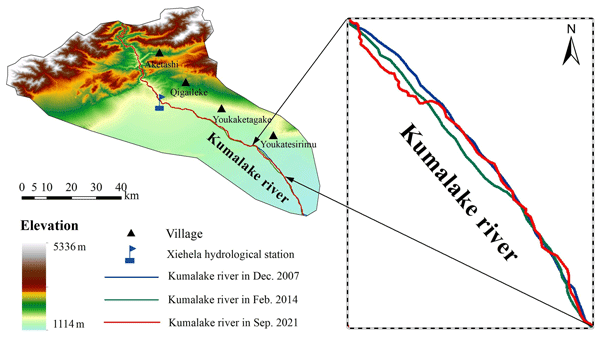
(5) A marked disparity in the extent of river channel migration is evident between the upstream and downstream reaches of the basin (Figure 11). The mechanisms underlying this phenomenon require further explanation.
(6) In the future scenario of SSP2-4.5 (Figure 14), significant river channel reorganization occurs, and the elevation changes in the river segments under this scenario are also noticeable, which is very interesting. What are the underlying mechanisms causing this phenomenon?
(7) It would be beneficial to add information on the variability (such as the standard deviation) of precipitation and temperature across the different scenarios in Table 5.
(8) To help readers distinguish the variables for the four climate scenarios, the line colours in Figure 13 should be redesigned.
Citation: https://doi.org/10.5194/egusphere-2025-6000-RC1 -
AC1: 'Reply on RC1', Xiankui Zeng, 06 Jan 2026
The comment was uploaded in the form of a supplement: https://egusphere.copernicus.org/preprints/2025/egusphere-2025-6000/egusphere-2025-6000-AC1-supplement.pdf
-
AC1: 'Reply on RC1', Xiankui Zeng, 06 Jan 2026
-
RC2: 'Comment on egusphere-2025-6000', Anonymous Referee #2, 17 Dec 2025
The manuscript presents an integrated, basin-scale framework for reconstructing and projecting river channel migration by coupling the LE-PIHM landscape evolution model with automated channel extraction from simulated DEMs, and it further advances the state of practice by embedding Bayesian MCMC uncertainty quantification using a modified average Hausdorff-distance likelihood and accelerating calibration via an LSTM surrogate that maps key parameters to channel planform coordinates; the approach is novel in its end-to-end linkage of process-based landscape evolution, spatial planform misfit calibration, and computationally efficient uncertainty analysis, and the case-study results are promising, so the paper is clearly valuable, but it requires some clarifications to improve statistical transparency, reproducibility, and interpretability before it is ready for publication.
1. The manuscript should explicitly clarify the statistical/error-model assumptions behind using the average Hausdorff distance H as the calibration target and then use the same metric to provide a reach-wise (regional) difficulty diagnosis for the channel prediction/surrogate. Currently, the likelihood formulation based on H (with 𝐻𝑜𝑏𝑠 = 0) is presented, but the assumed distribution for H and the selection/estimation of the scale (variance) term are not sufficiently specified, which directly affects posterior tightness and the credibility of uncertainty bounds. Also, the paper should quantify the known spatial heterogeneity in performance by splitting the main channel into two or three reaches (e.g., upstream canyon vs downstream plain) and reporting H (and optionally mean pointwise distance) per reach for both reconstruction/validation and surrogate evaluation, since the text indicates downstream deviations are larger. This will make the Bayesian calibration statistically transparent while also giving readers a practical, spatially explicit statement of where the workflow is reliable.
2. The LSTM surrogate section should be expanded with minimal but essential implementation details to ensure reproducibility, beyond the already provided training design (LHS sample size, train/validation split, optimizer and hyperparameters). Specifically, please add a compact description (ideally a short table plus a few sentences) of the LSTM architecture (number of layers, hidden units, dropout/regularization if any), the preprocessing applied to the 11 parameters (e.g., min–max scaling or z-score normalization), the exact output formatting of the 2,000-point planform, and the loss definition used to train the network (e.g., coordinate-wise MSE, any weighting along the channel). These additions are documentation-level and do not require new experiments, but they materially improve the scientific value of the surrogate contribution by allowing other groups to replicate and benchmark the approach.
3. The future-scenario projection component should include a clear, concise description of how CMIP6 EC-Earth3-Veg forcings under the SSP scenarios are prepared and mapped into LE-PIHM, because scenario-to-scenario differences in projected migration—particularly the large response reported for SSP2-4.5—are sensitive to bias correction, downscaling, and temporal aggregation choices. Please state explicitly whether precipitation/temperature are used raw or bias-corrected (and name the method at a high level if applied), how spatial downscaling/interpolation to the basin model grid is performed, and what temporal resolution is used to drive the model during 2021–2100 (including whether any aggregation is performed before the landscape-evolution time step). A brief paragraph should then connect the interpretation of “threshold-like” migration behavior to these forcing-preprocessing uncertainties; this strengthens the credibility of the scenario comparison.
Citation: https://doi.org/10.5194/egusphere-2025-6000-RC2 -
AC2: 'Reply on RC2', Xiankui Zeng, 06 Jan 2026
The comment was uploaded in the form of a supplement: https://egusphere.copernicus.org/preprints/2025/egusphere-2025-6000/egusphere-2025-6000-AC2-supplement.pdf
-
AC2: 'Reply on RC2', Xiankui Zeng, 06 Jan 2026
-
RC3: 'Comment on egusphere-2025-6000', Anonymous Referee #3, 19 Dec 2025
General Comments
River channel migration in basin scale shapes water distribution and ecosystems. Accurately measuring this process is vital for effective basin management and climate change adaptation. This study presents a coupled modelling framework that integrates landscape evolution model, channel-extraction method and Bayesian uncertainty analysis to reconstruct the river channel migration in the Kumalake River Basin. The paper validates the predictions of river channel migration, confirming the reliability of the proposed methodology. The proposed method exhibits good generalizability, it holds significant potential for application in other basins.
However, there are several points where the manuscript could be improved or clarified. I recommend a minor revision before considering it for publication. With the suggested revisions, the manuscript has the potential to make a significant impact on practical landscape evolution simulation.
Specific Comments
Comment 1. This study uses the average Hausdorff distance as an indicator to assess the difference between the simulated and the observed river channel, thereby evaluating the simulation accuracy. What is the justification for this indicator?
Comment 2. The results of the parameter uncertainty analysis in Figure 10 show the posterior distribution histograms of model parameters, which are very useful. The significance of these posterior distributions could be further explained. I recommend to provide additional discussion on the posterior ranges.
Comment 3. River channel migration at the basin scale is the result of landscape evolution processes. The manuscript proposes that LE-PIHM includes processes such as tectonics and hydrology. Could the authors provide more detailed explanations of the full-coupled multi-processes involved?
Comment 4: For the parameter calibration of river channel migration model, the reliability of the validation data is crucial. How were the river channel location data acquired? The authors should specify if they originate from field surveys or remote sensing techniques.
Comment 5: Figure 11 illustrates that the distribution of channel sections is narrow in the upstream areas of the basin, whereas it widens in the downstream areas. An explanation for this spatial pattern is required.
Minor Comments
To enhance the readability of the manuscript, it is advisable to add brief explanations for the technical terms, such as "Markov chain Monte Carlo" and "surrogate model".
2. The use of "Equation" and "Eq." in the manuscript should follow a consistent format. In line 264, Equation (10) is missing a closing parenthesis.
The “H” in the first column of Table 6.
Citation: https://doi.org/10.5194/egusphere-2025-6000-RC3 -
AC3: 'Reply on RC3', Xiankui Zeng, 06 Jan 2026
The comment was uploaded in the form of a supplement: https://egusphere.copernicus.org/preprints/2025/egusphere-2025-6000/egusphere-2025-6000-AC3-supplement.pdf
-
AC3: 'Reply on RC3', Xiankui Zeng, 06 Jan 2026
Peer review completion


Journal article(s) based on this preprint
Viewed
| HTML | XML | Total | BibTeX | EndNote | |
|---|---|---|---|---|---|
| 352 | 145 | 33 | 530 | 33 | 269 |
- HTML: 352
- PDF: 145
- XML: 33
- Total: 530
- BibTeX: 33
- EndNote: 269
Viewed (geographical distribution)
| Country | # | Views | % |
|---|
| Total: | 0 |
| HTML: | 0 |
| PDF: | 0 |
| XML: | 0 |
- 1
Jitian Wu
Xiankui Zeng
Qihui Wu
Dong Wang
Jichun Wu
The requested preprint has a corresponding peer-reviewed final revised paper. You are encouraged to refer to the final revised version.
- Preprint
(6249 KB) - Metadata XML
General Comments
The research on “Prediction of basin-scale river channel migration based on landscape evolution numerical simulation” provides a new basin-scale river channel migration simulation framework. To address the limitations of traditional approaches for application in large-scale river basins, this study coupled landscape evolution model and river channel extraction. Meanwhile, it is commendable that the use of the surrogate model and Bayesian parameter uncertainty analysis enhances the generalizability of the proposed method.
The paper is well organized and the topic is suitable for HESS. I recommend a moderate revision before considering it for publication. However, I have some suggestions before publication.
Specific comments
(1) The parameter uncertainty is performed by using Markov Chain Monte Carlo method, and a modified Gaussian likelihood function is used. It is interesting in Bayesian uncertainty analysis. However, the statistical assumptions behind Equation (10) are still somewhat unclear, and further explanation is recommended. What is the physical meaning of Σ in Equation (10)? Could non-Gaussian likelihood functions or different error model specifications further improve results?
(2) The manuscript mentioned that since 2012, there has been significant agricultural development in the downstream river reaches, and human activities may have altered land cover, soil properties, and river channel constraints. However, in the model, the settings for land cover and soil parameters do not seem to be influenced by time. This is an important limitation and should be more clearly emphasized. Currently, it is briefly mentioned only as a qualitative explanation for local mismatches.
(3) In section 3.2, the datasets from NASA (Leaf Area Index, Surface Roughness, Air Temperature) are referenced. The resolution of these input raster datasets is relatively coarse. Could this impact the accuracy of the simulations?
(4) The simulation technique for basin-scale river channels proposed in the manuscript has been successfully applied to the Kumalake River Basin. A broader discussion of the generalizability of this method would help improve its applicability.
(5) A marked disparity in the extent of river channel migration is evident between the upstream and downstream reaches of the basin (Figure 11). The mechanisms underlying this phenomenon require further explanation.
(6) In the future scenario of SSP2-4.5 (Figure 14), significant river channel reorganization occurs, and the elevation changes in the river segments under this scenario are also noticeable, which is very interesting. What are the underlying mechanisms causing this phenomenon?
(7) It would be beneficial to add information on the variability (such as the standard deviation) of precipitation and temperature across the different scenarios in Table 5.
(8) To help readers distinguish the variables for the four climate scenarios, the line colours in Figure 13 should be redesigned.