
the Creative Commons Attribution 4.0 License.
the Creative Commons Attribution 4.0 License.
 | 23 Dec 2025
Observational Insights into Atmospheric CO2 and CO at the Urban Canopy Layer Top in Metropolitan Shanghai, China
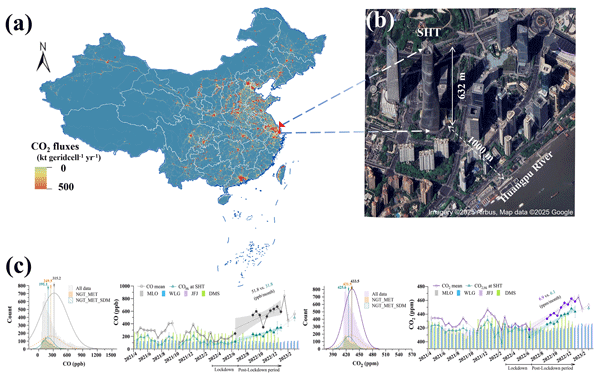
Abstract. Major metropolitan areas are critical carbon emission hotspots, and understanding their carbon dynamics is essential for developing targeted climate mitigation strategies. Remote background stations often capture spatially smoothed anthropogenic signals, failing to resolve distinct urban source–sink processes. Here, we leveraged the unique 632-m Shanghai Tower (121.51°E, 31.23°N) to conduct a nearly 2-yr field campaign (April 2021–March 2023), aiming to investigate CO2 and CO dynamic from the top of urban canopy layer (UCL) via stationary, continuous, single-level, high-precision, in-situ measurements with a cavity ringdown laser spectrometer. Campaign-averaged mole fractions substantially exceeded global and regional backgrounds, confirming a pronounced urban carbon burden. Through a multi-stage filtering framework targeting nocturnal measurements, we derived robust regional background values. Component analysis of CO2 excess, using CO as a reliable regional combustion tracer, revealed burning of fossil fuels as the dominant contributor (avg. 85%), alongside biogenic processes that enhanced this atmospheric excess, especially in winter under respiratory predominance, but less so in summer when partially offset by net photosynthetic uptake and cleaner airmass dilution. The 2022 Shanghai lockdown provided a natural experiment that underscored the pronounced sensitivity of UCL-top observations to metropolitan-scale anthropogenic perturbations, as reflected in synchronized decline and rapid rebound of CO2 and CO, along with a marked reversal of their emission ratio compared to 2021. Overall, these findings affirm that UCL-top observations effectively capture integrated metropolitan carbon signals, supporting refined emission tracking and top-down carbon neutrality strategies.
-
Notice on discussion status
The requested preprint has a corresponding peer-reviewed final revised paper. You are encouraged to refer to the final revised version.
-
Preprint
(8275 KB)
-
Supplement
(3528 KB)
-
The requested preprint has a corresponding peer-reviewed final revised paper. You are encouraged to refer to the final revised version.
- Preprint
(8275 KB) - Metadata XML
-
Supplement
(3528 KB) - BibTeX
- EndNote
- Final revised paper


Journal article(s) based on this preprint
Interactive discussion
Status: closed
-
RC1: 'Comment on egusphere-2025-5982', Anonymous Referee #1, 24 Feb 2026
-
AC1: 'Reply on RC1', Shuangxi Fang, 02 Apr 2026
We sincerely thank the editors and reviewers for dedicating your time and effort in handling and reviewing our manuscript (ID: Egusphere-2025-5982). We greatly appreciate the reviewers’ positive and encouraging feedback on our work. We have carefully considered all comments raised, which have been instrumental and invaluable in revising and improving the paper. In this response letter, the reviewers’ comments are shown in black italics, followed by our point-by-point replies in red roman font, with all line numbers referenced to the track-changes manuscript. Moreover, in the track-changes version of the manuscript, newly added or revised text is underlined in blue, while removed content is marked with light gray strikethrough, and the revisions we include in this response letter are formatted consistently. We hope that these revisions and improvements have sufficiently addressed the comments. Thank you once again for your time and expert input.
-
AC1: 'Reply on RC1', Shuangxi Fang, 02 Apr 2026
-
RC2: 'reviewer comment on egusphere-2025-5982', Anonymous Referee #2, 20 Mar 2026
General comments.
Authors are presenting a measurement report on 2-year observations of CO2 and CO at the top of Shanghai tower. The data are analyzed in the paper and are filtered into daytime data useful for urban emission analysis and nighttime data representative of wider surface flux influences. Seasonal variation of enhancement ratios of CO to CO2 is also discussed. The paper can be accepted after technical corrections.
Detailed comments:
As the paper gives a observation site overview, it would be good to provide details useful for model analysis of published data, for example, the sea breeze impact in wind direction and tower footprint is not mentioned (see Huang et al 2025).
Review and discussion can mention other research on similarly tall towers protruding above nocturnal boundary layer (eg WLEF, ATTO, ZOTTO)
L158-160 Here we see mention of “Global Data Assimilation System” and later “NCEP/NCAR reanalysis data” as data source for trajectory. Likely to be GDAS
L346 MLG site could be mistype?
L378 Can mention agricultural waste burning as possible source of autumn CO enhancement, and residential fuel burning in winter.
L505 PBLH is shown to be from ECMWF open data, but variable list at https://www.ecmwf.int/en/forecasts/datasets/open-data doesn’t include PBL
L566 doi is missing (https://doi.org/10.21957/open-data ?)
L609 Fu and Fang 2025 reference not available
References
Huang, Y., Li, S., Zhu, Y., Liu, Y., Hong, Y., Chen, X., et al. (2025). Increasing sea-land breeze frequencies over coastal areas of China in the past five decades. Geophysical Research Letters, 52, e2024GL112480. https://doi.org/10.1029/2024GL112480
Citation: https://doi.org/10.5194/egusphere-2025-5982-RC2 -
AC2: 'Reply on RC2', Shuangxi Fang, 02 Apr 2026
We sincerely thank the editors and reviewers for dedicating your time and effort in handling and reviewing our manuscript (ID: Egusphere-2025-5982). We greatly appreciate the reviewers’ positive and encouraging feedback on our work. We have carefully considered all comments raised, which have been instrumental and invaluable in revising and improving the paper. In this response letter, the reviewers’ comments are shown in black italics, followed by our point-by-point replies in red roman font, with all line numbers referenced to the track-changes manuscript. Moreover, in the track-changes version of the manuscript, newly added or revised text is underlined in blue, while removed content is marked with light gray strikethrough, and the revisions we include in this response letter are formatted consistently. We hope that these revisions and improvements have sufficiently addressed the comments. Thank you once again for your time and expert input.
-
AC2: 'Reply on RC2', Shuangxi Fang, 02 Apr 2026
Peer review completion


Interactive discussion
Status: closed
-
RC1: 'Comment on egusphere-2025-5982', Anonymous Referee #1, 24 Feb 2026
Review of the manuscript: "Observational Insights into Atmospheric CO2 and CO at the Urban Canopy Layer Top in Metropolitan Shanghai, China" by Shuang Fu et al. submitted to Atmospheric Chemistry and Physics (ACP).
The paper provides a detailed analysis of CO2 and CO measurements taken over a two-year period at the top of the Shanghai Tower. The originality of the study lies in the unique height (632m)at which the measurements were taken, in the heart of a city. The article also makes interesting use of measurements of other tracers taken at an air quality station at the foot of the tower. The procedure for estimating background signals and concentration excesses associated with regional activities is clearly explained and well suited to the specific conditions of the measurement site at the top of the building. Overall, the results obtained are consistent with the expected processes, particularly in relation to a two-month lockdown period. I therefore recommend publication of the article in the ACP journal, after correction of certain inaccuracies and a few revisions. Please note that several figure captions are incomplete.
My main comments are as follows:
Line 49: “…with cities responsible for ~85% of its carbon emissions” : Is it really 85% of emissions that occur in cities, or is it rather the carbon footprint of cities? Please clarify.
Line 51 : “China has been deploying an extensive urban and suburban carbon monitoring network” : Is it possible to know how extensive this measurement network is ? How many cities, or monitoring stations ?
Line 121: “The manufacturer reported a measurement precision (1σ over 5 min) of approximately 50 ppb for CO2 and 1 ppb for CO, with accuracy meeting WMO/GAW compatibility goals.” : Rather than having the manufacturer's specifications, I would prefer to have the measurement precision and repeatability estimated from regular measurements of the target gas. Could you please show the time series of the target gas measurements. Please also specify the frequency of calibration sequences, and indicate which method is used to dry the air.
Figure 2: Over the two-year measurement period, there is a significant amount of missing data. This is one of the difficulties involved in maintaining observations, and it would be interesting to know the reasons for the main data gaps. Could you please provide some description of the difficulties you encountered, and why the monitoring program has been discontinued ?
Figure 2: Also the CO concentrations measured at SHT in winter 2022 are higher than the previous winter, which is not seen in ground based measurements of CO, NO2, SO2. Do you have any explanation on this year to year wintertime variability which doesn’t seem to be related to the local surface emissions ?
Section 3.4: The value used as the CO2/CO ratio is not very clear to me. Do you use the average value for the entire measurement period? This ratio kCO2/CO, derived from atmospheric observations, corresponds to the total CO2 signal (ff and bio combined), and therefore, in my opinion, the justification for using it to deduce the CO2ff fraction is not sufficiently explained.
Section 3.5: Most of the variations described during and after the spring 2022 lockdown appear consistent and are well explained. There are still a few points that need to be discussed:
- “…with limited disruption to industrial operations. This explains why ground-level SO2 (largely tied to industrial activities) rose 6.3–153.6%”: At this level of increase, it seems more likely that there has been an increase in industrial activity. Is this conceivable? At the same time there is a sharp increase of COgl despite the decrease of traffic (as indicated by the sharp decrease of NO2). What is the possible driving force for this increase of CO ?
- The increase in CO and CO2 concentrations is also striking when measurements resume in September 2022, both when using all measurements, or only background measurements. Therefore, it seems a bit difficult to reconcile the huge increase of the background signal at SHT compare to the regional DMS background station (a signal which was not seen in 2021), with the stability or decrease of CO at the surface level in Shangai.
Minor comments :
Line 55: “To extract regionally representative data with minimal emission influence”: I suggest to mention “Local’ emission
2.1.2. Additional Environmental Data : can you please provide the elevation a.g.l. of the two air quality & meteorological stations ? I guess they are very close to the ground.
Figure 2: are the PBLH given on hourly basis, day and night ?
Figure 4: could you also locate the DMS site on the maps, or at least could you precise how far it is from SHT tower ?
Figure 5: In my opinion, the best practice for these wind rose figures is to use detrended and de-seasonalized dataset.
Figure 7b: there is no explanation about the dashed red line
-
AC1: 'Reply on RC1', Shuangxi Fang, 02 Apr 2026
We sincerely thank the editors and reviewers for dedicating your time and effort in handling and reviewing our manuscript (ID: Egusphere-2025-5982). We greatly appreciate the reviewers’ positive and encouraging feedback on our work. We have carefully considered all comments raised, which have been instrumental and invaluable in revising and improving the paper. In this response letter, the reviewers’ comments are shown in black italics, followed by our point-by-point replies in red roman font, with all line numbers referenced to the track-changes manuscript. Moreover, in the track-changes version of the manuscript, newly added or revised text is underlined in blue, while removed content is marked with light gray strikethrough, and the revisions we include in this response letter are formatted consistently. We hope that these revisions and improvements have sufficiently addressed the comments. Thank you once again for your time and expert input.
-
AC1: 'Reply on RC1', Shuangxi Fang, 02 Apr 2026
-
RC2: 'reviewer comment on egusphere-2025-5982', Anonymous Referee #2, 20 Mar 2026
General comments.
Authors are presenting a measurement report on 2-year observations of CO2 and CO at the top of Shanghai tower. The data are analyzed in the paper and are filtered into daytime data useful for urban emission analysis and nighttime data representative of wider surface flux influences. Seasonal variation of enhancement ratios of CO to CO2 is also discussed. The paper can be accepted after technical corrections.
Detailed comments:
As the paper gives a observation site overview, it would be good to provide details useful for model analysis of published data, for example, the sea breeze impact in wind direction and tower footprint is not mentioned (see Huang et al 2025).
Review and discussion can mention other research on similarly tall towers protruding above nocturnal boundary layer (eg WLEF, ATTO, ZOTTO)
L158-160 Here we see mention of “Global Data Assimilation System” and later “NCEP/NCAR reanalysis data” as data source for trajectory. Likely to be GDAS
L346 MLG site could be mistype?
L378 Can mention agricultural waste burning as possible source of autumn CO enhancement, and residential fuel burning in winter.
L505 PBLH is shown to be from ECMWF open data, but variable list at https://www.ecmwf.int/en/forecasts/datasets/open-data doesn’t include PBL
L566 doi is missing (https://doi.org/10.21957/open-data ?)
L609 Fu and Fang 2025 reference not available
References
Huang, Y., Li, S., Zhu, Y., Liu, Y., Hong, Y., Chen, X., et al. (2025). Increasing sea-land breeze frequencies over coastal areas of China in the past five decades. Geophysical Research Letters, 52, e2024GL112480. https://doi.org/10.1029/2024GL112480
Citation: https://doi.org/10.5194/egusphere-2025-5982-RC2 -
AC2: 'Reply on RC2', Shuangxi Fang, 02 Apr 2026
We sincerely thank the editors and reviewers for dedicating your time and effort in handling and reviewing our manuscript (ID: Egusphere-2025-5982). We greatly appreciate the reviewers’ positive and encouraging feedback on our work. We have carefully considered all comments raised, which have been instrumental and invaluable in revising and improving the paper. In this response letter, the reviewers’ comments are shown in black italics, followed by our point-by-point replies in red roman font, with all line numbers referenced to the track-changes manuscript. Moreover, in the track-changes version of the manuscript, newly added or revised text is underlined in blue, while removed content is marked with light gray strikethrough, and the revisions we include in this response letter are formatted consistently. We hope that these revisions and improvements have sufficiently addressed the comments. Thank you once again for your time and expert input.
-
AC2: 'Reply on RC2', Shuangxi Fang, 02 Apr 2026
Peer review completion
Journal article(s) based on this preprint
Viewed
| HTML | XML | Total | Supplement | BibTeX | EndNote | |
|---|---|---|---|---|---|---|
| 957 | 1,397 | 102 | 2,456 | 274 | 122 | 143 |
- HTML: 957
- PDF: 1,397
- XML: 102
- Total: 2,456
- Supplement: 274
- BibTeX: 122
- EndNote: 143
Viewed (geographical distribution)
| Country | # | Views | % |
|---|
| Total: | 0 |
| HTML: | 0 |
| PDF: | 0 |
| XML: | 0 |
- 1
Shuang Fu
Xuemei Qing
Kunpeng Zang
Yi Lin
Shuo Liu
Yuanyuan Chen
Bingjiang Chen
Wei Gao
Martin Steinbacher
Shuangxi Fang

The requested preprint has a corresponding peer-reviewed final revised paper. You are encouraged to refer to the final revised version.
- Preprint
(8275 KB) - Metadata XML
-
Supplement
(3528 KB) - BibTeX
- EndNote
- Final revised paper
Review of the manuscript: "Observational Insights into Atmospheric CO2 and CO at the Urban Canopy Layer Top in Metropolitan Shanghai, China" by Shuang Fu et al. submitted to Atmospheric Chemistry and Physics (ACP).
The paper provides a detailed analysis of CO2 and CO measurements taken over a two-year period at the top of the Shanghai Tower. The originality of the study lies in the unique height (632m)at which the measurements were taken, in the heart of a city. The article also makes interesting use of measurements of other tracers taken at an air quality station at the foot of the tower. The procedure for estimating background signals and concentration excesses associated with regional activities is clearly explained and well suited to the specific conditions of the measurement site at the top of the building. Overall, the results obtained are consistent with the expected processes, particularly in relation to a two-month lockdown period. I therefore recommend publication of the article in the ACP journal, after correction of certain inaccuracies and a few revisions. Please note that several figure captions are incomplete.
My main comments are as follows:
Line 49: “…with cities responsible for ~85% of its carbon emissions” : Is it really 85% of emissions that occur in cities, or is it rather the carbon footprint of cities? Please clarify.
Line 51 : “China has been deploying an extensive urban and suburban carbon monitoring network” : Is it possible to know how extensive this measurement network is ? How many cities, or monitoring stations ?
Line 121: “The manufacturer reported a measurement precision (1σ over 5 min) of approximately 50 ppb for CO2 and 1 ppb for CO, with accuracy meeting WMO/GAW compatibility goals.” : Rather than having the manufacturer's specifications, I would prefer to have the measurement precision and repeatability estimated from regular measurements of the target gas. Could you please show the time series of the target gas measurements. Please also specify the frequency of calibration sequences, and indicate which method is used to dry the air.
Figure 2: Over the two-year measurement period, there is a significant amount of missing data. This is one of the difficulties involved in maintaining observations, and it would be interesting to know the reasons for the main data gaps. Could you please provide some description of the difficulties you encountered, and why the monitoring program has been discontinued ?
Figure 2: Also the CO concentrations measured at SHT in winter 2022 are higher than the previous winter, which is not seen in ground based measurements of CO, NO2, SO2. Do you have any explanation on this year to year wintertime variability which doesn’t seem to be related to the local surface emissions ?
Section 3.4: The value used as the CO2/CO ratio is not very clear to me. Do you use the average value for the entire measurement period? This ratio kCO2/CO, derived from atmospheric observations, corresponds to the total CO2 signal (ff and bio combined), and therefore, in my opinion, the justification for using it to deduce the CO2ff fraction is not sufficiently explained.
Section 3.5: Most of the variations described during and after the spring 2022 lockdown appear consistent and are well explained. There are still a few points that need to be discussed:
- “…with limited disruption to industrial operations. This explains why ground-level SO2 (largely tied to industrial activities) rose 6.3–153.6%”: At this level of increase, it seems more likely that there has been an increase in industrial activity. Is this conceivable? At the same time there is a sharp increase of COgl despite the decrease of traffic (as indicated by the sharp decrease of NO2). What is the possible driving force for this increase of CO ?
- The increase in CO and CO2 concentrations is also striking when measurements resume in September 2022, both when using all measurements, or only background measurements. Therefore, it seems a bit difficult to reconcile the huge increase of the background signal at SHT compare to the regional DMS background station (a signal which was not seen in 2021), with the stability or decrease of CO at the surface level in Shangai.
Minor comments :
Line 55: “To extract regionally representative data with minimal emission influence”: I suggest to mention “Local’ emission
2.1.2. Additional Environmental Data : can you please provide the elevation a.g.l. of the two air quality & meteorological stations ? I guess they are very close to the ground.
Figure 2: are the PBLH given on hourly basis, day and night ?
Figure 4: could you also locate the DMS site on the maps, or at least could you precise how far it is from SHT tower ?
Figure 5: In my opinion, the best practice for these wind rose figures is to use detrended and de-seasonalized dataset.
Figure 7b: there is no explanation about the dashed red line