
the Creative Commons Attribution 4.0 License.
the Creative Commons Attribution 4.0 License.
 | 21 Nov 2025
Reduced Complexity Model Intercomparison Project Phase 3: Experimental protocol for coordinated constraining and evaluation of Reduced-Complexity Models
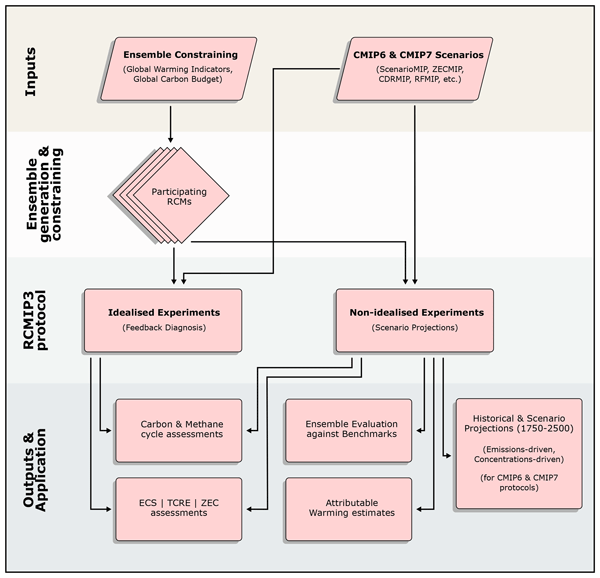
Abstract. Reduced-Complexity Models (RCMs) are a critical tool for synthesising climate science knowledge and providing climate projections for a wide range of emissions scenarios. The Reduced-Complexity Model Intercomparison Project (RCMIP) provides a framework for the coordinated evaluation and application of these models. Here, we introduce the experimental protocol for RCMIP Phase 3 (RCMIP3), which is timed to inform the upcoming seventh assessment cycle of the Intergovernmental Panel on Climate Change (IPCC AR7). Taking stock of lessons from previous phases, RCMIP3 builds on community climate assessment products to support a common framework to compare RCM output against historical climate benchmarks. The experimental design aims to support a comprehensive assessment of RCMs across multiple climate-relevant domains, with a particular focus on carbon cycle dynamics and climate reversibility. The protocol is designed in tandem with the Coupled Model Intercomparison Project Phase 7 (CMIP7), replicating its "Assessment Fast Track" together with complementary experiments which explore wider state dependencies, sampling multiple scenario generations, long timescale response and diverse emissions-driven process representation.
-
Notice on discussion status
The requested preprint has a corresponding peer-reviewed final revised paper. You are encouraged to refer to the final revised version.
-
Preprint
(1579 KB)
-
Supplement
(42545 KB)
-
The requested preprint has a corresponding peer-reviewed final revised paper. You are encouraged to refer to the final revised version.
- Preprint
(1579 KB) - Metadata XML
-
Supplement
(42545 KB) - BibTeX
- EndNote
- Final revised paper


Journal article(s) based on this preprint
Interactive discussion
Status: closed
-
RC1: 'Comment on egusphere-2025-5775', Marcus Sarofim, 06 Mar 2026
- AC1: 'Reply on RC1', Alejandro Romero-Prieto, 28 May 2026
-
RC2: 'Comment on egusphere-2025-5775', Anonymous Referee #2, 29 Apr 2026
Review of “Reduced Complexity Model Intercomparison Project Phase 3: Experimental protocol for coordinated constraining and evaluation of Reduced-Complexity Models”
This manuscript describes the effort to coordinate the RCMIP phase 3 project, including description of forcing, tuning, and standard model outputs. The work is very important for benchmarking simple climate models and will coordinate many simulations that will be considered for writing the next IPCC report. It is thus clearly an important contribution, it is suitable for publication, and this journal is appropriate for such an effort.
My comments are minor, the authors have achieved their goals and the paper is well written, clear, and concise. I recommend publishing the article after giving the authors a chance to make (optional) minor revisions.
Minor comments:
- One major aspect of this work that could be potentially controversial is the proposal for a standardized approach to tuning RCMs. The authors use language that suggests the standardized approach is optional, which suggests that it is not expected to be a universally accepted proposal. Could this standardization have some negative impacts, for example because they may decrease some aspects of model diversity? Are these benchmarks provided with uncertainty? A bit more discussion on the pros/cons to adopting the standardized approach could provide context and strengthen the argument for why modeling groups should adopt this procedure.
- Somewhere in the introduction it might be nice to add one paragraph with a brief background on RCMs (e.g., some physics discussion). There are some nice review studies already out there, and that is not the purpose of this document. But a little more background information may help ease the burden for readers who have less background on the topic.
- It would be informative to include comments on computational cost to run various tiers of the experiment set (probably a rough range given varying complexity) and of storage requirements for the tiers of outputs.
- L70: You could comment on some statistics of participation in this effort, how many individuals responded, what is the representation of different groups, etc.
- L87: This is the only place the reader is referred to as “you”, maybe rewrite.
- L319: Can this pyrcmip repo be tagged to a doi/citation?
- Table 8 & Table 10: If there are standard units it would be useful to include them here.
Minor/grammatical
- The paper is mostly very well written, but there can be a tendency for some sentences to run-on a bit. I suggest a little editing to try to avoid this tendency (e.g., L22-29 is two consecutive (long) single sentence paragraphs that could be rewritten for clarity; L32, L52 also have long, multi-comma sentences that could be rewritten for clarity).
Citation: https://doi.org/10.5194/egusphere-2025-5775-RC2 - AC2: 'Reply on RC2', Alejandro Romero-Prieto, 28 May 2026


Interactive discussion
Status: closed
-
RC1: 'Comment on egusphere-2025-5775', Marcus Sarofim, 06 Mar 2026
RCMIP paper review
Overall, this is a very well written paper that clearly and accurately documents the experimental protocol for the third phase of the Reduced Complexity Model Intercomparison Project (RCMIP). This is valuable because RCMIP is an important contribution to the understanding and improvement of reduced complexity models, which themselves are a valuable tool for both theoretical climate science and applied climate policy analysis.
I encourage the journal to accept this paper after a number of minor revisions (see following list). The most substantive comment is a criticism regarding the use of SSP3-7.0 for the CH4 variant experiments because of its unusual nature in terms of non-GHG emissions. The only other comment that potentially rises beyond just wording changes is a request to include tropospheric ozone concentration (not just forcing) as an output. This has potential wider implications about including links between global average O3 concentration and carbon cycle behavior, which I think would be consistent with the drive of RCMIP3 to improve carbon cycle representation and understanding.
Lines 1-29: The value of RCMs is a good starting point for this paper, and this is a pretty good description. However, I think that the authors have missed both a reason that RCMs are valuable, and a key application:
- As I state in Sarofim et al. 2021 (https://pmc.ncbi.nlm.nih.gov/articles/PMC8311623/), RCMs have at least three key advantages: “(1) computational efficiency, (2) adjustable model parameters and (3) lack of chaotic behaviour.” The drafted text addresses #1 and #2, but not #3. #3 is particularly important for understanding the response of the climate system to small perturbations (e.g., emissions pulses as in the SC-GHG – see next comment, or analyzing the benefit of a specific policy or regulation)
- RCMs are key for estimation of the Social Cost of Greenhouse Gases: I would suggest citing Rennert et al. 2022 (https://www.nature.com/articles/s41586-022-05224-9) and/or the EPA 2023 SC-GHG report or the NAS 2017 SC-GHG assessment.
Line 51: I think this is the first time flat10MIP is mentioned. A 1 sentence definition would be helpful for those readers (such as myself!) who don’t immediately recognize the term – I might suggest a parenthetical like (“a series of idealized experiments starting with constant 10 GtC/year CO2 emissions”)
Line 95: incomplete WMO reference
Line 125: I just want to commend the RCMIP team: I think this experiment will be very helpful for disentangling feedbacks (I could commend the team for much more - as I said, this paper is very good - but this experiment had particular appeal to me)
Line 135: And again, I think this will be very important. Dietz et al. 2021 (https://www.journals.uchicago.edu/doi/abs/10.1086/713977) was a great paper showing that modern RCMs behaved very different from the climate modules embedded in the 2010 USG SC-GHG IAMs, but I think the lack of proper GCM/ESM pulse experiments for “truthing” is something that the community needs to address.
Line 140: I think this experiment is describing a process where:
- Each RCM back-calculates CO2 emissions from a 1 pct CO2 concentration driven experiment
- This back-calculated CO2 run is the set to zero at the point at which it reaches 750/1000/2000 PgC cumulative carbon.
I think that this can be written more clearly.
Line 165: If I’ve read it right, flat7.5-cdr and flat7.5-rev are very similar, with the difference being that cdr ramps from 7.5 to -7.5 over a hundred years, whereas rev zeroes emissions out for those hundred years. But the cumulative emissions from the two experiments should be identical everywhere except those 100 years. If this is true then:
- I would put these experiments adjacent to each other
- I would explicitly note this relationship, as the rationale for having 2 similar experiments is presumably to look at how the ramp versus immediate jump of emissions lead to differences.
182: I don’t think that the source of historical concentrations has been described before this point. I would like a shorthand that could be used here and going forward like “Foster24” in the same way that “CMIP6” describes the alternate concentration source (you may need other references for the historical emissions source, volcanic/solar forcing source, etc…)
187: thank you for doing isolated aerosol, GHG, and CO2 experiments. I wish that CMIP could do more of this too.
218: from/form typo
222-230: I am concerned by the reliance on SSP3-7.0 for these experiments. See Shiogama et al. 2023 (https://ideas.repec.org/a/nat/natcli/v13y2023i12d10.1038_s41558-023-01883-2.html): as an outlier scenario it will introduce questions about the applicability of any results. This is particularly important for methane, as NOx, CO, and VOC emissions interact with the hydroxyl radical, which leads to changes in methane lifetime, so using SSP3-7.0 for low and high CH4 experiments seems a bit self-defeating. I know that SSP3-7.0 has the advantage of having a pre-made lowNTCF companion scenario, but RCMIP could take SSP4-6.0 and make its own high and low NTCF versions of it for the purpose of this exercise.
Line 227: typo: lowNTFC should be lowNTCF
Line 230: SSP3-7.0lowNTCF is not “an otherwise low-forcing background”- it is only low in non-GHG emissions.
Line 238: I think that this is the first time that the CMIP7 Scen7-H/L scenarios are mentioned: it would be worth a quick description here.
Table 2: As previously mentioned, I think a short modifier to “historical” (e.g., Foster24) would be useful in this table. Also, are the methanemip-TM-allGHG experiments all based on SSP2-4.5? If so, that would be useful to include in the description.
Line 312: I think it should be ECS and TCRE, not “ECS, TCRE”
Line 324: typo: “above” not “aboved”
Line 352: there is an “air” where there should be an “ocean” in the 2nd variable
Table 4 & Table 5 titles: should Table 4 be, “Atmospheric Composition: Major GHGs”, and Table 5 be, “Atmospheric Composition: Other GHGs”?
Table 5: I would like to put in a request for tropospheric ozone concentrations (not forcing) in the atmospheric composition readout. Not all (possibly, even, very few) RCMs will have it, and I recognize it is a very heterogenous substance so there are issues presenting a global average value, and yet, it is so important for ecosystems and carbon uptake that I think it would be a key improvement to include it. The GPP impacts of ozone could be on the order of 2-12% (see Unger et al. 2020). The inclusion of ozone/carbon cycle impacts will also matter a lot for looking at changes in methane emissions (because methane is such an important global ozone precursor) (see Collins et al. 2010). And it can even give a little insight into human health impacts.
Collins, W. J., S. Sitch, and O. Boucher. "How vegetation impacts affect climate metrics for ozone precursors." Journal of Geophysical Research: Atmospheres 115.D23 (2010).
Unger, Nadine, et al. "Mitigation of ozone damage to the world’s land ecosystems by source sector." Nature Climate Change 10.2 (2020): 134-137.
Table 6: Typo, N20 should be N2O (zero v. oh)
Table 15: Four more occurrences of the N20 vs. N2O typo (it is a common error that has always been a pet peeve of mine, along with C02 v. CO2 – though I didn’t see the latter one in the paper)
Citation: https://doi.org/10.5194/egusphere-2025-5775-RC1 - AC1: 'Reply on RC1', Alejandro Romero-Prieto, 28 May 2026
-
RC2: 'Comment on egusphere-2025-5775', Anonymous Referee #2, 29 Apr 2026
Review of “Reduced Complexity Model Intercomparison Project Phase 3: Experimental protocol for coordinated constraining and evaluation of Reduced-Complexity Models”
This manuscript describes the effort to coordinate the RCMIP phase 3 project, including description of forcing, tuning, and standard model outputs. The work is very important for benchmarking simple climate models and will coordinate many simulations that will be considered for writing the next IPCC report. It is thus clearly an important contribution, it is suitable for publication, and this journal is appropriate for such an effort.
My comments are minor, the authors have achieved their goals and the paper is well written, clear, and concise. I recommend publishing the article after giving the authors a chance to make (optional) minor revisions.
Minor comments:
- One major aspect of this work that could be potentially controversial is the proposal for a standardized approach to tuning RCMs. The authors use language that suggests the standardized approach is optional, which suggests that it is not expected to be a universally accepted proposal. Could this standardization have some negative impacts, for example because they may decrease some aspects of model diversity? Are these benchmarks provided with uncertainty? A bit more discussion on the pros/cons to adopting the standardized approach could provide context and strengthen the argument for why modeling groups should adopt this procedure.
- Somewhere in the introduction it might be nice to add one paragraph with a brief background on RCMs (e.g., some physics discussion). There are some nice review studies already out there, and that is not the purpose of this document. But a little more background information may help ease the burden for readers who have less background on the topic.
- It would be informative to include comments on computational cost to run various tiers of the experiment set (probably a rough range given varying complexity) and of storage requirements for the tiers of outputs.
- L70: You could comment on some statistics of participation in this effort, how many individuals responded, what is the representation of different groups, etc.
- L87: This is the only place the reader is referred to as “you”, maybe rewrite.
- L319: Can this pyrcmip repo be tagged to a doi/citation?
- Table 8 & Table 10: If there are standard units it would be useful to include them here.
Minor/grammatical
- The paper is mostly very well written, but there can be a tendency for some sentences to run-on a bit. I suggest a little editing to try to avoid this tendency (e.g., L22-29 is two consecutive (long) single sentence paragraphs that could be rewritten for clarity; L32, L52 also have long, multi-comma sentences that could be rewritten for clarity).
Citation: https://doi.org/10.5194/egusphere-2025-5775-RC2 - AC2: 'Reply on RC2', Alejandro Romero-Prieto, 28 May 2026
Journal article(s) based on this preprint
Viewed
| HTML | XML | Total | Supplement | BibTeX | EndNote | |
|---|---|---|---|---|---|---|
| 2,973 | 1,768 | 158 | 4,899 | 459 | 166 | 148 |
- HTML: 2,973
- PDF: 1,768
- XML: 158
- Total: 4,899
- Supplement: 459
- BibTeX: 166
- EndNote: 148
Viewed (geographical distribution)
| Country | # | Views | % |
|---|
| Total: | 0 |
| HTML: | 0 |
| PDF: | 0 |
| XML: | 0 |
- 1
Alejandro Romero-Prieto

Marit Sandstad
Benjamin M. Sanderson
Zebedee R. J. Nicholls
Norman J. Steinert
Thomas Gasser
Camilla Mathison
Jarmo Kikstra
Thomas J. Aubry
Chris Smith
The requested preprint has a corresponding peer-reviewed final revised paper. You are encouraged to refer to the final revised version.
- Preprint
(1579 KB) - Metadata XML
-
Supplement
(42545 KB) - BibTeX
- EndNote
- Final revised paper
RCMIP paper review
Overall, this is a very well written paper that clearly and accurately documents the experimental protocol for the third phase of the Reduced Complexity Model Intercomparison Project (RCMIP). This is valuable because RCMIP is an important contribution to the understanding and improvement of reduced complexity models, which themselves are a valuable tool for both theoretical climate science and applied climate policy analysis.
I encourage the journal to accept this paper after a number of minor revisions (see following list). The most substantive comment is a criticism regarding the use of SSP3-7.0 for the CH4 variant experiments because of its unusual nature in terms of non-GHG emissions. The only other comment that potentially rises beyond just wording changes is a request to include tropospheric ozone concentration (not just forcing) as an output. This has potential wider implications about including links between global average O3 concentration and carbon cycle behavior, which I think would be consistent with the drive of RCMIP3 to improve carbon cycle representation and understanding.
Lines 1-29: The value of RCMs is a good starting point for this paper, and this is a pretty good description. However, I think that the authors have missed both a reason that RCMs are valuable, and a key application:
Line 51: I think this is the first time flat10MIP is mentioned. A 1 sentence definition would be helpful for those readers (such as myself!) who don’t immediately recognize the term – I might suggest a parenthetical like (“a series of idealized experiments starting with constant 10 GtC/year CO2 emissions”)
Line 95: incomplete WMO reference
Line 125: I just want to commend the RCMIP team: I think this experiment will be very helpful for disentangling feedbacks (I could commend the team for much more - as I said, this paper is very good - but this experiment had particular appeal to me)
Line 135: And again, I think this will be very important. Dietz et al. 2021 (https://www.journals.uchicago.edu/doi/abs/10.1086/713977) was a great paper showing that modern RCMs behaved very different from the climate modules embedded in the 2010 USG SC-GHG IAMs, but I think the lack of proper GCM/ESM pulse experiments for “truthing” is something that the community needs to address.
Line 140: I think this experiment is describing a process where:
I think that this can be written more clearly.
Line 165: If I’ve read it right, flat7.5-cdr and flat7.5-rev are very similar, with the difference being that cdr ramps from 7.5 to -7.5 over a hundred years, whereas rev zeroes emissions out for those hundred years. But the cumulative emissions from the two experiments should be identical everywhere except those 100 years. If this is true then:
182: I don’t think that the source of historical concentrations has been described before this point. I would like a shorthand that could be used here and going forward like “Foster24” in the same way that “CMIP6” describes the alternate concentration source (you may need other references for the historical emissions source, volcanic/solar forcing source, etc…)
187: thank you for doing isolated aerosol, GHG, and CO2 experiments. I wish that CMIP could do more of this too.
218: from/form typo
222-230: I am concerned by the reliance on SSP3-7.0 for these experiments. See Shiogama et al. 2023 (https://ideas.repec.org/a/nat/natcli/v13y2023i12d10.1038_s41558-023-01883-2.html): as an outlier scenario it will introduce questions about the applicability of any results. This is particularly important for methane, as NOx, CO, and VOC emissions interact with the hydroxyl radical, which leads to changes in methane lifetime, so using SSP3-7.0 for low and high CH4 experiments seems a bit self-defeating. I know that SSP3-7.0 has the advantage of having a pre-made lowNTCF companion scenario, but RCMIP could take SSP4-6.0 and make its own high and low NTCF versions of it for the purpose of this exercise.
Line 227: typo: lowNTFC should be lowNTCF
Line 230: SSP3-7.0lowNTCF is not “an otherwise low-forcing background”- it is only low in non-GHG emissions.
Line 238: I think that this is the first time that the CMIP7 Scen7-H/L scenarios are mentioned: it would be worth a quick description here.
Table 2: As previously mentioned, I think a short modifier to “historical” (e.g., Foster24) would be useful in this table. Also, are the methanemip-TM-allGHG experiments all based on SSP2-4.5? If so, that would be useful to include in the description.
Line 312: I think it should be ECS and TCRE, not “ECS, TCRE”
Line 324: typo: “above” not “aboved”
Line 352: there is an “air” where there should be an “ocean” in the 2nd variable
Table 4 & Table 5 titles: should Table 4 be, “Atmospheric Composition: Major GHGs”, and Table 5 be, “Atmospheric Composition: Other GHGs”?
Table 5: I would like to put in a request for tropospheric ozone concentrations (not forcing) in the atmospheric composition readout. Not all (possibly, even, very few) RCMs will have it, and I recognize it is a very heterogenous substance so there are issues presenting a global average value, and yet, it is so important for ecosystems and carbon uptake that I think it would be a key improvement to include it. The GPP impacts of ozone could be on the order of 2-12% (see Unger et al. 2020). The inclusion of ozone/carbon cycle impacts will also matter a lot for looking at changes in methane emissions (because methane is such an important global ozone precursor) (see Collins et al. 2010). And it can even give a little insight into human health impacts.
Collins, W. J., S. Sitch, and O. Boucher. "How vegetation impacts affect climate metrics for ozone precursors." Journal of Geophysical Research: Atmospheres 115.D23 (2010).
Unger, Nadine, et al. "Mitigation of ozone damage to the world’s land ecosystems by source sector." Nature Climate Change 10.2 (2020): 134-137.
Table 6: Typo, N20 should be N2O (zero v. oh)
Table 15: Four more occurrences of the N20 vs. N2O typo (it is a common error that has always been a pet peeve of mine, along with C02 v. CO2 – though I didn’t see the latter one in the paper)