
the Creative Commons Attribution 4.0 License.
the Creative Commons Attribution 4.0 License.
 | 25 Nov 2025
Processing Multiple GNSS RO Data Using FSI and ROPP: Results from the ROMEX
Abstract. Global Navigation Satellite System (GNSS) Radio Occultation (RO) is a vital technique in atmospheric remote sensing, providing all-weather, high-resolution vertical observations that support numerical weather prediction (NWP) and atmospheric research. To enhance understanding of GNSS RO processing uncertainties and inter-algorithm consistency, NOAA/STAR developed an independent RO inversion algorithm based on the Full Spectrum Inversion (FSI) technique to derive bending angle and refractivity profiles from excess phase data. As part of the international Radio Occultation Modeling Experiment (ROMEX), endorsed by the International Radio Occultation Working Group (IROWG), STAR’s FSI results were systematically compared with outputs from the community standard Radio Occultation Processing Package (ROPP) and EUMETSAT datasets. Leveraging multi-GNSS RO observations from both commercial and government-funded missions, the study evaluates consistency across processing approaches using the European Centre for Medium-Range Weather Forecasts (ECMWF) Reanalysis v5 (ERA5) as the reference and structural differences against the three-dataset mean for the ROMEX period. Results reveal high overall agreement, while identifying variations linked to the signal-to-noise ratio (SNR) and mission characteristics, providing critical insights for interpreting ROMEX forecast impact studies and improving GNSS RO data assimilation systems.
-
Notice on discussion status
The requested preprint has a corresponding peer-reviewed final revised paper. You are encouraged to refer to the final revised version.
-
Preprint
(2187 KB)
-
The requested preprint has a corresponding peer-reviewed final revised paper. You are encouraged to refer to the final revised version.
- Preprint
(2187 KB) - Metadata XML
- BibTeX
- EndNote
- Final revised paper


Journal article(s) based on this preprint
Interactive discussion
Status: closed
-
RC1: 'Comment on egusphere-2025-5763', Josep M. Aparicio, 12 Jan 2026
- AC1: 'Reply on RC1', Yong Chen, 01 Apr 2026
-
EC1: 'Comment on egusphere-2025-5763', Richard Anthes, 15 Feb 2026
The authors say in lines 772-774 “Anthes et al. (2025) reported that the UCAR-processed COSMIC-2 bending angles included in ROMEX exhibit a positive bias of approximately +0.1-0.15% relative to ERA5 in the lower stratosphere, larger than the biases seen for Spire and other ROMEX datasets.” This statement by itself is incomplete and misleading. In the Anthes et al. (2025) preprint and in the final published version https://doi.org/10.5194/amt-18-6997-2025 it is made clear that the COSMIC-2 “bias” of 0.1 to 0.15% in the lower stratosphere (specifically between 10 and 30 km) is mostly a representativeness difference and not a true bias, and is caused by the different orbits of COSMIC-2 and the other ROMEX missions around the non-spherical Earth and the associated varying radius of curvature. This is described in detail in Section 5.2 of the paper as the azimuth effect and results in most (about 0.1%) of the apparent bias. Because it is a representativeness difference and not a true bias, it does not affect data assimilation in models. The remaining small part of the apparent bias (less than 0.05%) is due to the sideways sliding of the occultation plane and can be easily corrected in the processing of the RO data by applying a correction to the impact height.
Citation: https://doi.org/10.5194/egusphere-2025-5763-EC1 - AC4: 'Reply on EC1', Yong Chen, 01 Apr 2026
-
RC2: 'Comment on egusphere-2025-5763', Anonymous Referee #2, 02 Mar 2026
This paper describes the FSI-based retrieval system implemented at NOAA STAR (referred to as “RFSI”) and applied to process the ROMEX multi-mission dataset. The retrieved bending angle and refractivity profiles were compared statistically with results obtained using “standard” ROPP (based on CT2), starting from the same Level 1b excess phase data, and with results processed by EUMETSAT.
Overall, the paper contains interesting results that can be worthy of publication. I agree with the general finding that “structural uncertainly depends on both the processing algorithm and the satellite mission” (Lines 808-809) and studies like this are an important step in the right direction. The difference found in the COSMIC-2 bias is very interesting (Fig. 16). However, as detailed below, I think the explanation/attribution of the differences between the different processing systems was not done very rigorously. There are also certain aspects of the processing that should be explained better. These should be revised.
Specific comments:
- “Multipath effects”: The paper claims throughout the article that “multipath effects” are an important factor that account for the differences among the different processing methods (and among the different RO instruments). I would like to see this elaborated or substantiated. Given that FSI and CT methods both untangle the atmospheric multipaths in a similar way, why would the multipath leads to a different result? And is there any reason to think that the atmospheric multipath would impact the open-loop signal tracking among the different RO instruments/missions?
- FSI vs CT2: The paper claims that there is a fundamental difference between FSI and CT2 in that “The FSI method, designed to resolve fine-scale atmospheric structures by leveraging full-spectrum signal information, demonstrated improved sensitivity in the lower atmosphere…” (Lines 796-798). Also Linea 57-58 (and other places throughout the paper): “FSI has demonstrated particular strength in resolving fine-scale atmospheric structures.” Is it really true that FSI has improved sensitivity over CT/CT2 or phase matching? Is there any published paper that can back up this claim?
- RFSI SNR cutoff (Lines 240-261): RFSI uses a fairly complex SNR cutoff method. Unless it is described elsewhere (in which case please provide a citation), it would be important to include some examples showing how removing the low-level SNR spikes would modify the bending angle retrieval results.
- Section 3.2.1: computation of model phase. It is not entirely clear to me to this model phase is used for. Is it for correcting navigation bit jumps only? Why are you not using the actual GNSS navigation bits to account for this? Such “external” navigation bit jumps correction could be unreliable when the SNR is low.
- Section 3.4: quality control. A “7 sigma” (annual global average) determined from ERA5 forecast field is used to perform QC over 10-40 km altitude (not impact height?). Why “7 sigma”? And is the rejection rate? Also, Lines 465-466: “Model simulation data is unavailable” – why would it be unavailable?
- Lines 385-385: “The lowest point is defined as the location where the amplitude drops below 0.35 of the normalized amplitude.” How is 0.35 justified?
- Sec 3.3.1: Please explain what background bending angle was used for the statistical optimization.
- Lines 502-505: Figs 5-6, COSMIC-2 shows higher BA standard deviation below 10 km, especially using the RFSI method. “These discrepancies are likely attributed to increased atmospheric variability in the boundary layer, limitations in signal tracking during multipath propagation, and the sensitivity of the bending angle retrievals to SNR cut-off thresholds.” First, “boundary layer” should be changed to “troposphere” since the increase in standard deviation extends up to 10 km. Second, I don’t know what “limitations in signal tracking during multipath propagation” is referring to. And why should the “SNR cut-off thresholds” affect COSMIC-2 more than other missions?
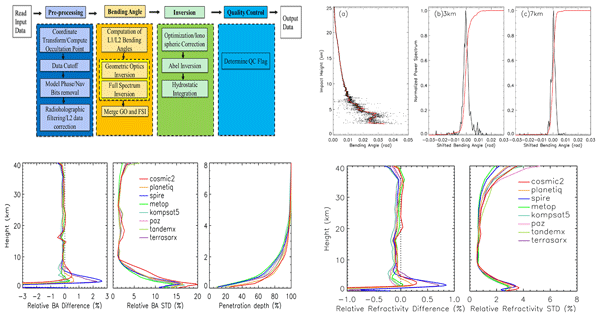
- I find it quite difficult to tell the different lines apart from the bending angle and refractivity figures in Figs 5-10. Can this be improved by changing the color scheme? Perhaps it makes sense to skip some missions (e.g, TSX, TDX, KS5, Paz should be quite similar, so you can probably combine them or just show one of them and state any notable difference among them in the caption or text). To interpret Figs 5-10 properly in the lowest few km, it would be important to see the profile depth penetration for the different missions/processing. Could this be included somehow without cluttering the plots too much?
Citation: https://doi.org/10.5194/egusphere-2025-5763-RC2 - AC2: 'Reply on RC2', Yong Chen, 01 Apr 2026
-
RC3: 'Comment on egusphere-2025-5763', Anonymous Referee #3, 05 Mar 2026
- AC3: 'Reply on RC3', Yong Chen, 01 Apr 2026


Interactive discussion
Status: closed
-
RC1: 'Comment on egusphere-2025-5763', Josep M. Aparicio, 12 Jan 2026
The paper is interesting as a source of homogenized structural uncertainty studies, where the ROMEX database has been used to provide a coherent sampling of different source data. It is relevant to be aware of difficult to reduce errors, sometimes systematic, and that some atmospheric circumstances lead to retrievals of better quality, while others are quite dependent on apparently minor details of the retrieval. The issue of the retrieval uncertainty is still insufficiently addressed.
The subject is thus interesting and a good application of the ROMEX database. There however are a number of corrections and clarifications that I believe are important, as detailed below.
L150 and Tab1: The volume of Tianmu is indeed small within the ROMEX ensemble. However the average I have, admittedly on a superficial count, is of the order of 300 profiles/day, rather than 100/day. Please verify.
L213, etc but also elsewhere: The authors mention interpolation of certain quantities onto a common sampling grid. Since certain quantities such as position are non-trivial to interpolate to the required accuracy, please indicate summarily some details about the sufficiency of the interpolation. A quadratic is mentioned. Is a quadratic interpolation sufficient at 1Hz?
L234: “intersection of the line-of-sight with the WGS84 ellipsoid”. The authors seem to be defining the SLTA=0 line and tangent point. This straight line between satellites is not a “line-of-sight”, as the propagation trajectory is bent. Also, this line at this moment is not intersecting the ellipsoid, but is tangent to it. Please adjust the wording.
L235: Presumably also the center of curvature has to be computed, and the coordinate system adjusted to be centered at that point.
L257: Please provide some references to some of the existing studies around this truncation. This is a significantly complex issue, and the referencing should indicate its non-trivial character.
L272-296: The MSIS-90 is ok for the temperature and to establish the approximate range in moist refractivity. However, one of the major issues is the presence of large vertical gradients of relative humidity, which may lead to large bending angles, superrefraction, etc. This model phase does not account for this possibility, nor seems to be considering the range of moistures. Is this model only identifying bit slips? Or will it introduce (false positive) bit corrections when there are RH gradients?
L300: There are many parameters here. Although I agree that filtering is to some extent desirable, are these parameters optimal? Have other filtering parameters been tested, with the optimal results chosen? Under which criteria are the mentioned parameters optimal?
L324: With MSP there may be a number of subcomponents that are stationary. There may be from none under anomalous propagation to several under multipath, although there is often just one dominant component. Should not L327 (eq 9) be a sum of perhaps several stationary components? Or has it been assumed that we focus only in the dominant? Does the text apply only to a case where there is one dominant component? Or does eq 9 express only one of the stationary components, in case there were several? Please clarify.
L363: Does this projection modify only the satellite orbits? Or, since the radius and center of curvature vary during the occultation, are these somehow reprojected also?
L386: Does this criterion reject the low troposphere?
L399, eq 17: Aren’t you using alpha in a different sense wrt before? Before it was the bending angle, while here it would suggest that alpha is the instantaneous bending angle minus the average bending angle (thus something like alpha-). Please make sure that the variable naming is consistent.
L417: Please reference Eq 18, as it is not the definition of the neutral bending angle, but a good practical approximation to obtain it from alpha L1 and alpha L2 (Vorobev & Krasilnikova, 1994).
L441: Could this climatological data be specified?
L456…: Is this procedure valid only in hindcast? Or can it be applied in Near-Real-Time? (Availability of ERA5). It is also unclear in L457 if sigma_Year means the yearly variability of O-B, or the variability of B. In L466, thus later, it appears that it is O-B. Besides, is this statistic global? It could have been regional, by latitude band… Please clarify.
L470: Is this intended to analyze only height between 8-40km (or 10-40). The most interesting part is below 5 km. Is the method inappropriate here?
L512: Comment here if the ionosphere was particularly active during the study period, thus if these are average circumstances, worse-case, etc.
L514…: Comment here on the typical SNR of the different missions.
L581: Isn’t there a GO-to-FSI switch at a given altitude? 25km? It is mentioned again below, but would it not be appropriate to remind it somewhere in this section?
L654…: The average and std between methods are shown, but not compared to the O-retrieval. Would it not be appropriate to indicate the fraction of the O-B differences that are explained by structural uncertainties of the retrieval? That is, are the O-B dominated by the retrieval method? Or is the exact retrieval a secondary source of uncertainty? This fraction is likely a function of altitude.
L840: Does the FSI being presented restrict the vertical range where it is practical to apply? Some issues mentioned above would suggest that the procedure may be inappropriate for the low troposphere. Is it the case? Or the method does provide an alternative estimation at all practical altitudes?
Citation: https://doi.org/10.5194/egusphere-2025-5763-RC1 - AC1: 'Reply on RC1', Yong Chen, 01 Apr 2026
-
EC1: 'Comment on egusphere-2025-5763', Richard Anthes, 15 Feb 2026
The authors say in lines 772-774 “Anthes et al. (2025) reported that the UCAR-processed COSMIC-2 bending angles included in ROMEX exhibit a positive bias of approximately +0.1-0.15% relative to ERA5 in the lower stratosphere, larger than the biases seen for Spire and other ROMEX datasets.” This statement by itself is incomplete and misleading. In the Anthes et al. (2025) preprint and in the final published version https://doi.org/10.5194/amt-18-6997-2025 it is made clear that the COSMIC-2 “bias” of 0.1 to 0.15% in the lower stratosphere (specifically between 10 and 30 km) is mostly a representativeness difference and not a true bias, and is caused by the different orbits of COSMIC-2 and the other ROMEX missions around the non-spherical Earth and the associated varying radius of curvature. This is described in detail in Section 5.2 of the paper as the azimuth effect and results in most (about 0.1%) of the apparent bias. Because it is a representativeness difference and not a true bias, it does not affect data assimilation in models. The remaining small part of the apparent bias (less than 0.05%) is due to the sideways sliding of the occultation plane and can be easily corrected in the processing of the RO data by applying a correction to the impact height.
Citation: https://doi.org/10.5194/egusphere-2025-5763-EC1 - AC4: 'Reply on EC1', Yong Chen, 01 Apr 2026
-
RC2: 'Comment on egusphere-2025-5763', Anonymous Referee #2, 02 Mar 2026
This paper describes the FSI-based retrieval system implemented at NOAA STAR (referred to as “RFSI”) and applied to process the ROMEX multi-mission dataset. The retrieved bending angle and refractivity profiles were compared statistically with results obtained using “standard” ROPP (based on CT2), starting from the same Level 1b excess phase data, and with results processed by EUMETSAT.
Overall, the paper contains interesting results that can be worthy of publication. I agree with the general finding that “structural uncertainly depends on both the processing algorithm and the satellite mission” (Lines 808-809) and studies like this are an important step in the right direction. The difference found in the COSMIC-2 bias is very interesting (Fig. 16). However, as detailed below, I think the explanation/attribution of the differences between the different processing systems was not done very rigorously. There are also certain aspects of the processing that should be explained better. These should be revised.
Specific comments:
- “Multipath effects”: The paper claims throughout the article that “multipath effects” are an important factor that account for the differences among the different processing methods (and among the different RO instruments). I would like to see this elaborated or substantiated. Given that FSI and CT methods both untangle the atmospheric multipaths in a similar way, why would the multipath leads to a different result? And is there any reason to think that the atmospheric multipath would impact the open-loop signal tracking among the different RO instruments/missions?
- FSI vs CT2: The paper claims that there is a fundamental difference between FSI and CT2 in that “The FSI method, designed to resolve fine-scale atmospheric structures by leveraging full-spectrum signal information, demonstrated improved sensitivity in the lower atmosphere…” (Lines 796-798). Also Linea 57-58 (and other places throughout the paper): “FSI has demonstrated particular strength in resolving fine-scale atmospheric structures.” Is it really true that FSI has improved sensitivity over CT/CT2 or phase matching? Is there any published paper that can back up this claim?
- RFSI SNR cutoff (Lines 240-261): RFSI uses a fairly complex SNR cutoff method. Unless it is described elsewhere (in which case please provide a citation), it would be important to include some examples showing how removing the low-level SNR spikes would modify the bending angle retrieval results.
- Section 3.2.1: computation of model phase. It is not entirely clear to me to this model phase is used for. Is it for correcting navigation bit jumps only? Why are you not using the actual GNSS navigation bits to account for this? Such “external” navigation bit jumps correction could be unreliable when the SNR is low.
- Section 3.4: quality control. A “7 sigma” (annual global average) determined from ERA5 forecast field is used to perform QC over 10-40 km altitude (not impact height?). Why “7 sigma”? And is the rejection rate? Also, Lines 465-466: “Model simulation data is unavailable” – why would it be unavailable?
- Lines 385-385: “The lowest point is defined as the location where the amplitude drops below 0.35 of the normalized amplitude.” How is 0.35 justified?
- Sec 3.3.1: Please explain what background bending angle was used for the statistical optimization.
- Lines 502-505: Figs 5-6, COSMIC-2 shows higher BA standard deviation below 10 km, especially using the RFSI method. “These discrepancies are likely attributed to increased atmospheric variability in the boundary layer, limitations in signal tracking during multipath propagation, and the sensitivity of the bending angle retrievals to SNR cut-off thresholds.” First, “boundary layer” should be changed to “troposphere” since the increase in standard deviation extends up to 10 km. Second, I don’t know what “limitations in signal tracking during multipath propagation” is referring to. And why should the “SNR cut-off thresholds” affect COSMIC-2 more than other missions?
- I find it quite difficult to tell the different lines apart from the bending angle and refractivity figures in Figs 5-10. Can this be improved by changing the color scheme? Perhaps it makes sense to skip some missions (e.g, TSX, TDX, KS5, Paz should be quite similar, so you can probably combine them or just show one of them and state any notable difference among them in the caption or text). To interpret Figs 5-10 properly in the lowest few km, it would be important to see the profile depth penetration for the different missions/processing. Could this be included somehow without cluttering the plots too much?
Citation: https://doi.org/10.5194/egusphere-2025-5763-RC2 - AC2: 'Reply on RC2', Yong Chen, 01 Apr 2026
-
RC3: 'Comment on egusphere-2025-5763', Anonymous Referee #3, 05 Mar 2026
- AC3: 'Reply on RC3', Yong Chen, 01 Apr 2026
Peer review completion


Journal article(s) based on this preprint
Viewed
| HTML | XML | Total | BibTeX | EndNote | |
|---|---|---|---|---|---|
| 1,661 | 829 | 195 | 2,685 | 168 | 117 |
- HTML: 1,661
- PDF: 829
- XML: 195
- Total: 2,685
- BibTeX: 168
- EndNote: 117
Viewed (geographical distribution)
| Country | # | Views | % |
|---|
| Total: | 0 |
| HTML: | 0 |
| PDF: | 0 |
| XML: | 0 |
- 1
Xinjia Zhou
Xin Jing
Shu-Peng Ho
Xi Shao
Tung-Chang Liu
The requested preprint has a corresponding peer-reviewed final revised paper. You are encouraged to refer to the final revised version.
- Preprint
(2187 KB) - Metadata XML
The paper is interesting as a source of homogenized structural uncertainty studies, where the ROMEX database has been used to provide a coherent sampling of different source data. It is relevant to be aware of difficult to reduce errors, sometimes systematic, and that some atmospheric circumstances lead to retrievals of better quality, while others are quite dependent on apparently minor details of the retrieval. The issue of the retrieval uncertainty is still insufficiently addressed.
The subject is thus interesting and a good application of the ROMEX database. There however are a number of corrections and clarifications that I believe are important, as detailed below.
L150 and Tab1: The volume of Tianmu is indeed small within the ROMEX ensemble. However the average I have, admittedly on a superficial count, is of the order of 300 profiles/day, rather than 100/day. Please verify.
L213, etc but also elsewhere: The authors mention interpolation of certain quantities onto a common sampling grid. Since certain quantities such as position are non-trivial to interpolate to the required accuracy, please indicate summarily some details about the sufficiency of the interpolation. A quadratic is mentioned. Is a quadratic interpolation sufficient at 1Hz?
L234: “intersection of the line-of-sight with the WGS84 ellipsoid”. The authors seem to be defining the SLTA=0 line and tangent point. This straight line between satellites is not a “line-of-sight”, as the propagation trajectory is bent. Also, this line at this moment is not intersecting the ellipsoid, but is tangent to it. Please adjust the wording.
L235: Presumably also the center of curvature has to be computed, and the coordinate system adjusted to be centered at that point.
L257: Please provide some references to some of the existing studies around this truncation. This is a significantly complex issue, and the referencing should indicate its non-trivial character.
L272-296: The MSIS-90 is ok for the temperature and to establish the approximate range in moist refractivity. However, one of the major issues is the presence of large vertical gradients of relative humidity, which may lead to large bending angles, superrefraction, etc. This model phase does not account for this possibility, nor seems to be considering the range of moistures. Is this model only identifying bit slips? Or will it introduce (false positive) bit corrections when there are RH gradients?
L300: There are many parameters here. Although I agree that filtering is to some extent desirable, are these parameters optimal? Have other filtering parameters been tested, with the optimal results chosen? Under which criteria are the mentioned parameters optimal?
L324: With MSP there may be a number of subcomponents that are stationary. There may be from none under anomalous propagation to several under multipath, although there is often just one dominant component. Should not L327 (eq 9) be a sum of perhaps several stationary components? Or has it been assumed that we focus only in the dominant? Does the text apply only to a case where there is one dominant component? Or does eq 9 express only one of the stationary components, in case there were several? Please clarify.
L363: Does this projection modify only the satellite orbits? Or, since the radius and center of curvature vary during the occultation, are these somehow reprojected also?
L386: Does this criterion reject the low troposphere?
L399, eq 17: Aren’t you using alpha in a different sense wrt before? Before it was the bending angle, while here it would suggest that alpha is the instantaneous bending angle minus the average bending angle (thus something like alpha-). Please make sure that the variable naming is consistent.
L417: Please reference Eq 18, as it is not the definition of the neutral bending angle, but a good practical approximation to obtain it from alpha L1 and alpha L2 (Vorobev & Krasilnikova, 1994).
L441: Could this climatological data be specified?
L456…: Is this procedure valid only in hindcast? Or can it be applied in Near-Real-Time? (Availability of ERA5). It is also unclear in L457 if sigma_Year means the yearly variability of O-B, or the variability of B. In L466, thus later, it appears that it is O-B. Besides, is this statistic global? It could have been regional, by latitude band… Please clarify.
L470: Is this intended to analyze only height between 8-40km (or 10-40). The most interesting part is below 5 km. Is the method inappropriate here?
L512: Comment here if the ionosphere was particularly active during the study period, thus if these are average circumstances, worse-case, etc.
L514…: Comment here on the typical SNR of the different missions.
L581: Isn’t there a GO-to-FSI switch at a given altitude? 25km? It is mentioned again below, but would it not be appropriate to remind it somewhere in this section?
L654…: The average and std between methods are shown, but not compared to the O-retrieval. Would it not be appropriate to indicate the fraction of the O-B differences that are explained by structural uncertainties of the retrieval? That is, are the O-B dominated by the retrieval method? Or is the exact retrieval a secondary source of uncertainty? This fraction is likely a function of altitude.
L840: Does the FSI being presented restrict the vertical range where it is practical to apply? Some issues mentioned above would suggest that the procedure may be inappropriate for the low troposphere. Is it the case? Or the method does provide an alternative estimation at all practical altitudes?