
the Creative Commons Attribution 4.0 License.
the Creative Commons Attribution 4.0 License.
 | 25 Nov 2025
Analysis of convective cell development with split and merge events using a graph-based methodology
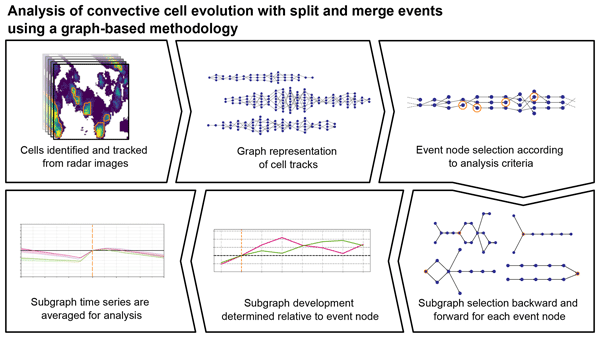
Abstract. Convective storms are associated with several hazards, including heavy rainfall, hail, and lightning, which pose severe risks to society. While the nowcasting (i.e., short-term forecasting from 5 minutes to 6 hours) of storm locations has been extensively studied, nowcasting storm development remains a challenge. Nowcasting rapid, non-linear convective storm development requires finding connections between observations and storm development and representing them in the nowcasting model. Convective cell identification and tracking algorithms are commonly used for nowcasting and analysis of convective storms. This analysis is complicated by the splits and merges that occur in the cell tracks, either due to the physical processes or data quality issues. Consequently, the splits and merges are often excluded from the analysis. Here, we present a methodology for analyzing cell development around time of interest that explicitly includes the splits and merges in the analysis. The time of interest can be the time when the nowcast is created or the occurrence of some fingerprint of meteorological processes, for example, Zdr columns. We represent the cell tracks as directed graphs where we select event nodes to represent the times of interest. For each event node, a subgraph of related cells from both the past and future of the event node is selected. We propose rules for selecting the subgraphs with the aim of retaining the available information in the subgraph at each time step. Once selected, the cell features in the subgraphs are aggregated into time series for analysis. We demonstrate the methodology through case studies of convective storms with Zdr column features signalling updrafts and apply it to analyze split and merge events using three years of warm-season (MJJAS) operational radar data from the Swiss national weather radar network, with a focus on the total rainfall amount produced by the cells. Splits and merges occur in 7.2 % of all identified cells, and are more frequent in cells with larger vertically integrated liquid (17.9 %) or containing Zdr columns (11.7 %). Typically, cell mergers are associated with growth in total rainfall and cell area, and cell splits are associated with decrease in total rainfall.
-
Notice on discussion status
The requested preprint has a corresponding peer-reviewed final revised paper. You are encouraged to refer to the final revised version.
-
Preprint
(3585 KB)
-
The requested preprint has a corresponding peer-reviewed final revised paper. You are encouraged to refer to the final revised version.
- Preprint
(3585 KB) - Metadata XML
- BibTeX
- EndNote
- Final revised paper


Journal article(s) based on this preprint
Interactive discussion
Status: closed
-
RC1: 'Comment on egusphere-2025-5697', Anonymous Referee #1, 22 Dec 2025
- AC4: 'Reply on RC1', Jenna Ritvanen, 19 Feb 2026
-
CC1: 'Comment on egusphere-2025-5697', Vinzent Klaus, 06 Jan 2026
Thank you for the very interesting work - I have only a short note. For your analysis of cell development surrounding split/merge or merge-split events, have you also considered evaluating other cell properties that are independent of cell size, i.e. based on average/maximum? For example, the maximum ZDR column height could be an interesting metric.
Citation: https://doi.org/10.5194/egusphere-2025-5697-CC1 -
AC3: 'Reply on CC1', Jenna Ritvanen, 19 Feb 2026
Thank you for the comment. We also considered evaluating other cell properties, but decided to leave them out of this study to keep the article shorter. We agree that maximum ZDR column height could be an interesting topic for further study that could be analysed by aggregating in the subgraphs with a maximum function rather than summing.
Citation: https://doi.org/10.5194/egusphere-2025-5697-AC3
-
AC3: 'Reply on CC1', Jenna Ritvanen, 19 Feb 2026
-
AC1: 'Comment on egusphere-2025-5697', Jenna Ritvanen, 12 Jan 2026
Dear colleagues,
due to an update in the data repository system, the data set submitted with the manuscript is currently unavailable. The issue should be resolved at some point during January 2026. Until then, please contact me (jenna.ritvanen@fmi.fi) if you want to obtain the dataset.Citation: https://doi.org/10.5194/egusphere-2025-5697-AC1 -
AC2: 'Reply on AC1', Jenna Ritvanen, 30 Jan 2026
Please note that the data set is now again available through the link.
Citation: https://doi.org/10.5194/egusphere-2025-5697-AC2
-
AC2: 'Reply on AC1', Jenna Ritvanen, 30 Jan 2026
-
RC2: 'Comment on egusphere-2025-5697', Anonymous Referee #2, 04 Feb 2026
The manuscript presents an interesting and very complex topic, such as the tracking of convective cells in environments with multiple splittings and mergings. It is one of the most challenging issues in short-term forecasting due to the nature of multicell systems, with many interactions across different scales.
- Consider a more recent reference (at least add one) for VIL introduction (L131)
- Figure 2 is a bit confusing. t0 is not the current time, and it should be clearly explained. Furthermore, regarding this scheme, I have not been able to find the validity period. I mean, until when can a certain scheme be used for nowcasting?
- A doubt regarding the cell identification: have you tested in highly efficient precipitation clouds without ice particles or scarce ones? Is this technique effective in these cases? Please comment in the text.
- Another point referring to the cell identification: "Contiguous area identified from a radar image; represents an observation of a convective storm" is very vague and needs more precision. Are you considering single-threshold or multiple ones? Are you considering the same values for all the months? Note that VIL is highly sensitive to the seasonal variation. How have you solved this point?
- The presented examples are very illustrative, but I miss a more difficult situation, for instance, from May or September, with lower VIL values and, therefore, a more complex cell identification.
- Figure 6: Why do the ZDr index values not coincide with those of the other variables? (e.g. left panel, most representative cell index is 3, but for Zdr is 1)
- For the same figure, I understand that the current time is 18.05 and 10.05, respectively. Is this it? Please, clarify
- "Thus, the impact of splits and merges to the analysis depends on the definition of the cells that the analysis focuses on." I think the Authors should provide more information about this point, maybe with a discussion referring to other Authors.
- Regarding the number of splittings and mergings, have you found any correlation with the size of the cells?
- I don't understand the source of this conclusion: "It was documented that splits and merges occurred in 7.2% of all identified cells, and they were more frequent in cells with maximum VIL ≥ 20.0 kg m−2 (17.9%) or containing ZdrC features (11.7%)" (I were not able to find in the Results any comment regarding this)
Best regards
Citation: https://doi.org/10.5194/egusphere-2025-5697-RC2 - AC5: 'Reply on RC2', Jenna Ritvanen, 19 Feb 2026
Peer review completion


Interactive discussion
Status: closed
-
RC1: 'Comment on egusphere-2025-5697', Anonymous Referee #1, 22 Dec 2025
General Comments
This paper addresses the important challenge of accounting for storm splits and mergers in storm tracking algorithms. The authors demonstrate that spatiotemporal graphs are a natural fit for this problem. The storm detection, tracking, and graph creation methods are clearly explained and well justified. An excellent case is made for the use of graph-based storm tracking in storm nowcasting algorithms.
Specific Comments
To avoid confusion between the notions of predicting storm initiation and predicting development of existing storms, I recommend replacing “development” with “evolution” in at least some instances, including within the title.
In the Intro, consider additionally citing Skinner et al. (2018, Wea. and Forecasting) and Heinselman et al. (2025, Wea. and Forecasting) as examples of storm object identification and storm nowcasting studies, respectively.
The x’s in Fig. 3 are somewhat difficult to see.
Section 4: For clarity, I recommend emphasizing/reminding that the statistics presented here are valid for cell events, not for entire cell lifetimes.
L374–375: Why is the smaller sample size likely to bias the rates of increase/decrease low? Is this a post hoc assumption?
Technical Corrections
L265: Figure 1 → Figure 3
Citation: https://doi.org/10.5194/egusphere-2025-5697-RC1 - AC4: 'Reply on RC1', Jenna Ritvanen, 19 Feb 2026
-
CC1: 'Comment on egusphere-2025-5697', Vinzent Klaus, 06 Jan 2026
Thank you for the very interesting work - I have only a short note. For your analysis of cell development surrounding split/merge or merge-split events, have you also considered evaluating other cell properties that are independent of cell size, i.e. based on average/maximum? For example, the maximum ZDR column height could be an interesting metric.
Citation: https://doi.org/10.5194/egusphere-2025-5697-CC1 -
AC3: 'Reply on CC1', Jenna Ritvanen, 19 Feb 2026
Thank you for the comment. We also considered evaluating other cell properties, but decided to leave them out of this study to keep the article shorter. We agree that maximum ZDR column height could be an interesting topic for further study that could be analysed by aggregating in the subgraphs with a maximum function rather than summing.
Citation: https://doi.org/10.5194/egusphere-2025-5697-AC3
-
AC3: 'Reply on CC1', Jenna Ritvanen, 19 Feb 2026
-
AC1: 'Comment on egusphere-2025-5697', Jenna Ritvanen, 12 Jan 2026
Dear colleagues,
due to an update in the data repository system, the data set submitted with the manuscript is currently unavailable. The issue should be resolved at some point during January 2026. Until then, please contact me (jenna.ritvanen@fmi.fi) if you want to obtain the dataset.Citation: https://doi.org/10.5194/egusphere-2025-5697-AC1 -
AC2: 'Reply on AC1', Jenna Ritvanen, 30 Jan 2026
Please note that the data set is now again available through the link.
Citation: https://doi.org/10.5194/egusphere-2025-5697-AC2
-
AC2: 'Reply on AC1', Jenna Ritvanen, 30 Jan 2026
-
RC2: 'Comment on egusphere-2025-5697', Anonymous Referee #2, 04 Feb 2026
The manuscript presents an interesting and very complex topic, such as the tracking of convective cells in environments with multiple splittings and mergings. It is one of the most challenging issues in short-term forecasting due to the nature of multicell systems, with many interactions across different scales.
- Consider a more recent reference (at least add one) for VIL introduction (L131)
- Figure 2 is a bit confusing. t0 is not the current time, and it should be clearly explained. Furthermore, regarding this scheme, I have not been able to find the validity period. I mean, until when can a certain scheme be used for nowcasting?
- A doubt regarding the cell identification: have you tested in highly efficient precipitation clouds without ice particles or scarce ones? Is this technique effective in these cases? Please comment in the text.
- Another point referring to the cell identification: "Contiguous area identified from a radar image; represents an observation of a convective storm" is very vague and needs more precision. Are you considering single-threshold or multiple ones? Are you considering the same values for all the months? Note that VIL is highly sensitive to the seasonal variation. How have you solved this point?
- The presented examples are very illustrative, but I miss a more difficult situation, for instance, from May or September, with lower VIL values and, therefore, a more complex cell identification.
- Figure 6: Why do the ZDr index values not coincide with those of the other variables? (e.g. left panel, most representative cell index is 3, but for Zdr is 1)
- For the same figure, I understand that the current time is 18.05 and 10.05, respectively. Is this it? Please, clarify
- "Thus, the impact of splits and merges to the analysis depends on the definition of the cells that the analysis focuses on." I think the Authors should provide more information about this point, maybe with a discussion referring to other Authors.
- Regarding the number of splittings and mergings, have you found any correlation with the size of the cells?
- I don't understand the source of this conclusion: "It was documented that splits and merges occurred in 7.2% of all identified cells, and they were more frequent in cells with maximum VIL ≥ 20.0 kg m−2 (17.9%) or containing ZdrC features (11.7%)" (I were not able to find in the Results any comment regarding this)
Best regards
Citation: https://doi.org/10.5194/egusphere-2025-5697-RC2 - AC5: 'Reply on RC2', Jenna Ritvanen, 19 Feb 2026
Peer review completion
Journal article(s) based on this preprint
Data sets
Data for manuscript "Analysis of convective cell development with split and merge events using a graph-based methodology" by Ritvanen et al. Jenna Ritvanen et al. https://doi.org/10.57707/fmi-b2share.c857ccb10eb547d2a21384cc37ddaf7b
Model code and software
fmidev/convective-cell-graph-analysis: Graph-based Analysis of Convective Cell Development Jenna Ritvanen https://doi.org/10.5281/zenodo.17540363
Viewed
| HTML | XML | Total | BibTeX | EndNote | |
|---|---|---|---|---|---|
| 928 | 462 | 133 | 1,523 | 53 | 47 |
- HTML: 928
- PDF: 462
- XML: 133
- Total: 1,523
- BibTeX: 53
- EndNote: 47
Viewed (geographical distribution)
| Country | # | Views | % |
|---|
| Total: | 0 |
| HTML: | 0 |
| PDF: | 0 |
| XML: | 0 |
- 1
Jenna Ritvanen

Martin Aregger
Dmitri Moisseev
Urs Germann
Alessandro Hering
Seppo Pulkkinen
The requested preprint has a corresponding peer-reviewed final revised paper. You are encouraged to refer to the final revised version.
- Preprint
(3585 KB) - Metadata XML
General Comments
This paper addresses the important challenge of accounting for storm splits and mergers in storm tracking algorithms. The authors demonstrate that spatiotemporal graphs are a natural fit for this problem. The storm detection, tracking, and graph creation methods are clearly explained and well justified. An excellent case is made for the use of graph-based storm tracking in storm nowcasting algorithms.
Specific Comments
To avoid confusion between the notions of predicting storm initiation and predicting development of existing storms, I recommend replacing “development” with “evolution” in at least some instances, including within the title.
In the Intro, consider additionally citing Skinner et al. (2018, Wea. and Forecasting) and Heinselman et al. (2025, Wea. and Forecasting) as examples of storm object identification and storm nowcasting studies, respectively.
The x’s in Fig. 3 are somewhat difficult to see.
Section 4: For clarity, I recommend emphasizing/reminding that the statistics presented here are valid for cell events, not for entire cell lifetimes.
L374–375: Why is the smaller sample size likely to bias the rates of increase/decrease low? Is this a post hoc assumption?
Technical Corrections
L265: Figure 1 → Figure 3