
the Creative Commons Attribution 4.0 License.
the Creative Commons Attribution 4.0 License.
 | 19 Nov 2025
Documenting the 2015–2017 freshening of the eastern Eurasian Basin of the Arctic Ocean and evaluating its drivers and consequences
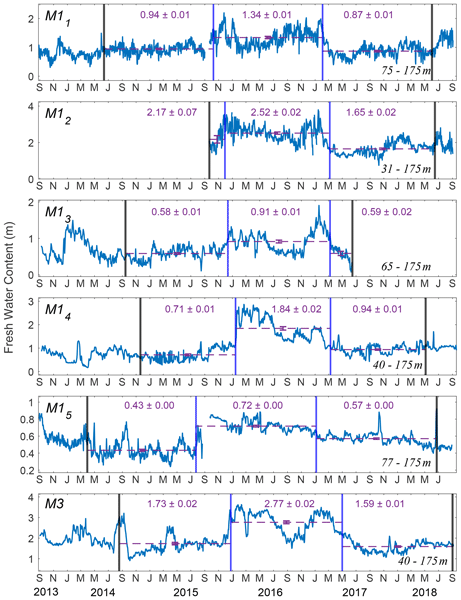
Abstract. The Arctic Ocean is undergoing rapid change, with freshwater playing a central role in shaping stratification, vertical heat exchange, and sea-ice loss. Using long-term observations from the Nansen and Amundsen Basins Observational System (NABOS), we document an extreme freshening event in the eastern Eurasian Basin between late 2015 and early 2017. During this period, salinity in the upper 175 m decreased by ~0.5 psu, equivalent to an additional ~0.6 m of freshwater, relative to the preceding (2013–2015) and following (2017–2018) years. The anomaly originated on the Kara Sea shelves in 2014–2015, when exceptional Yenisey and Ob discharge provided a combined freshwater surplus of ~0.78 m, sufficient to explain the observed freshening. Trajectory analysis traced the freshwater anomaly to the Kara Sea, with transport times of 8–9 months to the shelf and 22–23 months to offshore. The resulting enhanced stratification suppressed upper-ocean currents by ~22 % and vertical shear by ~50 %, reducing vertical heat flux from the ocean interior. These changes enabled thicker sea ice to persist through the summers of 2016–2017, in contrast to near-ice-free conditions in adjacent years. While wind anomalies aided the retention of freshwater along the slope, river discharge was the dominant driver of the event. Overall, the 2015–2017 event demonstrates how episodic river discharge events can restructure upper-ocean stratification, reduce oceanic heat fluxes, and lead to delayed melt and increased summer sea ice, highlighting the sensitivity of upper-ocean processes and sea ice to episodic freshwater forcing in the Arctic.
-
Notice on discussion status
The requested preprint has a corresponding peer-reviewed final revised paper. You are encouraged to refer to the final revised version.
-
Preprint
(3101 KB)
-
Supplement
(914 KB)
-
The requested preprint has a corresponding peer-reviewed final revised paper. You are encouraged to refer to the final revised version.
- Preprint
(3101 KB) - Metadata XML
-
Supplement
(914 KB) - BibTeX
- EndNote
- Final revised paper


Journal article(s) based on this preprint
Interactive discussion
Status: closed
-
RC1: 'Comment on egusphere-2025-5592', Anonymous Referee #1, 22 Dec 2025
- AC1: 'Reply on RC1', Igor Polyakov, 21 Apr 2026
-
RC2: 'Comment on egusphere-2025-5592', Sergei Kirillov, 04 Mar 2026
The comment was uploaded in the form of a supplement: https://egusphere.copernicus.org/preprints/2025/egusphere-2025-5592/egusphere-2025-5592-RC2-supplement.pdf
- AC2: 'Reply on RC2', Igor Polyakov, 21 Apr 2026
-
RC3: 'Comment on egusphere-2025-5592', Anonymous Referee #3, 18 Mar 2026
The comment was uploaded in the form of a supplement: https://egusphere.copernicus.org/preprints/2025/egusphere-2025-5592/egusphere-2025-5592-RC3-supplement.pdf
- AC3: 'Reply on RC3', Igor Polyakov, 21 Apr 2026
Peer review completion


Post-review adjustments


Interactive discussion
Status: closed
-
RC1: 'Comment on egusphere-2025-5592', Anonymous Referee #1, 22 Dec 2025
- AC1: 'Reply on RC1', Igor Polyakov, 21 Apr 2026
-
RC2: 'Comment on egusphere-2025-5592', Sergei Kirillov, 04 Mar 2026
The comment was uploaded in the form of a supplement: https://egusphere.copernicus.org/preprints/2025/egusphere-2025-5592/egusphere-2025-5592-RC2-supplement.pdf
- AC2: 'Reply on RC2', Igor Polyakov, 21 Apr 2026
-
RC3: 'Comment on egusphere-2025-5592', Anonymous Referee #3, 18 Mar 2026
The comment was uploaded in the form of a supplement: https://egusphere.copernicus.org/preprints/2025/egusphere-2025-5592/egusphere-2025-5592-RC3-supplement.pdf
- AC3: 'Reply on RC3', Igor Polyakov, 21 Apr 2026
Peer review completion
Post-review adjustments
Journal article(s) based on this preprint
Viewed
| HTML | XML | Total | Supplement | BibTeX | EndNote | |
|---|---|---|---|---|---|---|
| 1,345 | 453 | 175 | 1,973 | 333 | 205 | 136 |
- HTML: 1,345
- PDF: 453
- XML: 175
- Total: 1,973
- Supplement: 333
- BibTeX: 205
- EndNote: 136
Viewed (geographical distribution)
| Country | # | Views | % |
|---|
| Total: | 0 |
| HTML: | 0 |
| PDF: | 0 |
| XML: | 0 |
- 1
Dolly More
The requested preprint has a corresponding peer-reviewed final revised paper. You are encouraged to refer to the final revised version.
- Preprint
(3101 KB) - Metadata XML
-
Supplement
(914 KB) - BibTeX
- EndNote
- Final revised paper
Please see attached PDF document.