
the Creative Commons Attribution 4.0 License.
the Creative Commons Attribution 4.0 License.
 | 29 Dec 2025
Automated Analysis and Quality Assurance of Ice-Nucleating Particle Data: The PINE INP Analysis Software PIA
Abstract. The presence of ice-nucleating particles (INPs) in the atmosphere plays a crucial role in shaping cloud radiative properties, influencing their lifespan, and affecting precipitation and storm dynamics. To enable continuous and high-resolution monitoring of INP concentrations, the Portable Ice Nucleation Experiment (PINE) was developed. Complementing this, the PINE INP Analysis (PIA) software was created to ensure a standardised and reproducible data processing workflow. This work presents the setup of software version 3.0.0 and the structure of the processed data. The two main components of the software – the automated quality control of the data and the algorithm to distinguish between aerosols and droplets versus ice crystals based on their optical size – are described in detail. The second part of this study provides recommendations for quality assurance of PINE measurements. It outlines procedures for conducting background checks to detect potential contamination within the chamber, evaluates the consistency between adjacent temperature sensors, and discusses how large aerosol particles 10 can impact measurement uncertainty.
Competing interests: OM, LL, and BM were involved in a prior technology transfer project between KIT, University of Leeds, and Bilfinger Nuclear & Energy Transition GmbH (Würzburg, Germany) related to the development and commercialization of the underlying PINE instrument. The software described in this work is independent of this project, open source and freely available. The authors declare no competing financial interests.
Publisher's note: Copernicus Publications remains neutral with regard to jurisdictional claims made in the text, published maps, institutional affiliations, or any other geographical representation in this paper. While Copernicus Publications makes every effort to include appropriate place names, the final responsibility lies with the authors. Views expressed in the text are those of the authors and do not necessarily reflect the views of the publisher.-
Notice on discussion status
The requested preprint has a corresponding peer-reviewed final revised paper. You are encouraged to refer to the final revised version.
-
Preprint
(2214 KB)
-
The requested preprint has a corresponding peer-reviewed final revised paper. You are encouraged to refer to the final revised version.
- Preprint
(2214 KB) - Metadata XML
- BibTeX
- EndNote
- Final revised paper


Journal article(s) based on this preprint
Interactive discussion
Status: closed
-
RC1: 'Comment on egusphere-2025-5586', Anonymous Referee #1, 19 Jan 2026
The comment was uploaded in the form of a supplement: https://egusphere.copernicus.org/preprints/2025/egusphere-2025-5586/egusphere-2025-5586-RC1-supplement.pdfCitation: https://doi.org/
10.5194/egusphere-2025-5586-RC1 -
AC1: 'Reply on RC1', Nicole Büttner, 17 Jun 2026
The comment was uploaded in the form of a supplement: https://egusphere.copernicus.org/preprints/2025/egusphere-2025-5586/egusphere-2025-5586-AC1-supplement.pdf
-
AC1: 'Reply on RC1', Nicole Büttner, 17 Jun 2026
-
CC1: 'Comment on egusphere-2025-5586', Jan Bumberger, 14 Mar 2026
Please cite instead:
Schäfer, D., Palm, B., Lünenschloß, P., Schmidt, L., Schnicke, T., and Bumberger, J.: System for automated Quality Control - SaQC, https://doi.org/10.5281/zenodo.10975812, 2024.
Schmidt, L., Schäfer, D., Geller, J., Lünenschloss, P., Palm, B., Rinke, K., Rebmann, C., Rode, M., and Bumberger, J.: System for automated Quality Control (SaQC) to enable traceable and reproducible data streams in environmental science, Environmental Modelling & Software, 169, 105809, https://doi.org/10.1016/j.envsoft.2023.105809, 2023.
Citation: https://doi.org/10.5194/egusphere-2025-5586-CC1 -
AC3: 'Reply on CC1', Nicole Büttner, 17 Jun 2026
Thank you for pointing this out. We changed the citation accordingly.
Citation: https://doi.org/10.5194/egusphere-2025-5586-AC3
-
AC3: 'Reply on CC1', Nicole Büttner, 17 Jun 2026
-
RC2: 'Comment on egusphere-2025-5586', Anonymous Referee #2, 10 May 2026
Review of “Automated Analysis and Quality Assurance of Ice-Nucleating Particle Data: The PINE INP Analysis Software PIA” by Büttner et al., 2026
General comment:
The manuscript describes the PIA software for processing raw PINE chamber data into quality-controlled INP concentrations. The authors present the software architecture, an automated ice‑threshold identification algorithm, and a set of quality control tests. The ice-threshold algorithm, the multi-instrument temperature sensor analysis, and the large-aerosol contamination characterisation are original contributions that deserve publication. However, the manuscript requires major revision before the paper can describe PIA as providing a rigorous processing workflow.
I suspect that the INP concentration calculation contains a systematic, unacknowledged bias that likely dominates all other stated uncertainties. As I understand, the entire ice crystal count from each expansion is divided by the total volume pumped through the OPC over the full ~40 second expansion window, yet most nucleation events occur near the reported lowest temperature, which is reached only in the final seconds of the expansion. The volume of air experiencing the minimal temperature is a fraction of the used denominator, leading to a systematic underprediction of the INP concentration. The stated 10% OPC uncertainty is explicitly an assumption rather than a calibration result, and accounting for the volume bias described above, for temperature uncertainty, for large aerosol contamination, or for ice-threshold uncertainty must be included in an uncertainty budget. As the software that produces INP concentrations, the PIA paper must present a self-contained and complete uncertainty budget analysis. Further, large sections of the manuscript reproduce content already available in Möhler et al. (2021) and on pia.readthedocs.io without adding scientific justification, and the paper's relationship to the GloPINE dataset (Herbert et al., 2026), which was produced using PIA, is never stated.Specific comments:
Introduction and Sec. 4.1: Add a statement linking the paper to the GloPINE article (Herbert et al., 2026) and how the PIA software is involved in the processing chain contributing to this dataset. Table 1 of the GloPINE paper lists the PIA software version used for different campaigns. Please explain differences in the previous PIA versions and version 3 and whether the quality‑control remains identical or if not, how it affects the reported INP concentrations.
Section 2.1 and Figure 1: Condense the instrument description to the essential operating principle and key specifications needed to establish physical context for the software and refer for all instrument detail to Möhler et al. (2021). Currently the text follows the same structure and uses nearly identical phrasing as Möhler et al. (2021). Remove any verbatim phrasing. Figure 1 b), c) could be replaced with an illustration of a typical run like the Figure 3 in Möhler et al. (2021) to visualize the chambers working principle.
Line 59ff.: Clarify the relevance of the ambient temperature for the measurement of the dew point temperature. Does the Vaisala sensor report dew point or frost point below 273K? Quantify what dew point is required by the measurement and considered low enough. Below the frost point? On line 411 it is implied that frost formation on the chamber walls is not a severe problem, even helpful to achieve supersaturation.
Line 70, and 86: Figure 2 c) in Möhler et al. (2021) indicates that the refill air is usually not filtered. Please clarify.
Line 73: Provide a reference explaining the OPC tuning protocol.
Line 87-90: The INP concentration is computed as the number of ice crystal counts divided by the total volume pumped through the OPC during the entire expansion. The implicit assumption, that all air volume in the denominator was at the minimum temperature, is physically incorrect. The chamber cools adiabatically by 4-8 K over the expansion. Most ice crystals form near the end, as can be seen for example in Figure 3 in Möhler et al. (2021), when only a fraction of the total air volume was at or near minimum temperature. For a 40 second expansion with most nucleation in the final ~10 seconds, the volume of air close to the minimum temperature is less than 25% of the total. The denominator is therefore roughly 4 times too large, systematically underpredicting INP concentration at the assigned temperature by the same factor. The authors should acknowledge that the expansion method gives an integral INP concentration activating from the start to the end temperature and supersaturation of the expansion. If they want to report a single activation temperature, this bias from the expansion parameters (flow rate, total expansion duration, and the estimated duration of the cold tail) must be quantified. It could be assessed whether it is feasible using the high-resolution chamber condition records and OPC particle timestamps to segment the data into concentrations at different temperature intervals during an expansion. However, the uncertainty budget should be updated accordingly, considering either the sampled volume at the reported, minimum temperature or the change in temperature during an expansion.
Line 92-95: The entire uncertainty budget is outsourced to Böhmländer et al. (2025), which itself is incomplete and states that the 10% OPC uncertainty is a conservative assumption, not a calibration result. The PIA paper, as the software producing INP concentrations, must provide a complete, self-contained uncertainty budget, combining the volumetric bias described above, OPC uncertainty with proper justification, Poisson counting statistics, temperature labelling uncertainty (see comment on Section 5.1 below), ice-threshold uncertainty (Section 4.2.3), and large-aerosol contamination (Section 5.3). It is likely that these uncertainties together far exceed the stated 10% from the OPC, meaning the current stated uncertainty is not the dominant term. The uncertainty budget in Böhmländer et al. (2025), which omits several of these terms entirely, should be updated accordingly.
Section 4.2.3: The validation of the ice-threshold algorithm all uses the fidas-pine OPC, with no sensitivity analysis converting threshold uncertainty to INP concentration uncertainty. Discuss the physical reasons why the threshold varies between repetitions in the same environment as shown in Figure 4. Böhmländer et al. (2025) describe a manual fallback procedure, whose frequency and magnitude are not discussed in the PIA paper. The validation should be extended to include welas OPC data, a test with synthetic data where the true threshold is known, a quantification of INP concentration sensitivity to a up to 5 bin threshold shift, statistics on the frequency of manual fallback across campaigns, and an extended discussion of conditions where the algorithm may fail (e.g., very low ice counts, high background, large aerosol presence).
Figure 5: The last sentence in the caption mentions that zero concentrations are displayed as a ratio of one. Where on the x-axis are these data?
Section 4.3 and Table A2: The QC thresholds are stated to derive from empirical observations but are not scientifically justified. Test conditions could be included in Table A2. For each threshold the paper should state its physical basis, the fraction of expansions it flags, and provide a sensitivity analysis of mean INP concentration if a threshold is tightened or relaxed by 10–20 %. This will give confidence that the QC choices are not arbitrary. The bulk of this section and Table A2 reproduce content already on pia.readthedocs.io. The manuscript should present the scientific justification for the QC design, not a re-statement of the implementation.
Line 363: Clarify if the pump is turned off and not just the flow redirected.
Line 385: Are ice crystal counts corrected for the large aerosol BG measured during flushing?
Line 403: Clarify why -35°C is essential for the range test.
Line 407ff: Specify if supersaturation refers to ice or water, and DP to dew point or frost point.
Equation 4: Dubble check the units of the equation. It should be seconds, but in its current form the right-hand side units cancel out. Also explain where the 60 s come from.
Section 5.1: The finding that PINE-05-02 had Ti5 mispositioned near the chamber wall causing it to report temperatures higher than Ti4 and biasing the assigned minimum temperature warm is an important result but its consequence for INP concentrations in affected measurements is not quantified. To quantify this type of error the Temperature Error Factor framework of Schrod and Bingemer (2025) could be applied. For typical ambient INP spectra Schrod and Bingemer (2025) show that even a 1 K warm bias in the assigned temperature translates to a factor of up to 5 underestimations of INP concentration at the reported temperature. The authors should estimate what the magnitude of the temperature offset was before sensor repositioning, and what the resulting concentration bias is for affected campaigns (LIFE-FROSTDEFEND in the GloPINE table 1). Please calculate the sensitivity of INP concentration to temperature uncertainty for the typical PINE operating range and report the resulting contribution to the combined uncertainty.
Figure 7: The large particle BG seems not to depend on the measured INP concentration. This could be mentioned and the y-axis changed to INP concentration flush instead of the ratio.
Line 543: The manuscript describes version 3.0.0, but the Zenodo DOI cited in the code availability section (zenodo.15592883) is labelled Büttner and Fösig, 2024, while Herbert et al. (2026) and Böhmländer et al. (2025) both cite zenodo.15592431 as PIA Software (v3.1.0), Büttner and Fösig, 2025. It is unclear whether these are distinct archived releases. The manuscript could provide a brief changelog noting any algorithm changes between v2.x, v3.0.0, and the latest version, for tracking reproducibility of datasets processed under earlier versions.
Figure A4: Indicate flush, expansion, refill. Mention that this is a temperature ramp experiment.
Figure A5: Clarify what causes the pressure drop at the end of refill. A run without inlet icing could be added for comparison.
Technical corrections:
Line 93: "uncertainty budged" should be "uncertainty budget."
Line 175: the default Level 2 temperature bin of 0.5 K is finer than the stated ±1 K instrument temperature uncertainty and implies precision not supported by the instrument. The default should be widened to ≥1 K or a clear caveat added.
Line 332: the upper dew point QC range limit of +8°C should be verified. It would cause immediate frost formation, suggesting a sign error.
The expansion flow is given as 3 L min⁻¹ while the flush flow is 2–3 stdL min⁻¹. Use consistent standardised units throughout.
Language that could be interpreted as commercial endorsement should be avoided. Instead of describing PINE’s potential as a “key instrument” or “reference instrument”, stick to neutral, factual statements.
Competing Interests statement: The declaration of no conflict of interest seems inconsistent with acknowledging KIT Technology Transfer project N059 PINE funding, the project that produced the commercially available PINE instrument. This standard academic-commercial relationship should be declared transparently.
References
Böhmländer, A., Lacher, L., Fösig, R., Büttner, N., Nadolny, J., Brus, D., Doulgeris, K.-M., and Möhler, O.: Measurement of the ice-nucleating particle concentration with the Portable Ice Nucleation Experiment during the Pallas Cloud Experiment 2022, Earth Syst. Sci. Data, 17, 6165–6171, https://doi.org/10.5194/essd-17-6165-2025, 2025.
Herbert, R. J., Lacher, L., Böhmländer, A., Tarn, M. D., Canzi, A., Pantoya, A., Freney, E., Höhler, K., Bogert, P., Planche, C., Tian, P., Adams, M., Barr, S., Brus, D., Büttner, N., Daily, M., Doulgeris, K., Eleftheridadis, K., Forster, G., Fösig, R., Georgakopoulos, D., Gini, M., Hallar, A. G., Krejci, R., Ludewig, E., Mazzola, M., McCubbin, I. B., Petäjä, T., Robinson, J., Vogel, F., Zieger, P., Arnold, S. R., Carslaw, K. S., Hiranuma, N., Möhler, O., and Murray, B. J.: GloPINE dataset: model-ready measurements of INP concentrations using PINE instruments, Earth Syst. Sci. Data Discuss. [preprint], https://doi.org/10.5194/essd-2026-41, in review, 2026.
Möhler, O., Adams, M., Lacher, L., Vogel, F., Nadolny, J., Ullrich, R., Boffo, C., Pfeuffer, T., Hobl, A., Weiß, M., Vepuri, H. S. K., Hiranuma, N., and Murray, B. J.: The Portable Ice Nucleation Experiment (PINE): a new online instrument for laboratory studies and automated long-term field observations of ice-nucleating particles, Atmos. Meas. Tech., 14, 1143–1166, https://doi.org/10.5194/amt-14-1143-2021, 2021.
Schrod, J. and Bingemer, H. G.: A view on recent ice-nucleating particle intercomparison studies: why the uncertainty of the activation temperature matters, Atmos. Meas. Tech., 18, 2591–2605, https://doi.org/10.5194/amt-18-2591-2025, 2025.
Citation: https://doi.org/10.5194/egusphere-2025-5586-RC2 -
AC2: 'Reply on RC2', Nicole Büttner, 17 Jun 2026
The comment was uploaded in the form of a supplement: https://egusphere.copernicus.org/preprints/2025/egusphere-2025-5586/egusphere-2025-5586-AC2-supplement.pdf
-
AC2: 'Reply on RC2', Nicole Büttner, 17 Jun 2026
Peer review completion


Interactive discussion
Status: closed
-
RC1: 'Comment on egusphere-2025-5586', Anonymous Referee #1, 19 Jan 2026
The comment was uploaded in the form of a supplement: https://egusphere.copernicus.org/preprints/2025/egusphere-2025-5586/egusphere-2025-5586-RC1-supplement.pdf
-
AC1: 'Reply on RC1', Nicole Büttner, 17 Jun 2026
The comment was uploaded in the form of a supplement: https://egusphere.copernicus.org/preprints/2025/egusphere-2025-5586/egusphere-2025-5586-AC1-supplement.pdf
-
AC1: 'Reply on RC1', Nicole Büttner, 17 Jun 2026
-
CC1: 'Comment on egusphere-2025-5586', Jan Bumberger, 14 Mar 2026
Please cite instead:
Schäfer, D., Palm, B., Lünenschloß, P., Schmidt, L., Schnicke, T., and Bumberger, J.: System for automated Quality Control - SaQC, https://doi.org/10.5281/zenodo.10975812, 2024.
Schmidt, L., Schäfer, D., Geller, J., Lünenschloss, P., Palm, B., Rinke, K., Rebmann, C., Rode, M., and Bumberger, J.: System for automated Quality Control (SaQC) to enable traceable and reproducible data streams in environmental science, Environmental Modelling & Software, 169, 105809, https://doi.org/10.1016/j.envsoft.2023.105809, 2023.
Citation: https://doi.org/10.5194/egusphere-2025-5586-CC1 -
AC3: 'Reply on CC1', Nicole Büttner, 17 Jun 2026
Thank you for pointing this out. We changed the citation accordingly.
Citation: https://doi.org/10.5194/egusphere-2025-5586-AC3
-
AC3: 'Reply on CC1', Nicole Büttner, 17 Jun 2026
-
RC2: 'Comment on egusphere-2025-5586', Anonymous Referee #2, 10 May 2026
Review of “Automated Analysis and Quality Assurance of Ice-Nucleating Particle Data: The PINE INP Analysis Software PIA” by Büttner et al., 2026
General comment:
The manuscript describes the PIA software for processing raw PINE chamber data into quality-controlled INP concentrations. The authors present the software architecture, an automated ice‑threshold identification algorithm, and a set of quality control tests. The ice-threshold algorithm, the multi-instrument temperature sensor analysis, and the large-aerosol contamination characterisation are original contributions that deserve publication. However, the manuscript requires major revision before the paper can describe PIA as providing a rigorous processing workflow.
I suspect that the INP concentration calculation contains a systematic, unacknowledged bias that likely dominates all other stated uncertainties. As I understand, the entire ice crystal count from each expansion is divided by the total volume pumped through the OPC over the full ~40 second expansion window, yet most nucleation events occur near the reported lowest temperature, which is reached only in the final seconds of the expansion. The volume of air experiencing the minimal temperature is a fraction of the used denominator, leading to a systematic underprediction of the INP concentration. The stated 10% OPC uncertainty is explicitly an assumption rather than a calibration result, and accounting for the volume bias described above, for temperature uncertainty, for large aerosol contamination, or for ice-threshold uncertainty must be included in an uncertainty budget. As the software that produces INP concentrations, the PIA paper must present a self-contained and complete uncertainty budget analysis. Further, large sections of the manuscript reproduce content already available in Möhler et al. (2021) and on pia.readthedocs.io without adding scientific justification, and the paper's relationship to the GloPINE dataset (Herbert et al., 2026), which was produced using PIA, is never stated.Specific comments:
Introduction and Sec. 4.1: Add a statement linking the paper to the GloPINE article (Herbert et al., 2026) and how the PIA software is involved in the processing chain contributing to this dataset. Table 1 of the GloPINE paper lists the PIA software version used for different campaigns. Please explain differences in the previous PIA versions and version 3 and whether the quality‑control remains identical or if not, how it affects the reported INP concentrations.
Section 2.1 and Figure 1: Condense the instrument description to the essential operating principle and key specifications needed to establish physical context for the software and refer for all instrument detail to Möhler et al. (2021). Currently the text follows the same structure and uses nearly identical phrasing as Möhler et al. (2021). Remove any verbatim phrasing. Figure 1 b), c) could be replaced with an illustration of a typical run like the Figure 3 in Möhler et al. (2021) to visualize the chambers working principle.
Line 59ff.: Clarify the relevance of the ambient temperature for the measurement of the dew point temperature. Does the Vaisala sensor report dew point or frost point below 273K? Quantify what dew point is required by the measurement and considered low enough. Below the frost point? On line 411 it is implied that frost formation on the chamber walls is not a severe problem, even helpful to achieve supersaturation.
Line 70, and 86: Figure 2 c) in Möhler et al. (2021) indicates that the refill air is usually not filtered. Please clarify.
Line 73: Provide a reference explaining the OPC tuning protocol.
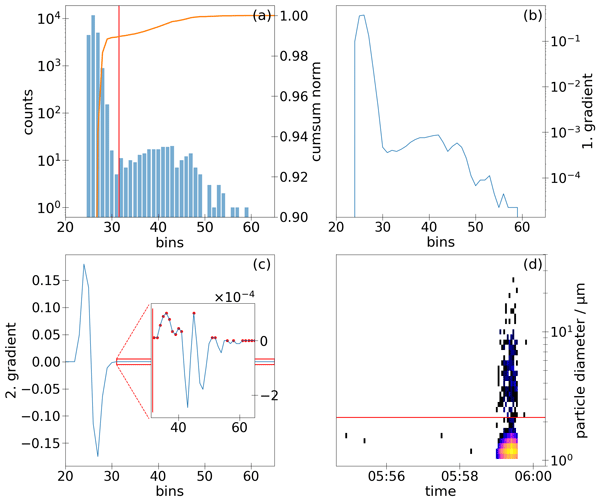
Line 87-90: The INP concentration is computed as the number of ice crystal counts divided by the total volume pumped through the OPC during the entire expansion. The implicit assumption, that all air volume in the denominator was at the minimum temperature, is physically incorrect. The chamber cools adiabatically by 4-8 K over the expansion. Most ice crystals form near the end, as can be seen for example in Figure 3 in Möhler et al. (2021), when only a fraction of the total air volume was at or near minimum temperature. For a 40 second expansion with most nucleation in the final ~10 seconds, the volume of air close to the minimum temperature is less than 25% of the total. The denominator is therefore roughly 4 times too large, systematically underpredicting INP concentration at the assigned temperature by the same factor. The authors should acknowledge that the expansion method gives an integral INP concentration activating from the start to the end temperature and supersaturation of the expansion. If they want to report a single activation temperature, this bias from the expansion parameters (flow rate, total expansion duration, and the estimated duration of the cold tail) must be quantified. It could be assessed whether it is feasible using the high-resolution chamber condition records and OPC particle timestamps to segment the data into concentrations at different temperature intervals during an expansion. However, the uncertainty budget should be updated accordingly, considering either the sampled volume at the reported, minimum temperature or the change in temperature during an expansion.
Line 92-95: The entire uncertainty budget is outsourced to Böhmländer et al. (2025), which itself is incomplete and states that the 10% OPC uncertainty is a conservative assumption, not a calibration result. The PIA paper, as the software producing INP concentrations, must provide a complete, self-contained uncertainty budget, combining the volumetric bias described above, OPC uncertainty with proper justification, Poisson counting statistics, temperature labelling uncertainty (see comment on Section 5.1 below), ice-threshold uncertainty (Section 4.2.3), and large-aerosol contamination (Section 5.3). It is likely that these uncertainties together far exceed the stated 10% from the OPC, meaning the current stated uncertainty is not the dominant term. The uncertainty budget in Böhmländer et al. (2025), which omits several of these terms entirely, should be updated accordingly.
Section 4.2.3: The validation of the ice-threshold algorithm all uses the fidas-pine OPC, with no sensitivity analysis converting threshold uncertainty to INP concentration uncertainty. Discuss the physical reasons why the threshold varies between repetitions in the same environment as shown in Figure 4. Böhmländer et al. (2025) describe a manual fallback procedure, whose frequency and magnitude are not discussed in the PIA paper. The validation should be extended to include welas OPC data, a test with synthetic data where the true threshold is known, a quantification of INP concentration sensitivity to a up to 5 bin threshold shift, statistics on the frequency of manual fallback across campaigns, and an extended discussion of conditions where the algorithm may fail (e.g., very low ice counts, high background, large aerosol presence).
Figure 5: The last sentence in the caption mentions that zero concentrations are displayed as a ratio of one. Where on the x-axis are these data?
Section 4.3 and Table A2: The QC thresholds are stated to derive from empirical observations but are not scientifically justified. Test conditions could be included in Table A2. For each threshold the paper should state its physical basis, the fraction of expansions it flags, and provide a sensitivity analysis of mean INP concentration if a threshold is tightened or relaxed by 10–20 %. This will give confidence that the QC choices are not arbitrary. The bulk of this section and Table A2 reproduce content already on pia.readthedocs.io. The manuscript should present the scientific justification for the QC design, not a re-statement of the implementation.
Line 363: Clarify if the pump is turned off and not just the flow redirected.
Line 385: Are ice crystal counts corrected for the large aerosol BG measured during flushing?
Line 403: Clarify why -35°C is essential for the range test.
Line 407ff: Specify if supersaturation refers to ice or water, and DP to dew point or frost point.
Equation 4: Dubble check the units of the equation. It should be seconds, but in its current form the right-hand side units cancel out. Also explain where the 60 s come from.
Section 5.1: The finding that PINE-05-02 had Ti5 mispositioned near the chamber wall causing it to report temperatures higher than Ti4 and biasing the assigned minimum temperature warm is an important result but its consequence for INP concentrations in affected measurements is not quantified. To quantify this type of error the Temperature Error Factor framework of Schrod and Bingemer (2025) could be applied. For typical ambient INP spectra Schrod and Bingemer (2025) show that even a 1 K warm bias in the assigned temperature translates to a factor of up to 5 underestimations of INP concentration at the reported temperature. The authors should estimate what the magnitude of the temperature offset was before sensor repositioning, and what the resulting concentration bias is for affected campaigns (LIFE-FROSTDEFEND in the GloPINE table 1). Please calculate the sensitivity of INP concentration to temperature uncertainty for the typical PINE operating range and report the resulting contribution to the combined uncertainty.
Figure 7: The large particle BG seems not to depend on the measured INP concentration. This could be mentioned and the y-axis changed to INP concentration flush instead of the ratio.
Line 543: The manuscript describes version 3.0.0, but the Zenodo DOI cited in the code availability section (zenodo.15592883) is labelled Büttner and Fösig, 2024, while Herbert et al. (2026) and Böhmländer et al. (2025) both cite zenodo.15592431 as PIA Software (v3.1.0), Büttner and Fösig, 2025. It is unclear whether these are distinct archived releases. The manuscript could provide a brief changelog noting any algorithm changes between v2.x, v3.0.0, and the latest version, for tracking reproducibility of datasets processed under earlier versions.
Figure A4: Indicate flush, expansion, refill. Mention that this is a temperature ramp experiment.
Figure A5: Clarify what causes the pressure drop at the end of refill. A run without inlet icing could be added for comparison.
Technical corrections:
Line 93: "uncertainty budged" should be "uncertainty budget."
Line 175: the default Level 2 temperature bin of 0.5 K is finer than the stated ±1 K instrument temperature uncertainty and implies precision not supported by the instrument. The default should be widened to ≥1 K or a clear caveat added.
Line 332: the upper dew point QC range limit of +8°C should be verified. It would cause immediate frost formation, suggesting a sign error.
The expansion flow is given as 3 L min⁻¹ while the flush flow is 2–3 stdL min⁻¹. Use consistent standardised units throughout.
Language that could be interpreted as commercial endorsement should be avoided. Instead of describing PINE’s potential as a “key instrument” or “reference instrument”, stick to neutral, factual statements.
Competing Interests statement: The declaration of no conflict of interest seems inconsistent with acknowledging KIT Technology Transfer project N059 PINE funding, the project that produced the commercially available PINE instrument. This standard academic-commercial relationship should be declared transparently.
References
Böhmländer, A., Lacher, L., Fösig, R., Büttner, N., Nadolny, J., Brus, D., Doulgeris, K.-M., and Möhler, O.: Measurement of the ice-nucleating particle concentration with the Portable Ice Nucleation Experiment during the Pallas Cloud Experiment 2022, Earth Syst. Sci. Data, 17, 6165–6171, https://doi.org/10.5194/essd-17-6165-2025, 2025.
Herbert, R. J., Lacher, L., Böhmländer, A., Tarn, M. D., Canzi, A., Pantoya, A., Freney, E., Höhler, K., Bogert, P., Planche, C., Tian, P., Adams, M., Barr, S., Brus, D., Büttner, N., Daily, M., Doulgeris, K., Eleftheridadis, K., Forster, G., Fösig, R., Georgakopoulos, D., Gini, M., Hallar, A. G., Krejci, R., Ludewig, E., Mazzola, M., McCubbin, I. B., Petäjä, T., Robinson, J., Vogel, F., Zieger, P., Arnold, S. R., Carslaw, K. S., Hiranuma, N., Möhler, O., and Murray, B. J.: GloPINE dataset: model-ready measurements of INP concentrations using PINE instruments, Earth Syst. Sci. Data Discuss. [preprint], https://doi.org/10.5194/essd-2026-41, in review, 2026.
Möhler, O., Adams, M., Lacher, L., Vogel, F., Nadolny, J., Ullrich, R., Boffo, C., Pfeuffer, T., Hobl, A., Weiß, M., Vepuri, H. S. K., Hiranuma, N., and Murray, B. J.: The Portable Ice Nucleation Experiment (PINE): a new online instrument for laboratory studies and automated long-term field observations of ice-nucleating particles, Atmos. Meas. Tech., 14, 1143–1166, https://doi.org/10.5194/amt-14-1143-2021, 2021.
Schrod, J. and Bingemer, H. G.: A view on recent ice-nucleating particle intercomparison studies: why the uncertainty of the activation temperature matters, Atmos. Meas. Tech., 18, 2591–2605, https://doi.org/10.5194/amt-18-2591-2025, 2025.
Citation: https://doi.org/10.5194/egusphere-2025-5586-RC2 -
AC2: 'Reply on RC2', Nicole Büttner, 17 Jun 2026
The comment was uploaded in the form of a supplement: https://egusphere.copernicus.org/preprints/2025/egusphere-2025-5586/egusphere-2025-5586-AC2-supplement.pdf
-
AC2: 'Reply on RC2', Nicole Büttner, 17 Jun 2026
Peer review completion
Journal article(s) based on this preprint
Data sets
PINE-04-02 CORONA 2020-21 Franziska Vogel et al. https://doi.org/10.35097/sqmdyj7ckbccq9zy
PINE-04-02 CORONA_new 21 Franziska Vogel et al. https://doi.org/10.35097/c78mxhyjyd269pr9
Data from the Portable Ice Nucleation Experiment (PINE) during the CountIce (part 1) 2021-2022 campaign Mark Tarn and Benjamin Murray https://doi.org/10.5281/zenodo.17451019
Viewed
| HTML | XML | Total | BibTeX | EndNote | |
|---|---|---|---|---|---|
| 1,761 | 925 | 206 | 2,892 | 502 | 425 |
- HTML: 1,761
- PDF: 925
- XML: 206
- Total: 2,892
- BibTeX: 502
- EndNote: 425
Viewed (geographical distribution)
| Country | # | Views | % |
|---|
| Total: | 0 |
| HTML: | 0 |
| PDF: | 0 |
| XML: | 0 |
- 1

Romy Fösig
Alexander Böhmländer
Larissa Lacher
Franziska Vogel
Mark Tarn
Pia Bogert
Jens Nadolny
Benjamin Murray
Ottmar Möhler
The requested preprint has a corresponding peer-reviewed final revised paper. You are encouraged to refer to the final revised version.
- Preprint
(2214 KB) - Metadata XML