
the Creative Commons Attribution 4.0 License.
the Creative Commons Attribution 4.0 License.
 | 17 Dec 2025
Divergent carbon use efficiency-growth rate tradeoff in popular biological growth models
Abstract. Carbon use efficiency (CUE) is an important trait emerging from processes regulating biological growth. CUE can be computed either based on the growth of structural biomass or total biomass divided by substrate uptake rate. Nonequilibrium thermodynamics and observations suggest that, for an exponentially growing population, structural biomass CUE should first increase, then peak, and finally decrease with specific growth rate; meanwhile, total biomass CUE increases asymptotically with specific growth rate. We compared predictions from six popular models that are often used for plant and microbial growth in existing ecosystem models. We found that, for an exponentially growing population of biological cells, (1) the Pirt model and Compromise model predict that structural biomass CUE increase asymptotically with growth rate; (2) the modified Droop model predicts that structural biomass CUE decreases with growth rate; and (3) the variable internal storage model and two dynamic energy budget models predict that structural biomass CUE first increases, then peaks, and finally decreases with growth rate. Moreover, the modified Droop model predicts that total biomass CUE is constant with growth rate, while all other five models predict that total biomass CUE increases with growth rate asymptotically. For non-exponential biological growth, we show that there is no deterministic relationship between total biomass CUE or structural biomass CUE with respect to either growth rate or temperature. Therefore, we contend that biological growth models should explicitly represent interactions between substrate acquisition, substate transformation, and maintenance respiration to better capture observed CUE dynamics and thereby ecosystem biogeochemistry.
-
Notice on discussion status
The requested preprint has a corresponding peer-reviewed final revised paper. You are encouraged to refer to the final revised version.
-
Preprint
(3450 KB)
-
Supplement
(4809 KB)
-
The requested preprint has a corresponding peer-reviewed final revised paper. You are encouraged to refer to the final revised version.
- Preprint
(3450 KB) - Metadata XML
-
Supplement
(4809 KB) - BibTeX
- EndNote
- Final revised paper


Journal article(s) based on this preprint
Interactive discussion
Status: closed
-
RC1: 'Comment on egusphere-2025-5448', Anonymous Referee #1, 08 Jan 2026
-
AC2: 'Reply on RC1', Jinyun Tang, 01 Mar 2026
General comment: This manuscript presents a theoretical and numerical analysis of carbon use efficiency (CUE) dynamics across six commonly used biological growth formulations. By grounding the analysis in nonequilibrium thermodynamics, the authors argue that under exponential growth conditions, structural biomass CUE should exhibit a non-monotonic tradeoff with growth rate, analogous to power–efficiency tradeoffs in thermal engines. They further demonstrate that only models explicitly representing internal storage and sink-driven growth (VIS, sDEB, mDEB) reproduce this behavior, whereas the Pirt and Compromise models do not.
Overall, the manuscript is well written and addresses an important and timely question regarding the mechanistic consistency of microbial growth representations in ecosystem models. The comparison across multiple models is systematic and informative, and the conclusions are potentially useful for future land surface and Earth system model development. I have several suggestions that I believe would strengthen the interpretation and applicability of the results, as outlined below.
Response: We appreciate the reviewer’s encouragement for our study, and are glad to hear that our study has the potential to help improve land surface and ecosystem models. We address the comments point by point below. For readability, we highlighted our revised text as italic.
Comment 1: Clarifying the connection between structural vs. total biomass CUE and empirical observations
The manuscript clearly distinguishes between structural biomass CUE and total biomass CUE, and convincingly demonstrates that these two metrics exhibit markedly different behaviors across models. I suggest that the authors further strengthen the manuscript by explicitly connecting this conceptual distinction to empirical CUE measurements, particularly in the Introduction and Discussion.
For example, in the DEB framework, the denominator of structural biomass CUE includes all energetic sinks, including transient accumulation in reserve pools. In contrast, some empirical approaches (e.g., the ¹⁸O–H₂O labeling method) estimate CUE based on the ratio of growth to respiration, without explicitly accounting for reserve dynamics. Consequently, the structural biomass CUE analyzed here is not strictly equivalent to commonly used empirical CUE estimates, except under special conditions where changes in reserve pools are negligible.
Explicitly discussing this distinction would help readers better interpret the comparability (and limitations thereof) between the model-derived CUE metrics and observational datasets.
Response: Per the reviewer's suggestion, we now clarified the distinction between the structural and total biomass CUE to the empirical measurements. In the introduction, we added the following
Among the existing empirical methods measuring microbial CUE, for the respiration induced by a given amount of substrate addition, the Chloroform fumigation-extraction method and the 13C or 14C-labeling method focus on total biomass increase after substrate addition, thus they derive CUE conditioned on total biomass (Geyer et al., 2019; Hagerty et al., 2022). In contrast, the PLFA (phospholipid fatty acids) approach quantifies structural biomass growth by measuring how much new membrane is synthesized upon the substrate addition (Ibekwe and Kennedy, 1998; Liu et al., 2020). The 18O-H2O labeling method and 13C-DNA stable isotope probing (SIP) method quantify the amount of microbial growth based on new DNA synthesis (Xu et al., 2024; Sayre et al., 2026). However, DNA synthesis is not equivalent to increase in cell population size. Therefore, only the PLFA method measures the structural biomass CUE, while the 18O-H2O method and 13C-DNA SIP method measure what is more accurately described as “apparent” structural biomass CUE. Despite the difference in those approaches, the measured CUE values are often treated as equivalent in the literature. For plants, the CUE is often defined as the ratio between net primary productivity and gross primary productivity, signifying the total biomass CUE (Sinsabaugh et al., 2017).
Comment 2: Clarifying the role of plant CUE in the manuscript
The manuscript repeatedly refers to plant growth CUE alongside microbial CUE. While this comparison is potentially valuable, the purpose of comparing plant and microbial CUE is not always entirely clear.
For instance, the paragraph on plant CUE in the Introduction (lines 55–62) appears rather suddenly and could benefit from clearer framing. In the Discussion (lines 291–292), the authors note that representations of plant growth processes in Earth system models are generally more advanced than those of soil microbes. This is an important point that many readers would appreciate seeing further developed.
I suggest that the authors more clearly explain why plant CUE is introduced, how it conceptually relates to microbial CUE in the context of this study, and whether plant growth modeling can serve as a useful reference for improving microbial growth representations. Strengthening this linkage—potentially by using plant CUE as a motivating example in the Introduction—would improve narrative coherence.
Response: To make the introduction of plant CUE less surprising, we now improved the connection by expanding the original paragraph into:
As another essential group of biological organisms in the biosphere, plants are structurally more complex than microbes, and, naturally, the CUE dynamics during plant growth is also more complicated. However, since plants are constrained by the same physical rules as nature enforces onto the microbes, plant and microbial CUEs should be treated similarly both in modeling and measurements. (As it is argued in Tang et al. (2024), a consistent treatment of similar processes in different contexts will make the resultant ecosystem models more robust by improving the coupling coherency between the models’ different components.) Theoretically, the whole plant CUE should be defined as the fraction of allocated carbon to various organs that becomes newly synthesized biomass (Thornley, 1972). Because the relative carbon allocation to each plant organ varies with environmental conditions and different organs usually have different CUEs, the whole plant CUE is generally dynamic (Manzoni et al., 2018). Even when all plant organs are assumed to have the same CUE, the dynamics of relative carbon allocation for maintenance and growth will still result in dynamic whole plant CUE. In the literature, the mean whole plant CUE has been mapped for some regions using remote sensing imagery (Bloom et al., 2016; Zhang et al., 2009) and field data (Liu et al., 2022).
Comment 3. Scope and limitations of the thermal engine analogy
A key conceptual assumption (or analogy) in the manuscript is that biological growth can be treated as a finite-time engine operating under nonequilibrium conditions, and therefore subject to a universal power–efficiency tradeoff. I find this analogy appealing and conceptually stimulating.
At the same time, I would appreciate seeing the authors more explicitly acknowledge and discuss the potential limitations or conditions of applicability of this analogy. In real soil microbial systems, processes such as dormancy, physiological acclimation, and adaptation to fluctuating environmental conditions are common. It would be helpful for readers if the authors briefly discussed whether, and to what extent, such processes might challenge or constrain the strict applicability of the thermal engine analogy.
Response: We believe the non-equilibrium thermal engine analogy is universal in the sense that dormancy, physiological acclimation and adaptation to fluctuating environmental conditions are able to be modeled via the transient coupling between storage and structural biomass. Some of this was done in Tang and Riley (2015). Evolution is different, to which we are not sure how non-equilibrium thermodynamics can be applied. We did note that the Odum-Pinkerton model has limitations that it is applicable to exponential biological growth, where the reserve biomass is in steady-state. In revision, we added the following to better understand the analogy between thermal engines the complex biology growth dynamics:
Nonetheless, we do expect the CUE dynamics of biological growth to be more complex than the energy use efficiency dynamics of thermal engines. Thermal engines, like internal combustion engines, generally do not include energy storage. In contrast, biological growth is often compounded with processes like dormancy, adaptation and acclimation to environmental changes, giving rise to hysteretic CUE dynamics. Particularly for trees in winter, their roots can grow vigorously while the shoots are dormant (Marchand et al., 2025). Still, these complex CUE dynamics can analogously be conceptualized as the coupling of multiple thermal engines, such as the coupling of electric motor and internal combustion engine in hybrid vehicles, which are more resilient in terms of energy expenditure than either electric vehicles or internal combustion engine vehicles (under mixed disruption conditions of energy supply).
Comment 4: Implications of source-driven versus sink-driven growth for existing soil carbon models. Another important concept of this manuscript is the distinction between source-driven and sink-driven growth, with the results suggesting that sink-driven formulations more robustly capture emergent CUE dynamics. I encourage the authors to expand the discussion on how this conceptual framework applies to existing soil carbon models.
If my understanding is correct, widely used models such as MIMICS, Millennial, and even traditional non-microbial models like CENTURY would fall largely into the source-driven category. From the perspective in this manuscript, this would imply that most microbial growth representations currently used in Earth system models are structurally limited.
I suggest that the authors: explicitly discuss how common soil carbon models fit within the source- vs. sink-driven framework; clarify what it would mean, in practical modeling terms, to implement sink-driven growth (e.g., explicit reserve pools, maintenance priority, internal growth constraints); and discuss both the potential benefits and the new challenges (e.g., parameterization, computational cost, data requirements) that such implementations might entail.
This expanded discussion would greatly enhance the practical relevance of the manuscript for ongoing soil carbon and land surface model development.
Response: Following the reviewer’s suggestion, we now provide a whole subsection (now 4.2) discussing the source vs sink driven models. Specifically, we added:
In the literature, due to their simple mathematical formulation and relatively good performance, the source-driven Pirt and Compromise models have been used much more frequently than the other four models in modeling microbes and plants. For instance, the land component (ELM) of the Energy Exascale Earth Model (Zhu et al., 2019) represents plant growth in a form that resembles the Compromise model, where new structural growth is driven by the residual gross primary productivity flux after subtracting the carbon requirement for maintenance and storage-replenishment. This source-driven approach is also adopted for plant growth by the BiomE model (Weng et al., 2019) and the FATES model (Knox et al., 2024). Sierra et al. (2022) criticized that this source-driven approach may lead to overly fast plant carbon turnover as indicated by a modeled too young radiocarbon signal in plant respiration compared to observations. Indeed, these source-driven models assume that carbon storage is negligible, so that biological growth is dictated by carbon supply. For plants, this contrast with the existence of nonstructural carbon, which leads to observed phenomenon like delayed growth under nutrient limitation (Li et al., 2021; Boussadia et al., 2010), or coarse root growth during the dormant winter (Marchand et al., 2025). In the relative demand configuration of ELM, in order to match observed nighttime root growth (when carbon supply from photosynthesis is zero), its source-driven approach forces the model to introduce a carbon storage pool that may often become (unrealistically) negative at night and be replenished by new photosynthates in the following daytime (Burrows et al., 2020). When these source-driven models are extended to include nitrogen and phosphorus regulation of plant growth, they may be forced to adopt the law of the minimum (Yang et al., 2014), making predictions that contradict the often-observed multiple nutrients co-limited plant growth (Fay et al., 2015). Additionally, the source-driven models may also be forced to adopt the carbon overflow mechanism under nutrient limitation and forbid luxury nutrient uptake under carbon limitation (Jarrell and Beverly, 1981), both artificially accelerating the carbon cycling. When microbes are also modeled with the source-driven approach, such as in the traditional CENTURY-like models (Koven et al., 2013; Parton et al., 1988), or the more recent MIMICS and Millennial models (Wieder et al., 2014; Abramoff et al., 2018), by induction, they will also predict too-fast soil carbon cycling unless being compensated by inappropriate model parameter values.
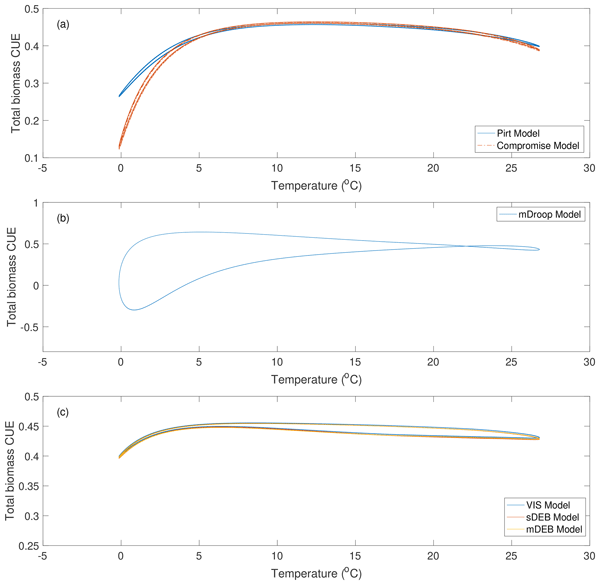
It has long been advocated that plant growth is better modeled using the sink-driven approach, where photosynthesis product is first stored as nonstructural carbon, which is then mobilized to drive the growth of plant organs, (Fatichi et al., 2014; Fourcaud et al., 2008). Our analysis here suggests that the Pirt and Compromise models, although treating growth as driven directly by substrate uptake, are able to produce very rich variation in microbial CUE when analyzed with respect to either specific growth rates or temperatures (Figure 5a and Figure 6a). Interestingly but not surprisingly, their predicted CUE patterns vary more widely than those predicted by the VIS, sDEB, and mDEB models (Figure 5c and Figure 6c), where structural biomass growth is sink-driven as fueled by reserve biomass, which is evolutionarily developed by biological organisms to stabilize their metabolic performance in the face of environmental fluctuations (Kooijman, 2009). From the greater CUE variation by the Pirt and Compromise models, we deduce that, due to the missing of buffering effect from the reserve biomass, the source-driven models may very likely overestimate the plant and microbial response to environmental change, such as elevated CO2, nutrient limitation or warming. (Some support is shown in Figures S4 and S5. There by increasing the variability of carbon input and temperature, the source-driven models respond stronger.) Among the four sink-driven models, the VIS model considers maintenance respiration and growth as two-parallel processes of equal priority, while the sDEB and mDEB models regard maintenance to have priority over growth. Thus, at the cellular level, the VIS model seems to be mechanistically less reasonable by triggering earlier death through maintenance and growth competition. The mDroop model represents biological growth as sink-driven only apparently (because it computes the carbon quota based on total biomass, rather than reserve biomass, to drive the growth), and predicted transient CUE dynamics that are quite different from the three truly sink-driven models (Figure 5 and Figure 6, and also Figures S4 and S5). We believe that the predictions by the mDroop model are likely to be more easily falsified empirically.
Citation: https://doi.org/10.5194/egusphere-2025-5448-AC2
-
AC2: 'Reply on RC1', Jinyun Tang, 01 Mar 2026
-
RC2: 'Comment on egusphere-2025-5448', Stefano Manzoni, 18 Jan 2026
Tang and co-authors investigate the relation between carbon-use efficiency (CUE) and growth rate, with specific examples on microbial growth in soil. This is an interesting topic in general and the examples on soils are particularly timely, given the recent efforts to measure, model, and map soil microbial growth and CUE, and their effects on soil organic matter. The topic itself fits well the scope of Biogeosciences. The authors selected six mathematical models describing growth processes and one more abstract describing energy flows in a generic system. The chosen models range from purely theoretical to phenomenological, to fairly detailed mechanistic, thus offering a comprehensive view of modelling approaches currently in use. The models are analyzed by plotting modeled CUE vs. growth rate under different scenarios. My main concerns are listed first, followed by line-by-line comments.
Note: I have not read the comments by Anonymous Referee #1 before writing my own comments, so it is possible that some overlap.
Main concerns
- Analytical solutions. Having analytical solutions for the exponential growth scenario is useful to see how CUE-growth relations emerge mathematically during a transient phase. I wonder if analytical solutions can also be found for a steady state scenario in which a single substrate is supplied at constant rate, leading to microbial growth with or without necromass recycling in the substrate pool. This alternative scenario would complement the transient analysis and represent an intermediate step before the current scenarios 2 and 3, though I am not sure analytical solutions can be found for all six models.
- Scenario setup. By reading the main text, it is not clear how the scenarios were setup. For the exponential growth case, what drives growth rate variations? In L154, it is stated that the rate of substrate supply is constant, but I suppose this means it is constant for each growth rate value, so to draw the CUE-growth curves in Figure 2, input rates are varied. It would be good to clarify that these curves are not result of temporal changes in growth rate as substrate is depleted during a transient simulation, but rather represent a range of experiments with different realized growth rates. What is the goal of scenarios 2 and 3? If I understand correctly, the aim is to show how variations in input rates (scenario 2) and environmental conditions (temperature in scenario 3) affect the CUE-growth relations. But imposing random fluctuations in addition to a smooth seasonal cycle does not help seeing these effects clearly. I would suggest forcing the system only with smooth seasonally varying input in scenario 2 and temperature in scenario 3 (sine functions should do the job). With this setup, the erratic behaviors shown in Figures 3-6 would disappear and more regular and interpretable trajectories would emerge. One can additionally play with the timing of the annual input and temperature peak to assess the consequences of synchronous vs. asynchronous drivers. I just want to emphasize that there is nothing wrong in the current scenarios, but I find them less informative and useful than they could be—and they leave many questions on the model behavior unanswered because of the large noise introduced by the driver variability.
- Numerical simulations. The trajectories in some of the figures show sharp edges, which I guess are due to changes in temperature affecting the rates, but I wonder to what degree this is an artifact of the way the numerical simulations are conducted. How are temperature variations imposed in the numerical solution? In L157 it is stated that temperature is varied within a day, but in L252 variations are defined as “daily”. In addition to clarifying what is the scale of temperature variations (within a day or across days?), how are such variations implemented in the numerical solution of the mass balance equations? Are the equations solved at finer temporal resolution for numerical stability, so that temperature is piecewise constant? This comment is not relevant if the authors decide to simplify the setup of scenarios 2 and 3 as suggested in my previous comment.
- I would suggest a slight restructuring of the Introduction paragraphs 2 and 3. Now paragraph 2 starts with a description of soil systems, then presents general concepts, and is followed by paragraph 3 on plants. I would present general concepts first and then examples on soil, plants, or other organisms.
- Discussion and conclusions. Section 4.2 develops arguments to support the claim that dynamic energy budget models (in particular mDEB) are “superior” compared to the other models. My impression is that this manuscript is not about comparing model performance, but rather about comparing model emergent behaviors in terms of CUE-growth relations. There is no comparison with data, so statements regarding how “good” a model is are not well supported (e.g., L310, L313). For example, one could argue that CUE-growth data tend to only populate the growing branch of the CUE-growth curve (Figure 3 in Hu et al. 2025, https://doi.org/10.1111/gcb.70036), suggesting that Pirt and Compromise models might be able to capture the essential dynamics without the added complexity of DEB models. Similarly, the conclusion that environmental factors should not be included as multiplier functions is not supported by evidence shown in this work. To sum up, I would try to limit discussion and conclusions to the patterns presented in the analyses.
Other comments
L12: I would provide a concise definition of “structural biomass” (as opposed to “total biomass”)
L44: Tao et al. assumed Monod kinetics for substrate assimilation and Michaelis-Menten kinetics for enzymatic decomposition, so their model was not linear
L105: I find this thermodynamic toy model very useful to understand the origin of CUE-growth curves, but I would suggest to explain in simple terms what negative efficiencies mean, and how the forces are related to substrate and biomass thermodynamic properties
L156: please check the units of the input rate—here it’s a rate (mass/time), while in Supplementary Section E it is expressed a flux (mass/area/time). It would be good to have consistent units in the main text and in the supplementary materials
Bottom of P4: the terminology introduced here is not always clear; “food capture” in my mind is the process of ingesting food, while “assimilation” is the process of absorbing resources from the guts, but here it seems J2 is a rate supplying the reserve pool if I interpreted correctly, so not “food capture”
Section 4.1, L325: the trajectories shown in Figures 3-6 might look complicated because the drivers were not smooth functions, but they are (likely) still deterministic. My suggestions to test the effect of smooth driver functions could also help assess if trajectories are indeed deterministic or if they exhibit chaotic behavior. In the current version, I don’t think it can be concluded that the relationships are not deterministic (though I agree with the authors that they are not unique)
L273: it is not clear what “averaging method” refers to
L287-289: are the details on the dynamics of this particular carbon storage pool important here?
Supplementary Section A: I am a bit confused by the definition of cellular quota—I have often seen it defined as content of a given element per unit total biomass (or per cell), while here it is defined as the inverse of the common definition
Supplementary Section B: in contrast to Section A where B_X represented the total biomass, here the same symbol B_X represents storage biomass (B_X – B_V in Section A). Please use the same definition for a given symbol throughout the manuscript, otherwise it becomes very difficult to follow the derivations
Supplementary Section E: “one microbe” meaning a homogeneous microbial population (as opposed to one microbial cell)?
Eq. F2 and F3: to avoid confusion with variable and parameter symbols, I would use normal font for mathematical functions exp and ln
Citation: https://doi.org/10.5194/egusphere-2025-5448-RC2 -
AC1: 'Reply on RC2', Jinyun Tang, 01 Mar 2026
General comment: Tang and co-authors investigate the relation between carbon-use efficiency (CUE) and growth rate, with specific examples on microbial growth in soil. This is an interesting topic in general and the examples on soils are particularly timely, given the recent efforts to measure, model, and map soil microbial growth and CUE, and their effects on soil organic matter. The topic itself fits well the scope of Biogeosciences. The authors selected six mathematical models describing growth processes and one more abstract describing energy flows in a generic system. The chosen models range from purely theoretical to phenomenological, to fairly detailed mechanistic, thus offering a comprehensive view of modelling approaches currently in use. The models are analyzed by plotting modeled CUE vs. growth rate under different scenarios. My main concerns are listed first, followed by line-by-line comments.
Note: I have not read the comments by Anonymous Referee #1 before writing my own comments, so it is possible that some overlap.
Response: We appreciate Dr. Manzoni’s detailed evaluation of our manuscript. We address his comments point by point below. For clarity, we highlighted our revised text as italic.
Comment 1: Analytical solutions. Having analytical solutions for the exponential growth scenario is useful to see how CUE-growth relations emerge mathematically during a transient phase. I wonder if analytical solutions can also be found for a steady state scenario in which a single substrate is supplied at constant rate, leading to microbial growth with or without necromass recycling in the substrate pool. This alternative scenario would complement the transient analysis and represent an intermediate step before the current scenarios 2 and 3, though I am not sure analytical solutions can be found for all six models.
Respond: We followed this suggestion and analyzed the steady-state solution with constant supply of a single substrate. We found that, under this condition, the carbon use efficiency of each model becomes a function of microbial parameters (e.g. specific maintenance, substrate assimilation efficiency and specific mortality rate for the Pirt and Compromise models), and is independent of substrate supply rate. Because of this lack of dynamics, thus we decide not to include them in the manuscript.
Comment 2: Scenario setup. By reading the main text, it is not clear how the scenarios were setup. For the exponential growth case, what drives growth rate variations? In L154, it is stated that the rate of substrate supply is constant, but I suppose this means it is constant for each growth rate value, so to draw the CUE-growth curves in Figure 2, input rates are varied. It would be good to clarify that these curves are not result of temporal changes in growth rate as substrate is depleted during a transient simulation, but rather represent a range of experiments with different realized growth rates.
What is the goal of scenarios 2 and 3? If I understand correctly, the aim is to show how variations in input rates (scenario 2) and environmental conditions (temperature in scenario 3) affect the CUE-growth relations. But imposing random fluctuations in addition to a smooth seasonal cycle does not help seeing these effects clearly. I would suggest forcing the system only with smooth seasonally varying input in scenario 2 and temperature in scenario 3 (sine functions should do the job). With this setup, the erratic behaviors shown in Figures 3-6 would disappear and more regular and interpretable trajectories would emerge. One can additionally play with the timing of the annual input and temperature peak to assess the consequences of synchronous vs. asynchronous drivers. I just want to emphasize that there is nothing wrong in the current scenarios, but I find them less informative and useful than they could be—and they leave many questions on the model behavior unanswered because of the large noise introduced by the driver variability.
Response: Following this suggestion, we revised the scenario configurations as: scenario 2) monthly varying but yearly constant carbon input, and constant temperature; scenario 3) monthly varying but yearly constant carbon input, and smoothed temperature using a sine function T=13.32*sin(2)+13.32, with n being the ordinal day. The patterns shown in the new figures (Figures 3-6) are much tighter and regular, while supporting our general conclusion that CUE is an emergent dynamic variable that varies with environmental conditions non-deterministically. To further buttress the point that including more forcing variability will induce wilder variability of CUE dynamics, we put another two scenarios in the supplemental material: Figure S4 for scenario 3) monthly varying but yearly constant carbon input, and unsmoothed daily-variable temperature; and Figure S5 for scenario 4) monthly and annually varying carbon input, and non-smoothed daily varying temperature.
Comment 3: Numerical simulations. The trajectories in some of the figures show sharp edges, which I guess are due to changes in temperature affecting the rates, but I wonder to what degree this is an artifact of the way the numerical simulations are conducted. How are temperature variations imposed in the numerical solution? In L157 it is stated that temperature is varied within a day, but in L252 variations are defined as “daily”. In addition to clarifying what is the scale of temperature variations (within a day or across days?), how are such variations implemented in the numerical solution of the mass balance equations? Are the equations solved at finer temporal resolution for numerical stability, so that temperature is piecewise constant? This comment is not relevant if the authors decide to simplify the setup of scenarios 2 and 3 as suggested in my previous comment.
Response: We now revised the enforcement of temperature by using the function T=13.32*sin(2)+13.32, with n being the ordinal day. This function makes the model output much smoother. In the original implementation, the daily temperature was derived from an ecosystem model simulation by EcoSIM at a US Midwest crop land. The data were plotted in Figure S1.
Comment 4: I would suggest a slight restructuring of the Introduction paragraphs 2 and 3. Now paragraph 2 starts with a description of soil systems, then presents general concepts, and is followed by paragraph 3 on plants. I would present general concepts first and then examples on soil, plants, or other organisms.
Response: Combined with comments from the other reviewer, we modified the presentation as general concepts, followed by microbes and then plants. In particular, we added the following to link the structural biomass CUE and total biomass CUE to measurements:
In the variable internal storage models, structural biomass refers to DNA, cell wall and membrane material, and anything that requires maintenance to support an organism’s normal function, while reserve biomass includes lipids, glycogen, circulating metabolites, short-lived rRNA and anything that stores energy and acts as precursor of structural biomass (Kooijman, 2009). Since it is the structural biomass that represents the effect of microbial population on substrate uptake, it is important to recognize how the way of CUE computation affects the interpretation of CUE dynamics. Specifically, is it the structural biomass CUE that focuses on population growth, or is it the total biomass that focuses on biomass growth? Among the existing empirical methods measuring microbial CUE, for the respiration induced by a given amount of substrate addition, the Chloroform fumigation-extraction method and the 13C or 14C-labeling method focus on total biomass increase after substrate addition, thus they derive CUE conditioned on total biomass (Geyer et al., 2019; Hagerty et al., 2022). In contrast, the PLFA (phospholipid fatty acids) approach quantifies structural biomass growth by measuring how much new membrane is synthesized upon the substrate addition (Ibekwe and Kennedy, 1998; Liu et al., 2020). The 18O-H2O labeling method and 13C-DNA stable isotope probing (SIP) method quantify the amount of microbial growth based on new DNA synthesis (Xu et al., 2024; Sayre et al., 2026). However, DNA synthesis is not equivalent to increase in cell population size. Therefore, only the PLFA method measures the structural biomass CUE, while the 18O-H2O method and 13C-DNA SIP method measure what is more accurately described as “apparent” structural biomass CUE. Despite the difference in those approaches, the measured CUE values are often treated as equivalent in the literature. For plants, the CUE is often defined as the ratio between net primary productivity and gross primary productivity, signifying the total biomass CUE (Sinsabaugh et al., 2017).
Comment 5: Discussion and conclusions. Section 4.2 develops arguments to support the claim that dynamic energy budget models (in particular mDEB) are “superior” compared to the other models. My impression is that this manuscript is not about comparing model performance, but rather about comparing model emergent behaviors in terms of CUE-growth relations. There is no comparison with data, so statements regarding how “good” a model is are not well supported (e.g., L310, L313). For example, one could argue that CUE-growth data tend to only populate the growing branch of the CUE-growth curve (Figure 3 in Hu et al. 2025, https://doi.org/10.1111/gcb.70036), suggesting that Pirt and Compromise models might be able to capture the essential dynamics without the added complexity of DEB models. Similarly, the conclusion that environmental factors should not be included as multiplier functions is not supported by evidence shown in this work. To sum up, I would try to limit discussion and conclusions to the patterns presented in the analyses.
Response: By also considering the comments from the other reviewer, we now expanded the discussion on source-driven and sink-driven models (the new section 4.2), and identified clearly shortcomings of the source-driven models, including the Pirt and Compromise models. In short, we infer that source-driven will inevitably predict fast carbon cycling, and have limitations in dealing with multiple nutrients co-limited biological growth. With all these considerations, we buttress our recommendation of the mDEB model to be the superior candidate for developing sophisticated ecosystem models.
Other comments
Comment: L12: I would provide a concise definition of “structural biomass” (as opposed to “total biomass”)
Response: We now define structural biomass as “DNA, cell wall and membrane material, and anything that requires maintenance to support an organism’s normal function.”
Comment: L44: Tao et al. assumed Monod kinetics for substrate assimilation and Michaelis-Menten kinetics for enzymatic decomposition, so their model was not linear.
Response: We double-checked their paper, and found their model is non-linear.
Comment: L105: I find this thermodynamic toy model very useful to understand the origin of CUE-growth curves, but I would suggest to explain in simple terms what negative efficiencies mean, and how the forces are related to substrate and biomass thermodynamic properties
Response: For biological growth, negative CUE refers to starvation induced loss of microbial biomass. Related phenomena include nutrient remobilization and starvation caused biomass loss, which happen both to microbes and plants.
Comment: L156: please check the units of the input rate—here it’s a rate (mass/time), while in Supplementary Section E it is expressed a flux (mass/area/time). It would be good to have consistent units in the main text and in the supplementary materials
Response: We double checked the table, and corrected inappropriate units. We made it clear that, for simplicity, the computing volume is assumed to be 1 m2 in horizontal surface area and 1 m in depth.
Comment: Bottom of P4: the terminology introduced here is not always clear; “food capture” in my mind is the process of ingesting food, while “assimilation” is the process of absorbing resources from the guts, but here it seems J2 is a rate supplying the reserve pool if I interpreted correctly, so not “food capture”
Response: We clarified that food supply refers to J1, and J2 is the use of the reserve pool. Specifically, we now wrote:
Following the interpretation by OP1955, in this example, describes the rate of food supply, corresponds to the energy drop in metabolism of captured food units (thus is equivalent to Gibbs free energy, e.g. that of glucose, representing the energy quality of the substrate taken from the environment), represents the rate of effective food use for biomass synthesis, is the energy drop inherent in the metabolism of a unit of food (thus is analogous to the Gibbs free energy of reserve biomass in the DEB models)
Comment: Section 4.1, L325: the trajectories shown in Figures 3-6 might look complicated because the drivers were not smooth functions, but they are (likely) still deterministic. My suggestions to test the effect of smooth driver functions could also help assess if trajectories are indeed deterministic or if they exhibit chaotic behavior. In the current version, I don’t think it can be concluded that the relationships are not deterministic (though I agree with the authors that they are not unique)
Response: We now revised the figures using simulations from smoother forcing. Also, we cited the empirical observations by (Graham et al., 2007) that showed that coupled microbial groups may show chaotic behavior. Therefore, we buttress our conclusion that CUE is not a deterministic function of control variables (e.g. substrate type, temperature, or moisture), instead, CUE should be treated as dynamic.
Comment: L273: it is not clear what “averaging method” refers to
Response: We clarified it as “temporal averaging method”.
Comment: L287-289: are the details on the dynamics of this particular carbon storage pool important here?
Response: We clarified that this is a model artifact that resulted in the source-driven formulation. And in the more serious case, the source-driven formulation makes it impossible to model observed coarse root growth in the dormant season.
Comment: Supplementary Section A: I am a bit confused by the definition of cellular quota—I have often seen it defined as content of a given element per unit total biomass (or per cell), while here it is defined as the inverse of the common definition
Response: We used the definition from the paper by Thingstad (1987). It is true that the Droop model can be modified to define quota as the ratio between reserve and structural biomass, which, however, will require Q_min (which becomes zero or a very small number), and Q_max defined differently.
Comment: Supplementary Section B: in contrast to Section A where B_X represented the total biomass, here the same symbol B_X represents storage biomass (B_X – B_V in Section A). Please use the same definition for a given symbol throughout the manuscript, otherwise it becomes very difficult to follow the derivations
Response: We now introduce B_T for the modified Droop model to improve the consistency.
Comment: Supplementary Section E: “one microbe” meaning a homogeneous microbial population (as opposed to one microbial cell)?
Response: We clarified as one homogeneous microbial population.
Comment: Eq. F2 and F3: to avoid confusion with variable and parameter symbols, I would use normal font for mathematical functions exp and ln
Response: we made the suggested change to avoid confusion.
Citation: https://doi.org/10.5194/egusphere-2025-5448-AC1
Peer review completion


Interactive discussion
Status: closed
-
RC1: 'Comment on egusphere-2025-5448', Anonymous Referee #1, 08 Jan 2026
This manuscript presents a theoretical and numerical analysis of carbon use efficiency (CUE) dynamics across six commonly used biological growth formulations. By grounding the analysis in nonequilibrium thermodynamics, the authors argue that under exponential growth conditions, structural biomass CUE should exhibit a non-monotonic tradeoff with growth rate, analogous to power–efficiency tradeoffs in thermal engines. They further demonstrate that only models explicitly representing internal storage and sink-driven growth (VIS, sDEB, mDEB) reproduce this behavior, whereas the Pirt and Compromise models do not.
Overall, the manuscript is well written and addresses an important and timely question regarding the mechanistic consistency of microbial growth representations in ecosystem models. The comparison across multiple models is systematic and informative, and the conclusions are potentially useful for future land surface and Earth system model development.
I have several suggestions that I believe would strengthen the interpretation and applicability of the results, as outlined below.
- Clarifying the connection between structural vs. total biomass CUE and empirical observations
The manuscript clearly distinguishes between structural biomass CUE and total biomass CUE, and convincingly demonstrates that these two metrics exhibit markedly different behaviors across models. I suggest that the authors further strengthen the manuscript by explicitly connecting this conceptual distinction to empirical CUE measurements, particularly in the Introduction and Discussion.
For example, in the DEB framework, the denominator of structural biomass CUE includes all energetic sinks, including transient accumulation in reserve pools. In contrast, some empirical approaches (e.g., the ¹⁸O–H₂O labeling method) estimate CUE based on the ratio of growth to respiration, without explicitly accounting for reserve dynamics. Consequently, the structural biomass CUE analyzed here is not strictly equivalent to commonly used empirical CUE estimates, except under special conditions where changes in reserve pools are negligible.
Explicitly discussing this distinction would help readers better interpret the comparability (and limitations thereof) between the model-derived CUE metrics and observational datasets.
- Clarifying the role of plant CUE in the manuscript
The manuscript repeatedly refers to plant growth CUE alongside microbial CUE. While this comparison is potentially valuable, the purpose of comparing plant and microbial CUE is not always entirely clear.
For instance, the paragraph on plant CUE in the Introduction (lines 55–62) appears rather suddenly and could benefit from clearer framing. In the Discussion (lines 291–292), the authors note that representations of plant growth processes in Earth system models are generally more advanced than those of soil microbes. This is an important point that many readers would appreciate seeing further developed.
I suggest that the authors more clearly explain why plant CUE is introduced, how it conceptually relates to microbial CUE in the context of this study, and whether plant growth modeling can serve as a useful reference for improving microbial growth representations. Strengthening this linkage—potentially by using plant CUE as a motivating example in the Introduction—would improve narrative coherence.
- Scope and limitations of the thermal engine analogy
A key conceptual assumption (or analogy) in the manuscript is that biological growth can be treated as a finite-time engine operating under nonequilibrium conditions, and therefore subject to a universal power–efficiency tradeoff. I find this analogy appealing and conceptually stimulating.
At the same time, I would appreciate seeing the authors more explicitly acknowledge and discuss the potential limitations or conditions of applicability of this analogy. In real soil microbial systems, processes such as dormancy, physiological acclimation, and adaptation to fluctuating environmental conditions are common. It would be helpful for readers if the authors briefly discussed whether, and to what extent, such processes might challenge or constrain the strict applicability of the thermal engine analogy.
- Implications of source-driven versus sink-driven growth for existing soil carbon models
Another important concept of this manuscript is the distinction between source-driven and sink-driven growth, with the results suggesting that sink-driven formulations more robustly capture emergent CUE dynamics. I encourage the authors to expand the discussion on how this conceptual framework applies to existing soil carbon models.
If my understanding is correct, widely used models such as MIMICS, Millennial, and even traditional non-microbial models like CENTURY would fall largely into the source-driven category. From the perspective in this manuscript, this would imply that most microbial growth representations currently used in Earth system models are structurally limited.
I suggest that the authors:
- explicitly discuss how common soil carbon models fit within the source- vs. sink-driven framework;
- clarify what it would mean, in practical modeling terms, to implement sink-driven growth (e.g., explicit reserve pools, maintenance priority, internal growth constraints);
- and discuss both the potential benefits and the new challenges (e.g., parameterization, computational cost, data requirements) that such implementations might entail.
This expanded discussion would greatly enhance the practical relevance of the manuscript for ongoing soil carbon and land surface model development.
Citation: https://doi.org/10.5194/egusphere-2025-5448-RC1 -
AC2: 'Reply on RC1', Jinyun Tang, 01 Mar 2026
General comment: This manuscript presents a theoretical and numerical analysis of carbon use efficiency (CUE) dynamics across six commonly used biological growth formulations. By grounding the analysis in nonequilibrium thermodynamics, the authors argue that under exponential growth conditions, structural biomass CUE should exhibit a non-monotonic tradeoff with growth rate, analogous to power–efficiency tradeoffs in thermal engines. They further demonstrate that only models explicitly representing internal storage and sink-driven growth (VIS, sDEB, mDEB) reproduce this behavior, whereas the Pirt and Compromise models do not.
Overall, the manuscript is well written and addresses an important and timely question regarding the mechanistic consistency of microbial growth representations in ecosystem models. The comparison across multiple models is systematic and informative, and the conclusions are potentially useful for future land surface and Earth system model development. I have several suggestions that I believe would strengthen the interpretation and applicability of the results, as outlined below.
Response: We appreciate the reviewer’s encouragement for our study, and are glad to hear that our study has the potential to help improve land surface and ecosystem models. We address the comments point by point below. For readability, we highlighted our revised text as italic.
Comment 1: Clarifying the connection between structural vs. total biomass CUE and empirical observations
The manuscript clearly distinguishes between structural biomass CUE and total biomass CUE, and convincingly demonstrates that these two metrics exhibit markedly different behaviors across models. I suggest that the authors further strengthen the manuscript by explicitly connecting this conceptual distinction to empirical CUE measurements, particularly in the Introduction and Discussion.
For example, in the DEB framework, the denominator of structural biomass CUE includes all energetic sinks, including transient accumulation in reserve pools. In contrast, some empirical approaches (e.g., the ¹⁸O–H₂O labeling method) estimate CUE based on the ratio of growth to respiration, without explicitly accounting for reserve dynamics. Consequently, the structural biomass CUE analyzed here is not strictly equivalent to commonly used empirical CUE estimates, except under special conditions where changes in reserve pools are negligible.
Explicitly discussing this distinction would help readers better interpret the comparability (and limitations thereof) between the model-derived CUE metrics and observational datasets.
Response: Per the reviewer's suggestion, we now clarified the distinction between the structural and total biomass CUE to the empirical measurements. In the introduction, we added the following
Among the existing empirical methods measuring microbial CUE, for the respiration induced by a given amount of substrate addition, the Chloroform fumigation-extraction method and the 13C or 14C-labeling method focus on total biomass increase after substrate addition, thus they derive CUE conditioned on total biomass (Geyer et al., 2019; Hagerty et al., 2022). In contrast, the PLFA (phospholipid fatty acids) approach quantifies structural biomass growth by measuring how much new membrane is synthesized upon the substrate addition (Ibekwe and Kennedy, 1998; Liu et al., 2020). The 18O-H2O labeling method and 13C-DNA stable isotope probing (SIP) method quantify the amount of microbial growth based on new DNA synthesis (Xu et al., 2024; Sayre et al., 2026). However, DNA synthesis is not equivalent to increase in cell population size. Therefore, only the PLFA method measures the structural biomass CUE, while the 18O-H2O method and 13C-DNA SIP method measure what is more accurately described as “apparent” structural biomass CUE. Despite the difference in those approaches, the measured CUE values are often treated as equivalent in the literature. For plants, the CUE is often defined as the ratio between net primary productivity and gross primary productivity, signifying the total biomass CUE (Sinsabaugh et al., 2017).
Comment 2: Clarifying the role of plant CUE in the manuscript
The manuscript repeatedly refers to plant growth CUE alongside microbial CUE. While this comparison is potentially valuable, the purpose of comparing plant and microbial CUE is not always entirely clear.
For instance, the paragraph on plant CUE in the Introduction (lines 55–62) appears rather suddenly and could benefit from clearer framing. In the Discussion (lines 291–292), the authors note that representations of plant growth processes in Earth system models are generally more advanced than those of soil microbes. This is an important point that many readers would appreciate seeing further developed.
I suggest that the authors more clearly explain why plant CUE is introduced, how it conceptually relates to microbial CUE in the context of this study, and whether plant growth modeling can serve as a useful reference for improving microbial growth representations. Strengthening this linkage—potentially by using plant CUE as a motivating example in the Introduction—would improve narrative coherence.
Response: To make the introduction of plant CUE less surprising, we now improved the connection by expanding the original paragraph into:
As another essential group of biological organisms in the biosphere, plants are structurally more complex than microbes, and, naturally, the CUE dynamics during plant growth is also more complicated. However, since plants are constrained by the same physical rules as nature enforces onto the microbes, plant and microbial CUEs should be treated similarly both in modeling and measurements. (As it is argued in Tang et al. (2024), a consistent treatment of similar processes in different contexts will make the resultant ecosystem models more robust by improving the coupling coherency between the models’ different components.) Theoretically, the whole plant CUE should be defined as the fraction of allocated carbon to various organs that becomes newly synthesized biomass (Thornley, 1972). Because the relative carbon allocation to each plant organ varies with environmental conditions and different organs usually have different CUEs, the whole plant CUE is generally dynamic (Manzoni et al., 2018). Even when all plant organs are assumed to have the same CUE, the dynamics of relative carbon allocation for maintenance and growth will still result in dynamic whole plant CUE. In the literature, the mean whole plant CUE has been mapped for some regions using remote sensing imagery (Bloom et al., 2016; Zhang et al., 2009) and field data (Liu et al., 2022).
Comment 3. Scope and limitations of the thermal engine analogy
A key conceptual assumption (or analogy) in the manuscript is that biological growth can be treated as a finite-time engine operating under nonequilibrium conditions, and therefore subject to a universal power–efficiency tradeoff. I find this analogy appealing and conceptually stimulating.
At the same time, I would appreciate seeing the authors more explicitly acknowledge and discuss the potential limitations or conditions of applicability of this analogy. In real soil microbial systems, processes such as dormancy, physiological acclimation, and adaptation to fluctuating environmental conditions are common. It would be helpful for readers if the authors briefly discussed whether, and to what extent, such processes might challenge or constrain the strict applicability of the thermal engine analogy.
Response: We believe the non-equilibrium thermal engine analogy is universal in the sense that dormancy, physiological acclimation and adaptation to fluctuating environmental conditions are able to be modeled via the transient coupling between storage and structural biomass. Some of this was done in Tang and Riley (2015). Evolution is different, to which we are not sure how non-equilibrium thermodynamics can be applied. We did note that the Odum-Pinkerton model has limitations that it is applicable to exponential biological growth, where the reserve biomass is in steady-state. In revision, we added the following to better understand the analogy between thermal engines the complex biology growth dynamics:
Nonetheless, we do expect the CUE dynamics of biological growth to be more complex than the energy use efficiency dynamics of thermal engines. Thermal engines, like internal combustion engines, generally do not include energy storage. In contrast, biological growth is often compounded with processes like dormancy, adaptation and acclimation to environmental changes, giving rise to hysteretic CUE dynamics. Particularly for trees in winter, their roots can grow vigorously while the shoots are dormant (Marchand et al., 2025). Still, these complex CUE dynamics can analogously be conceptualized as the coupling of multiple thermal engines, such as the coupling of electric motor and internal combustion engine in hybrid vehicles, which are more resilient in terms of energy expenditure than either electric vehicles or internal combustion engine vehicles (under mixed disruption conditions of energy supply).
Comment 4: Implications of source-driven versus sink-driven growth for existing soil carbon models. Another important concept of this manuscript is the distinction between source-driven and sink-driven growth, with the results suggesting that sink-driven formulations more robustly capture emergent CUE dynamics. I encourage the authors to expand the discussion on how this conceptual framework applies to existing soil carbon models.
If my understanding is correct, widely used models such as MIMICS, Millennial, and even traditional non-microbial models like CENTURY would fall largely into the source-driven category. From the perspective in this manuscript, this would imply that most microbial growth representations currently used in Earth system models are structurally limited.
I suggest that the authors: explicitly discuss how common soil carbon models fit within the source- vs. sink-driven framework; clarify what it would mean, in practical modeling terms, to implement sink-driven growth (e.g., explicit reserve pools, maintenance priority, internal growth constraints); and discuss both the potential benefits and the new challenges (e.g., parameterization, computational cost, data requirements) that such implementations might entail.
This expanded discussion would greatly enhance the practical relevance of the manuscript for ongoing soil carbon and land surface model development.
Response: Following the reviewer’s suggestion, we now provide a whole subsection (now 4.2) discussing the source vs sink driven models. Specifically, we added:
In the literature, due to their simple mathematical formulation and relatively good performance, the source-driven Pirt and Compromise models have been used much more frequently than the other four models in modeling microbes and plants. For instance, the land component (ELM) of the Energy Exascale Earth Model (Zhu et al., 2019) represents plant growth in a form that resembles the Compromise model, where new structural growth is driven by the residual gross primary productivity flux after subtracting the carbon requirement for maintenance and storage-replenishment. This source-driven approach is also adopted for plant growth by the BiomE model (Weng et al., 2019) and the FATES model (Knox et al., 2024). Sierra et al. (2022) criticized that this source-driven approach may lead to overly fast plant carbon turnover as indicated by a modeled too young radiocarbon signal in plant respiration compared to observations. Indeed, these source-driven models assume that carbon storage is negligible, so that biological growth is dictated by carbon supply. For plants, this contrast with the existence of nonstructural carbon, which leads to observed phenomenon like delayed growth under nutrient limitation (Li et al., 2021; Boussadia et al., 2010), or coarse root growth during the dormant winter (Marchand et al., 2025). In the relative demand configuration of ELM, in order to match observed nighttime root growth (when carbon supply from photosynthesis is zero), its source-driven approach forces the model to introduce a carbon storage pool that may often become (unrealistically) negative at night and be replenished by new photosynthates in the following daytime (Burrows et al., 2020). When these source-driven models are extended to include nitrogen and phosphorus regulation of plant growth, they may be forced to adopt the law of the minimum (Yang et al., 2014), making predictions that contradict the often-observed multiple nutrients co-limited plant growth (Fay et al., 2015). Additionally, the source-driven models may also be forced to adopt the carbon overflow mechanism under nutrient limitation and forbid luxury nutrient uptake under carbon limitation (Jarrell and Beverly, 1981), both artificially accelerating the carbon cycling. When microbes are also modeled with the source-driven approach, such as in the traditional CENTURY-like models (Koven et al., 2013; Parton et al., 1988), or the more recent MIMICS and Millennial models (Wieder et al., 2014; Abramoff et al., 2018), by induction, they will also predict too-fast soil carbon cycling unless being compensated by inappropriate model parameter values.
It has long been advocated that plant growth is better modeled using the sink-driven approach, where photosynthesis product is first stored as nonstructural carbon, which is then mobilized to drive the growth of plant organs, (Fatichi et al., 2014; Fourcaud et al., 2008). Our analysis here suggests that the Pirt and Compromise models, although treating growth as driven directly by substrate uptake, are able to produce very rich variation in microbial CUE when analyzed with respect to either specific growth rates or temperatures (Figure 5a and Figure 6a). Interestingly but not surprisingly, their predicted CUE patterns vary more widely than those predicted by the VIS, sDEB, and mDEB models (Figure 5c and Figure 6c), where structural biomass growth is sink-driven as fueled by reserve biomass, which is evolutionarily developed by biological organisms to stabilize their metabolic performance in the face of environmental fluctuations (Kooijman, 2009). From the greater CUE variation by the Pirt and Compromise models, we deduce that, due to the missing of buffering effect from the reserve biomass, the source-driven models may very likely overestimate the plant and microbial response to environmental change, such as elevated CO2, nutrient limitation or warming. (Some support is shown in Figures S4 and S5. There by increasing the variability of carbon input and temperature, the source-driven models respond stronger.) Among the four sink-driven models, the VIS model considers maintenance respiration and growth as two-parallel processes of equal priority, while the sDEB and mDEB models regard maintenance to have priority over growth. Thus, at the cellular level, the VIS model seems to be mechanistically less reasonable by triggering earlier death through maintenance and growth competition. The mDroop model represents biological growth as sink-driven only apparently (because it computes the carbon quota based on total biomass, rather than reserve biomass, to drive the growth), and predicted transient CUE dynamics that are quite different from the three truly sink-driven models (Figure 5 and Figure 6, and also Figures S4 and S5). We believe that the predictions by the mDroop model are likely to be more easily falsified empirically.
Citation: https://doi.org/10.5194/egusphere-2025-5448-AC2
-
RC2: 'Comment on egusphere-2025-5448', Stefano Manzoni, 18 Jan 2026
Tang and co-authors investigate the relation between carbon-use efficiency (CUE) and growth rate, with specific examples on microbial growth in soil. This is an interesting topic in general and the examples on soils are particularly timely, given the recent efforts to measure, model, and map soil microbial growth and CUE, and their effects on soil organic matter. The topic itself fits well the scope of Biogeosciences. The authors selected six mathematical models describing growth processes and one more abstract describing energy flows in a generic system. The chosen models range from purely theoretical to phenomenological, to fairly detailed mechanistic, thus offering a comprehensive view of modelling approaches currently in use. The models are analyzed by plotting modeled CUE vs. growth rate under different scenarios. My main concerns are listed first, followed by line-by-line comments.
Note: I have not read the comments by Anonymous Referee #1 before writing my own comments, so it is possible that some overlap.
Main concerns
- Analytical solutions. Having analytical solutions for the exponential growth scenario is useful to see how CUE-growth relations emerge mathematically during a transient phase. I wonder if analytical solutions can also be found for a steady state scenario in which a single substrate is supplied at constant rate, leading to microbial growth with or without necromass recycling in the substrate pool. This alternative scenario would complement the transient analysis and represent an intermediate step before the current scenarios 2 and 3, though I am not sure analytical solutions can be found for all six models.
- Scenario setup. By reading the main text, it is not clear how the scenarios were setup. For the exponential growth case, what drives growth rate variations? In L154, it is stated that the rate of substrate supply is constant, but I suppose this means it is constant for each growth rate value, so to draw the CUE-growth curves in Figure 2, input rates are varied. It would be good to clarify that these curves are not result of temporal changes in growth rate as substrate is depleted during a transient simulation, but rather represent a range of experiments with different realized growth rates. What is the goal of scenarios 2 and 3? If I understand correctly, the aim is to show how variations in input rates (scenario 2) and environmental conditions (temperature in scenario 3) affect the CUE-growth relations. But imposing random fluctuations in addition to a smooth seasonal cycle does not help seeing these effects clearly. I would suggest forcing the system only with smooth seasonally varying input in scenario 2 and temperature in scenario 3 (sine functions should do the job). With this setup, the erratic behaviors shown in Figures 3-6 would disappear and more regular and interpretable trajectories would emerge. One can additionally play with the timing of the annual input and temperature peak to assess the consequences of synchronous vs. asynchronous drivers. I just want to emphasize that there is nothing wrong in the current scenarios, but I find them less informative and useful than they could be—and they leave many questions on the model behavior unanswered because of the large noise introduced by the driver variability.
- Numerical simulations. The trajectories in some of the figures show sharp edges, which I guess are due to changes in temperature affecting the rates, but I wonder to what degree this is an artifact of the way the numerical simulations are conducted. How are temperature variations imposed in the numerical solution? In L157 it is stated that temperature is varied within a day, but in L252 variations are defined as “daily”. In addition to clarifying what is the scale of temperature variations (within a day or across days?), how are such variations implemented in the numerical solution of the mass balance equations? Are the equations solved at finer temporal resolution for numerical stability, so that temperature is piecewise constant? This comment is not relevant if the authors decide to simplify the setup of scenarios 2 and 3 as suggested in my previous comment.
- I would suggest a slight restructuring of the Introduction paragraphs 2 and 3. Now paragraph 2 starts with a description of soil systems, then presents general concepts, and is followed by paragraph 3 on plants. I would present general concepts first and then examples on soil, plants, or other organisms.
- Discussion and conclusions. Section 4.2 develops arguments to support the claim that dynamic energy budget models (in particular mDEB) are “superior” compared to the other models. My impression is that this manuscript is not about comparing model performance, but rather about comparing model emergent behaviors in terms of CUE-growth relations. There is no comparison with data, so statements regarding how “good” a model is are not well supported (e.g., L310, L313). For example, one could argue that CUE-growth data tend to only populate the growing branch of the CUE-growth curve (Figure 3 in Hu et al. 2025, https://doi.org/10.1111/gcb.70036), suggesting that Pirt and Compromise models might be able to capture the essential dynamics without the added complexity of DEB models. Similarly, the conclusion that environmental factors should not be included as multiplier functions is not supported by evidence shown in this work. To sum up, I would try to limit discussion and conclusions to the patterns presented in the analyses.
Other comments
L12: I would provide a concise definition of “structural biomass” (as opposed to “total biomass”)
L44: Tao et al. assumed Monod kinetics for substrate assimilation and Michaelis-Menten kinetics for enzymatic decomposition, so their model was not linear
L105: I find this thermodynamic toy model very useful to understand the origin of CUE-growth curves, but I would suggest to explain in simple terms what negative efficiencies mean, and how the forces are related to substrate and biomass thermodynamic properties
L156: please check the units of the input rate—here it’s a rate (mass/time), while in Supplementary Section E it is expressed a flux (mass/area/time). It would be good to have consistent units in the main text and in the supplementary materials
Bottom of P4: the terminology introduced here is not always clear; “food capture” in my mind is the process of ingesting food, while “assimilation” is the process of absorbing resources from the guts, but here it seems J2 is a rate supplying the reserve pool if I interpreted correctly, so not “food capture”
Section 4.1, L325: the trajectories shown in Figures 3-6 might look complicated because the drivers were not smooth functions, but they are (likely) still deterministic. My suggestions to test the effect of smooth driver functions could also help assess if trajectories are indeed deterministic or if they exhibit chaotic behavior. In the current version, I don’t think it can be concluded that the relationships are not deterministic (though I agree with the authors that they are not unique)
L273: it is not clear what “averaging method” refers to
L287-289: are the details on the dynamics of this particular carbon storage pool important here?
Supplementary Section A: I am a bit confused by the definition of cellular quota—I have often seen it defined as content of a given element per unit total biomass (or per cell), while here it is defined as the inverse of the common definition
Supplementary Section B: in contrast to Section A where B_X represented the total biomass, here the same symbol B_X represents storage biomass (B_X – B_V in Section A). Please use the same definition for a given symbol throughout the manuscript, otherwise it becomes very difficult to follow the derivations
Supplementary Section E: “one microbe” meaning a homogeneous microbial population (as opposed to one microbial cell)?
Eq. F2 and F3: to avoid confusion with variable and parameter symbols, I would use normal font for mathematical functions exp and ln
Citation: https://doi.org/10.5194/egusphere-2025-5448-RC2 -
AC1: 'Reply on RC2', Jinyun Tang, 01 Mar 2026
General comment: Tang and co-authors investigate the relation between carbon-use efficiency (CUE) and growth rate, with specific examples on microbial growth in soil. This is an interesting topic in general and the examples on soils are particularly timely, given the recent efforts to measure, model, and map soil microbial growth and CUE, and their effects on soil organic matter. The topic itself fits well the scope of Biogeosciences. The authors selected six mathematical models describing growth processes and one more abstract describing energy flows in a generic system. The chosen models range from purely theoretical to phenomenological, to fairly detailed mechanistic, thus offering a comprehensive view of modelling approaches currently in use. The models are analyzed by plotting modeled CUE vs. growth rate under different scenarios. My main concerns are listed first, followed by line-by-line comments.
Note: I have not read the comments by Anonymous Referee #1 before writing my own comments, so it is possible that some overlap.
Response: We appreciate Dr. Manzoni’s detailed evaluation of our manuscript. We address his comments point by point below. For clarity, we highlighted our revised text as italic.
Comment 1: Analytical solutions. Having analytical solutions for the exponential growth scenario is useful to see how CUE-growth relations emerge mathematically during a transient phase. I wonder if analytical solutions can also be found for a steady state scenario in which a single substrate is supplied at constant rate, leading to microbial growth with or without necromass recycling in the substrate pool. This alternative scenario would complement the transient analysis and represent an intermediate step before the current scenarios 2 and 3, though I am not sure analytical solutions can be found for all six models.
Respond: We followed this suggestion and analyzed the steady-state solution with constant supply of a single substrate. We found that, under this condition, the carbon use efficiency of each model becomes a function of microbial parameters (e.g. specific maintenance, substrate assimilation efficiency and specific mortality rate for the Pirt and Compromise models), and is independent of substrate supply rate. Because of this lack of dynamics, thus we decide not to include them in the manuscript.
Comment 2: Scenario setup. By reading the main text, it is not clear how the scenarios were setup. For the exponential growth case, what drives growth rate variations? In L154, it is stated that the rate of substrate supply is constant, but I suppose this means it is constant for each growth rate value, so to draw the CUE-growth curves in Figure 2, input rates are varied. It would be good to clarify that these curves are not result of temporal changes in growth rate as substrate is depleted during a transient simulation, but rather represent a range of experiments with different realized growth rates.
What is the goal of scenarios 2 and 3? If I understand correctly, the aim is to show how variations in input rates (scenario 2) and environmental conditions (temperature in scenario 3) affect the CUE-growth relations. But imposing random fluctuations in addition to a smooth seasonal cycle does not help seeing these effects clearly. I would suggest forcing the system only with smooth seasonally varying input in scenario 2 and temperature in scenario 3 (sine functions should do the job). With this setup, the erratic behaviors shown in Figures 3-6 would disappear and more regular and interpretable trajectories would emerge. One can additionally play with the timing of the annual input and temperature peak to assess the consequences of synchronous vs. asynchronous drivers. I just want to emphasize that there is nothing wrong in the current scenarios, but I find them less informative and useful than they could be—and they leave many questions on the model behavior unanswered because of the large noise introduced by the driver variability.
Response: Following this suggestion, we revised the scenario configurations as: scenario 2) monthly varying but yearly constant carbon input, and constant temperature; scenario 3) monthly varying but yearly constant carbon input, and smoothed temperature using a sine function T=13.32*sin(2)+13.32, with n being the ordinal day. The patterns shown in the new figures (Figures 3-6) are much tighter and regular, while supporting our general conclusion that CUE is an emergent dynamic variable that varies with environmental conditions non-deterministically. To further buttress the point that including more forcing variability will induce wilder variability of CUE dynamics, we put another two scenarios in the supplemental material: Figure S4 for scenario 3) monthly varying but yearly constant carbon input, and unsmoothed daily-variable temperature; and Figure S5 for scenario 4) monthly and annually varying carbon input, and non-smoothed daily varying temperature.
Comment 3: Numerical simulations. The trajectories in some of the figures show sharp edges, which I guess are due to changes in temperature affecting the rates, but I wonder to what degree this is an artifact of the way the numerical simulations are conducted. How are temperature variations imposed in the numerical solution? In L157 it is stated that temperature is varied within a day, but in L252 variations are defined as “daily”. In addition to clarifying what is the scale of temperature variations (within a day or across days?), how are such variations implemented in the numerical solution of the mass balance equations? Are the equations solved at finer temporal resolution for numerical stability, so that temperature is piecewise constant? This comment is not relevant if the authors decide to simplify the setup of scenarios 2 and 3 as suggested in my previous comment.
Response: We now revised the enforcement of temperature by using the function T=13.32*sin(2)+13.32, with n being the ordinal day. This function makes the model output much smoother. In the original implementation, the daily temperature was derived from an ecosystem model simulation by EcoSIM at a US Midwest crop land. The data were plotted in Figure S1.
Comment 4: I would suggest a slight restructuring of the Introduction paragraphs 2 and 3. Now paragraph 2 starts with a description of soil systems, then presents general concepts, and is followed by paragraph 3 on plants. I would present general concepts first and then examples on soil, plants, or other organisms.
Response: Combined with comments from the other reviewer, we modified the presentation as general concepts, followed by microbes and then plants. In particular, we added the following to link the structural biomass CUE and total biomass CUE to measurements:
In the variable internal storage models, structural biomass refers to DNA, cell wall and membrane material, and anything that requires maintenance to support an organism’s normal function, while reserve biomass includes lipids, glycogen, circulating metabolites, short-lived rRNA and anything that stores energy and acts as precursor of structural biomass (Kooijman, 2009). Since it is the structural biomass that represents the effect of microbial population on substrate uptake, it is important to recognize how the way of CUE computation affects the interpretation of CUE dynamics. Specifically, is it the structural biomass CUE that focuses on population growth, or is it the total biomass that focuses on biomass growth? Among the existing empirical methods measuring microbial CUE, for the respiration induced by a given amount of substrate addition, the Chloroform fumigation-extraction method and the 13C or 14C-labeling method focus on total biomass increase after substrate addition, thus they derive CUE conditioned on total biomass (Geyer et al., 2019; Hagerty et al., 2022). In contrast, the PLFA (phospholipid fatty acids) approach quantifies structural biomass growth by measuring how much new membrane is synthesized upon the substrate addition (Ibekwe and Kennedy, 1998; Liu et al., 2020). The 18O-H2O labeling method and 13C-DNA stable isotope probing (SIP) method quantify the amount of microbial growth based on new DNA synthesis (Xu et al., 2024; Sayre et al., 2026). However, DNA synthesis is not equivalent to increase in cell population size. Therefore, only the PLFA method measures the structural biomass CUE, while the 18O-H2O method and 13C-DNA SIP method measure what is more accurately described as “apparent” structural biomass CUE. Despite the difference in those approaches, the measured CUE values are often treated as equivalent in the literature. For plants, the CUE is often defined as the ratio between net primary productivity and gross primary productivity, signifying the total biomass CUE (Sinsabaugh et al., 2017).
Comment 5: Discussion and conclusions. Section 4.2 develops arguments to support the claim that dynamic energy budget models (in particular mDEB) are “superior” compared to the other models. My impression is that this manuscript is not about comparing model performance, but rather about comparing model emergent behaviors in terms of CUE-growth relations. There is no comparison with data, so statements regarding how “good” a model is are not well supported (e.g., L310, L313). For example, one could argue that CUE-growth data tend to only populate the growing branch of the CUE-growth curve (Figure 3 in Hu et al. 2025, https://doi.org/10.1111/gcb.70036), suggesting that Pirt and Compromise models might be able to capture the essential dynamics without the added complexity of DEB models. Similarly, the conclusion that environmental factors should not be included as multiplier functions is not supported by evidence shown in this work. To sum up, I would try to limit discussion and conclusions to the patterns presented in the analyses.
Response: By also considering the comments from the other reviewer, we now expanded the discussion on source-driven and sink-driven models (the new section 4.2), and identified clearly shortcomings of the source-driven models, including the Pirt and Compromise models. In short, we infer that source-driven will inevitably predict fast carbon cycling, and have limitations in dealing with multiple nutrients co-limited biological growth. With all these considerations, we buttress our recommendation of the mDEB model to be the superior candidate for developing sophisticated ecosystem models.
Other comments
Comment: L12: I would provide a concise definition of “structural biomass” (as opposed to “total biomass”)
Response: We now define structural biomass as “DNA, cell wall and membrane material, and anything that requires maintenance to support an organism’s normal function.”
Comment: L44: Tao et al. assumed Monod kinetics for substrate assimilation and Michaelis-Menten kinetics for enzymatic decomposition, so their model was not linear.
Response: We double-checked their paper, and found their model is non-linear.
Comment: L105: I find this thermodynamic toy model very useful to understand the origin of CUE-growth curves, but I would suggest to explain in simple terms what negative efficiencies mean, and how the forces are related to substrate and biomass thermodynamic properties
Response: For biological growth, negative CUE refers to starvation induced loss of microbial biomass. Related phenomena include nutrient remobilization and starvation caused biomass loss, which happen both to microbes and plants.
Comment: L156: please check the units of the input rate—here it’s a rate (mass/time), while in Supplementary Section E it is expressed a flux (mass/area/time). It would be good to have consistent units in the main text and in the supplementary materials
Response: We double checked the table, and corrected inappropriate units. We made it clear that, for simplicity, the computing volume is assumed to be 1 m2 in horizontal surface area and 1 m in depth.
Comment: Bottom of P4: the terminology introduced here is not always clear; “food capture” in my mind is the process of ingesting food, while “assimilation” is the process of absorbing resources from the guts, but here it seems J2 is a rate supplying the reserve pool if I interpreted correctly, so not “food capture”
Response: We clarified that food supply refers to J1, and J2 is the use of the reserve pool. Specifically, we now wrote:
Following the interpretation by OP1955, in this example, describes the rate of food supply, corresponds to the energy drop in metabolism of captured food units (thus is equivalent to Gibbs free energy, e.g. that of glucose, representing the energy quality of the substrate taken from the environment), represents the rate of effective food use for biomass synthesis, is the energy drop inherent in the metabolism of a unit of food (thus is analogous to the Gibbs free energy of reserve biomass in the DEB models)
Comment: Section 4.1, L325: the trajectories shown in Figures 3-6 might look complicated because the drivers were not smooth functions, but they are (likely) still deterministic. My suggestions to test the effect of smooth driver functions could also help assess if trajectories are indeed deterministic or if they exhibit chaotic behavior. In the current version, I don’t think it can be concluded that the relationships are not deterministic (though I agree with the authors that they are not unique)
Response: We now revised the figures using simulations from smoother forcing. Also, we cited the empirical observations by (Graham et al., 2007) that showed that coupled microbial groups may show chaotic behavior. Therefore, we buttress our conclusion that CUE is not a deterministic function of control variables (e.g. substrate type, temperature, or moisture), instead, CUE should be treated as dynamic.
Comment: L273: it is not clear what “averaging method” refers to
Response: We clarified it as “temporal averaging method”.
Comment: L287-289: are the details on the dynamics of this particular carbon storage pool important here?
Response: We clarified that this is a model artifact that resulted in the source-driven formulation. And in the more serious case, the source-driven formulation makes it impossible to model observed coarse root growth in the dormant season.
Comment: Supplementary Section A: I am a bit confused by the definition of cellular quota—I have often seen it defined as content of a given element per unit total biomass (or per cell), while here it is defined as the inverse of the common definition
Response: We used the definition from the paper by Thingstad (1987). It is true that the Droop model can be modified to define quota as the ratio between reserve and structural biomass, which, however, will require Q_min (which becomes zero or a very small number), and Q_max defined differently.
Comment: Supplementary Section B: in contrast to Section A where B_X represented the total biomass, here the same symbol B_X represents storage biomass (B_X – B_V in Section A). Please use the same definition for a given symbol throughout the manuscript, otherwise it becomes very difficult to follow the derivations
Response: We now introduce B_T for the modified Droop model to improve the consistency.
Comment: Supplementary Section E: “one microbe” meaning a homogeneous microbial population (as opposed to one microbial cell)?
Response: We clarified as one homogeneous microbial population.
Comment: Eq. F2 and F3: to avoid confusion with variable and parameter symbols, I would use normal font for mathematical functions exp and ln
Response: we made the suggested change to avoid confusion.
Citation: https://doi.org/10.5194/egusphere-2025-5448-AC1
Peer review completion
Journal article(s) based on this preprint
Data sets
Modeling code Jinyun Tang https://github.com/jinyun1tang/cue_paper
Viewed
| HTML | XML | Total | Supplement | BibTeX | EndNote | |
|---|---|---|---|---|---|---|
| 1,566 | 560 | 199 | 2,325 | 290 | 237 | 216 |
- HTML: 1,566
- PDF: 560
- XML: 199
- Total: 2,325
- Supplement: 290
- BibTeX: 237
- EndNote: 216
Viewed (geographical distribution)
| Country | # | Views | % |
|---|
| Total: | 0 |
| HTML: | 0 |
| PDF: | 0 |
| XML: | 0 |
- 1
Jinyun Tang
William J. Riley
Gianna L. Marschmann
Eoin L. Brodie
The requested preprint has a corresponding peer-reviewed final revised paper. You are encouraged to refer to the final revised version.
- Preprint
(3450 KB) - Metadata XML
-
Supplement
(4809 KB) - BibTeX
- EndNote
- Final revised paper
This manuscript presents a theoretical and numerical analysis of carbon use efficiency (CUE) dynamics across six commonly used biological growth formulations. By grounding the analysis in nonequilibrium thermodynamics, the authors argue that under exponential growth conditions, structural biomass CUE should exhibit a non-monotonic tradeoff with growth rate, analogous to power–efficiency tradeoffs in thermal engines. They further demonstrate that only models explicitly representing internal storage and sink-driven growth (VIS, sDEB, mDEB) reproduce this behavior, whereas the Pirt and Compromise models do not.
Overall, the manuscript is well written and addresses an important and timely question regarding the mechanistic consistency of microbial growth representations in ecosystem models. The comparison across multiple models is systematic and informative, and the conclusions are potentially useful for future land surface and Earth system model development.
I have several suggestions that I believe would strengthen the interpretation and applicability of the results, as outlined below.
The manuscript clearly distinguishes between structural biomass CUE and total biomass CUE, and convincingly demonstrates that these two metrics exhibit markedly different behaviors across models. I suggest that the authors further strengthen the manuscript by explicitly connecting this conceptual distinction to empirical CUE measurements, particularly in the Introduction and Discussion.
For example, in the DEB framework, the denominator of structural biomass CUE includes all energetic sinks, including transient accumulation in reserve pools. In contrast, some empirical approaches (e.g., the ¹⁸O–H₂O labeling method) estimate CUE based on the ratio of growth to respiration, without explicitly accounting for reserve dynamics. Consequently, the structural biomass CUE analyzed here is not strictly equivalent to commonly used empirical CUE estimates, except under special conditions where changes in reserve pools are negligible.
Explicitly discussing this distinction would help readers better interpret the comparability (and limitations thereof) between the model-derived CUE metrics and observational datasets.
The manuscript repeatedly refers to plant growth CUE alongside microbial CUE. While this comparison is potentially valuable, the purpose of comparing plant and microbial CUE is not always entirely clear.
For instance, the paragraph on plant CUE in the Introduction (lines 55–62) appears rather suddenly and could benefit from clearer framing. In the Discussion (lines 291–292), the authors note that representations of plant growth processes in Earth system models are generally more advanced than those of soil microbes. This is an important point that many readers would appreciate seeing further developed.
I suggest that the authors more clearly explain why plant CUE is introduced, how it conceptually relates to microbial CUE in the context of this study, and whether plant growth modeling can serve as a useful reference for improving microbial growth representations. Strengthening this linkage—potentially by using plant CUE as a motivating example in the Introduction—would improve narrative coherence.
A key conceptual assumption (or analogy) in the manuscript is that biological growth can be treated as a finite-time engine operating under nonequilibrium conditions, and therefore subject to a universal power–efficiency tradeoff. I find this analogy appealing and conceptually stimulating.
At the same time, I would appreciate seeing the authors more explicitly acknowledge and discuss the potential limitations or conditions of applicability of this analogy. In real soil microbial systems, processes such as dormancy, physiological acclimation, and adaptation to fluctuating environmental conditions are common. It would be helpful for readers if the authors briefly discussed whether, and to what extent, such processes might challenge or constrain the strict applicability of the thermal engine analogy.
Another important concept of this manuscript is the distinction between source-driven and sink-driven growth, with the results suggesting that sink-driven formulations more robustly capture emergent CUE dynamics. I encourage the authors to expand the discussion on how this conceptual framework applies to existing soil carbon models.
If my understanding is correct, widely used models such as MIMICS, Millennial, and even traditional non-microbial models like CENTURY would fall largely into the source-driven category. From the perspective in this manuscript, this would imply that most microbial growth representations currently used in Earth system models are structurally limited.
I suggest that the authors:
This expanded discussion would greatly enhance the practical relevance of the manuscript for ongoing soil carbon and land surface model development.