
the Creative Commons Attribution 4.0 License.
the Creative Commons Attribution 4.0 License.
 | 13 Nov 2025
The September 2024 Danube Flood Compared to the 1899, 2002, and 2013 Events: A Hydrometeorological Analysis in a Changing Climate
Abstract. In September 2024, an exceptional flood occurred in the Austrian Danube Basin, producing the highest discharges in parts of Lower Austria since instrumental records began. This study analyses the meteorological and hydrological drivers of the 2024 event and compares them with three historic floods with return periods of around 100 years at the Austrian Danube – 1899, 2002, and 2013 – to identify similarities, differences, and emerging trends in flood generation. Using representative station observations, reanalysis data, and hydrometric records from a dense network of river gauges, we examine atmospheric circulation, spatio-temporal rainfall patterns, runoff response, and flood-wave propagation along the Danube and its tributaries.
The 2024 flood was triggered by a quasi-stationary low-pressure system over the eastern Alps and western Hungary that produced two rainfall phases: a stratiform period in the west followed by convective extremes in the east, with local totals of 450–500 mm in five days. Although antecedent soil moisture was initially low, sustained rainfall led to rapid saturation and unusually high runoff coefficients (0.6–0.9) in central Lower Austria, where tributaries such as the Perschling and Kleine Tulln exceeded their HQ100 discharges by more than 150–250 %. In contrast, the main Danube and western Alpine tributaries showed only moderate responses.
The comparison with historical floods reveals a gradual shift from Alpine-controlled, basin-wide events toward regionally concentrated, convectively enhanced floods. The 2024 case highlights the increasing importance of atmospheric persistence, antecedent saturation, and tributary synchronisation in shaping flood extremes, providing new insights for adaptive flood-risk management in a changing climate.
Competing interests: Günter Blöschl is a member of the editorial board of HESS.
Publisher's note: Copernicus Publications remains neutral with regard to jurisdictional claims made in the text, published maps, institutional affiliations, or any other geographical representation in this paper. While Copernicus Publications makes every effort to include appropriate place names, the final responsibility lies with the authors. Views expressed in the text are those of the authors and do not necessarily reflect the views of the publisher.-
Notice on discussion status
The requested preprint has a corresponding peer-reviewed final revised paper. You are encouraged to refer to the final revised version.
-
Preprint
(4204 KB)
-
The requested preprint has a corresponding peer-reviewed final revised paper. You are encouraged to refer to the final revised version.
- Preprint
(4204 KB) - Metadata XML
- BibTeX
- EndNote
- Final revised paper


Journal article(s) based on this preprint
Interactive discussion
Status: closed
-
RC1: 'Comment on egusphere-2025-5435', Anonymous Referee #1, 12 Dec 2025
-
AC1: 'Reply on RC1', Jürgen Komma, 24 Mar 2026
Response to Reviewer #1
Manuscript: The September 2024 Austrian flood in a historical and climatic context
EGUsphere discussion paper: egusphere-2025-5435
We thank Reviewer #1 for the careful reading of the manuscript, the positive overall assessment, and the detailed and constructive comments. We particularly appreciate the recognition of the clarity of exposition, the quality of the figures, and the comprehensive hydrometeorological characterisation. Below we respond point by point to all comments.
________________________________________
General assessment
“The paper is structured as Blöschl et al. (2013)… The climate change issue is tackled better in this last work… The amount of information analysed here, the clarity of exposition, and the quality of the figures make the paper exemplary…”
Response:
We thank the reviewer for this encouraging and positive assessment. The manuscript was intentionally structured following Blöschl et al. (2013) to ensure comparability with previous landmark flood analyses. At the same time, the September 2024 event provides an opportunity to place such an analysis in a contemporary climatic context, drawing on more recent work on flood-rich periods and thermodynamic drivers. We are grateful that the reviewer finds this balance appropriate.
________________________________________
Detailed comments
Comment 1 (former line 41; Introduction)
“In Blöschl et al. (2020), the recent period is unprecedented in terms of being a flood-rich period in a warmer-than-usual climate. Blöschl et al. (2020) actually shows that other periods in the past were even more flood-rich than the recent one in Europe.”Response:
The reviewer is correct. Blöschl et al. (2020) show that recent decades represent a flood-rich period occurring under warmer-than-usual climatic conditions, but not the most flood-rich period in absolute terms when considering the last several centuries. Our original wording was too strong and could be interpreted as implying absolute unprecedentedness.
Manuscript change:
We revised the sentence in the Introduction to clarify that the recent period is among the flood-rich periods, distinguished by its occurrence in a warmer climate, rather than the most flood-rich period overall.
Revised to:
“The current period is exceptional as a flood-rich period in a warmer-than-usual climate, although other, colder periods in the past have seen even more frequent floods (Blöschl et al., 2020).”________________________________________
Comment 2 (former line 66; Introduction)
“What does ‘assess the plausibility’ mean in this context?”
Response:
We agree that the phrase was ambiguous. Our intention was not to imply a formal statistical plausibility test, but rather a process-based evaluation of whether the observed characteristics of the 2024 event are physically consistent with known flood-generating mechanisms and historical events.
Manuscript change:
We replaced the phrase with a more explicit formulation referring to a process-based and physically consistent comparison with historical floods.
________________________________________
Comment 3 (former lines 135 ff.; transition to event description)
“The description of the 2024 event here looks like a repetition of what was already said at lines 125 and following.”
Response:
We agree that some redundancy was present. While the intention was to move from a general introduction of the event toward the analytical sections, this transition was not sufficiently clear.
Manuscript change:
We shortened the later passage and removed repetitive elements, retaining only information that directly motivates the subsequent synoptic and hydrological analyses.
________________________________________
Comment 4 (former line 143)
“‘…during the peak of four historic flood events…’”
Response:
Thank you for pointing this out. The phrasing was imprecise.
Manuscript change:
We corrected the wording to explicitly refer to the four flood events considered (1899, 2002, 2013, and 2024).
________________________________________
Comment 5 (former line 145; synoptic description)
“For non-meteorologists, maybe comment on how low the pressures are and how high is precipitable water compared to the usual.”
Response:
We agree that additional quantitative context improves accessibility for readers without a meteorological background.
Manuscript change:
We added a brief explanation indicating how the sea-level pressure anomalies and precipitable water values during the event compare to typical climatological values for Central Europe. The following scentence was added: “The emerging low pressure systems were rather strong synoptic systems, showing core pressure anomalies of roughly two standard deviations from the mean values for the time of the year.”Additionally the caption of figure 2 was updated accordingly.
________________________________________
Comment 6 (former line 163; Figure 3)
“Looking at Figure 3, Austria seems to be mostly covered by blue colour (negative anomaly). I do not see an abnormally warm air mass over Austria in the figure.”
Response:
This is a valid observation. Figure 3 shows temperature anomalies at an upper-tropospheric level, where the cold-core structure of the low-pressure system dominates. Near-surface and lower-tropospheric conditions, which are more relevant for moisture availability and precipitation processes, were nevertheless relatively warm. This distinction was not sufficiently explained in the original text.
Manuscript change:
We clarified the description of Figure 3 by explicitly distinguishing between upper-level temperature anomalies and lower-tropospheric thermodynamic conditions. We corrected the sentence to: “The anomalies, computed relative to the 1991–2020 climatology, highlight an abnormally warm air mass over North-eastern Europe (5–10 °C above average) that persisted throughout the event, while a cold-core low remained nearly stationary over vast expanses of Central Europe.”________________________________________
Comment 7 (former line 217)
“The four maps show…”
Response:
We agree that the sentence was incomplete.
Manuscript change:
We revised the sentence to clearly state what the four maps show and how they support the comparison of the four events.
________________________________________
Comment 8 (Figure 5)
“Niederschlag to be translated.”
Response:
Thank you for noting this oversight.
Manuscript change:
All remaining German labels in Figure 5 have been translated into English.
________________________________________
Comment 9 (former line 239)
“The cold-air outbreak seems consistent with Figure 3 colours (being that a high elevation temperature).”
Response:
We agree with this interpretation.
Manuscript change:
We added a short clarifying sentence explicitly linking the cold-air outbreak to the upper-level temperature anomalies shown in Figure 3.
________________________________________
Comment 10 (Figure 7)
“The two panels seem to be one the negative of the other. Wouldn’t it be prettier to have both rain and snow on the same map but with different colours?”
Response:
We appreciate the suggestion. We chose separate panels to clearly distinguish liquid and solid precipitation contributions, which we consider important for interpreting runoff generation. A combined map could reduce clarity in complex Alpine terrain.
Manuscript change:
No change to the figure layout. We added a brief justification in the figure caption.
________________________________________
Comment 11 (Figure 8)
“why not showing more than one hydrograph here? Are the “local” hydrographs (those not affected by major confluences) similar, i.e., increasing slowly (because of the dry initial conditions) and decreasing quickly??”
Response:
Thank you for this helpful suggestion. Initially, we had chosen a single hydrograph to maintain visual clarity, but we agree that including a second site adds valuable perspective. We revised Figure 8 to now display hydrographs from two representative catchments: Böheimkirchen (55 km²) and Lilienfeld (345 km²). Böheimkirchen exhibited a fast and sharp response, driven by embedded high rainfall intensities on already saturated soils. In contrast, Lilienfeld, representing a larger catchment in the Traisen Valley, responded more gradually, producing a broader hydrograph. We believe this combination illustrates the variability in hydrological responses while preserving the figure’s readability.
Manuscript change:
Figure 8 was revised to include both hydrographs, and Section 4.5 was updated to reflect and discuss the contrasting runoff behaviors.
________________________________________
Comment 12 (Figure 9)
“maybe one could add an indication on how extreme the peak was for the individual sites (e.g. through the colours of the flood waves) to better show the relative importance of the eastern tributaries of the Danube to the event.
Response:
We appreciate this suggestion and agree that it would be valuable to emphasize the relative extremeness of the tributary peaks. However, to preserve the clarity of Figure 9, we opted not to add another visual dimension (such as color) to the hydrographs. Instead, we clarified in the main text and figure caption which tributaries exhibited extreme behavior. We also added a reference to Figure 13, which explicitly compares return periods across sites and thus provides a quantitative measure of severity. Furthermore, names of the relevant locations are consistently shown in Figure 1, and further labels in Figure 9 would risk visual overload.
Manuscript change:
Text in Section 5.2 and the caption of Figure 9 were updated to (i) note that the most extreme peaks were observed in the Pielach, Traisen, and Perschling catchments, and (ii) refer readers to Figure 13 for detailed return period estimates.
________________________________________
Comment 13 (Figure 10)
“I would mention the distance between the sites (or show them in Figure 9).”
Response:
We agree with this helpful suggestion. To aid interpretation of the hydrograph propagation, we now refer to the approximate river distances between Achleiten, Kienstock, and Korneuburg. These distances help contextualize the travel time and the shape evolution of the Danube hydrograph between these sites. For orientation, the river distance from Achleiten to Kienstock is approximately 208 km, and from Kienstock to Korneuburg about 74 km. These distances can be inferred from Figure 11, which displays river stations by river kilometers, and are also mentioned in the updated caption.
Manuscript change:Text in Section 4.6 was updated to note the distances between the key gauges.
Caption of Figure 10 updated to: “Figure 10: Comparison of Danube hydrographs during the 2013 and 2024 floods at the gauging stations Achleiten, Kienstock, and Korneuburg. The river distance from Achleiten to Kienstock is approximately 208 km, and from Kienstock to Korneuburg 74 km. See also Figure 11 for river station locations along the profile.”
________________________________________
Comment 14 (former line 370; Discussion)
“Are 4 events enough to detect the transition of flood dynamics? Is this transition something to be feared?”
Response:
We agree that four events are not sufficient to detect a transition in a statistical sense. Our intention is exploratory: to discuss potential changes in flood-generating mechanisms rather than to claim definitive trends.
Manuscript change:
We clarified this explicitly, framing the discussion as hypothesis-generating and noting the need for larger-sample analyses.
________________________________________
Comment 15 (Figure 11)
“If these sites were visible in Figure 9, that would help the reader.”
Response:
Thank you. Many of the stations included in Figure 11—particularly those referring to historic events—do not have full hydrograph records, as the peak discharges were reconstructed from hydraulic analyses or archival reports. As a result, not all of these stations are included in the schematic overview in Figure 9. However, all key stations with available hydrographs from the 2024 event are represented in Figure 9. To support orientation, Figure 11 provides the full set of river stations and river-km markers, allowing readers to localize the respective sites. We have added a cross-reference in the captions.
Manuscript change:
Clarified in the captions of Figures 9 and 11.
________________________________________
Comment 16 (former line 408)
“The patterns in the two panels of Figure 13 do not look that similar to me.”
Response:
Thank you for this observation. We agree that the similarity is qualitative rather than exact. We revised the manuscript text to clarify that the correspondence between the Qₚₑₐₖ/HQ₁₀₀ ratios and runoff coefficients is particularly notable in Lower Austria, where both indicators reached exceptional values in areas that typically exhibit low runoff efficiencies. In other regions, high runoff coefficients are more common due to different hydrological characteristics.
Manuscript change:
Clarified that the patterns in Figure 13 are not identical but show a strong overlap in Lower Austria. Language was softened from “looks similar” to “shows a spatial overlap,” and the interpretation was refined to distinguish between event-based extremes and climatological patterns.
________________________________________
Comment 17 (former line 410)
“Does this imply that the other regions with high runoff coefficients are not that unusual?”
Response:
Yes, exactly. We clarified in the text that high runoff coefficients in some western and northern Alpine basins are consistent with their typical hydrological behavior, including higher annual precipitation, shallow soils, and steeper slopes. What was unusual in 2024 was the occurrence of such high runoff coefficients in central and eastern Lower Austria, where infiltration is usually much greater.
Manuscript change:
Added a sentence to explain that high runoff coefficients in western Austria are in line with known regional behavior, while the exceptionally high values in Lower Austria were unusual and due to saturated soils and storm structure.
________________________________________
Comment 18 (former line 439)
“High runoff coefficients…”
Response:
Thank you for telling us.
Manuscript change:
Corrected this typo.
________________________________________
Comment 19 (former line 446)
“Shall we expect more synchronicity in neighbouring small-medium catchments only, or does the reasoning apply also to large catchments?”
Response:
Thank you for raising this important point. We agree that the implications of runoff synchrony extend beyond small and medium catchments. While synchronised peaks are most readily observed in smaller neighbouring basins, our results indicate that spatially coherent rainfall under persistent atmospheric conditions—such as in September 2024—can also align hydrograph peaks in larger river systems. We now clarify this in the revised text.
Manuscript change:
We added the following sentence toward the end of the paragraph on synchrony and future flood risk: “Although synchronised flood peaks are most apparent in neighbouring small to medium-sized catchments, the 2024 event suggests that under persistent atmospheric conditions, synchrony can extend across sub-regions and even affect larger river segments through spatially coherent rainfall.”________________________________________
Closing
We once again thank Reviewer #1 for the constructive and thoughtful review. The comments helped us to improve the clarity and precision of the manuscript, while maintaining the core results and conclusions.
-
AC1: 'Reply on RC1', Jürgen Komma, 24 Mar 2026
-
RC2: 'Comment on egusphere-2025-5435', Anonymous Referee #2, 16 Dec 2025
The study presented in this paper uses compares the September 2024 Danube flood to several historical floods in the same area and analyses the hydrometeorological conditions leading to the floods in the context of climate change.
The paper is well written and easy to follow, however, as I am no meteorologist I am not commenting on the meteorological part of the paper. Most of the comments are just minor corrections, and some to refer to the figures.
I recommend minor revisions and have listed some issues I found in the paper below.
Comments
- Please check the literature list as it does not seem to be complete. Lauda (1908) (page 2, line 54) is not in the literature list (however, this might be a typing mistake). Also, Godina et al. (2005) (page 2, line 59) and HD NÖ, 2024 (pages 15, line 287 and page 17, line 316) are not in the list. Merz et al. (2014) seems to be missing as well. There is a reference to Penna et al. (2006), which I could not find in the text. You might also want to check on the references to Blöschl et al. (2019) (page 29, line 502), Blöschl et al. (2020) (page 29, line 504), and Blöschl et al. (online 2019, printed 2020) (page 31, line 546), as there seems to be some kind of confusion.
- Line 71. Different word order suggested - Smaller tributary catchments in Lower Austria were hit particularly hard.
- Line 97. … to over 3000 m in the Alps. à … to over 3700 m in the Alps.
- Line 126-Line 136. Some parts of these lines seem to be redundant. Please revise.
- Line 140 (Figure 2) – is it possible to add the overlay of the Danube catchment as a red line? This would make orientation easier.
- Line 169 (Figure 3) – The figures do not have the same extent as Figure 2 – maybe this would be able to change. Adding an overlay of the Danube catchment as suggested before would help to orientate.
- Line 179. After Figure 4, there are two punctuation marks.
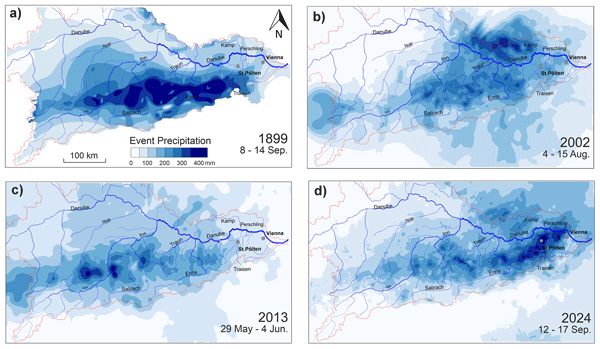
- Lines 200 ff. … roughly between St. Pölten and Vienna. You could add the two towns in Figures 4a-d for easier orientation. Also, the rivers Traisen and Perschling could be highlighted in the figures for the same reason.
- Line 217. The four maps how heavy rainfall… The word “show” seems to be missing.
- Line 222 (Figure 5) – add locations of some towns and rivers for easier orientation.
- Line 253 – Traisen-Pielach area – add location of rivers in Figure 7.
- Line 256 and 257. Admont and Mittersill – where are they?
- Lines 290 ff. Text is not consistent with Figure 8: … rainfall intensities in St. Pölten and Böheimkirchen. In Figure 8, Lilienfeld and St. Pölten are shown.
- Line 300. Figure 8. For the classification of the flood magnitude it could help to add some HQx (30, 100) values in the figure.
- Line 347 – At Korneuburg (not In Korneuburg)
- Lines 355 ff. … the Inn-Traun-Enns area produced only moderate discharges. In figure 11, the tributaries downstream between Linz and Melk seem to contribute a lot to the flood (steep increase!), also in Figure 9 the hydrographs in these catchments seem to contribute more runoff than the tributaries in Lower Austria.
- Line 368. The Lower Austrian tributaries supplied more than 1000 m³/s of additional discharge between Melk and Korneuburg. In the previous lines, the values for the Melk, Pielach, Ybbs, Traisen, Perschling and Große Tulln add up to roughly 3100 m³/s. Is this just because of the time lag in some of the catchments?
- Line 389. The 2024 maximum discharge of 9800 m³/s remained below the HQ30 level (9340 m³/s). Please check the numbers.
- Line 403. The contrast across the basinS is striking. Please add S at the end of basin.
Citation: https://doi.org/10.5194/egusphere-2025-5435-RC2 -
AC2: 'Reply on RC2', Jürgen Komma, 24 Mar 2026
Response to Reviewer #2
Manuscript: The September 2024 Austrian flood in a historical and climatic context
EGUsphere discussion paper: egusphere-2025-5435
We thank Reviewer #2 for the constructive and thoughtful feedback, the positive assessment of the manuscript, and the helpful comments, particularly regarding the figures and wording. We address each of the points below in detail.
________________________________________Comment 1: "Please check the literature list as it does not seem to be complete. Lauda (1908) (page 2, line 54) is not in the literature list (however, this might be a typing mistake). Also, Godina et al. (2005) (page 2, line 59) and HD NÖ, 2024 (pages 15, line 287 and page 17, line 316) are not in the list. Merz et al. (2014) seems to be missing as well. There is a reference to Penna et al. (2006), which I could not find in the text. You might also want to check on the references to Blöschl et al. (2019) (page 29, line 502), Blöschl et al. (2020) (page 29, line 504), and Blöschl et al. (online 2019, printed 2020) (page 31, line 546), as there seems to be some kind of confusion."
Response: We carefully reviewed the reference list and corrected all inconsistencies. The missing entries (Lauda, Godina et al., HD NÖ, Merz et al. 2014) have been added. The citation of Penna et al. (2006) was removed, as it no longer appears in the main text. The multiple references to Blöschl et al. were consolidated and checked for consistency.
Manuscript change: Reference list updated and checked; redundant citations corrected.
________________________________________
Comment 2: "Line 71. Different word order suggested - Smaller tributary catchments in Lower Austria were hit particularly hard."
Response: We adopted the suggested rewording for improved clarity.
Manuscript change: Sentence revised accordingly.
________________________________________
Comment 3: "Line 97. … to over 3000 m in the Alps. à … to over 3700 m in the Alps."
Response: We corrected the elevation range.
Manuscript change: "...to over 3700 m in the Alps."
________________________________________
Comment 4: "Line 126-Line 136. Some parts of these lines seem to be redundant. Please revise."
Response: We revised the passage to remove redundancy and better streamline the transition to the synoptic analysis.
Manuscript change: Section restructered and overlapping content removed.
________________________________________
Comment 5: "Line 140 (Figure 2) – is it possible to add the overlay of the Danube catchment as a red line? This would make orientation easier."
Response: We agree and added the Danube catchment outline to the figure.
Manuscript change: Danube catchment added in Figure 2; caption updated.
________________________________________
Comment 6: "Line 169 (Figure 3) – The figures do not have the same extent as Figure 2 – maybe this would be able to change. Adding an overlay of the Danube catchment as suggested before would help to orientate."
Response: We added the catchment boundaries as suggested to the figures. However, the spatial domain is intentionally larger than in Figure 3 to better display the continental atmospheric situation. However, we think with the added catchment boundaries the increases the readability of the figure.
Manuscript change: Figure 3 adjusted accordingly; caption revised.
________________________________________
Comment 7: "Line 179. After Figure 4, there are two punctuation marks."
Response: Corrected.
Manuscript change: Duplicate punctuation removed.
________________________________________
Comment 8: "Lines 200 ff. … roughly between St. Pölten and Vienna. You could add the two towns in Figures 4a-d for easier orientation. Also, the rivers Traisen and Perschling could be highlighted in the figures for the same reason."
Response: We added St. Pölten and Vienna as well as the Traisen and Perschling rivers to Figures 4a-d.
Manuscript change: Map annotations updated.
________________________________________
Comment 9: "Line 217. The four maps how heavy rainfall… The word “show” seems to be missing."
Response: Corrected.
Manuscript change: Typo fixed.
________________________________________
Comment 10: "Line 222 (Figure 5) – add locations of some towns and rivers for easier orientation."
Response: Done. We added St. Pölten, Lilienfeld, and Böheimkirchen as well as key rivers to the map.
Manuscript change: Figure 5 updated; caption modified.
________________________________________
Comment 11: "Line 253 – Traisen-Pielach area – add location of rivers in Figure 7."
Response: Locations of Traisen and Pielach rivers were added.
Manuscript change: Figure 7 revised accordingly.
________________________________________
Comment 12: "Line 256 and 257. Admont and Mittersill – where are they?"
Response: We added black rectangles indicating their locations.
Manuscript change: Figure 7 updated with annotations.
________________________________________
Comment 13: "Lines 290 ff. Text is not consistent with Figure 8: … rainfall intensities in St. Pölten and Böheimkirchen. In Figure 8, Lilienfeld and St. Pölten are shown."
Response: We revised the text to correctly refer to Lilienfeld.
Manuscript change: Text corrected to match figure.
________________________________________
Comment 14: "Line 300. Figure 8. For the classification of the flood magnitude it could help to add some HQx (30, 100) values in the figure."
Response: We added HQ100 reference lines to the hydrograph panels.
Manuscript change: Figure 8 and caption updated.
________________________________________
Comment 15: "Line 347 – At Korneuburg (not In Korneuburg)"
Response: Corrected.
Manuscript change: Text revised.
________________________________________
Comment 16: "Lines 355 ff. … the Inn-Traun-Enns area produced only moderate discharges. In figure 11, the tributaries downstream between Linz and Melk seem to contribute a lot to the flood (steep increase!), also in Figure 9 the hydrographs in these catchments seem to contribute more runoff than the tributaries in Lower Austria."
Response: We thank the reviewer for this observation. We rephrased the paragraph to better reflect the contributions of tributaries between Linz and Melk and acknowledge that these catchments—although geographically located west of core Lower Austria—delivered considerable flood volumes during the 2024 event. We now refer more clearly to their steep hydrograph shapes and temporal alignment with the Danube peak.
Manuscript change: Section 5.2 revised accordingly to highlight tributaries between Linz and Melk and their synchronised contribution to downstream amplification.
________________________________________
Comment 17: "Line 368. The Lower Austrian tributaries supplied more than 1000 m³/s of additional discharge between Melk and Korneuburg. In the previous lines, the values for the Melk, Pielach, Ybbs, Traisen, Perschling and Große Tulln add up to roughly 3100 m³/s. Is this just because of the time lag in some of the catchments?"
Response: We agree that the phrasing could be misunderstood. The individual tributary peaks add up to a larger total, but not all of them were fully synchronised at the Danube. The stated net contribution of ~1000 m³/s reflects the cumulative downstream increase in Danube discharge, which results from the partial temporal overlap of tributary inflows, attenuation, and storage effects. We have clarified this aspect in the text.
Manuscript change: We added the sentence: “The sum of tributary peaks exceeds the net increase in the Danube discharge, as not all inflows were fully synchronous; the ~1000 m³/s estimate reflects the effective downstream amplification after accounting for timing, losses, and routing effects.”
________________________________________
Comment 18: "Line 389. The 2024 maximum discharge of 9800 m³/s remained below the HQ30 level (9340 m³/s). Please check the numbers."
Response: Thank you for noting this inconsistency. We checked the values and confirmed that the 2024 peak discharge at Korneuburg was approximately 9800 m³/s, which slightly exceeds the HQ30 estimate of 9340 m³/s but remains clearly below HQ100. The interpretation has been corrected accordingly.
Manuscript change: We revised the corresponding sentence in the manuscript to:
“At Korneuburg (101 537 km²), the 2024 maximum discharge of approximately 9800 m³/s slightly exceeded the HQ30 threshold (9340 m³/s) but remained well below the HQ100 reference (10 400 m³/s).”________________________________________
Comment 19: "Line 403. The contrast across the basinS is striking. Please add S at the end of basin."
Response: Corrected.
Manuscript change: Typo fixed.
________________________________________
Closing: We thank Reviewer #2 for the thorough and constructive review, which led to many improvements in clarity and precision.
-
RC3: 'Comment on egusphere-2025-5435', Anonymous Referee #3, 21 Dec 2025
The manuscript offers an interesting analysis of the recent extreme flooding in Austria in September 2024 and its classification in the context of previous historic flood events. The analysis considers the Danube catchment area above the gauge at Wildungsmauer and covers meteorological and hydrological aspects, including atmospheric conditions, precipitation characteristics, and the propagation of the flood wave. The study joins a series of analyses of previous events and provides new insights into the processes that lead to flooding in the Upper Danube region. The paper is well structured and well written. The results are presented in an appropriate way, and overall, I would recommend publication of the paper in HESS.
However, a few issues should be improved.
The statements about antecedent conditions in section 4.3 are mostly semi-quantitative, and it is not clear how these statements have been derived and if they are comparable between the different events. The paper would benefit from a more systematic assessment of antecedent catchment conditions
Section 5.1 provides an interesting spatial analysis of peak discharge frequency and runoff coefficients. However, this assessment is only shown for Austria and should be extended to the whole region of interest (Danube basin upstream of gauge Wildungsmauer). This analysis should also be applied to the historic events. Additional details about how runoff coefficients have been derived should be provided.
Other minor points that should be corrected are listed below.
l 55 Is the 2002 flood from the past century?
l 117 How is the 'estimated peak of the events' defined?
l 179 repeated full stop
l 180 How have the time periods for accumulated precipitation been determined for the different events?Fig. 4 upper Danube catchment is not completely covered, include lower Austria outline (yellow in Fig. 1)
l 204 rain persisted for five consecutive days - why are only 4 days shown in Fig. 5?
l 217 how - > show how
Fig. 5 indicate location of St. Pölten, Lilienfeld; include lower Austria outline (yellow in Fig. 1); legend title Niederschlag mm/Tag - > Precipitation mm/d
l 240 daily mean - > daily mean temperatures
l 256 Where are Admont and Mittersill located? Include location in Fig. 7
Fig. 7 Upper Danube catchment is not covered completely, include lower Austria outline (yellow in Fig. 1), include contour lines to give orientation for the snow lineFig. 9 Add the gauge station names to hydrographs; include lower Austria outline (yellow in Fig. 1)
l 341 not clear: Why is the 2024 flood steeper at Achleiten? It seems to be much lower and exhibits a double peak.
l 347 rephrase the sentence "By Korneuburg, the 2024 hydrograph closely approached that of 2013, indicating a shift from upstream-controlled to tributary-controlled flood dynamics." - what do you mean by closely? The 2024 flood peak is ca. 1000 m³/s below 2013 and shows a double peak, which is not discussed.
l 356 main-stem - > main-stream
ll 370-371 repetition from ll 348-349
l 387 stem -> stream
Fig 12: include historical reference event labels also for Boeheimkirchen and Sieghardskirchen plots
l 401 basin-wide indicators - > Fig 13 only covers Austria, should be expanded to Danube basin; include lower Austria outline (yellow in Fig. 1); (see above); Location of Perschling, Kleine Tulln, Traisen, and Pielach catchments should be indicated in the map
l410 and l413 Please provide ranges of typical runoff coefficients
l418 Flood peaks are only far above HQ100 in the tributaries, not in the Danube
Citation: https://doi.org/10.5194/egusphere-2025-5435-RC3 -
AC3: 'Reply on RC3', Jürgen Komma, 24 Mar 2026
Response to Reviewer #3
Manuscript: The September 2024 Austrian flood in a historical and climatic context
EGUsphere discussion paper: egusphere-2025-5435
We thank Reviewer #3 for the positive evaluation and constructive suggestions. We have addressed all points and provide a detailed response below.________________________________________Comment 1: " The statements about antecedent conditions in section 4.3 are mostly semi-quantitative, and it is not clear how these statements have been derived and if they are comparable between the different events. The paper would benefit from a more systematic assessment of antecedent catchment conditions."
Response: We thank the reviewer for this helpful suggestion. To assess antecedent catchment conditions, we systematically evaluated all available sources, including historical flood reports, hydrological assessments, expert judgements, and pre-event precipitation data (from the hours to several weeks before peak runoff). While the density and type of available information differ between recent and older events, we aimed to reconstruct antecedent conditions as plausibly and consistently as possible across cases. We acknowledge that a fully uniform approach was not feasible, but we believe that the resulting estimates are robust and representative for the purpose of this comparative analysis.
Manuscript change: Section 4.3 was revised to clarify the sources and approach used to characterise antecedent conditions, and to note the differences in data availability between events.________________________________________
Comment 2: “Section 5.1 provides an interesting spatial analysis of peak discharge frequency and runoff coefficients. However, this assessment is only shown for Austria and should be extended to the whole region of interest (Danube basin upstream of gauge Wildungsmauer). This analysis should also be applied to the historic events. Additional details about how runoff coefficients have been derived should be provided.”
Response: We fully agree that an extension of the spatial analysis to the entire Upper Danube basin and a comparison with past events would be highly valuable. However, for the current analysis, we were limited by data availability. High-resolution precipitation and discharge data necessary for spatially consistent runoff coefficient estimation were only accessible for Austrian catchments. Unfortunately, comparable datasets for the non-Austrian parts of the basin—especially with sufficient temporal resolution and catchment delineation—were not available at the required detail.
Similarly, applying the runoff coefficient and return period analyses to historical events (1899, 2002, 2013) would indeed provide insightful comparisons. Yet, the heterogeneity and scarcity of discharge and precipitation data across different time periods and regions presented a major constraint. Given these limitations, we focused the spatial analysis in Section 5.1 exclusively on the September 2024 flood and on Austrian sub-catchments, where reliable, high-resolution data were available.As for the derivation of runoff coefficients, we now clarify that these were calculated based on the cumulative precipitation sums from the INCA gridded precipitation product (Haiden et al., 2011) and the corresponding event runoff volumes derived from discharge hydrographs. To isolate the event-related runoff, we applied a standard baseflow separation approach to the observed hydrographs and integrated the quickflow volumes over the relevant event window. This yielded robust, first-order estimates of runoff coefficients for a large number of Austrian catchments during the 2024 event.
Manuscript change: We have added this explanation of the runoff coefficient derivation method to Section 5.1 and clarified the scope limitations in the figure caption and discussion text.Minor Comments:
• l.55:
“Is the 2002 flood from the past century?”
Response: We corrected the wording.
Change: Now reads “...one of the most extreme events in recent decades…”
• l.117:
“How is the ‘estimated peak of the events’ defined?”
Response: Thank you for this useful comment. We clarified in Section 3 and in the figure caption that the "estimated peak" refers to the time of maximum discharge at key Danube gauges—primarily based on hydrograph records for recent events and on hydrodynamic reconstructions for historical floods. For reconstructed events like 1899, the timing at the Vienna section is considered most reliable.
Change: A sentence was added in Section 3:
• “The estimated peak times shown in Figure 2 correspond to the timing of maximum discharge at representative Danube gauges—based on hydrograph data for recent floods and reconstructed from hydraulic modelling and archival reports for historical events. For 1899, the peak at the Vienna gauge was used as a reference point.”
• l.179:
“Repeated full stop.”
Response: Corrected.
Change: Removed extra punctuation.
• l.180:
“How have the time periods for accumulated precipitation been determined for the different events?”
Response: We clarified that the periods reflect the core rainfall phase leading to peak discharge.
Change: Added a sentence in Section 4.1.
• Figure 4:
“Upper Danube catchment is not completely covered, include Lower Austria outline (yellow in Fig. 1).”
Response: Thank you for the suggestion. We added the Lower Austria outline to all panels for orientation. However, consistent with the approach taken in previous event studies (e.g. Blöschl et al., 2013), we limited the spatial extent to areas where precipitation data of sufficient quality were available for all four events. Unfortunately, full coverage of the Upper Danube basin was not possible for the historical events due to data constraints.
Change: Lower Austria outline added to all panels in Figure 4. Explanatory note on spatial coverage added in Section 4.1.
• l.204:
“Rain persisted for five consecutive days – why are only four days shown in Fig. 5?”
Response: We agree that the event lasted for five days. However, we limited Figure 5 to the four core days leading up to the Danube peak to focus on the most relevant precipitation period. While additional rainfall occurred after the peak, the selected panels capture the critical hydrological input. Using four panels also preserves visual clarity without loss of essential information.
Change: Caption of Figure 5 revised to clarify that the four days correspond to the core rainfall phase prior to peak discharge.
• l.217:
“how → show how”
Response: Corrected.
Change: “The four maps show how…”
• Figure 5:
“Indicate location of St. Pölten, Lilienfeld; include Lower Austria outline; legend ‘Niederschlag’ → ‘Precipitation’”
Response: Done.
Change: Figure updated accordingly.
• l.240:
“daily mean → daily mean temperatures”
Response: Corrected.
• l.256:
“Where are Admont and Mittersill located?”
Response: Locations added.
Change: Indicated in Figure 7.
• Figure 7:
“Add Lower Austria outline; include contour lines for snow line.”
Response: Lower Austria outline added.
Change: We added Lower Austria outline.
• Figure 9:
“Add gauge station names to hydrographs; include Lower Austria outline.”
Response: Thank you for the suggestion. To avoid visual overload in Figure 9, we decided not to label the gauging stations directly on the hydrographs. Instead, all station names are clearly indicated in Figure 1 for reference. To improve orientation, we have added the borders of Austria and Lower Austria to Figure 9.
• l.341:
“Not clear: Why is the 2024 flood steeper at Achleiten?”
Response: We clarified the explanation regarding double peaks and lower magnitude.
Change: Text revised in Section 5.2.
• l.347:
“Rephrase ‘closely approached…’ – the 2024 flood peak is lower and shows a double peak.”
Response: We rephrased and included mention of the double peak.
Change: Adjusted sentence in Section 5.2.
• l.356:
“main-stem → main-stream”
Response: We retained “main-stem” as hydrologically correct but ensured consistent usage.
• ll.370–371:
“Repetition from ll.348–349.”
Response: We agree that the original sentence repeated a point already made in the previous paragraph.
Change: The sentence was rephrased for conciseness and to avoid redundancy. It now reads:
• “This longitudinal increase illustrates how flood amplification in 2024 was driven by coordinated tributary inflows, shifting the system dynamics from upstream wave translation toward a response dominated by mid-basin contributions.”
• l.387:
“stem → stream”
Response: Changed to “main channel” for clarity.
• Figure 12:
“Include historical event labels for Böheimkirchen and Sieghartskirchen.”
Response: Done.
• l.401:
“‘basin-wide indicators’ → Fig. 13 only covers Austria. Should be expanded to Danube basin…”
Response: We agree that extending the analysis beyond Austria would be valuable. However, for the 2024 event, we only had access to the high-resolution precipitation and discharge data required to compute consistent runoff coefficients within Austrian sub-catchments. This limitation restricted the spatial extent of the assessment. While we recognise the importance of analysing the full Danube basin upstream of Wildungsmauer, reliable and homogeneous data for the entire region—especially for computing peak discharge ratios and event runoff coefficients—were not available at the time of writing.
Change: We clarified in Section 5.1 and the caption of Figure 13 that the analysis is limited to Austrian territory due to data availability.
• l.410 and 413:
“Please provide ranges of typical runoff coefficients.”
Response: Thank you for this helpful suggestion. We added reference ranges for typical event runoff coefficients to clarify what constitutes an exceptional value. Based on the analysis by Merz and Blöschl (2009), typical coefficients in Lower Austria and Burgenland lie between 0.05 and 0.25, reflecting the relatively flat topography, deeper soils, and higher infiltration capacity. In contrast, the northern Alpine rim and western Austria often show values between 0.3 and 0.6 due to steeper terrain, shallower soils, and more frequent saturation.
Change: Ranges were added to Section 5.1, second paragraph, to contextualise the 2024 runoff coefficients.
• l.418:
“Flood peaks only exceed HQ100 in tributaries, not in the Danube.”
Response: Clarified.
Change: Sentence now specifies tributaries explicitly.
Closing: We thank Reviewer #3 for the thorough and constructive review, which led to many improvements in clarity and precision.
-
AC3: 'Reply on RC3', Jürgen Komma, 24 Mar 2026
Peer review completion


Interactive discussion
Status: closed
-
RC1: 'Comment on egusphere-2025-5435', Anonymous Referee #1, 12 Dec 2025
The paper describes the Austrian flood(s) in September 2024, comparing it to previous notable events. The analysis is climatic, meteorological, and hydrological. The paper is structured as Blöschl et al. (2013), also published in HESS, which describes the August 2013 event in comparison to the previous ones. In a way, this paper is incremental in that a new event is added to the comparison. However, the climate change issue is tackled better in this last work, also thanks to other publications of the same group on the issue. The amount of information analysed here, the clarity of exposition, and the quality of the figures make the paper exemplary in terms of hydrometeorological characterisation of flood events.
Detailed comments:
- line 41: in Blöschl et al. (2020), the recent period is unprecedented in terms of being a flood-rich period in a warmer-than-usual climate. Blöschl et al. (2020) actually shows that other periods in the past were even more flood-rich than the recent one in Europe.
- line 66: what does “assess the plausibility” mean in this context?
- lines 135 and following: the description of the 2024 event here looks like a repetition of what was already said at lines 125 and following.
- line 143: “...during the peak of four historic flood events…”
- line 145: for non-meteorologists, maybe comment on how low the pressures are and how high is precipitable water compared to the usual.
- line 163: looking at Figure 3, Austria seems to be mostly covered by blue colour (negative anomaly). I do not see an abnormally warm air mass over Austria in the figure.
- line 217: The four maps show…
- Figure 5: Niederschlag to be translated.
- line 239: the cold-air outbreak seems consistent with Figure 3 colours (being that a high elevation temperature).
- Figure 7: the two panels seem to be one the negative of the other. Wouldn’t it be prettier to have both rain and snow on the same map but with different colours?
- Figure 8: why not showing more than one hydrograph here? Are the “local” hydrographs (those not affected by major confluences) similar, i.e., increasing slowly (because of the dry initial conditions) and decreasing quickly?
- Figure 9: maybe one could add an indication on how extreme the peak was for the individual sites (e.g. through the colours of the flood waves) to better show the relative importance of the eastern tributaries of the Danube to the event.
- Figure 10: I would mention the distance between the sites (or show them in Figure 9).
- line 370: are 4 events enough to detect the transition of flood dynamics? Is this transition something to be feared?
- Figure 11: if these sites were visible in Figure 9, that would help the reader.
- line 408: the patterns in the two panels of Figure 13 do not look that similar to me.
- line 410: does this imply that the other regions with high runoff coefficients, these are not that unusual?
- line 439: high runoff coefficients…
- line 446: shall we expect more synchronicity in neighbouring small-medium catchments only, or does the reasoning apply also to large catchments?
Citation: https://doi.org/10.5194/egusphere-2025-5435-RC1 -
AC1: 'Reply on RC1', Jürgen Komma, 24 Mar 2026
Response to Reviewer #1
Manuscript: The September 2024 Austrian flood in a historical and climatic context
EGUsphere discussion paper: egusphere-2025-5435
We thank Reviewer #1 for the careful reading of the manuscript, the positive overall assessment, and the detailed and constructive comments. We particularly appreciate the recognition of the clarity of exposition, the quality of the figures, and the comprehensive hydrometeorological characterisation. Below we respond point by point to all comments.
________________________________________
General assessment
“The paper is structured as Blöschl et al. (2013)… The climate change issue is tackled better in this last work… The amount of information analysed here, the clarity of exposition, and the quality of the figures make the paper exemplary…”
Response:
We thank the reviewer for this encouraging and positive assessment. The manuscript was intentionally structured following Blöschl et al. (2013) to ensure comparability with previous landmark flood analyses. At the same time, the September 2024 event provides an opportunity to place such an analysis in a contemporary climatic context, drawing on more recent work on flood-rich periods and thermodynamic drivers. We are grateful that the reviewer finds this balance appropriate.
________________________________________
Detailed comments
Comment 1 (former line 41; Introduction)
“In Blöschl et al. (2020), the recent period is unprecedented in terms of being a flood-rich period in a warmer-than-usual climate. Blöschl et al. (2020) actually shows that other periods in the past were even more flood-rich than the recent one in Europe.”Response:
The reviewer is correct. Blöschl et al. (2020) show that recent decades represent a flood-rich period occurring under warmer-than-usual climatic conditions, but not the most flood-rich period in absolute terms when considering the last several centuries. Our original wording was too strong and could be interpreted as implying absolute unprecedentedness.
Manuscript change:
We revised the sentence in the Introduction to clarify that the recent period is among the flood-rich periods, distinguished by its occurrence in a warmer climate, rather than the most flood-rich period overall.
Revised to:
“The current period is exceptional as a flood-rich period in a warmer-than-usual climate, although other, colder periods in the past have seen even more frequent floods (Blöschl et al., 2020).”________________________________________
Comment 2 (former line 66; Introduction)
“What does ‘assess the plausibility’ mean in this context?”
Response:
We agree that the phrase was ambiguous. Our intention was not to imply a formal statistical plausibility test, but rather a process-based evaluation of whether the observed characteristics of the 2024 event are physically consistent with known flood-generating mechanisms and historical events.
Manuscript change:
We replaced the phrase with a more explicit formulation referring to a process-based and physically consistent comparison with historical floods.
________________________________________
Comment 3 (former lines 135 ff.; transition to event description)
“The description of the 2024 event here looks like a repetition of what was already said at lines 125 and following.”
Response:
We agree that some redundancy was present. While the intention was to move from a general introduction of the event toward the analytical sections, this transition was not sufficiently clear.
Manuscript change:
We shortened the later passage and removed repetitive elements, retaining only information that directly motivates the subsequent synoptic and hydrological analyses.
________________________________________
Comment 4 (former line 143)
“‘…during the peak of four historic flood events…’”
Response:
Thank you for pointing this out. The phrasing was imprecise.
Manuscript change:
We corrected the wording to explicitly refer to the four flood events considered (1899, 2002, 2013, and 2024).
________________________________________
Comment 5 (former line 145; synoptic description)
“For non-meteorologists, maybe comment on how low the pressures are and how high is precipitable water compared to the usual.”
Response:
We agree that additional quantitative context improves accessibility for readers without a meteorological background.
Manuscript change:
We added a brief explanation indicating how the sea-level pressure anomalies and precipitable water values during the event compare to typical climatological values for Central Europe. The following scentence was added: “The emerging low pressure systems were rather strong synoptic systems, showing core pressure anomalies of roughly two standard deviations from the mean values for the time of the year.”Additionally the caption of figure 2 was updated accordingly.
________________________________________
Comment 6 (former line 163; Figure 3)
“Looking at Figure 3, Austria seems to be mostly covered by blue colour (negative anomaly). I do not see an abnormally warm air mass over Austria in the figure.”
Response:
This is a valid observation. Figure 3 shows temperature anomalies at an upper-tropospheric level, where the cold-core structure of the low-pressure system dominates. Near-surface and lower-tropospheric conditions, which are more relevant for moisture availability and precipitation processes, were nevertheless relatively warm. This distinction was not sufficiently explained in the original text.
Manuscript change:
We clarified the description of Figure 3 by explicitly distinguishing between upper-level temperature anomalies and lower-tropospheric thermodynamic conditions. We corrected the sentence to: “The anomalies, computed relative to the 1991–2020 climatology, highlight an abnormally warm air mass over North-eastern Europe (5–10 °C above average) that persisted throughout the event, while a cold-core low remained nearly stationary over vast expanses of Central Europe.”________________________________________
Comment 7 (former line 217)
“The four maps show…”
Response:
We agree that the sentence was incomplete.
Manuscript change:
We revised the sentence to clearly state what the four maps show and how they support the comparison of the four events.
________________________________________
Comment 8 (Figure 5)
“Niederschlag to be translated.”
Response:
Thank you for noting this oversight.
Manuscript change:
All remaining German labels in Figure 5 have been translated into English.
________________________________________
Comment 9 (former line 239)
“The cold-air outbreak seems consistent with Figure 3 colours (being that a high elevation temperature).”
Response:
We agree with this interpretation.
Manuscript change:
We added a short clarifying sentence explicitly linking the cold-air outbreak to the upper-level temperature anomalies shown in Figure 3.
________________________________________
Comment 10 (Figure 7)
“The two panels seem to be one the negative of the other. Wouldn’t it be prettier to have both rain and snow on the same map but with different colours?”
Response:
We appreciate the suggestion. We chose separate panels to clearly distinguish liquid and solid precipitation contributions, which we consider important for interpreting runoff generation. A combined map could reduce clarity in complex Alpine terrain.
Manuscript change:
No change to the figure layout. We added a brief justification in the figure caption.
________________________________________
Comment 11 (Figure 8)
“why not showing more than one hydrograph here? Are the “local” hydrographs (those not affected by major confluences) similar, i.e., increasing slowly (because of the dry initial conditions) and decreasing quickly??”
Response:
Thank you for this helpful suggestion. Initially, we had chosen a single hydrograph to maintain visual clarity, but we agree that including a second site adds valuable perspective. We revised Figure 8 to now display hydrographs from two representative catchments: Böheimkirchen (55 km²) and Lilienfeld (345 km²). Böheimkirchen exhibited a fast and sharp response, driven by embedded high rainfall intensities on already saturated soils. In contrast, Lilienfeld, representing a larger catchment in the Traisen Valley, responded more gradually, producing a broader hydrograph. We believe this combination illustrates the variability in hydrological responses while preserving the figure’s readability.
Manuscript change:
Figure 8 was revised to include both hydrographs, and Section 4.5 was updated to reflect and discuss the contrasting runoff behaviors.
________________________________________
Comment 12 (Figure 9)
“maybe one could add an indication on how extreme the peak was for the individual sites (e.g. through the colours of the flood waves) to better show the relative importance of the eastern tributaries of the Danube to the event.
Response:
We appreciate this suggestion and agree that it would be valuable to emphasize the relative extremeness of the tributary peaks. However, to preserve the clarity of Figure 9, we opted not to add another visual dimension (such as color) to the hydrographs. Instead, we clarified in the main text and figure caption which tributaries exhibited extreme behavior. We also added a reference to Figure 13, which explicitly compares return periods across sites and thus provides a quantitative measure of severity. Furthermore, names of the relevant locations are consistently shown in Figure 1, and further labels in Figure 9 would risk visual overload.
Manuscript change:
Text in Section 5.2 and the caption of Figure 9 were updated to (i) note that the most extreme peaks were observed in the Pielach, Traisen, and Perschling catchments, and (ii) refer readers to Figure 13 for detailed return period estimates.
________________________________________
Comment 13 (Figure 10)
“I would mention the distance between the sites (or show them in Figure 9).”
Response:
We agree with this helpful suggestion. To aid interpretation of the hydrograph propagation, we now refer to the approximate river distances between Achleiten, Kienstock, and Korneuburg. These distances help contextualize the travel time and the shape evolution of the Danube hydrograph between these sites. For orientation, the river distance from Achleiten to Kienstock is approximately 208 km, and from Kienstock to Korneuburg about 74 km. These distances can be inferred from Figure 11, which displays river stations by river kilometers, and are also mentioned in the updated caption.
Manuscript change:Text in Section 4.6 was updated to note the distances between the key gauges.
Caption of Figure 10 updated to: “Figure 10: Comparison of Danube hydrographs during the 2013 and 2024 floods at the gauging stations Achleiten, Kienstock, and Korneuburg. The river distance from Achleiten to Kienstock is approximately 208 km, and from Kienstock to Korneuburg 74 km. See also Figure 11 for river station locations along the profile.”
________________________________________
Comment 14 (former line 370; Discussion)
“Are 4 events enough to detect the transition of flood dynamics? Is this transition something to be feared?”
Response:
We agree that four events are not sufficient to detect a transition in a statistical sense. Our intention is exploratory: to discuss potential changes in flood-generating mechanisms rather than to claim definitive trends.
Manuscript change:
We clarified this explicitly, framing the discussion as hypothesis-generating and noting the need for larger-sample analyses.
________________________________________
Comment 15 (Figure 11)
“If these sites were visible in Figure 9, that would help the reader.”
Response:
Thank you. Many of the stations included in Figure 11—particularly those referring to historic events—do not have full hydrograph records, as the peak discharges were reconstructed from hydraulic analyses or archival reports. As a result, not all of these stations are included in the schematic overview in Figure 9. However, all key stations with available hydrographs from the 2024 event are represented in Figure 9. To support orientation, Figure 11 provides the full set of river stations and river-km markers, allowing readers to localize the respective sites. We have added a cross-reference in the captions.
Manuscript change:
Clarified in the captions of Figures 9 and 11.
________________________________________
Comment 16 (former line 408)
“The patterns in the two panels of Figure 13 do not look that similar to me.”
Response:
Thank you for this observation. We agree that the similarity is qualitative rather than exact. We revised the manuscript text to clarify that the correspondence between the Qₚₑₐₖ/HQ₁₀₀ ratios and runoff coefficients is particularly notable in Lower Austria, where both indicators reached exceptional values in areas that typically exhibit low runoff efficiencies. In other regions, high runoff coefficients are more common due to different hydrological characteristics.
Manuscript change:
Clarified that the patterns in Figure 13 are not identical but show a strong overlap in Lower Austria. Language was softened from “looks similar” to “shows a spatial overlap,” and the interpretation was refined to distinguish between event-based extremes and climatological patterns.
________________________________________
Comment 17 (former line 410)
“Does this imply that the other regions with high runoff coefficients are not that unusual?”
Response:
Yes, exactly. We clarified in the text that high runoff coefficients in some western and northern Alpine basins are consistent with their typical hydrological behavior, including higher annual precipitation, shallow soils, and steeper slopes. What was unusual in 2024 was the occurrence of such high runoff coefficients in central and eastern Lower Austria, where infiltration is usually much greater.
Manuscript change:
Added a sentence to explain that high runoff coefficients in western Austria are in line with known regional behavior, while the exceptionally high values in Lower Austria were unusual and due to saturated soils and storm structure.
________________________________________
Comment 18 (former line 439)
“High runoff coefficients…”
Response:
Thank you for telling us.
Manuscript change:
Corrected this typo.
________________________________________
Comment 19 (former line 446)
“Shall we expect more synchronicity in neighbouring small-medium catchments only, or does the reasoning apply also to large catchments?”
Response:
Thank you for raising this important point. We agree that the implications of runoff synchrony extend beyond small and medium catchments. While synchronised peaks are most readily observed in smaller neighbouring basins, our results indicate that spatially coherent rainfall under persistent atmospheric conditions—such as in September 2024—can also align hydrograph peaks in larger river systems. We now clarify this in the revised text.
Manuscript change:
We added the following sentence toward the end of the paragraph on synchrony and future flood risk: “Although synchronised flood peaks are most apparent in neighbouring small to medium-sized catchments, the 2024 event suggests that under persistent atmospheric conditions, synchrony can extend across sub-regions and even affect larger river segments through spatially coherent rainfall.”________________________________________
Closing
We once again thank Reviewer #1 for the constructive and thoughtful review. The comments helped us to improve the clarity and precision of the manuscript, while maintaining the core results and conclusions.
-
AC1: 'Reply on RC1', Jürgen Komma, 24 Mar 2026
-
RC2: 'Comment on egusphere-2025-5435', Anonymous Referee #2, 16 Dec 2025
The study presented in this paper uses compares the September 2024 Danube flood to several historical floods in the same area and analyses the hydrometeorological conditions leading to the floods in the context of climate change.
The paper is well written and easy to follow, however, as I am no meteorologist I am not commenting on the meteorological part of the paper. Most of the comments are just minor corrections, and some to refer to the figures.
I recommend minor revisions and have listed some issues I found in the paper below.
Comments
- Please check the literature list as it does not seem to be complete. Lauda (1908) (page 2, line 54) is not in the literature list (however, this might be a typing mistake). Also, Godina et al. (2005) (page 2, line 59) and HD NÖ, 2024 (pages 15, line 287 and page 17, line 316) are not in the list. Merz et al. (2014) seems to be missing as well. There is a reference to Penna et al. (2006), which I could not find in the text. You might also want to check on the references to Blöschl et al. (2019) (page 29, line 502), Blöschl et al. (2020) (page 29, line 504), and Blöschl et al. (online 2019, printed 2020) (page 31, line 546), as there seems to be some kind of confusion.
- Line 71. Different word order suggested - Smaller tributary catchments in Lower Austria were hit particularly hard.
- Line 97. … to over 3000 m in the Alps. à … to over 3700 m in the Alps.
- Line 126-Line 136. Some parts of these lines seem to be redundant. Please revise.
- Line 140 (Figure 2) – is it possible to add the overlay of the Danube catchment as a red line? This would make orientation easier.
- Line 169 (Figure 3) – The figures do not have the same extent as Figure 2 – maybe this would be able to change. Adding an overlay of the Danube catchment as suggested before would help to orientate.
- Line 179. After Figure 4, there are two punctuation marks.
- Lines 200 ff. … roughly between St. Pölten and Vienna. You could add the two towns in Figures 4a-d for easier orientation. Also, the rivers Traisen and Perschling could be highlighted in the figures for the same reason.
- Line 217. The four maps how heavy rainfall… The word “show” seems to be missing.
- Line 222 (Figure 5) – add locations of some towns and rivers for easier orientation.
- Line 253 – Traisen-Pielach area – add location of rivers in Figure 7.
- Line 256 and 257. Admont and Mittersill – where are they?
- Lines 290 ff. Text is not consistent with Figure 8: … rainfall intensities in St. Pölten and Böheimkirchen. In Figure 8, Lilienfeld and St. Pölten are shown.
- Line 300. Figure 8. For the classification of the flood magnitude it could help to add some HQx (30, 100) values in the figure.
- Line 347 – At Korneuburg (not In Korneuburg)
- Lines 355 ff. … the Inn-Traun-Enns area produced only moderate discharges. In figure 11, the tributaries downstream between Linz and Melk seem to contribute a lot to the flood (steep increase!), also in Figure 9 the hydrographs in these catchments seem to contribute more runoff than the tributaries in Lower Austria.
- Line 368. The Lower Austrian tributaries supplied more than 1000 m³/s of additional discharge between Melk and Korneuburg. In the previous lines, the values for the Melk, Pielach, Ybbs, Traisen, Perschling and Große Tulln add up to roughly 3100 m³/s. Is this just because of the time lag in some of the catchments?
- Line 389. The 2024 maximum discharge of 9800 m³/s remained below the HQ30 level (9340 m³/s). Please check the numbers.
- Line 403. The contrast across the basinS is striking. Please add S at the end of basin.
Citation: https://doi.org/10.5194/egusphere-2025-5435-RC2 -
AC2: 'Reply on RC2', Jürgen Komma, 24 Mar 2026
Response to Reviewer #2
Manuscript: The September 2024 Austrian flood in a historical and climatic context
EGUsphere discussion paper: egusphere-2025-5435
We thank Reviewer #2 for the constructive and thoughtful feedback, the positive assessment of the manuscript, and the helpful comments, particularly regarding the figures and wording. We address each of the points below in detail.
________________________________________Comment 1: "Please check the literature list as it does not seem to be complete. Lauda (1908) (page 2, line 54) is not in the literature list (however, this might be a typing mistake). Also, Godina et al. (2005) (page 2, line 59) and HD NÖ, 2024 (pages 15, line 287 and page 17, line 316) are not in the list. Merz et al. (2014) seems to be missing as well. There is a reference to Penna et al. (2006), which I could not find in the text. You might also want to check on the references to Blöschl et al. (2019) (page 29, line 502), Blöschl et al. (2020) (page 29, line 504), and Blöschl et al. (online 2019, printed 2020) (page 31, line 546), as there seems to be some kind of confusion."
Response: We carefully reviewed the reference list and corrected all inconsistencies. The missing entries (Lauda, Godina et al., HD NÖ, Merz et al. 2014) have been added. The citation of Penna et al. (2006) was removed, as it no longer appears in the main text. The multiple references to Blöschl et al. were consolidated and checked for consistency.
Manuscript change: Reference list updated and checked; redundant citations corrected.
________________________________________
Comment 2: "Line 71. Different word order suggested - Smaller tributary catchments in Lower Austria were hit particularly hard."
Response: We adopted the suggested rewording for improved clarity.
Manuscript change: Sentence revised accordingly.
________________________________________
Comment 3: "Line 97. … to over 3000 m in the Alps. à … to over 3700 m in the Alps."
Response: We corrected the elevation range.
Manuscript change: "...to over 3700 m in the Alps."
________________________________________
Comment 4: "Line 126-Line 136. Some parts of these lines seem to be redundant. Please revise."
Response: We revised the passage to remove redundancy and better streamline the transition to the synoptic analysis.
Manuscript change: Section restructered and overlapping content removed.
________________________________________
Comment 5: "Line 140 (Figure 2) – is it possible to add the overlay of the Danube catchment as a red line? This would make orientation easier."
Response: We agree and added the Danube catchment outline to the figure.
Manuscript change: Danube catchment added in Figure 2; caption updated.
________________________________________
Comment 6: "Line 169 (Figure 3) – The figures do not have the same extent as Figure 2 – maybe this would be able to change. Adding an overlay of the Danube catchment as suggested before would help to orientate."
Response: We added the catchment boundaries as suggested to the figures. However, the spatial domain is intentionally larger than in Figure 3 to better display the continental atmospheric situation. However, we think with the added catchment boundaries the increases the readability of the figure.
Manuscript change: Figure 3 adjusted accordingly; caption revised.
________________________________________
Comment 7: "Line 179. After Figure 4, there are two punctuation marks."
Response: Corrected.
Manuscript change: Duplicate punctuation removed.
________________________________________
Comment 8: "Lines 200 ff. … roughly between St. Pölten and Vienna. You could add the two towns in Figures 4a-d for easier orientation. Also, the rivers Traisen and Perschling could be highlighted in the figures for the same reason."
Response: We added St. Pölten and Vienna as well as the Traisen and Perschling rivers to Figures 4a-d.
Manuscript change: Map annotations updated.
________________________________________
Comment 9: "Line 217. The four maps how heavy rainfall… The word “show” seems to be missing."
Response: Corrected.
Manuscript change: Typo fixed.
________________________________________
Comment 10: "Line 222 (Figure 5) – add locations of some towns and rivers for easier orientation."
Response: Done. We added St. Pölten, Lilienfeld, and Böheimkirchen as well as key rivers to the map.
Manuscript change: Figure 5 updated; caption modified.
________________________________________
Comment 11: "Line 253 – Traisen-Pielach area – add location of rivers in Figure 7."
Response: Locations of Traisen and Pielach rivers were added.
Manuscript change: Figure 7 revised accordingly.
________________________________________
Comment 12: "Line 256 and 257. Admont and Mittersill – where are they?"
Response: We added black rectangles indicating their locations.
Manuscript change: Figure 7 updated with annotations.
________________________________________
Comment 13: "Lines 290 ff. Text is not consistent with Figure 8: … rainfall intensities in St. Pölten and Böheimkirchen. In Figure 8, Lilienfeld and St. Pölten are shown."
Response: We revised the text to correctly refer to Lilienfeld.
Manuscript change: Text corrected to match figure.
________________________________________
Comment 14: "Line 300. Figure 8. For the classification of the flood magnitude it could help to add some HQx (30, 100) values in the figure."
Response: We added HQ100 reference lines to the hydrograph panels.
Manuscript change: Figure 8 and caption updated.
________________________________________
Comment 15: "Line 347 – At Korneuburg (not In Korneuburg)"
Response: Corrected.
Manuscript change: Text revised.
________________________________________
Comment 16: "Lines 355 ff. … the Inn-Traun-Enns area produced only moderate discharges. In figure 11, the tributaries downstream between Linz and Melk seem to contribute a lot to the flood (steep increase!), also in Figure 9 the hydrographs in these catchments seem to contribute more runoff than the tributaries in Lower Austria."
Response: We thank the reviewer for this observation. We rephrased the paragraph to better reflect the contributions of tributaries between Linz and Melk and acknowledge that these catchments—although geographically located west of core Lower Austria—delivered considerable flood volumes during the 2024 event. We now refer more clearly to their steep hydrograph shapes and temporal alignment with the Danube peak.
Manuscript change: Section 5.2 revised accordingly to highlight tributaries between Linz and Melk and their synchronised contribution to downstream amplification.
________________________________________
Comment 17: "Line 368. The Lower Austrian tributaries supplied more than 1000 m³/s of additional discharge between Melk and Korneuburg. In the previous lines, the values for the Melk, Pielach, Ybbs, Traisen, Perschling and Große Tulln add up to roughly 3100 m³/s. Is this just because of the time lag in some of the catchments?"
Response: We agree that the phrasing could be misunderstood. The individual tributary peaks add up to a larger total, but not all of them were fully synchronised at the Danube. The stated net contribution of ~1000 m³/s reflects the cumulative downstream increase in Danube discharge, which results from the partial temporal overlap of tributary inflows, attenuation, and storage effects. We have clarified this aspect in the text.
Manuscript change: We added the sentence: “The sum of tributary peaks exceeds the net increase in the Danube discharge, as not all inflows were fully synchronous; the ~1000 m³/s estimate reflects the effective downstream amplification after accounting for timing, losses, and routing effects.”
________________________________________
Comment 18: "Line 389. The 2024 maximum discharge of 9800 m³/s remained below the HQ30 level (9340 m³/s). Please check the numbers."
Response: Thank you for noting this inconsistency. We checked the values and confirmed that the 2024 peak discharge at Korneuburg was approximately 9800 m³/s, which slightly exceeds the HQ30 estimate of 9340 m³/s but remains clearly below HQ100. The interpretation has been corrected accordingly.
Manuscript change: We revised the corresponding sentence in the manuscript to:
“At Korneuburg (101 537 km²), the 2024 maximum discharge of approximately 9800 m³/s slightly exceeded the HQ30 threshold (9340 m³/s) but remained well below the HQ100 reference (10 400 m³/s).”________________________________________
Comment 19: "Line 403. The contrast across the basinS is striking. Please add S at the end of basin."
Response: Corrected.
Manuscript change: Typo fixed.
________________________________________
Closing: We thank Reviewer #2 for the thorough and constructive review, which led to many improvements in clarity and precision.
-
RC3: 'Comment on egusphere-2025-5435', Anonymous Referee #3, 21 Dec 2025
The manuscript offers an interesting analysis of the recent extreme flooding in Austria in September 2024 and its classification in the context of previous historic flood events. The analysis considers the Danube catchment area above the gauge at Wildungsmauer and covers meteorological and hydrological aspects, including atmospheric conditions, precipitation characteristics, and the propagation of the flood wave. The study joins a series of analyses of previous events and provides new insights into the processes that lead to flooding in the Upper Danube region. The paper is well structured and well written. The results are presented in an appropriate way, and overall, I would recommend publication of the paper in HESS.
However, a few issues should be improved.
The statements about antecedent conditions in section 4.3 are mostly semi-quantitative, and it is not clear how these statements have been derived and if they are comparable between the different events. The paper would benefit from a more systematic assessment of antecedent catchment conditions
Section 5.1 provides an interesting spatial analysis of peak discharge frequency and runoff coefficients. However, this assessment is only shown for Austria and should be extended to the whole region of interest (Danube basin upstream of gauge Wildungsmauer). This analysis should also be applied to the historic events. Additional details about how runoff coefficients have been derived should be provided.
Other minor points that should be corrected are listed below.
l 55 Is the 2002 flood from the past century?
l 117 How is the 'estimated peak of the events' defined?
l 179 repeated full stop
l 180 How have the time periods for accumulated precipitation been determined for the different events?Fig. 4 upper Danube catchment is not completely covered, include lower Austria outline (yellow in Fig. 1)
l 204 rain persisted for five consecutive days - why are only 4 days shown in Fig. 5?
l 217 how - > show how
Fig. 5 indicate location of St. Pölten, Lilienfeld; include lower Austria outline (yellow in Fig. 1); legend title Niederschlag mm/Tag - > Precipitation mm/d
l 240 daily mean - > daily mean temperatures
l 256 Where are Admont and Mittersill located? Include location in Fig. 7
Fig. 7 Upper Danube catchment is not covered completely, include lower Austria outline (yellow in Fig. 1), include contour lines to give orientation for the snow lineFig. 9 Add the gauge station names to hydrographs; include lower Austria outline (yellow in Fig. 1)
l 341 not clear: Why is the 2024 flood steeper at Achleiten? It seems to be much lower and exhibits a double peak.
l 347 rephrase the sentence "By Korneuburg, the 2024 hydrograph closely approached that of 2013, indicating a shift from upstream-controlled to tributary-controlled flood dynamics." - what do you mean by closely? The 2024 flood peak is ca. 1000 m³/s below 2013 and shows a double peak, which is not discussed.
l 356 main-stem - > main-stream
ll 370-371 repetition from ll 348-349
l 387 stem -> stream
Fig 12: include historical reference event labels also for Boeheimkirchen and Sieghardskirchen plots
l 401 basin-wide indicators - > Fig 13 only covers Austria, should be expanded to Danube basin; include lower Austria outline (yellow in Fig. 1); (see above); Location of Perschling, Kleine Tulln, Traisen, and Pielach catchments should be indicated in the map
l410 and l413 Please provide ranges of typical runoff coefficients
l418 Flood peaks are only far above HQ100 in the tributaries, not in the Danube
Citation: https://doi.org/10.5194/egusphere-2025-5435-RC3 -
AC3: 'Reply on RC3', Jürgen Komma, 24 Mar 2026
Response to Reviewer #3
Manuscript: The September 2024 Austrian flood in a historical and climatic context
EGUsphere discussion paper: egusphere-2025-5435
We thank Reviewer #3 for the positive evaluation and constructive suggestions. We have addressed all points and provide a detailed response below.________________________________________Comment 1: " The statements about antecedent conditions in section 4.3 are mostly semi-quantitative, and it is not clear how these statements have been derived and if they are comparable between the different events. The paper would benefit from a more systematic assessment of antecedent catchment conditions."
Response: We thank the reviewer for this helpful suggestion. To assess antecedent catchment conditions, we systematically evaluated all available sources, including historical flood reports, hydrological assessments, expert judgements, and pre-event precipitation data (from the hours to several weeks before peak runoff). While the density and type of available information differ between recent and older events, we aimed to reconstruct antecedent conditions as plausibly and consistently as possible across cases. We acknowledge that a fully uniform approach was not feasible, but we believe that the resulting estimates are robust and representative for the purpose of this comparative analysis.
Manuscript change: Section 4.3 was revised to clarify the sources and approach used to characterise antecedent conditions, and to note the differences in data availability between events.________________________________________
Comment 2: “Section 5.1 provides an interesting spatial analysis of peak discharge frequency and runoff coefficients. However, this assessment is only shown for Austria and should be extended to the whole region of interest (Danube basin upstream of gauge Wildungsmauer). This analysis should also be applied to the historic events. Additional details about how runoff coefficients have been derived should be provided.”
Response: We fully agree that an extension of the spatial analysis to the entire Upper Danube basin and a comparison with past events would be highly valuable. However, for the current analysis, we were limited by data availability. High-resolution precipitation and discharge data necessary for spatially consistent runoff coefficient estimation were only accessible for Austrian catchments. Unfortunately, comparable datasets for the non-Austrian parts of the basin—especially with sufficient temporal resolution and catchment delineation—were not available at the required detail.
Similarly, applying the runoff coefficient and return period analyses to historical events (1899, 2002, 2013) would indeed provide insightful comparisons. Yet, the heterogeneity and scarcity of discharge and precipitation data across different time periods and regions presented a major constraint. Given these limitations, we focused the spatial analysis in Section 5.1 exclusively on the September 2024 flood and on Austrian sub-catchments, where reliable, high-resolution data were available.As for the derivation of runoff coefficients, we now clarify that these were calculated based on the cumulative precipitation sums from the INCA gridded precipitation product (Haiden et al., 2011) and the corresponding event runoff volumes derived from discharge hydrographs. To isolate the event-related runoff, we applied a standard baseflow separation approach to the observed hydrographs and integrated the quickflow volumes over the relevant event window. This yielded robust, first-order estimates of runoff coefficients for a large number of Austrian catchments during the 2024 event.
Manuscript change: We have added this explanation of the runoff coefficient derivation method to Section 5.1 and clarified the scope limitations in the figure caption and discussion text.Minor Comments:
• l.55:
“Is the 2002 flood from the past century?”
Response: We corrected the wording.
Change: Now reads “...one of the most extreme events in recent decades…”
• l.117:
“How is the ‘estimated peak of the events’ defined?”
Response: Thank you for this useful comment. We clarified in Section 3 and in the figure caption that the "estimated peak" refers to the time of maximum discharge at key Danube gauges—primarily based on hydrograph records for recent events and on hydrodynamic reconstructions for historical floods. For reconstructed events like 1899, the timing at the Vienna section is considered most reliable.
Change: A sentence was added in Section 3:
• “The estimated peak times shown in Figure 2 correspond to the timing of maximum discharge at representative Danube gauges—based on hydrograph data for recent floods and reconstructed from hydraulic modelling and archival reports for historical events. For 1899, the peak at the Vienna gauge was used as a reference point.”
• l.179:
“Repeated full stop.”
Response: Corrected.
Change: Removed extra punctuation.
• l.180:
“How have the time periods for accumulated precipitation been determined for the different events?”
Response: We clarified that the periods reflect the core rainfall phase leading to peak discharge.
Change: Added a sentence in Section 4.1.
• Figure 4:
“Upper Danube catchment is not completely covered, include Lower Austria outline (yellow in Fig. 1).”
Response: Thank you for the suggestion. We added the Lower Austria outline to all panels for orientation. However, consistent with the approach taken in previous event studies (e.g. Blöschl et al., 2013), we limited the spatial extent to areas where precipitation data of sufficient quality were available for all four events. Unfortunately, full coverage of the Upper Danube basin was not possible for the historical events due to data constraints.
Change: Lower Austria outline added to all panels in Figure 4. Explanatory note on spatial coverage added in Section 4.1.
• l.204:
“Rain persisted for five consecutive days – why are only four days shown in Fig. 5?”
Response: We agree that the event lasted for five days. However, we limited Figure 5 to the four core days leading up to the Danube peak to focus on the most relevant precipitation period. While additional rainfall occurred after the peak, the selected panels capture the critical hydrological input. Using four panels also preserves visual clarity without loss of essential information.
Change: Caption of Figure 5 revised to clarify that the four days correspond to the core rainfall phase prior to peak discharge.
• l.217:
“how → show how”
Response: Corrected.
Change: “The four maps show how…”
• Figure 5:
“Indicate location of St. Pölten, Lilienfeld; include Lower Austria outline; legend ‘Niederschlag’ → ‘Precipitation’”
Response: Done.
Change: Figure updated accordingly.
• l.240:
“daily mean → daily mean temperatures”
Response: Corrected.
• l.256:
“Where are Admont and Mittersill located?”
Response: Locations added.
Change: Indicated in Figure 7.
• Figure 7:
“Add Lower Austria outline; include contour lines for snow line.”
Response: Lower Austria outline added.
Change: We added Lower Austria outline.
• Figure 9:
“Add gauge station names to hydrographs; include Lower Austria outline.”
Response: Thank you for the suggestion. To avoid visual overload in Figure 9, we decided not to label the gauging stations directly on the hydrographs. Instead, all station names are clearly indicated in Figure 1 for reference. To improve orientation, we have added the borders of Austria and Lower Austria to Figure 9.
• l.341:
“Not clear: Why is the 2024 flood steeper at Achleiten?”
Response: We clarified the explanation regarding double peaks and lower magnitude.
Change: Text revised in Section 5.2.
• l.347:
“Rephrase ‘closely approached…’ – the 2024 flood peak is lower and shows a double peak.”
Response: We rephrased and included mention of the double peak.
Change: Adjusted sentence in Section 5.2.
• l.356:
“main-stem → main-stream”
Response: We retained “main-stem” as hydrologically correct but ensured consistent usage.
• ll.370–371:
“Repetition from ll.348–349.”
Response: We agree that the original sentence repeated a point already made in the previous paragraph.
Change: The sentence was rephrased for conciseness and to avoid redundancy. It now reads:
• “This longitudinal increase illustrates how flood amplification in 2024 was driven by coordinated tributary inflows, shifting the system dynamics from upstream wave translation toward a response dominated by mid-basin contributions.”
• l.387:
“stem → stream”
Response: Changed to “main channel” for clarity.
• Figure 12:
“Include historical event labels for Böheimkirchen and Sieghartskirchen.”
Response: Done.
• l.401:
“‘basin-wide indicators’ → Fig. 13 only covers Austria. Should be expanded to Danube basin…”
Response: We agree that extending the analysis beyond Austria would be valuable. However, for the 2024 event, we only had access to the high-resolution precipitation and discharge data required to compute consistent runoff coefficients within Austrian sub-catchments. This limitation restricted the spatial extent of the assessment. While we recognise the importance of analysing the full Danube basin upstream of Wildungsmauer, reliable and homogeneous data for the entire region—especially for computing peak discharge ratios and event runoff coefficients—were not available at the time of writing.
Change: We clarified in Section 5.1 and the caption of Figure 13 that the analysis is limited to Austrian territory due to data availability.
• l.410 and 413:
“Please provide ranges of typical runoff coefficients.”
Response: Thank you for this helpful suggestion. We added reference ranges for typical event runoff coefficients to clarify what constitutes an exceptional value. Based on the analysis by Merz and Blöschl (2009), typical coefficients in Lower Austria and Burgenland lie between 0.05 and 0.25, reflecting the relatively flat topography, deeper soils, and higher infiltration capacity. In contrast, the northern Alpine rim and western Austria often show values between 0.3 and 0.6 due to steeper terrain, shallower soils, and more frequent saturation.
Change: Ranges were added to Section 5.1, second paragraph, to contextualise the 2024 runoff coefficients.
• l.418:
“Flood peaks only exceed HQ100 in tributaries, not in the Danube.”
Response: Clarified.
Change: Sentence now specifies tributaries explicitly.
Closing: We thank Reviewer #3 for the thorough and constructive review, which led to many improvements in clarity and precision.
-
AC3: 'Reply on RC3', Jürgen Komma, 24 Mar 2026
Peer review completion
Journal article(s) based on this preprint
Viewed
| HTML | XML | Total | BibTeX | EndNote | |
|---|---|---|---|---|---|
| 3,398 | 1,021 | 220 | 4,639 | 164 | 169 |
- HTML: 3,398
- PDF: 1,021
- XML: 220
- Total: 4,639
- BibTeX: 164
- EndNote: 169
Viewed (geographical distribution)
| Country | # | Views | % |
|---|
| Total: | 0 |
| HTML: | 0 |
| PDF: | 0 |
| XML: | 0 |
- 1
Cited


1 citations as recorded by crossref.

Peter Valent
Miriam Bertola
Juraj Parajka
Klaus Haslinger
Benedikt Bica
Georg Pistotnik
Korbinian Breinl
Gabriele Müller
Lovrenc Pavlin
Bianca Kahl
Achim Naderer
Günter Blöschl
The requested preprint has a corresponding peer-reviewed final revised paper. You are encouraged to refer to the final revised version.
- Preprint
(4204 KB) - Metadata XML
The paper describes the Austrian flood(s) in September 2024, comparing it to previous notable events. The analysis is climatic, meteorological, and hydrological. The paper is structured as Blöschl et al. (2013), also published in HESS, which describes the August 2013 event in comparison to the previous ones. In a way, this paper is incremental in that a new event is added to the comparison. However, the climate change issue is tackled better in this last work, also thanks to other publications of the same group on the issue. The amount of information analysed here, the clarity of exposition, and the quality of the figures make the paper exemplary in terms of hydrometeorological characterisation of flood events.
Detailed comments:
- line 41: in Blöschl et al. (2020), the recent period is unprecedented in terms of being a flood-rich period in a warmer-than-usual climate. Blöschl et al. (2020) actually shows that other periods in the past were even more flood-rich than the recent one in Europe.
- line 66: what does “assess the plausibility” mean in this context?
- lines 135 and following: the description of the 2024 event here looks like a repetition of what was already said at lines 125 and following.
- line 143: “...during the peak of four historic flood events…”
- line 145: for non-meteorologists, maybe comment on how low the pressures are and how high is precipitable water compared to the usual.
- line 163: looking at Figure 3, Austria seems to be mostly covered by blue colour (negative anomaly). I do not see an abnormally warm air mass over Austria in the figure.
- line 217: The four maps show…
- Figure 5: Niederschlag to be translated.
- line 239: the cold-air outbreak seems consistent with Figure 3 colours (being that a high elevation temperature).
- Figure 7: the two panels seem to be one the negative of the other. Wouldn’t it be prettier to have both rain and snow on the same map but with different colours?
- Figure 8: why not showing more than one hydrograph here? Are the “local” hydrographs (those not affected by major confluences) similar, i.e., increasing slowly (because of the dry initial conditions) and decreasing quickly?
- Figure 9: maybe one could add an indication on how extreme the peak was for the individual sites (e.g. through the colours of the flood waves) to better show the relative importance of the eastern tributaries of the Danube to the event.
- Figure 10: I would mention the distance between the sites (or show them in Figure 9).
- line 370: are 4 events enough to detect the transition of flood dynamics? Is this transition something to be feared?
- Figure 11: if these sites were visible in Figure 9, that would help the reader.
- line 408: the patterns in the two panels of Figure 13 do not look that similar to me.
- line 410: does this imply that the other regions with high runoff coefficients, these are not that unusual?
- line 439: high runoff coefficients…
- line 446: shall we expect more synchronicity in neighbouring small-medium catchments only, or does the reasoning apply also to large catchments?