
the Creative Commons Attribution 4.0 License.
the Creative Commons Attribution 4.0 License.
 | 25 Nov 2025
Importance of hydrated aerosol particles for aerosol-fog relationships in the Italian Po Valley
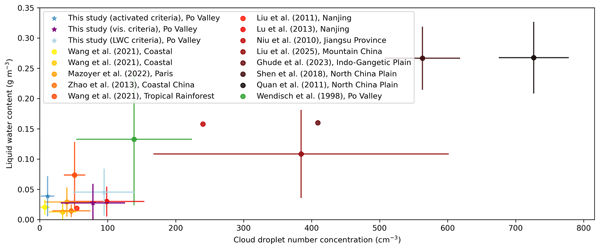
Abstract. Air pollution and fog are closely connected, influencing both visibility and human health. As relative humidity rises, aerosol particles absorb water and grow hygroscopically, potentially activating into fog droplets when supersaturation is reached. However, distinguishing between hydrated (non-activated) aerosols and activated droplets is critical, as their differing thermodynamic states influence fog chemistry and dissipation. This study quantifies the impact of hydrated aerosol particles on fog microphysical properties and visibility in the Po Valley, one of Europe’s most polluted regions. We analyzed detailed aerosol–fog observations from the 2021/22 FAIRARI campaign at San Pietro Capofiume, Italy, using κ-Köhler theory and the Large Eddy Simulation (LES) model MIMICA. The median hygroscopicity κ-value of fog residuals (0.45) exceeded that of interstitial particles (0.40) and out-of-fog aerosols (0.34), reflecting enhanced inorganic content in fog droplets. Hygroscopic growth calculations show that hydrated particles can reach several micrometers in diameter, significantly influencing inferred fog microphysical properties. Excluding hydrated aerosols led to an 81 % increase in effective diameter (from 11.6 μm to 21.0 μm) and an 87 % decrease in cloud droplet number concentration (from 97.4 to 12.4 cm-3). Hydrated particles contributed on average 21 % to liquid water content and accounted for 36 % of sub-kilometer visibility events without droplet activation. LES results emphasize that fog prediction depends strongly on the largest dry aerosol particles. Our findings demonstrate the need to distinguish between hydrated and activated particles when interpreting fog observations and modeling fog development in polluted environments.
Competing interests: At least one of the (co-)authors is a member of the editorial board of Atmospheric Chemistry and Physics. The peer-review process was guided by an independent editor, and the authors also have no other competing interests to declare.
Publisher's note: Copernicus Publications remains neutral with regard to jurisdictional claims made in the text, published maps, institutional affiliations, or any other geographical representation in this paper. While Copernicus Publications makes every effort to include appropriate place names, the final responsibility lies with the authors. Views expressed in the text are those of the authors and do not necessarily reflect the views of the publisher.-
Notice on discussion status
The requested preprint has a corresponding peer-reviewed final revised paper. You are encouraged to refer to the final revised version.
-
Preprint
(5767 KB)
-
Supplement
(6330 KB)
-
The requested preprint has a corresponding peer-reviewed final revised paper. You are encouraged to refer to the final revised version.
- Preprint
(5767 KB) - Metadata XML
-
Supplement
(6330 KB) - BibTeX
- EndNote
- Final revised paper


Journal article(s) based on this preprint
Interactive discussion
Status: closed
-
RC1: 'Comment on egusphere-2025-5419', Anonymous Referee #1, 08 Jan 2026
- AC1: 'Reply on RC1', Paul Zieger, 23 Apr 2026
-
RC2: 'Comment on egusphere-2025-5419', Anonymous Referee #2, 30 Jan 2026
This manuscript investigates the link between air pollution and fog by emphasizing the role of hydrated aerosol particles in fog microphysics. Using an extensive measurement dataset from a field campaign in the Po Valley together with large‑eddy‑simulations (LES), the authors quantify how hydrated aerosols affect fog effective diameter (ED), cloud‑droplet number concentration (CDNC), liquid‑water content (LWC), and visibility. Their results demonstrate that incorporating hydrated particles is essential for interpreting observations in particular in polluted areas and must also be represented in numerical models. The study is well presented, provides novel insights into the influence of hydrated aerosols on fog, and falls within the scope of ACP. I recommend publication after minor revisions.
R1: Add a definition section for key terminology
I would suggest having a clear definition of the key terms in one place, very early in the manuscript: hydrated vs activated aerosols, activated/unactivated fog, activated droplets. the terms are defined, in different locations in the manuscript and it would be easier for the reader to have it in one terminology section
R2: Clarify the use of GFAS data
In section 2.3.3. it was shown and mentioned that the GFAS is most likely underestimating LWC, I would clearly state in line 319 that in the following LWC measurement from the PVM are used for quantitative LWC assessment and GFAS data are only used for relative trends and patterns. Otherwise readers might wonder, why GFAS data is shown in later figures.
Minor suggestions:
- L 211: typo: “normalized root mean square error (normalized root mean squared error (NRMSE))”
- L 238: how is droplet activation defined?
- L340: “until 14 UTC” on the consecutive day
- L355: S10 comes before other supplementary Figures in the text. E.g. S12 mentioned before S11. Please reorganize supplement figures to correct order
- L360: more discussion and explanation of Fig. S11 would be helpful here
- L374: It would be nice to also have fog duration in the comparison plot of Fig 3
- Figure 4a: it is hard to make out the interstitial k distribution in yellow. Maybe another colour works better
Citation: https://doi.org/10.5194/egusphere-2025-5419-RC2 - AC1: 'Reply on RC1', Paul Zieger, 23 Apr 2026
Peer review completion


Post-review adjustments


Interactive discussion
Status: closed
-
RC1: 'Comment on egusphere-2025-5419', Anonymous Referee #1, 08 Jan 2026
The manuscript entitled 'Importance of hydrated aerosol particles for aerosol-fog relationships in the Italian Po Valley', submitted by Neuberger et al. focuses on investigating the relationship between ambient air pollution (namely, aerosols) and fog. The study was conducted in the Italian Po Valley, which is infamous for being one of the most polluted regions in Europe, with frequent occurrences of radiation fog. The authors attempt to quantify the impact of hydrated aerosol particles on fog microphysical properties and visibility.
This is an interesting study with a well-designed approach that brings new important results to our understanding of fog behaviour. The scientific outcomes are interesting, the topic is within the scope of ACP and in interest of this journal readership, and as such deserves to be published.
However, I strongly feel that the basic terms used in this study should be properly defined, ideally in the introduction, as they can currently be perceived differently by the audience. I would like to see the difference between hydrated and activated aerosols clarified, as well as the difference between droplet activation and aerosol activation. Furthermore, it should be made clear that the authors are talking about radiation fog. This is specified in the title, but should also be stated explicitly in the text. For example, the statement 'the fog develops in calm and stable air, where supersaturation remains very low' (line 43) is not generally valid for fog formation, but is only valid for radiation fog.
Line 73 - The authors declare that 'pollution levels have declined in the last decade'. It would be very useful to present at least some indicators of ambient air pollution in the Po Valley to support this general statement.
Line 95 – The measurements were carried out between November 2021 and May 2022. The authors should explain why they selected this specific time period. For example, is it the period when the highest fog frequency can be expected?
Line 375 – It should also be noted what the shortest observed fog event was.
Line 476 - 'These past results from the Po Valley are generally consistent with our observations, although the supersaturation levels in particular seem to have decreased over the years.' Could the authors please discuss this in more detail, explaining the likely reasons for the suggested decrease in supersaturation? If possible, could they support this statement with numbers?
Citation: https://doi.org/10.5194/egusphere-2025-5419-RC1 - AC1: 'Reply on RC1', Paul Zieger, 23 Apr 2026
-
RC2: 'Comment on egusphere-2025-5419', Anonymous Referee #2, 30 Jan 2026
This manuscript investigates the link between air pollution and fog by emphasizing the role of hydrated aerosol particles in fog microphysics. Using an extensive measurement dataset from a field campaign in the Po Valley together with large‑eddy‑simulations (LES), the authors quantify how hydrated aerosols affect fog effective diameter (ED), cloud‑droplet number concentration (CDNC), liquid‑water content (LWC), and visibility. Their results demonstrate that incorporating hydrated particles is essential for interpreting observations in particular in polluted areas and must also be represented in numerical models. The study is well presented, provides novel insights into the influence of hydrated aerosols on fog, and falls within the scope of ACP. I recommend publication after minor revisions.
R1: Add a definition section for key terminology
I would suggest having a clear definition of the key terms in one place, very early in the manuscript: hydrated vs activated aerosols, activated/unactivated fog, activated droplets. the terms are defined, in different locations in the manuscript and it would be easier for the reader to have it in one terminology section
R2: Clarify the use of GFAS data
In section 2.3.3. it was shown and mentioned that the GFAS is most likely underestimating LWC, I would clearly state in line 319 that in the following LWC measurement from the PVM are used for quantitative LWC assessment and GFAS data are only used for relative trends and patterns. Otherwise readers might wonder, why GFAS data is shown in later figures.
Minor suggestions:
- L 211: typo: “normalized root mean square error (normalized root mean squared error (NRMSE))”
- L 238: how is droplet activation defined?
- L340: “until 14 UTC” on the consecutive day
- L355: S10 comes before other supplementary Figures in the text. E.g. S12 mentioned before S11. Please reorganize supplement figures to correct order
- L360: more discussion and explanation of Fig. S11 would be helpful here
- L374: It would be nice to also have fog duration in the comparison plot of Fig 3
- Figure 4a: it is hard to make out the interstitial k distribution in yellow. Maybe another colour works better
Citation: https://doi.org/10.5194/egusphere-2025-5419-RC2 - AC1: 'Reply on RC1', Paul Zieger, 23 Apr 2026
Peer review completion
Post-review adjustments
Journal article(s) based on this preprint
Data sets
The fog and aerosol interaction research Italy (FAIRARI) campaign, November 2021 to May 2022 Almuth Neuberger et al. https://bolin.su.se/data/fairari-2021-2022-1
Model code and software
MIMICA LES model ver 5 Julien Savre et al. https://bitbucket.org/matthiasbrakebusch/mimicav5/src/master
Viewed
| HTML | XML | Total | Supplement | BibTeX | EndNote | |
|---|---|---|---|---|---|---|
| 2,729 | 1,079 | 186 | 3,994 | 549 | 137 | 172 |
- HTML: 2,729
- PDF: 1,079
- XML: 186
- Total: 3,994
- Supplement: 549
- BibTeX: 137
- EndNote: 172
Viewed (geographical distribution)
| Country | # | Views | % |
|---|
| Total: | 0 |
| HTML: | 0 |
| PDF: | 0 |
| XML: | 0 |
- 1
Almuth Neuberger
Rahul Ranjan
Hao Ding
Fredrik Mattsson
Lea Haberstock
Darrel Baumgardner
Stefano Decesari
Annica M. L. Ekman
Dagen D. Hughes
Claudia Mohr
Marco Paglione
Ilona Riipinen
Matteo Rinaldi

The requested preprint has a corresponding peer-reviewed final revised paper. You are encouraged to refer to the final revised version.
- Preprint
(5767 KB) - Metadata XML
-
Supplement
(6330 KB) - BibTeX
- EndNote
- Final revised paper
The manuscript entitled 'Importance of hydrated aerosol particles for aerosol-fog relationships in the Italian Po Valley', submitted by Neuberger et al. focuses on investigating the relationship between ambient air pollution (namely, aerosols) and fog. The study was conducted in the Italian Po Valley, which is infamous for being one of the most polluted regions in Europe, with frequent occurrences of radiation fog. The authors attempt to quantify the impact of hydrated aerosol particles on fog microphysical properties and visibility.
This is an interesting study with a well-designed approach that brings new important results to our understanding of fog behaviour. The scientific outcomes are interesting, the topic is within the scope of ACP and in interest of this journal readership, and as such deserves to be published.
However, I strongly feel that the basic terms used in this study should be properly defined, ideally in the introduction, as they can currently be perceived differently by the audience. I would like to see the difference between hydrated and activated aerosols clarified, as well as the difference between droplet activation and aerosol activation. Furthermore, it should be made clear that the authors are talking about radiation fog. This is specified in the title, but should also be stated explicitly in the text. For example, the statement 'the fog develops in calm and stable air, where supersaturation remains very low' (line 43) is not generally valid for fog formation, but is only valid for radiation fog.
Line 73 - The authors declare that 'pollution levels have declined in the last decade'. It would be very useful to present at least some indicators of ambient air pollution in the Po Valley to support this general statement.
Line 95 – The measurements were carried out between November 2021 and May 2022. The authors should explain why they selected this specific time period. For example, is it the period when the highest fog frequency can be expected?
Line 375 – It should also be noted what the shortest observed fog event was.
Line 476 - 'These past results from the Po Valley are generally consistent with our observations, although the supersaturation levels in particular seem to have decreased over the years.' Could the authors please discuss this in more detail, explaining the likely reasons for the suggested decrease in supersaturation? If possible, could they support this statement with numbers?