
the Creative Commons Attribution 4.0 License.
the Creative Commons Attribution 4.0 License.
 | 04 Dec 2025
Tropospheric Low Ozone and Its Diurnal Cycle over the Western Pacific Warm Pool from Solar Absorption FTIR observations
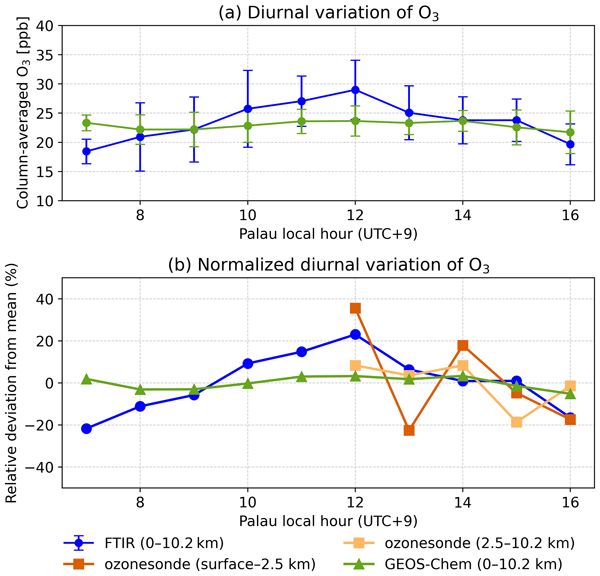
Abstract. We present observations of the daytime diurnal cycle of tropospheric column ozone over Palau in the tropical Pacific Warm Pool, based on high-resolution solar absorption Fourier Transform Infrared (FTIR) spectrometry during September–October 2022. The tropospheric column-averaged ozone (surface–10.2 km) showed a distinct diurnal cycle, with concentrations increasing from morning to a midday maximum and declining in the afternoon, primarily reflecting near-surface variability. Relative comparisons with ozonesonde profiles confirm this diurnal pattern. GEOS-Chem model simulations reproduce the daily mean variability but are not able to capture the observed diurnal cycle, underscoring the need for improved representation of local photochemistry and boundary-layer processes in models.
Palau exhibited persistently low column-averaged ozone between 20–30 ppb during the campaign period, reflecting limited precursor availability, efficient convective washout, and advection of clean marine air from the eastern Pacific. Satellite and reanalysis data indicate low aerosol loadings and large cloud droplets, which suppress convective electrification and reduce lightning activity. With lightning providing a key natural source of NOx, this suppression limits upper-tropospheric ozone and OH production. GEOS-Chem sensitivity simulations confirm that removing lightning NOx emissions further decreases both species, underscoring how aerosol–cloud interactions indirectly shape a chemically low-oxidizing environment. Given that the Tropical Western Pacific (TWP) is a major pathway for troposphere-to-stratosphere transport, the persistence of low ozone and OH suggests that air can ascend into the stratosphere before reactive species are removed by oxidation, thereby influencing the chemical composition of the lower stratosphere.
-
Notice on discussion status
The requested preprint has a corresponding peer-reviewed final revised paper. You are encouraged to refer to the final revised version.
-
Preprint
(4035 KB)
-
The requested preprint has a corresponding peer-reviewed final revised paper. You are encouraged to refer to the final revised version.
- Preprint
(4035 KB) - Metadata XML
- BibTeX
- EndNote
- Final revised paper


Journal article(s) based on this preprint
Interactive discussion
Status: closed
-
RC1: 'Comment on egusphere-2025-5394', Anonymous Referee #1, 16 Dec 2025
- AC1: 'Reply on RC1', Xiaoyu Sun, 17 Feb 2026
-
RC2: 'Comment on egusphere-2025-5394', Anonymous Referee #2, 16 Jan 2026
Review of the manuscript 10.5194/egusphere-2025-5394 by Sun et al. titled
Tropospheric low ozone and its diurnal cycle over the Western Pacific warm pool from solar absorption FTIR observations.
General comment
This manuscript investigates the diurnal cycle of tropospheric ozone above Palau (7.3°N, 134.5°E), using primarily observations performed with a FTIR spectrometer during a campaign-type effort. More specifically, two months of observations collected in September-October 2022 are analyzed and interpreted, taking advantage of supporting data sets consisting in ozone soundings performed from the same place, GEOS-Chem dedicated simulations, 10-days HYSPLIT back-trajectories and satellite observations of precursors (e.g., CO, H2CO) as well as other relevant parameters (cloud effective radius, dust aerosol information). The scientific motivation lies in the exceptionally low tropospheric ozone levels which are characterizing the Tropical Western Pacific (TWP) and the Western Pacific Ocean warm pool, and this manuscript intends to advance our understanding of the factors at play.
After a nice overview of previous works, the authors carefully characterize and exploit the tropospheric ozone measurements at hand. An uncertainty budget is established, and the sensitivity of the FTIR measurements in the troposphere is evaluated, notably accounting for the effect of the viewing geometry (solar elevation). These are compared with sondes measurements and GEOS-Chem simulations, allowing the authors to determine typical abundance of tropospheric ozone for the available time period and to derive its diurnal variation, showing maximum concentrations around noontime. A reasonable agreement is found with the soundings data. GEOS-Chem is shown to reproduce day-to-day variations fairly well but fails to capture the diurnal cycle.
Overall, this is an interesting manuscript, logically organized. The figures have been prepared with care and they are readable. This study conveys useful information to the scientific community. At places, I found that the English could have been improved or polished, but this will likely be handled by the journal at a later stage.
I would recommend publication after consideration of the suggestions provided below.
Major comments
Figure 3 is really central in this study, as it presents the diurnal variation of tropospheric ozone over September-October 2022 derived from the FTIR observations, with a comparison to other data sets. However, we only have partial information on how the measurements have been combined, and we also lack information on the measurement statistics, leaving the reader unsure about the relative weight of each circle/mean in the panel a of Figure 3. I would recommend providing such information: how many days, how many measurements were retained to compute these averages? Furthermore, my view is that some uncertainty information should be added to each means, e.g., the standard deviation around each of them. This way, we would have a better feeling on the possible maximum or minimum magnitude of the tropospheric ozone diurnal cycle. At present, the authors somewhat speculate (line 299) that the amplitude of the variation could be larger than as indicated by the FTIR, but the low-end value of 6 ppb does not account for any uncertainty other than the possible “damping effect”.
Minor comments
[line 30] are we missing some parentheses around Müller et al. and Anderson et al.?
[line 65] in case of reduced oxidative capacity, I would expect a lengthening of the reactive trace gas lifetimes as one of the sink is of less importance?
[Table 1] Is water vapor the only fitted interference in such a busy spectral region? Is the adopted retrieval strategy commonly used in your community? If yes, this should be mentioned and at least one relevant reference should be added.
[line 109] What is typically the tropopause height above Palau in September-October?
[Equation 1] There is a bit of confusion resulting from the use of the “column” wording [e.g., line 116] and the adoption of the “TOC” acronym (expressed in ppb), while in fact it is a mole fraction, as correctly stated on [line 113].
[line 124] …and this inevitably…
[line 137] Please rephrase this sentence.
[Table 2] Why is the day-to-day variability lacking a relative uncertainty (in %)?
[line 209] It is stated that the soundings are released at varying times, but the morning time period does not seem to be covered (based on Fig. 3). Why is this the case?
[line 210] I feel like the end of the sentence, after the semicolon, should be rephrased?
[line 257] Is the TOC on the 16 October 2022 really that low? I don’t see it standing as an outlier in Figure 2(a).
[line 257] a space is missing (after “Figure 3b).
[line 306] indicating that transport
[line 312] boundary layer and increasing with…
[lines 337 and 340] they appear redundant/repetitive, please check.
Citation: https://doi.org/10.5194/egusphere-2025-5394-RC2 - AC2: 'Reply on RC2', Xiaoyu Sun, 17 Feb 2026
Peer review completion


Interactive discussion
Status: closed
-
RC1: 'Comment on egusphere-2025-5394', Anonymous Referee #1, 16 Dec 2025
In “Tropospheric Low Ozone and Its Diurnal Cycle over the Western Pacific Warm Pool from Solar Absorption FTIR observation”, Sun et al. present FTIR-based tropospheric ozone column measurements over the Palau Atmospheric Observatory in the Pacific Warm Pool between September and October 2022. Low ozone is observed and attributed to the low precursor availability, including low lightning activity, and the transport of clean marine air. The authors find a pronounced diurnal cycle of ozone, which cannot be reproduced by GEOS-Chem model simulations.
The paper is well-written and presents interesting observations in a part of the globe that is currently still understudied, but highly important to atmospheric chemistry processes with global implications. I have a few questions and comments. Once these are addressed, the paper will be a valuable addition to the current literature.
Specific comments:
L. 31 f.: An important removal process for O3, that’s missing here, is photolysis and subsequent reaction with H2O, particularly in the marine boundary layer.
L. 33 f.: The reaction of NO with O3 is not really a sink of O3 because NO2 can be photolyzed back to O3 and the interconversion occurs on a short timescale.
L. 250 / Figure 2: Which area does the model represent? Is it the grid extracted at the observatory? How do the error bars look like?
L. 267 / Figure 3: Are these hourly averages including all observation days? I recommend adding error bars to the plot or showing them in the Supplement.
L. 270: Is there really any significant variation in the model throughout the day? Please add error bars.
L. 276: What about the diurnal cycle of other trace gases? And it would be interesting to look at the diurnal cycle of ozone production and loss, since you have the GEOS Chem outputs.
L. 291 f.: Is the pattern significant given the large variability in the data points? Please add error bars.
L. 319: HCHO is not only a precursor, but also an important by-product of O3 formation from VOCs.
L. 325: NOx itself is not removed by precipitation; it can only be removed indirectly after formation of HNO3.
L. 325: Is Rex et al., 2014 really the correct citation here regarding the washout of soluble species?
L. 328 f.: HCHO might not be transported over long distances, but it can be formed locally from longer-lived VOCs, including CH4.
L. 368 / Figure 6: Could the authors also show a panel for NOx to highlight the changes introduced by the sensitivity run?
L. 371: Is the difference really only 7 pptv? If so, that would show that lightning has basically no impact on O3 (< 0.1%). Or is 7 ppbv meant here? However, that would be a surprisingly large impact.
L. 373: I recommend adding a sensitivity study with enhanced lightning, e.g. doubled or tripled lightning NOx emissions. The Warm Pool experiences very low lightning activity and therefore it would be interesting to show the impact of lightning enhancements on O3 and OH as well.
Technical comments:
L. 226 f.: Please double-check the sentence: double use of “available”.
L. 406: Do you mean day-to-day variation here? “Daily” implies “Diurnal” to me.
L. 440: Same here; day-to-day would be better than daily.
Citation: https://doi.org/10.5194/egusphere-2025-5394-RC1 - AC1: 'Reply on RC1', Xiaoyu Sun, 17 Feb 2026
-
RC2: 'Comment on egusphere-2025-5394', Anonymous Referee #2, 16 Jan 2026
Review of the manuscript 10.5194/egusphere-2025-5394 by Sun et al. titled
Tropospheric low ozone and its diurnal cycle over the Western Pacific warm pool from solar absorption FTIR observations.
General comment
This manuscript investigates the diurnal cycle of tropospheric ozone above Palau (7.3°N, 134.5°E), using primarily observations performed with a FTIR spectrometer during a campaign-type effort. More specifically, two months of observations collected in September-October 2022 are analyzed and interpreted, taking advantage of supporting data sets consisting in ozone soundings performed from the same place, GEOS-Chem dedicated simulations, 10-days HYSPLIT back-trajectories and satellite observations of precursors (e.g., CO, H2CO) as well as other relevant parameters (cloud effective radius, dust aerosol information). The scientific motivation lies in the exceptionally low tropospheric ozone levels which are characterizing the Tropical Western Pacific (TWP) and the Western Pacific Ocean warm pool, and this manuscript intends to advance our understanding of the factors at play.
After a nice overview of previous works, the authors carefully characterize and exploit the tropospheric ozone measurements at hand. An uncertainty budget is established, and the sensitivity of the FTIR measurements in the troposphere is evaluated, notably accounting for the effect of the viewing geometry (solar elevation). These are compared with sondes measurements and GEOS-Chem simulations, allowing the authors to determine typical abundance of tropospheric ozone for the available time period and to derive its diurnal variation, showing maximum concentrations around noontime. A reasonable agreement is found with the soundings data. GEOS-Chem is shown to reproduce day-to-day variations fairly well but fails to capture the diurnal cycle.
Overall, this is an interesting manuscript, logically organized. The figures have been prepared with care and they are readable. This study conveys useful information to the scientific community. At places, I found that the English could have been improved or polished, but this will likely be handled by the journal at a later stage.
I would recommend publication after consideration of the suggestions provided below.
Major comments
Figure 3 is really central in this study, as it presents the diurnal variation of tropospheric ozone over September-October 2022 derived from the FTIR observations, with a comparison to other data sets. However, we only have partial information on how the measurements have been combined, and we also lack information on the measurement statistics, leaving the reader unsure about the relative weight of each circle/mean in the panel a of Figure 3. I would recommend providing such information: how many days, how many measurements were retained to compute these averages? Furthermore, my view is that some uncertainty information should be added to each means, e.g., the standard deviation around each of them. This way, we would have a better feeling on the possible maximum or minimum magnitude of the tropospheric ozone diurnal cycle. At present, the authors somewhat speculate (line 299) that the amplitude of the variation could be larger than as indicated by the FTIR, but the low-end value of 6 ppb does not account for any uncertainty other than the possible “damping effect”.
Minor comments
[line 30] are we missing some parentheses around Müller et al. and Anderson et al.?
[line 65] in case of reduced oxidative capacity, I would expect a lengthening of the reactive trace gas lifetimes as one of the sink is of less importance?
[Table 1] Is water vapor the only fitted interference in such a busy spectral region? Is the adopted retrieval strategy commonly used in your community? If yes, this should be mentioned and at least one relevant reference should be added.
[line 109] What is typically the tropopause height above Palau in September-October?
[Equation 1] There is a bit of confusion resulting from the use of the “column” wording [e.g., line 116] and the adoption of the “TOC” acronym (expressed in ppb), while in fact it is a mole fraction, as correctly stated on [line 113].
[line 124] …and this inevitably…
[line 137] Please rephrase this sentence.
[Table 2] Why is the day-to-day variability lacking a relative uncertainty (in %)?
[line 209] It is stated that the soundings are released at varying times, but the morning time period does not seem to be covered (based on Fig. 3). Why is this the case?
[line 210] I feel like the end of the sentence, after the semicolon, should be rephrased?
[line 257] Is the TOC on the 16 October 2022 really that low? I don’t see it standing as an outlier in Figure 2(a).
[line 257] a space is missing (after “Figure 3b).
[line 306] indicating that transport
[line 312] boundary layer and increasing with…
[lines 337 and 340] they appear redundant/repetitive, please check.
Citation: https://doi.org/10.5194/egusphere-2025-5394-RC2 - AC2: 'Reply on RC2', Xiaoyu Sun, 17 Feb 2026
Peer review completion
Journal article(s) based on this preprint
Viewed
| HTML | XML | Total | BibTeX | EndNote | |
|---|---|---|---|---|---|
| 814 | 662 | 75 | 1,551 | 91 | 84 |
- HTML: 814
- PDF: 662
- XML: 75
- Total: 1,551
- BibTeX: 91
- EndNote: 84
Viewed (geographical distribution)
| Country | # | Views | % |
|---|
| Total: | 0 |
| HTML: | 0 |
| PDF: | 0 |
| XML: | 0 |
- 1
Xiaoyu Sun
Mathias Palm
Katrin Müller
Denghui Ji

Justus Notholt
The requested preprint has a corresponding peer-reviewed final revised paper. You are encouraged to refer to the final revised version.
- Preprint
(4035 KB) - Metadata XML
In “Tropospheric Low Ozone and Its Diurnal Cycle over the Western Pacific Warm Pool from Solar Absorption FTIR observation”, Sun et al. present FTIR-based tropospheric ozone column measurements over the Palau Atmospheric Observatory in the Pacific Warm Pool between September and October 2022. Low ozone is observed and attributed to the low precursor availability, including low lightning activity, and the transport of clean marine air. The authors find a pronounced diurnal cycle of ozone, which cannot be reproduced by GEOS-Chem model simulations.
The paper is well-written and presents interesting observations in a part of the globe that is currently still understudied, but highly important to atmospheric chemistry processes with global implications. I have a few questions and comments. Once these are addressed, the paper will be a valuable addition to the current literature.
Specific comments:
L. 31 f.: An important removal process for O3, that’s missing here, is photolysis and subsequent reaction with H2O, particularly in the marine boundary layer.
L. 33 f.: The reaction of NO with O3 is not really a sink of O3 because NO2 can be photolyzed back to O3 and the interconversion occurs on a short timescale.
L. 250 / Figure 2: Which area does the model represent? Is it the grid extracted at the observatory? How do the error bars look like?
L. 267 / Figure 3: Are these hourly averages including all observation days? I recommend adding error bars to the plot or showing them in the Supplement.
L. 270: Is there really any significant variation in the model throughout the day? Please add error bars.
L. 276: What about the diurnal cycle of other trace gases? And it would be interesting to look at the diurnal cycle of ozone production and loss, since you have the GEOS Chem outputs.
L. 291 f.: Is the pattern significant given the large variability in the data points? Please add error bars.
L. 319: HCHO is not only a precursor, but also an important by-product of O3 formation from VOCs.
L. 325: NOx itself is not removed by precipitation; it can only be removed indirectly after formation of HNO3.
L. 325: Is Rex et al., 2014 really the correct citation here regarding the washout of soluble species?
L. 328 f.: HCHO might not be transported over long distances, but it can be formed locally from longer-lived VOCs, including CH4.
L. 368 / Figure 6: Could the authors also show a panel for NOx to highlight the changes introduced by the sensitivity run?
L. 371: Is the difference really only 7 pptv? If so, that would show that lightning has basically no impact on O3 (< 0.1%). Or is 7 ppbv meant here? However, that would be a surprisingly large impact.
L. 373: I recommend adding a sensitivity study with enhanced lightning, e.g. doubled or tripled lightning NOx emissions. The Warm Pool experiences very low lightning activity and therefore it would be interesting to show the impact of lightning enhancements on O3 and OH as well.
Technical comments:
L. 226 f.: Please double-check the sentence: double use of “available”.
L. 406: Do you mean day-to-day variation here? “Daily” implies “Diurnal” to me.
L. 440: Same here; day-to-day would be better than daily.