
the Creative Commons Attribution 4.0 License.
the Creative Commons Attribution 4.0 License.
 | 12 Nov 2025
DOM consumption and demethylation as potential drivers of low MeHg in Mediterranean Sea sponges and benthic fish: a modelling perspective
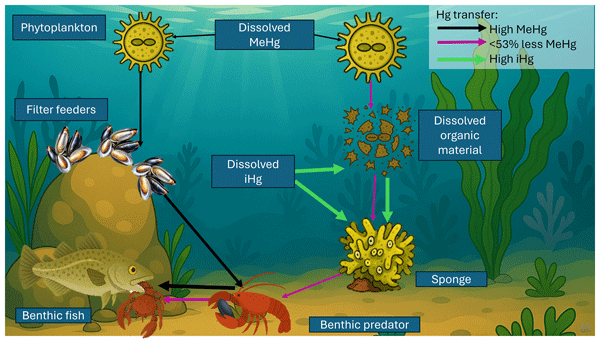
Abstract. Methylmercury (MeHg) is a bioaccumulative neurotoxin that poses a risk to human health through seafood consumption. Sponges play a complex role in mercury (Hg) cycling, with measurements showing an unusually high inorganic Hg (iHg) content in Low Microbial Assemblage (LMA) sponges and an even higher iHg content in High Microbial Assemblage (HMA) sponges. At the same time, the MeHg content remains low, particularly in HMA sponges. In this study, we used a 1D water column model to investigate the bioaccumulation of MeHg in sponges. It has been hypothesized that this low MeHg content is due to active demethylation in HMA sponges. Our model results suggest that the consumption of dissolved organic matter (DOM) in LMA sponges can explain the low observed MeHg content, and higher DOM consumption in HMA sponges can account for the even lower MeHg content in HMA sponges. If demethylation occurs, a low demethylation rate of 1 % per day can account for the observed difference between LMA and HMA sponges. Although DOM consumption increases iHg bioaccumulation in both LMA and HMA sponges, it does not explain the extremely high values observed, suggesting a reduced iHg release rate in sponges. We propose that this low Hg release rate is due to sulfated polysaccharides, which are abundant in sponges, especially HMA sponges. Finally, our model suggests that HMA sponges could potentially reduce the MeHg content in benthic fish by up to 45 % when HMA sponges dominate at the base of the food web. While these findings suggest an important role of sponges in Hg cycling and emphasize the need to preserve sponge grounds to mitigate human MeHg exposure through seafood, this should be seen as a hypothesis-generating model result which would require further empirical validation.
Competing interests: One of the authors is a member of the editorial board of biogeosciences.
Publisher's note: Copernicus Publications remains neutral with regard to jurisdictional claims made in the text, published maps, institutional affiliations, or any other geographical representation in this paper. While Copernicus Publications makes every effort to include appropriate place names, the final responsibility lies with the authors. Views expressed in the text are those of the authors and do not necessarily reflect the views of the publisher.-
Notice on discussion status
The requested preprint has a corresponding peer-reviewed final revised paper. You are encouraged to refer to the final revised version.
-
Preprint
(1256 KB)
-
The requested preprint has a corresponding peer-reviewed final revised paper. You are encouraged to refer to the final revised version.
- Preprint
(1256 KB) - Metadata XML
- BibTeX
- EndNote
- Final revised paper


Journal article(s) based on this preprint
Interactive discussion
Status: closed
-
RC1: 'Comment on egusphere-2025-5377', Anonymous Referee #1, 15 Dec 2025
-
AC2: 'Reply on RC1', David Amptmeijer, 19 Feb 2026
Dear Reviewer,
Thank you very much for taking the time to review the manuscript and for your helpful suggestions. In the attached PDF, we have presented your comments in grey boxes, our responses in blue, and the suggested edits in red. While we fully agree with your recommendations regarding improvements to the model evaluation and the sensitivity analyses, these are constrained by the availability of observational data for validation. We hope you agree that the proposed revisions address your concerns and effectively strengthen the manuscript.
Kind regards
-
AC2: 'Reply on RC1', David Amptmeijer, 19 Feb 2026
-
RC2: 'Comment on egusphere-2025-5377', Anonymous Referee #2, 29 Dec 2025
The manuscript addresses a significant and persistent anomaly in marine ecotoxicology: the observation that marine sponges, particularly those with high microbial abundance, accumulate high concentrations of inorganic Hg while maintaining unexpectedly low levels of MeHg. The authors employ a coupled 1D hydrodynamic-biogeochemical model to test the hypothesis that trophic dilution via DOM consumption, rather than microbial mediated MeHg demethylation, drives these patterns. Furthermore, the study posits a potentially massive ecosystem service, suggesting that sponge grounds could reduce MeHg bioaccumulation in benthic fish by up to 45%. The overall manuscript is well organized, and a minor revision is needed. My specific comments are as below:
- Title: MeHg demethylation
- Abstract: The second sentence is too long. The complex role of sponges and their significance should be more clearly emphasized.
- Line 6: demethylation of MeHg
- Line 11-12: This conclusion is overly speculative and requires additional supporting evidence.
- Lines 17-24: Links between sponges Hg and fish Hg are needed here.
- Line 36: ?
- Lines 33-43: This section is overly general and would benefit from greater conciseness.
- Lines 45-48: In the case of inorganic mercury (iHg), iHg-DOM binding determines the bioavailability of iHg for methylation.
- Section2:In this section, the role of sponges in Hg cycling and MeHg accumulation in biota should be clearly highlighted. This is important and helps readers understand the significance of this study.
- Section 1.3: Why DOM consumption can result in low MeHg concentrations?
- Lines 567-570: Yes, The validation of the model relies on a limited sample sizes (n=4 for HMA and n=6 for LMA sponges). The use of Kolmogorov-Smirnov (KS) tests on such sparse data provides a misleading sense of statistical robustness, as the test lacks the power to reject the null hypothesis, thereby creating a "false positive" agreement between model and observation. The author should strengthen the discussion by explicitly addressing how the limited sample size may influence the validity and generalizability of the findings, rather than simply noting the limitation.
Citation: https://doi.org/10.5194/egusphere-2025-5377-RC2 -
AC1: 'Reply on RC2', David Amptmeijer, 19 Feb 2026
Dear Reviewer,
Thank you very much for your suggestions and for the time you invested in reviewing this manuscript. We have attached a PDF to this message in which we provide a detailed response to your concerns and recommendations. We agree with all of your suggestions and hope you will agree that our proposed revisions strengthen the weaker points of the manuscript.
Kind regards


Interactive discussion
Status: closed
-
RC1: 'Comment on egusphere-2025-5377', Anonymous Referee #1, 15 Dec 2025
This study constructed a model to trace the bioaccumulation of MeHg within the Mediterranean Sea food web in the Bay of Villefranche. The model initially enabled assessing the levels of iHg and MeHg accumulating in LMA sponges. The model was also used to assess the differences in MeHg bioaccumulation in fish in a setup with and without sponges to see if sponges influence the MeHg bioaccumulation in fish. Although an advanced model was developed and the design of scenarios was ingenious in this study, the article reads rather obscure. Many paragraphs are suggested to be refined, and the logicality should be simultaneously increased. Major revision is needed and some comments are shown as follows.
(1) Line 85: The sentence “This is proposed in (Amptmeijer et al., 2025b), which is a……” is confused. Please rewrite the sentence.
(2) Section 2.1: A map is needed for the model domain in the main text.
(3) For the subtitles of sections 2.1, 2.2, 2.3, and 2.3.2, dashes are better than semicolons. And capitalize the first letter of “semi-labile” in Section 2.6.
(4) Section 3.4: In my opinion, the observations of Hg and MeHg in the study domain are too few to support the model evaluation. I suggest more observations particularly for various environments and functional groups.
(5) All the figures should be improved due to their rough presentation.
(6) Section 4.2: What’s the underlying mechanisms for low MeHg due to DOM consumption in HMA sponges? I only see the results of model scenarios. However, the mechanistic inference is more meaningful.
(7) For model studies, uncertainty analysis is necessary to explain the credibility of the model results. I recommend the supplement of uncertainty analysis.
Citation: https://doi.org/10.5194/egusphere-2025-5377-RC1 -
AC2: 'Reply on RC1', David Amptmeijer, 19 Feb 2026
Dear Reviewer,
Thank you very much for taking the time to review the manuscript and for your helpful suggestions. In the attached PDF, we have presented your comments in grey boxes, our responses in blue, and the suggested edits in red. While we fully agree with your recommendations regarding improvements to the model evaluation and the sensitivity analyses, these are constrained by the availability of observational data for validation. We hope you agree that the proposed revisions address your concerns and effectively strengthen the manuscript.
Kind regards
-
AC2: 'Reply on RC1', David Amptmeijer, 19 Feb 2026
-
RC2: 'Comment on egusphere-2025-5377', Anonymous Referee #2, 29 Dec 2025
The manuscript addresses a significant and persistent anomaly in marine ecotoxicology: the observation that marine sponges, particularly those with high microbial abundance, accumulate high concentrations of inorganic Hg while maintaining unexpectedly low levels of MeHg. The authors employ a coupled 1D hydrodynamic-biogeochemical model to test the hypothesis that trophic dilution via DOM consumption, rather than microbial mediated MeHg demethylation, drives these patterns. Furthermore, the study posits a potentially massive ecosystem service, suggesting that sponge grounds could reduce MeHg bioaccumulation in benthic fish by up to 45%. The overall manuscript is well organized, and a minor revision is needed. My specific comments are as below:
- Title: MeHg demethylation
- Abstract: The second sentence is too long. The complex role of sponges and their significance should be more clearly emphasized.
- Line 6: demethylation of MeHg
- Line 11-12: This conclusion is overly speculative and requires additional supporting evidence.
- Lines 17-24: Links between sponges Hg and fish Hg are needed here.
- Line 36: ?
- Lines 33-43: This section is overly general and would benefit from greater conciseness.
- Lines 45-48: In the case of inorganic mercury (iHg), iHg-DOM binding determines the bioavailability of iHg for methylation.
- Section2:In this section, the role of sponges in Hg cycling and MeHg accumulation in biota should be clearly highlighted. This is important and helps readers understand the significance of this study.
- Section 1.3: Why DOM consumption can result in low MeHg concentrations?
- Lines 567-570: Yes, The validation of the model relies on a limited sample sizes (n=4 for HMA and n=6 for LMA sponges). The use of Kolmogorov-Smirnov (KS) tests on such sparse data provides a misleading sense of statistical robustness, as the test lacks the power to reject the null hypothesis, thereby creating a "false positive" agreement between model and observation. The author should strengthen the discussion by explicitly addressing how the limited sample size may influence the validity and generalizability of the findings, rather than simply noting the limitation.
Citation: https://doi.org/10.5194/egusphere-2025-5377-RC2 -
AC1: 'Reply on RC2', David Amptmeijer, 19 Feb 2026
Dear Reviewer,
Thank you very much for your suggestions and for the time you invested in reviewing this manuscript. We have attached a PDF to this message in which we provide a detailed response to your concerns and recommendations. We agree with all of your suggestions and hope you will agree that our proposed revisions strengthen the weaker points of the manuscript.
Kind regards
Peer review completion


Journal article(s) based on this preprint
Viewed
| HTML | XML | Total | BibTeX | EndNote | |
|---|---|---|---|---|---|
| 1,798 | 734 | 188 | 2,720 | 196 | 179 |
- HTML: 1,798
- PDF: 734
- XML: 188
- Total: 2,720
- BibTeX: 196
- EndNote: 179
Viewed (geographical distribution)
| Country | # | Views | % |
|---|
| Total: | 0 |
| HTML: | 0 |
| PDF: | 0 |
| XML: | 0 |
- 1
David Johannes Amptmeijer
Ulrike Hanz
Corinna Schrum
Johannes Bieser
The requested preprint has a corresponding peer-reviewed final revised paper. You are encouraged to refer to the final revised version.
- Preprint
(1256 KB) - Metadata XML
This study constructed a model to trace the bioaccumulation of MeHg within the Mediterranean Sea food web in the Bay of Villefranche. The model initially enabled assessing the levels of iHg and MeHg accumulating in LMA sponges. The model was also used to assess the differences in MeHg bioaccumulation in fish in a setup with and without sponges to see if sponges influence the MeHg bioaccumulation in fish. Although an advanced model was developed and the design of scenarios was ingenious in this study, the article reads rather obscure. Many paragraphs are suggested to be refined, and the logicality should be simultaneously increased. Major revision is needed and some comments are shown as follows.
(1) Line 85: The sentence “This is proposed in (Amptmeijer et al., 2025b), which is a……” is confused. Please rewrite the sentence.
(2) Section 2.1: A map is needed for the model domain in the main text.
(3) For the subtitles of sections 2.1, 2.2, 2.3, and 2.3.2, dashes are better than semicolons. And capitalize the first letter of “semi-labile” in Section 2.6.
(4) Section 3.4: In my opinion, the observations of Hg and MeHg in the study domain are too few to support the model evaluation. I suggest more observations particularly for various environments and functional groups.
(5) All the figures should be improved due to their rough presentation.
(6) Section 4.2: What’s the underlying mechanisms for low MeHg due to DOM consumption in HMA sponges? I only see the results of model scenarios. However, the mechanistic inference is more meaningful.
(7) For model studies, uncertainty analysis is necessary to explain the credibility of the model results. I recommend the supplement of uncertainty analysis.