
the Creative Commons Attribution 4.0 License.
the Creative Commons Attribution 4.0 License.
 | 07 Nov 2025
Observed multiscale dynamical processes responsible for an extreme wind gust event in Beijing
Abstract. Extreme wind gusts pose substantial threats to human safety and infrastructure, yet pre-onset observational constraints remain inadequate, leading to large uncertainties and inaccuracies in nowcasting and prediction. To address this gap, we conduct an in-depth investigation of a record-breaking surface gust event (wind speed >35 m s⁻¹) that occurred in Beijing during the early afternoon of 30 May 2024. We explore the dynamical characteristics of this event utilizing a high-resolution meteorological mesonet, which includes seven radar wind profilers, a meteorological tower, automated weather stations, radar and satellite data. Multi-source observational analyses show the development of multicellular storm ahead of the convergence line as the northeasterly cold outflows met environmental southerly winds during its downhill propagation. Evaporative cooling contributed to the generation of the extreme winds through the downward momentum transport and pressure gradient forcing. After reaching the plain, two convective segments subsequently merged into a well-organized squall system embedded with a midlevel mesovortex with intense rear-inflow jet. The emergence of low-level frontogenesis and shearing deformation provided favorable conditions for sustaining mesoscale convection. This mesoscale convection then fueled small-scale turbulent energy processes. The inverse energy cascades of turbulence – a process involving energy transfer from small to large eddies – significantly intensified as wind speeds increased markedly. This study offers valuable insights into the multiscale dynamical processes governing extreme gust wind events. Moreover, these findings underscore the value of RWP mesonet observations for enhancing our understanding of extreme wind events and in improving the nowcasting and prediction efforts in the future.
-
Notice on discussion status
The requested preprint has a corresponding peer-reviewed final revised paper. You are encouraged to refer to the final revised version.
-
Preprint
(7859 KB)
-
The requested preprint has a corresponding peer-reviewed final revised paper. You are encouraged to refer to the final revised version.
- Preprint
(7859 KB) - Metadata XML
- BibTeX
- EndNote
- Final revised paper


Journal article(s) based on this preprint
Interactive discussion
Status: closed
-
RC1: 'Comment on egusphere-2025-5371', Anonymous Referee #1, 01 Dec 2025
- AC1: 'Reply on RC1', Jianping Guo, 30 Jan 2026
-
RC2: 'Comment on egusphere-2025-5371', Anonymous Referee #2, 03 Dec 2025
This manuscript presents a very nice detailed analysis of intensive
observations made of an extreme surface wind event produced by a
quasi-linear convective system (QLCS), that occurred in Beijing. The
QLCS was associated with a Mesoscale Convective System (MCS). The
observational facilities included a network of 7 radar wind profilers, a
325-m meteorological tower with 7 ultrasonic anemometers, 2 sounding
sites, 250 automated weather stations, and the national radar network.
Himawari-8/9 satellite data are also used.
Detailed commentsMy only main criticism is the conjecture that is not supported by
evidence. Mainly that is wording. I have made quite a few suggestions
below. I hope (most of) these are useful.L46-48. It would be helpful to say what these valuable insights are.
L47. Specify RWP on L33.
Abstract. Would it be useful to mention the record-breaking surface gust
wind event that occurred on 30 April 2021 described by Chen et al, 24?L54. It would perhaps be useful to mention the work of e.g. Browning et
al, in considering the concept of transporting high momentum downwards
to give damaging surface winds, even though the underlying systems were
different. The paper by Browning et al 2010 (Q. J. R. Meteorol. Soc.
136: 354–373, DOI:10.1002/qj.582) is also worth considering. It provided
an in-depth analysis of an MCS. It may be relevant (your L86-89) because
of one of their conclusions: "The absence of strong winds at the surface
within the MCS is consistent with the failure of the rear-inflow jet to
reach the ground and produce a strong cold pool."L68-74. Please explain the role of the various interactions
on these wind gusts. Otherwise the sentence does not provide any
information.L90. Significant progress?
L121-128. It would be better (here and later) to put the details (such
as coordinates) in the caption.L137. Is there any evidence that the mountains affect the soundings made
at Zhangjiakou?L150-154. Does this mean that the maximum reflectivity in a pixel column
is shown? How long does a volume scan take? Is there confidence that the
maximum reflectivities are between 60 and 65 dBZ?L155-156. Mention the radar at BWO in the caption to Fig 1?
L157-160. Are the AWSs in the valleys? There will be limited radar
information in the valleys.L241-242. In my opinion, it would be helpful to show the radar plots in
Fig 4 at this stage. Also two questions, what does a downhill
thunderstorm really mean and secondly, is there a single thunderstorm
involved, or is it the MCS?L245. There are also high winds shown in Fig 2a before 1400. And... is
it possible to place some height contours on Fig 2.L247. Mark the Qianling Mountain site on Fig 2?
L249-250. Again, referring to the radar plots would be helpful. This is
the first mention of the merger of two convective segments and formation
of the squall line.L251. Similarly here. Also, the size of the dots are just as large in
Fig 2c and there are maximum radar echoes before 1500, at 1448 and
possibly 1436. Why is the squall line mature during 1500-1529?Fig 3. What do the black contours represent?
L262. Likely dynamic contribution?
L268-272. What is the mountaintop level? What are the orographic effects
due to the interaction of the strong northwesterly winds and the
mountains? It is not clear what point is being made and in what way the
citations are relevant.L277-280. What do you mean that the dry column provided a favorable
environment for the evaporation of precipitation particles? Do you mean
the humidity below the LCL indicated on the skew-T diagrams? It may be
the case that there is a favorable environment that affect
a fraction of the precipitation. However, it isn't right to use the words
"intense evaporative cooling" and "thus leading to". It really is
conjecture as stated.L282. What "heat release" do you mean?
L283-284. The sentence doesn't make sense as written.
L297-298. It is an impressive set of temperature data shown in Fig 5. Is
there evidence that the sub-cloud air was dry?L306-308. The radar reflectivity is 50 dBZ or greater at 1424 (and
actually well before that time), which is indicative of heavy
precipitation. It is important to know what is actually shown in Fig 4.
Fig 2 shows the accumulation of rain in a 30 min period.L323. Please state the time.
L376-378. Is this conjecture at this stage?
L395. Should this be Fig 5?
L431. Incorrect figure numbers.
L466. I think there is value in showing Fig 8 earlier. It helps to put
some things into perspective clearly.L540. It would be useful to refer to previous studies in this section.
L591-593. The sentence is a bit ambiguous. An important novelty is the
high density of multiple observations. Is that correct?Citation: https://doi.org/10.5194/egusphere-2025-5371-RC2 - AC2: 'Reply on RC2', Jianping Guo, 30 Jan 2026
Peer review completion


Interactive discussion
Status: closed
-
RC1: 'Comment on egusphere-2025-5371', Anonymous Referee #1, 01 Dec 2025
This manuscript presents a comprehensive analysis of an extreme wind gust event associated with a quasi-linear convective system (QLCS) in Beijing on 30 May 2024. The study leverages a high-resolution observational mesonet, including radar wind profilers, a meteorological tower, and multi-source remote sensing data, to elucidate the multi-scale dynamical processes involved. The findings provide valuable insights into the mechanisms of convective gust generation and have potential implications for nowcasting and model improvement. Thus, I recommend the publication of this paper in Atmospheric Chemistry and Physics after the following points have been addressed:
Major comments:
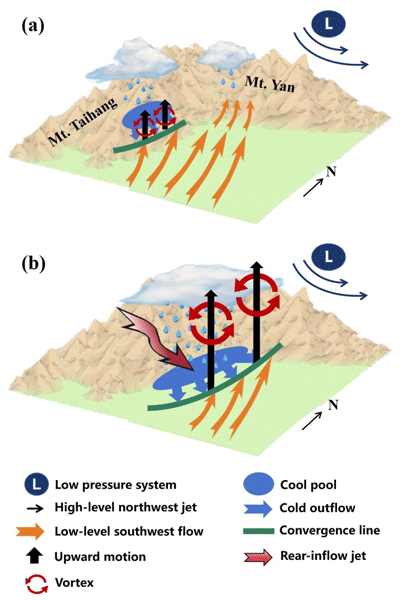
The manuscript would benefit from a detailed description about the conceptual model in Figure 10. A discussion about key findings of this observed mechanism compared with those in previous QLCS studies, especially from other terrain regions, would also enhance this study.
Minor comments:
- The acronym "RWP" is defined early on, but "QLCS" is used in the abstract before being spelled out in the introduction. Please ensure all acronyms are defined upon first use.
- The study relies heavily on RWP-derived parameters (e.g., divergence, vorticity, frontogenesis). The uncertainty associated with these calculations should be quantified and discussed.
- For the frontogenesis calculation, surface observations are implied for gradients of θe. Please comment on the potential implications of using surface data to represent low-level processes, and any associated limitations.
- Line 286: Hiamwari -> Himawari.
- Why you choose the 95th percentile of 10-m wind speed in the triangle rather than the maximum value or another percentile?
- Section 4.4: The link between IEC and gust intensity is intriguing. but needs more physical explanation.
- The use of “jet” should be more cautious. According to the definition, wind speed should be greater than a certain threshold to be called a "jet".
- Ensure all cited references are included and formatted in accordance with ACP guidelines.
Citation: https://doi.org/10.5194/egusphere-2025-5371-RC1 - AC1: 'Reply on RC1', Jianping Guo, 30 Jan 2026
-
RC2: 'Comment on egusphere-2025-5371', Anonymous Referee #2, 03 Dec 2025
This manuscript presents a very nice detailed analysis of intensive
observations made of an extreme surface wind event produced by a
quasi-linear convective system (QLCS), that occurred in Beijing. The
QLCS was associated with a Mesoscale Convective System (MCS). The
observational facilities included a network of 7 radar wind profilers, a
325-m meteorological tower with 7 ultrasonic anemometers, 2 sounding
sites, 250 automated weather stations, and the national radar network.
Himawari-8/9 satellite data are also used.
Detailed commentsMy only main criticism is the conjecture that is not supported by
evidence. Mainly that is wording. I have made quite a few suggestions
below. I hope (most of) these are useful.L46-48. It would be helpful to say what these valuable insights are.
L47. Specify RWP on L33.
Abstract. Would it be useful to mention the record-breaking surface gust
wind event that occurred on 30 April 2021 described by Chen et al, 24?L54. It would perhaps be useful to mention the work of e.g. Browning et
al, in considering the concept of transporting high momentum downwards
to give damaging surface winds, even though the underlying systems were
different. The paper by Browning et al 2010 (Q. J. R. Meteorol. Soc.
136: 354–373, DOI:10.1002/qj.582) is also worth considering. It provided
an in-depth analysis of an MCS. It may be relevant (your L86-89) because
of one of their conclusions: "The absence of strong winds at the surface
within the MCS is consistent with the failure of the rear-inflow jet to
reach the ground and produce a strong cold pool."L68-74. Please explain the role of the various interactions
on these wind gusts. Otherwise the sentence does not provide any
information.L90. Significant progress?
L121-128. It would be better (here and later) to put the details (such
as coordinates) in the caption.L137. Is there any evidence that the mountains affect the soundings made
at Zhangjiakou?L150-154. Does this mean that the maximum reflectivity in a pixel column
is shown? How long does a volume scan take? Is there confidence that the
maximum reflectivities are between 60 and 65 dBZ?L155-156. Mention the radar at BWO in the caption to Fig 1?
L157-160. Are the AWSs in the valleys? There will be limited radar
information in the valleys.L241-242. In my opinion, it would be helpful to show the radar plots in
Fig 4 at this stage. Also two questions, what does a downhill
thunderstorm really mean and secondly, is there a single thunderstorm
involved, or is it the MCS?L245. There are also high winds shown in Fig 2a before 1400. And... is
it possible to place some height contours on Fig 2.L247. Mark the Qianling Mountain site on Fig 2?
L249-250. Again, referring to the radar plots would be helpful. This is
the first mention of the merger of two convective segments and formation
of the squall line.L251. Similarly here. Also, the size of the dots are just as large in
Fig 2c and there are maximum radar echoes before 1500, at 1448 and
possibly 1436. Why is the squall line mature during 1500-1529?Fig 3. What do the black contours represent?
L262. Likely dynamic contribution?
L268-272. What is the mountaintop level? What are the orographic effects
due to the interaction of the strong northwesterly winds and the
mountains? It is not clear what point is being made and in what way the
citations are relevant.L277-280. What do you mean that the dry column provided a favorable
environment for the evaporation of precipitation particles? Do you mean
the humidity below the LCL indicated on the skew-T diagrams? It may be
the case that there is a favorable environment that affect
a fraction of the precipitation. However, it isn't right to use the words
"intense evaporative cooling" and "thus leading to". It really is
conjecture as stated.L282. What "heat release" do you mean?
L283-284. The sentence doesn't make sense as written.
L297-298. It is an impressive set of temperature data shown in Fig 5. Is
there evidence that the sub-cloud air was dry?L306-308. The radar reflectivity is 50 dBZ or greater at 1424 (and
actually well before that time), which is indicative of heavy
precipitation. It is important to know what is actually shown in Fig 4.
Fig 2 shows the accumulation of rain in a 30 min period.L323. Please state the time.
L376-378. Is this conjecture at this stage?
L395. Should this be Fig 5?
L431. Incorrect figure numbers.
L466. I think there is value in showing Fig 8 earlier. It helps to put
some things into perspective clearly.L540. It would be useful to refer to previous studies in this section.
L591-593. The sentence is a bit ambiguous. An important novelty is the
high density of multiple observations. Is that correct?Citation: https://doi.org/10.5194/egusphere-2025-5371-RC2 - AC2: 'Reply on RC2', Jianping Guo, 30 Jan 2026
Peer review completion
Journal article(s) based on this preprint
Viewed
| HTML | XML | Total | BibTeX | EndNote | |
|---|---|---|---|---|---|
| 1,197 | 950 | 90 | 2,237 | 83 | 70 |
- HTML: 1,197
- PDF: 950
- XML: 90
- Total: 2,237
- BibTeX: 83
- EndNote: 70
Viewed (geographical distribution)
| Country | # | Views | % |
|---|
| Total: | 0 |
| HTML: | 0 |
| PDF: | 0 |
| XML: | 0 |
- 1
Xiaoran Guo

Ning Li
Zhen Zhang
Tianmeng Chen
Pengzhan Yao
Shuairu Jiang
Lei Zhao
Fei Hu
The requested preprint has a corresponding peer-reviewed final revised paper. You are encouraged to refer to the final revised version.
- Preprint
(7859 KB) - Metadata XML
This manuscript presents a comprehensive analysis of an extreme wind gust event associated with a quasi-linear convective system (QLCS) in Beijing on 30 May 2024. The study leverages a high-resolution observational mesonet, including radar wind profilers, a meteorological tower, and multi-source remote sensing data, to elucidate the multi-scale dynamical processes involved. The findings provide valuable insights into the mechanisms of convective gust generation and have potential implications for nowcasting and model improvement. Thus, I recommend the publication of this paper in Atmospheric Chemistry and Physics after the following points have been addressed:
Major comments:
The manuscript would benefit from a detailed description about the conceptual model in Figure 10. A discussion about key findings of this observed mechanism compared with those in previous QLCS studies, especially from other terrain regions, would also enhance this study.
Minor comments: