
the Creative Commons Attribution 4.0 License.
the Creative Commons Attribution 4.0 License.
 | 17 Nov 2025
Glass plate sampling efficiency for trace gases in the sea surface microlayer
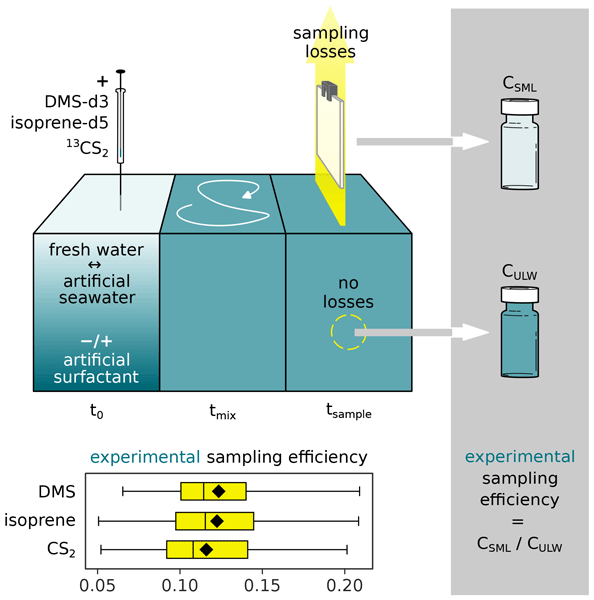
Abstract. Many climate-active trace gases in the atmosphere are closely linked to production and consumption in the ocean, which are, in turn, influenced by the sea surface microlayer (SML). The SML is the upper most layer of the ocean with up to 1 mm thickness, often enriched in organics. Studies of trace gases in the SML aim to identify and quantify potential processes unique to the SML and to understand the SML's influence on the transfer between air and sea. Established sampling techniques of the SML (e.g., glass plate, mesh screen) are associated with high losses for the volatile trace gases. Despite the high losses, in this study we find that meaningful analysis of glass plate samples for trace gases is possible. We experimentally determined the sampling efficiency for the short-lived trace gases dimethyl sulphide (DMS), isoprene, and carbon disulphide (CS2). Water temperature and trace gas concentration were the main drivers for sampling efficiency variability, while salinity and the number of dips of the glass plate were not significant. The effect of surfactants could not finally be untangled. Although our results are consistent, we do not quantify a sampling efficiency to correct individual measurements, as our experiments did not encompass the full suite of environmental parameters normally encountered in the field. Instead, we suggest to use 0.13 ± 0.01 (± standard error) for DMS and isoprene, and 0.12 ± 0.01 for CS2 as thresholds to identify cases of net production in the SML. Future studies should extend to long-lived species (e.g., nitrous oxide, methane), include the effect of wind, and be repeated for the mesh screen. We hypothesize that a correction of individual measurements requires to determine sampling efficiency as a function of environmental parameters, for which the underlying physicochemical relationships need to be unraveled by increasing the parameter space studied here.
Competing interests: Hermann W. Bange is a member of the editorial board of Biogeosciences.
Publisher's note: Copernicus Publications remains neutral with regard to jurisdictional claims made in the text, published maps, institutional affiliations, or any other geographical representation in this paper. While Copernicus Publications makes every effort to include appropriate place names, the final responsibility lies with the authors. Views expressed in the text are those of the authors and do not necessarily reflect the views of the publisher.-
Notice on discussion status
The requested preprint has a corresponding peer-reviewed final revised paper. You are encouraged to refer to the final revised version.
-
Preprint
(1252 KB)
-
The requested preprint has a corresponding peer-reviewed final revised paper. You are encouraged to refer to the final revised version.
- Preprint
(1252 KB) - Metadata XML
- BibTeX
- EndNote
- Final revised paper


Journal article(s) based on this preprint
Interactive discussion
Status: closed
-
RC1: 'Comment on egusphere-2025-5361', Anonymous Referee #1, 08 Dec 2025
-
AC1: 'Reply on RC1', Lea Lange, 30 Jan 2026
The comment was uploaded in the form of a supplement: https://egusphere.copernicus.org/preprints/2025/egusphere-2025-5361/egusphere-2025-5361-AC1-supplement.pdf
-
AC1: 'Reply on RC1', Lea Lange, 30 Jan 2026
-
RC2: 'Comment on egusphere-2025-5361', Anonymous Referee #2, 07 Jan 2026
The comment was uploaded in the form of a supplement: https://egusphere.copernicus.org/preprints/2025/egusphere-2025-5361/egusphere-2025-5361-RC2-supplement.pdf
-
AC2: 'Reply on RC2', Lea Lange, 30 Jan 2026
The comment was uploaded in the form of a supplement: https://egusphere.copernicus.org/preprints/2025/egusphere-2025-5361/egusphere-2025-5361-AC2-supplement.pdf
-
AC2: 'Reply on RC2', Lea Lange, 30 Jan 2026
Peer review completion


Post-review adjustments


Interactive discussion
Status: closed
-
RC1: 'Comment on egusphere-2025-5361', Anonymous Referee #1, 08 Dec 2025
Comments on “Glass plate sampling efficiency for trace gases in the sea surface microlayer”
EGUsphere-2025-5361
General Comments
This manuscript addresses an important methodological gap in sea surface microlayer (SML) research by quantifying the sampling efficiency of the glass plate technique for short-lived trace gases (DMS, isoprene, CS₂). The topic is highly relevant for SML biogeochemistry and air–sea exchange studies. The manuscript is generally well structured, and the authors make a commendable effort to analyse their data comprehensively.
However, there are several limitations that prevent the study from supporting some of its conclusions in the current form. The experimental configuration is constrained by practical conditions (homogeneous tank, no natural organic enrichment, oversaturated conditions) and does not fully represent the complexity of natural SMLs. The key assumption that SML and ULW have identical concentrations (CSML = CULW) requires further clarification, especially under oversaturation and in surfactant treatments. Moreover, differences between experiments are confounded by changes in tank material, location, and artificial sea salt formulation. In addition to the major points above, several specific issues in the manuscript should also be addressed.
Specific Comments
- The manuscript proposes to use sampling efficiencies of 0.13±0.01 (DMS/isoprene) and 0.12±0.01 (CS₂) as thresholds to identify cases of net production in the SML. However, this recommendation requires significant caution. The experimental setup represents a specific scenario: a stagnant, homogeneous system with trace gas oversaturation. The steep concentration gradient driven by this oversaturation likely promotes rapid outgassing during the sampling process, potentially resulting in a lower sampling efficiency than might occur under near-equilibrium field conditions. Conversely, the lack of wind-driven turbulence in the lab might overestimate efficiency compared with rough seas. Therefore, these “thresholds” should be framed as system-specific empirical values derived from a high-outgassing regime, rather than general operational criteria.
- The central definition of sampling efficiency assumes CSML = CULW so that any difference between SML and ULW samples reflects pure sampling artefacts. This assumption is particularly challenging under the experimental conditions of strong oversaturation and during surfactant treatment, where ongoing outgassing and the sampling sequence may introduce gradients not fully accounted for by the "well-mixed" test. It is therefore recommended that the Discussion more explicitly acknowledge this limitation, clarifying that the reported sampling efficiencies likely reflect a combination of true sampling artefacts and contemporaneous water-air exchange.
- The decision to omit explicit calibration and rely only on PA ratios is reasonable in principle, provided the GC-MS response is linear with negligible intercept over the concentration range used. However, the manuscript does not show any supporting calibration data, yet draws conclusions that depend on distinguishing efficiencies around 0.12–0.13. Even small deviations from linearity or a non-zero intercept could affect the ratio PA_SML/PA_ULW, especially if SML and ULW concentrations differ by a factor of ~8–10. A brief demonstration of linearity (in Supplementary Material) or a more explicit discussion of this assumption would strengthen the quantitative claims.
Minor Comments
Page 1, line 18 – “in the field. . Instead,” → remove extra period.
Page 4, Line 121: Two types of artificial seawater (Tropic Marin® Pro-Reef Sea Salt vs. ordinary aquarium salt) are used. It would help to explain the rationale for these choices and how their compositions differ (e.g. trace metals, alkalinity, additives). Since sampling efficiency differs between experiments B and C, the role of salt composition should be discussed more concretely.
Page 6, Line 140: The text notes that a single glass plate dip yields 1.8–6.3 mL of medium, leading to substantial variability in sample volume per dip. Could you clarify what factors drive this large range in collected volume per dip? Understanding these drivers is important for assessing whether volume variability introduces bias to sampling efficiency.
Page 7, Line 190: The decision to use peak area ratios without GC-MS calibration is stated, but the assumption of a linear relationship between peak area and concentration is not validated. Including a brief note on how this assumption was tested or acknowledging its limitations would enhance transparency.
Page 13 Line 337: Correct figure reference formatting. Several places refer to “Fig. Figure X” (e.g. Figure 1, Figure 2, Figure 3, Figure 5, Figure 6, Figure 7), which is clearly a typesetting artefact.
Page 21, Lines 490–495: The total water temperature range is modest (ΔT ≈ 5.9 °C). You might add that this limited range likely contributes to the relatively weak apparent temperature effect in the raw data, despite statistical significance in the MLR.
Citation: https://doi.org/10.5194/egusphere-2025-5361-RC1 -
AC1: 'Reply on RC1', Lea Lange, 30 Jan 2026
The comment was uploaded in the form of a supplement: https://egusphere.copernicus.org/preprints/2025/egusphere-2025-5361/egusphere-2025-5361-AC1-supplement.pdf
-
RC2: 'Comment on egusphere-2025-5361', Anonymous Referee #2, 07 Jan 2026
The comment was uploaded in the form of a supplement: https://egusphere.copernicus.org/preprints/2025/egusphere-2025-5361/egusphere-2025-5361-RC2-supplement.pdf
-
AC2: 'Reply on RC2', Lea Lange, 30 Jan 2026
The comment was uploaded in the form of a supplement: https://egusphere.copernicus.org/preprints/2025/egusphere-2025-5361/egusphere-2025-5361-AC2-supplement.pdf
-
AC2: 'Reply on RC2', Lea Lange, 30 Jan 2026
Peer review completion
Post-review adjustments
Journal article(s) based on this preprint
Viewed
| HTML | XML | Total | BibTeX | EndNote | |
|---|---|---|---|---|---|
| 1,848 | 966 | 235 | 3,049 | 171 | 267 |
- HTML: 1,848
- PDF: 966
- XML: 235
- Total: 3,049
- BibTeX: 171
- EndNote: 267
Viewed (geographical distribution)
| Country | # | Views | % |
|---|
| Total: | 0 |
| HTML: | 0 |
| PDF: | 0 |
| XML: | 0 |
- 1
Cited



Dennis Booge
Hendrik Feil
Josefine Karnatz
Ina Stoltenberg
Hermann W. Bange
Christa A. Marandino
The requested preprint has a corresponding peer-reviewed final revised paper. You are encouraged to refer to the final revised version.
- Preprint
(1252 KB) - Metadata XML
Comments on “Glass plate sampling efficiency for trace gases in the sea surface microlayer”
EGUsphere-2025-5361
General Comments
This manuscript addresses an important methodological gap in sea surface microlayer (SML) research by quantifying the sampling efficiency of the glass plate technique for short-lived trace gases (DMS, isoprene, CS₂). The topic is highly relevant for SML biogeochemistry and air–sea exchange studies. The manuscript is generally well structured, and the authors make a commendable effort to analyse their data comprehensively.
However, there are several limitations that prevent the study from supporting some of its conclusions in the current form. The experimental configuration is constrained by practical conditions (homogeneous tank, no natural organic enrichment, oversaturated conditions) and does not fully represent the complexity of natural SMLs. The key assumption that SML and ULW have identical concentrations (CSML = CULW) requires further clarification, especially under oversaturation and in surfactant treatments. Moreover, differences between experiments are confounded by changes in tank material, location, and artificial sea salt formulation. In addition to the major points above, several specific issues in the manuscript should also be addressed.
Specific Comments
Minor Comments
Page 1, line 18 – “in the field. . Instead,” → remove extra period.
Page 4, Line 121: Two types of artificial seawater (Tropic Marin® Pro-Reef Sea Salt vs. ordinary aquarium salt) are used. It would help to explain the rationale for these choices and how their compositions differ (e.g. trace metals, alkalinity, additives). Since sampling efficiency differs between experiments B and C, the role of salt composition should be discussed more concretely.
Page 6, Line 140: The text notes that a single glass plate dip yields 1.8–6.3 mL of medium, leading to substantial variability in sample volume per dip. Could you clarify what factors drive this large range in collected volume per dip? Understanding these drivers is important for assessing whether volume variability introduces bias to sampling efficiency.
Page 7, Line 190: The decision to use peak area ratios without GC-MS calibration is stated, but the assumption of a linear relationship between peak area and concentration is not validated. Including a brief note on how this assumption was tested or acknowledging its limitations would enhance transparency.
Page 13 Line 337: Correct figure reference formatting. Several places refer to “Fig. Figure X” (e.g. Figure 1, Figure 2, Figure 3, Figure 5, Figure 6, Figure 7), which is clearly a typesetting artefact.
Page 21, Lines 490–495: The total water temperature range is modest (ΔT ≈ 5.9 °C). You might add that this limited range likely contributes to the relatively weak apparent temperature effect in the raw data, despite statistical significance in the MLR.