
the Creative Commons Attribution 4.0 License.
the Creative Commons Attribution 4.0 License.
 | 12 Nov 2025
Coastal emissions modify the composition and properties of marginal sea aerosols
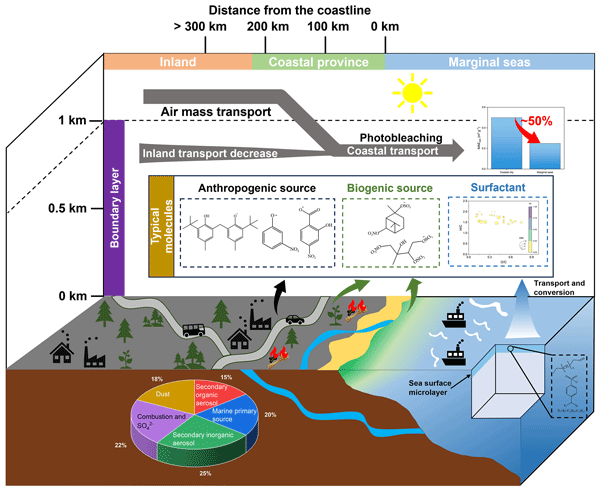
Abstract. Aerosols originating from marginal seas significantly contribute to regional and global air pollution burdens and climate regulation. However, the responses of marine aerosols to terrestrial transport remain uncertain. In this work, we investigated chemical composition and properties of aerosols over Bohai Sea (BS) and Yellow Sea (YS). Our observation results indicate that in the BS and YS regions in summer, the proportion of terrestrial boundary layer air masses is lower than that of marine boundary layer air masses. But the terrestrial characteristics of aerosols in these two regions are still apparent. The characteristics of carbon component ratios in aerosols are similar to those in coastal cities, and the proportion of non–sea–salt ions (> 80 %) is significantly higher than that of sea salt ions. Humic–like substances (HULIS) and water–insoluble organic compounds (WISOC) mainly contain anthropogenic components (oxygenated aromatic compounds, nitrogen-containing aromatic compounds, anthropogenic surfactants, fossil fuel-derived SOA). The δ13CTC characteristics and positive matrix factorization model (PMF) reveal that biomass burning contributes 60–80 % to carbonaceous species and marine primary emissions contribute 20 % to aerosols. According to the height of air mass trajectories and the half–life (15–20 h) of light–absorbing components, we determined the coastal region within 190–260 km of the coastline and the coastal waters as key regions controlling the composition of BS and YS aerosols. Our results emphasize that even with an increase of marine air masses in summer, terrestrial emissions from coastal regions remain the major factor affecting marginal aerosols.
-
Notice on discussion status
The requested preprint has a corresponding peer-reviewed final revised paper. You are encouraged to refer to the final revised version.
-
Preprint
(984 KB)
-
Supplement
(2159 KB)
-
The requested preprint has a corresponding peer-reviewed final revised paper. You are encouraged to refer to the final revised version.
- Preprint
(984 KB) - Metadata XML
-
Supplement
(2159 KB) - BibTeX
- EndNote
- Final revised paper


Journal article(s) based on this preprint
Interactive discussion
Status: closed
-
RC1: 'Comment on egusphere-2025-5303', Anonymous Referee #1, 10 Dec 2025
-
AC3: 'Reply on RC1', Lin Du, 08 Jan 2026
The comment was uploaded in the form of a supplement: https://egusphere.copernicus.org/preprints/2025/egusphere-2025-5303/egusphere-2025-5303-AC3-supplement.pdf
-
AC3: 'Reply on RC1', Lin Du, 08 Jan 2026
-
RC2: 'Comment on egusphere-2025-5303', Anonymous Referee #2, 14 Dec 2025
This study by Hu et al. presents a comprehensive study on the chemical composition, optical properties, and sources of aerosols over the Bohai Sea and Yellow Sea during summer 2023, based on shipboard observations of TSP and PM2.5. The authors combine detailed chemical analyses, optical measurements, stable isotopes, PMF source apportionment, and air mass trajectory analysis to demonstrate that, despite a higher proportion of marine air masses in summer, terrestrial (particularly coastal) emissions dominate the aerosol characteristics in these marginal seas. The topic is important for understanding land–sea interactions in heavily anthropogenically influenced marginal seas. The dataset is valuable and the conclusions are well-supported by the integrated analyses. With some corrections to technical errors and clarifications, this manuscript is suitable for publication in Atmospheric Chemistry and Physics. I recommend minor revision.
Comments:
- Page 3: Change “from 15 to July 23, 2023,” to “from July 15 to 23, 2023”. Similarly, change “from 11 to August 13, 2023” to “from August 11 to 13, 2023”.
- Page 3: The flow rate should be 1.05 m3 min–1.
- Page 3: “a standard solution of 5mg L–1 was used…”. Specify what ions are in this standard.
- Page 7: The choice of 1000 m as the boundary layer height is reasonable, but it can vary due local meteorology. Consider adding sensitivity analysis (e.g., testing 500 and 1500 m) to show if Rtbl/Rmbl values are robust.
- Page 8: “…the concentration of particulate matter is significantly correlated with the calculated Rtbl”, provide the correlation coefficient here.
Citation: https://doi.org/10.5194/egusphere-2025-5303-RC2 -
AC4: 'Reply on RC2', Lin Du, 08 Jan 2026
The comment was uploaded in the form of a supplement: https://egusphere.copernicus.org/preprints/2025/egusphere-2025-5303/egusphere-2025-5303-AC4-supplement.pdf
-
RC3: 'Comment on egusphere-2025-5303', Anonymous Referee #3, 16 Dec 2025
Hu et al. investigate the chemical composition, optical properties, and sources of aerosols (TSP and PM2.5) over the Bohai Sea (BS) and Yellow Sea (YS) during the summer of 2023. By combining bulk chemical analysis (ions, carbonaceous components), stable carbon isotopes (δ13CTC), and high-resolution mass spectrometry (Q-TOF MS) for molecular characterization, the authors provide an insight on how coastal terrestrial emissions impact the marginal sea atmospheres. It is an interesting study and the paper is well-written in general. I have some minor comments on the manuscript.
- Title: I think that the authors have to revise the title of the manuscript to be more specific as ‘coastal emissions’ is too unclear and undefinable.
- Line 23-24, Abstract: Suggest to revise the sentence. It is not clear how terrestrial emissions from coastal regions remain the major factor affecting marginal aerosols. Please be specific.
- Line 61: The term "weekly" seems inappropriate here. Did the authors mean "weakly"?
- Lines 73-75: Sampling on the first deck of a research vessel is highly susceptible to the influence of the ship's own exhaust plumes. If any measures were taken to exclude self-contamination (e.g., wind sector control or BC filtering), please describe them in detail.
- Lines 126-127: In Equations (5) and (6), 72 hours is used as the time scale for weight decay. What is the basis for selecting 72 hours? Should different weighting factors be applied for substances with different atmospheric lifetimes?
- Lines 145-146: PMF models typically require a large sample size to ensure the stability of factorization. The manuscript notes that sampling occurred from July 15-23 and August 11-13, with TSP sampling durations of 12 h and PM5 of 24 h. This implies a relatively small total number of samples (roughly estimated at fewer than 30-40 valid samples). Resolving 4-5 factors with such a small sample size can lead to highly uncertain in the results. I suggest the author to include the results of residual analysis and other error analyses in the text.
- Section 3.5: This manuscript will benefit more by further extending the discussion in this section. The current discussion is too simple and not detail enough. For example, what kind of combustion source and atmospheric secondary transformation in the atmosphere is plausible for influencing the marginal seas. Or further showing how important are these sources in this region. Are there any previous study supports the current PMF results and so on?
- References: Please edit on the formatting issues in the reference list.
- Supporting Info, Figure S10: The figure resolution is low and the wording is too small. Please revise.
- Supporting Info, Figure S12: What does the dotted line in the figure represent?
Citation: https://doi.org/10.5194/egusphere-2025-5303-RC3 -
AC2: 'Reply on RC3', Lin Du, 08 Jan 2026
The comment was uploaded in the form of a supplement: https://egusphere.copernicus.org/preprints/2025/egusphere-2025-5303/egusphere-2025-5303-AC2-supplement.pdf
-
RC4: 'Comment on egusphere-2025-5303', Anonymous Referee #4, 27 Dec 2025
This investigated the chemical compositions and properties of marine aerosols over the Bohai Sea and Yellow Sea. This work is generally well-written and within the scope of ACP. I support the publication once the following comments are addressed.
1. For the PMF source apportionment analysis, I’m confused by the statements in lines 346-350. Have the authors investigated the uncertainty of your PMF results? This is needed before discussion based on the results. Sometimes, terrestrial sources and anthropogenic pollutants occur at the same time. Have the authors check the collinearity between sources (e.g., secondary inorganic aerosols, combustion, secondary organic aerosols, dust)?
It seems the authors focused on the results of δ13CTC to analyze the sources of marine organic aerosols. How about the source contributions of marine organic aerosols apportioned by the PMF model? I may suggest to add related discussion in section 3.5.
2. This work highlights the importance of coastal emissions on the marine aerosols over the marginal seas. What do you mean “coastal emissions” here? It is unclear. Please specific in the title and throughout the manuscript.
The “properties” in the title is unclear. Pleas be specific.
3. The abbreviations (e.g., Rmbl, Rtbl, Rmam, Rtam) in Fig 1b are not easy to follow. And similar abbreviations appear a lot in the main text. I may suggest to use more concise and clear abbreviations throughout the manuscript, and define them clearly when they first appear.
4. Lines 186-187: Please explain this statement in detail. Do you have any related references?
5. Lines 310-311: What do you mean "no significant differences in...." here? Please explain and be specific.
Citation: https://doi.org/10.5194/egusphere-2025-5303-RC4 -
AC1: 'Reply on RC4', Lin Du, 08 Jan 2026
The comment was uploaded in the form of a supplement: https://egusphere.copernicus.org/preprints/2025/egusphere-2025-5303/egusphere-2025-5303-AC1-supplement.pdf
-
AC1: 'Reply on RC4', Lin Du, 08 Jan 2026
Peer review completion


Interactive discussion
Status: closed
-
RC1: 'Comment on egusphere-2025-5303', Anonymous Referee #1, 10 Dec 2025
This manuscript presents a comprehensive investigation into the chemical composition and sources of aerosols over the Bohai Sea (BS) and Yellow Sea (YS) during summer. The study effectively combines field observations, advanced analytical techniques (including high-resolution mass spectrometry and stable carbon isotope analysis), and receptor modeling to demonstrate the dominant influence of coastal terrestrial emissions, particularly biomass burning, on the aerosol properties of these marginal seas, even under conditions of increased marine air mass influence. The topic is relevant and the conclusions are well-supported by the data. The manuscript is generally well-structured, and the methods are appropriately described. The findings contribute valuable insights to the understanding of land-sea interactions in polluted coastal environments. I recommend publication after addressing the following minor revisions to enhance clarity and impact.
Specific Comments:
- Line 16: The authors wrote “The characteristics of carbon component ratios in aerosols are similar to those in coastal cities”, it is better to provide the exact values.
- In Figure 1, Panel A the running time of the backward trajectories should provided. Panel B full name of the acronyms should be given in the caption, the X-axis title should be added. Panel D is confusing and misleading; the four components should not be placed together.
- In Figure 2, The gray circle should change to “The gray circular surface in Panel A”.
- In Figure 3, the meaning of C1, C2 and C3 should given in the caption. Besides, what is the X-axis of Panel A.
- Line 197-198: Did the author consider all chloride ions to be derived from the sea salts
- Line 202-205: the authors mentioned that “aerosols over the northern sea region exhibited higher OC/EC and lower EC concentration (Fig. S2C), indicating a greater influence of atmospheric transformation on aerosols over the northern sea region. Contrary to the OC/EC, the WSOC/OC was higher in the southern sea region. WSOC/OC is often used as an indicator of secondary organic aerosol (SOA) formation, but this ratio is also influenced by biomass burning or environmental factors”. My understanding of this part is that in the norther sea the higher OC/EC ratios indicates secondary organic aerosol formation, the WSOC/OC ratios is higher in the southern sea also indicate secondary organic aerosol formation. If so, why the ratio is contrary between norther and southern sea?
- Line 205-210: the authors said that “WSOC originates not only from primary biomass burning emissions but also from SOA formation”, the authors need to provide more direct evidence. The authors provide WSOC showed significant correlations with EC and nss–K+, and the spatial distribution of the WSOC/OC aligned with that of EC, nss–K+ and K+ concentration which only indicates the primary sources.
Citation: https://doi.org/10.5194/egusphere-2025-5303-RC1 -
AC3: 'Reply on RC1', Lin Du, 08 Jan 2026
The comment was uploaded in the form of a supplement: https://egusphere.copernicus.org/preprints/2025/egusphere-2025-5303/egusphere-2025-5303-AC3-supplement.pdf
-
RC2: 'Comment on egusphere-2025-5303', Anonymous Referee #2, 14 Dec 2025
This study by Hu et al. presents a comprehensive study on the chemical composition, optical properties, and sources of aerosols over the Bohai Sea and Yellow Sea during summer 2023, based on shipboard observations of TSP and PM2.5. The authors combine detailed chemical analyses, optical measurements, stable isotopes, PMF source apportionment, and air mass trajectory analysis to demonstrate that, despite a higher proportion of marine air masses in summer, terrestrial (particularly coastal) emissions dominate the aerosol characteristics in these marginal seas. The topic is important for understanding land–sea interactions in heavily anthropogenically influenced marginal seas. The dataset is valuable and the conclusions are well-supported by the integrated analyses. With some corrections to technical errors and clarifications, this manuscript is suitable for publication in Atmospheric Chemistry and Physics. I recommend minor revision.
Comments:
- Page 3: Change “from 15 to July 23, 2023,” to “from July 15 to 23, 2023”. Similarly, change “from 11 to August 13, 2023” to “from August 11 to 13, 2023”.
- Page 3: The flow rate should be 1.05 m3 min–1.
- Page 3: “a standard solution of 5mg L–1 was used…”. Specify what ions are in this standard.
- Page 7: The choice of 1000 m as the boundary layer height is reasonable, but it can vary due local meteorology. Consider adding sensitivity analysis (e.g., testing 500 and 1500 m) to show if Rtbl/Rmbl values are robust.
- Page 8: “…the concentration of particulate matter is significantly correlated with the calculated Rtbl”, provide the correlation coefficient here.
Citation: https://doi.org/10.5194/egusphere-2025-5303-RC2 -
AC4: 'Reply on RC2', Lin Du, 08 Jan 2026
The comment was uploaded in the form of a supplement: https://egusphere.copernicus.org/preprints/2025/egusphere-2025-5303/egusphere-2025-5303-AC4-supplement.pdf
-
RC3: 'Comment on egusphere-2025-5303', Anonymous Referee #3, 16 Dec 2025
Hu et al. investigate the chemical composition, optical properties, and sources of aerosols (TSP and PM2.5) over the Bohai Sea (BS) and Yellow Sea (YS) during the summer of 2023. By combining bulk chemical analysis (ions, carbonaceous components), stable carbon isotopes (δ13CTC), and high-resolution mass spectrometry (Q-TOF MS) for molecular characterization, the authors provide an insight on how coastal terrestrial emissions impact the marginal sea atmospheres. It is an interesting study and the paper is well-written in general. I have some minor comments on the manuscript.
- Title: I think that the authors have to revise the title of the manuscript to be more specific as ‘coastal emissions’ is too unclear and undefinable.
- Line 23-24, Abstract: Suggest to revise the sentence. It is not clear how terrestrial emissions from coastal regions remain the major factor affecting marginal aerosols. Please be specific.
- Line 61: The term "weekly" seems inappropriate here. Did the authors mean "weakly"?
- Lines 73-75: Sampling on the first deck of a research vessel is highly susceptible to the influence of the ship's own exhaust plumes. If any measures were taken to exclude self-contamination (e.g., wind sector control or BC filtering), please describe them in detail.
- Lines 126-127: In Equations (5) and (6), 72 hours is used as the time scale for weight decay. What is the basis for selecting 72 hours? Should different weighting factors be applied for substances with different atmospheric lifetimes?
- Lines 145-146: PMF models typically require a large sample size to ensure the stability of factorization. The manuscript notes that sampling occurred from July 15-23 and August 11-13, with TSP sampling durations of 12 h and PM5 of 24 h. This implies a relatively small total number of samples (roughly estimated at fewer than 30-40 valid samples). Resolving 4-5 factors with such a small sample size can lead to highly uncertain in the results. I suggest the author to include the results of residual analysis and other error analyses in the text.
- Section 3.5: This manuscript will benefit more by further extending the discussion in this section. The current discussion is too simple and not detail enough. For example, what kind of combustion source and atmospheric secondary transformation in the atmosphere is plausible for influencing the marginal seas. Or further showing how important are these sources in this region. Are there any previous study supports the current PMF results and so on?
- References: Please edit on the formatting issues in the reference list.
- Supporting Info, Figure S10: The figure resolution is low and the wording is too small. Please revise.
- Supporting Info, Figure S12: What does the dotted line in the figure represent?
Citation: https://doi.org/10.5194/egusphere-2025-5303-RC3 -
AC2: 'Reply on RC3', Lin Du, 08 Jan 2026
The comment was uploaded in the form of a supplement: https://egusphere.copernicus.org/preprints/2025/egusphere-2025-5303/egusphere-2025-5303-AC2-supplement.pdf
-
RC4: 'Comment on egusphere-2025-5303', Anonymous Referee #4, 27 Dec 2025
This investigated the chemical compositions and properties of marine aerosols over the Bohai Sea and Yellow Sea. This work is generally well-written and within the scope of ACP. I support the publication once the following comments are addressed.
1. For the PMF source apportionment analysis, I’m confused by the statements in lines 346-350. Have the authors investigated the uncertainty of your PMF results? This is needed before discussion based on the results. Sometimes, terrestrial sources and anthropogenic pollutants occur at the same time. Have the authors check the collinearity between sources (e.g., secondary inorganic aerosols, combustion, secondary organic aerosols, dust)?
It seems the authors focused on the results of δ13CTC to analyze the sources of marine organic aerosols. How about the source contributions of marine organic aerosols apportioned by the PMF model? I may suggest to add related discussion in section 3.5.
2. This work highlights the importance of coastal emissions on the marine aerosols over the marginal seas. What do you mean “coastal emissions” here? It is unclear. Please specific in the title and throughout the manuscript.
The “properties” in the title is unclear. Pleas be specific.
3. The abbreviations (e.g., Rmbl, Rtbl, Rmam, Rtam) in Fig 1b are not easy to follow. And similar abbreviations appear a lot in the main text. I may suggest to use more concise and clear abbreviations throughout the manuscript, and define them clearly when they first appear.
4. Lines 186-187: Please explain this statement in detail. Do you have any related references?
5. Lines 310-311: What do you mean "no significant differences in...." here? Please explain and be specific.
Citation: https://doi.org/10.5194/egusphere-2025-5303-RC4 -
AC1: 'Reply on RC4', Lin Du, 08 Jan 2026
The comment was uploaded in the form of a supplement: https://egusphere.copernicus.org/preprints/2025/egusphere-2025-5303/egusphere-2025-5303-AC1-supplement.pdf
-
AC1: 'Reply on RC4', Lin Du, 08 Jan 2026
Peer review completion
Journal article(s) based on this preprint
Viewed
| HTML | XML | Total | Supplement | BibTeX | EndNote | |
|---|---|---|---|---|---|---|
| 1,351 | 415 | 124 | 1,890 | 231 | 94 | 78 |
- HTML: 1,351
- PDF: 415
- XML: 124
- Total: 1,890
- Supplement: 231
- BibTeX: 94
- EndNote: 78
Viewed (geographical distribution)
| Country | # | Views | % |
|---|
| Total: | 0 |
| HTML: | 0 |
| PDF: | 0 |
| XML: | 0 |
- 1
Kuanyun Hu
Narcisse Tsona Tchinda
Harmut Herrmann
Jianlong Li

The requested preprint has a corresponding peer-reviewed final revised paper. You are encouraged to refer to the final revised version.
- Preprint
(984 KB) - Metadata XML
-
Supplement
(2159 KB) - BibTeX
- EndNote
- Final revised paper
This manuscript presents a comprehensive investigation into the chemical composition and sources of aerosols over the Bohai Sea (BS) and Yellow Sea (YS) during summer. The study effectively combines field observations, advanced analytical techniques (including high-resolution mass spectrometry and stable carbon isotope analysis), and receptor modeling to demonstrate the dominant influence of coastal terrestrial emissions, particularly biomass burning, on the aerosol properties of these marginal seas, even under conditions of increased marine air mass influence. The topic is relevant and the conclusions are well-supported by the data. The manuscript is generally well-structured, and the methods are appropriately described. The findings contribute valuable insights to the understanding of land-sea interactions in polluted coastal environments. I recommend publication after addressing the following minor revisions to enhance clarity and impact.
Specific Comments: