
the Creative Commons Attribution 4.0 License.
the Creative Commons Attribution 4.0 License.
 | 18 Nov 2025
A spatiotemporal analysis of errors in InSAR SWE measurements caused by non-snow phase changes
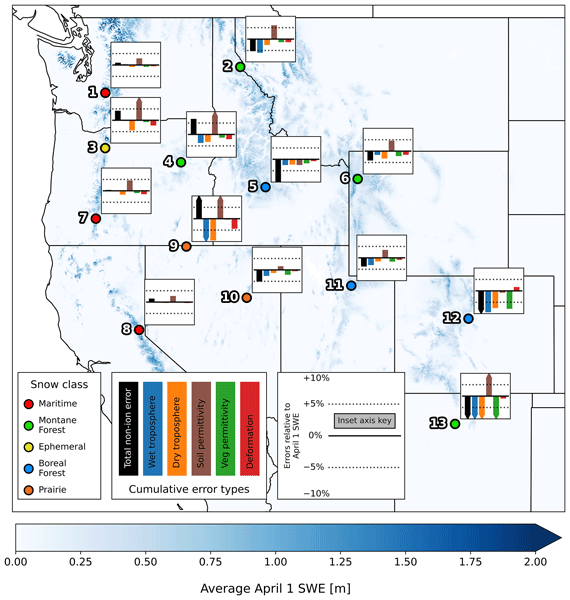
Abstract. Spatially distributed measurements of snow water equivalent (SWE) in mountainous terrain are not currently feasible from existing satellite platforms. The NISAR satellite has the potential to provide high resolution (80 m) SWE measurements on a 12-day orbit cycle over many of Earth's snowy regions, which would represent a new era of spaceborne snow monitoring. The most promising approach for NISAR SWE measurements uses interferometric synthetic aperture radar (InSAR) techniques to derive the 12-day change in SWE (ΔSWE) from the change in phase between two SAR acquisitions. However, many non-snow factors can also change in this 12-day period which subsequently modulate the SAR phase. These non-snow factors can vary differently in both space and time, and in turn introduce spatially and temporally variable errors into InSAR-derived ΔSWE measurements. Here we explore the effects of six non-snow factors that can affect InSAR phase: electron content of the ionosphere, atmospheric water vapor, atmospheric pressure, soil permittivity, vegetation permittivity, and surface deformation. We show how these factors affect phase-based SWE measurements at 13 SNOTEL stations across the western US, as well as regionally across North America. We consider errors resulting from a individual 12-day baselines, as well as the cumulative effects of these errors when a timeseries of ΔSWE measurements are integrated to derive peak seasonal SWE.
The ionospheric effect results in the largest cumulative error at all stations, with changes in the total electron content resulting in phase changes equivalent to 0.271–0.414 m of SWE, or more than 500 % larger than the median April 1 SWE at some shallow snow stations. When ionospheric effects are removed, the remaining cumulative error ranges from -0.074–0.022 m of SWE, equivalent to 0–89 % of April 1 SWE, with results affected primarily by differences in peak SWE rather than differences in absolute error values. Individual error components can show offsetting effects, where positive and negative biases partially cancel out to result in a lower total cumulative error. For a randomly selected 12-day baseline, exceedance probability analysis shows that there is a 50 % chance the ionospheric component introduces an error larger than 0.211 m into the overall ΔSWE measurement, while the remaining five components have a 50 % exceedance probability of 0.031 m. Accurate ΔSWE measurements using NISAR data will not be possible unless ionospheric effects can be appropriately addressed. Removal of other error sources requires careful consideration of the SWE monitoring application: for tracking total SWE accumulation in areas with deeper snowpacks, correcting some errors but not others may actually decrease accuracy by removing offsetting cumulative effects. For individual 12-day baselines, removing as many errors as possible will generally lead to improved accuracy.
-
Notice on discussion status
The requested preprint has a corresponding peer-reviewed final revised paper. You are encouraged to refer to the final revised version.
-
Preprint
(17279 KB)
-
The requested preprint has a corresponding peer-reviewed final revised paper. You are encouraged to refer to the final revised version.
- Preprint
(17279 KB) - Metadata XML
- BibTeX
- EndNote
- Final revised paper


Journal article(s) based on this preprint
Interactive discussion
Status: closed
-
RC1: 'Comment on egusphere-2025-5255', Anonymous Referee #1, 13 Jan 2026
-
AC1: 'Reply on RC1', Ross Palomaki, 03 Apr 2026
The comment was uploaded in the form of a supplement: https://egusphere.copernicus.org/preprints/2025/egusphere-2025-5255/egusphere-2025-5255-AC1-supplement.pdf
-
AC1: 'Reply on RC1', Ross Palomaki, 03 Apr 2026
-
RC2: 'Comment on egusphere-2025-5255', Anonymous Referee #2, 11 Mar 2026
General Comments
The authors assess six potential error sources that may influence NISAR L-band snow water equivalent retrievals using the phase-change approach. To do so, they apply equations describing the theoretical influence on signal phase for each component, using a combination of observed and modeled data to derive the expected influence. These phase shifts are used as input to the SWE retrieval algorithm to determine the expected magnitude of SWE change errors from each factor. The study is a necessary and well-conceived sensitivity analysis, not an observationally focused effort. While the authors do not assess all potential factors that influence SWE, the authors offer a thoughtful discussion of their study limitations and the recommendations that can realistically be drawn from this study. They provide well-written, clear, and concise methods, with effective and visually appealing figures and results. It is already a strong paper, and it was enjoyable to read and will be a good addition to the literature on InSAR-based SWE retrievals – especially as NISAR data begins to become available for SWE mapping. I have only minor comments that I believe would further strengthen the manuscript.
Specific Comments
- The concept of the 12-day baseline may warrant a clearer description in the introduction or methods. How it differs from a 12-day moving-window approach should be clarified.
- The last sentence of the abstract ‘For individual 12-day baselines, removing as many errors as possible….’ comes across as very general. The study has several key takeaways and suggestions that are presented at the end of the conclusion – I’d suggest drawing upon those to provide a more impactful and informative concluding sentence to the abstract
- The introduction is lacking a summary of the InSAR SWE retrieval literature, particularly in terms of observed errors from field testing. I recommend that the authors draw on that literature to provide more insights into expected retrieval errors based on observational data.
- While I am sure each of the 6 assessed components are described in the unpublished companion paper in detail, it would be helpful to the reader if the authors could provide brief (but more detailed than is currently provided) descriptions of each component. For example, some background as to what drives ionospheric variability or surface deformations would be useful to mention early on in the introduction.
- In Figure 6, the exceedance probability of the ionospheric error contribution looks like a step function with error only occurring in ~0.025m bands. This is not reflected in the red line which summarizes all error components as well. – why is this?
- There are opportunities in the discussion and conclusion to add more statistical metrics, which would strengthen the analysis and provide key insights for readers. See Line 279 (‘largest error values’). Paragraph 1 of the conclusions attempts to clarify the expected errors using the exceedance statistics, but its presentation could be clearer in my opinion. Presenting the 50% exceedance for each component would provide a good indication of the relative influence of error across all 6 assessed error sources. The delta SWE threshold should also be consistent and clearly described.
Technical Suggestions
Line 40: I recommend mentioning the target +/- 10% goal when introducing the decadal survey
Line 46 (& referenced elsewhere): The submitted (unpublished?) companion paper (Hoppinen et al., ) should be published before this work is published, since this relies directly on those presented methods
Line 53: Briefly noting other potential error sources here would be relevant
Consider more descriptive section titles (sections 3 and 4) and adding an additional sub-section of results after the error exceedance analysis (before the gridded analysis), as this came across as a separate analysis sub-section
Line 128-129: Providing an explicit example of such interactions would be helpful. The author’s use of examples elsewhere in the paper really helps its clarity in my opinion.
Line 222: consider adding the relative difference in error (numerically) between the morning and evening overpasses – it is clear in Figure 5, but the specific magnitude of the difference is less so, especially because of the different temporal variation patterns
Line 236: Consider adding further justification as to why the ionospheric component was excluded from Figure 6b
Line 344: Where did 670% come from? The highest error was around 500% in the presented tables
Line 352: Is there a relevant manuscript/source that the authors would refer readers to review to better understand how the ionic corrections are made? Consider adding a source within the text that details ionospheric correction effects – in the discussion, if possible
Citation: https://doi.org/10.5194/egusphere-2025-5255-RC2 -
AC2: 'Reply on RC2', Ross Palomaki, 03 Apr 2026
The comment was uploaded in the form of a supplement: https://egusphere.copernicus.org/preprints/2025/egusphere-2025-5255/egusphere-2025-5255-AC2-supplement.pdf
Peer review completion


Interactive discussion
Status: closed
-
RC1: 'Comment on egusphere-2025-5255', Anonymous Referee #1, 13 Jan 2026
Summary and Recommendation
This paper quantifies and compares non-snow errors for InSAR-based retrievals of change in snow water equivalent (SWE). The analysis is conducted at 13 SNOTEL sites in the western United States. Six error sources are considered, including ionospheric effects, atmospheric humidity and pressure, soil permittivity, vegetation permittivity, and surface deformation. The paper finds that errors due to the ionosphere are large and can easily exceed the median SWE value at many sites with lower snowpack accumulation. If ionosphere effects are removed, then the remaining cumulative errors are on the order of 2 to 7 cm in SWE, with some errors offsetting each other. For 10 out of 13 sites, these errors are within 10% error for April 1 SWE, which is within the target accuracy set forth by the U.S. decadal survey.
I find this to be a straightforward and useful analysis with good potential to support SWE error assessments with InSAR-based retrievals like from NISAR. I think it would be a great contribution to the journal following attention to some comments, as elaborated below.
- The specific selection of these 13 SNOTEL sites could use better justification. I understand they were sampled from different regions/zones of the western United States. However, in each of those zones, there are multiple sites which could have alternatively been selected, and the low sample size leads me to wonder about the stability/robustness of the results. Would the results have changed with different sites selected?
- Two of the SNOTEL sites (Disaster Peak and Quemazon) are in post-burn areas and likely have altered snow accumulation and melt dynamics relative to their pre-fire condition (see Smoot and Gleason, 2021). One might argue these two sites may not be broadly representative of their respective geographic zones due to the fire. At the same time, there are broad swaths of the western U.S. where fire has impacted snow dynamics. Similar to the previous comment, I would ask the authors to provide more justification for specific site selection and elaborate on what is being represented by the sites.
- To what extent might error/uncertainty in satellite location/position induce a change in InSAR phase and thus an error in retrieved SWE? I assume this might manifest as a bias over the scene and could be detected/corrected. However, if much of the scene included a change in SWE along with other non-snow errors, then I wonder to what extend orbit error might be detected or corrected.
Line Comments
- L. 43: Delete “a”.
- L. 51: Delete “will”.
- L. 66-67: Why is it 2*pi for equation 1 but 4*pi for the appendix equations? I assume the 4*pi is due to the two-way distance from satellite to surface, so it is a little odd that equation 1 is developed as 2*pi.
- L. 162: Delete “season”.
- L. 210: Remove first “early”.
- L. 220: Add “the” before “largest error”.
- L. 236-243 and Fig. 6: What about cases when delta SWE = 0? This may not be an uncommon occurrence (e.g., cold regions/periods with no new snow and no ablation), and would be important to document. I understand the challenge with including this case (i.e., cannot divide by zero for Fig 6b) but perhaps there is another way to summarize and report expected errors for the dSWE=0 case?
- L. 338: Add “of” after “effects”.
- L. 380: add “(i.e., surface deformation)” at the end of this line because that is what is causing the change in distance.
- L. 410: This canopy height is from LandFIRE, right? Please clarify.
Figures and Tables
- Table 1 – how is surface deformation mapped to the SNOTEL locations, given that these two stations may be separated by some distance?
- Figure 1 – I think it is better stack the 4 panels vertically to align their common axis (time).
- Figure 2 – Similar to previous comment. I think this would display more effectively if it was flipped with 2 rows by 3 columns. That way, the SWE errors can be compared more readily to SWE on the common axis (time).
- Figure 2 – remove “6” at the start of the caption.
- Figure 3 – I realize these are ordered by site number, but think that this could be more effective if arranged by bias (from most negative to most positive, on a median basis).
- Figure 7 – the longitude and latitude labels on the horizontal axes of all 3 panels should be swapped (e.g., longitude should be latitude, and vice versa).
- Figure 7 – would it help to denote the intersection points between the transects on each of the 3 panels?
References
- Smoot, E. E. and Gleason, K. E.: Forest Fires Reduce Snow-Water Storage and Advance the Timing of Snowmelt across the Western U.S., Water, 13, 3533, https://doi.org/10.3390/w13243533, 2021.
Citation: https://doi.org/10.5194/egusphere-2025-5255-RC1 -
AC1: 'Reply on RC1', Ross Palomaki, 03 Apr 2026
The comment was uploaded in the form of a supplement: https://egusphere.copernicus.org/preprints/2025/egusphere-2025-5255/egusphere-2025-5255-AC1-supplement.pdf
-
RC2: 'Comment on egusphere-2025-5255', Anonymous Referee #2, 11 Mar 2026
General Comments
The authors assess six potential error sources that may influence NISAR L-band snow water equivalent retrievals using the phase-change approach. To do so, they apply equations describing the theoretical influence on signal phase for each component, using a combination of observed and modeled data to derive the expected influence. These phase shifts are used as input to the SWE retrieval algorithm to determine the expected magnitude of SWE change errors from each factor. The study is a necessary and well-conceived sensitivity analysis, not an observationally focused effort. While the authors do not assess all potential factors that influence SWE, the authors offer a thoughtful discussion of their study limitations and the recommendations that can realistically be drawn from this study. They provide well-written, clear, and concise methods, with effective and visually appealing figures and results. It is already a strong paper, and it was enjoyable to read and will be a good addition to the literature on InSAR-based SWE retrievals – especially as NISAR data begins to become available for SWE mapping. I have only minor comments that I believe would further strengthen the manuscript.
Specific Comments
- The concept of the 12-day baseline may warrant a clearer description in the introduction or methods. How it differs from a 12-day moving-window approach should be clarified.
- The last sentence of the abstract ‘For individual 12-day baselines, removing as many errors as possible….’ comes across as very general. The study has several key takeaways and suggestions that are presented at the end of the conclusion – I’d suggest drawing upon those to provide a more impactful and informative concluding sentence to the abstract
- The introduction is lacking a summary of the InSAR SWE retrieval literature, particularly in terms of observed errors from field testing. I recommend that the authors draw on that literature to provide more insights into expected retrieval errors based on observational data.
- While I am sure each of the 6 assessed components are described in the unpublished companion paper in detail, it would be helpful to the reader if the authors could provide brief (but more detailed than is currently provided) descriptions of each component. For example, some background as to what drives ionospheric variability or surface deformations would be useful to mention early on in the introduction.
- In Figure 6, the exceedance probability of the ionospheric error contribution looks like a step function with error only occurring in ~0.025m bands. This is not reflected in the red line which summarizes all error components as well. – why is this?
- There are opportunities in the discussion and conclusion to add more statistical metrics, which would strengthen the analysis and provide key insights for readers. See Line 279 (‘largest error values’). Paragraph 1 of the conclusions attempts to clarify the expected errors using the exceedance statistics, but its presentation could be clearer in my opinion. Presenting the 50% exceedance for each component would provide a good indication of the relative influence of error across all 6 assessed error sources. The delta SWE threshold should also be consistent and clearly described.
Technical Suggestions
Line 40: I recommend mentioning the target +/- 10% goal when introducing the decadal survey
Line 46 (& referenced elsewhere): The submitted (unpublished?) companion paper (Hoppinen et al., ) should be published before this work is published, since this relies directly on those presented methods
Line 53: Briefly noting other potential error sources here would be relevant
Consider more descriptive section titles (sections 3 and 4) and adding an additional sub-section of results after the error exceedance analysis (before the gridded analysis), as this came across as a separate analysis sub-section
Line 128-129: Providing an explicit example of such interactions would be helpful. The author’s use of examples elsewhere in the paper really helps its clarity in my opinion.
Line 222: consider adding the relative difference in error (numerically) between the morning and evening overpasses – it is clear in Figure 5, but the specific magnitude of the difference is less so, especially because of the different temporal variation patterns
Line 236: Consider adding further justification as to why the ionospheric component was excluded from Figure 6b
Line 344: Where did 670% come from? The highest error was around 500% in the presented tables
Line 352: Is there a relevant manuscript/source that the authors would refer readers to review to better understand how the ionic corrections are made? Consider adding a source within the text that details ionospheric correction effects – in the discussion, if possible
Citation: https://doi.org/10.5194/egusphere-2025-5255-RC2 -
AC2: 'Reply on RC2', Ross Palomaki, 03 Apr 2026
The comment was uploaded in the form of a supplement: https://egusphere.copernicus.org/preprints/2025/egusphere-2025-5255/egusphere-2025-5255-AC2-supplement.pdf
Peer review completion
Journal article(s) based on this preprint
Interactive computing environment
SWE_error_analysis github repository Ross Palomaki and Zachary Hoppinen https://github.com/rpalomaki/SWE_error_analysis
Viewed
| HTML | XML | Total | BibTeX | EndNote | |
|---|---|---|---|---|---|
| 1,918 | 1,304 | 173 | 3,395 | 154 | 137 |
- HTML: 1,918
- PDF: 1,304
- XML: 173
- Total: 3,395
- BibTeX: 154
- EndNote: 137
Viewed (geographical distribution)
| Country | # | Views | % |
|---|
| Total: | 0 |
| HTML: | 0 |
| PDF: | 0 |
| XML: | 0 |
- 1

Zachary Hoppinen
Hans-Peter Marshall
The requested preprint has a corresponding peer-reviewed final revised paper. You are encouraged to refer to the final revised version.
- Preprint
(17279 KB) - Metadata XML
Summary and Recommendation
This paper quantifies and compares non-snow errors for InSAR-based retrievals of change in snow water equivalent (SWE). The analysis is conducted at 13 SNOTEL sites in the western United States. Six error sources are considered, including ionospheric effects, atmospheric humidity and pressure, soil permittivity, vegetation permittivity, and surface deformation. The paper finds that errors due to the ionosphere are large and can easily exceed the median SWE value at many sites with lower snowpack accumulation. If ionosphere effects are removed, then the remaining cumulative errors are on the order of 2 to 7 cm in SWE, with some errors offsetting each other. For 10 out of 13 sites, these errors are within 10% error for April 1 SWE, which is within the target accuracy set forth by the U.S. decadal survey.
I find this to be a straightforward and useful analysis with good potential to support SWE error assessments with InSAR-based retrievals like from NISAR. I think it would be a great contribution to the journal following attention to some comments, as elaborated below.
Line Comments
Figures and Tables
References