
the Creative Commons Attribution 4.0 License.
the Creative Commons Attribution 4.0 License.
 | 07 Nov 2025
Ideas and perspectives: Mineralizing Fluid Control on Minor Elements in Biogenic CaCO3: Insights from Otoliths
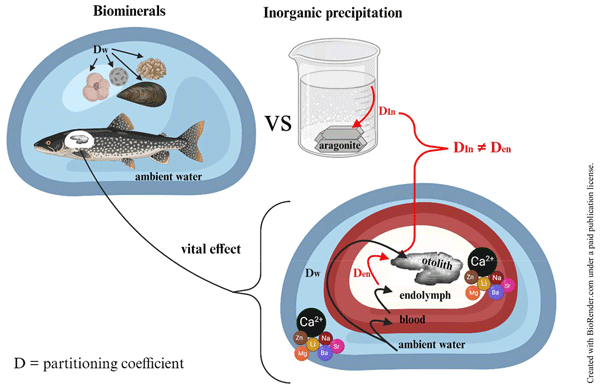
Abstract. The minor element composition of calcium carbonate (CaCO3) biominerals from marine calcifying organisms leaving a sedimentary record has been used for decades to reconstruct various biogeochemical parameters. Advancing geochemical proxies and understanding their underlying mechanisms is essential for climate reconstructions, environmental research, and investigations of biomineralization processes. Despite considerable success of proxy applications, limited mechanistic understanding still restricts their full potential. The problem is often summarized by the term "vital effect", i.e. minor element partitioning due to biological activity. The element partitioning from the calcifying fluid into the biomineral, however, is usually described in terms of inorganic precipitation of a mineral from an aqueous solution of inorganic ions. Although this assumption is central to many partitioning models it has not been tested because the calcifying fluid of classic proxy archives such as foraminifera, molluscs, and coccolithophores has not been successfully sampled for element analysis. The calcifying fluid of fish otolith formation (endolymph), by contrast, was sampled and chemically analysed accompanied by corresponding otolith data. However, previous datasets have not been compared to inorganic partitioning coefficients to test this assumption. In this study, we address this gap using published data from four fish species and six elements. Our results indicate that the final stage of otolith minor element incorporation is influenced by organic matter in the endolymph fluid and therefore cannot be considered purely inorganic. Our conclusion questions a central assumption of many minor element partitioning models. This does not imply that existing models are questionable, but that they share a common oversimplification. By removing this oversimplification all kinds of different models can be improved. Our study contributes broadly to the understanding of biogenic CaCO3 geochemistry, and it is relevant to the majority of existing models.
-
Notice on discussion status
The requested preprint has a corresponding peer-reviewed final revised paper. You are encouraged to refer to the final revised version.
-
Preprint
(1513 KB)
-
Supplement
(438 KB)
-
The requested preprint has a corresponding peer-reviewed final revised paper. You are encouraged to refer to the final revised version.
- Preprint
(1513 KB) - Metadata XML
-
Supplement
(438 KB) - BibTeX
- EndNote
- Final revised paper


Journal article(s) based on this preprint
Interactive discussion
Status: closed
-
RC1: 'Comment on egusphere-2025-5251', Nina Keul, 09 Dec 2025
The manuscript “Ideas and perspectives: Mineralizing Fluid Control on Minor Elements in Biogenic CaCO3: Insights from Otoliths” (https://doi.org/10.5194/egusphere-2025-5251) by Athina Kekelou, Gerald Langer and Patrizia Ziveri investigates how the minor element composition of biogenic calcium carbonate (CaCO₃) is influenced by the chemical environment of the mineralizing fluid, using published datasets from fish otoliths. The authors synthesize data from four fish species and six elements, and compare otolith partitioning to inorganic partitioning coefficients to assess the role of organic matter in the endolymph fluid. The research is original and addresses an important mechanistic question in the field of biogeochemistry and proxy development. The study is well-positioned to advance understanding of “vital effects” in biomineralization, and the methods and datasets used are appropriate for the research questions. However, certain sections, particularly the Results, require more precise data presentation (e.g. comprehensive data tables!) and clarification to fully support the conclusions. Furthermore, this section needs to be carefully re-worked, as currently it reads like a draft version. Despite these issues, the manuscript is clearly written, conceptually strong, and provides valuable insights for the community. I would recommend publication after the authors address the points raised in the review. Also, while I am from a biomineralization background and feel confident assessing the present manuscript, I am not a fish biology expert and therefore cannot fully assess the fish-specific literature. I trust the authors have ensured appropriate citation and coverage of these aspects.
I wish the authors success with the revisions and remain available for further feedback.
Best wishes,
Nina Keul
Recommendation: Major revision.
Specific Comments
- 14: is a graphical abstract actually required in BG? But it’s a nice idea and summarizes the study well
Introduction
- Line 44: Cite additional earlier publications alongside Pallacks et al., 2023.
- L. 65 “but a well-known riddle is the Mg-problem” at least allude to the problem in a few words, as the readership of BG is too large to all be familiar with this.
- L. 66 end sentence with full stop.
- L. 68/ 69: Rephrase the Figure caption into proper English (add depicts, and literature should be replaced by references.
- L. 85: different formatting (size, font, colour of Tab and Fig, should be checked for consistencey)
- L. 99: pleas rephrase, since foraminifera exist in all these environments (see. E.g. Siemensma et al., for taxonomy of freshwater forams), however, they do not form CaCO3 shells.
- ;. 102 – 104:paragraph is a bit short, either expand or merge
Materials and Methods
- 2: linewidth between rows 1 and 2 is different to rest of table, please adjust, why are there brackets around the references? (same for Tab. 1), add spaces after commas in elements list
- -add sub-chapters to M&M, e.g. data collection (literature review), calculations
- 148/ 149:”Tthe first study byThomas et al., 2017 used a marine species”-> what makes this the first study? I d suggest rephrasing all allusions to some artificial order which I assume has not meaning throughout the text, e.g. also l. 156/ 157: the second and third paper”)
- Line 150: Use spectrometer instead of -metry.
- Line 158: Sp. For S1, S2, S3, and S4 ( as in Sp1, Sp2, Sp3., Sp4) would make it easier for the reader
- Line 155: Explain what the indices in N represent (e.g. Nb)
- Line 150: Spell out the full word inductively coupled plasma mass spectrometry (ICP-MS) before using the abbreviation, plasmamass spectrometry is incorrect
- equation 3: consistent formatting (square roots have different sizes)
several formatting inconsistencies throughout manuscript: it should always be referred to Fig. x not Figure x. Please check throughout manuscript
Results
- Provide comprehensive data tables including all raw data and partition coefficients, and reference these in the Results section.
- The manuscript needs to be carefully language edited, I am sure the co-authors are capable of that. E.g. l. 191: instead of writing “Figure 2 illustrates that cows are green” it should be formulated in a way that the statement is made and the reference is added in a bracket, e.g. Cows are green (Fig. 2). This is just one example of many and would transfer this piece from a student draft to a scientific manuscript.
- Currently there are so many imprecise statements that all need clarification, I am just listing a few to demonstrate my point.
- Line 188: Specify the differences at the species level.
- Line 190: Clarify what is similar and which comparisons are made.
- Line 193-195 Rephrase for proper English, I do not understand what you want to day..
- Overall, the Results section reads like a draft and requires substantial revision, I am confident that the co-authors can guide this process as I feel like this is beyond my role as a reviewer. The same applies to Figure and Table captions, they need to be carefully checked, e.g. if they are all in italics, species names should not be in italics.
Discussion
- While this section is very relevant and in broad of interest to the broader community it is a bit hard to follow. The discussion jumps back and forth between several elements, e.g. in section 4.2., for example: For Zn, consider addressing seawater organic complexing (line 278) and endolymph organics/differential partitioning (lines 296) in the same paragraph.
- Line 246: Rename species as Sp. 1–Sp. 4 to avoid confusion with Fig. S2.
- Please incorporate in the discussion the endolymph-otolith system is aragonite based, while foram proxies are calcite based. An extrapolation is further complicated by the fact that there are low (e.g. Globigerinoides) and high Mg (e.g. Amphistegina) foraminifer species.
- Line 306: Mg, Na and Zn: given the previous sections, where it was argued in detail what processes different from inorganic precipitation are involved for these elements, this header is misleading and maybe can be renamed? While “invisible vital effects” might be an obvious choice I do not think it makes this any clearer, maybe something along the lines “The special case when apparently the biogenic and inorganic partitioning coeff. are indistinguishable?
- Section 4.4.: great section, I esp. like Figs 3/ S2
Figures
Supplementary Information
- Consistencies: in actual document it is refered to e.g. Figure S2, however, in the supplementary material it is the labeled as Figure Supp. 2
Citation: https://doi.org/10.5194/egusphere-2025-5251-RC1 -
AC1: 'Reply on RC1', Athina Kekelou, 16 Feb 2026
We thank Dr. Nina Keul for her thorough and constructive evaluation of our manuscript. We greatly appreciate the recognition of the strengths of the study and their supportive comments regarding the relevance and quality of the work. We believe that the revisions undertaken in response to these comments have significantly improved the clarity, rigor, and overall presentation of the manuscript.
Specific Comments
- Line 14: is a graphical abstract actually required in BG? But it’s a nice idea and summarizes the study well
REPLY: A graphical abstract is not required by Biogeosciences. However, we chose to include one because we believe it serves as a useful key figure that visually summarizes the main concept of the study and helps readers quickly grasp its central idea.
Introduction
- Line 44: Cite additional earlier publications alongside Pallacks et al., 2023.
REPLY: Line 44 Added: Druffel E.R.M. 1997.; Katz et al., 2010
Druffel E.R.M. (1997). Geochemistry of corals: Proxies of past ocean chemistry, ocean circulation, and climate, Proc. Natl. Acad. Sci. U.S.A. 94 (16) 8354-8361, https://doi.org/10.1073/pnas.94.16.8354
Katz M. E., Cramer B. S., Franzese A., Honisch B., Miller K. G., Rosenthal Y., & Wright J. D. (2010). Traditional and emerging geochemical proxies in foraminifera. The Journal of Foraminiferal Research, 40(2), 165–192. https://doi.org/10.2113/gsjfr.40.2.165
- 65 “but a well-known riddle is the Mg-problem” at least allude to the problem in a few words, as the readership of BG is too large to all be familiar with this.
- 66 end sentence with full stop.
NEW TEXT for the line 65-66: “but a well-known riddle is the Mg-problem, as it is often informally referred to, in calcitic biominerals. Specifically, the fact that Mg/Ca does not simply reflect inorganic temperature-modulated partitioning but is strongly affected by biological (vital) effects. Organisms can actively regulate Mg transport, potentially resulting in calcifying fluids with varying Mg/Ca ratios. Additionally, Mg might partly reside in the organics of a biomineral (Schöne et al 2010), as opposed to the mineral phase (Branson et al 2013) exhibiting different partitioning behaviour in organic and mineral phase respectively. These factors might cause biomineral Mg/Ca to deviate from what would be expected from inorganic precipitation from seawater (Bentov & Erez, 2006; Nehrke et al., 2013).”
Schöne, B. R., Fiebig, J., Pfeiffer, M., Gleiber, M., Hickson, J., Johnson, A. L. A., … Oschmann, W. (2010). Environmental controls on shell growth rates and δ18O and δ13C values in modern freshwater bivalves (Unionidae). Geochemical Journal, 44, 23–37.
Branson, O., Redfern, S.A.T., Tyliszczak, T., Sadekov, A., Langer, G., Kimoto, K., & Elderfield, H. (2013). The coordination of Mg in foraminiferal calcite. Earth and Planetary Science Letters, 383, 134–141. https://doi.org/10.1016/j.epsl.2013.09.037
- 68/ 69: Rephrase the Figure caption into proper English (add depicts, and literature should be replaced by references.)
NEW TEXT: “Figure 1: Sr partitioning coefficient range (DSr = (Sr/Ca) biomineral / (Sr/Ca)seawater) observed in different organisms with aragonite biominerals (shown in various colors) compared with the range for inorganic aragonite (black bar, with the full range indicated by the dashed black line). The references of the data are listed in the figure legend.”
- 85: different formatting (size, font, colour of Tab and Fig, should be checked for consistencey)
REPLY: We fixed that as well and double checked for font, color etc.)
- 99: please rephrase, since foraminifera exist in all these environments (see. E.g. Siemensma et al., for taxonomy of freshwater forams), however, they do not form CaCO3 shells
NEW TEXT 98-99:“b) Unlike foraminifera that live and calcify mainly in marine environments, whereas fish otoliths biomineralize in teleosts across marine, brackish, and freshwater habitats, providing a potential archive that spans diverse aquatic systems;”
- ;. 102 – 104: paragraph is a bit short, either expand or merge
REPLY: We merged the paragraph with the following one (line 105).
Materials and Methods
- 2: linewidth between rows 1 and 2 is different to rest of table, please adjust, why are there brackets around the references? (same for Tab. 1), add spaces after commas in elements list
REPLY: We fixed it, thank you for noticing it.
- -add sub-chapters to M&M, e.g. data collection (literature review), calculations
REPLY: Done, we add sub-chapters to the M&M in line 141 we add “Data collection and data handling” and to line 168 “Partitioning coefficient estimations”
- 148/149:” The first study by Thomas et al., 2017 used a marine species”-> what makes this the first study? I d suggest rephrasing all allusions to some artificial order which I assume has not meaning throughout the text, e.g. also l. 156/ 157: the second and third paper”)
REPLY: For clarity, we removed the arbitrary ordering.
- Line 150: Spell out the full word inductively coupled plasma mass spectrometry (ICP-MS) before using the abbreviation, plasmamass spectrometry is incorrect
REPLY: Done, see reply to next comment.
- Line 150: Use spectrometer instead of -metry.
NEWTEXT (line 150): “… inductively coupled plasma mass spectrometer (ICP-MS)…”.
- Line 158: Sp. For S1, S2, S3, and S4 ( as in Sp1, Sp2, Sp3., Sp4) would make it easier for the reader
REPLY: We replaced S1 by Sp1 etc.
- Line 155: Explain what the indices in N represent (e.g. Nb)
REPLY: The indices in N are according to the fish species. That means b was for burbot, t was for trout and w for walleye. But we change the initial letter by using the full word.
NEW TEXT: Line 156-159 “In the other two available studies including data meeting the criteria required for our calculations, concentration of minor elements in the otolith and in the endolymph were given (Melancon et al., 2008, 2009a). The species that were used in these studies were the freshwater species burbot Lota lota (Sp2), lake trout Salvelinus namaycush (Sp3) and a walleye Sander vitreus (Sp4). The number of the individuals (N) used was Nburbot=18 and Ntrout=11 and Nwalleye=8, respectively."
- equation 3: consistent formatting (square roots have different sizes) several formatting inconsistencies throughout manuscript: it should always be referred to Fig. x not Figure x. Please check the manuscript
REPLY: We fixed the issue with the square roots and the figure.
Results
- Provide comprehensive data tables including all raw data and partition coefficients and reference these in the Results section.
REPLY: All relevant data are provided in the data repository (Kekelou et al. (2025), “Trace element incorporation in the fish otolith, inorganic crystals vs otoliths”, Mendeley Data, V2, doi: 10.17632/8ysgz5nb82.2) and supplementary materials. Given the equations presented in the Methods section and the documented sources of the data, including a table of raw data in the Results section would detract from the focus of the paper. For readers interested in examining the underlying data in greater detail, we provide an Excel file containing the raw data from the referenced sources used to estimate the original study data following partitioning coefficient estimation.
- The manuscript needs to be carefully language edited, I am sure the co-authors are capable of that. E.g. l. 191: instead of writing “Figure 2 illustrates that cows are green” it should be formulated in a way that the statement is made and the reference is added in a bracket, e.g. Cows are green (Fig. 2). This is just one example of many and would transfer this piece from a student draft to a scientific manuscript.
- Currently there are so many imprecise statements that all need clarification, I am just listing a few to demonstrate my point.
- Line 188: Specify the differences at the species level.
- Line 190: Clarify what is similar and which comparisons are made.
- Line 193-195 Rephrase for proper English, I do not understand what you want to day..
- Overall, the Results section reads like a draft and requires substantial revision, I am confident that the co-authors can guide this process as I feel like this is beyond my role as a reviewer. The same applies to Figure and Table captions, they need to be carefully checked, e.g. if they are all in italics, species names should not be in italics.
REPLY: The Results section has undergone substantial revision to improve language, clarity, structure, and scientific style. Statements have been reformulated so that interpretations are presented directly, with figure references provided in parentheses where appropriate. All previously identified imprecise statements have been clarified; species-level differences are now explicitly stated, comparisons are clearly defined, and unclear phrasing has been reworked to ensure proper English and scientific precision. In addition, all figure and table captions have been carefully reviewed for consistency, formatting, and adherence to correct taxonomic conventions. The revised manuscript has been carefully language edited.
Discussion
- While this section is very relevant and in broad of interest to the broader community it is a bit hard to follow. The discussion jumps back and forth between several elements, e.g. in section 4.2., for example: For Zn, consider addressing seawater organic complexing (line 278) and endolymph organics/differential partitioning (lines 296) in the same paragraph.
REPLY: We now address seawater organic complexation of Zn (line 278) and endolymph organics/differential partitioning (line 296) within the same paragraph: Lines 277-287 were removed and placed after line 300.
NEW TEXT (after line 300): “Additionally, organic complexes with Zn can comprise the majority of total Zn, for example in surface seawater down to 500m (Bruland, 1989). These naturally occurring organic ligands in seawater will be important in calcifiers using seawater as substrate supply for calcification, e.g. foraminifera (Elderfield et al., 1996). The influence of organic material in the calcifying fluid on minor element partitioning shows that the localization of the minor element in the mineral part of the biomineral does not justify the conclusion that the partitioning process is inorganic. This reasoning has nevertheless been applied to Mg partitioning into foraminiferal calcite (Branson et al., 2013). The latter authors show that Mg resides in foraminiferal calcite and from this observation conclude that the partitioning behaviour of Mg is inorganic. Since Mg is an important temperature proxy (Elderfield & Ganssen, 2000), this example illustrates the usefulness of the endolymph-otolith system for the286 development of a process-based understanding of proxy signal formation more generally.”
- Line 246: Rename species as Sp. 1–Sp. 4 to avoid confusion with Fig. S2.
REPLY: we now use Sp1 – Sp4 as abbreviation for species.
- Please incorporate in the discussion the endolymph-otolith system is aragonite based, while foram proxies are calcite based. An extrapolation is further complicated by the fact that there are low (e.g. Globigerinoides) and high Mg (e.g. Amphistegina) foraminifer species.
REPLY: We added the following after line 287:
NEW TEXT: “Please note that foraminiferal shells are calcitic while otoliths are aragonitic. This difference in the calcium carbonate polymorph used by different organisms has implications for numerical values of partitioning coefficients (Langer et al 2018), but has no bearing on the argument made above. We claim that the fact that Mg resides in the mineral phase of a biomineral, as opposed to the organic phase, is not sufficient to support the inference that the partitioning process is a case of inorganic co-precipitation. This claim holds regardless of the calcium carbonate mineral into which Mg is incorporated, and regardless of the Mg/Ca of the respective mineral. Foraminifera for example comprise low-Mg (e.g. Ammonia), intermediate-Mg (e.g. Amphistegina), and high-Mg (e.g. Heterostegina) species (Mewes et al 2014, Mewes et al 2015, Raitzsch et al 2010). In the example mentioned above (Branson et al 2013) both a low-Mg species (Orbulina) and an intermediate-Mg species (Amphistegina) are discussed. Both the author’s argument and our finding are equally applicable to both species; and would be so for any other species.”.
Mewes, A., Langer, G., de Nooijer, L. J., Bijma, J., & Reichart, G. J. (2014). Effect of different seawater Mg2+ concentrations on calcification in two benthic foraminifers. Marine Micropaleontology, 113, 56–64. https://doi.org/10.1016/j.marmicro.2014.09.003
Mewes, A., Langer, G., de Nooijer, L. J., Reichart, G. J., & Bijma, J. (2015). [Title of paper]. Chemical Geology, [Volume], [Page range]. https://doi.org/10.1016/j.chemgeo.2015.06.026
Raitzsch, M., Dueñas-Bohórquez, A., Reichart, G.-J., de Nooijer, L. J., & Bickert, T. (2010). Incorporation of Mg and Sr in calcite of cultured benthic foraminifera: Impact of calcium concentration and associated calcite saturation state. Biogeosciences, 7, 869–881.
- Line 306: Mg, Na and Zn: given the previous sections, where it was argued in detail what processes different from inorganic precipitation are involved for these elements, this header is misleading and maybe can be renamed? While “invisible vital effects” might be an obvious choice I do not think it makes this any clearer, maybe something along the lines “The special case when apparently the biogenic and inorganic partitioning coeff. are indistinguishable?
REPLY: We updated the header as:
NEW TEXT: “4.3 Biogenic and inorganic partitioning coefficient numerically identical: Mg, Na and Zn”.
- Section 4.4.: great section, I esp. like Figs 3/ S2
REPLY: Appreciated. We noted that units were missing in Fig. 3 and S2 and we have now added them. The y-axis titles have been changed to Me/Ca (mmol/mol), and the figure caption now clarifies that the data are displayed on a log₁₀-scaled y-axis. This ensures that both the units and the logarithmic visualization are clearly specified.
Figures
Supplementary Information
- Consistencies: in actual document it is refered to e.g. Figure S2, however, in the supplementary material it is the labeled as Figure Supp. 2
REPLY: Fixed.
And thank you for taking the time to review our work.
Citation: https://doi.org/10.5194/egusphere-2025-5251-AC1
-
RC2: 'Comment on egusphere-2025-5251', Karin Limburg, 26 Jan 2026
As mentioned by the other reviewer, this manuscript presents some novel ways at examining partitioning coefficients for minor elements through a number of pathways from the outside environment into a fish's otolith. It is a pity that there are very few papers available from which to extract data for the calculations. However, as a demonstration of method, this paper has merit.
In agreement with the other reviewer, the manuscript needs some work in the Results section. The Discussion section reads pretty well.
Note: "minor" elements are typically those whose concentrations exceed 1000 ppm. This would not be the case for any of the elements discussed except for Na and Sr. Below 1000 ppm concentrations, elements are referred to as "trace."
Line 246: replace "all other" with "the remaining"
Line 255: "coefficient" should be plural (add "s")
Line 263 ff: I'm a bit confused as to the use of "fractionating" rather than "discriminating." Would the latter be better?
Line 342-3: re-write as "The traditional way of calculating partitioning coefficients is from the ambient water to the biomineral..."
Citation: https://doi.org/10.5194/egusphere-2025-5251-RC2 -
AC2: 'Reply on RC2', Athina Kekelou, 16 Feb 2026
We thank Professor Karin Limburg for her supportive evaluation of the manuscript and for concurring with the comments of RC1. All points raised have been carefully addressed in the revised version.
- As mentioned by the other reviewer, this manuscript presents some novel ways at examining partitioning coefficients for minor elements through a number of pathways from the outside environment into a fish's otolith. It is a pity that there are very few papers available from which to extract data for the calculations. However, as a demonstration of method, this paper has merit. In agreement with the other reviewer, the manuscript needs some work in the Results section. The Discussion section reads pretty well.
REPLY: We appreciate the positive evaluation. We have thoroughly revised the Results section, as also mentioned in our response to RC1. We appreciate the positive evaluation of the methodological contribution of this study. We have substantially revised the Results section to improve clarity, structure, language, and scientific style. All previously imprecise or ambiguous statements have been clarified, species-level differences are now explicitly stated, comparisons are clearly defined, and interpretations are presented directly in the text with figure references provided in parentheses. Figures, tables, and their captions have also been thoroughly reviewed and corrected for clarity. All raw data and partition coefficients are fully documented in the supplementary materials and in a publicly accessible data repository ((Kekelou et al. (2025), “Trace element incorporation in the fish otolith, inorganic crystals vs otoliths”, Mendeley Data, V2, doi:10.17632/8ysgz5nb82.2). We believe these revisions substantially strengthen the Results section and improve its alignment with the overall quality of the Discussion.
- Note: "minor" elements are typically those whose concentrations exceed 1000 ppm. This would not be the case for any of the elements discussed except for Na and Sr. Below 1000 ppm concentrations, elements are referred to as "trace."
REPLY: We appreciate this helpful comment. While the distinction between “minor” and “trace” element is technically correct, it is not essential for the purpose of our study. To avoid unnecessary differentiation, we have revised the terminology and now refer to the elements discussed (apart from Ca) “foreign elements”. This term has been used previously in a similar context (Nehrke and Langer 2023).
- Line 246: replace "all other" with "the remaining"
REPLY: Done.
- Line 255: "coefficient" should be plural (add "s")
REPLY: Done.
- Line 263 ff: I'm a bit confused as to the use of "fractionating" rather than "discriminating." Would the latter be better?
REPLY: We prefer the term “fractionating” because it is neutral and can be used in both directions, as in “fractionating for” and “fractionating against”. The use of “discriminating for” would sound slightly awkward in this context.
- Line 342-3: re-write as "The traditional way of calculating partitioning coefficients is from the ambient water to the biomineral..."
REPLY: Done.
And thank you for your thoughtful comments.
Citation: https://doi.org/10.5194/egusphere-2025-5251-AC2
-
AC2: 'Reply on RC2', Athina Kekelou, 16 Feb 2026
Peer review completion


Interactive discussion
Status: closed
-
RC1: 'Comment on egusphere-2025-5251', Nina Keul, 09 Dec 2025
The manuscript “Ideas and perspectives: Mineralizing Fluid Control on Minor Elements in Biogenic CaCO3: Insights from Otoliths” (https://doi.org/10.5194/egusphere-2025-5251) by Athina Kekelou, Gerald Langer and Patrizia Ziveri investigates how the minor element composition of biogenic calcium carbonate (CaCO₃) is influenced by the chemical environment of the mineralizing fluid, using published datasets from fish otoliths. The authors synthesize data from four fish species and six elements, and compare otolith partitioning to inorganic partitioning coefficients to assess the role of organic matter in the endolymph fluid. The research is original and addresses an important mechanistic question in the field of biogeochemistry and proxy development. The study is well-positioned to advance understanding of “vital effects” in biomineralization, and the methods and datasets used are appropriate for the research questions. However, certain sections, particularly the Results, require more precise data presentation (e.g. comprehensive data tables!) and clarification to fully support the conclusions. Furthermore, this section needs to be carefully re-worked, as currently it reads like a draft version. Despite these issues, the manuscript is clearly written, conceptually strong, and provides valuable insights for the community. I would recommend publication after the authors address the points raised in the review. Also, while I am from a biomineralization background and feel confident assessing the present manuscript, I am not a fish biology expert and therefore cannot fully assess the fish-specific literature. I trust the authors have ensured appropriate citation and coverage of these aspects.
I wish the authors success with the revisions and remain available for further feedback.
Best wishes,
Nina Keul
Recommendation: Major revision.
Specific Comments
- 14: is a graphical abstract actually required in BG? But it’s a nice idea and summarizes the study well
Introduction
- Line 44: Cite additional earlier publications alongside Pallacks et al., 2023.
- L. 65 “but a well-known riddle is the Mg-problem” at least allude to the problem in a few words, as the readership of BG is too large to all be familiar with this.
- L. 66 end sentence with full stop.
- L. 68/ 69: Rephrase the Figure caption into proper English (add depicts, and literature should be replaced by references.
- L. 85: different formatting (size, font, colour of Tab and Fig, should be checked for consistencey)
- L. 99: pleas rephrase, since foraminifera exist in all these environments (see. E.g. Siemensma et al., for taxonomy of freshwater forams), however, they do not form CaCO3 shells.
- ;. 102 – 104:paragraph is a bit short, either expand or merge
Materials and Methods
- 2: linewidth between rows 1 and 2 is different to rest of table, please adjust, why are there brackets around the references? (same for Tab. 1), add spaces after commas in elements list
- -add sub-chapters to M&M, e.g. data collection (literature review), calculations
- 148/ 149:”Tthe first study byThomas et al., 2017 used a marine species”-> what makes this the first study? I d suggest rephrasing all allusions to some artificial order which I assume has not meaning throughout the text, e.g. also l. 156/ 157: the second and third paper”)
- Line 150: Use spectrometer instead of -metry.
- Line 158: Sp. For S1, S2, S3, and S4 ( as in Sp1, Sp2, Sp3., Sp4) would make it easier for the reader
- Line 155: Explain what the indices in N represent (e.g. Nb)
- Line 150: Spell out the full word inductively coupled plasma mass spectrometry (ICP-MS) before using the abbreviation, plasmamass spectrometry is incorrect
- equation 3: consistent formatting (square roots have different sizes)
several formatting inconsistencies throughout manuscript: it should always be referred to Fig. x not Figure x. Please check throughout manuscript
Results
- Provide comprehensive data tables including all raw data and partition coefficients, and reference these in the Results section.
- The manuscript needs to be carefully language edited, I am sure the co-authors are capable of that. E.g. l. 191: instead of writing “Figure 2 illustrates that cows are green” it should be formulated in a way that the statement is made and the reference is added in a bracket, e.g. Cows are green (Fig. 2). This is just one example of many and would transfer this piece from a student draft to a scientific manuscript.
- Currently there are so many imprecise statements that all need clarification, I am just listing a few to demonstrate my point.
- Line 188: Specify the differences at the species level.
- Line 190: Clarify what is similar and which comparisons are made.
- Line 193-195 Rephrase for proper English, I do not understand what you want to day..
- Overall, the Results section reads like a draft and requires substantial revision, I am confident that the co-authors can guide this process as I feel like this is beyond my role as a reviewer. The same applies to Figure and Table captions, they need to be carefully checked, e.g. if they are all in italics, species names should not be in italics.
Discussion
- While this section is very relevant and in broad of interest to the broader community it is a bit hard to follow. The discussion jumps back and forth between several elements, e.g. in section 4.2., for example: For Zn, consider addressing seawater organic complexing (line 278) and endolymph organics/differential partitioning (lines 296) in the same paragraph.
- Line 246: Rename species as Sp. 1–Sp. 4 to avoid confusion with Fig. S2.
- Please incorporate in the discussion the endolymph-otolith system is aragonite based, while foram proxies are calcite based. An extrapolation is further complicated by the fact that there are low (e.g. Globigerinoides) and high Mg (e.g. Amphistegina) foraminifer species.
- Line 306: Mg, Na and Zn: given the previous sections, where it was argued in detail what processes different from inorganic precipitation are involved for these elements, this header is misleading and maybe can be renamed? While “invisible vital effects” might be an obvious choice I do not think it makes this any clearer, maybe something along the lines “The special case when apparently the biogenic and inorganic partitioning coeff. are indistinguishable?
- Section 4.4.: great section, I esp. like Figs 3/ S2
Figures
Supplementary Information
- Consistencies: in actual document it is refered to e.g. Figure S2, however, in the supplementary material it is the labeled as Figure Supp. 2
Citation: https://doi.org/10.5194/egusphere-2025-5251-RC1 -
AC1: 'Reply on RC1', Athina Kekelou, 16 Feb 2026
We thank Dr. Nina Keul for her thorough and constructive evaluation of our manuscript. We greatly appreciate the recognition of the strengths of the study and their supportive comments regarding the relevance and quality of the work. We believe that the revisions undertaken in response to these comments have significantly improved the clarity, rigor, and overall presentation of the manuscript.
Specific Comments
- Line 14: is a graphical abstract actually required in BG? But it’s a nice idea and summarizes the study well
REPLY: A graphical abstract is not required by Biogeosciences. However, we chose to include one because we believe it serves as a useful key figure that visually summarizes the main concept of the study and helps readers quickly grasp its central idea.
Introduction
- Line 44: Cite additional earlier publications alongside Pallacks et al., 2023.
REPLY: Line 44 Added: Druffel E.R.M. 1997.; Katz et al., 2010
Druffel E.R.M. (1997). Geochemistry of corals: Proxies of past ocean chemistry, ocean circulation, and climate, Proc. Natl. Acad. Sci. U.S.A. 94 (16) 8354-8361, https://doi.org/10.1073/pnas.94.16.8354
Katz M. E., Cramer B. S., Franzese A., Honisch B., Miller K. G., Rosenthal Y., & Wright J. D. (2010). Traditional and emerging geochemical proxies in foraminifera. The Journal of Foraminiferal Research, 40(2), 165–192. https://doi.org/10.2113/gsjfr.40.2.165
- 65 “but a well-known riddle is the Mg-problem” at least allude to the problem in a few words, as the readership of BG is too large to all be familiar with this.
- 66 end sentence with full stop.
NEW TEXT for the line 65-66: “but a well-known riddle is the Mg-problem, as it is often informally referred to, in calcitic biominerals. Specifically, the fact that Mg/Ca does not simply reflect inorganic temperature-modulated partitioning but is strongly affected by biological (vital) effects. Organisms can actively regulate Mg transport, potentially resulting in calcifying fluids with varying Mg/Ca ratios. Additionally, Mg might partly reside in the organics of a biomineral (Schöne et al 2010), as opposed to the mineral phase (Branson et al 2013) exhibiting different partitioning behaviour in organic and mineral phase respectively. These factors might cause biomineral Mg/Ca to deviate from what would be expected from inorganic precipitation from seawater (Bentov & Erez, 2006; Nehrke et al., 2013).”
Schöne, B. R., Fiebig, J., Pfeiffer, M., Gleiber, M., Hickson, J., Johnson, A. L. A., … Oschmann, W. (2010). Environmental controls on shell growth rates and δ18O and δ13C values in modern freshwater bivalves (Unionidae). Geochemical Journal, 44, 23–37.
Branson, O., Redfern, S.A.T., Tyliszczak, T., Sadekov, A., Langer, G., Kimoto, K., & Elderfield, H. (2013). The coordination of Mg in foraminiferal calcite. Earth and Planetary Science Letters, 383, 134–141. https://doi.org/10.1016/j.epsl.2013.09.037
- 68/ 69: Rephrase the Figure caption into proper English (add depicts, and literature should be replaced by references.)
NEW TEXT: “Figure 1: Sr partitioning coefficient range (DSr = (Sr/Ca) biomineral / (Sr/Ca)seawater) observed in different organisms with aragonite biominerals (shown in various colors) compared with the range for inorganic aragonite (black bar, with the full range indicated by the dashed black line). The references of the data are listed in the figure legend.”
- 85: different formatting (size, font, colour of Tab and Fig, should be checked for consistencey)
REPLY: We fixed that as well and double checked for font, color etc.)
- 99: please rephrase, since foraminifera exist in all these environments (see. E.g. Siemensma et al., for taxonomy of freshwater forams), however, they do not form CaCO3 shells
NEW TEXT 98-99:“b) Unlike foraminifera that live and calcify mainly in marine environments, whereas fish otoliths biomineralize in teleosts across marine, brackish, and freshwater habitats, providing a potential archive that spans diverse aquatic systems;”
- ;. 102 – 104: paragraph is a bit short, either expand or merge
REPLY: We merged the paragraph with the following one (line 105).
Materials and Methods
- 2: linewidth between rows 1 and 2 is different to rest of table, please adjust, why are there brackets around the references? (same for Tab. 1), add spaces after commas in elements list
REPLY: We fixed it, thank you for noticing it.
- -add sub-chapters to M&M, e.g. data collection (literature review), calculations
REPLY: Done, we add sub-chapters to the M&M in line 141 we add “Data collection and data handling” and to line 168 “Partitioning coefficient estimations”
- 148/149:” The first study by Thomas et al., 2017 used a marine species”-> what makes this the first study? I d suggest rephrasing all allusions to some artificial order which I assume has not meaning throughout the text, e.g. also l. 156/ 157: the second and third paper”)
REPLY: For clarity, we removed the arbitrary ordering.
- Line 150: Spell out the full word inductively coupled plasma mass spectrometry (ICP-MS) before using the abbreviation, plasmamass spectrometry is incorrect
REPLY: Done, see reply to next comment.
- Line 150: Use spectrometer instead of -metry.
NEWTEXT (line 150): “… inductively coupled plasma mass spectrometer (ICP-MS)…”.
- Line 158: Sp. For S1, S2, S3, and S4 ( as in Sp1, Sp2, Sp3., Sp4) would make it easier for the reader
REPLY: We replaced S1 by Sp1 etc.
- Line 155: Explain what the indices in N represent (e.g. Nb)
REPLY: The indices in N are according to the fish species. That means b was for burbot, t was for trout and w for walleye. But we change the initial letter by using the full word.
NEW TEXT: Line 156-159 “In the other two available studies including data meeting the criteria required for our calculations, concentration of minor elements in the otolith and in the endolymph were given (Melancon et al., 2008, 2009a). The species that were used in these studies were the freshwater species burbot Lota lota (Sp2), lake trout Salvelinus namaycush (Sp3) and a walleye Sander vitreus (Sp4). The number of the individuals (N) used was Nburbot=18 and Ntrout=11 and Nwalleye=8, respectively."
- equation 3: consistent formatting (square roots have different sizes) several formatting inconsistencies throughout manuscript: it should always be referred to Fig. x not Figure x. Please check the manuscript
REPLY: We fixed the issue with the square roots and the figure.
Results
- Provide comprehensive data tables including all raw data and partition coefficients and reference these in the Results section.
REPLY: All relevant data are provided in the data repository (Kekelou et al. (2025), “Trace element incorporation in the fish otolith, inorganic crystals vs otoliths”, Mendeley Data, V2, doi: 10.17632/8ysgz5nb82.2) and supplementary materials. Given the equations presented in the Methods section and the documented sources of the data, including a table of raw data in the Results section would detract from the focus of the paper. For readers interested in examining the underlying data in greater detail, we provide an Excel file containing the raw data from the referenced sources used to estimate the original study data following partitioning coefficient estimation.
- The manuscript needs to be carefully language edited, I am sure the co-authors are capable of that. E.g. l. 191: instead of writing “Figure 2 illustrates that cows are green” it should be formulated in a way that the statement is made and the reference is added in a bracket, e.g. Cows are green (Fig. 2). This is just one example of many and would transfer this piece from a student draft to a scientific manuscript.
- Currently there are so many imprecise statements that all need clarification, I am just listing a few to demonstrate my point.
- Line 188: Specify the differences at the species level.
- Line 190: Clarify what is similar and which comparisons are made.
- Line 193-195 Rephrase for proper English, I do not understand what you want to day..
- Overall, the Results section reads like a draft and requires substantial revision, I am confident that the co-authors can guide this process as I feel like this is beyond my role as a reviewer. The same applies to Figure and Table captions, they need to be carefully checked, e.g. if they are all in italics, species names should not be in italics.
REPLY: The Results section has undergone substantial revision to improve language, clarity, structure, and scientific style. Statements have been reformulated so that interpretations are presented directly, with figure references provided in parentheses where appropriate. All previously identified imprecise statements have been clarified; species-level differences are now explicitly stated, comparisons are clearly defined, and unclear phrasing has been reworked to ensure proper English and scientific precision. In addition, all figure and table captions have been carefully reviewed for consistency, formatting, and adherence to correct taxonomic conventions. The revised manuscript has been carefully language edited.
Discussion
- While this section is very relevant and in broad of interest to the broader community it is a bit hard to follow. The discussion jumps back and forth between several elements, e.g. in section 4.2., for example: For Zn, consider addressing seawater organic complexing (line 278) and endolymph organics/differential partitioning (lines 296) in the same paragraph.
REPLY: We now address seawater organic complexation of Zn (line 278) and endolymph organics/differential partitioning (line 296) within the same paragraph: Lines 277-287 were removed and placed after line 300.
NEW TEXT (after line 300): “Additionally, organic complexes with Zn can comprise the majority of total Zn, for example in surface seawater down to 500m (Bruland, 1989). These naturally occurring organic ligands in seawater will be important in calcifiers using seawater as substrate supply for calcification, e.g. foraminifera (Elderfield et al., 1996). The influence of organic material in the calcifying fluid on minor element partitioning shows that the localization of the minor element in the mineral part of the biomineral does not justify the conclusion that the partitioning process is inorganic. This reasoning has nevertheless been applied to Mg partitioning into foraminiferal calcite (Branson et al., 2013). The latter authors show that Mg resides in foraminiferal calcite and from this observation conclude that the partitioning behaviour of Mg is inorganic. Since Mg is an important temperature proxy (Elderfield & Ganssen, 2000), this example illustrates the usefulness of the endolymph-otolith system for the286 development of a process-based understanding of proxy signal formation more generally.”
- Line 246: Rename species as Sp. 1–Sp. 4 to avoid confusion with Fig. S2.
REPLY: we now use Sp1 – Sp4 as abbreviation for species.
- Please incorporate in the discussion the endolymph-otolith system is aragonite based, while foram proxies are calcite based. An extrapolation is further complicated by the fact that there are low (e.g. Globigerinoides) and high Mg (e.g. Amphistegina) foraminifer species.
REPLY: We added the following after line 287:
NEW TEXT: “Please note that foraminiferal shells are calcitic while otoliths are aragonitic. This difference in the calcium carbonate polymorph used by different organisms has implications for numerical values of partitioning coefficients (Langer et al 2018), but has no bearing on the argument made above. We claim that the fact that Mg resides in the mineral phase of a biomineral, as opposed to the organic phase, is not sufficient to support the inference that the partitioning process is a case of inorganic co-precipitation. This claim holds regardless of the calcium carbonate mineral into which Mg is incorporated, and regardless of the Mg/Ca of the respective mineral. Foraminifera for example comprise low-Mg (e.g. Ammonia), intermediate-Mg (e.g. Amphistegina), and high-Mg (e.g. Heterostegina) species (Mewes et al 2014, Mewes et al 2015, Raitzsch et al 2010). In the example mentioned above (Branson et al 2013) both a low-Mg species (Orbulina) and an intermediate-Mg species (Amphistegina) are discussed. Both the author’s argument and our finding are equally applicable to both species; and would be so for any other species.”.
Mewes, A., Langer, G., de Nooijer, L. J., Bijma, J., & Reichart, G. J. (2014). Effect of different seawater Mg2+ concentrations on calcification in two benthic foraminifers. Marine Micropaleontology, 113, 56–64. https://doi.org/10.1016/j.marmicro.2014.09.003
Mewes, A., Langer, G., de Nooijer, L. J., Reichart, G. J., & Bijma, J. (2015). [Title of paper]. Chemical Geology, [Volume], [Page range]. https://doi.org/10.1016/j.chemgeo.2015.06.026
Raitzsch, M., Dueñas-Bohórquez, A., Reichart, G.-J., de Nooijer, L. J., & Bickert, T. (2010). Incorporation of Mg and Sr in calcite of cultured benthic foraminifera: Impact of calcium concentration and associated calcite saturation state. Biogeosciences, 7, 869–881.
- Line 306: Mg, Na and Zn: given the previous sections, where it was argued in detail what processes different from inorganic precipitation are involved for these elements, this header is misleading and maybe can be renamed? While “invisible vital effects” might be an obvious choice I do not think it makes this any clearer, maybe something along the lines “The special case when apparently the biogenic and inorganic partitioning coeff. are indistinguishable?
REPLY: We updated the header as:
NEW TEXT: “4.3 Biogenic and inorganic partitioning coefficient numerically identical: Mg, Na and Zn”.
- Section 4.4.: great section, I esp. like Figs 3/ S2
REPLY: Appreciated. We noted that units were missing in Fig. 3 and S2 and we have now added them. The y-axis titles have been changed to Me/Ca (mmol/mol), and the figure caption now clarifies that the data are displayed on a log₁₀-scaled y-axis. This ensures that both the units and the logarithmic visualization are clearly specified.
Figures
Supplementary Information
- Consistencies: in actual document it is refered to e.g. Figure S2, however, in the supplementary material it is the labeled as Figure Supp. 2
REPLY: Fixed.
And thank you for taking the time to review our work.
Citation: https://doi.org/10.5194/egusphere-2025-5251-AC1
-
RC2: 'Comment on egusphere-2025-5251', Karin Limburg, 26 Jan 2026
As mentioned by the other reviewer, this manuscript presents some novel ways at examining partitioning coefficients for minor elements through a number of pathways from the outside environment into a fish's otolith. It is a pity that there are very few papers available from which to extract data for the calculations. However, as a demonstration of method, this paper has merit.
In agreement with the other reviewer, the manuscript needs some work in the Results section. The Discussion section reads pretty well.
Note: "minor" elements are typically those whose concentrations exceed 1000 ppm. This would not be the case for any of the elements discussed except for Na and Sr. Below 1000 ppm concentrations, elements are referred to as "trace."
Line 246: replace "all other" with "the remaining"
Line 255: "coefficient" should be plural (add "s")
Line 263 ff: I'm a bit confused as to the use of "fractionating" rather than "discriminating." Would the latter be better?
Line 342-3: re-write as "The traditional way of calculating partitioning coefficients is from the ambient water to the biomineral..."
Citation: https://doi.org/10.5194/egusphere-2025-5251-RC2 -
AC2: 'Reply on RC2', Athina Kekelou, 16 Feb 2026
We thank Professor Karin Limburg for her supportive evaluation of the manuscript and for concurring with the comments of RC1. All points raised have been carefully addressed in the revised version.
- As mentioned by the other reviewer, this manuscript presents some novel ways at examining partitioning coefficients for minor elements through a number of pathways from the outside environment into a fish's otolith. It is a pity that there are very few papers available from which to extract data for the calculations. However, as a demonstration of method, this paper has merit. In agreement with the other reviewer, the manuscript needs some work in the Results section. The Discussion section reads pretty well.
REPLY: We appreciate the positive evaluation. We have thoroughly revised the Results section, as also mentioned in our response to RC1. We appreciate the positive evaluation of the methodological contribution of this study. We have substantially revised the Results section to improve clarity, structure, language, and scientific style. All previously imprecise or ambiguous statements have been clarified, species-level differences are now explicitly stated, comparisons are clearly defined, and interpretations are presented directly in the text with figure references provided in parentheses. Figures, tables, and their captions have also been thoroughly reviewed and corrected for clarity. All raw data and partition coefficients are fully documented in the supplementary materials and in a publicly accessible data repository ((Kekelou et al. (2025), “Trace element incorporation in the fish otolith, inorganic crystals vs otoliths”, Mendeley Data, V2, doi:10.17632/8ysgz5nb82.2). We believe these revisions substantially strengthen the Results section and improve its alignment with the overall quality of the Discussion.
- Note: "minor" elements are typically those whose concentrations exceed 1000 ppm. This would not be the case for any of the elements discussed except for Na and Sr. Below 1000 ppm concentrations, elements are referred to as "trace."
REPLY: We appreciate this helpful comment. While the distinction between “minor” and “trace” element is technically correct, it is not essential for the purpose of our study. To avoid unnecessary differentiation, we have revised the terminology and now refer to the elements discussed (apart from Ca) “foreign elements”. This term has been used previously in a similar context (Nehrke and Langer 2023).
- Line 246: replace "all other" with "the remaining"
REPLY: Done.
- Line 255: "coefficient" should be plural (add "s")
REPLY: Done.
- Line 263 ff: I'm a bit confused as to the use of "fractionating" rather than "discriminating." Would the latter be better?
REPLY: We prefer the term “fractionating” because it is neutral and can be used in both directions, as in “fractionating for” and “fractionating against”. The use of “discriminating for” would sound slightly awkward in this context.
- Line 342-3: re-write as "The traditional way of calculating partitioning coefficients is from the ambient water to the biomineral..."
REPLY: Done.
And thank you for your thoughtful comments.
Citation: https://doi.org/10.5194/egusphere-2025-5251-AC2
-
AC2: 'Reply on RC2', Athina Kekelou, 16 Feb 2026
Peer review completion
Journal article(s) based on this preprint
Viewed
| HTML | XML | Total | Supplement | BibTeX | EndNote | |
|---|---|---|---|---|---|---|
| 930 | 413 | 90 | 1,433 | 101 | 100 | 98 |
- HTML: 930
- PDF: 413
- XML: 90
- Total: 1,433
- Supplement: 101
- BibTeX: 100
- EndNote: 98
Viewed (geographical distribution)
| Country | # | Views | % |
|---|
| Total: | 0 |
| HTML: | 0 |
| PDF: | 0 |
| XML: | 0 |
- 1
Athina Kekelou

Gerald Langer
Patrizia Ziveri
The requested preprint has a corresponding peer-reviewed final revised paper. You are encouraged to refer to the final revised version.
- Preprint
(1513 KB) - Metadata XML
-
Supplement
(438 KB) - BibTeX
- EndNote
- Final revised paper