
the Creative Commons Attribution 4.0 License.
the Creative Commons Attribution 4.0 License.
 | 24 Nov 2025
Ocean acidification alters phytoplankton diversity and community structure in the coastal water of the East China Sea
Abstract. Anthropogenic CO2 emissions and their continuous dissolution into seawater lead to seawater pCO2 rise and ocean acidification (OA). Phytoplankton groups are known to be differentially affected by carbonate chemistry changes associated with OA in different regions of contrasting physical and chemical features. To explore responses of phytoplankton to OA in the Chinese coastal waters, we conducted a mesocosm experiment in a eutrophic bay of the southern East China Sea under ambient (410 μatm, AC) and elevated (1000 μatm, HC) pCO2 levels. The HC stimulated phytoplankton growth and primary production during the initial nutrient-replete stage, while the community diversity and evenness were reduced during this stage due to the rapid nutrient consumption and diatom blooms, and the subsequent shift from diatoms to hetero-dinoflagellates led to a decline in primary production during the mid and later phases under nutrient depletion. Such suppression of diatom-to-dinoflagellate succession occurred with enhanced remineralization of organic matter under the HC conditions, with smaller phytoplankton becoming dominant for the sustained primary production. Our findings indicate that, the impacts of OA on phytoplankton diversity in the coastal water of the southern East China Sea depend on availability of nutrients, with primary productivity and biodiversity of phytoplankton reduced in the eutrophicated coastal water.
-
Notice on discussion status
The requested preprint has a corresponding peer-reviewed final revised paper. You are encouraged to refer to the final revised version.
-
Preprint
(1491 KB)
-
Supplement
(1426 KB)
-
The requested preprint has a corresponding peer-reviewed final revised paper. You are encouraged to refer to the final revised version.
- Preprint
(1491 KB) - Metadata XML
-
Supplement
(1426 KB) - BibTeX
- EndNote
- Final revised paper


Journal article(s) based on this preprint
Interactive discussion
Status: closed
- CC1: 'Comment on egusphere-2025-5218', Li Gang, 31 Dec 2025
-
RC1: 'Comment on egusphere-2025-5218', Anonymous Referee #1, 15 Mar 2026
Reviewer Report
This manuscript aims to understand the effects of ocean acidification (OA) on marine phytoplankton communities in coastal waters of the East China Sea. Using surface seawater collected from a highly eutrophic coastal region, the authors conducted an in situ 3000 L mesocosm experiment to determine primary productivity, as well as phytoplankton growth rate and composition. They found that the effects of OA on phytoplankton diversity and primary productivity depend on nutrient availability. Since both the diversity and biomass of phytoplankton decreased under OA and nutrient-depleted conditions, the authors propose that diversity will be lost and primary production will decrease in future oceans. The premise of this study is meaningful, as the effects of OA on marine phytoplankton remain controversial. This in situ mesocosm experiment makes the conclusions straightforward and reliable, so my comments on this manuscript are quite minor as follows:
Minor revisions
Lines 26-27, as I understand it, and as shown in Figs. 5, 6, the smaller phytoplankton became dominant after the diatom-to-dinoflagellate succession and concurrently with enhanced organic matter remineralization, but these three events look like to happen simultaneously, please check it.
Lines 59-61, Does this sentence describe the same thing (i.e., the availabilities of nutrient can modulate the effects of OA) as that in line 66 ‘On the other hand….’?
Lines 123-128, more information is needed on the nutrient analyses, especifically the methods used and the standard curve information. More importantly, does ‘0.45 mm’ refer to the diameter or pore size of the membrane?
Line 162, lugol’s iodine or acidic lugol’s iodine? Was the statically time sufficient for cells sedimentation? The method should be described in more detail.
Line 176, TYPO: analyses.
Lines 190, 194 and elsewhere, the description of ‘day’ and ‘Day’ should be consistent through the manuscript.
Line 267, Figure 4. It is unclear why primary production increased, yet primary productivity decreased. For example, from day 4 to day 6, primary production increased with increasing Chl a, but primary productivity decreased. Please add more explanation.
Lines 282-283, this sentence “Diatom density was lower in the HC than in the AC mesocosms, though the difference was not statistically significant (p = 0.259, Fig. S7 a)” should be revised to “There was no statistically significant difference in diatom density between the HC and AC mesocosms (p = 0.259, Fig. S7a), although the value was lower in the former than in the latter treatment.”.
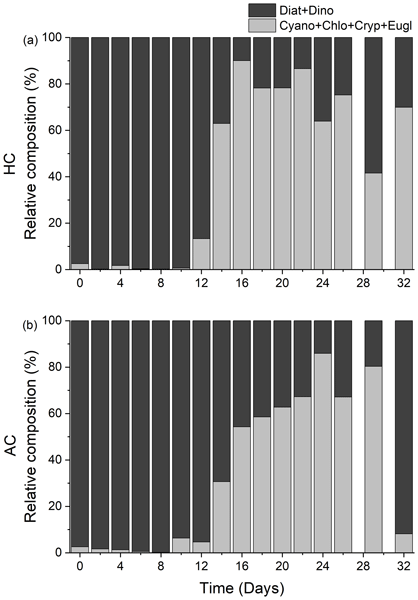
Line 313, Fig 6, according to figure legend, the authors classified diatoms and dinoflagellates as microphytoplankton, and classified Cyanobacteria, Chlorophyta, Cryptophytes, Euglenophyta as nanophytoplankton. Is that correct? I disagree with this classification, since some diatoms and dinoflagellates are smaller than 20 μm, as indicated in lines 329-332. I acknowledge that the phytoplankton groups mentioned as small (Cyano, Chlo, Cryp, Eugl) are generally smaller than diatoms and dinoflagellates, but this statement, as well as the legend and caption in Fig. 6 should be clarified more carefully.
Lines 326-329, which shift was suppressed? Indeed, as seen in Figs. 5 c, S7 b, transition from diatoms to autotrophic dinoflagellates was suppressed. However, as shown in Fig. S8 b, elevated pCO2 only had a negative effect on community diversity after day 24. Before that day, elevated pCO2 led to higher diversity under diatom dominance and partially compensated for the negative effects of subsequent reduced nutrient availability on community diversity (as described by the authors in lines 344-345 and 402-403). Therefore, I believe the authors should substantially revise this part of the discussion.
Citation: https://doi.org/10.5194/egusphere-2025-5218-RC1 -
AC1: 'Reply on RC1', Kunshan Gao, 05 May 2026
Anonymous referee #1 This manuscript aims to understand the effects of ocean acidification (OA) on marine phytoplankton communities in coastal waters of the East China Sea. Using surface seawater collected from a highly eutrophic coastal region, the authors conducted an in situ 3000 L mesocosm experiment to determine primary productivity, as well as phytoplankton growth rate and composition. They found that the effects of OA on phytoplankton diversity and primary productivity depend on nutrient availability. Since both the diversity and biomass of phytoplankton decreased under OA and nutrient-depleted conditions, the authors propose that diversity will be lost and primary production will decrease in future oceans. The premise of this study is meaningful, as the effects of OA on marine phytoplankton remain controversial. This in situ mesocosm experiment makes the conclusions straightforward and reliable, so my comments on this manuscript are quite minor as follows. Authors: We appreciated the supportive comments, and have revised the manuscript point by point according to the comments as shown below. Minor revisions Referee #1: Lines 26-27, as I understand it, and as shown in Figs. 5, 6, the smaller phytoplankton became dominant after the diatom-to-dinoflagellate succession and concurrently with enhanced organic matter remineralization, but these three events look like to happen simultaneously, please check it. Authors: Yes, these three events happened almost simultaneously, but there was a certain order to them. As shown in Figs. 2 and 5, the mesocosm community underwent a diatom-dinoflagellate-small phytoplankton succession, during which diatoms started to decline on day 8, corresponding to the increase in dinoflagellate abundance. Then, the concentrations of both NO3− and PO43− began to increase again after day 10. From day 12, dinoflagellates declined with small phytoplankton increasing in terms of abundance, so it is clear that in the HC mesocosms the success of small phytoplankton was attributed to the enhanced remineralization (reflected as increased nutrients). We have checked the data and revised the sentence from lines 27 to 28 as follows: HC treatment suppressed the diatom-to-dinoflagellate succession and enhanced the subsequent remineralization of organic matter, thereby facilitating smaller phytoplankton to dominant and sustaining primary production. Referee #1: Lines 59-61, Does this sentence describe the same thing (i.e., the availabilities of nutrient can modulate the effects of OA) as that in line 66 ‘On the other hand….’? Authors: We agree with the referee that these two parts described the same thing, namely that the effect of OA on in situ phytoplankton species/communities is regulated by nutrient availability. Accordingly, this part of introduction is revised at lines 54-72. Referee #1: Lines 123-128, more information is needed on the nutrient analyses, specifically the methods used and the standard curve information. More importantly, does ‘0.45 mm’ refer to the diameter or pore size of the membrane? Authors: ‘0.45 mm’ was mistyped, and we have clarified the detail information of the membrane at line 122. We agree with the referee and added necessary information in the revised manuscript. Specifically, the standard curve information is added and the methods used are described at lines 126-132, as follows: NH4+ was measured with indophenol blue spectrophotometry using a spectrophotometer (Tri-223, Spectrum, China) at 25 ℃. NO2− and NO3− were analyzed using the copper-cadmium reduction method, the standard concentrations used for the NO2−+NO3− calibration curve were 0, 1.04, 2.08, 4.16, 10.4, 20.8, and 41.6 μM, and those for NO2− calibration curve were 0, 0.04, 0.08, 0.16, 0.4, 0.8, and 1.6 μM (Dai et al., 2008). PO43− and SiO32− were measured using typical spectrophotometric method (Knap et al., 1994), and the calibration curves of both parameters were prepared using standard concentrations of 0, 0.08, 0.16, 0.32, 0.8, 1.6, 3.2 μM and 0, 4, 8, 16, 40, 80, 160 μM, respectively. Referee #1: Line 162, lugol’s iodine or acidic lugol’s iodine? Was the statically time sufficient for cells sedimentation? The method should be described in more detail. Authors: We used acidic lugol’s iodine, and the statically time (2-3 days) was sufficient for cells sedimentation under the experimental conditions (Hasle and Syvertsen, 1997; Steidinger and Jangen, 1997; Yang and Liu, 2018), and relevant information have added at lines 166. Hasle, G. R. and Syvertsen, E. E.: Chapter 2 - Marine Diatoms, in: Identifying Marine Phytoplankton, edited by: Tomas, C. R., Academic Press, San Diego, 5-385, https://doi.org/10.1016/B978-012693018-4/50004-5, 1997. Steidinger, K. A. and Jangen, K.: Chapter 3 - Dinoflagellates, in: Identifying Marine Phytoplankton, edited by: Tomas, C. R., Academic Press, San Diego, 387-584, https://doi.org/10.1016/B978-012693018-4/50005-7, 1997. Yang, S. and Liu, X.: Characteristics of phytoplankton assemblages in the southern Yellow Sea, China, Mar. Pollut. Bull., 135, 562-568, 2018. Referee #1: Line 176, TYPO: analyses. Authors: Corrected. Referee #1: Lines 190, 194 and elsewhere, the description of ‘day’ and ‘Day’ should be consistent through the manuscript. Authors: Corrected. Referee #1: Line 267, Figure 4. It is unclear why primary production increased, yet primary productivity decreased. For example, from day 4 to day 6, primary production increased with increasing Chl a, but primary productivity decreased. Please add more explanation. Authors: Higher Chl a concentration (greater algal biomass) usually leads to higher primary production per water volume, while rates of photosynthetic carbon fixation, that is assimilation number or primary productivity (per chl a per time), usually remains relative constant or lower at high Chl a level (Behrenfeld and Falkowski. 1997; Falkowski et al., 2003). We have added relevant discussion at lines 341-345, which reads “When diatoms dominated the phytoplankton community (before day 8), primary production per water volume and per Chl a did not change in the same pattern with increased diatom biomass (Fig. 4). This is likely attributable to the larger size of photosynthetic unit (PSU) and lower reaction center-to-Chl a ratio in diatoms, which could result in relatively lower photosynthetic efficiency (Wu et al., 2014; Malerba et al., 2018).” References: Behrenfeld, M. J. and Falkowski, P. G.: Photosynthetic rates derived from satellite-based chlorophyll concentration, Limnol. Oceanogr., 42, 1-20, https://doi.org/10.4319/lo.1997.42.1.0001, 1997. Falkowski, P. G. and Chen, Y.-B.: Photoacclimation of Light Harvesting Systems in Eukaryotic Algae, in: Light-Harvesting Antennas in Photosynthesis, edited by: Green, B. R., and Parson, W. W., Springer Netherlands, Dordrecht, 423-447, 10.1007/978-94-017-2087-8_15, 2003. Huang, R., Sun, J., Yang, Y., Jiang, X., Wang, Z., Song, X., Wang, T., Zhang, D., Li, H., and Yi, X.: Elevated pCO2 Impedes Succession of Phytoplankton Community From Diatoms to Dinoflagellates Along With Increased Abundance of Viruses and Bacteria, Front. Mar. Sci, 8, 642208, 2021. Malerba, M. E., Palacios, M. M., Palacios Delgado, Y. M., Beardall, J., and Marshall, D. J.: Cell size, photosynthesis and the package effect: an artificial selection approach, New. Phytol., 219, 449-461, https://doi.org/10.1111/nph.15163, 2018. Perry, M. J., Talbot, M. C., and Alberte, R. S.: Photoadaption in marine phytoplankton: Response of the photosynthetic unit, Mar. Biol., 62, 91-101, 10.1007/BF00388170, 1981. Wu, Y., Jeans, J., Suggett, D. J., Finkel, Z. V., and Campbell, D. A.: Large centric diatoms allocate more cellular nitrogen to photosynthesis to counter slower RUBISCO turnover rates, Front. Mar. Sci, Volume 1 - 2014, 10.3389/fmars.2014.00068, 2014. Referee #1: Lines 282-283, this sentence “Diatom density was lower in the HC than in the AC mesocosms, though the difference was not statistically significant (p = 0.259, Fig. S7 a)” should be revised to “There was no statistically significant difference in diatom density between the HC and AC mesocosms (p = 0.259, Fig. S7a), although the value was lower in the former than in the latter treatment.”. Authors: We revised the sentence accordingly. Referee #1: Fig 6, according to figure legend, the authors classified diatoms and dinoflagellates as microphytoplankton, and classified Cyanobacteria, Chlorophyta, Cryptophytes, Euglenophyta as nanophytoplankton. Is that correct? I disagree with this classification, since some diatoms and dinoflagellates are smaller than 20 μm, as indicated in lines 329-332. I acknowledge that the phytoplankton groups mentioned as small (Cyano, Chlo, Cryp, Eugl) are generally smaller than diatoms and dinoflagellates, but this statement, as well as the legend and caption in Fig. 6 should be clarified more carefully. Authors: We agree with the referee that some diatoms and dinoflagellates are smaller than 20 μm, as stated at lines 336 to 337. So we revised the original description. Particularly, we changed the legend and caption in Fig. 6, and a micrograph of one dinoflagellate smaller than 20 μm was provided in Fig. S9. Referee #1: Lines 326-329, which shift was suppressed? Indeed, as seen in Figs. 5 c, S7 b, transition from diatoms to autotrophic dinoflagellates was suppressed. However, as shown in Fig. S8 b, elevated pCO2 only had a negative effect on community diversity after day 24. Before that day, elevated pCO2 led to higher diversity under diatom dominance and partially compensated for the negative effects of subsequent reduced nutrient availability on community diversity (as described by the authors in lines 344-345 and 402-403). Therefore, I believe the authors should substantially revise this part of the discussion. Authors: We admit that our original description might had led to confusion. What we intended to express is that the transition from diatoms to autotrophic dinoflagellates was suppressed. As indicated by the GAMs analyses shown in Fig. S7, elevated pCO2 had insignificant negative effect on diatoms, but significantly reduced the cell number of autotrophic dinoflagellates during day 10-14, therefore, we revised at lines 333-334, as follows: However, this shift from diatoms to autotrophic dinoflagellates was relatively suppressed under elevated pCO2 conditions.
Citation: https://doi.org/10.5194/egusphere-2025-5218-AC1
-
AC1: 'Reply on RC1', Kunshan Gao, 05 May 2026
-
RC2: 'Comment on egusphere-2025-5218', Anonymous Referee #2, 15 Apr 2026
In this manuscript, Rao et al. conducted a mesocosm experiment in a eutrophic bay of the southern East China Sea under ambient (410 µatm, AC) and elevated (1000 µatm, HC) pCO₂ levels to investigate the responses of phytoplankton to ocean acidification (OA) in Chinese coastal waters. The study documents fluctuations in phytoplankton growth and primary production during the experiment and reveals that elevated pCO₂, together with the natural decrease in surface water temperature and declining nutrient availability, altered the structure and diversity of the phytoplankton community.
Overall, the methods and analyses are sound, and the interpretations are generally appropriate. The manuscript is well written and adequately referenced. In principle, this is an excellent study. However, several points should be addressed before acceptance.
Minor comments:
- Line 26: Please clarify the phrase “such suppression of diatom-to-dinoflagellate succession.” Additional context is needed to help readers understand this statement.
- As the authors stated, the experiment was conducted in autumn, during which water temperature naturally decreased. Is there a way to estimate the influence of temperature on phytoplankton growth and community structure? Additionally, could temperature interact with ocean acidification? Please elaborate on this point in the Discussion, potentially incorporating insights from your previous study (Huang et al., 2021; cited in Line 395).
- Line 185: In the Results section, the order of figures should be consistent with their citation in the main-text. For example, after Figure 1 is mentioned (Line 193), Figure 3, rather than Figure 2, is cited (Line 194). Please revise the figure order in both the main text and the supplementary materials.
- Line 192: Please explain why total alkalinity (TA) did not differ significantly between the HC and AC treatments.
- In the Discussion section, it is generally unnecessary to cite figures and restate results already presented in the Results. Please streamline this section accordingly.
- Line 200: If data are available, please include a figure showing diel fluctuations of pCO₂ under HC and AC conditions during the early, middle, and final stages of the experiment.
- Figure 6: The bottom panel should be labeled “AC,” not “LC,” to maintain consistency with the rest of the manuscript. Moreover, please define the terms “micro” and “nano” in the figure legend.
- Please consider adding a figure that further resolves the phytoplankton composition presented in Figure 6. Such a figure could illustrate temporal changes in dominant groups (e.g., diatoms, autotrophic dinoflagellates, and heterotrophic dinoflagellates) throughout the experiment.
- To improve readability, consider including a table of abbreviations.
Citation: https://doi.org/10.5194/egusphere-2025-5218-RC2 -
AC2: 'Reply on RC2', Kunshan Gao, 05 May 2026
Anonymous referee #2 In this manuscript, Rao et al. conducted a mesocosm experiment in a eutrophic bay of the southern East China Sea under ambient (410 µatm, AC) and elevated (1000 µatm, HC) pCO2 levels to investigate the responses of phytoplankton to ocean acidification (OA) in Chinese coastal waters. The study documents fluctuations in phytoplankton growth and primary production during the experiment and reveals that elevated pCO2, together with the natural decrease in surface water temperature and declining nutrient availability, altered the structure and diversity of the phytoplankton community. Overall, the methods and analyses are sound, and the interpretations are generally appropriate. The manuscript is well written and adequately referenced. In principle, this is an excellent study. However, several points should be addressed before acceptance. Authors: We appreciate the supportive comments and have addressed them as follows. Minor comments: Referee #2: Line 26: Please clarify the phrase “such suppression of diatom-to-dinoflagellate succession.” Additional context is needed to help readers understand this statement. Authors: Please see our response to Referee #1, it was clear that the mesocosm community underwent a diatom-dinoflagellate-small phytoplankton succession, during which diatoms started to decline on day 8, corresponding to the increase in dinoflagellate cell numbers. From day 12, dinoflagellates declined with small phytoplankton increasing in terms of abundance. Such transition was regulated by HC treatment, we have revised the sentence from lines 27 to 28 as follows: HC treatment suppressed the diatom-to-dinoflagellate succession and enhanced the subsequent remineralization of organic matter, thereby facilitating smaller phytoplankton to dominant and sustaining primary production. Referee #2: As the authors stated, the experiment was conducted in autumn, during which water temperature naturally decreased. Is there a way to estimate the influence of temperature on phytoplankton growth and community structure? Additionally, could temperature interact with ocean acidification? Please elaborate on this point in the Discussion, potentially incorporating insights from your previous study (Huang et al., 2021; cited in Line 395). Authors: We appreciate the constructive comments. We agree that the change in water temperature might have influenced phytoplankton growth and community structure, either individually or in interaction with OA, as reported in previous mesocosm studies (Bénard et al., 2018; Courboulès et al., 2018) or lab cultures (Li et al., 2018). Since temperatures changed concurrently with other environmental factors (e.g., nutrient conditions, phytoplankton biomass, light attenuation due to increased biomass), it is difficult to isolate and quantify the temperature effect alone from our mesocosm experiment. Nevertheless, it is clear that some results of this study is consistent with our previous study (Huang et al., 2021), showing that OA suppresses the transition from diatoms to autotrophic dinoflagellates, suggesting that it is not the seasonal temperature trajectories but the availability of nutrients that controlled the shift. We have already discussed this consistency between our mesocosm experiments carried out in different seasons at lines 402-406, and the different influence direction of OA reported in the literatures are mentioned at lines 400-402. References: Bénard, R., Levasseur, M., Scarratt, M., Blais, M. A., Mucci, A., Ferreyra, G., Starr, M., Gosselin, M., Tremblay, J. É., and Lizotte, M.: Experimental assessment of the sensitivity of an estuarine phytoplankton fall bloom to acidification and warming, Biogeosciences, 15, 4883-4904, 10.5194/bg-15-4883-2018, 2018. Courboulès, J., Vidussi, F., Soulié, T., Mas, S., Pecqueur, D., and Mostajir, B.: Effects of experimental warming on small phytoplankton, bacteria and viruses in autumn in the Mediterranean coastal Thau Lagoon, Aquatic Ecology, 55, 647-666, 10.1007/s10452-021-09852-7, 2021. Li, F., Beardall, J., and Gao, K.: Diatom performance in a future ocean: interactions between nitrogen limitation, temperature, and CO2-induced seawater acidification, ICES. J. Mar. Sci., 75, 1451-1464, 10.1093/icesjms/fsx239, 2018. Referee #2: Line 185: In the Results section, the order of figures should be consistent with their citation in the main-text. For example, after Figure 1 is mentioned (Line 193), Figure 3, rather than Figure 2, is cited (Line 194). Please revise the figure order in both the main text and the supplementary materials. Authors: We agree with the referee and have revised the figure order in both the main text and the supporting information. In the results section, Figure 3 was introduced to indicate that the fast bloom of phytoplankton biomass (indirect presented by Chl a concentration) led to the significant change in pHNBS, so we did not change the Fig. 3 cited here. Referee #2: Line 192: Please explain why total alkalinity (TA) did not differ significantly between the HC and AC treatments. Authors: The HC treatment was achieved by aerating the mesocosms with pre-mixed airs of ambient and targeted CO2 levels (1000 μatm), which affected DIC and pH rather than TA (Wolf-Gladrow et al. 2007). While TA can be affected by assimilations of biogenic elements, we did not find a significant difference in TA between the HC and AC treatments, which implies that biological production under HC and AC did not result in significant changes in terms of nitrate uptake, denitrification, denitrification, carboxylation et al (Kerr et al. 2021; Wolf-Gladrow and Klaas. 2024). References Kerr, D. E., Brown, P. J., Grey, A., and Kelleher, B. P.: The influence of organic alkalinity on the carbonate system in coastal waters, Marine Chemistry, 237, 104050, https://doi.org/10.1016/j.marchem.2021.104050, 2021. Wolf-Gladrow, D. A. and Klaas, C.: Total alkalinity change: The perspective of phytoplankton stoichiometry, Limnol. Oceanogr., 69, 1900-1904, https://doi.org/10.1002/lno.12597, 2024. Wolf-Gladrow, D. A., Zeebe, R. E., Klaas, C., Körtzinger, A., and Dickson, A. G.: Total alkalinity: The explicit conservative expression and its application to biogeochemical processes, Marine Chemistry, 106, 287-300, https://doi.org/10.1016/j.marchem.2007.01.006, 2007. Referee #2: In the Discussion section, it is generally unnecessary to cite figures and restate results already presented in the Results. Please streamline this section accordingly. Authors: Advice taken, we have removed the repeated expressions, focusing on citing the relevant data, and have revised the discussion section accordingly. Referee #2: Line 200: If data are available, please include a figure showing diel fluctuations of pCO2 under HC and AC conditions during the early, middle, and final stages of the experiment. Authors: We appreciate this helpful suggestion. Unfortunately, we cannot provide the requested data because water samples for pH, DIC, and TA measurements were collected only in the morning due to logistic difficulties. Nevertheless, it can be expected that pCO2 (pH) under both HC and AC would be lower (higher) during daytime due to photosynthetic utilization of bicarbonate or removal of CO2 in open culture systems of algae (Gao et al., 1991, Gao. 2021). References: Gao, K., Aruga, Y., Asada, K., Ishihara, T., Akano, T., and Kiyohara, M.: Enhanced growth of the red alga Porphyra yezoensis Ueda in high CO2 concentrations, J. Appl. Phycol, 3, 355-362, 10.1007/BF00026098, 1991. Gao, K.: Approaches and involved principles to control pH/pCO2 stability in algal cultures, J. Appl. Phycol, 33, 3497-3505, 2021. Referee #2: Figure 6: The bottom panel should be labeled “AC,” not “LC,” to maintain consistency with the rest of the manuscript. Moreover, please define the terms “micro” and “nano” in the figure legend. Authors: Advice taken, the label was changed to “AC” as suggested. Regarding the classification of “micro” and “nano”, we admit that some diatoms and dinoflagellates are smaller than 20 μm, as stated at lines 336 to 337, so the original description was not accurate. We have revised the the legend and caption in Fig. 6, and a micrograph of one dinoflagellate smaller than 20 μm was provided in Fig. S9. Referee #2: Please consider adding a figure that further resolves the phytoplankton composition presented in Figure 6. Such a figure could illustrate temporal changes in dominant groups (e.g., diatoms, autotrophic dinoflagellates, and heterotrophic dinoflagellates) throughout the experiment. Authors: We thank the referee for this suggestion, Fig. 6 presents the temporal changes in total phytoplankton abundance, diatoms, autotrophic dinoflagellates, heterotrophic dinoflagellates, and small phytoplankton. In addition, we have already provided a supplementary figure (Fig. S4) showing the temporal dynamics of the dominant species within these group. Therefore, we believe the current figures already capture both the group-level and species-level patterns of phytoplankton succession during the experiment, as suggested by the referee. Referee #2: To improve readability, consider including a table of abbreviations. Authors: We agree with the referee and have added a table of abbreviations in the Supporting information as Table S1.
Citation: https://doi.org/10.5194/egusphere-2025-5218-AC2
Peer review completion


Interactive discussion
Status: closed
-
CC1: 'Comment on egusphere-2025-5218', Li Gang, 31 Dec 2025
Reviewer Report
The authors present an interesting manuscript aimed at understanding the effects of OA (ocean acidification) on marine phytoplankton communities in coastal waters. Using surface water collected from highly eutrophic coastal region in the East China Sea, they performed an in situ mesocosm experiment to measure primary productivity, as well as phytoplankton community growth and composition. They observed the effects of OA on phytoplankton diversity and primary productivity depend on availability of nutrients. Since both phytoplankton diversity and biomass decreased under OA and nitrient-depleted conditions, the authors proposed that community diversity will be lost and primary production will decrease in the future ocean.
The premise of the study is of interest to the scientific community, as the effects of OA on marine phytoplankton remain controversy. The authors utilized in situ mesocosm experiment making the results straightforward and reliable. For these reasons, my comments on the manuscript are quite minor and based on the authors’ line numbers as follows:
Lines 26-27, as I understand it, and as shown in Figs. 5, 6, the smaller phytoplankton became dominant after the diatom-to-dinoflagellate succession and concurrently with enhanced organic matter remineralization, but this sentence looks like these three incidents happened simultaneously, please clarify.
Lines 59-61, Doesn’t this sentence describe the same thing (i.e., the availabilities of nutrient can modulate the effects of OA) as what’s described after line 66 ‘On the other hand….’?
Line 84, I am not in favor of the repeated mentions of Chinese coastal regions, shouldn’t the results of this work have some inplication that reflect a global perspective?
Lines 123-128, more information is needed on the nutrient analyses, specifically the actual methods used and the standard curve information. More importantly, does ‘0.45 mm’ refer to the diameter or pore size of the membrane?
Lines 139 and 299-301, What’s the point of measuring POC and PON in different size fraction? If 20 μm is the threshold of micro- and nano-sized phytoplankton, the discussion of the correlations between POC/PON in different size an phytoplankton species of corresponding size classes was not sufficient.
Line 162, lugol’s iodine or acidic lugol’s iodine? Was the statically time sufficient for cells sedimentation? The actual method should be described in more detail.
Line 176, TYPO: analyses.
Lines 190, 194 and elsewhere, the discription of ‘day’ and ‘Day’ should be consistent through the manuscript.
Line 267, Figure 4. It is unclear why primary production increased, yet primary productivity decreased? For example, from day 4 to day 6, primary production increased with the increasing Chl a, but primary productivity decreased.
Line 313, Fig 6, as I understand from the figure legend, did the author classifed diatoms and dinoflagellates as microphytoplankton, and classfied Cyanobacteria, Chlorophyta, Cryptophytes, Euglenophyta as nanophytoplankton? I disagree with the classification, since some diatoms and dinoflagellates are smaller than 20 μm, which is acknoledged by the author in lines 329-332. I admit that the phytoplankton groups mentioned as being small (Cyano, Chlo, Cryp, Eugl) are generally smaller than diatoms and dinoflagellates, but this statement, as well as the legend and caption in Fig. 6 should be clarified more carefully.
Lines 326-329, which shift was suppressed? Indeed, as seen from Figs. 5 c, S7 b, transition from diatoms to autotrophic dinoflagellates was suppresed. However, as shown from Fig. S8 b, elevated pCO2 only had a negative on community diversity after day 24. Before that, elevated pCO2 led to higher diversity under diatoms dominance and somehow compensated for the negative effects of subsequent reduced nutrient availability on community diversity (as described by the authors in lines 344-345 and 402-403). Therefore, I believe the authors should substantially revised this part of discussion.
Citation: https://doi.org/10.5194/egusphere-2025-5218-CC1 -
RC1: 'Comment on egusphere-2025-5218', Anonymous Referee #1, 15 Mar 2026
Reviewer Report
This manuscript aims to understand the effects of ocean acidification (OA) on marine phytoplankton communities in coastal waters of the East China Sea. Using surface seawater collected from a highly eutrophic coastal region, the authors conducted an in situ 3000 L mesocosm experiment to determine primary productivity, as well as phytoplankton growth rate and composition. They found that the effects of OA on phytoplankton diversity and primary productivity depend on nutrient availability. Since both the diversity and biomass of phytoplankton decreased under OA and nutrient-depleted conditions, the authors propose that diversity will be lost and primary production will decrease in future oceans. The premise of this study is meaningful, as the effects of OA on marine phytoplankton remain controversial. This in situ mesocosm experiment makes the conclusions straightforward and reliable, so my comments on this manuscript are quite minor as follows:
Minor revisions
Lines 26-27, as I understand it, and as shown in Figs. 5, 6, the smaller phytoplankton became dominant after the diatom-to-dinoflagellate succession and concurrently with enhanced organic matter remineralization, but these three events look like to happen simultaneously, please check it.
Lines 59-61, Does this sentence describe the same thing (i.e., the availabilities of nutrient can modulate the effects of OA) as that in line 66 ‘On the other hand….’?
Lines 123-128, more information is needed on the nutrient analyses, especifically the methods used and the standard curve information. More importantly, does ‘0.45 mm’ refer to the diameter or pore size of the membrane?
Line 162, lugol’s iodine or acidic lugol’s iodine? Was the statically time sufficient for cells sedimentation? The method should be described in more detail.
Line 176, TYPO: analyses.
Lines 190, 194 and elsewhere, the description of ‘day’ and ‘Day’ should be consistent through the manuscript.
Line 267, Figure 4. It is unclear why primary production increased, yet primary productivity decreased. For example, from day 4 to day 6, primary production increased with increasing Chl a, but primary productivity decreased. Please add more explanation.
Lines 282-283, this sentence “Diatom density was lower in the HC than in the AC mesocosms, though the difference was not statistically significant (p = 0.259, Fig. S7 a)” should be revised to “There was no statistically significant difference in diatom density between the HC and AC mesocosms (p = 0.259, Fig. S7a), although the value was lower in the former than in the latter treatment.”.
Line 313, Fig 6, according to figure legend, the authors classified diatoms and dinoflagellates as microphytoplankton, and classified Cyanobacteria, Chlorophyta, Cryptophytes, Euglenophyta as nanophytoplankton. Is that correct? I disagree with this classification, since some diatoms and dinoflagellates are smaller than 20 μm, as indicated in lines 329-332. I acknowledge that the phytoplankton groups mentioned as small (Cyano, Chlo, Cryp, Eugl) are generally smaller than diatoms and dinoflagellates, but this statement, as well as the legend and caption in Fig. 6 should be clarified more carefully.
Lines 326-329, which shift was suppressed? Indeed, as seen in Figs. 5 c, S7 b, transition from diatoms to autotrophic dinoflagellates was suppressed. However, as shown in Fig. S8 b, elevated pCO2 only had a negative effect on community diversity after day 24. Before that day, elevated pCO2 led to higher diversity under diatom dominance and partially compensated for the negative effects of subsequent reduced nutrient availability on community diversity (as described by the authors in lines 344-345 and 402-403). Therefore, I believe the authors should substantially revise this part of the discussion.
Citation: https://doi.org/10.5194/egusphere-2025-5218-RC1 -
AC1: 'Reply on RC1', Kunshan Gao, 05 May 2026
Anonymous referee #1 This manuscript aims to understand the effects of ocean acidification (OA) on marine phytoplankton communities in coastal waters of the East China Sea. Using surface seawater collected from a highly eutrophic coastal region, the authors conducted an in situ 3000 L mesocosm experiment to determine primary productivity, as well as phytoplankton growth rate and composition. They found that the effects of OA on phytoplankton diversity and primary productivity depend on nutrient availability. Since both the diversity and biomass of phytoplankton decreased under OA and nutrient-depleted conditions, the authors propose that diversity will be lost and primary production will decrease in future oceans. The premise of this study is meaningful, as the effects of OA on marine phytoplankton remain controversial. This in situ mesocosm experiment makes the conclusions straightforward and reliable, so my comments on this manuscript are quite minor as follows. Authors: We appreciated the supportive comments, and have revised the manuscript point by point according to the comments as shown below. Minor revisions Referee #1: Lines 26-27, as I understand it, and as shown in Figs. 5, 6, the smaller phytoplankton became dominant after the diatom-to-dinoflagellate succession and concurrently with enhanced organic matter remineralization, but these three events look like to happen simultaneously, please check it. Authors: Yes, these three events happened almost simultaneously, but there was a certain order to them. As shown in Figs. 2 and 5, the mesocosm community underwent a diatom-dinoflagellate-small phytoplankton succession, during which diatoms started to decline on day 8, corresponding to the increase in dinoflagellate abundance. Then, the concentrations of both NO3− and PO43− began to increase again after day 10. From day 12, dinoflagellates declined with small phytoplankton increasing in terms of abundance, so it is clear that in the HC mesocosms the success of small phytoplankton was attributed to the enhanced remineralization (reflected as increased nutrients). We have checked the data and revised the sentence from lines 27 to 28 as follows: HC treatment suppressed the diatom-to-dinoflagellate succession and enhanced the subsequent remineralization of organic matter, thereby facilitating smaller phytoplankton to dominant and sustaining primary production. Referee #1: Lines 59-61, Does this sentence describe the same thing (i.e., the availabilities of nutrient can modulate the effects of OA) as that in line 66 ‘On the other hand….’? Authors: We agree with the referee that these two parts described the same thing, namely that the effect of OA on in situ phytoplankton species/communities is regulated by nutrient availability. Accordingly, this part of introduction is revised at lines 54-72. Referee #1: Lines 123-128, more information is needed on the nutrient analyses, specifically the methods used and the standard curve information. More importantly, does ‘0.45 mm’ refer to the diameter or pore size of the membrane? Authors: ‘0.45 mm’ was mistyped, and we have clarified the detail information of the membrane at line 122. We agree with the referee and added necessary information in the revised manuscript. Specifically, the standard curve information is added and the methods used are described at lines 126-132, as follows: NH4+ was measured with indophenol blue spectrophotometry using a spectrophotometer (Tri-223, Spectrum, China) at 25 ℃. NO2− and NO3− were analyzed using the copper-cadmium reduction method, the standard concentrations used for the NO2−+NO3− calibration curve were 0, 1.04, 2.08, 4.16, 10.4, 20.8, and 41.6 μM, and those for NO2− calibration curve were 0, 0.04, 0.08, 0.16, 0.4, 0.8, and 1.6 μM (Dai et al., 2008). PO43− and SiO32− were measured using typical spectrophotometric method (Knap et al., 1994), and the calibration curves of both parameters were prepared using standard concentrations of 0, 0.08, 0.16, 0.32, 0.8, 1.6, 3.2 μM and 0, 4, 8, 16, 40, 80, 160 μM, respectively. Referee #1: Line 162, lugol’s iodine or acidic lugol’s iodine? Was the statically time sufficient for cells sedimentation? The method should be described in more detail. Authors: We used acidic lugol’s iodine, and the statically time (2-3 days) was sufficient for cells sedimentation under the experimental conditions (Hasle and Syvertsen, 1997; Steidinger and Jangen, 1997; Yang and Liu, 2018), and relevant information have added at lines 166. Hasle, G. R. and Syvertsen, E. E.: Chapter 2 - Marine Diatoms, in: Identifying Marine Phytoplankton, edited by: Tomas, C. R., Academic Press, San Diego, 5-385, https://doi.org/10.1016/B978-012693018-4/50004-5, 1997. Steidinger, K. A. and Jangen, K.: Chapter 3 - Dinoflagellates, in: Identifying Marine Phytoplankton, edited by: Tomas, C. R., Academic Press, San Diego, 387-584, https://doi.org/10.1016/B978-012693018-4/50005-7, 1997. Yang, S. and Liu, X.: Characteristics of phytoplankton assemblages in the southern Yellow Sea, China, Mar. Pollut. Bull., 135, 562-568, 2018. Referee #1: Line 176, TYPO: analyses. Authors: Corrected. Referee #1: Lines 190, 194 and elsewhere, the description of ‘day’ and ‘Day’ should be consistent through the manuscript. Authors: Corrected. Referee #1: Line 267, Figure 4. It is unclear why primary production increased, yet primary productivity decreased. For example, from day 4 to day 6, primary production increased with increasing Chl a, but primary productivity decreased. Please add more explanation. Authors: Higher Chl a concentration (greater algal biomass) usually leads to higher primary production per water volume, while rates of photosynthetic carbon fixation, that is assimilation number or primary productivity (per chl a per time), usually remains relative constant or lower at high Chl a level (Behrenfeld and Falkowski. 1997; Falkowski et al., 2003). We have added relevant discussion at lines 341-345, which reads “When diatoms dominated the phytoplankton community (before day 8), primary production per water volume and per Chl a did not change in the same pattern with increased diatom biomass (Fig. 4). This is likely attributable to the larger size of photosynthetic unit (PSU) and lower reaction center-to-Chl a ratio in diatoms, which could result in relatively lower photosynthetic efficiency (Wu et al., 2014; Malerba et al., 2018).” References: Behrenfeld, M. J. and Falkowski, P. G.: Photosynthetic rates derived from satellite-based chlorophyll concentration, Limnol. Oceanogr., 42, 1-20, https://doi.org/10.4319/lo.1997.42.1.0001, 1997. Falkowski, P. G. and Chen, Y.-B.: Photoacclimation of Light Harvesting Systems in Eukaryotic Algae, in: Light-Harvesting Antennas in Photosynthesis, edited by: Green, B. R., and Parson, W. W., Springer Netherlands, Dordrecht, 423-447, 10.1007/978-94-017-2087-8_15, 2003. Huang, R., Sun, J., Yang, Y., Jiang, X., Wang, Z., Song, X., Wang, T., Zhang, D., Li, H., and Yi, X.: Elevated pCO2 Impedes Succession of Phytoplankton Community From Diatoms to Dinoflagellates Along With Increased Abundance of Viruses and Bacteria, Front. Mar. Sci, 8, 642208, 2021. Malerba, M. E., Palacios, M. M., Palacios Delgado, Y. M., Beardall, J., and Marshall, D. J.: Cell size, photosynthesis and the package effect: an artificial selection approach, New. Phytol., 219, 449-461, https://doi.org/10.1111/nph.15163, 2018. Perry, M. J., Talbot, M. C., and Alberte, R. S.: Photoadaption in marine phytoplankton: Response of the photosynthetic unit, Mar. Biol., 62, 91-101, 10.1007/BF00388170, 1981. Wu, Y., Jeans, J., Suggett, D. J., Finkel, Z. V., and Campbell, D. A.: Large centric diatoms allocate more cellular nitrogen to photosynthesis to counter slower RUBISCO turnover rates, Front. Mar. Sci, Volume 1 - 2014, 10.3389/fmars.2014.00068, 2014. Referee #1: Lines 282-283, this sentence “Diatom density was lower in the HC than in the AC mesocosms, though the difference was not statistically significant (p = 0.259, Fig. S7 a)” should be revised to “There was no statistically significant difference in diatom density between the HC and AC mesocosms (p = 0.259, Fig. S7a), although the value was lower in the former than in the latter treatment.”. Authors: We revised the sentence accordingly. Referee #1: Fig 6, according to figure legend, the authors classified diatoms and dinoflagellates as microphytoplankton, and classified Cyanobacteria, Chlorophyta, Cryptophytes, Euglenophyta as nanophytoplankton. Is that correct? I disagree with this classification, since some diatoms and dinoflagellates are smaller than 20 μm, as indicated in lines 329-332. I acknowledge that the phytoplankton groups mentioned as small (Cyano, Chlo, Cryp, Eugl) are generally smaller than diatoms and dinoflagellates, but this statement, as well as the legend and caption in Fig. 6 should be clarified more carefully. Authors: We agree with the referee that some diatoms and dinoflagellates are smaller than 20 μm, as stated at lines 336 to 337. So we revised the original description. Particularly, we changed the legend and caption in Fig. 6, and a micrograph of one dinoflagellate smaller than 20 μm was provided in Fig. S9. Referee #1: Lines 326-329, which shift was suppressed? Indeed, as seen in Figs. 5 c, S7 b, transition from diatoms to autotrophic dinoflagellates was suppressed. However, as shown in Fig. S8 b, elevated pCO2 only had a negative effect on community diversity after day 24. Before that day, elevated pCO2 led to higher diversity under diatom dominance and partially compensated for the negative effects of subsequent reduced nutrient availability on community diversity (as described by the authors in lines 344-345 and 402-403). Therefore, I believe the authors should substantially revise this part of the discussion. Authors: We admit that our original description might had led to confusion. What we intended to express is that the transition from diatoms to autotrophic dinoflagellates was suppressed. As indicated by the GAMs analyses shown in Fig. S7, elevated pCO2 had insignificant negative effect on diatoms, but significantly reduced the cell number of autotrophic dinoflagellates during day 10-14, therefore, we revised at lines 333-334, as follows: However, this shift from diatoms to autotrophic dinoflagellates was relatively suppressed under elevated pCO2 conditions.
Citation: https://doi.org/10.5194/egusphere-2025-5218-AC1
-
AC1: 'Reply on RC1', Kunshan Gao, 05 May 2026
-
RC2: 'Comment on egusphere-2025-5218', Anonymous Referee #2, 15 Apr 2026
In this manuscript, Rao et al. conducted a mesocosm experiment in a eutrophic bay of the southern East China Sea under ambient (410 µatm, AC) and elevated (1000 µatm, HC) pCO₂ levels to investigate the responses of phytoplankton to ocean acidification (OA) in Chinese coastal waters. The study documents fluctuations in phytoplankton growth and primary production during the experiment and reveals that elevated pCO₂, together with the natural decrease in surface water temperature and declining nutrient availability, altered the structure and diversity of the phytoplankton community.
Overall, the methods and analyses are sound, and the interpretations are generally appropriate. The manuscript is well written and adequately referenced. In principle, this is an excellent study. However, several points should be addressed before acceptance.
Minor comments:
- Line 26: Please clarify the phrase “such suppression of diatom-to-dinoflagellate succession.” Additional context is needed to help readers understand this statement.
- As the authors stated, the experiment was conducted in autumn, during which water temperature naturally decreased. Is there a way to estimate the influence of temperature on phytoplankton growth and community structure? Additionally, could temperature interact with ocean acidification? Please elaborate on this point in the Discussion, potentially incorporating insights from your previous study (Huang et al., 2021; cited in Line 395).
- Line 185: In the Results section, the order of figures should be consistent with their citation in the main-text. For example, after Figure 1 is mentioned (Line 193), Figure 3, rather than Figure 2, is cited (Line 194). Please revise the figure order in both the main text and the supplementary materials.
- Line 192: Please explain why total alkalinity (TA) did not differ significantly between the HC and AC treatments.
- In the Discussion section, it is generally unnecessary to cite figures and restate results already presented in the Results. Please streamline this section accordingly.
- Line 200: If data are available, please include a figure showing diel fluctuations of pCO₂ under HC and AC conditions during the early, middle, and final stages of the experiment.
- Figure 6: The bottom panel should be labeled “AC,” not “LC,” to maintain consistency with the rest of the manuscript. Moreover, please define the terms “micro” and “nano” in the figure legend.
- Please consider adding a figure that further resolves the phytoplankton composition presented in Figure 6. Such a figure could illustrate temporal changes in dominant groups (e.g., diatoms, autotrophic dinoflagellates, and heterotrophic dinoflagellates) throughout the experiment.
- To improve readability, consider including a table of abbreviations.
Citation: https://doi.org/10.5194/egusphere-2025-5218-RC2 -
AC2: 'Reply on RC2', Kunshan Gao, 05 May 2026
Anonymous referee #2 In this manuscript, Rao et al. conducted a mesocosm experiment in a eutrophic bay of the southern East China Sea under ambient (410 µatm, AC) and elevated (1000 µatm, HC) pCO2 levels to investigate the responses of phytoplankton to ocean acidification (OA) in Chinese coastal waters. The study documents fluctuations in phytoplankton growth and primary production during the experiment and reveals that elevated pCO2, together with the natural decrease in surface water temperature and declining nutrient availability, altered the structure and diversity of the phytoplankton community. Overall, the methods and analyses are sound, and the interpretations are generally appropriate. The manuscript is well written and adequately referenced. In principle, this is an excellent study. However, several points should be addressed before acceptance. Authors: We appreciate the supportive comments and have addressed them as follows. Minor comments: Referee #2: Line 26: Please clarify the phrase “such suppression of diatom-to-dinoflagellate succession.” Additional context is needed to help readers understand this statement. Authors: Please see our response to Referee #1, it was clear that the mesocosm community underwent a diatom-dinoflagellate-small phytoplankton succession, during which diatoms started to decline on day 8, corresponding to the increase in dinoflagellate cell numbers. From day 12, dinoflagellates declined with small phytoplankton increasing in terms of abundance. Such transition was regulated by HC treatment, we have revised the sentence from lines 27 to 28 as follows: HC treatment suppressed the diatom-to-dinoflagellate succession and enhanced the subsequent remineralization of organic matter, thereby facilitating smaller phytoplankton to dominant and sustaining primary production. Referee #2: As the authors stated, the experiment was conducted in autumn, during which water temperature naturally decreased. Is there a way to estimate the influence of temperature on phytoplankton growth and community structure? Additionally, could temperature interact with ocean acidification? Please elaborate on this point in the Discussion, potentially incorporating insights from your previous study (Huang et al., 2021; cited in Line 395). Authors: We appreciate the constructive comments. We agree that the change in water temperature might have influenced phytoplankton growth and community structure, either individually or in interaction with OA, as reported in previous mesocosm studies (Bénard et al., 2018; Courboulès et al., 2018) or lab cultures (Li et al., 2018). Since temperatures changed concurrently with other environmental factors (e.g., nutrient conditions, phytoplankton biomass, light attenuation due to increased biomass), it is difficult to isolate and quantify the temperature effect alone from our mesocosm experiment. Nevertheless, it is clear that some results of this study is consistent with our previous study (Huang et al., 2021), showing that OA suppresses the transition from diatoms to autotrophic dinoflagellates, suggesting that it is not the seasonal temperature trajectories but the availability of nutrients that controlled the shift. We have already discussed this consistency between our mesocosm experiments carried out in different seasons at lines 402-406, and the different influence direction of OA reported in the literatures are mentioned at lines 400-402. References: Bénard, R., Levasseur, M., Scarratt, M., Blais, M. A., Mucci, A., Ferreyra, G., Starr, M., Gosselin, M., Tremblay, J. É., and Lizotte, M.: Experimental assessment of the sensitivity of an estuarine phytoplankton fall bloom to acidification and warming, Biogeosciences, 15, 4883-4904, 10.5194/bg-15-4883-2018, 2018. Courboulès, J., Vidussi, F., Soulié, T., Mas, S., Pecqueur, D., and Mostajir, B.: Effects of experimental warming on small phytoplankton, bacteria and viruses in autumn in the Mediterranean coastal Thau Lagoon, Aquatic Ecology, 55, 647-666, 10.1007/s10452-021-09852-7, 2021. Li, F., Beardall, J., and Gao, K.: Diatom performance in a future ocean: interactions between nitrogen limitation, temperature, and CO2-induced seawater acidification, ICES. J. Mar. Sci., 75, 1451-1464, 10.1093/icesjms/fsx239, 2018. Referee #2: Line 185: In the Results section, the order of figures should be consistent with their citation in the main-text. For example, after Figure 1 is mentioned (Line 193), Figure 3, rather than Figure 2, is cited (Line 194). Please revise the figure order in both the main text and the supplementary materials. Authors: We agree with the referee and have revised the figure order in both the main text and the supporting information. In the results section, Figure 3 was introduced to indicate that the fast bloom of phytoplankton biomass (indirect presented by Chl a concentration) led to the significant change in pHNBS, so we did not change the Fig. 3 cited here. Referee #2: Line 192: Please explain why total alkalinity (TA) did not differ significantly between the HC and AC treatments. Authors: The HC treatment was achieved by aerating the mesocosms with pre-mixed airs of ambient and targeted CO2 levels (1000 μatm), which affected DIC and pH rather than TA (Wolf-Gladrow et al. 2007). While TA can be affected by assimilations of biogenic elements, we did not find a significant difference in TA between the HC and AC treatments, which implies that biological production under HC and AC did not result in significant changes in terms of nitrate uptake, denitrification, denitrification, carboxylation et al (Kerr et al. 2021; Wolf-Gladrow and Klaas. 2024). References Kerr, D. E., Brown, P. J., Grey, A., and Kelleher, B. P.: The influence of organic alkalinity on the carbonate system in coastal waters, Marine Chemistry, 237, 104050, https://doi.org/10.1016/j.marchem.2021.104050, 2021. Wolf-Gladrow, D. A. and Klaas, C.: Total alkalinity change: The perspective of phytoplankton stoichiometry, Limnol. Oceanogr., 69, 1900-1904, https://doi.org/10.1002/lno.12597, 2024. Wolf-Gladrow, D. A., Zeebe, R. E., Klaas, C., Körtzinger, A., and Dickson, A. G.: Total alkalinity: The explicit conservative expression and its application to biogeochemical processes, Marine Chemistry, 106, 287-300, https://doi.org/10.1016/j.marchem.2007.01.006, 2007. Referee #2: In the Discussion section, it is generally unnecessary to cite figures and restate results already presented in the Results. Please streamline this section accordingly. Authors: Advice taken, we have removed the repeated expressions, focusing on citing the relevant data, and have revised the discussion section accordingly. Referee #2: Line 200: If data are available, please include a figure showing diel fluctuations of pCO2 under HC and AC conditions during the early, middle, and final stages of the experiment. Authors: We appreciate this helpful suggestion. Unfortunately, we cannot provide the requested data because water samples for pH, DIC, and TA measurements were collected only in the morning due to logistic difficulties. Nevertheless, it can be expected that pCO2 (pH) under both HC and AC would be lower (higher) during daytime due to photosynthetic utilization of bicarbonate or removal of CO2 in open culture systems of algae (Gao et al., 1991, Gao. 2021). References: Gao, K., Aruga, Y., Asada, K., Ishihara, T., Akano, T., and Kiyohara, M.: Enhanced growth of the red alga Porphyra yezoensis Ueda in high CO2 concentrations, J. Appl. Phycol, 3, 355-362, 10.1007/BF00026098, 1991. Gao, K.: Approaches and involved principles to control pH/pCO2 stability in algal cultures, J. Appl. Phycol, 33, 3497-3505, 2021. Referee #2: Figure 6: The bottom panel should be labeled “AC,” not “LC,” to maintain consistency with the rest of the manuscript. Moreover, please define the terms “micro” and “nano” in the figure legend. Authors: Advice taken, the label was changed to “AC” as suggested. Regarding the classification of “micro” and “nano”, we admit that some diatoms and dinoflagellates are smaller than 20 μm, as stated at lines 336 to 337, so the original description was not accurate. We have revised the the legend and caption in Fig. 6, and a micrograph of one dinoflagellate smaller than 20 μm was provided in Fig. S9. Referee #2: Please consider adding a figure that further resolves the phytoplankton composition presented in Figure 6. Such a figure could illustrate temporal changes in dominant groups (e.g., diatoms, autotrophic dinoflagellates, and heterotrophic dinoflagellates) throughout the experiment. Authors: We thank the referee for this suggestion, Fig. 6 presents the temporal changes in total phytoplankton abundance, diatoms, autotrophic dinoflagellates, heterotrophic dinoflagellates, and small phytoplankton. In addition, we have already provided a supplementary figure (Fig. S4) showing the temporal dynamics of the dominant species within these group. Therefore, we believe the current figures already capture both the group-level and species-level patterns of phytoplankton succession during the experiment, as suggested by the referee. Referee #2: To improve readability, consider including a table of abbreviations. Authors: We agree with the referee and have added a table of abbreviations in the Supporting information as Table S1.
Citation: https://doi.org/10.5194/egusphere-2025-5218-AC2
Peer review completion
Journal article(s) based on this preprint
Viewed
| HTML | XML | Total | Supplement | BibTeX | EndNote | |
|---|---|---|---|---|---|---|
| 1,931 | 927 | 136 | 2,994 | 277 | 84 | 148 |
- HTML: 1,931
- PDF: 927
- XML: 136
- Total: 2,994
- Supplement: 277
- BibTeX: 84
- EndNote: 148
Viewed (geographical distribution)
| Country | # | Views | % |
|---|
| Total: | 0 |
| HTML: | 0 |
| PDF: | 0 |
| XML: | 0 |
- 1
Yuming Rao
Na Wang
He Li
Jiazhen Sun
Xiaowen Jiang
Di Zhang
Liming Qu
Qianqian Fu
Xuyang Wang
Cong Zhou
Zichao Deng
Yang Tian
Xiangqi Yi
Ruiping Huang
Guang Gao
Xin Lin

The requested preprint has a corresponding peer-reviewed final revised paper. You are encouraged to refer to the final revised version.
- Preprint
(1491 KB) - Metadata XML
-
Supplement
(1426 KB) - BibTeX
- EndNote
- Final revised paper
Reviewer Report
The authors present an interesting manuscript aimed at understanding the effects of OA (ocean acidification) on marine phytoplankton communities in coastal waters. Using surface water collected from highly eutrophic coastal region in the East China Sea, they performed an in situ mesocosm experiment to measure primary productivity, as well as phytoplankton community growth and composition. They observed the effects of OA on phytoplankton diversity and primary productivity depend on availability of nutrients. Since both phytoplankton diversity and biomass decreased under OA and nitrient-depleted conditions, the authors proposed that community diversity will be lost and primary production will decrease in the future ocean.
The premise of the study is of interest to the scientific community, as the effects of OA on marine phytoplankton remain controversy. The authors utilized in situ mesocosm experiment making the results straightforward and reliable. For these reasons, my comments on the manuscript are quite minor and based on the authors’ line numbers as follows:
Lines 26-27, as I understand it, and as shown in Figs. 5, 6, the smaller phytoplankton became dominant after the diatom-to-dinoflagellate succession and concurrently with enhanced organic matter remineralization, but this sentence looks like these three incidents happened simultaneously, please clarify.
Lines 59-61, Doesn’t this sentence describe the same thing (i.e., the availabilities of nutrient can modulate the effects of OA) as what’s described after line 66 ‘On the other hand….’?
Line 84, I am not in favor of the repeated mentions of Chinese coastal regions, shouldn’t the results of this work have some inplication that reflect a global perspective?
Lines 123-128, more information is needed on the nutrient analyses, specifically the actual methods used and the standard curve information. More importantly, does ‘0.45 mm’ refer to the diameter or pore size of the membrane?
Lines 139 and 299-301, What’s the point of measuring POC and PON in different size fraction? If 20 μm is the threshold of micro- and nano-sized phytoplankton, the discussion of the correlations between POC/PON in different size an phytoplankton species of corresponding size classes was not sufficient.
Line 162, lugol’s iodine or acidic lugol’s iodine? Was the statically time sufficient for cells sedimentation? The actual method should be described in more detail.
Line 176, TYPO: analyses.
Lines 190, 194 and elsewhere, the discription of ‘day’ and ‘Day’ should be consistent through the manuscript.
Line 267, Figure 4. It is unclear why primary production increased, yet primary productivity decreased? For example, from day 4 to day 6, primary production increased with the increasing Chl a, but primary productivity decreased.
Line 313, Fig 6, as I understand from the figure legend, did the author classifed diatoms and dinoflagellates as microphytoplankton, and classfied Cyanobacteria, Chlorophyta, Cryptophytes, Euglenophyta as nanophytoplankton? I disagree with the classification, since some diatoms and dinoflagellates are smaller than 20 μm, which is acknoledged by the author in lines 329-332. I admit that the phytoplankton groups mentioned as being small (Cyano, Chlo, Cryp, Eugl) are generally smaller than diatoms and dinoflagellates, but this statement, as well as the legend and caption in Fig. 6 should be clarified more carefully.
Lines 326-329, which shift was suppressed? Indeed, as seen from Figs. 5 c, S7 b, transition from diatoms to autotrophic dinoflagellates was suppresed. However, as shown from Fig. S8 b, elevated pCO2 only had a negative on community diversity after day 24. Before that, elevated pCO2 led to higher diversity under diatoms dominance and somehow compensated for the negative effects of subsequent reduced nutrient availability on community diversity (as described by the authors in lines 344-345 and 402-403). Therefore, I believe the authors should substantially revised this part of discussion.