
the Creative Commons Attribution 4.0 License.
the Creative Commons Attribution 4.0 License.
 | 04 Nov 2025
Measurement of turbulence energy dissipation rate by a standalone high-resolution Doppler lidar
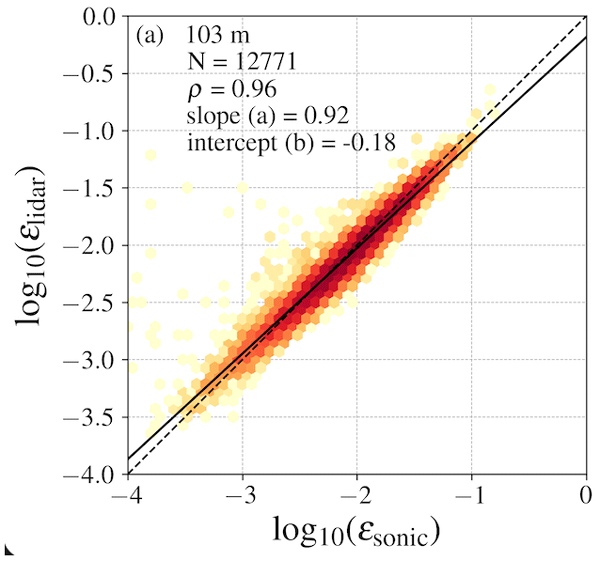
Abstract. A second-order structure function model for the lidar line of sight (LOS) velocities is proposed. This structure function model corrects for the turbulence filtering due to the probe volume averaging effect using a Gaussian weighting function. It takes advantage of the high range gate resolution of the BEAM 6x pulsed lidar used in this study, i.e., 3 m, to effectively resolve the inertial subrange. The structure function model is then used to obtain the turbulence energy dissipation rate (ε) by fitting the model over lidar measurements in the inertial subrange. Unlike previously presented structure function methods to evaluate ε in the literature, this method has a weaker dependence on the turbulence length scale. The estimated ε values obtained from the lidar are compared with the values obtained from ultrasonic anemometers at three heights: 103 m, 175 m, and 241 m. The comparison results show excellent correlation between the two sets, with a Pearson correlation coefficient (ρ) value of more than 0.9 at all three heights. The observed bias was also found to be very small, i.e., more than 50 % of all the lidar-measured ε values were found within ±20 % of the sonic-measured values. This method relies on the proper detection of the inertial subrange; hence, during very stable atmospheric conditions, the model fitting on the measurements produced relatively larger errors, due to the difficulty in detecting the inertial subrange. Applications of this method include, but are not limited to, quantifying turbulence in the wake of aircraft, understanding pollutant dispersion in urban environments, and wind resource and turbulence assessment in areas where erecting a meteorological mast is not possible.
Competing interests: MM is employed by Lumibird SA, the manufacturer of the lidar used in this study.
Publisher's note: Copernicus Publications remains neutral with regard to jurisdictional claims made in the text, published maps, institutional affiliations, or any other geographical representation in this paper. While Copernicus Publications makes every effort to include appropriate place names, the final responsibility lies with the authors. Views expressed in the text are those of the authors and do not necessarily reflect the views of the publisher.-
Notice on discussion status
The requested preprint has a corresponding peer-reviewed final revised paper. You are encouraged to refer to the final revised version.
-
Preprint
(8339 KB)
-
The requested preprint has a corresponding peer-reviewed final revised paper. You are encouraged to refer to the final revised version.
- Preprint
(8339 KB) - Metadata XML
- BibTeX
- EndNote
- Final revised paper


Journal article(s) based on this preprint
Interactive discussion
Status: closed
-
RC1: 'Comment on egusphere-2025-5214', Feng Guo, 06 Dec 2025
-
AC1: 'Reply on RC1and RC2 in one file', Jakob Mann, 17 Aug 2026
The comment was uploaded in the form of a supplement: https://egusphere.copernicus.org/preprints/2025/egusphere-2025-5214/egusphere-2025-5214-AC1-supplement.pdf
-
AC1: 'Reply on RC1and RC2 in one file', Jakob Mann, 17 Aug 2026
-
RC2: 'Comment on egusphere-2025-5214', Maxime Thiébaut, 17 May 2026
The comment was uploaded in the form of a supplement: https://egusphere.copernicus.org/preprints/2025/egusphere-2025-5214/egusphere-2025-5214-RC2-supplement.pdf
-
AC2: 'Reply on RC2', Jakob Mann, 17 Aug 2026
See reply to reviewer 1. All response was collected in one file.
Jakob Mann
Citation: https://doi.org/10.5194/egusphere-2025-5214-AC2
-
AC2: 'Reply on RC2', Jakob Mann, 17 Aug 2026
Peer review completion


Interactive discussion
Status: closed
-
RC1: 'Comment on egusphere-2025-5214', Feng Guo, 06 Dec 2025
General comments:
This paper proposes a novel second-order structure function model for lidar measurements. The model can be used to correct turbulence filtering caused by probe-volume averaging and to estimate the turbulence energy dissipation rate. The proposed method is shown to provide energy dissipation rate estimates from a six-beam lidar that are in good agreement with traditional spectra-based methods using a sonic anemometer. Overall, the paper is well written, and the proposed method makes a significant scientific contribution across multiple fields. I have several comments, mostly minor, that the authors may consider to further improve the manuscript.
Major comments:
- L20 in introduction. The authors claim that hot-wire sensors are commonly used for atmospheric turbulence measurements. Based on my experience, hot-wire anemometers are used far more often in laboratory experiments. Hot-wire instruments are sensitive and fragile; the thin wire is extremely delicate and breaks easily under real atmospheric conditions. Rain, dust, insects, humidity, and temperature swings can affect their accuracy or damage the sensor. In addition, hot-wire anemometers exhibit calibration drift and require frequent recalibration, making them impractical for remote or long-term field deployments.
- Some explanations or references on why a pulsed lidar does not measure point but rather a probe volume is helpful. Also, a CW lidar is possible to measure a point-like turbulence as a hot-wire or sonic anemometer if the focused distance is very short (smaller than several meters) to the probe lens.
- Line 140, Some additional details on the six-beam lidar are recommended. Commercial pulsed lidars typically have a radial (range-gate) resolution of 15–60 m, which is determined by the temporal window used in the Fourier transform applied to the heterodyne signal. Can the reported 3 m resolution be achieved simply by selecting a shorter window length, or is a different signal-processing strategy or hardware configuration being used?
- Line 182. Is the mean obtained by averaging over time—for example, every 6 seconds for each beam? In Step 2, the six beams will produce different LOS wind-speed spectra because each beam is contaminated by different velocity components according to its projection vector, and because atmospheric turbulence is anisotropic. Please explain why the average is taken over the six beams. In particular, the vertical beam measures only the vertical velocity component, yet it is still included in the averaging.
- The impact of the mean vertical wind profile (related to atmosphere stability) on the LOS velocity distribution within the probe volume also requires further discussion.
- It is recommended that the authors discuss how the proposed method for detecting energy dissipation rates could be utilized to improve turbulence intensity estimation in wind-energy applications.
Minor comments:
- Abstracts: in areas ->in areas or at heights
- Line-of-sight some times written as line of sight
- Line 172, please explain why these wavenumber range is chosen
- Line 177, Is the Taylor’s theory is also considered in the accumulation time (is), please clarify
- Please explain N in eq (11)
- Figure 5, should be k1 not k in the left figure
- Line 215, Can the author further explain why the errors increase with heights?
- Figure 7. The point density needs to be explained.
- Line 249, DSW already defined
Citation: https://doi.org/10.5194/egusphere-2025-5214-RC1 -
AC1: 'Reply on RC1and RC2 in one file', Jakob Mann, 17 Aug 2026
The comment was uploaded in the form of a supplement: https://egusphere.copernicus.org/preprints/2025/egusphere-2025-5214/egusphere-2025-5214-AC1-supplement.pdf
-
RC2: 'Comment on egusphere-2025-5214', Maxime Thiébaut, 17 May 2026
The comment was uploaded in the form of a supplement: https://egusphere.copernicus.org/preprints/2025/egusphere-2025-5214/egusphere-2025-5214-RC2-supplement.pdf
-
AC2: 'Reply on RC2', Jakob Mann, 17 Aug 2026
See reply to reviewer 1. All response was collected in one file.
Jakob Mann
Citation: https://doi.org/10.5194/egusphere-2025-5214-AC2
-
AC2: 'Reply on RC2', Jakob Mann, 17 Aug 2026
Peer review completion
Journal article(s) based on this preprint
Viewed
| HTML | XML | Total | BibTeX | EndNote | |
|---|---|---|---|---|---|
| 1,831 | 1,120 | 161 | 3,112 | 196 | 276 |
- HTML: 1,831
- PDF: 1,120
- XML: 161
- Total: 3,112
- BibTeX: 196
- EndNote: 276
Viewed (geographical distribution)
| Country | # | Views | % |
|---|
| Total: | 0 |
| HTML: | 0 |
| PDF: | 0 |
| XML: | 0 |
- 1
Abdul Haseeb Syed

Mohammadreza Manami
The requested preprint has a corresponding peer-reviewed final revised paper. You are encouraged to refer to the final revised version.
- Preprint
(8339 KB) - Metadata XML
General comments:
This paper proposes a novel second-order structure function model for lidar measurements. The model can be used to correct turbulence filtering caused by probe-volume averaging and to estimate the turbulence energy dissipation rate. The proposed method is shown to provide energy dissipation rate estimates from a six-beam lidar that are in good agreement with traditional spectra-based methods using a sonic anemometer. Overall, the paper is well written, and the proposed method makes a significant scientific contribution across multiple fields. I have several comments, mostly minor, that the authors may consider to further improve the manuscript.
Major comments:
Minor comments: