
the Creative Commons Attribution 4.0 License.
the Creative Commons Attribution 4.0 License.
 | 24 Oct 2025
Rapid formation of secondary aerosol precursors from the autoxidation of C5–C8 n-aldehydes
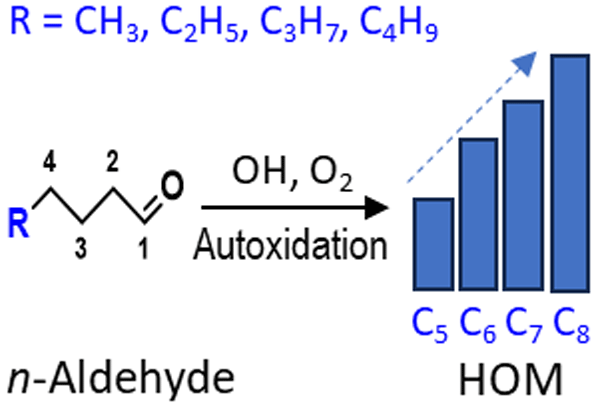
Abstract. Long chain aldehydes are common atmospheric constituents, and their gas-phase oxidation form low volatility condensable products leading to secondary organic aerosol. Although the oxidation of n-aldehydes initiated by OH radicals is dominated by aldehydic hydrogen abstraction, the non-aldehydic hydrogen abstractions tend to become competitive with the increase of aldehyde carbon chain length. Here, we experimentally investigated the oxidation of C5–C8 n-aldehydes in variable reaction times (1–13 s) in a flow tube reactor coupled to a nitrate ion time-of-flight chemical ionization mass spectrometer (NO3–-ToF-CIMS). Octanal produced highly oxygenated organic molecules (HOMs – low volatility products) with up to 7 O atoms within 1.0 s while the same level of oxygenation was acquired by pentanal within 2.3 s. In long reaction time (11–13 s) experiments, we observed HOMs with progressively more O atoms and higher intensity product signals with the increase of carbon atoms in the precursor aldehydes. Our experiments in the presence of high NO concentrations (2 ppb to 1 ppm) showed the formation of prominent highly oxygenated organonitrates along with the suppression of HOM accretion products. However, some enhancement in the monomeric HOMs even with 6 O atoms were seen under variable NO conditions. Results from hydrogen to deuterium (H/D) exchange experiments showed that the studied n-aldehydes undergo similar autoxidation mechanisms, but the reactivity and HOM formation potential increase with increasing carbon chain length.
-
Notice on discussion status
The requested preprint has a corresponding peer-reviewed final revised paper. You are encouraged to refer to the final revised version.
-
Preprint
(1321 KB)
-
Supplement
(535 KB)
-
The requested preprint has a corresponding peer-reviewed final revised paper. You are encouraged to refer to the final revised version.
- Preprint
(1321 KB) - Metadata XML
-
Supplement
(535 KB) - BibTeX
- EndNote
- Final revised paper


Journal article(s) based on this preprint
Interactive discussion
Status: closed
- RC1: 'Comment on egusphere-2025-5207', Anonymous Referee #1, 09 Nov 2025
-
RC2: 'Comment on egusphere-2025-5207', Anonymous Referee #2, 25 Nov 2025
Review of “Rapid formation of secondary aerosol precursors from the autoxidation of C5-C8 n-aldehydes” by Barua, et al.
This paper reports on product observations of oxidation of suite of n-aldehydes in the presence of OH and other peroxy radicals with and without added NO. The study makes use of a nitrate (NO3-) chemical ionization mass spectrometer for product detection. The experiments are conducted in a flow tube-type of experiment at room temperature and 1 atmosphere, using the ozone reaction with tetra methyl ethylene as an OH source, analyzing products after a range of reaction times. Highly oxygenated molecules are observed to form after short reaction times (timescales of approx. 1-10 s) for all aldehydes studied, and the formation mechanism is proposed to occur through autoxidation reactions of peroxy radical intermediates.
General comments:
Generally, these results are very nice, following in step with a previous paper by the same first author. While this is a result demonstrating similar aldehydes behave like hexanal for longish RO2 lifetimes, I think the authors should add more value to this work, by extending this work beyond the previous paper. A simple kinetic model of the experiments would, substantially improve the understanding of the experiments, and allow more definitive statements to be made regarding the very important H-shift rate coefficients. Calibration and time-response/wall loss of the sensor and experiment apparatus needs to be discussed and may help authors report HOM yields. In addition, a simulation would lead to better understanding of the experiments with added NO.
Specific comments:
L82-83: ‘autoxidation’ needs to be more broadly defined… perhaps something like “Chain radical processes, generally starting with an oxygen-centered radical and leading to a carbon-centered radical species whose dominant fate is to add additional molecular oxygen.” Most would consider alkoxy H-shifts and endocylization of peroxy and alkoxy radicals, with subsequent O2 addition to be examples of autoxidation.
L91-96: Please also cite previous work on RO2 H-shifts from aldehydes. These have generally been found to be fast: https://doi.org/10.1021/jp108358y, https://doi.org/10.1021/jp211560u, https://doi.org/10.1021/acs.jpca.6b09370, https://doi.org/10.1021/acs.jpclett.9b01972, etc…
L101: replace ‘besides’ with ‘In addition’?
L132: ‘within’ à ‘below’ ?
L181-184(and other places): The term ‘appeared’ is unfortunately not quantitative. It would be more useful to the reader if some additional information were provided. This ties back to the general comments above regarding instrumental calibration/sensitivity, and noise level and response/wall-losses of the instrument. Ideally, something like XX fraction of ‘aldehyde’ molecules add 6 additional oxygen atoms within 2.1 s after reacting with OH, in absences of bimolecular reactions.
Fig 1E: The bottom of this panel should be zoomed by ~4x on Y-axis.
Figs 1,2,6: There are negative going peaks in these figures, which leads to the question of what is being shown in the figures. Please explain the data processing in the text, ie is some background being subtracted off? This can also lead into a discussion of response times (when zeroing or starting/stopping expt).
General comment: As a reader, I want know more about how your experiment evolves as a function of time. A simple kinetic simulation would quickly allow the authors to plot time profiles of the various reactants and products in the system, and would help readers to better understand the experiment.
L219-220: To jump from comparing signals (shown in figure) to comparing yields (in text) one must be making some assumption about sensitivities… explicitly state what is being assumed for sensitivity in text.
L222-227: This could be diagnosed with kinetic simulation.
L236-237: This could be phased more clearly.
Sect 3.2: What do the profiles of NO and O3 look like across these experiments? The lifetime of NO with 200 ppbv O3 is ~0.02s. Similarly, the lifetime of O3 with 1 ppmv NO is ~0.005s. This will almost certainly impact the interpretation of the results as when NO < O3 most of the NO will react with O3, and ‘average’ NO seen by peroxy radicals will be much less than initial NO. When NO>O3, O3 is largely titrated by NO, making much less OH available to react with the aldehyde. When NO and O3 are very similar one may actually maximize total OH production due to recycling of OH from HO2 + OH. To increase the usefulness of Fig 5, the points need to be normalized by total aldehyde reacting with OH across experiment, and x-axis labeled with ‘average’ NO rather than initial NO (perhaps weighted by [OH] profile). A kinetic simulation of the experiments will help enable this.
Citation: https://doi.org/10.5194/egusphere-2025-5207-RC2 -
RC3: 'Comment on egusphere-2025-5207', Anonymous Referee #2, 25 Nov 2025
There was an error estimating the lifetimes of O3 and NO in the original comment of referee 2. The final paragraph should read:
Sect 3.2: What do the profiles of NO and O3 look like across these experiments? The lifetime of NO with 200 ppbv O3 is ~10s. Similarly, the lifetime of O3 with 1 ppmv NO is ~2s. This will impact the interpretation of the results as reactants will significantly change over the course of the experiment. When NO>>O3, O3 will significantly react with NO, making less OH available to react with the aldehyde. When NO and O3 are very similar one may actually maximize total OH production due to recycling of OH from HO2 + OH. To increase the usefulness of Fig 5, the points need to be normalized by total aldehyde reacting with OH across experiment, and x-axis labeled with ‘average’ NO rather than initial NO (perhaps weighted by [OH] profile). A kinetic simulation of the experiments will help enable this.
Citation: https://doi.org/10.5194/egusphere-2025-5207-RC3 -
RC4: 'Comment on egusphere-2025-5207', Anonymous Referee #3, 10 Dec 2025
Barua et al report HOMs formation of C5-C8 linear aldehydes and effect of chain length on autoxidation of C5-C8 aldehyde. HOMs were formed in a flow tube and detected by using NO3--CIMS. The authors found that octanal reached same level oxygenation (form O7-HOM )in shorter time than pentanal. At similar reaction time (11-13s), increasing oxygenation and higher intensity of HOMs signal were observed for C5-C8 aldehydes. HOMs formation mechanism of pentanal is applicable to C5-C8 aldehydes, shown by D2O experiments. NO suppressed accretion products but enhanced some of the monomeric HOMs. Some HOMs (O4-O6) were not suppressed by NO up to 50-100 ppb NO.
Aldehyde is a class of important atmospheric VOCs. Their oxidation may contribute largely to formation of low-volatility organics and thus to secondary organic aerosol. Therefore, understanding the HOMs formation of aldehydes have critical atmospheric significance. The experiments in this study are well designed. The manuscript is generally well-written. I have the follows comments for the authors to consider.
Specific comments
1. The comparison of various aldehydes on “the reactivity and HOM formation potential” is mostly based on whether HOMs can be observed at certain times, or precursor concentrations required, and/or signal intensity (e.g. L16-19, L166-167). Such a comparison is somewhat not systematic, in my opinion. Is there a way to provide the HOM yield or kinetic parameters and make direct comparison of different aldehydes?
2. The concentrations of precursor concentrations (a few ppm) appear to be much higher than ambient atmospheric conditions, which affects RO2 concentrations and fates. As the authors mentioned that some of key RO2 observed in this study were formed via bimolecular reactions, I suggest some discussion regarding the influence of RO2 concentrations on product distribution in this study and comparison of the RO2 fates with those in the ambient atmosphere, and how this would affect the formation of low volatility condensable materials.
3. L238-241, I suggest adding (Yan et al., 2020) and (Shen et al., 2022).
4. .L353-354,what is the “ highest intensity” compared with?
5. L352-353, can the authors specify what bimolecular reactions and what conditions are referred to as this statement clearly depend on reactions conditions such as RO2 and NO concentrations.
References
Shen, H., Vereecken, L., Kang, S., Pullinen, I., Fuchs, H., Zhao, D., and Mentel, T. F.: Unexpected significance of a minor reaction pathway in daytime formation of biogenic highly oxygenated organic compounds, Science advances, 8, eabp8702, 10.1126/sciadv.abp8702, 2022.
Yan, C., Nie, W., Vogel, A. L., Dada, L., Lehtipalo, K., Stolzenburg, D., Wagner, R., Rissanen, M. P., Xiao, M., Ahonen, L., Fischer, L., Rose, C., Bianchi, F., Gordon, H., Simon, M., Heinritzi, M., Garmash, O., Roldin, P., Dias, A., Ye, P., Hofbauer, V., Amorim, A., Bauer, P. S., Bergen, A., Bernhammer, A. K., Breitenlechner, M., Brilke, S., Buchholz, A., Mazon, S. B., Canagaratna, M. R., Chen, X., Ding, A., Dommen, J., Draper, D. C., Duplissy, J., Frege, C., Heyn, C., Guida, R., Hakala, J., Heikkinen, L., Hoyle, C. R., Jokinen, T., Kangasluoma, J., Kirkby, J., Kontkanen, J., Kurten, A., Lawler, M. J., Mai, H., Mathot, S., Mauldin, R. L., Molteni, U., Nichman, L., Nieminen, T., Nowak, J., Ojdanic, A., Onnela, A., Pajunoja, A., Petaja, T., Piel, F., Quelever, L. L. J., Sarnela, N., Schallhart, S., Sengupta, K., Sipila, M., Tome, A., Trostl, J., Vaisanen, O., Wagner, A. C., Ylisirnio, A., Zha, Q., Baltensperger, U., Carslaw, K. S., Curtius, J., Flagan, R. C., Hansel, A., Riipinen, I., Smith, J. N., Virtanen, A., Winkler, P. M., Donahue, N. M., Kerminen, V. M., Kulmala, M., Ehn, M., and Worsnop, D. R.: Size-dependent influence of NOx on the growth rates of organic aerosol particles, Science Advances, 6, 9, 10.1126/sciadv.aay4945, 2020.
Citation: https://doi.org/10.5194/egusphere-2025-5207-RC4 -
RC5: 'Comment on egusphere-2025-5207', Anonymous Referee #4, 16 Dec 2025
The comment was uploaded in the form of a supplement: https://egusphere.copernicus.org/preprints/2025/egusphere-2025-5207/egusphere-2025-5207-RC5-supplement.pdf
- AC1: 'Comment on egusphere-2025-5207', Shawon Barua, 05 Mar 2026
Peer review completion


Interactive discussion
Status: closed
-
RC1: 'Comment on egusphere-2025-5207', Anonymous Referee #1, 09 Nov 2025
This paper reports the results of a thorough and carefully conducted experimental study of the formation of secondary aerosol precursors from the autooxidation of several long chain aldehydes. The topic is of current research interest to the atmospheric chemistry community. The results are presented clearly and concisely. The conclusions are well supported by the results. I recommend publication as is.
I noticed a couple of typos:
(1) On line 121, “we conducted the reactions at variable reaction times” might read better as “we studied the reactions over a range of reaction times”.
(2) Calvert et al. "(2020)" should be “Calvert et al. (2011)” throughout.
Citation: https://doi.org/10.5194/egusphere-2025-5207-RC1 -
RC2: 'Comment on egusphere-2025-5207', Anonymous Referee #2, 25 Nov 2025
Review of “Rapid formation of secondary aerosol precursors from the autoxidation of C5-C8 n-aldehydes” by Barua, et al.
This paper reports on product observations of oxidation of suite of n-aldehydes in the presence of OH and other peroxy radicals with and without added NO. The study makes use of a nitrate (NO3-) chemical ionization mass spectrometer for product detection. The experiments are conducted in a flow tube-type of experiment at room temperature and 1 atmosphere, using the ozone reaction with tetra methyl ethylene as an OH source, analyzing products after a range of reaction times. Highly oxygenated molecules are observed to form after short reaction times (timescales of approx. 1-10 s) for all aldehydes studied, and the formation mechanism is proposed to occur through autoxidation reactions of peroxy radical intermediates.
General comments:
Generally, these results are very nice, following in step with a previous paper by the same first author. While this is a result demonstrating similar aldehydes behave like hexanal for longish RO2 lifetimes, I think the authors should add more value to this work, by extending this work beyond the previous paper. A simple kinetic model of the experiments would, substantially improve the understanding of the experiments, and allow more definitive statements to be made regarding the very important H-shift rate coefficients. Calibration and time-response/wall loss of the sensor and experiment apparatus needs to be discussed and may help authors report HOM yields. In addition, a simulation would lead to better understanding of the experiments with added NO.
Specific comments:
L82-83: ‘autoxidation’ needs to be more broadly defined… perhaps something like “Chain radical processes, generally starting with an oxygen-centered radical and leading to a carbon-centered radical species whose dominant fate is to add additional molecular oxygen.” Most would consider alkoxy H-shifts and endocylization of peroxy and alkoxy radicals, with subsequent O2 addition to be examples of autoxidation.
L91-96: Please also cite previous work on RO2 H-shifts from aldehydes. These have generally been found to be fast: https://doi.org/10.1021/jp108358y, https://doi.org/10.1021/jp211560u, https://doi.org/10.1021/acs.jpca.6b09370, https://doi.org/10.1021/acs.jpclett.9b01972, etc…
L101: replace ‘besides’ with ‘In addition’?
L132: ‘within’ à ‘below’ ?
L181-184(and other places): The term ‘appeared’ is unfortunately not quantitative. It would be more useful to the reader if some additional information were provided. This ties back to the general comments above regarding instrumental calibration/sensitivity, and noise level and response/wall-losses of the instrument. Ideally, something like XX fraction of ‘aldehyde’ molecules add 6 additional oxygen atoms within 2.1 s after reacting with OH, in absences of bimolecular reactions.
Fig 1E: The bottom of this panel should be zoomed by ~4x on Y-axis.
Figs 1,2,6: There are negative going peaks in these figures, which leads to the question of what is being shown in the figures. Please explain the data processing in the text, ie is some background being subtracted off? This can also lead into a discussion of response times (when zeroing or starting/stopping expt).
General comment: As a reader, I want know more about how your experiment evolves as a function of time. A simple kinetic simulation would quickly allow the authors to plot time profiles of the various reactants and products in the system, and would help readers to better understand the experiment.
L219-220: To jump from comparing signals (shown in figure) to comparing yields (in text) one must be making some assumption about sensitivities… explicitly state what is being assumed for sensitivity in text.
L222-227: This could be diagnosed with kinetic simulation.
L236-237: This could be phased more clearly.
Sect 3.2: What do the profiles of NO and O3 look like across these experiments? The lifetime of NO with 200 ppbv O3 is ~0.02s. Similarly, the lifetime of O3 with 1 ppmv NO is ~0.005s. This will almost certainly impact the interpretation of the results as when NO < O3 most of the NO will react with O3, and ‘average’ NO seen by peroxy radicals will be much less than initial NO. When NO>O3, O3 is largely titrated by NO, making much less OH available to react with the aldehyde. When NO and O3 are very similar one may actually maximize total OH production due to recycling of OH from HO2 + OH. To increase the usefulness of Fig 5, the points need to be normalized by total aldehyde reacting with OH across experiment, and x-axis labeled with ‘average’ NO rather than initial NO (perhaps weighted by [OH] profile). A kinetic simulation of the experiments will help enable this.
Citation: https://doi.org/10.5194/egusphere-2025-5207-RC2 -
RC3: 'Comment on egusphere-2025-5207', Anonymous Referee #2, 25 Nov 2025
There was an error estimating the lifetimes of O3 and NO in the original comment of referee 2. The final paragraph should read:
Sect 3.2: What do the profiles of NO and O3 look like across these experiments? The lifetime of NO with 200 ppbv O3 is ~10s. Similarly, the lifetime of O3 with 1 ppmv NO is ~2s. This will impact the interpretation of the results as reactants will significantly change over the course of the experiment. When NO>>O3, O3 will significantly react with NO, making less OH available to react with the aldehyde. When NO and O3 are very similar one may actually maximize total OH production due to recycling of OH from HO2 + OH. To increase the usefulness of Fig 5, the points need to be normalized by total aldehyde reacting with OH across experiment, and x-axis labeled with ‘average’ NO rather than initial NO (perhaps weighted by [OH] profile). A kinetic simulation of the experiments will help enable this.
Citation: https://doi.org/10.5194/egusphere-2025-5207-RC3 -
RC4: 'Comment on egusphere-2025-5207', Anonymous Referee #3, 10 Dec 2025
Barua et al report HOMs formation of C5-C8 linear aldehydes and effect of chain length on autoxidation of C5-C8 aldehyde. HOMs were formed in a flow tube and detected by using NO3--CIMS. The authors found that octanal reached same level oxygenation (form O7-HOM )in shorter time than pentanal. At similar reaction time (11-13s), increasing oxygenation and higher intensity of HOMs signal were observed for C5-C8 aldehydes. HOMs formation mechanism of pentanal is applicable to C5-C8 aldehydes, shown by D2O experiments. NO suppressed accretion products but enhanced some of the monomeric HOMs. Some HOMs (O4-O6) were not suppressed by NO up to 50-100 ppb NO.
Aldehyde is a class of important atmospheric VOCs. Their oxidation may contribute largely to formation of low-volatility organics and thus to secondary organic aerosol. Therefore, understanding the HOMs formation of aldehydes have critical atmospheric significance. The experiments in this study are well designed. The manuscript is generally well-written. I have the follows comments for the authors to consider.
Specific comments
1. The comparison of various aldehydes on “the reactivity and HOM formation potential” is mostly based on whether HOMs can be observed at certain times, or precursor concentrations required, and/or signal intensity (e.g. L16-19, L166-167). Such a comparison is somewhat not systematic, in my opinion. Is there a way to provide the HOM yield or kinetic parameters and make direct comparison of different aldehydes?
2. The concentrations of precursor concentrations (a few ppm) appear to be much higher than ambient atmospheric conditions, which affects RO2 concentrations and fates. As the authors mentioned that some of key RO2 observed in this study were formed via bimolecular reactions, I suggest some discussion regarding the influence of RO2 concentrations on product distribution in this study and comparison of the RO2 fates with those in the ambient atmosphere, and how this would affect the formation of low volatility condensable materials.
3. L238-241, I suggest adding (Yan et al., 2020) and (Shen et al., 2022).
4. .L353-354,what is the “ highest intensity” compared with?
5. L352-353, can the authors specify what bimolecular reactions and what conditions are referred to as this statement clearly depend on reactions conditions such as RO2 and NO concentrations.
References
Shen, H., Vereecken, L., Kang, S., Pullinen, I., Fuchs, H., Zhao, D., and Mentel, T. F.: Unexpected significance of a minor reaction pathway in daytime formation of biogenic highly oxygenated organic compounds, Science advances, 8, eabp8702, 10.1126/sciadv.abp8702, 2022.
Yan, C., Nie, W., Vogel, A. L., Dada, L., Lehtipalo, K., Stolzenburg, D., Wagner, R., Rissanen, M. P., Xiao, M., Ahonen, L., Fischer, L., Rose, C., Bianchi, F., Gordon, H., Simon, M., Heinritzi, M., Garmash, O., Roldin, P., Dias, A., Ye, P., Hofbauer, V., Amorim, A., Bauer, P. S., Bergen, A., Bernhammer, A. K., Breitenlechner, M., Brilke, S., Buchholz, A., Mazon, S. B., Canagaratna, M. R., Chen, X., Ding, A., Dommen, J., Draper, D. C., Duplissy, J., Frege, C., Heyn, C., Guida, R., Hakala, J., Heikkinen, L., Hoyle, C. R., Jokinen, T., Kangasluoma, J., Kirkby, J., Kontkanen, J., Kurten, A., Lawler, M. J., Mai, H., Mathot, S., Mauldin, R. L., Molteni, U., Nichman, L., Nieminen, T., Nowak, J., Ojdanic, A., Onnela, A., Pajunoja, A., Petaja, T., Piel, F., Quelever, L. L. J., Sarnela, N., Schallhart, S., Sengupta, K., Sipila, M., Tome, A., Trostl, J., Vaisanen, O., Wagner, A. C., Ylisirnio, A., Zha, Q., Baltensperger, U., Carslaw, K. S., Curtius, J., Flagan, R. C., Hansel, A., Riipinen, I., Smith, J. N., Virtanen, A., Winkler, P. M., Donahue, N. M., Kerminen, V. M., Kulmala, M., Ehn, M., and Worsnop, D. R.: Size-dependent influence of NOx on the growth rates of organic aerosol particles, Science Advances, 6, 9, 10.1126/sciadv.aay4945, 2020.
Citation: https://doi.org/10.5194/egusphere-2025-5207-RC4 -
RC5: 'Comment on egusphere-2025-5207', Anonymous Referee #4, 16 Dec 2025
The comment was uploaded in the form of a supplement: https://egusphere.copernicus.org/preprints/2025/egusphere-2025-5207/egusphere-2025-5207-RC5-supplement.pdf
- AC1: 'Comment on egusphere-2025-5207', Shawon Barua, 05 Mar 2026
Peer review completion
Journal article(s) based on this preprint
Viewed
| HTML | XML | Total | Supplement | BibTeX | EndNote | |
|---|---|---|---|---|---|---|
| 1,123 | 433 | 127 | 1,683 | 275 | 104 | 108 |
- HTML: 1,123
- PDF: 433
- XML: 127
- Total: 1,683
- Supplement: 275
- BibTeX: 104
- EndNote: 108
Viewed (geographical distribution)
| Country | # | Views | % |
|---|
| Total: | 0 |
| HTML: | 0 |
| PDF: | 0 |
| XML: | 0 |
- 1

Avinash Kumar
Prasenjit Seal
Siddharth Iyer
The requested preprint has a corresponding peer-reviewed final revised paper. You are encouraged to refer to the final revised version.
- Preprint
(1321 KB) - Metadata XML
-
Supplement
(535 KB) - BibTeX
- EndNote
- Final revised paper
This paper reports the results of a thorough and carefully conducted experimental study of the formation of secondary aerosol precursors from the autooxidation of several long chain aldehydes. The topic is of current research interest to the atmospheric chemistry community. The results are presented clearly and concisely. The conclusions are well supported by the results. I recommend publication as is.
I noticed a couple of typos:
(1) On line 121, “we conducted the reactions at variable reaction times” might read better as “we studied the reactions over a range of reaction times”.
(2) Calvert et al. "(2020)" should be “Calvert et al. (2011)” throughout.