
the Creative Commons Attribution 4.0 License.
the Creative Commons Attribution 4.0 License.
 | 27 Oct 2025
Performance and longevity of compact all-in-one weather stations – the good, the bad and the ugly
Abstract. We provide a long-term evaluation of compact, all-in-one automatic weather stations (AiOWS) compared to professional-grade Automatic Weather Stations (AWS). We examine the performance, longevity, and degradation of six AiO WS models over several years of non serviced use. The objective was to determine how closely these low-cost stations meet World Meteorological Organization (WMO) performance standards for temperature, humidity, wind, and precipitation, and to identify their weaknesses and maintenance needs.
Previous studies show the potential value of AiOWS when data are properly quality-controlled, yet long-term reliability remains uncertain. To address this we deployed six AiO WS units— Davis VVue, Davis VP2, METER ATMOS41, Lufft WS601, and Vaisala WXT520, alongside two collocated reference AWS meeting WMO standards. Before field installation, each unit was tested in (KNMI’s) calibration lab for baseline validation. The stations were then operated in open terrain for multiple years without any servicing, simulating typical end-user neglect.
Initially, all AiO WS met manufacturer specifications. After long-term exposure, however, sensors displayed varied durability. The Vaisala unit operated continuously for over 13 years, while others failed between four and seven years due to corrosion, component wear, and sensor drift. The METER and Davis VVue remained mostly functional but with degraded performance, whereas both Davis VP2 rain gauges failed early due to reed switch damage.
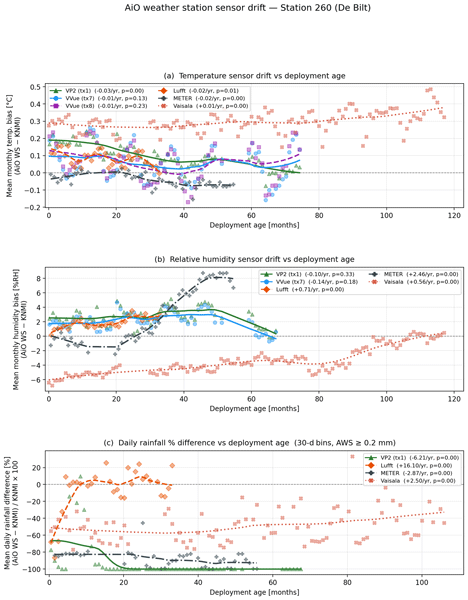
Temperature measurements were the most robust. In climate chamber tests, new and aged sensors maintained accuracy within ±0.3 °C across -15 °C to 30 °C, drifting slightly (underestimating by 0.5–0.7 °C) above 30 °C. Field data confirmed these results, though strong solar radiation caused overestimations during summer. The Vaisala and Davis VVue units remained within WMO Class B limits after a decade. Relative humidity showed consistent deterioration. Most sensors overestimated low humidity and underestimated above 90 %, particularly the METER unit, whose bias grew markedly after five years. Wind speed accuracy degraded due to mechanical wear. Cup anemometers underreported low winds and failed completely in some cases. Sonic sensors (Vaisala, METER) produced erratic readings after several years, highlighting their fragility outdoors. Precipitation performance was weakest across all models. Tipping bucket designs suffered from clogging, internal corrosion, and undercatch errors, while haptic or drip-based sensors became inaccurate as components aged or fouled.
We concluded that compact AiO WS can provide scientifically useful temperature data if properly managed but fall short for humidity, wind, and particularly precipitation unless regularly serviced. Long-term unattended operation severely limits reliability, yet moderate maintenance can potentially restore performance close to WMO Class A/B standards, extending their utility for dense observation networks.
-
Notice on discussion status
The requested preprint has a corresponding peer-reviewed final revised paper. You are encouraged to refer to the final revised version.
-
Preprint
(1643 KB)
-
The requested preprint has a corresponding peer-reviewed final revised paper. You are encouraged to refer to the final revised version.
- Preprint
(1643 KB) - Metadata XML
- BibTeX
- EndNote
- Final revised paper


Journal article(s) based on this preprint
Interactive discussion
Status: closed
-
RC1: 'Comment on egusphere-2025-5194', Anonymous Referee #1, 19 Dec 2025
-
AC1: 'Reply on RC1', Christopher Brown, 09 Feb 2026
The authors have performed a very interesting, long-term study on the quality of "all-in-one" weather stations, or Personal Weather Stations, looking at the decay of quality over time when these stations are operated without maintenance. It's a unique study, and thereby worthy of publishing in my opinion since it addresses a big unknown in the use of non-WMO data (quality drift over time). However, the presentation of the results, the structure of the text and the meager application discussions leave the overall quality of the manuscript something Has been desired. I recognize that additional experiments for such a long-term study are fully impossible, but there are some scientific improvements Has been made nevertheless before the article is fully suitable for publication. hence my recommendation for Major Revisions, with the sidenote that this mainly contains the framing, structure and presentation of the work and not so much its experimental core.
The authors would like to thank reviewer 1 for their time and effort in reading and commenting on our manuscript. We agree with many of the points raised and believe that the below suggested modifications will strengthen the quality and clarity of the manuscript.
A major point I felt while reading through the manuscript is that, while it's a really interesting work, the presentation feels shallow. The authors do not go much beyond presenting some statistics on performance, and the only comparisons made are to the standard WMO table of station siting (as well as their reference data at the weather field). I would have liked to see some comparisons to similar studies, or studies using PWS data: for instance in section 3.2.1, a lot of the somewhat cheaper brands of PWS (e.g. Netatmo) suffer from moisture retention at high RH values - hence what you see in those stations is that moisture gets inside the sensor and oversaturates it (RH reported at nearly 100) for a long time. This problem of moisture pooling inside the sensor is also an issue for e.g. the Netatmo sonic anemometer which understandably deteriorates its usage - it would have been interesting to draw those comparisons and look a little further than just the findings in the field: what do they mean? Similarly, the authors could dive a little deeper into the data: I get that for wind observations a direct comparison to a different height is tricky, but it would benefit the manuscript if that was at least given a go. Now the wind results, as well as the rain results because of the equipment failure, feel fairly underwhelming and inconclusive. On the application side of things, I feel like the focus is too much on direct comparison to WMO guidelines and equipment, which will always be an unfair comparison. Rather, the power and interesting use cases of PWS data is in those locations where WMO siting will always say it's imperfect: heterogeneous terrain and especially cities. So rather than focus on the poor performance, I would like to see the authors' thoughts on when these data CAN help: where and how should we as scientists, or citizen scientists, deploy these stations, in order to have them both running well for a longer time, and provide good data? There are quite a few other studies using PWS data (the authors already mention a few) that are pretty positive on their usage, but a thorough discussion of the link between this work and those studies is now missing from this paper. Creating that connection, between this well-studied field experiment and those opportunistic sensing studies would strengthen the field as a whole.
The reviewer makes a number of useful few points here that we agree with, in turn:
- We have added more references to other studies using AiOWS data.
- We have added the method of failure/bias in the rH measurements to the paper. The discussion on the Netatmo failure point is certainly useful, and we have included that within the introduction (also due to its importance in calculating derived fields, such as Wet Bulb Globe Temperature in tropical environments)
- We appreciate the question regarding going into more detail for the wind comparison. Upon initial writing of the paper, we discussed whether there was a scientifically useful option to use an algorithmic method to transform 10m windspeed to 1.5m windspeed, but decided against it due to unresolvable uncertainties (due to varying land use at/ surrounding the test field and because theoretical vertical profiles are designed to work in highly homogeneous surface roughness conditions). Thus, we added a note on this in the text.
“Surface roughness is not consistent on the testfield (due to other instruments, fences and buildings within the surrounding 500 m), and theoretical vertical wind profiles such as the power law or the logarithmic wind profile are only valid under idealized conditions (e.g. neutral stability and horizontal homogeneity) and are therefore not generally applicable across all meteorological conditions (Stull, 1988). Hence an algorithmic method of calculating true 1.5 m wind velocity from the 10 m AWS observations will introduce additional uncertainty.”
- We have added some text in the discussion section on the use of wind measurements from AiOWS and their general siting on complex terrain or in cities.
- we would like to emphasize that evaluating the performance of the AiOWS devices under test against the WMO measurement quality classification as defined in Annex 1.G of WMO-No. 8 represents a relatively novel approach (this is not to do with the “standard table” of station siting, as mentioned by the reviewer). This type of assessment is increasingly recognized as essential for the design and implementation of so-called tiered networks within the WMO Integrated Global Observing System (WIGOS) framework. To the best of our knowledge, we are currently not aware of other studies worldwide that have applied this specific metric for the classification of these types of weather stations. (World Meteorological Organization (WMO), Guide to Instruments and Methods of Observation (WMO-No. 8), Annex 1.G.)
The figures don't really help with that feeling of shallow presentation: figures 4 and 5 especially are giant tables, without proper captions, that I cannot read very well in the printed version of the manuscript. The presentation idea is very nice, showing the bias in time, but providing a giant table without context is fairly overwhelming. Also the RH colorbar is counterintuitive: positive biases would mean higher RH for the observations, which tends Has been colored blue (minor detail). Figure 2 is of quite low resolution. Figure 6 is quite nice as an example of the level of filth that can accumulate in rain gauges, though a small explanation of the scale bar on the bottom would be nice (I imagine it's a ruler in cm?). table 1 can be referred to a bit more often when WMO siting classes are referenced in the text, e.g. in the conclusions. In that table, an overview of the measurement equipment beyond their accuracy would be helpful: e.g. the type of wind sensor, do they have a radiation shield, single/double tipping bucket etc etc, for easier comparison between the brands of PWS.
We have reassessed and reproduced all figures, to improve clarity, resolution, and captions. We further decided to split our table in two individual tables.
Changes:
- Figure 1: Replaced photograph of AiO WSs on test field
- Figures 2 & 3: re-ordered
- Figure 4:Improved for clarity, using inspiration from Figure 3.5 from https://publications.aston.ac.uk/id/eprint/26693/1/Bell_Simon_J._2015.pdf
- Figure 5: Extensively revised
- Figure 6: Improved labelling
Modified captions:
- Figure 1: (a) Satellite image of the KNMI testfield. The location of the AiO WSs, and AWS 06261, are indicated with a blue square; WIGOS 0-20000-0-06260 is indicated with a red circle (approx. 200 m apart). Inset shows a map of the Netherlands indicating the location the testfield (52.099ºN, 5.176ºE). (b) Photograph of the aged AiOWSs at the testfield.
- Figure 2: Photographs of AiO WS at the end of their deployment, showing failed or damaged parts. (a) METER’s drop counter system, using two gold plated electrodes. (b) Corrosion of the sealed ball bearing supporting the cup anemometer on the Davis VP2 instrument. (c) Failed reed switch on the Davis VP2. (d) Corrosion on circuit boards and tipping bucket rain gauge in Lufft.
- Figure 3: Measurement difference of each AiO WS from the laboratory reference. (a) temperature (°C), (b) relative humidity (%), (c) wind speed (m/s).
- Figure 4: (a) Temperature and (b) relative humidity bias from the AiO WSs relative to the collocated AWS. Biases are calculated for 5 °C/10 % bins of temperature/humiditiy and for each year of the field test separately to show potential bias changes over time.
- Figure 5: As Figure 4, but here for (a) precipitation intensity and (b) windspeed bias.
- Figure 6: Detritus found in Davis VP2 tipping bucket rain gauge after 7 years of operation. For scale a ruler (cm) is shown along the bottom.
- Table 1: WMO classification of measurement uncertainty from AiO WSs, adapted from (World Meteorological Organization (WMO), Guide to Instruments and Methods of Observation (WMO-No. 8), Annex 1.G.)
- Table 2: AiO WS measurement accuracy, as specified by the manufacturers' and confirmed at initial calibration laboratory testing.
Some smaller comments, issues and points below:
In the literature, the stations that the authors call "All-in-one weather stations" are usually called Personal Weather Stations (PWS) or sometimes Citizen Weather Stations (CWS). Given that the authors actually use the term PWS in figure 2, I would recommend that they use this term throughout the manuscript instead of AiOWS, to keep it consistent with earlier work on these stations.
This was a point of discussion with the co-authors whilst writing the paper. We acknowledge that historically the term PWS is more frequently used. However, PWS gives a notion of the resulting observations being ‘consumer grade’ and hence maybe not (scientifically) useful. It also leads to confusion with some of the more expensive equipment (e.g. the Vaisala WXT series) which can be many thousands of euros to purchase. From that point of view we chose ‘all-in-one’, in order to maintain consistency with WMO SC-MINT terminology.
L.109: Automatic Weather Stations doesn't need Has been written out fully here
Modified
A question I had was: what is the typical longevity of a PWS? In other words: is the level of deterioration realistic? Especially the station that ran for 14 years without any maintenance, seems quite unlikely that the owner wouldn't look at it at all. Would be interesting to get an idea of that to place the results in the application context.
At KNMI we are in contact with many citizen scientists, and are continually surprised at the longevity of some consumer-grade weather stations still in use. Through this network we know of a Davis Wizard AiO WS that has run continuously from 1997 to present day. Whether maintenance was performed according the manufacturer guidelines is difficult to know, given both the citizen-scientist owner and the fact that we can’t see this in incoming data/metadata. For this reason, we know (as from this research project) that the basic weather station can survive (and send data) for many years- but we have no way of knowing whether that station is serviced, or effectively a ‘zombie’ weather station, that has been forgotten about by its owner, but still has an internet connection.
L227: "both used failed almost immediately in the field": how come?
The failure was not investigated directly when it happened, as the Davis VP2s were working correctly for other observation types (e.g temperature, wind, humidity) and thus remained in the field, as part of the life-span experiment. Reed switches are delicate items, and are commonly damaged by dropping or hitting the housing (and thus misaligning the reed from its magnetic actuator). However, this was not the case in our deployment, as the Davis VP2s were deployed to the test field, and then not touched for multiple years (thus, they would not have suffered collision/ dropping damage). A secondary cause of failure to reed switches is if water/ humidity enters the switch, and corrodes the reed. Again, upon inspection there was no internal corrosion of the switch evident. However, corrosion to the Davis VP2’s wiring appears to be present. Thus, we have added this information to the discussion:
“Both Davis VP2 had poor performance in tests; although the reed-switch mechanism worked moderately well when assessed initially (–5% error), both units failed almost immediately in the test field. At the end of the deployment, it was found that no signal was able to be generated from either reed switch, potentially indicating failure or corrosion of the Davis VP2’s wiring/ soldered connectors (Figure 2c).”
We note that Davis recently modified their VP2 raingauge design (after our instruments were made) to use a different switch- which is potentially more robust in damp climates such as in the Netherlands.
Do you have any idea of the initial quality of the observations? Of course there's the manufacturers list and the in-field data, but did you also perform the lab tests at the start of the experiment? Understandable if you didn't, but just curious!
At the start of the experiment, all AiO WSs were tested in the laboratory. At the time the aim was to confirm the manufacturers’ specifications of each instrument (as listed in Table 2). We will note this in the manuscript:
“Prior to deployment, each AiO WS underwent calibration laboratory testing to quantify baseline accuracy, operational range, and to verify consistency with manufacturer specifications. All AiO WSs tested initially met manufacturer specifications (Table 2).” Ideally, any future experiment on AiOWS would see multiple identical AiOWS tested in the calibration laboratory prior to deployment, and the difference in initial observations
L301: is it possible to explicitly test the radiation bias (following the study by Simon Bell, 2015)?
We thank the reviewer for pointing us to the PhD thesis of Dr Bell (we are using this document: https://publications.aston.ac.uk/id/eprint/26693/1/Bell_Simon_J._2015.pdf). We assume the reviewer refers to Bell’s Figure 3.5, plotting temperature biases in radiation bins. Indeed, this is a logical and neat method of highlighting the effect of radiation on temperature bias. We agree that it is logical to perform a similar analysis for our data, and replace the aforementioned figure 4 with this new plot.
Section 4.2: rapid degradation is mentioned: any idea why specifically this rapid degradation occurs? Is there a specific kind of equipment damage that causes rapid versus gradual deterioration?
We have expanded this in the discussion, but we were surprised at the manufacturer’s use of steel (vs stainless steel) within tipping bucket mechanisms, or unprotected cup and vane anemometer shafts (which allows moisture access to bearing races). Ideally, an outdoor weatherstation would be manufactured from inert materials, and have weather resistance to IP66 equivalence in order to negate these corrosion-related failures.
Ch 4 in general reads a bit messily, with a lot of short paragraphs, sometimes starting with just "Precipitation." (L. 328). I would recommend restructuring so it all flows a bit better
We agree, and have done a thorough job on extending and reordering the section in a more logical order.
In figure 1: it would also be nice to clearly showcase all the instruments together, the rightmost figure shows most (?) of them but it's not clear which is which.
We have replaced the photograph with an annotated photo of the AiO WSs on the KNMI testfield.
Citation: https://doi.org/10.5194/egusphere-2025-5194-AC1
-
AC1: 'Reply on RC1', Christopher Brown, 09 Feb 2026
-
RC2: 'Comment on egusphere-2025-5194', Anonymous Referee #2, 19 Dec 2025
Review of “Performance and longevity of compact all-in-one weather stations – the good, the bad and the ugly”
The authors address the performance and durability of six all-in-one weather stations (AiOWSs) over multiple years, by both evaluating it against a reference station in the lab and in the field. The study identifies the weaknesses and maintenance needs of these AiOWSs. Given that over the past decades there is a growing interest in using AiOWSs as an additional data source, this study is a relevant addition to the literature and is suited for AMT.
Major comments:
- Overall, the level of English is good, however, the manuscript would benefit from improvements in readability and the structure. There are several typos or awkwardly formulated sentences, I recommend careful proofreading and revision to improve the clarity and flow. I addressed some of these issues as minor comments, but please go through the whole manuscript.
- Please include in the data section more information about the different AiOWSs and AWSs used in this study. Consider the put the exact locations of all the different AiOWSs and AWSs in the left map in Figure 1 and showing the different AiOWSs. Also, include some additional information/specifications about all these weather stations, e.g. are they solar-powered, batteries, what is the temporal resolution, how do they measure rainfall, using tipping bucket system, drip count system or? Maybe some of this information can be presented in a table.
- For clarity I suggest revising 3.1, making it clearer which instruments were functional at the end and which ones not, so when Figure 2 is presented, it is more obvious why not all instruments are shown. For example, first write:
“Prior to deployment, each AiO WS underwent calibration laboratory testing to quantify baseline accuracy, operational range, and to verify consistency with manufacturer specifications. All AiO WS tested initially met manufacturer specifications (Table 1). After being deployed in the field for a minimum of 5 years, the AiO WS were removed and reassessed in the calibration laboratory.”
Next, discuss which instruments worked for how long, e.g.:
“Both Davis VVue units (TX7 and TX8), and the METER ATMS41 remained functional at the end of deployment (TX7 and TX8 10 years, METER for 5 years). The Vaisala remained active for more than 13 years in the field. Eventually failing in July 2024. Both Davis VP2 units (TX1 after 7 years and 4 months, and TX2 after 6 years and 8 months) and the Lufft WS601 ceased transmitting data.”
Then discuss individual sensors, which (temporarily) failed. Please make it clear which sensor worked, and which did not etc. E.g. in L166-168 it is not clear which part is referred to in “partially functional again” working, same for L168 “partially recovered”. - Captions of figures and tables are sometimes missing or do not provide enough information. E.g. the caption of Table 2 is missing. In Figures 4 and 5 it is not clear how to bias is calculated.
- The bias and MAE give insight into the systematic and average error. For a more complete analysis I would recommend also using the Pearson correlation coefficient. Did you check what the correlation between the different sensors is from TX1 and TX2 is and between TX7 and TX8? This also gives information about the accuracy of these stations.
- Several studies demonstrate the potential of AiOWSs (see for example the references listed below), whereas the present study finds for example that precipitation measurements are unreliable. Can you please discuss these different findings?
Minor comments:
- The literature provided in the introduction is limited. Please consider adding some additional literature in the introduction (L73-88), you may include following literature if you find them fitting:
- https://doi.org/10.5194/nhess-20-299-2020 investigates how these AiOWSs can contribute observing deep-convection processes.
- https://doi.org/10.1175/JAMC-D-11-0135.1 uses observations from AiOWSs to quantify urban heat islands.
- https://doi.org/10.2166/nh.2023.136 how rainfall observations can fill the gap from official monitoring networks.
- https://doi.org/10.5194/hess-29-4585-2025 evaluates (heavy) rainfall observations from AiOWSs against reference gauges.
- https://doi.org/10.1002/qj.3811 investigates the potential of wind data from AiOWSs.
- 1088/1748-9326/ac5c0f investigates the potential of citizen weather stations in capturing complex dynamical and physical processes in urban environments.
- https://doi.org/10.5194/nhess-24-907-2024 evaluates what the benefit of assimilating pressure data from AiOWSs is in numerical weather predictions.
- L33: AiOWS is singular, AiOWSs is plural. Please adjust throughout the text.
- L34: AWS is singular, AWSs is plural. Please adjust throughout the text.
- L43: Add “Royal Netherlands Meteorological Institute”
- L73: Remove “indeed”
- L75: not only nowcasting also for numerical weather predictions: https://doi.org/10.5194/nhess-24-907-2024
- L100: Remove: “systems”.
- L104: Do you have a source that says they are poorly maintained? Otherwise, it is better to state that these are likely not maintained according to WMO guidelines.
- L188: Which ones are new?
- L202-203 & L204: Try to avoid one or two sentenced paragraphs.
- L224-L251: Try to avoid words like “excellent”, this is subjective.
- L241: This sentence is not clear: “If the drip is too small or large a volume, ....”
- L248: What are low temperatures, please quantify.
- L270: Over all the years of deployment, or which period?
- L280-281: please quantify
- L285: Consider changing it into: “Degradation for temperature, wind and rain sensors is seemingly governed less by….”
- L288-291: Suggest to revise and not use two times “whilst” in one sentence.
- L303-307: Please improve clarity
- L322-L323: Please improve the clarity, e.g.: “All anemometers were underestimating windspeed compared to the reference AWS at 10m height. This underestimation was primarily due to the different height at which the AiOWSs were installed, namely 1.5m, and thus influenced by surface roughness at the ground.”
- L324: Not clear what is meant by “our binned AiOWS”.
- Figure 4 and 5: How is this bias determined? Is this averaged over each 5 min?
- L328: Remove “Precipitation.”
- L339: Remove “Temperature.”
- L339: Not clear what is meant by ‘new units’
- L341: platforms --> do you mean instruments?
- L465: Now you use PWS instead of AiOWS, please be consistent.
Citation: https://doi.org/10.5194/egusphere-2025-5194-RC2 -
AC2: 'Reply on RC2', Christopher Brown, 09 Feb 2026
The authors address the performance and durability of six all-in-one weather stations (AiOWSs) over multiple years, by both evaluating it against a reference station in the lab and in the field. The study identifies the weaknesses and maintenance needs of these AiOWSs. Given that over the past decades there is a growing interest in using AiOWSs as an additional data source, this study is a relevant addition to the literature and is suited for AMT.
We thank the reviewer for their careful reading and for the useful comments on the manuscript. We are happy to read the reviewer finds the analysis and results of relevance to the community.
Major comments:
Overall, the level of English is good, however, the manuscript would benefit from improvements in readability and the structure. There are several typos or awkwardly formulated sentences, I recommend careful proofreading and revision to improve the clarity and flow. I addressed some of these issues as minor comments, but please go through the whole manuscript.
We thank the reviewer for the suggestions in the list of minor comments, we have followed most/all of those (see our replies below). Furthermore we have worked on improving flow and clarity throughout.
Please include in the data section more information about the different AiOWSs and AWSs used in this study. Consider the put the exact locations of all the different AiOWSs and AWSs in the left map in Figure 1 and showing the different AiOWSs. Also, include some additional information/specifications about all these weather stations, e.g. are they solar-powered, batteries, what is the temporal resolution, how do they measure rainfall, using tipping bucket system, drip count system or? Maybe some of this information can be presented in a table.
The different AiO units were placed very closely together (within 5 metres of each other) on our test field. As such, on the satellite image they would be indistinguishable. We have added more details on the specific AiOWS to clarify this, agreeing with the point raised by reviewer 2.
For clarity I suggest revising 3.1, making it clearer which instruments were functional at the end and which ones not, so when Figure 2 is presented, it is more obvious why not all instruments are shown. For example, first write:
“Prior to deployment, each AiO WS underwent calibration laboratory testing to quantify baseline accuracy, operational range, and to verify consistency with manufacturer specifications. All AiO WS tested initially met manufacturer specifications (Table 1). After being deployed in the field for a minimum of 5 years, the AiO WS were removed and reassessed in the calibration laboratory.”
Next, discuss which instruments worked for how long, e.g.:
“Both Davis VVue units (TX7 and TX8), and the METER ATMS41 remained functional at the end of deployment (TX7 and TX8 10 years, METER for 5 years). The Vaisala remained active for more than 13 years in the field. Eventually failing in July 2024. Both Davis VP2 units (TX1 after 7 years and 4 months, and TX2 after 6 years and 8 months) and the Lufft WS601 ceased transmitting data.”
Then discuss individual sensors, which (temporarily) failed. Please make it clear which sensor worked, and which did not etc. E.g. in L166-168 it is not clear which part is referred to in “partially functional again” working, same for L168 “partially recovered”.We thank the reviewer for this suggestion, indeed a re-ordering of the Results section have improved clarity. We have reorganized to form the following subsections:
3.1 AiO WS Life Span
3.2 Laboratory Calibration Post-Deployment
3.3 Field Performance
Regarding the Davis VP2s, the regaining of some functionality in the windspeed sensors. In general, we have modified the paragraphs in (new) section 3.1 to improve the clarity of life span of AiO units and individual sensors.
Captions of figures and tables are sometimes missing or do not provide enough information. E.g. the caption of Table 2 is missing. In Figures 4 and 5 it is not clear how to bias is calculated.
We have improved all captions, as described in the response from reviewer 1.
The bias and MAE give insight into the systematic and average error. For a more complete analysis I would recommend also using the Pearson correlation coefficient. Did you check what the correlation between the different sensors is from TX1 and TX2 is and between TX7 and TX8? This also gives information about the accuracy of these stations.
This is a good suggestion, we will try this, and see if it elucidates further information on the error.
Several studies demonstrate the potential of AiOWSs (see for example the references listed below), whereas the present study finds for example that precipitation measurements are unreliable. Can you please discuss these different findings?
This comment overlaps with similar requests from the first reviewer (e.g. on humidity), so we agree that this will enhance the paper and this will be added.
Minor comments:
The literature provided in the introduction is limited. Please consider adding some additional literature in the introduction (L73-88), you may include following literature if you find them fitting:
- https://doi.org/10.5194/nhess-20-299-2020 investigates how these AiOWSs can contribute observing deep-convection processes.
- https://doi.org/10.1175/JAMC-D-11-0135.1 uses observations from AiOWSs to quantify urban heat islands.
- https://doi.org/10.2166/nh.2023.136 how rainfall observations can fill the gap from official monitoring networks.
- https://doi.org/10.5194/hess-29-4585-2025 evaluates (heavy) rainfall observations from AiOWSs against reference gauges.
- https://doi.org/10.1002/qj.3811 investigates the potential of wind data from AiOWSs.
- 1088/1748-9326/ac5c0f investigates the potential of citizen weather stations in capturing complex dynamical and physical processes in urban environments.
- https://doi.org/10.5194/nhess-24-907-2024 evaluates what the benefit of assimilating pressure data from AiOWSs is in numerical weather predictions.
Many we thank the reviewer for these suggestions, as with above, we have added in more information
L33: AiOWS is singular, AiOWSs is plural. Please adjust throughout the text.
We have changed this throughout and will make sure that correct application of singular/ plural is maintained.
L34: AWS is singular, AWSs is plural. Please adjust throughout the text.
We have changed this throughout.
L43: Add “Royal Netherlands Meteorological Institute”
Done
L73: Remove “indeed”
Done
L75: not only nowcasting also for numerical weather predictions: https://doi.org/10.5194/nhess-24-907-2024
We thank the reviewer for the reference, we have discussed this in the text.
L100: Remove: “systems”.
Done
L104: Do you have a source that says they are poorly maintained? Otherwise, it is better to state that these are likely not maintained according to WMO guidelines.
We have reworded this sentence for clarity
L188: Which ones are new?
We meant all AiO WSs, we have removed the word ‘new’ from the sentence.
L202-203 & L204: Try to avoid one or two sentenced paragraphs.
We have joined the sentences into a single paragraph on the relative humidity tests. Similarly in other places in the manuscript, we have modified too short paragraphs.
L224-L251: Try to avoid words like “excellent”, this is subjective.
Replaced with “performed within specifications”.
L241: This sentence is not clear: “If the drip is too small or large a volume, ....”
We have reworded this sentence for clarity
L248: What are low temperatures, please quantify.
We have clarified this, indeed as the Netherlands has a mild climate, a temperature of –10 Celsius is not universally viewed as a low temperature.
L270: Over all the years of deployment, or which period?
Over all the years of deployment
L280-281: please quantify
Amended
L285: Consider changing it into: “Degradation for temperature, wind and rain sensors is seemingly governed less by….”
Agree, this improves the sentence. we thank the reviewer for the suggestion
L288-291: Suggest to revise and not use two times “whilst” in one sentence.
The sentence is reworded
L303-307: Please improve clarity
We have rewritten this paragraph
L322-L323: Please improve the clarity, e.g.: “All anemometers were underestimating windspeed compared to the reference AWS at 10m height. This underestimation was primarily due to the different height at which the AiOWSs were installed, namely 1.5m, and thus influenced by surface roughness at the ground.”
Done, statement now reads:
“In the comparison with the 10 m AWS wind data, the sonic-anemometer-equipped METER showed values closest to the AWS, while the cup-and-vane-equipped Davis VUE deviated most (Fig. 5); all AiOWSs underestimated wind speed relative to the 10 m reference, primarily because they were installed at a lower height (1.5 m) and were therefore more strongly influenced by surface roughness near the ground.”
L324: Not clear what is meant by “our binned AiOWS”.
This is indeed unclear, the data is binned, rather than the physical AiOWS(!). We have adjusted.
Figure 4 and 5: How is this bias determined? Is this averaged over each 5 min?
We are going to change this figure, on the advice of the first reviewer, to mirror the technique used by Simon Bell. We have be sure to detail the full calculation associated with the new method.
L328: Remove “Precipitation.”
Done
L339: Remove “Temperature.”
Done
L339: Not clear what is meant by ‘new units’
This is poorly phrased by us, indeed, the new unit refers to a AiOWS that has been newly manufactured, and is being deployed for the first time.
L341: platforms --> do you mean instruments?
Indeed, we do. Thanks we have adjusted
L465: Now you use PWS instead of AiOWS, please be consistent.
Changed to AiOWS throughout.
Citation: https://doi.org/10.5194/egusphere-2025-5194-AC2
Peer review completion


Interactive discussion
Status: closed
-
RC1: 'Comment on egusphere-2025-5194', Anonymous Referee #1, 19 Dec 2025
The authors have performed a very interesting, long-term study on the quality of "all-in-one" weather stations, or Personal Weather Stations, looking at the decay of quality over time when these stations are operated without maintenance. It's a unique study, and thereby worthy of publishing in my opinion since it addresses a big unknown in the use of non-WMO data (quality drift over time). However, the presentation of the results, the structure of the text and the meager application discussions leave the overall quality of the manuscript something to be desired. I recognize that additional experiments for such a long-term study are fully impossible, but there are some scientific improvements to be made nevertheless before the article is fully suitable for publication. hence my recommendation for Major Revisions, with the sidenote that this mainly contains the framing, structure and presentation of the work and not so much its experimental core.
A major point I felt while reading through the manuscript is that, while it's a really interesting work, the presentation feels shallow. The authors do not go much beyond presenting some statistics on performance, and the only comparisons made are to the standard WMO table of station siting (as well as their reference data at the weather field). I would have liked to see some comparisons to similar studies, or studies using PWS data: for instance in section 3.2.1, a lot of the somewhat cheaper brands of PWS (e.g. Netatmo) suffer from moisture retention at high RH values - hence what you see in those stations is that moisture gets inside the sensor and oversaturates it (RH reported at nearly 100) for a long time. This problem of moisture pooling inside the sensor is also an issue for e.g. the Netatmo sonic anemometer which understandably deteriorates its usage - it would have been interesting to draw those comparisons and look a little further than just the findings in the field: what do they mean? Similarly, the authors could dive a little deeper into the data: I get that for wind observations a direct comparison to a different height is tricky, but it would benefit the manuscript if that was at least given a go. Now the wind results, as well as the rain results because of the equipment failure, feel fairly underwhelming and inconclusive. On the application side of things, I feel like the focus is too much on direct comparison to WMO guidelines and equipment, which will always be an unfair comparison. Rather, the power and interesting use cases of PWS data is in those locations where WMO siting will always say it's imperfect: heterogeneous terrain and especially cities. So rather than focus on the poor performance, I would like to see the authors' thoughts on when these data CAN help: where and how should we as scientists, or citizen scientists, deploy these stations, in order to have them both running well for a longer time, and provide good data? There are quite a few other studies using PWS data (the authors already mention a few) that are pretty positive on their usage, but a thorough discussion of the link between this work and those studies is now missing from this paper. Creating that connection, between this well-studied field experiment and those opportunistic sensing studies would strengthen the field as a whole.
The figures don't really help with that feeling of shallow presentation: figures 4 and 5 especially are giant tables, without proper captions, that I cannot read very well in the printed version of the manuscript. The presentation idea is very nice, showing the bias in time, but providing a giant table without context is fairly overwhelming. Also the RH colorbar is counterintuitive: positive biases would mean higher RH for the observations, which tends to be colored blue (minor detail). Figure 2 is of quite low resolution. Figure 6 is quite nice as an example of the level of filth that can accumulate in rain gauges, though a small explanation of the scale bar on the bottom would be nice (I imagine it's a ruler in cm?). table 1 can be referred to a bit more often when WMO siting classes are referenced in the text, e.g. in the conclusions. In that table, an overview of the measurement equipment beyond their accuracy would be helpful: e.g. the type of wind sensor, do they have a radiation shield, single/double tipping bucket etc etc, for easier comparison between the brands of PWS.
Some smaller comments, issues and points below:
- In the literature, the stations that the authors call "All-in-one weather stations" are usually called Personal Weather Stations (PWS) or sometimes Citizen Weather Stations (CWS). Given that the authors actually use the term PWS in figure 2, I would recommend that they use this term throughout the manuscript instead of AiOWS, to keep it consistent with earlier work on these stations.
- L.109: Automatic Weather Stations doesn't need to be written out fully here
- A question I had was: what is the typical longevity of a PWS? In other words: is the level of deterioration realistic? Especially the station that ran for 14 years without any maintenance, seems quite unlikely that the owner wouldn't look at it at all. Would be interesting to get an idea of that to place the results in the application context.
- L227: "both used failed almost immediately in the field": how come?
- Do you have any idea of the initial quality of the observations? Of course there's the manufacturers list and the in-field data, but did you also perform the lab tests at the start of the experiment? Understandable if you didn't, but just curious!
- L301: is it possible to explicitly test the radiation bias (following the study by Simon Bell, 2015)?
- Section 4.2: rapid degradation is mentioned: any idea why specifically this rapid degradation occurs? Is there a specific kind of equipment damage that causes rapid versus gradual deterioration?
- Ch 4 in general reads a bit messily, with a lot of short paragraphs, sometimes starting with just "Precipitation." (L. 328). I would recommend restructuring so it all flows a bit better
- In figure 1: it would also be nice to clearly showcase all the instruments together, the rightmost figure shows most (?) of them but it's not clear which is which.
Citation: https://doi.org/10.5194/egusphere-2025-5194-RC1 -
AC1: 'Reply on RC1', Christopher Brown, 09 Feb 2026
The authors have performed a very interesting, long-term study on the quality of "all-in-one" weather stations, or Personal Weather Stations, looking at the decay of quality over time when these stations are operated without maintenance. It's a unique study, and thereby worthy of publishing in my opinion since it addresses a big unknown in the use of non-WMO data (quality drift over time). However, the presentation of the results, the structure of the text and the meager application discussions leave the overall quality of the manuscript something Has been desired. I recognize that additional experiments for such a long-term study are fully impossible, but there are some scientific improvements Has been made nevertheless before the article is fully suitable for publication. hence my recommendation for Major Revisions, with the sidenote that this mainly contains the framing, structure and presentation of the work and not so much its experimental core.
The authors would like to thank reviewer 1 for their time and effort in reading and commenting on our manuscript. We agree with many of the points raised and believe that the below suggested modifications will strengthen the quality and clarity of the manuscript.
A major point I felt while reading through the manuscript is that, while it's a really interesting work, the presentation feels shallow. The authors do not go much beyond presenting some statistics on performance, and the only comparisons made are to the standard WMO table of station siting (as well as their reference data at the weather field). I would have liked to see some comparisons to similar studies, or studies using PWS data: for instance in section 3.2.1, a lot of the somewhat cheaper brands of PWS (e.g. Netatmo) suffer from moisture retention at high RH values - hence what you see in those stations is that moisture gets inside the sensor and oversaturates it (RH reported at nearly 100) for a long time. This problem of moisture pooling inside the sensor is also an issue for e.g. the Netatmo sonic anemometer which understandably deteriorates its usage - it would have been interesting to draw those comparisons and look a little further than just the findings in the field: what do they mean? Similarly, the authors could dive a little deeper into the data: I get that for wind observations a direct comparison to a different height is tricky, but it would benefit the manuscript if that was at least given a go. Now the wind results, as well as the rain results because of the equipment failure, feel fairly underwhelming and inconclusive. On the application side of things, I feel like the focus is too much on direct comparison to WMO guidelines and equipment, which will always be an unfair comparison. Rather, the power and interesting use cases of PWS data is in those locations where WMO siting will always say it's imperfect: heterogeneous terrain and especially cities. So rather than focus on the poor performance, I would like to see the authors' thoughts on when these data CAN help: where and how should we as scientists, or citizen scientists, deploy these stations, in order to have them both running well for a longer time, and provide good data? There are quite a few other studies using PWS data (the authors already mention a few) that are pretty positive on their usage, but a thorough discussion of the link between this work and those studies is now missing from this paper. Creating that connection, between this well-studied field experiment and those opportunistic sensing studies would strengthen the field as a whole.
The reviewer makes a number of useful few points here that we agree with, in turn:
- We have added more references to other studies using AiOWS data.
- We have added the method of failure/bias in the rH measurements to the paper. The discussion on the Netatmo failure point is certainly useful, and we have included that within the introduction (also due to its importance in calculating derived fields, such as Wet Bulb Globe Temperature in tropical environments)
- We appreciate the question regarding going into more detail for the wind comparison. Upon initial writing of the paper, we discussed whether there was a scientifically useful option to use an algorithmic method to transform 10m windspeed to 1.5m windspeed, but decided against it due to unresolvable uncertainties (due to varying land use at/ surrounding the test field and because theoretical vertical profiles are designed to work in highly homogeneous surface roughness conditions). Thus, we added a note on this in the text.
“Surface roughness is not consistent on the testfield (due to other instruments, fences and buildings within the surrounding 500 m), and theoretical vertical wind profiles such as the power law or the logarithmic wind profile are only valid under idealized conditions (e.g. neutral stability and horizontal homogeneity) and are therefore not generally applicable across all meteorological conditions (Stull, 1988). Hence an algorithmic method of calculating true 1.5 m wind velocity from the 10 m AWS observations will introduce additional uncertainty.”
- We have added some text in the discussion section on the use of wind measurements from AiOWS and their general siting on complex terrain or in cities.
- we would like to emphasize that evaluating the performance of the AiOWS devices under test against the WMO measurement quality classification as defined in Annex 1.G of WMO-No. 8 represents a relatively novel approach (this is not to do with the “standard table” of station siting, as mentioned by the reviewer). This type of assessment is increasingly recognized as essential for the design and implementation of so-called tiered networks within the WMO Integrated Global Observing System (WIGOS) framework. To the best of our knowledge, we are currently not aware of other studies worldwide that have applied this specific metric for the classification of these types of weather stations. (World Meteorological Organization (WMO), Guide to Instruments and Methods of Observation (WMO-No. 8), Annex 1.G.)
The figures don't really help with that feeling of shallow presentation: figures 4 and 5 especially are giant tables, without proper captions, that I cannot read very well in the printed version of the manuscript. The presentation idea is very nice, showing the bias in time, but providing a giant table without context is fairly overwhelming. Also the RH colorbar is counterintuitive: positive biases would mean higher RH for the observations, which tends Has been colored blue (minor detail). Figure 2 is of quite low resolution. Figure 6 is quite nice as an example of the level of filth that can accumulate in rain gauges, though a small explanation of the scale bar on the bottom would be nice (I imagine it's a ruler in cm?). table 1 can be referred to a bit more often when WMO siting classes are referenced in the text, e.g. in the conclusions. In that table, an overview of the measurement equipment beyond their accuracy would be helpful: e.g. the type of wind sensor, do they have a radiation shield, single/double tipping bucket etc etc, for easier comparison between the brands of PWS.
We have reassessed and reproduced all figures, to improve clarity, resolution, and captions. We further decided to split our table in two individual tables.
Changes:
- Figure 1: Replaced photograph of AiO WSs on test field
- Figures 2 & 3: re-ordered
- Figure 4:Improved for clarity, using inspiration from Figure 3.5 from https://publications.aston.ac.uk/id/eprint/26693/1/Bell_Simon_J._2015.pdf
- Figure 5: Extensively revised
- Figure 6: Improved labelling
Modified captions:
- Figure 1: (a) Satellite image of the KNMI testfield. The location of the AiO WSs, and AWS 06261, are indicated with a blue square; WIGOS 0-20000-0-06260 is indicated with a red circle (approx. 200 m apart). Inset shows a map of the Netherlands indicating the location the testfield (52.099ºN, 5.176ºE). (b) Photograph of the aged AiOWSs at the testfield.
- Figure 2: Photographs of AiO WS at the end of their deployment, showing failed or damaged parts. (a) METER’s drop counter system, using two gold plated electrodes. (b) Corrosion of the sealed ball bearing supporting the cup anemometer on the Davis VP2 instrument. (c) Failed reed switch on the Davis VP2. (d) Corrosion on circuit boards and tipping bucket rain gauge in Lufft.
- Figure 3: Measurement difference of each AiO WS from the laboratory reference. (a) temperature (°C), (b) relative humidity (%), (c) wind speed (m/s).
- Figure 4: (a) Temperature and (b) relative humidity bias from the AiO WSs relative to the collocated AWS. Biases are calculated for 5 °C/10 % bins of temperature/humiditiy and for each year of the field test separately to show potential bias changes over time.
- Figure 5: As Figure 4, but here for (a) precipitation intensity and (b) windspeed bias.
- Figure 6: Detritus found in Davis VP2 tipping bucket rain gauge after 7 years of operation. For scale a ruler (cm) is shown along the bottom.
- Table 1: WMO classification of measurement uncertainty from AiO WSs, adapted from (World Meteorological Organization (WMO), Guide to Instruments and Methods of Observation (WMO-No. 8), Annex 1.G.)
- Table 2: AiO WS measurement accuracy, as specified by the manufacturers' and confirmed at initial calibration laboratory testing.
Some smaller comments, issues and points below:
In the literature, the stations that the authors call "All-in-one weather stations" are usually called Personal Weather Stations (PWS) or sometimes Citizen Weather Stations (CWS). Given that the authors actually use the term PWS in figure 2, I would recommend that they use this term throughout the manuscript instead of AiOWS, to keep it consistent with earlier work on these stations.
This was a point of discussion with the co-authors whilst writing the paper. We acknowledge that historically the term PWS is more frequently used. However, PWS gives a notion of the resulting observations being ‘consumer grade’ and hence maybe not (scientifically) useful. It also leads to confusion with some of the more expensive equipment (e.g. the Vaisala WXT series) which can be many thousands of euros to purchase. From that point of view we chose ‘all-in-one’, in order to maintain consistency with WMO SC-MINT terminology.
L.109: Automatic Weather Stations doesn't need Has been written out fully here
Modified
A question I had was: what is the typical longevity of a PWS? In other words: is the level of deterioration realistic? Especially the station that ran for 14 years without any maintenance, seems quite unlikely that the owner wouldn't look at it at all. Would be interesting to get an idea of that to place the results in the application context.
At KNMI we are in contact with many citizen scientists, and are continually surprised at the longevity of some consumer-grade weather stations still in use. Through this network we know of a Davis Wizard AiO WS that has run continuously from 1997 to present day. Whether maintenance was performed according the manufacturer guidelines is difficult to know, given both the citizen-scientist owner and the fact that we can’t see this in incoming data/metadata. For this reason, we know (as from this research project) that the basic weather station can survive (and send data) for many years- but we have no way of knowing whether that station is serviced, or effectively a ‘zombie’ weather station, that has been forgotten about by its owner, but still has an internet connection.
L227: "both used failed almost immediately in the field": how come?
The failure was not investigated directly when it happened, as the Davis VP2s were working correctly for other observation types (e.g temperature, wind, humidity) and thus remained in the field, as part of the life-span experiment. Reed switches are delicate items, and are commonly damaged by dropping or hitting the housing (and thus misaligning the reed from its magnetic actuator). However, this was not the case in our deployment, as the Davis VP2s were deployed to the test field, and then not touched for multiple years (thus, they would not have suffered collision/ dropping damage). A secondary cause of failure to reed switches is if water/ humidity enters the switch, and corrodes the reed. Again, upon inspection there was no internal corrosion of the switch evident. However, corrosion to the Davis VP2’s wiring appears to be present. Thus, we have added this information to the discussion:
“Both Davis VP2 had poor performance in tests; although the reed-switch mechanism worked moderately well when assessed initially (–5% error), both units failed almost immediately in the test field. At the end of the deployment, it was found that no signal was able to be generated from either reed switch, potentially indicating failure or corrosion of the Davis VP2’s wiring/ soldered connectors (Figure 2c).”
We note that Davis recently modified their VP2 raingauge design (after our instruments were made) to use a different switch- which is potentially more robust in damp climates such as in the Netherlands.
Do you have any idea of the initial quality of the observations? Of course there's the manufacturers list and the in-field data, but did you also perform the lab tests at the start of the experiment? Understandable if you didn't, but just curious!
At the start of the experiment, all AiO WSs were tested in the laboratory. At the time the aim was to confirm the manufacturers’ specifications of each instrument (as listed in Table 2). We will note this in the manuscript:
“Prior to deployment, each AiO WS underwent calibration laboratory testing to quantify baseline accuracy, operational range, and to verify consistency with manufacturer specifications. All AiO WSs tested initially met manufacturer specifications (Table 2).” Ideally, any future experiment on AiOWS would see multiple identical AiOWS tested in the calibration laboratory prior to deployment, and the difference in initial observations
L301: is it possible to explicitly test the radiation bias (following the study by Simon Bell, 2015)?
We thank the reviewer for pointing us to the PhD thesis of Dr Bell (we are using this document: https://publications.aston.ac.uk/id/eprint/26693/1/Bell_Simon_J._2015.pdf). We assume the reviewer refers to Bell’s Figure 3.5, plotting temperature biases in radiation bins. Indeed, this is a logical and neat method of highlighting the effect of radiation on temperature bias. We agree that it is logical to perform a similar analysis for our data, and replace the aforementioned figure 4 with this new plot.
Section 4.2: rapid degradation is mentioned: any idea why specifically this rapid degradation occurs? Is there a specific kind of equipment damage that causes rapid versus gradual deterioration?
We have expanded this in the discussion, but we were surprised at the manufacturer’s use of steel (vs stainless steel) within tipping bucket mechanisms, or unprotected cup and vane anemometer shafts (which allows moisture access to bearing races). Ideally, an outdoor weatherstation would be manufactured from inert materials, and have weather resistance to IP66 equivalence in order to negate these corrosion-related failures.
Ch 4 in general reads a bit messily, with a lot of short paragraphs, sometimes starting with just "Precipitation." (L. 328). I would recommend restructuring so it all flows a bit better
We agree, and have done a thorough job on extending and reordering the section in a more logical order.
In figure 1: it would also be nice to clearly showcase all the instruments together, the rightmost figure shows most (?) of them but it's not clear which is which.
We have replaced the photograph with an annotated photo of the AiO WSs on the KNMI testfield.
Citation: https://doi.org/10.5194/egusphere-2025-5194-AC1
-
RC2: 'Comment on egusphere-2025-5194', Anonymous Referee #2, 19 Dec 2025
Review of “Performance and longevity of compact all-in-one weather stations – the good, the bad and the ugly”
The authors address the performance and durability of six all-in-one weather stations (AiOWSs) over multiple years, by both evaluating it against a reference station in the lab and in the field. The study identifies the weaknesses and maintenance needs of these AiOWSs. Given that over the past decades there is a growing interest in using AiOWSs as an additional data source, this study is a relevant addition to the literature and is suited for AMT.
Major comments:
- Overall, the level of English is good, however, the manuscript would benefit from improvements in readability and the structure. There are several typos or awkwardly formulated sentences, I recommend careful proofreading and revision to improve the clarity and flow. I addressed some of these issues as minor comments, but please go through the whole manuscript.
- Please include in the data section more information about the different AiOWSs and AWSs used in this study. Consider the put the exact locations of all the different AiOWSs and AWSs in the left map in Figure 1 and showing the different AiOWSs. Also, include some additional information/specifications about all these weather stations, e.g. are they solar-powered, batteries, what is the temporal resolution, how do they measure rainfall, using tipping bucket system, drip count system or? Maybe some of this information can be presented in a table.
- For clarity I suggest revising 3.1, making it clearer which instruments were functional at the end and which ones not, so when Figure 2 is presented, it is more obvious why not all instruments are shown. For example, first write:
“Prior to deployment, each AiO WS underwent calibration laboratory testing to quantify baseline accuracy, operational range, and to verify consistency with manufacturer specifications. All AiO WS tested initially met manufacturer specifications (Table 1). After being deployed in the field for a minimum of 5 years, the AiO WS were removed and reassessed in the calibration laboratory.”
Next, discuss which instruments worked for how long, e.g.:
“Both Davis VVue units (TX7 and TX8), and the METER ATMS41 remained functional at the end of deployment (TX7 and TX8 10 years, METER for 5 years). The Vaisala remained active for more than 13 years in the field. Eventually failing in July 2024. Both Davis VP2 units (TX1 after 7 years and 4 months, and TX2 after 6 years and 8 months) and the Lufft WS601 ceased transmitting data.”
Then discuss individual sensors, which (temporarily) failed. Please make it clear which sensor worked, and which did not etc. E.g. in L166-168 it is not clear which part is referred to in “partially functional again” working, same for L168 “partially recovered”. - Captions of figures and tables are sometimes missing or do not provide enough information. E.g. the caption of Table 2 is missing. In Figures 4 and 5 it is not clear how to bias is calculated.
- The bias and MAE give insight into the systematic and average error. For a more complete analysis I would recommend also using the Pearson correlation coefficient. Did you check what the correlation between the different sensors is from TX1 and TX2 is and between TX7 and TX8? This also gives information about the accuracy of these stations.
- Several studies demonstrate the potential of AiOWSs (see for example the references listed below), whereas the present study finds for example that precipitation measurements are unreliable. Can you please discuss these different findings?
Minor comments:
- The literature provided in the introduction is limited. Please consider adding some additional literature in the introduction (L73-88), you may include following literature if you find them fitting:
- https://doi.org/10.5194/nhess-20-299-2020 investigates how these AiOWSs can contribute observing deep-convection processes.
- https://doi.org/10.1175/JAMC-D-11-0135.1 uses observations from AiOWSs to quantify urban heat islands.
- https://doi.org/10.2166/nh.2023.136 how rainfall observations can fill the gap from official monitoring networks.
- https://doi.org/10.5194/hess-29-4585-2025 evaluates (heavy) rainfall observations from AiOWSs against reference gauges.
- https://doi.org/10.1002/qj.3811 investigates the potential of wind data from AiOWSs.
- 1088/1748-9326/ac5c0f investigates the potential of citizen weather stations in capturing complex dynamical and physical processes in urban environments.
- https://doi.org/10.5194/nhess-24-907-2024 evaluates what the benefit of assimilating pressure data from AiOWSs is in numerical weather predictions.
- L33: AiOWS is singular, AiOWSs is plural. Please adjust throughout the text.
- L34: AWS is singular, AWSs is plural. Please adjust throughout the text.
- L43: Add “Royal Netherlands Meteorological Institute”
- L73: Remove “indeed”
- L75: not only nowcasting also for numerical weather predictions: https://doi.org/10.5194/nhess-24-907-2024
- L100: Remove: “systems”.
- L104: Do you have a source that says they are poorly maintained? Otherwise, it is better to state that these are likely not maintained according to WMO guidelines.
- L188: Which ones are new?
- L202-203 & L204: Try to avoid one or two sentenced paragraphs.
- L224-L251: Try to avoid words like “excellent”, this is subjective.
- L241: This sentence is not clear: “If the drip is too small or large a volume, ....”
- L248: What are low temperatures, please quantify.
- L270: Over all the years of deployment, or which period?
- L280-281: please quantify
- L285: Consider changing it into: “Degradation for temperature, wind and rain sensors is seemingly governed less by….”
- L288-291: Suggest to revise and not use two times “whilst” in one sentence.
- L303-307: Please improve clarity
- L322-L323: Please improve the clarity, e.g.: “All anemometers were underestimating windspeed compared to the reference AWS at 10m height. This underestimation was primarily due to the different height at which the AiOWSs were installed, namely 1.5m, and thus influenced by surface roughness at the ground.”
- L324: Not clear what is meant by “our binned AiOWS”.
- Figure 4 and 5: How is this bias determined? Is this averaged over each 5 min?
- L328: Remove “Precipitation.”
- L339: Remove “Temperature.”
- L339: Not clear what is meant by ‘new units’
- L341: platforms --> do you mean instruments?
- L465: Now you use PWS instead of AiOWS, please be consistent.
Citation: https://doi.org/10.5194/egusphere-2025-5194-RC2 -
AC2: 'Reply on RC2', Christopher Brown, 09 Feb 2026
The authors address the performance and durability of six all-in-one weather stations (AiOWSs) over multiple years, by both evaluating it against a reference station in the lab and in the field. The study identifies the weaknesses and maintenance needs of these AiOWSs. Given that over the past decades there is a growing interest in using AiOWSs as an additional data source, this study is a relevant addition to the literature and is suited for AMT.
We thank the reviewer for their careful reading and for the useful comments on the manuscript. We are happy to read the reviewer finds the analysis and results of relevance to the community.
Major comments:
Overall, the level of English is good, however, the manuscript would benefit from improvements in readability and the structure. There are several typos or awkwardly formulated sentences, I recommend careful proofreading and revision to improve the clarity and flow. I addressed some of these issues as minor comments, but please go through the whole manuscript.
We thank the reviewer for the suggestions in the list of minor comments, we have followed most/all of those (see our replies below). Furthermore we have worked on improving flow and clarity throughout.
Please include in the data section more information about the different AiOWSs and AWSs used in this study. Consider the put the exact locations of all the different AiOWSs and AWSs in the left map in Figure 1 and showing the different AiOWSs. Also, include some additional information/specifications about all these weather stations, e.g. are they solar-powered, batteries, what is the temporal resolution, how do they measure rainfall, using tipping bucket system, drip count system or? Maybe some of this information can be presented in a table.
The different AiO units were placed very closely together (within 5 metres of each other) on our test field. As such, on the satellite image they would be indistinguishable. We have added more details on the specific AiOWS to clarify this, agreeing with the point raised by reviewer 2.
For clarity I suggest revising 3.1, making it clearer which instruments were functional at the end and which ones not, so when Figure 2 is presented, it is more obvious why not all instruments are shown. For example, first write:
“Prior to deployment, each AiO WS underwent calibration laboratory testing to quantify baseline accuracy, operational range, and to verify consistency with manufacturer specifications. All AiO WS tested initially met manufacturer specifications (Table 1). After being deployed in the field for a minimum of 5 years, the AiO WS were removed and reassessed in the calibration laboratory.”
Next, discuss which instruments worked for how long, e.g.:
“Both Davis VVue units (TX7 and TX8), and the METER ATMS41 remained functional at the end of deployment (TX7 and TX8 10 years, METER for 5 years). The Vaisala remained active for more than 13 years in the field. Eventually failing in July 2024. Both Davis VP2 units (TX1 after 7 years and 4 months, and TX2 after 6 years and 8 months) and the Lufft WS601 ceased transmitting data.”
Then discuss individual sensors, which (temporarily) failed. Please make it clear which sensor worked, and which did not etc. E.g. in L166-168 it is not clear which part is referred to in “partially functional again” working, same for L168 “partially recovered”.We thank the reviewer for this suggestion, indeed a re-ordering of the Results section have improved clarity. We have reorganized to form the following subsections:
3.1 AiO WS Life Span
3.2 Laboratory Calibration Post-Deployment
3.3 Field Performance
Regarding the Davis VP2s, the regaining of some functionality in the windspeed sensors. In general, we have modified the paragraphs in (new) section 3.1 to improve the clarity of life span of AiO units and individual sensors.
Captions of figures and tables are sometimes missing or do not provide enough information. E.g. the caption of Table 2 is missing. In Figures 4 and 5 it is not clear how to bias is calculated.
We have improved all captions, as described in the response from reviewer 1.
The bias and MAE give insight into the systematic and average error. For a more complete analysis I would recommend also using the Pearson correlation coefficient. Did you check what the correlation between the different sensors is from TX1 and TX2 is and between TX7 and TX8? This also gives information about the accuracy of these stations.
This is a good suggestion, we will try this, and see if it elucidates further information on the error.
Several studies demonstrate the potential of AiOWSs (see for example the references listed below), whereas the present study finds for example that precipitation measurements are unreliable. Can you please discuss these different findings?
This comment overlaps with similar requests from the first reviewer (e.g. on humidity), so we agree that this will enhance the paper and this will be added.
Minor comments:
The literature provided in the introduction is limited. Please consider adding some additional literature in the introduction (L73-88), you may include following literature if you find them fitting:
- https://doi.org/10.5194/nhess-20-299-2020 investigates how these AiOWSs can contribute observing deep-convection processes.
- https://doi.org/10.1175/JAMC-D-11-0135.1 uses observations from AiOWSs to quantify urban heat islands.
- https://doi.org/10.2166/nh.2023.136 how rainfall observations can fill the gap from official monitoring networks.
- https://doi.org/10.5194/hess-29-4585-2025 evaluates (heavy) rainfall observations from AiOWSs against reference gauges.
- https://doi.org/10.1002/qj.3811 investigates the potential of wind data from AiOWSs.
- 1088/1748-9326/ac5c0f investigates the potential of citizen weather stations in capturing complex dynamical and physical processes in urban environments.
- https://doi.org/10.5194/nhess-24-907-2024 evaluates what the benefit of assimilating pressure data from AiOWSs is in numerical weather predictions.
Many we thank the reviewer for these suggestions, as with above, we have added in more information
L33: AiOWS is singular, AiOWSs is plural. Please adjust throughout the text.
We have changed this throughout and will make sure that correct application of singular/ plural is maintained.
L34: AWS is singular, AWSs is plural. Please adjust throughout the text.
We have changed this throughout.
L43: Add “Royal Netherlands Meteorological Institute”
Done
L73: Remove “indeed”
Done
L75: not only nowcasting also for numerical weather predictions: https://doi.org/10.5194/nhess-24-907-2024
We thank the reviewer for the reference, we have discussed this in the text.
L100: Remove: “systems”.
Done
L104: Do you have a source that says they are poorly maintained? Otherwise, it is better to state that these are likely not maintained according to WMO guidelines.
We have reworded this sentence for clarity
L188: Which ones are new?
We meant all AiO WSs, we have removed the word ‘new’ from the sentence.
L202-203 & L204: Try to avoid one or two sentenced paragraphs.
We have joined the sentences into a single paragraph on the relative humidity tests. Similarly in other places in the manuscript, we have modified too short paragraphs.
L224-L251: Try to avoid words like “excellent”, this is subjective.
Replaced with “performed within specifications”.
L241: This sentence is not clear: “If the drip is too small or large a volume, ....”
We have reworded this sentence for clarity
L248: What are low temperatures, please quantify.
We have clarified this, indeed as the Netherlands has a mild climate, a temperature of –10 Celsius is not universally viewed as a low temperature.
L270: Over all the years of deployment, or which period?
Over all the years of deployment
L280-281: please quantify
Amended
L285: Consider changing it into: “Degradation for temperature, wind and rain sensors is seemingly governed less by….”
Agree, this improves the sentence. we thank the reviewer for the suggestion
L288-291: Suggest to revise and not use two times “whilst” in one sentence.
The sentence is reworded
L303-307: Please improve clarity
We have rewritten this paragraph
L322-L323: Please improve the clarity, e.g.: “All anemometers were underestimating windspeed compared to the reference AWS at 10m height. This underestimation was primarily due to the different height at which the AiOWSs were installed, namely 1.5m, and thus influenced by surface roughness at the ground.”
Done, statement now reads:
“In the comparison with the 10 m AWS wind data, the sonic-anemometer-equipped METER showed values closest to the AWS, while the cup-and-vane-equipped Davis VUE deviated most (Fig. 5); all AiOWSs underestimated wind speed relative to the 10 m reference, primarily because they were installed at a lower height (1.5 m) and were therefore more strongly influenced by surface roughness near the ground.”
L324: Not clear what is meant by “our binned AiOWS”.
This is indeed unclear, the data is binned, rather than the physical AiOWS(!). We have adjusted.
Figure 4 and 5: How is this bias determined? Is this averaged over each 5 min?
We are going to change this figure, on the advice of the first reviewer, to mirror the technique used by Simon Bell. We have be sure to detail the full calculation associated with the new method.
L328: Remove “Precipitation.”
Done
L339: Remove “Temperature.”
Done
L339: Not clear what is meant by ‘new units’
This is poorly phrased by us, indeed, the new unit refers to a AiOWS that has been newly manufactured, and is being deployed for the first time.
L341: platforms --> do you mean instruments?
Indeed, we do. Thanks we have adjusted
L465: Now you use PWS instead of AiOWS, please be consistent.
Changed to AiOWS throughout.
Citation: https://doi.org/10.5194/egusphere-2025-5194-AC2
Peer review completion
Journal article(s) based on this preprint
Viewed
| HTML | XML | Total | BibTeX | EndNote | |
|---|---|---|---|---|---|
| 1,246 | 1,088 | 110 | 2,444 | 100 | 79 |
- HTML: 1,246
- PDF: 1,088
- XML: 110
- Total: 2,444
- BibTeX: 100
- EndNote: 79
Viewed (geographical distribution)
| Country | # | Views | % |
|---|
| Total: | 0 |
| HTML: | 0 |
| PDF: | 0 |
| XML: | 0 |
- 1
Cited


Christopher Walker Brown

Marin Schadee
Marijn de Haij
Theo Brandsma
The requested preprint has a corresponding peer-reviewed final revised paper. You are encouraged to refer to the final revised version.
- Preprint
(1643 KB) - Metadata XML
The authors have performed a very interesting, long-term study on the quality of "all-in-one" weather stations, or Personal Weather Stations, looking at the decay of quality over time when these stations are operated without maintenance. It's a unique study, and thereby worthy of publishing in my opinion since it addresses a big unknown in the use of non-WMO data (quality drift over time). However, the presentation of the results, the structure of the text and the meager application discussions leave the overall quality of the manuscript something to be desired. I recognize that additional experiments for such a long-term study are fully impossible, but there are some scientific improvements to be made nevertheless before the article is fully suitable for publication. hence my recommendation for Major Revisions, with the sidenote that this mainly contains the framing, structure and presentation of the work and not so much its experimental core.
A major point I felt while reading through the manuscript is that, while it's a really interesting work, the presentation feels shallow. The authors do not go much beyond presenting some statistics on performance, and the only comparisons made are to the standard WMO table of station siting (as well as their reference data at the weather field). I would have liked to see some comparisons to similar studies, or studies using PWS data: for instance in section 3.2.1, a lot of the somewhat cheaper brands of PWS (e.g. Netatmo) suffer from moisture retention at high RH values - hence what you see in those stations is that moisture gets inside the sensor and oversaturates it (RH reported at nearly 100) for a long time. This problem of moisture pooling inside the sensor is also an issue for e.g. the Netatmo sonic anemometer which understandably deteriorates its usage - it would have been interesting to draw those comparisons and look a little further than just the findings in the field: what do they mean? Similarly, the authors could dive a little deeper into the data: I get that for wind observations a direct comparison to a different height is tricky, but it would benefit the manuscript if that was at least given a go. Now the wind results, as well as the rain results because of the equipment failure, feel fairly underwhelming and inconclusive. On the application side of things, I feel like the focus is too much on direct comparison to WMO guidelines and equipment, which will always be an unfair comparison. Rather, the power and interesting use cases of PWS data is in those locations where WMO siting will always say it's imperfect: heterogeneous terrain and especially cities. So rather than focus on the poor performance, I would like to see the authors' thoughts on when these data CAN help: where and how should we as scientists, or citizen scientists, deploy these stations, in order to have them both running well for a longer time, and provide good data? There are quite a few other studies using PWS data (the authors already mention a few) that are pretty positive on their usage, but a thorough discussion of the link between this work and those studies is now missing from this paper. Creating that connection, between this well-studied field experiment and those opportunistic sensing studies would strengthen the field as a whole.
The figures don't really help with that feeling of shallow presentation: figures 4 and 5 especially are giant tables, without proper captions, that I cannot read very well in the printed version of the manuscript. The presentation idea is very nice, showing the bias in time, but providing a giant table without context is fairly overwhelming. Also the RH colorbar is counterintuitive: positive biases would mean higher RH for the observations, which tends to be colored blue (minor detail). Figure 2 is of quite low resolution. Figure 6 is quite nice as an example of the level of filth that can accumulate in rain gauges, though a small explanation of the scale bar on the bottom would be nice (I imagine it's a ruler in cm?). table 1 can be referred to a bit more often when WMO siting classes are referenced in the text, e.g. in the conclusions. In that table, an overview of the measurement equipment beyond their accuracy would be helpful: e.g. the type of wind sensor, do they have a radiation shield, single/double tipping bucket etc etc, for easier comparison between the brands of PWS.
Some smaller comments, issues and points below: