
the Creative Commons Attribution 4.0 License.
the Creative Commons Attribution 4.0 License.
 | 14 Nov 2025
Significance of microphysical processes for uncertainties in ensemble forecasts of summertime convection over central Europe
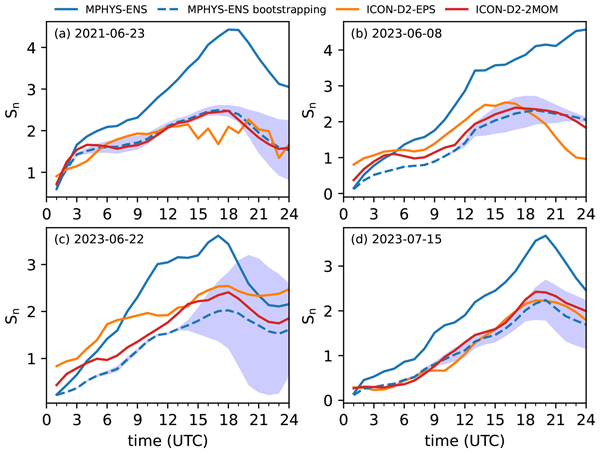
Abstract. Accurately forecasting summertime convection remains a challenge for convection-permitting ensemble prediction systems, which often show insufficient spread in precipitation forecasts. This study examines the role of microphysical uncertainties using the ICOsahedral Non-hydrostatic (ICON) model for four representative convective cases over central Europe. A 108-member cloud microphysics ensemble (MPHYS-ENS) was generated by perturbing cloud condensation nuclei (CCN) and ice-nucleating particle (INP) concentrations, graupel sedimentation velocity, and the cloud droplet size distribution. Microphysical perturbations alone produced substantial variability in convective intensity and location, despite identical initial and boundary conditions. Precipitation totals were highly sensitive to CCN and graupel sedimentation, with deviations of 17–33 % across cases, while the timing of convection onset was only weakly affected. Rapid domain-wide error growth indicated strong thermodynamic impacts even in cloud-free regions. Process diagnostics showed that water–ice and vapor–liquid phase changes dominate mean hydrometeor mass rates, while the most frequent processes involved evaporation. Cold-rain pathways consistently governed precipitation; higher CCN and INP concentrations enhanced this dominance, whereas faster graupel sedimentation weakened it. The ratio of cold- to warm-rain processes emerged as a potential diagnostic for identifying regimes in which increased aerosol loading enhances, rather than suppresses, precipitation. Comparison with operational ensembles highlighted the importance of ensemble size. The 108-member MPHYS-ENS generated the largest spread, while bootstrapped 20-member subsets approached operational ensemble system levels. This study demonstrates that cloud microphysics is a major source of forecast uncertainty in summertime convection and should be explicitly represented in ensemble design.
-
Notice on discussion status
The requested preprint has a corresponding peer-reviewed final revised paper. You are encouraged to refer to the final revised version.
-
Preprint
(94588 KB)
-
The requested preprint has a corresponding peer-reviewed final revised paper. You are encouraged to refer to the final revised version.
- Preprint
(94588 KB) - Metadata XML
- BibTeX
- EndNote
- Final revised paper


Journal article(s) based on this preprint
Interactive discussion
Status: closed
-
RC1: 'Comment on egusphere-2025-5192', Anonymous Referee #1, 11 Dec 2025
- AC2: 'Reply on RC1', Christian Barthlott, 17 Mar 2026
-
RC2: 'Comment on egusphere-2025-5192', Anonymous Referee #2, 27 Feb 2026
General CommentsThe manuscript addresses a highly relevant and topical issue in convective weather prediction: the role of cloud microphysical uncertainties in ensemble forecast spread. Using a 108-member ensemble generated by perturbing key microphysical parameters, such as CCN and INP concentrations, graupel sedimentation velocity, and droplet size distribution, the authors systematically explore how these perturbations affect convective precipitation intensity, spatial distribution, and ensemble spread in convection-permitting simulations with the ICON model.The study makes several important contributions:
- It demonstrates substantial variability in precipitation outcomes attributable solely to microphysics perturbations, despite identical initial and boundary conditions, highlighting microphysics as a major source of forecast uncertainty.
- Results linking cold-rain vs warm-rain process dominance to aerosol conditions offer valuable physical insight and suggest new diagnostics for regime classification.
- The comparison between large ensembles and operational-scale subsets meaningfully illustrates how ensemble size influences forecast spread representation.
Overall, the methodology is innovative, and the results are of broad interest to both weather prediction and microphysical parameterization communities. However, key areas require clarification and expansion before the manuscript can be considered for publication.Major Comments1. The paper convincingly shows that perturbations in CCN, INP, and sedimentation rates significantly alter precipitation totals. However, the mechanistic explanations linking these perturbations to changes in convective evolution (e.g. why cold-rain dominance increases with higher CCN/INP) could be expanded to provide a more complete physical narrative.2. The analysis uses four convective cases over central Europe. It would help the reader if the authors justify why these specific cases were chosen and whether they capture a wide range of synoptic environments. Are the conclusions generalizable beyond these particular events?3. The comparison between the 108-member microphysics ensemble and operational ensemble spread is valuable. Yet, the operational ensemble design (physics schemes, perturbation strategies) should be described in more detail to support a fair qualitative comparison. Differences in model configuration, resolution, or perturbation strategy could confound interpretations.4. In several cases presented (e.g., as noted by existing RC1 comments), peak precipitation occurs near the end of the simulation window (e.g. Figure 7). This raises the question of whether the full lifecycle of convective events is captured for all ensemble members. Analyses truncated before event completion could bias statistical measures.5. Introducing additional objective ensemble verification metrics (e.g., continuous ranked probability score, rank histograms, reliability diagrams) would contextualize the spread relative to forecast skill and probabilistic performance, beyond just spread magnitude.Minor Comments and Suggestions1. The authors should situate their approach relative to prior work perturbing similar microphysical parameters (e.g., Thompson et al. 2021-style approaches), to better frame the novelty of the perturbation strategy.2. Ensure consistent use of terminology (e.g., “cold-rain pathways,” “warm-rain processes”) and define early how these categories are diagnosed.3. The finding of rapid domain-wide error growth even in cloud-free regions is important. A discussion linking this to broader convective-scale predictability limits and non-local coupling would enhance the manuscript’s implications for ensemble design.Thompson, G., Berner, J., Frediani, M., Otkin, J. A., & Griffin, S. M. (2021).A stochastic parameter perturbation method to represent uncertainty in a microphysics scheme. Monthly Weather Review, 149(5), 1481-1497. https://doi.org/10.1175/MWR‑D‑20‑0077.1Citation: https://doi.org/10.5194/egusphere-2025-5192-RC2 - AC1: 'Reply on RC2', Christian Barthlott, 17 Mar 2026
Peer review completion


Interactive discussion
Status: closed
-
RC1: 'Comment on egusphere-2025-5192', Anonymous Referee #1, 11 Dec 2025
Overall Evaluation
The manuscript, “Significance of microphysical processes for uncertainties in ensemble forecasts of summertime convection over central Europe,” investigates the impact of perturbing selected microphysical parameters in the two-moment bulk microphysics scheme of the ICON model, using a 108-member ensemble for 4 summertime convective cases. The methodology and statistical analyses are generally well presented. Figures 5, 10, and 11 are particularly creative and effectively illustrate the distinct effects of each ensemble perturbation, accompanied by clear discussions. Moreover, the authors convincingly demonstrate the importance of microphysical perturbations by generating an ensemble spread that compares with the operational ensemble results. Consequently, this study provides valuable insights into microphysics-related ensemble design and should be of interest to the broader forecasting and microphysics communities. However, some scientific clarifications and physical interpretations are needed. In its current form, the study feels incomplete, and I therefore recommend major revision, contingent upon addressing the comments below.
Major comments:
- Line 48-54, Introduction, Although the methods differ, Thompson et al. (2021) could be mentioned here because they perturbed similar parameters, including the cloud droplet size distribution, CCN activation, and graupel size spectra within a single microphysics scheme. In addition, Barthlott et al. (2022a, b) are cited repeatedly, so the authors may consider introducing an abbreviation after the first occurrence.
- Figure 7 shows that the precipitation rate reaches its maximum near the end of the simulation period for Cases 1, 3, and 4. In other words, the rainfall events have not yet completed. Thus, how can the perturbed microphysical parameters fully represent their total impact on the statistical analyses if the latter part of the event evolution is not captured?
- Line 302, Eq. 5, What does the symbol x represent? Also, why is the forecast error quantified relative to a reference simulation rather than to reanalysis or observations? Does the reference simulation objectively show the best performance? A justification is needed.
- Figure 10 is very useful for illustrating the relative importance of the different microphysical processes in terms of magnitude and frequency. Because graupel fall speed directly influences surface precipitation through sedimentation, would it be possible to include the hydrometeor sedimentation rate in the analysis additionally?
- Figure 11, The ratio of cold-rain to warm-rain production is an important diagnostic. Since melting of frozen hydrometeors is the most direct pathway to cold-rain formation, it would be more appropriate to use melting, rather than DEP + RIM, to compute this ratio.
- Figure 12, CCN concentration and graupel fall speed appear to be the two most influential parameters. Therefore, it would be valuable to compute the ensemble spread using only the corresponding subsets of ensemble members. This would allow an assessment of whether a high-impact parameter represented by a small subset contributes more to the overall spread than a low-impact parameter represented by a larger subset, thereby supporting a clearer conclusion.
Minor comment:
- Line 101, INP uncertainty, what is Tmin in Eq. (1)? Is it necessary to list the full formulations of Eqs. (1)–(3)? Please make a check whether an upper-limit constraint is imposed by the prescribed ice-nucleating particle number concentration (i.e., using up available ice nuclei) to reduce the potential overproduction of ice crystals and thereby limit the impact of INP perturbations.
- Line 128, Eq. 4, A and λ denote the intercept and slope parameters, respectively. Also, there is one typo of v’ = 2, 5, 8, 14 in line 140.
- Figure 3, a minor typo of “radar-derived”.
- Figure 4, consider adding the spatial correlation between the ensemble median and the observations shown in Fig. 3 to demonstrate how well the precipitation systems are captured.
- Line 253, the sentence “This may be overcompensated by the reduced riming efficiency associated with the smaller cloud droplets” is unclear. How are smaller cloud droplets related to enhanced graupel fall speed? Further clarification is needed.
Citation: https://doi.org/10.5194/egusphere-2025-5192-RC1 - AC2: 'Reply on RC1', Christian Barthlott, 17 Mar 2026
-
RC2: 'Comment on egusphere-2025-5192', Anonymous Referee #2, 27 Feb 2026
General CommentsThe manuscript addresses a highly relevant and topical issue in convective weather prediction: the role of cloud microphysical uncertainties in ensemble forecast spread. Using a 108-member ensemble generated by perturbing key microphysical parameters, such as CCN and INP concentrations, graupel sedimentation velocity, and droplet size distribution, the authors systematically explore how these perturbations affect convective precipitation intensity, spatial distribution, and ensemble spread in convection-permitting simulations with the ICON model.The study makes several important contributions:
- It demonstrates substantial variability in precipitation outcomes attributable solely to microphysics perturbations, despite identical initial and boundary conditions, highlighting microphysics as a major source of forecast uncertainty.
- Results linking cold-rain vs warm-rain process dominance to aerosol conditions offer valuable physical insight and suggest new diagnostics for regime classification.
- The comparison between large ensembles and operational-scale subsets meaningfully illustrates how ensemble size influences forecast spread representation.
Overall, the methodology is innovative, and the results are of broad interest to both weather prediction and microphysical parameterization communities. However, key areas require clarification and expansion before the manuscript can be considered for publication.Major Comments1. The paper convincingly shows that perturbations in CCN, INP, and sedimentation rates significantly alter precipitation totals. However, the mechanistic explanations linking these perturbations to changes in convective evolution (e.g. why cold-rain dominance increases with higher CCN/INP) could be expanded to provide a more complete physical narrative.2. The analysis uses four convective cases over central Europe. It would help the reader if the authors justify why these specific cases were chosen and whether they capture a wide range of synoptic environments. Are the conclusions generalizable beyond these particular events?3. The comparison between the 108-member microphysics ensemble and operational ensemble spread is valuable. Yet, the operational ensemble design (physics schemes, perturbation strategies) should be described in more detail to support a fair qualitative comparison. Differences in model configuration, resolution, or perturbation strategy could confound interpretations.4. In several cases presented (e.g., as noted by existing RC1 comments), peak precipitation occurs near the end of the simulation window (e.g. Figure 7). This raises the question of whether the full lifecycle of convective events is captured for all ensemble members. Analyses truncated before event completion could bias statistical measures.5. Introducing additional objective ensemble verification metrics (e.g., continuous ranked probability score, rank histograms, reliability diagrams) would contextualize the spread relative to forecast skill and probabilistic performance, beyond just spread magnitude.Minor Comments and Suggestions1. The authors should situate their approach relative to prior work perturbing similar microphysical parameters (e.g., Thompson et al. 2021-style approaches), to better frame the novelty of the perturbation strategy.2. Ensure consistent use of terminology (e.g., “cold-rain pathways,” “warm-rain processes”) and define early how these categories are diagnosed.3. The finding of rapid domain-wide error growth even in cloud-free regions is important. A discussion linking this to broader convective-scale predictability limits and non-local coupling would enhance the manuscript’s implications for ensemble design.Thompson, G., Berner, J., Frediani, M., Otkin, J. A., & Griffin, S. M. (2021).A stochastic parameter perturbation method to represent uncertainty in a microphysics scheme. Monthly Weather Review, 149(5), 1481-1497. https://doi.org/10.1175/MWR‑D‑20‑0077.1Citation: https://doi.org/10.5194/egusphere-2025-5192-RC2 - AC1: 'Reply on RC2', Christian Barthlott, 17 Mar 2026
Peer review completion
Journal article(s) based on this preprint
Viewed
| HTML | XML | Total | BibTeX | EndNote | |
|---|---|---|---|---|---|
| 921 | 334 | 82 | 1,337 | 71 | 335 |
- HTML: 921
- PDF: 334
- XML: 82
- Total: 1,337
- BibTeX: 71
- EndNote: 335
Viewed (geographical distribution)
| Country | # | Views | % |
|---|
| Total: | 0 |
| HTML: | 0 |
| PDF: | 0 |
| XML: | 0 |
- 1
Christian Barthlott

Beata Czajka
Christoph Gebhardt
Corinna Hoose
The requested preprint has a corresponding peer-reviewed final revised paper. You are encouraged to refer to the final revised version.
- Preprint
(94588 KB) - Metadata XML
Overall Evaluation
The manuscript, “Significance of microphysical processes for uncertainties in ensemble forecasts of summertime convection over central Europe,” investigates the impact of perturbing selected microphysical parameters in the two-moment bulk microphysics scheme of the ICON model, using a 108-member ensemble for 4 summertime convective cases. The methodology and statistical analyses are generally well presented. Figures 5, 10, and 11 are particularly creative and effectively illustrate the distinct effects of each ensemble perturbation, accompanied by clear discussions. Moreover, the authors convincingly demonstrate the importance of microphysical perturbations by generating an ensemble spread that compares with the operational ensemble results. Consequently, this study provides valuable insights into microphysics-related ensemble design and should be of interest to the broader forecasting and microphysics communities. However, some scientific clarifications and physical interpretations are needed. In its current form, the study feels incomplete, and I therefore recommend major revision, contingent upon addressing the comments below.
Major comments:
Minor comment: