
the Creative Commons Attribution 4.0 License.
the Creative Commons Attribution 4.0 License.
 | 14 Nov 2025
Strong monsoon influence on South Asian methane emissions in 2020 revealed by a Bayesian inversion constrained by satellite observations
Abstract. South Asia is a major contributor to global methane (CH₄) emissions, yet its emissions remain poorly constrained, limiting targeted mitigation. Current bottom-up inventories do not consistently capture the magnitude and seasonality of CH₄ emissions in this region, particularly during the monsoon. Here we quantify South Asian CH₄ emissions for 2020 using column observations from TROPOMI, a Lagrangian transport model (FLEXPART), and a Bayesian inversion system (FLEXINVERT+). We estimate a posteriori emission of 73.0 ± 0.5 Tg yr⁻¹ for South Asia, including 35.6 ± 0.5 Tg yr⁻¹ for India and 13.2 ± 0.2 Tg yr⁻¹ for Bangladesh. Agriculture and wetlands contribute substantially to the regional budget, with the flux increments coincident with rice‑growing areas and inundated lowlands. The inversion indicates pronounced monsoon‑modulated seasonality: posterior fluxes are higher than the prior during June–September by ~70 % and lower during January–May by ~46 %. Localized enhancements seen over the lower Indus Basin align with runoff patterns, while the seasonal peaks here are absent in inventories. By resolving monsoon seasonality with satellite constraints, our results point towards key uncertainties in the South Asian CH₄ budget and underscore the need for process-based, seasonally responsive inventories to inform mitigation strategies and reconcile bottom-up and top-down estimates.
-
Notice on discussion status
The requested preprint has a corresponding peer-reviewed final revised paper. You are encouraged to refer to the final revised version.
-
Preprint
(2713 KB)
-
Supplement
(5175 KB)
-
The requested preprint has a corresponding peer-reviewed final revised paper. You are encouraged to refer to the final revised version.
- Preprint
(2713 KB) - Metadata XML
-
Supplement
(5175 KB) - BibTeX
- EndNote
- Final revised paper


Journal article(s) based on this preprint
Interactive discussion
Status: closed
-
RC1: 'Comment on egusphere-2025-5108', Anonymous Referee #1, 15 Dec 2025
-
AC1: 'Reply on RC1', Rakesh Subramanian, 26 Feb 2026
The comment was uploaded in the form of a supplement: https://egusphere.copernicus.org/preprints/2025/egusphere-2025-5108/egusphere-2025-5108-AC1-supplement.pdf
-
AC1: 'Reply on RC1', Rakesh Subramanian, 26 Feb 2026
-
RC2: 'Comment on egusphere-2025-5108', Anita Ganesan, 16 Dec 2025
The comment was uploaded in the form of a supplement: https://egusphere.copernicus.org/preprints/2025/egusphere-2025-5108/egusphere-2025-5108-RC2-supplement.pdf
-
AC2: 'Reply on RC2', Rakesh Subramanian, 26 Feb 2026
The comment was uploaded in the form of a supplement: https://egusphere.copernicus.org/preprints/2025/egusphere-2025-5108/egusphere-2025-5108-AC2-supplement.pdf
-
AC2: 'Reply on RC2', Rakesh Subramanian, 26 Feb 2026
Peer review completion


Interactive discussion
Status: closed
-
RC1: 'Comment on egusphere-2025-5108', Anonymous Referee #1, 15 Dec 2025
Review report for Strong monsoon influence on South Asian methane emissions in 2020 revealed by a Bayesian inversion constrained by satellite observations by Subramanian et al.
This study estimates methane emissions in a key region where greenhouse gas emissions and satellite data have considerable biases. This uncertainty, along with the proportion of emissions from this region to the global burden, makes it a target for mitigation efforts. Regional emission estimates, therefore, are important in that direction. This manuscript is written concisely but needs some additional points. Key analysis to add includes a validation with independent data, as satellite data have been known to have biases in this region. Monsoon seasonality in emissions related to rain-fed agriculture or wetlands is expected, but how robust the estimate/conclusion should be shown with posterior statistics, with independent observations in this region. Also, the focus should be on the whole domain (the abstract also lacks that- e.g., what causes the seasonality for the whole domain), instead of projecting the LIB result as a key result. After addressing the comments, this manuscript may be considered for publication.
Specific points
Abstract
“Agriculture and wetlands contribute substantially to the regional budget,..”. Better to be quantitative here. You have analyzed climatic factors in the South Asian domain as well. Better to reflect those aspects in the abstract also.
Introduction
26-27: “Methane (CH₄) is a potent greenhouse gas with a global warming potential 85 times higher than that of carbon dioxide over a 20-year period.” Reference needed
59-60: include basic references for SCIAMACHY, GOSAT, etc., and give credit to the Agency behind the effort
Connect the last two paragraphs of page 2 on the sparsity of surface networks to the use of satellites
Also mention some studies on the biases in satellite products over Asia, then the biases in TROPOMI early products, and how this product is better
Data and methods
Section 2.2.
- 126: Edgar > EDGAR
- 128: finn > FINN?
- How come the wetland prior map is so weak in Pakistan, while 10% of Pakistan's land is wetlands? Maybe use proper scales for each panel? Use non-linear scales for flux maps, as you will miss some key information.
- 146: Significant landfill emissions can also be in other major cities. Maybe elaborate on other regions also.
- Table 1. Edgar > “EDGAR”
Section 2.3.
- Include reference to CAMS, EGG4, etc.
- ECMWF- write in full at the first use for all abbreviations (e.g. RMSD in line 166)
Section 2.4
- 169: Flexpart > FLEXPART
Results
- The prior map clearly shows emissions from anthropogenic sources in the LIB. So, how do the river discharge peaks correspond to methane emissions? If it is related to rain-fed agriculture, this should be clearly written with some references. (What is the agricultural practice in Pakistan etc.). Wetlands in Pakistan are also in the region where you have anthropogenic emissions (your wetland prior plot does not show that due to large emissions from Bangladesh). So the double peak, is it from seasonally inundated wetlands or seasonal agriculture?
- Also, the aggregated posterior for SA also shows peaks in two seasons, as has been shown in some previous studies (e.g., Ganesan et al., 2017) for Indian agriculture emissions. So emphasis may be given to the whole domain instead of LIB.
- Should mention in the Figure 10 caption about the prior uncertainty? How is the prior uncertainty calculated? Is it not small for South Asia?
- “However, since this validation is not against independent data, this shows only that the inversion is performing as expected”. A posterior simulation with independent surface observation should be done, as satellite data are not real observations. So, make use of surface observations to demonstrate that the posterior fits well with observations in this region.
- Figure 11 gives the ensemble values, but where does it stand when compared to prior or recent studies? More information can be added there. Also, provide prior/posterior uncertainty in all applicable figures (e.g., no prior uncertainty in Figure 12, no posterior uncertainty in Figure 11).
- Figure 12. Group the regions together (darker/lighter) for direct comparison to the respective prior.
- 267-269: "The model prior mole fractions (orange line) significantly overestimate". No need for ‘(orange line)’ etc in the text.
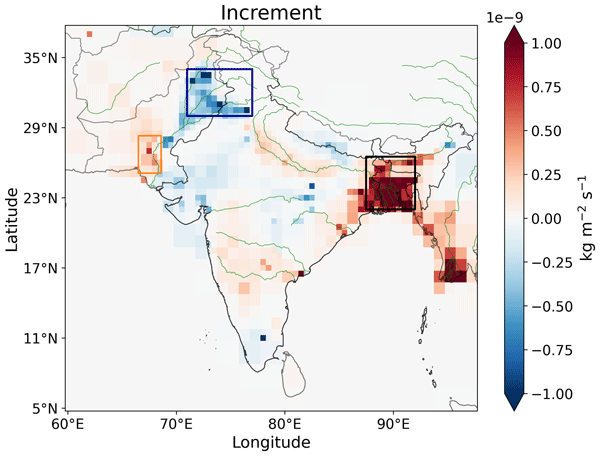
- 295-296: "Figure 8 (c) shows the spatial distribution of the increments in the methane fluxes after the inversion (posterior-prior)". The word ‘increment’ normally implies a positive addition. Maybe better to refer to it as flux correction or adjustments
- 302 “trajectory of the river Yamuna and Ganges,”. Trajectory may be replaced by ‘course’ or something more appropriate.
- 303-305 “Several studies have shown rice cultivation as a key contributor to methane emissions here due to the use of nitrogen fertilizers, organic manure, and livestock population in this region [Singh et al., 2021]”. Be generous with citations when you say ‘several’.
- 307-308 ‘In the area marked within the blue box,’. You should not be writing about the marked boxes, but specifically write Upper Indus Basin or whatever you can geographically name it.
Conclusion
- 419-420 “…the back box region…”. This is not an appropriate reference to the analysis region in conclusion. Specify the region so that the conclusion stands alone.
- “These analyses suggest that the 2020 rise in methane emissions is strongly linked to biogenic processes driven by glacial melt (in the Indus river basin), heavy monsoonal rainfall and enhanced inundation (both in the Indus river basin and in Bangladesh). These findings are consistent with earlier studies (e.g., Peng et al., (2022), Niwa et al., (2025)) that identify wetlands and agriculture as dominant contributors to the regional and global methane budget in recent years.” Since you estimate only one year of emission, you do not need to tell from this particular study that there was a rise in 2020.
Citation: https://doi.org/10.5194/egusphere-2025-5108-RC1 -
AC1: 'Reply on RC1', Rakesh Subramanian, 26 Feb 2026
The comment was uploaded in the form of a supplement: https://egusphere.copernicus.org/preprints/2025/egusphere-2025-5108/egusphere-2025-5108-AC1-supplement.pdf
-
RC2: 'Comment on egusphere-2025-5108', Anita Ganesan, 16 Dec 2025
The comment was uploaded in the form of a supplement: https://egusphere.copernicus.org/preprints/2025/egusphere-2025-5108/egusphere-2025-5108-RC2-supplement.pdf
-
AC2: 'Reply on RC2', Rakesh Subramanian, 26 Feb 2026
The comment was uploaded in the form of a supplement: https://egusphere.copernicus.org/preprints/2025/egusphere-2025-5108/egusphere-2025-5108-AC2-supplement.pdf
-
AC2: 'Reply on RC2', Rakesh Subramanian, 26 Feb 2026
Peer review completion
Journal article(s) based on this preprint
Viewed
| HTML | XML | Total | Supplement | BibTeX | EndNote | |
|---|---|---|---|---|---|---|
| 2,072 | 966 | 236 | 3,274 | 279 | 266 | 299 |
- HTML: 2,072
- PDF: 966
- XML: 236
- Total: 3,274
- Supplement: 279
- BibTeX: 266
- EndNote: 299
Viewed (geographical distribution)
| Country | # | Views | % |
|---|
| Total: | 0 |
| HTML: | 0 |
| PDF: | 0 |
| XML: | 0 |
- 1
Rakesh Subramanian

Rona L. Thompson
Martin Vojta
Oliver Schneising
Andreas Stohl
The requested preprint has a corresponding peer-reviewed final revised paper. You are encouraged to refer to the final revised version.
- Preprint
(2713 KB) - Metadata XML
-
Supplement
(5175 KB) - BibTeX
- EndNote
- Final revised paper
Review report for Strong monsoon influence on South Asian methane emissions in 2020 revealed by a Bayesian inversion constrained by satellite observations by Subramanian et al.
This study estimates methane emissions in a key region where greenhouse gas emissions and satellite data have considerable biases. This uncertainty, along with the proportion of emissions from this region to the global burden, makes it a target for mitigation efforts. Regional emission estimates, therefore, are important in that direction. This manuscript is written concisely but needs some additional points. Key analysis to add includes a validation with independent data, as satellite data have been known to have biases in this region. Monsoon seasonality in emissions related to rain-fed agriculture or wetlands is expected, but how robust the estimate/conclusion should be shown with posterior statistics, with independent observations in this region. Also, the focus should be on the whole domain (the abstract also lacks that- e.g., what causes the seasonality for the whole domain), instead of projecting the LIB result as a key result. After addressing the comments, this manuscript may be considered for publication.
Specific points
Abstract
“Agriculture and wetlands contribute substantially to the regional budget,..”. Better to be quantitative here. You have analyzed climatic factors in the South Asian domain as well. Better to reflect those aspects in the abstract also.
Introduction
26-27: “Methane (CH₄) is a potent greenhouse gas with a global warming potential 85 times higher than that of carbon dioxide over a 20-year period.” Reference needed
59-60: include basic references for SCIAMACHY, GOSAT, etc., and give credit to the Agency behind the effort
Connect the last two paragraphs of page 2 on the sparsity of surface networks to the use of satellites
Also mention some studies on the biases in satellite products over Asia, then the biases in TROPOMI early products, and how this product is better
Data and methods
Section 2.2.
Section 2.3.
Section 2.4
Results
Conclusion