
the Creative Commons Attribution 4.0 License.
the Creative Commons Attribution 4.0 License.
 | 13 Nov 2025
Curlew 1.0: Spatio-temporal implicit geological modelling with neural fields in python
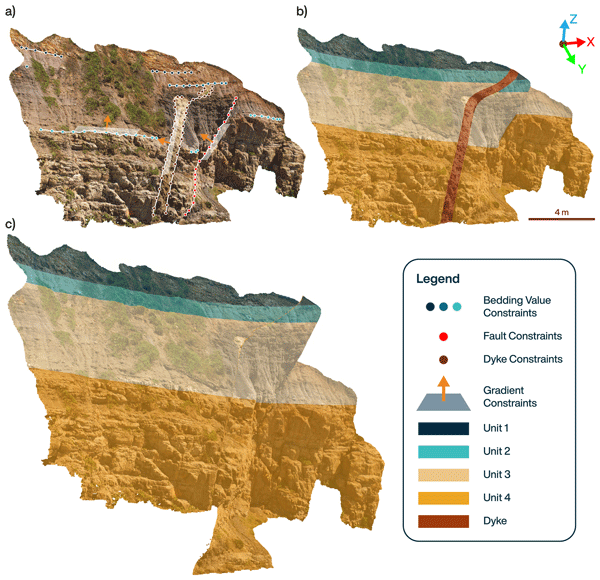
Abstract. We present curlew, an open-source python package for structural geological modelling using neural fields. This modelling framework incorporates various local constraints (value, gradient, orientation and (in)equalities) and tailored global loss functions to ensure data-consistent and geologically realistic predictions. Random Fourier Feature (RFF) encodings are used to improve model convergence and facilitate stochastic uncertainty quantification, while simultaneously improving the model's ability to learn naturally periodic features such as folds. These advances are integrated into a software framework that allows incremental construction of complex geological models through temporally-linked neural fields, each representing a specific deposition, intrusion or faulting event. Significantly, this framework allows semi-supervised learning to integrate diverse unlabelled datasets (e.g., geochemistry, petrophysics), reducing interpretation bias and potentially improving model robustness. We describe and demonstrate these various capabilities using synthetic examples and real data from a faulted stratigraphic digital outcrop model from Newcastle, Australia.
-
Notice on discussion status
The requested preprint has a corresponding peer-reviewed final revised paper. You are encouraged to refer to the final revised version.
-
Preprint
(0 KB)
-
The requested preprint has a corresponding peer-reviewed final revised paper. You are encouraged to refer to the final revised version.


Journal article(s) based on this preprint
Interactive discussion
Status: closed
-
CEC1: 'Comment on egusphere-2025-5100 - No compliance with the policy of the journal', Juan Antonio Añel, 07 Dec 2025
-
CC1: 'Reply on CEC1', Samuel Thiele, 15 Dec 2025
Dear Editor,
We have checked the permanent (zenodo) data repository listed in the Code and Data Availability section (https://zenodo.org/records/17190282), and can confirm that it contains all of the datasets used in this paper (and code needed to reproduce our results).
ausgeol.org is mentioned only because it is the original source of the digital outcrop model. We can remove this reference if it is confusing.
Kind regards,
Sam Thiele
Citation: https://doi.org/10.5194/egusphere-2025-5100-CC1
-
CC1: 'Reply on CEC1', Samuel Thiele, 15 Dec 2025
-
RC1: 'Comment on egusphere-2025-5100', Ítalo Gonçalves, 23 Jan 2026
The authors present a novel method for implicit geological modelling based on neural networks. The text is very well-written and organized. I recommend its publication after a clarification of the points presented below, which could also help strenghten the discussion section.
1) The geological operators (fault displacement, overprint, etc.) are mentioned only briefly. I think an appendix would help readers understand the details better by putting all these equations (including those from other works) within a standardized notation.
2) I assume the MLP uses a smooth activation function. Which one? Does the choice of activation have an impact on the final result?
3) Have you considered using Bayesian neural networks? This way probabilistic predictions could be generated from a single model, and the priors on the weights and length scales could help to better control the model smoothness.
4) As the inputs are always in 2D or 3D, have you considered an uniform distribution of directions for the RFF features instead of random sampling? For turning bands this is the recommended method (Emery and Lantéjoul, 2006). Also a "power spectrum" of length scales derived from the grid extents could help reduce the number of hyperparameters. Furthermore, the application of L1 regularization on the weights could help with model interpretability and/or help propagate periodic features far from the data.
5) It seems to me that the average user may find it difficult to adjust the hyperparameters for each field. Is there any recommendation that can be made to help the user choose the values? Any defaults?
6) The examples presented involved some manual interventions such as multiple training phases and fixation of weights. Please discuss how the modelling process could be streamined in future versions of the library.
Minor remarks:Figure 1 is not cited in the text.
Figure 6: for the sake of clarity it would be good to mention that each field influences the subsequent ones through the displacement functions and etc., pointing to Figure 7.
Lines 210-220: are the points resampled with each training step?
Line 122: verify sentence "...to the Laplace’s equation..."
Line 362: remove "-"
Line 376: verify "...the monotonicity loss enabled used to encourage..."Citation: https://doi.org/10.5194/egusphere-2025-5100-RC1 - AC1: 'Reply on RC1', Akshay Kamath, 13 Mar 2026
-
RC2: 'Comment on egusphere-2025-5100', Anonymous Referee #2, 27 Jan 2026
Dear editor,
I have reviewed the manuscript "Curlew 1.0: Spatio-temporal implicit geological modelling with neural fields in python" from Kamath et al. and provide detailed comments and suggestions aimed at helping improve the quality of the work.
Kamath et al. present curlew, a new open-source Python package designed for structural geological reconstructions using measured geological constraints. They use a neural-fields approach which allows for the incorporation of different local and global loss functions. This is a flexible framework for imposing different kinds of geological data constraints. The manuscript also demonstrates how Random Fourier Features (RFFs) can be used both to evaluate model uncertainty and to improve convergence.
The codes related to this work are publicly available in a Zenodo repository. All of the files that were used to produce the diagrams of the manuscript are present in this repository. I tried reproducing the figures by running them in a Jupyter notebook. The Jupyter notebooks included pre-computed outputs, showing that the code had already been run and reproduced the manuscript’s figures. However, rerunning the Jupyter cells yielded results different compared to the original outputs (see attached file). On several occasions the results could alter the interpretation (for example Figure 5d). Therefore, it is unclear whether the random seed was applied correctly. Could this issue be related to the fact that the NumPy and PyTorch operations have not been controlled by the random seed? Additionally, it would be important to assess the extent to which the algorithm’s inherent randomness affects the final geological reconstruction.
A question that arose while reading the manuscript concerns the comparison between curlew and existing structural modeling packages such as Aspen-SKUA, 3D-GeoModeller, Leapfrog and GemPy. The computational benefits of curlew are clear since it is a differentiable and adaptable code that can run in parallel on multi-CPU and GPU systems. However, it would be very insightful if the manuscript elaborated on whether curlew also provides qualitative improvements in geological detail or interpretability due to the flexible incorporation of multiple loss functions. For example, would a model produced with curlew give comparable results to the previously mentioned algorithms? What differences could be expected between the available codes for geological reconstructions?
Another point that could benefit from further discussion is the tuning of the loss-function weighting factors. The authors briefly mention the use of SoftAdapt (Heydari et al., 2019) but also point out that the results are mixed. Because the weights (or hyperparameters) can significantly influence the final reconstruction, additional insight into this challenge would be welcome. For instance, what alternative methods (e.g., Bayesian optimization, gradient-based methods) could be suitable in future improvements of the algorithm and the tuning of the weighting factors?
Finally, I have a few minor remarks regarding the text. I would recommend simplifying some of the sentence structures. In several places the use of long sentences or multiple commas makes the text a bit difficult to follow. Shorter sentences would largely improve the readability. In addition, I noticed a few typographical errors throughout the manuscript. Careful proofreading would be helpful. For example:
- Equation (1) should have vs instead of v
- Line 48, “do not” instead of “don’t”
- Line 272, there is a noun missing after “from”
Overall, the manuscript presents a very promising and adaptable tool with strong potential for advancing structural reconstructions and I think should be published if the points above are addressed.
- AC2: 'Reply on RC2', Akshay Kamath, 13 Mar 2026
-
CC2: 'Comment on egusphere-2025-5100', Michal Michalak, 15 Feb 2026
In my opinion, this is a well-structured manuscript. In this "unsolicited" community comment, I have only a couple of specific questions to better understand differences with existing approaches:
- what is the minimum data to run your software? For example, in GemPy (co-kriging) one needs surface points and orientation data. Please specify the minimum data categories and data amount in the manuscript.
- in your manuscript, you write about "bubbles". Can the following effect in the GemPy tutorial (1:31:57) be described as "bubbles"? Source: https://www.youtube.com/watch?v=1oS6xTJkRwo . Could you provide a figure or a reference where "bubbles" are discussed in scientific literature?
- In the above-referenced GemPy tutorial, there is a claim that adding more orientations improves the geological model in that it avoids some negative effects (maybe "bubbles"?). The proposed solution, as far as I understand, calculates a normal vector from three surface points. Could you compare this approach with your approach in the manuscript?
- Line 414: " This contrasts against established methods such as co-kriging and RBF, which scale poorly with data
volume (typically with cubic complexity in the number of data points)," - do you mean the need of inverting matrices in geostatistical methods? Please provide a reference.
Citation: https://doi.org/10.5194/egusphere-2025-5100-CC2 - AC3: 'Reply on CC2', Akshay Kamath, 13 Mar 2026
Peer review completion


Interactive discussion
Status: closed
-
CEC1: 'Comment on egusphere-2025-5100 - No compliance with the policy of the journal', Juan Antonio Añel, 07 Dec 2025
Dear authors,
Unfortunately, after checking your manuscript, it has come to our attention that it does not comply with our "Code and Data Policy".
https://www.geoscientific-model-development.net/policies/code_and_data_policy.htmlIn your manuscript you have not included permanent repositories for the data used and produced in your work. Also, you cite an ausgeo.org site to store some of the assets, which we can not accept. Therefore, the current situation with your manuscript is irregular. Please, publish all the assets that you have used or generated for your work in one of the appropriate repositories and reply to this comment with the relevant information (link and a permanent identifier for it (e.g. DOI)) as soon as possible, as we can not accept manuscripts in Discussions that do not comply with our policy.
I must note that if you do not fix this problem, we cannot continue with the peer-review process or accept your manuscript for publication in our journal.
Juan A. Añel
Geosci. Model Dev. Executive EditorCitation: https://doi.org/10.5194/egusphere-2025-5100-CEC1 -
CC1: 'Reply on CEC1', Samuel Thiele, 15 Dec 2025
Dear Editor,
We have checked the permanent (zenodo) data repository listed in the Code and Data Availability section (https://zenodo.org/records/17190282), and can confirm that it contains all of the datasets used in this paper (and code needed to reproduce our results).
ausgeol.org is mentioned only because it is the original source of the digital outcrop model. We can remove this reference if it is confusing.
Kind regards,
Sam Thiele
Citation: https://doi.org/10.5194/egusphere-2025-5100-CC1
-
CC1: 'Reply on CEC1', Samuel Thiele, 15 Dec 2025
-
RC1: 'Comment on egusphere-2025-5100', Ítalo Gonçalves, 23 Jan 2026
The authors present a novel method for implicit geological modelling based on neural networks. The text is very well-written and organized. I recommend its publication after a clarification of the points presented below, which could also help strenghten the discussion section.
1) The geological operators (fault displacement, overprint, etc.) are mentioned only briefly. I think an appendix would help readers understand the details better by putting all these equations (including those from other works) within a standardized notation.
2) I assume the MLP uses a smooth activation function. Which one? Does the choice of activation have an impact on the final result?
3) Have you considered using Bayesian neural networks? This way probabilistic predictions could be generated from a single model, and the priors on the weights and length scales could help to better control the model smoothness.
4) As the inputs are always in 2D or 3D, have you considered an uniform distribution of directions for the RFF features instead of random sampling? For turning bands this is the recommended method (Emery and Lantéjoul, 2006). Also a "power spectrum" of length scales derived from the grid extents could help reduce the number of hyperparameters. Furthermore, the application of L1 regularization on the weights could help with model interpretability and/or help propagate periodic features far from the data.
5) It seems to me that the average user may find it difficult to adjust the hyperparameters for each field. Is there any recommendation that can be made to help the user choose the values? Any defaults?
6) The examples presented involved some manual interventions such as multiple training phases and fixation of weights. Please discuss how the modelling process could be streamined in future versions of the library.
Minor remarks:Figure 1 is not cited in the text.
Figure 6: for the sake of clarity it would be good to mention that each field influences the subsequent ones through the displacement functions and etc., pointing to Figure 7.
Lines 210-220: are the points resampled with each training step?
Line 122: verify sentence "...to the Laplace’s equation..."
Line 362: remove "-"
Line 376: verify "...the monotonicity loss enabled used to encourage..."Citation: https://doi.org/10.5194/egusphere-2025-5100-RC1 - AC1: 'Reply on RC1', Akshay Kamath, 13 Mar 2026
-
RC2: 'Comment on egusphere-2025-5100', Anonymous Referee #2, 27 Jan 2026
Dear editor,
I have reviewed the manuscript "Curlew 1.0: Spatio-temporal implicit geological modelling with neural fields in python" from Kamath et al. and provide detailed comments and suggestions aimed at helping improve the quality of the work.
Kamath et al. present curlew, a new open-source Python package designed for structural geological reconstructions using measured geological constraints. They use a neural-fields approach which allows for the incorporation of different local and global loss functions. This is a flexible framework for imposing different kinds of geological data constraints. The manuscript also demonstrates how Random Fourier Features (RFFs) can be used both to evaluate model uncertainty and to improve convergence.
The codes related to this work are publicly available in a Zenodo repository. All of the files that were used to produce the diagrams of the manuscript are present in this repository. I tried reproducing the figures by running them in a Jupyter notebook. The Jupyter notebooks included pre-computed outputs, showing that the code had already been run and reproduced the manuscript’s figures. However, rerunning the Jupyter cells yielded results different compared to the original outputs (see attached file). On several occasions the results could alter the interpretation (for example Figure 5d). Therefore, it is unclear whether the random seed was applied correctly. Could this issue be related to the fact that the NumPy and PyTorch operations have not been controlled by the random seed? Additionally, it would be important to assess the extent to which the algorithm’s inherent randomness affects the final geological reconstruction.
A question that arose while reading the manuscript concerns the comparison between curlew and existing structural modeling packages such as Aspen-SKUA, 3D-GeoModeller, Leapfrog and GemPy. The computational benefits of curlew are clear since it is a differentiable and adaptable code that can run in parallel on multi-CPU and GPU systems. However, it would be very insightful if the manuscript elaborated on whether curlew also provides qualitative improvements in geological detail or interpretability due to the flexible incorporation of multiple loss functions. For example, would a model produced with curlew give comparable results to the previously mentioned algorithms? What differences could be expected between the available codes for geological reconstructions?
Another point that could benefit from further discussion is the tuning of the loss-function weighting factors. The authors briefly mention the use of SoftAdapt (Heydari et al., 2019) but also point out that the results are mixed. Because the weights (or hyperparameters) can significantly influence the final reconstruction, additional insight into this challenge would be welcome. For instance, what alternative methods (e.g., Bayesian optimization, gradient-based methods) could be suitable in future improvements of the algorithm and the tuning of the weighting factors?
Finally, I have a few minor remarks regarding the text. I would recommend simplifying some of the sentence structures. In several places the use of long sentences or multiple commas makes the text a bit difficult to follow. Shorter sentences would largely improve the readability. In addition, I noticed a few typographical errors throughout the manuscript. Careful proofreading would be helpful. For example:
- Equation (1) should have vs instead of v
- Line 48, “do not” instead of “don’t”
- Line 272, there is a noun missing after “from”
Overall, the manuscript presents a very promising and adaptable tool with strong potential for advancing structural reconstructions and I think should be published if the points above are addressed.
- AC2: 'Reply on RC2', Akshay Kamath, 13 Mar 2026
-
CC2: 'Comment on egusphere-2025-5100', Michal Michalak, 15 Feb 2026
In my opinion, this is a well-structured manuscript. In this "unsolicited" community comment, I have only a couple of specific questions to better understand differences with existing approaches:
- what is the minimum data to run your software? For example, in GemPy (co-kriging) one needs surface points and orientation data. Please specify the minimum data categories and data amount in the manuscript.
- in your manuscript, you write about "bubbles". Can the following effect in the GemPy tutorial (1:31:57) be described as "bubbles"? Source: https://www.youtube.com/watch?v=1oS6xTJkRwo . Could you provide a figure or a reference where "bubbles" are discussed in scientific literature?
- In the above-referenced GemPy tutorial, there is a claim that adding more orientations improves the geological model in that it avoids some negative effects (maybe "bubbles"?). The proposed solution, as far as I understand, calculates a normal vector from three surface points. Could you compare this approach with your approach in the manuscript?
- Line 414: " This contrasts against established methods such as co-kriging and RBF, which scale poorly with data
volume (typically with cubic complexity in the number of data points)," - do you mean the need of inverting matrices in geostatistical methods? Please provide a reference.
Citation: https://doi.org/10.5194/egusphere-2025-5100-CC2 - AC3: 'Reply on CC2', Akshay Kamath, 13 Mar 2026
Peer review completion
Journal article(s) based on this preprint
Viewed
Since the preprint corresponding to this journal article was posted outside of Copernicus Publications, the preprint-related metrics are limited to HTML views.
| HTML | XML | Total | BibTeX | EndNote | |
|---|---|---|---|---|---|
| 1,134 | 0 | 25 | 1,159 | 0 | 0 |
- HTML: 1,134
- PDF: 0
- XML: 25
- Total: 1,159
- BibTeX: 0
- EndNote: 0
Viewed (geographical distribution)
Since the preprint corresponding to this journal article was posted outside of Copernicus Publications, the preprint-related metrics are limited to HTML views.
| Country | # | Views | % |
|---|
| Total: | 0 |
| HTML: | 0 |
| PDF: | 0 |
| XML: | 0 |
- 1

Samuel T. Thiele
Marie Moulard
Lachlan Grose
Raimon Tolosana-Delgado
Michael J. Hillier
Florian Wellmann
Richard Gloaguen
The requested preprint has a corresponding peer-reviewed final revised paper. You are encouraged to refer to the final revised version.
Dear authors,
Unfortunately, after checking your manuscript, it has come to our attention that it does not comply with our "Code and Data Policy".
https://www.geoscientific-model-development.net/policies/code_and_data_policy.html
In your manuscript you have not included permanent repositories for the data used and produced in your work. Also, you cite an ausgeo.org site to store some of the assets, which we can not accept. Therefore, the current situation with your manuscript is irregular. Please, publish all the assets that you have used or generated for your work in one of the appropriate repositories and reply to this comment with the relevant information (link and a permanent identifier for it (e.g. DOI)) as soon as possible, as we can not accept manuscripts in Discussions that do not comply with our policy.
I must note that if you do not fix this problem, we cannot continue with the peer-review process or accept your manuscript for publication in our journal.
Juan A. Añel
Geosci. Model Dev. Executive Editor