
the Creative Commons Attribution 4.0 License.
the Creative Commons Attribution 4.0 License.
 | 18 Nov 2025
Spatial and temporal variability of CO2, N2O and CH4 fluxes from an urban park in Denmark
Abstract. With the rapid worldwide increase in urbanization, urban green spaces are becoming increasingly important in regulating biogeochemical cycles and associated greenhouse gas (GHG) fluxes on regional and global scales. However, the existing data and research on the potential roles of urban green spaces remain limited. In this study, we conducted in situ measurements of nitrous oxide (N2O) and methane (CH4) fluxes, as well as ecosystem carbon dioxide (CO2) respiration, at 56 sites in a temperate urban park with a hilly landscape during the vegetation and frost-free period as well as the freeze–thaw period. Based on the arithmetic mean of all the measurements, the soil acted as a source of N2O (23.8 ± 1.7 μg N m−2 h−1) and a weak sink of CH4 (-0.26 ± 2.14 μg C m−2 h−1). Over the entire observation period, the mean ecosystem CO2 respiration was calculated to be 228 ± 18.5 mg C m-2 h-1. High spatial and temporal variability was observed for all three GHGs fluxes, with the coefficient of variation ranging from 45.6–259 % for N2O, 3154–4962 % for CH4 and 40.3–49.3 % for CO2, respectively. This variability was primarily associated with changes in soil and environmental factors, including vegetation structure, soil hydrothermal conditions, pH, and the availability of soil carbon and nitrogen. Moreover, random forest models combining the in situ measured data and landscape parameters demonstrated a high probability of identifying spatial patterns and hot or cold spots of GHG fluxes across this heterogeneous landscape. However, the models' performance was limited by the lack of high-resolution soil and vegetation data. Overall, our study provides valuable insights into scaling GHG fluxes in urban green spaces more effectively, enabling a more accurate assessment of how urbanization changes landscape fluxes.
-
Notice on discussion status
The requested preprint has a corresponding peer-reviewed final revised paper. You are encouraged to refer to the final revised version.
-
Preprint
(3755 KB)
-
Supplement
(388 KB)
-
The requested preprint has a corresponding peer-reviewed final revised paper. You are encouraged to refer to the final revised version.
- Preprint
(3755 KB) - Metadata XML
-
Supplement
(388 KB) - BibTeX
- EndNote
- Final revised paper


Journal article(s) based on this preprint
Interactive discussion
Status: closed
-
RC1: 'Comment on egusphere-2025-5091', Anonymous Referee #1, 09 Dec 2025
-
AC1: 'Reply on RC1', Zhisheng Yao, 18 Feb 2026
The comment was uploaded in the form of a supplement: https://egusphere.copernicus.org/preprints/2025/egusphere-2025-5091/egusphere-2025-5091-AC1-supplement.pdf
-
AC1: 'Reply on RC1', Zhisheng Yao, 18 Feb 2026
-
CC1: 'Comment on egusphere-2025-5091', Longlong Xia, 05 Jan 2026
The manuscript, titled “Spatial and temporal variability of CO2, N2O and CH4 fluxes from an urban park in Denmark”, examines the spatiotemporal variations in soil N2O and CH4 fluxes, as well as ER-CO2 in an urban park. It also employs a random forest (RF) classification approach to map the hot and cold spots of greenhouse gas fluxes with high spatial resolution. Importantly, this study considers CO2, N2O and CH4 fluxes from urban green spaces together, and attempts to link chamber-based measurements to spatially explicit maps that could be useful for management purposes. The field dataset is valuable, and the combination of chamber measurements with RF modelling is promising. However, there are several comments that need to be tackled before the manuscript can be accepted for publication:
1.Line 33: The phrase “such as parks, gardens, street trees, grassy lawns and wooded areas” mixes urban greenery types (parks, gardens, street trees as locations) with vegetation types (grassy lawns, wooded areas). I suggest revising it to “such as urban parks, residential gardens, street trees and small wooded patches” to keep all examples at the same categorical level.
- Line 38: The word ‘Unlike’ in the sentence beginning “Unlike natural forests, grasslands, and managed agricultural systems…” feels somewhat categorical. A more neutral alternative, such as “In contrast to…” or “Compared with…” would read more effective.
- Line 44: I would avoid using the verb “found” in this context. More cautious alternatives such as “reported”, “observed” or “shown” would be preferable.
- Line 50: It would be helpful to add a closing sentence to this paragraph that explicitly links urban green spaces to climate impacts, for example, “This suggests that, although urban green spaces are often overlooked, existing studies indicate that they can influence climate by increasing N2O emissions and reducing CH4 uptake.”
- As a significant portion of the analysis is based on the RF modelling, it should briefly outline the RF approach (or similar machine-learning methods) and cite a few relevant studies that have used RF to analyze GHG fluxes or hot/cold spots in the Introduction section.
- Line 81 and Fig. 1: Although Fig. 1 shows the locations of the 56 sampling sites, it remains unclear how these sites were selected and whether they represent different vegetation compositions and land-use types (e.g. low-management urban forest vs. heavily used open lawns). Some points near the lake appear highly clustered, while others are more scattered. Please briefly explain the site-selection strategy and whether different vegetation and land use types were explicitly included.
- Line 100: “During the vegetation and frost-free period (20 July to 9 November 2023) and the freeze–thaw period …”, the choice of these start and end dates is not explained.
- Line 104: “On each sampling day (08:00–16:00), we used a chamber closure time of 5–7 min …”. Because temperature and other drivers can vary substantially over the course of a day, fluxes measured at different times may differ considerably, which is why many studies restrict measurements to a narrower morning time (8:00-10:00). If the 56 sites were measured at different times of day, how did you account for potential diurnal variation? Alternatively, do you have any diurnal measurements showing that daily variability is small compared with seasonal variability?
- Line 113: “Soil temperature and volumetric water content at a depth of 5 cm” It should be clearly stated whether soil temperature and soil moisture were measured simultaneously with the gas fluxes. Given that these variables can change over the day, non-simultanous measurements may introduce additional uncertainty.
- Line 135: There seems to be a conceptual problem with the definitions of hot and cold spots in Eqs. (2)–(3). As the authors written, the thresholds based on the median and IQR do not clearly match the verbal description of “hot spots” (high-emission tails) and “cold spots” (high-uptake tails), and it is not obvious whether signed or absolute flux values were used. I strongly recommend that the authors carefully re-check these equations, explicitly state how hot/cold/normal classes were defined, and ensure that the formulas in the Methods correspond exactly to the classification actually used in the analysis.
- Line 192: “The temporal coefficient of variation (CV) for N2O fluxes was 45.6% during the measurement period.” Please add an equation or short description in the Materials and Methods explaining how CV was calculated.
- I suggest adding a figure showing the observed GHG fluxes (or observed hot/cold/normal classifications) at the 56 sites. It would be very valuable to compare directly with the RF prediction maps; otherwise, it is difficult to judge how well the model reflects the actual measurements.
- Given that both N2O and CH4 fluxes were measured, it would be very interesting to calculate a combined non-CO2 climate metric in CO2-equivalent units. For example, the areas with low CH4 uptake but high N2O emissions might have high non-CO2 climate forcing, whereas north-western areas with both low N2O emissions and strong CH4 uptake might show low non-CO2 climate forcing. Even a simple non-CO2 analysis would enhance the practical value of the results.
- Many sentences in the Discussion and Introduction are very long and contain multiple clauses with shifting subjects, which makes the argument difficult to follow. Besides, issues such as “all above-ground biomass were trapped…” (should be “was”), “ranging from 45.6% and 259%” (should be “to”) indicate that a thorough language edit would be beneficial.
- The quality of all the figures needs to be improved.
Citation: https://doi.org/10.5194/egusphere-2025-5091-CC1 -
AC4: 'Reply on CC1', Zhisheng Yao, 18 Feb 2026
Publisher’s note: this comment is a copy of AC5 and its content was therefore removed on 19 February 2026.
Citation: https://doi.org/10.5194/egusphere-2025-5091-AC4 -
AC5: 'Reply on CC1', Zhisheng Yao, 18 Feb 2026
The comment was uploaded in the form of a supplement: https://egusphere.copernicus.org/preprints/2025/egusphere-2025-5091/egusphere-2025-5091-AC5-supplement.pdf
-
RC2: 'Comment on egusphere-2025-5091', Anonymous Referee #2, 05 Jan 2026
The manuscript, titled “Spatial and temporal variability of CO2, N2O and CH4 fluxes from an urban park in Denmark”, examines the spatiotemporal variations in soil N2O and CH4 fluxes, as well as ER-CO2 in an urban park. It also employs a random forest (RF) classification approach to map the hot and cold spots of greenhouse gas fluxes with high spatial resolution. Importantly, this study considers CO2, N2O and CH4 fluxes from urban green spaces together, and attempts to link chamber-based measurements to spatially explicit maps that could be useful for management purposes. The field dataset is valuable, and the combination of chamber measurements with RF modelling is promising. However, there are several comments that need to be tackled before the manuscript can be accepted for publication:
1.Line 33: The phrase “such as parks, gardens, street trees, grassy lawns and wooded areas” mixes urban greenery types (parks, gardens, street trees as locations) with vegetation types (grassy lawns, wooded areas). I suggest revising it to “such as urban parks, residential gardens, street trees and small wooded patches” to keep all examples at the same categorical level.
- Line 38: The word ‘Unlike’ in the sentence beginning “Unlike natural forests, grasslands, and managed agricultural systems…” feels somewhat categorical. A more neutral alternative, such as “In contrast to…” or “Compared with…” would read more effective.
- Line 44: I would avoid using the verb “found” in this context. More cautious alternatives such as “reported”, “observed” or “shown” would be preferable.
- Line 50: It would be helpful to add a closing sentence to this paragraph that explicitly links urban green spaces to climate impacts, for example, “This suggests that, although urban green spaces are often overlooked, existing studies indicate that they can influence climate by increasing N2O emissions and reducing CH4 uptake.”
- As a significant portion of the analysis is based on the RF modelling, it should briefly outline the RF approach (or similar machine-learning methods) and cite a few relevant studies that have used RF to analyze GHG fluxes or hot/cold spots in the Introduction section.
- Line 81 and Fig. 1: Although Fig. 1 shows the locations of the 56 sampling sites, it remains unclear how these sites were selected and whether they represent different vegetation compositions and land-use types (e.g. low-management urban forest vs. heavily used open lawns). Some points near the lake appear highly clustered, while others are more scattered. Please briefly explain the site-selection strategy and whether different vegetation and land use types were explicitly included.
- Line 100: “During the vegetation and frost-free period (20 July to 9 November 2023) and the freeze–thaw period …”, the choice of these start and end dates is not explained.
- Line 104: “On each sampling day (08:00–16:00), we used a chamber closure time of 5–7 min …”. Because temperature and other drivers can vary substantially over the course of a day, fluxes measured at different times may differ considerably, which is why many studies restrict measurements to a narrower morning time (8:00-10:00). If the 56 sites were measured at different times of day, how did you account for potential diurnal variation? Alternatively, do you have any diurnal measurements showing that daily variability is small compared with seasonal variability?
- Line 113: “Soil temperature and volumetric water content at a depth of 5 cm” It should be clearly stated whether soil temperature and soil moisture were measured simultaneously with the gas fluxes. Given that these variables can change over the day, non-simultanous measurements may introduce additional uncertainty.
- Line 135: There seems to be a conceptual problem with the definitions of hot and cold spots in Eqs. (2)–(3). As the authors written, the thresholds based on the median and IQR do not clearly match the verbal description of “hot spots” (high-emission tails) and “cold spots” (high-uptake tails), and it is not obvious whether signed or absolute flux values were used. I strongly recommend that the authors carefully re-check these equations, explicitly state how hot/cold/normal classes were defined, and ensure that the formulas in the Methods correspond exactly to the classification actually used in the analysis.
- Line 192: “The temporal coefficient of variation (CV) for N2O fluxes was 45.6% during the measurement period.” Please add an equation or short description in the Materials and Methods explaining how CV was calculated.
- I suggest adding a figure showing the observed GHG fluxes (or observed hot/cold/normal classifications) at the 56 sites. It would be very valuable to compare directly with the RF prediction maps; otherwise, it is difficult to judge how well the model reflects the actual measurements.
- Given that both N2O and CH4 fluxes were measured, it would be very interesting to calculate a combined non-CO2 climate metric in CO2-equivalent units. For example, the areas with low CH4 uptake but high N2O emissions might have high non-CO2 climate forcing, whereas north-western areas with both low N2O emissions and strong CH4 uptake might show low non-CO2 climate forcing. Even a simple non-CO2 analysis would enhance the practical value of the results.
- Many sentences in the Discussion and Introduction are very long and contain multiple clauses with shifting subjects, which makes the argument difficult to follow. Besides, issues such as “all above-ground biomass were trapped…” (should be “was”), “ranging from 45.6% and 259%” (should be “to”) indicate that a thorough language edit would be beneficial.
- The quality of all the figures needs to be improved.
Citation: https://doi.org/10.5194/egusphere-2025-5091-RC2 -
AC2: 'Reply on RC2', Zhisheng Yao, 18 Feb 2026
The comment was uploaded in the form of a supplement: https://egusphere.copernicus.org/preprints/2025/egusphere-2025-5091/egusphere-2025-5091-AC2-supplement.pdf
-
RC3: 'Comment on egusphere-2025-5091', Anonymous Referee #3, 13 Jan 2026
Comment on "Spatial and temporal variability of CO2, N2O and CH4 fluxes from an urban park in Denmark" by Bai et al., Biogeosciences
In this manuscript, authors applied an opaque chamber to measure fluxes of three major greenhouse gases (GHGs) within an urban park in 2023. Authors also developed a random forest model to 1) explore the relative importance of different environmental factors to GHG fluxes and 2) map the hot/cold spots of GHGs over the whole park. The dataset collected in this study is unique and most of the presentation is scientifically valid. Authors highlighted their findings in urban ecosystems, but discussion on how different their findings compared to natural ecosystems is missing. This manuscript shall be improved to add more discussion that addresses this issue.
In addition, I have the following specific comments:
Line 19: Calculation of CV is based on weekly/monthly/annual mean fluxes?
Line 72: What is the total area of the park?
Line 100: "During the vegetation and frost-free period" what does "vegetation" mean here?
Line 110: "chamber area" is ambiguous. Shall be clarified. How about "the area of the chamber top face"?
Line 131: "In this study, the observed GHG fluxes were classified into three categories" shall be "In this study, the different subsections of park were classified into three categories based on the relative magnitude of observed GHG fluxes"
Line 137: "M is the median and Q3 – Q1 is the interquartile range of the measured fluxes". Please clarify the temporal resolution of measured fluxes used for calculating M, Q3 and Q1? Instantaneous value, weekly mean or something else?
Line 144: Need to rephrase this paragraph. I suggest to revise as follow but also expect authors to double check and make sure that the revised text has identical meaning: "First, the counts of hot, cold, and normal spots varied substantially across the three gases, with the normal spots category being predominant. This imbalance could potentially introduce biased sample numbers of training data under different categories, thus causing the RF model favoring the majority class and failing to accurately identify the minority classes. To address this issue, the minority categories were oversampled during training. We used an ad hoc, iterative approach to identify the most effective inflation factor of oversampling for each GHG (Tables S1-S3)."
Line 154: In Table S5. There are three numbers in each row. What do they mean respectively?
Fig. 2: Authors need to improve this figure through resolving the following issues: 1) Layout is too tight, 2) precipitation and soil moisture shall use the same y axis scale, 3) air and soil temperature shall use the same y axis scale, 4) x axis labels are too crowd, consider reducing, e.g., can put 1 label for each month, 5) y axis scale (GHG fluxes) can be changed to logarithmic scale, 6) subplot id (a-e) can be moved inside the upper left corner of subplots and 7) too much gridlines inside the plot, but this can be improved after reducing x axis label and change y axis to logarithmic scale.
Line 192: "recorded during both the vegetation and frost-free periods and the freeze-thaw period." Any snow cover during the freeze-thaw period? Please clarify.
Line 216: I'm a bit surprised that total N content is not one of the top predictors for N2O flux. Please explain the reason.
Line 231: "Areas draining toward the artificial ponds showed the highest overall probability of becoming cold spots of CH4 uptake over time" It's not likely that regions closer to ponds have stronger CH4 uptake. Not sure if this finding is only indicated from RF model prediction, or reflected by the collected original samples. Since VWC is the major predictors of CH4 flux, I suggest authors add every sample as dot to the map, with different colors showing either hot or cold spots, and plot VWC anomaly (actual VWC - mean) as basemap to support your finding.
Fig. 4 & 5: Both figures show correlations between specific environmental predictors and GHG fluxes, so I suggest merging them together. Also, please put CO2, CH4 emission, CH4 uptake and N2O subplots in different rows for clarity purposes.
Line 363: "Moreover, the SOC decomposition process is constrained by anoxia, which restricts the release of nutrients necessary for CO2 formation (Keiluweit et al., 2017)." If anoxia is important, I would suggest authors explore the correlation between water-filled pore space (WFPS) and CH4 fluxes to corroborate your finding.
In the discussion section, it is important to add a comparison between this study, which measured GHG fluxes over urban ecosystem, and other studies measuring the same fluxes from natural grassland, since it is one of the highlights of this work.
Citation: https://doi.org/10.5194/egusphere-2025-5091-RC3 -
AC3: 'Reply on RC3', Zhisheng Yao, 18 Feb 2026
The comment was uploaded in the form of a supplement: https://egusphere.copernicus.org/preprints/2025/egusphere-2025-5091/egusphere-2025-5091-AC3-supplement.pdf
-
AC3: 'Reply on RC3', Zhisheng Yao, 18 Feb 2026


Interactive discussion
Status: closed
-
RC1: 'Comment on egusphere-2025-5091', Anonymous Referee #1, 09 Dec 2025
This manuscript addresses the current limitations in the understanding of biogeochemical carbon and nitrogen cycles in urban green spaces and the relatively low accuracy in estimating greenhouse gas (GHG) budgets. To this end, 56 representative sampling sites with diverse vegetation types and landscape positions were selected within urban parks to conduct long-term, seasonally cross-sectional observations of greenhouse gas fluxes. Through systematic measurements of soil methane (CH4), nitrous oxide (N2O), and carbon dioxide (CO2) fluxes, the study reveals the dynamic patterns and driving mechanisms across temporal and spatial scales. Based on the observational data, the random forest (RF) model was developed to predict the probability of GHG hot spots and/or cold spots. The findings provide critical data support for a deeper understanding of carbon and nitrogen cycling processes in urban ecosystems, and lay a scientific foundation for improving the accuracy and predictive capability of GHG budget models for urban green spaces. Although the manuscript presents some valuable findings, I do not believe the authors are adequately prepared for this manuscript to be published. The manuscript contains numerous basic errors that require careful revision and correction. The main issues are outlined below:
- Figure and Table Issues: The figures and tables need to be redrawn and improved in terms of visual clarity and design. Additionally, detailed descriptions should be provided in the figure and table legends to clarify the information they contain.
- Figure 1: This figure contains a large amount of irrelevant information, such as street names. It is recommended that the figure be revised to remove such unnecessary details and enhance its scientific presentation.
- Figure 2: The visualization is poor, and it appears that a significant amount of data is missing during the sampling period. The authors should clearly explain the reasons for these data gaps.
- Page 101, Methods Section: The authors state that sampling was conducted once per week; however, this frequency is not reflected in Figure 2. A detailed explanation is required to clarify this discrepancy.
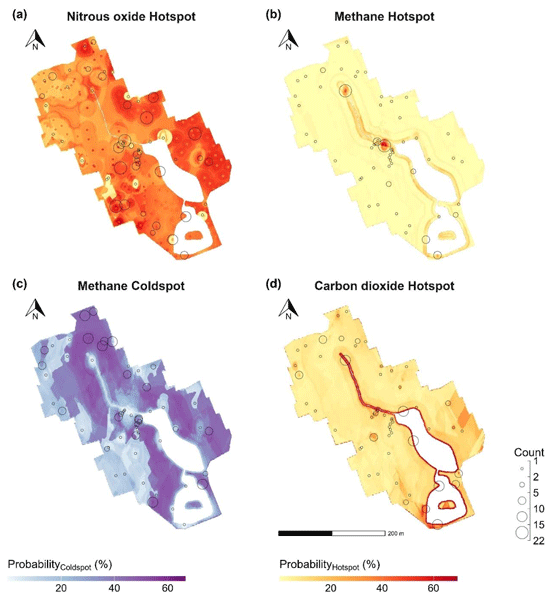
- Figure 3: In figure 3a, the hotspots of N2O are presented as point-based distributions, which may be inconsistent with the appropriate visualization principles for such data. The validity of this representation should be re-evaluated.
In figure 3b, a clear emission hotspot is observed near the stream. However, based on the sampling point distribution in figure 1, the number of plots located around the stream is limited, which raises concerns about the accuracy of this result. A similar issue is also present in figure 3d. The authors are advised to re-examine the data and verify the accuracy of the results.
- Figure 4: The results in figure c and e show opposite trends, yet the authors have not provided a sufficient explanation for this inconsistency. Furthermore, the notation “p≤0.01” should be corrected to conform to standard scientific writing conventions (“p<0.01”).
- Supplementary Materials: The supplementary tables S9 and S10, mentioned in the main text, are not found in the provided supplementary files. Moreover, some tables in the supplementary materials appear to be duplicated. The authors should review and organize the supplementary content accordingly.
- Model Parameters: The manuscript does not clearly indicate the parameters used for the different GHG models. In particular, figure S3 lacks essential information such as the coefficient of determination (e.g., R²) and statistical significance (e.g., p-values), which are critical for assessing model performance.
- Discussion Section: It is recommended that “Discussion” be thoroughly revised and restructured.
Citation: https://doi.org/10.5194/egusphere-2025-5091-RC1 -
AC1: 'Reply on RC1', Zhisheng Yao, 18 Feb 2026
The comment was uploaded in the form of a supplement: https://egusphere.copernicus.org/preprints/2025/egusphere-2025-5091/egusphere-2025-5091-AC1-supplement.pdf
-
CC1: 'Comment on egusphere-2025-5091', Longlong Xia, 05 Jan 2026
The manuscript, titled “Spatial and temporal variability of CO2, N2O and CH4 fluxes from an urban park in Denmark”, examines the spatiotemporal variations in soil N2O and CH4 fluxes, as well as ER-CO2 in an urban park. It also employs a random forest (RF) classification approach to map the hot and cold spots of greenhouse gas fluxes with high spatial resolution. Importantly, this study considers CO2, N2O and CH4 fluxes from urban green spaces together, and attempts to link chamber-based measurements to spatially explicit maps that could be useful for management purposes. The field dataset is valuable, and the combination of chamber measurements with RF modelling is promising. However, there are several comments that need to be tackled before the manuscript can be accepted for publication:
1.Line 33: The phrase “such as parks, gardens, street trees, grassy lawns and wooded areas” mixes urban greenery types (parks, gardens, street trees as locations) with vegetation types (grassy lawns, wooded areas). I suggest revising it to “such as urban parks, residential gardens, street trees and small wooded patches” to keep all examples at the same categorical level.
- Line 38: The word ‘Unlike’ in the sentence beginning “Unlike natural forests, grasslands, and managed agricultural systems…” feels somewhat categorical. A more neutral alternative, such as “In contrast to…” or “Compared with…” would read more effective.
- Line 44: I would avoid using the verb “found” in this context. More cautious alternatives such as “reported”, “observed” or “shown” would be preferable.
- Line 50: It would be helpful to add a closing sentence to this paragraph that explicitly links urban green spaces to climate impacts, for example, “This suggests that, although urban green spaces are often overlooked, existing studies indicate that they can influence climate by increasing N2O emissions and reducing CH4 uptake.”
- As a significant portion of the analysis is based on the RF modelling, it should briefly outline the RF approach (or similar machine-learning methods) and cite a few relevant studies that have used RF to analyze GHG fluxes or hot/cold spots in the Introduction section.
- Line 81 and Fig. 1: Although Fig. 1 shows the locations of the 56 sampling sites, it remains unclear how these sites were selected and whether they represent different vegetation compositions and land-use types (e.g. low-management urban forest vs. heavily used open lawns). Some points near the lake appear highly clustered, while others are more scattered. Please briefly explain the site-selection strategy and whether different vegetation and land use types were explicitly included.
- Line 100: “During the vegetation and frost-free period (20 July to 9 November 2023) and the freeze–thaw period …”, the choice of these start and end dates is not explained.
- Line 104: “On each sampling day (08:00–16:00), we used a chamber closure time of 5–7 min …”. Because temperature and other drivers can vary substantially over the course of a day, fluxes measured at different times may differ considerably, which is why many studies restrict measurements to a narrower morning time (8:00-10:00). If the 56 sites were measured at different times of day, how did you account for potential diurnal variation? Alternatively, do you have any diurnal measurements showing that daily variability is small compared with seasonal variability?
- Line 113: “Soil temperature and volumetric water content at a depth of 5 cm” It should be clearly stated whether soil temperature and soil moisture were measured simultaneously with the gas fluxes. Given that these variables can change over the day, non-simultanous measurements may introduce additional uncertainty.
- Line 135: There seems to be a conceptual problem with the definitions of hot and cold spots in Eqs. (2)–(3). As the authors written, the thresholds based on the median and IQR do not clearly match the verbal description of “hot spots” (high-emission tails) and “cold spots” (high-uptake tails), and it is not obvious whether signed or absolute flux values were used. I strongly recommend that the authors carefully re-check these equations, explicitly state how hot/cold/normal classes were defined, and ensure that the formulas in the Methods correspond exactly to the classification actually used in the analysis.
- Line 192: “The temporal coefficient of variation (CV) for N2O fluxes was 45.6% during the measurement period.” Please add an equation or short description in the Materials and Methods explaining how CV was calculated.
- I suggest adding a figure showing the observed GHG fluxes (or observed hot/cold/normal classifications) at the 56 sites. It would be very valuable to compare directly with the RF prediction maps; otherwise, it is difficult to judge how well the model reflects the actual measurements.
- Given that both N2O and CH4 fluxes were measured, it would be very interesting to calculate a combined non-CO2 climate metric in CO2-equivalent units. For example, the areas with low CH4 uptake but high N2O emissions might have high non-CO2 climate forcing, whereas north-western areas with both low N2O emissions and strong CH4 uptake might show low non-CO2 climate forcing. Even a simple non-CO2 analysis would enhance the practical value of the results.
- Many sentences in the Discussion and Introduction are very long and contain multiple clauses with shifting subjects, which makes the argument difficult to follow. Besides, issues such as “all above-ground biomass were trapped…” (should be “was”), “ranging from 45.6% and 259%” (should be “to”) indicate that a thorough language edit would be beneficial.
- The quality of all the figures needs to be improved.
Citation: https://doi.org/10.5194/egusphere-2025-5091-CC1 -
AC4: 'Reply on CC1', Zhisheng Yao, 18 Feb 2026
Publisher’s note: this comment is a copy of AC5 and its content was therefore removed on 19 February 2026.
Citation: https://doi.org/10.5194/egusphere-2025-5091-AC4 -
AC5: 'Reply on CC1', Zhisheng Yao, 18 Feb 2026
The comment was uploaded in the form of a supplement: https://egusphere.copernicus.org/preprints/2025/egusphere-2025-5091/egusphere-2025-5091-AC5-supplement.pdf
-
RC2: 'Comment on egusphere-2025-5091', Anonymous Referee #2, 05 Jan 2026
The manuscript, titled “Spatial and temporal variability of CO2, N2O and CH4 fluxes from an urban park in Denmark”, examines the spatiotemporal variations in soil N2O and CH4 fluxes, as well as ER-CO2 in an urban park. It also employs a random forest (RF) classification approach to map the hot and cold spots of greenhouse gas fluxes with high spatial resolution. Importantly, this study considers CO2, N2O and CH4 fluxes from urban green spaces together, and attempts to link chamber-based measurements to spatially explicit maps that could be useful for management purposes. The field dataset is valuable, and the combination of chamber measurements with RF modelling is promising. However, there are several comments that need to be tackled before the manuscript can be accepted for publication:
1.Line 33: The phrase “such as parks, gardens, street trees, grassy lawns and wooded areas” mixes urban greenery types (parks, gardens, street trees as locations) with vegetation types (grassy lawns, wooded areas). I suggest revising it to “such as urban parks, residential gardens, street trees and small wooded patches” to keep all examples at the same categorical level.
- Line 38: The word ‘Unlike’ in the sentence beginning “Unlike natural forests, grasslands, and managed agricultural systems…” feels somewhat categorical. A more neutral alternative, such as “In contrast to…” or “Compared with…” would read more effective.
- Line 44: I would avoid using the verb “found” in this context. More cautious alternatives such as “reported”, “observed” or “shown” would be preferable.
- Line 50: It would be helpful to add a closing sentence to this paragraph that explicitly links urban green spaces to climate impacts, for example, “This suggests that, although urban green spaces are often overlooked, existing studies indicate that they can influence climate by increasing N2O emissions and reducing CH4 uptake.”
- As a significant portion of the analysis is based on the RF modelling, it should briefly outline the RF approach (or similar machine-learning methods) and cite a few relevant studies that have used RF to analyze GHG fluxes or hot/cold spots in the Introduction section.
- Line 81 and Fig. 1: Although Fig. 1 shows the locations of the 56 sampling sites, it remains unclear how these sites were selected and whether they represent different vegetation compositions and land-use types (e.g. low-management urban forest vs. heavily used open lawns). Some points near the lake appear highly clustered, while others are more scattered. Please briefly explain the site-selection strategy and whether different vegetation and land use types were explicitly included.
- Line 100: “During the vegetation and frost-free period (20 July to 9 November 2023) and the freeze–thaw period …”, the choice of these start and end dates is not explained.
- Line 104: “On each sampling day (08:00–16:00), we used a chamber closure time of 5–7 min …”. Because temperature and other drivers can vary substantially over the course of a day, fluxes measured at different times may differ considerably, which is why many studies restrict measurements to a narrower morning time (8:00-10:00). If the 56 sites were measured at different times of day, how did you account for potential diurnal variation? Alternatively, do you have any diurnal measurements showing that daily variability is small compared with seasonal variability?
- Line 113: “Soil temperature and volumetric water content at a depth of 5 cm” It should be clearly stated whether soil temperature and soil moisture were measured simultaneously with the gas fluxes. Given that these variables can change over the day, non-simultanous measurements may introduce additional uncertainty.
- Line 135: There seems to be a conceptual problem with the definitions of hot and cold spots in Eqs. (2)–(3). As the authors written, the thresholds based on the median and IQR do not clearly match the verbal description of “hot spots” (high-emission tails) and “cold spots” (high-uptake tails), and it is not obvious whether signed or absolute flux values were used. I strongly recommend that the authors carefully re-check these equations, explicitly state how hot/cold/normal classes were defined, and ensure that the formulas in the Methods correspond exactly to the classification actually used in the analysis.
- Line 192: “The temporal coefficient of variation (CV) for N2O fluxes was 45.6% during the measurement period.” Please add an equation or short description in the Materials and Methods explaining how CV was calculated.
- I suggest adding a figure showing the observed GHG fluxes (or observed hot/cold/normal classifications) at the 56 sites. It would be very valuable to compare directly with the RF prediction maps; otherwise, it is difficult to judge how well the model reflects the actual measurements.
- Given that both N2O and CH4 fluxes were measured, it would be very interesting to calculate a combined non-CO2 climate metric in CO2-equivalent units. For example, the areas with low CH4 uptake but high N2O emissions might have high non-CO2 climate forcing, whereas north-western areas with both low N2O emissions and strong CH4 uptake might show low non-CO2 climate forcing. Even a simple non-CO2 analysis would enhance the practical value of the results.
- Many sentences in the Discussion and Introduction are very long and contain multiple clauses with shifting subjects, which makes the argument difficult to follow. Besides, issues such as “all above-ground biomass were trapped…” (should be “was”), “ranging from 45.6% and 259%” (should be “to”) indicate that a thorough language edit would be beneficial.
- The quality of all the figures needs to be improved.
Citation: https://doi.org/10.5194/egusphere-2025-5091-RC2 -
AC2: 'Reply on RC2', Zhisheng Yao, 18 Feb 2026
The comment was uploaded in the form of a supplement: https://egusphere.copernicus.org/preprints/2025/egusphere-2025-5091/egusphere-2025-5091-AC2-supplement.pdf
-
RC3: 'Comment on egusphere-2025-5091', Anonymous Referee #3, 13 Jan 2026
Comment on "Spatial and temporal variability of CO2, N2O and CH4 fluxes from an urban park in Denmark" by Bai et al., Biogeosciences
In this manuscript, authors applied an opaque chamber to measure fluxes of three major greenhouse gases (GHGs) within an urban park in 2023. Authors also developed a random forest model to 1) explore the relative importance of different environmental factors to GHG fluxes and 2) map the hot/cold spots of GHGs over the whole park. The dataset collected in this study is unique and most of the presentation is scientifically valid. Authors highlighted their findings in urban ecosystems, but discussion on how different their findings compared to natural ecosystems is missing. This manuscript shall be improved to add more discussion that addresses this issue.
In addition, I have the following specific comments:
Line 19: Calculation of CV is based on weekly/monthly/annual mean fluxes?
Line 72: What is the total area of the park?
Line 100: "During the vegetation and frost-free period" what does "vegetation" mean here?
Line 110: "chamber area" is ambiguous. Shall be clarified. How about "the area of the chamber top face"?
Line 131: "In this study, the observed GHG fluxes were classified into three categories" shall be "In this study, the different subsections of park were classified into three categories based on the relative magnitude of observed GHG fluxes"
Line 137: "M is the median and Q3 – Q1 is the interquartile range of the measured fluxes". Please clarify the temporal resolution of measured fluxes used for calculating M, Q3 and Q1? Instantaneous value, weekly mean or something else?
Line 144: Need to rephrase this paragraph. I suggest to revise as follow but also expect authors to double check and make sure that the revised text has identical meaning: "First, the counts of hot, cold, and normal spots varied substantially across the three gases, with the normal spots category being predominant. This imbalance could potentially introduce biased sample numbers of training data under different categories, thus causing the RF model favoring the majority class and failing to accurately identify the minority classes. To address this issue, the minority categories were oversampled during training. We used an ad hoc, iterative approach to identify the most effective inflation factor of oversampling for each GHG (Tables S1-S3)."
Line 154: In Table S5. There are three numbers in each row. What do they mean respectively?
Fig. 2: Authors need to improve this figure through resolving the following issues: 1) Layout is too tight, 2) precipitation and soil moisture shall use the same y axis scale, 3) air and soil temperature shall use the same y axis scale, 4) x axis labels are too crowd, consider reducing, e.g., can put 1 label for each month, 5) y axis scale (GHG fluxes) can be changed to logarithmic scale, 6) subplot id (a-e) can be moved inside the upper left corner of subplots and 7) too much gridlines inside the plot, but this can be improved after reducing x axis label and change y axis to logarithmic scale.
Line 192: "recorded during both the vegetation and frost-free periods and the freeze-thaw period." Any snow cover during the freeze-thaw period? Please clarify.
Line 216: I'm a bit surprised that total N content is not one of the top predictors for N2O flux. Please explain the reason.
Line 231: "Areas draining toward the artificial ponds showed the highest overall probability of becoming cold spots of CH4 uptake over time" It's not likely that regions closer to ponds have stronger CH4 uptake. Not sure if this finding is only indicated from RF model prediction, or reflected by the collected original samples. Since VWC is the major predictors of CH4 flux, I suggest authors add every sample as dot to the map, with different colors showing either hot or cold spots, and plot VWC anomaly (actual VWC - mean) as basemap to support your finding.
Fig. 4 & 5: Both figures show correlations between specific environmental predictors and GHG fluxes, so I suggest merging them together. Also, please put CO2, CH4 emission, CH4 uptake and N2O subplots in different rows for clarity purposes.
Line 363: "Moreover, the SOC decomposition process is constrained by anoxia, which restricts the release of nutrients necessary for CO2 formation (Keiluweit et al., 2017)." If anoxia is important, I would suggest authors explore the correlation between water-filled pore space (WFPS) and CH4 fluxes to corroborate your finding.
In the discussion section, it is important to add a comparison between this study, which measured GHG fluxes over urban ecosystem, and other studies measuring the same fluxes from natural grassland, since it is one of the highlights of this work.
Citation: https://doi.org/10.5194/egusphere-2025-5091-RC3 -
AC3: 'Reply on RC3', Zhisheng Yao, 18 Feb 2026
The comment was uploaded in the form of a supplement: https://egusphere.copernicus.org/preprints/2025/egusphere-2025-5091/egusphere-2025-5091-AC3-supplement.pdf
-
AC3: 'Reply on RC3', Zhisheng Yao, 18 Feb 2026
Peer review completion


Journal article(s) based on this preprint
Viewed
| HTML | XML | Total | Supplement | BibTeX | EndNote | |
|---|---|---|---|---|---|---|
| 2,251 | 1,362 | 196 | 3,809 | 336 | 136 | 128 |
- HTML: 2,251
- PDF: 1,362
- XML: 196
- Total: 3,809
- Supplement: 336
- BibTeX: 136
- EndNote: 128
Viewed (geographical distribution)
| Country | # | Views | % |
|---|
| Total: | 0 |
| HTML: | 0 |
| PDF: | 0 |
| XML: | 0 |
- 1
Tom Cripps
João Serra
Klaus Butterbach-Bahl
Zhisheng Yao
The requested preprint has a corresponding peer-reviewed final revised paper. You are encouraged to refer to the final revised version.
- Preprint
(3755 KB) - Metadata XML
-
Supplement
(388 KB) - BibTeX
- EndNote
- Final revised paper
This manuscript addresses the current limitations in the understanding of biogeochemical carbon and nitrogen cycles in urban green spaces and the relatively low accuracy in estimating greenhouse gas (GHG) budgets. To this end, 56 representative sampling sites with diverse vegetation types and landscape positions were selected within urban parks to conduct long-term, seasonally cross-sectional observations of greenhouse gas fluxes. Through systematic measurements of soil methane (CH4), nitrous oxide (N2O), and carbon dioxide (CO2) fluxes, the study reveals the dynamic patterns and driving mechanisms across temporal and spatial scales. Based on the observational data, the random forest (RF) model was developed to predict the probability of GHG hot spots and/or cold spots. The findings provide critical data support for a deeper understanding of carbon and nitrogen cycling processes in urban ecosystems, and lay a scientific foundation for improving the accuracy and predictive capability of GHG budget models for urban green spaces. Although the manuscript presents some valuable findings, I do not believe the authors are adequately prepared for this manuscript to be published. The manuscript contains numerous basic errors that require careful revision and correction. The main issues are outlined below:
In figure 3b, a clear emission hotspot is observed near the stream. However, based on the sampling point distribution in figure 1, the number of plots located around the stream is limited, which raises concerns about the accuracy of this result. A similar issue is also present in figure 3d. The authors are advised to re-examine the data and verify the accuracy of the results.